
Layer One: The Calm Base
A boho kitchen is built on plants, pattern, and color. That is the definition the 10 boho kitchen ideas for a bohemian style kitchen gives, and its consequence is underrated: the cabinets stay calm.
Natural wood, white, or one soft painted color is the whole cabinet doctrine. The fronts are the quiet stage; the decor does the acting.
This is why boho renovates less than other styles. The base most kitchens already own passes the audition once the layers arrive.
Honey oak is the famous case. The Bohemian style kitchen made from the one you already have redeems it directly: warm, visible wood grain is a defining boho material, and builder oak already supplies it.
What honey oak lacks is company, not paint. Sage, cream, and terracotta sit well beside that grain, and woven rattan picks up the same warmth.
Before buying anything, sort the room into three groups. What stays exactly as it is, what gets covered or added to, and what gets swapped because it is small and cheap.
Cabinet boxes, counters, the sink, and the layout almost always stay. Bare walls, dark corners, and empty floors get covered. Fixtures, knobs, and towels get swapped.
Layer Two: One Pattern Hero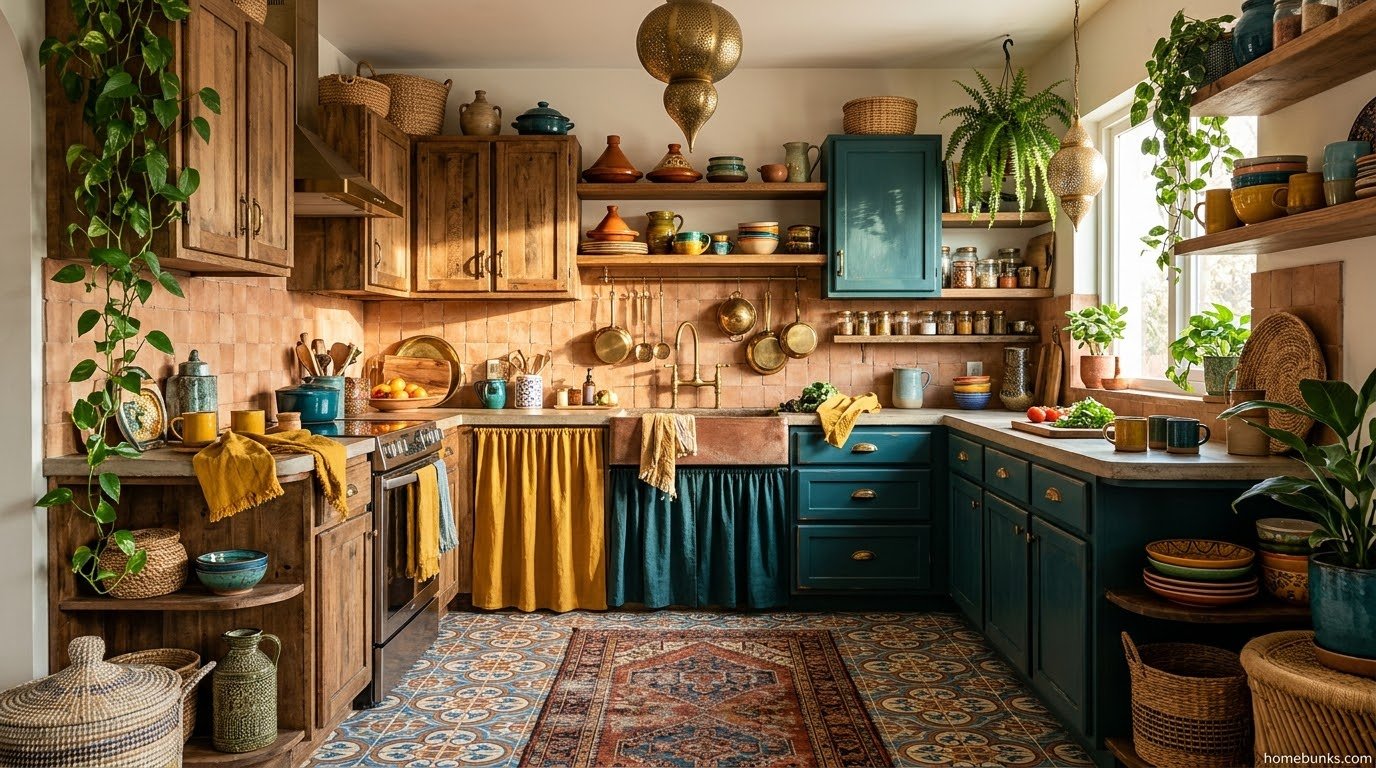
Start with one big pattern. That rule appears in both the 10 boho kitchen ideas for a bohemian style kitchen and the Bohemian style kitchen made from the one you already have, and it is the style’s load bearing wall.
The hero candidates are three: patterned tile, a vintage style rug, or bold wallpaper. Pick one, and crown it properly.
Everything after the hero is texture, not pattern. A second pattern may appear small and quiet, speaking in the hero’s own colors.
Checkerboard is the forgiving layout for tile heroes: two or three earthy colors, rust, cream, and sage, give the patchwork feel without a dozen motifs.
Zellige is the connoisseur’s hero: handmade tiles with irregular glaze that shifts across the wall as light moves through the day.
Pair handmade tile with contrast grout in warm grey or charcoal. It emphasizes the irregularity that makes the tile special; matched grout flattens what you paid for.
Peel and stick tile is the renter’s route to the same wall. Better versions copy the glossy uneven glaze convincingly, within the manufacturer’s heat limits.
Layer Three: Texture and Textiles
With pattern rationed, texture does the layering. Rattan, wicker, jute, bamboo, macrame, and woven cotton are the working materials of this layer.
Rattan pendants are the signature piece: they soften the room’s color and pattern while becoming its focal point, a double duty few fixtures manage.
Now the rule that surprises everyone: layer two or three wood tones on purpose. Warm oak shelving, a darker walnut table, light pine accents.
This is the exact inverse of the Scandinavian rule, and it is correct here. Boho depth comes from tones that were never matched, only harmonized.
Beside the woods runs the color repeat rule: pick two or three colors and repeat them in textiles, ceramics, and plants until the room rhymes.
Kilim and Moroccan style runners, linen towels, block print cloth in small doses, and woven placemats carry most of the color and nearly all the softness.
Layer Four: The Living and Collected Layer
Plants in boho are architecture, not garnish. They occupy the vertical space other styles leave empty: shelf tops, hooks, and the fridge summit.
Trailing pothos and string of pearls spill from high places. Herbs crowd the windowsill in mismatched terracotta, working as decor and ingredients at once.
One large plant or small tree in a terracotta pot is an anchor, equal in weight to a piece of furniture. Size is what separates architecture from garnish.
Then come the collected pieces: thrifted ceramics, vintage tools, a chair with a past. Estate sales and flea markets are the sourcing department.
Patina beats pristine. A genuine worn piece carries the story; a reproduction that looks too perfect reads as costume, and the field’s avoid boxes say so plainly.
Intentional mismatch is the doctrine: mismatched jars, chairs, and dishware are not a compromise at all. They are the look itself, unified by the repeated colors.
The Anchors: Size Is the Secret
Boho fails small more often than it fails loud. Dozens of little objects read as clutter; a few full size pieces read as confidence.
The Bohemian style kitchen made from the one you already have sizes the anchor set for an average room. One large natural fiber pendant, about 24 inches across, over the table or island.
One solid wood table, roughly 72 by 36 inches if the floor allows. One living tree or large plant, and one floor textile such as a jute rug.
Those four pieces do most of the work. Every one of them is movable, which is why this layer system suits renters so well.
Smaller rooms scale the set, not the logic. A pair of woven stools replaces the table, a tall plant replaces the tree, and the pendant shrinks only when the ceiling forces it.
What never scales down is the editing: four anchors means four, and the fifth beautiful thing waits for a rotation, not a corner.
|
Layer |
What goes there |
The rule |
|---|---|---|
|
Cabinets, walls, counters |
Calm colors; keep what you have |
|
Tile, rug, or wallpaper |
One hero only; the rest is texture |
|
Rattan, wicker, textiles, woods |
Two to three wood tones; repeat two to three colors |
|
Plants, vintage, ceramics |
Full size anchors; patina over pristine |
Open Shelving, Boho Rules
Open shelves are boho’s display engine, and they run on daily life. Pottery, baskets, glass jars, and plants earn their places by being used.
Borrow one rule from the calm styles: shelves near the sink hold what washes daily, and nothing precious parks beside the stove’s grease.
Breathing room is the boho shelf’s discipline. Groups with air between them read as collections; a continuous row reads as inventory.
Baskets are the hidden storage. They corral oils, produce, and clutter inside the very texture the style wants on display, mess hidden in plain sight.
Glass jars of grains and spices do the same work at pantry scale: function first, and the pattern of fills and lids becomes quiet decoration.
Lighting: Rattan and Dappled Light
Woven pendants filter light into dappled patterns, which is why photographs of boho kitchens glow. The shade is a light effect, not just an object.
Hang the anchor pendant where the room gathers: over the island or the table. A cluster of smaller woven shades suits long islands.
Warm bulbs are non negotiable in spirit: boho light is fire adjacent, amber and low, even when it comes from a filament.
Aged brass and amber glass are the metal accents of this layer. Uniform chrome fights the warmth the whole system is built to produce.
The Sub Styles: Pick Your Register
Boho is a spectrum, and choosing a register before shopping is the cheapest discipline in this article.
|
Register |
Palette |
Pattern level |
Best for |
|---|---|---|---|
|
Vibrant global |
Jewel tones, terracotta, teal |
High: tile hero plus prints |
Color lovers, large rooms |
|
Earthy |
Clay, sand, olive, wood |
Medium: rug or tile |
The classic boho kitchen |
|
Modern / sleek |
Warm neutrals, one color |
Low: one hero, clean lines |
Newer homes, small kitchens |
|
Tranquil |
Warm white, natural texture |
Very low: texture only |
Calm seekers, easy cleaning |
|
Scandi boho |
Pale wood, warm white |
Low: one statement pattern |
Restraint with warmth |
The Scandi boho register has its own following. The 29 Scandi boho kitchen ideas codifies its rules: two to three cushions, uncrowded shelves, one statement pattern.
The 40 unique boho kitchen decor ideas covers the vibrant end at full breadth: forty decor ideas across the earthy and jewel spectrum.
Sage green kitchen ideas is the cluster’s earthy register in cabinet form. Its muted green is boho’s favorite base color when paint does the work.
Cream kitchen ideas supplies the tranquil base. Cream cabinets are the calm stage on which the quietest boho layers still read clearly.
The No Remodel Boho Layer, Step by Step
This is the style’s signature move, because boho is a layer, not a construction project. Work it in the layer order.
Step one: sort the room. Stays, gets covered, gets swapped. The sort is free and it prevents most bad purchases.
Step two: calm what needs calming. A warm white or cream on the worst wall; the rest of the base stays as found.
Step three: crown the pattern hero. Peel and stick tile, a vintage style rug, or one bold textile doing hero duty.
Step four: hang the anchor pendant. Swap the fixture, keep the old one stored, and let 24 inches of woven shade change the room’s weather.
Step five: place the anchors. The table, the big plant, the rug. Full size, movable, and none of them matched.
Step six: layer the textiles. Runner, towels, cushions, one macrame hanging. Colors chosen from the hero’s own palette.
Step seven: shelve and collect. Ceramics, jars, baskets, and the first thrifted pieces. Leave gaps; the collection finishes over months, not weekends.
Small, Family, and Rental Branches
The Small Kitchen Branch
The layer system scales down gracefully: one pattern, full size anchors, plants trailing from high spots, and baskets doing storage duty.
Skip the table anchor where floor is scarce. The pendant, the plant, and the rug carry the system at apartment scale.
The Family Branch
Choose washable runners, closed baskets for small clutter, and plants out of toddler reach. The collected look forgives replacements, which suits family life.
Avoid the fragile hero: a rug takes family traffic better than wallpaper at chair height, and thrifted ceramics break without grief.
The Rental Branch
Every anchor is movable by design. Peel and stick tile, swapped fixtures kept in storage, textiles, and plants deliver boho with the deposit intact.
Living in It: Dust, Grease, and the Reset
Honesty chapter: open display collects dust and kitchen grease. Boho asks for a rhythm, and the rhythm is lighter than feared.
Daily use items wash constantly, so they self clean on the shelves. The monthly wipe covers the decorative minority.
Washable textiles are the workhorses: runners and towels that survive weekly laundry keep the layers fresh instead of fragile.
Plants want their own small calendar: water, dust the big leaves, and rotate the windowsill herbs so growth stays even.
The reset is a five minute habit: baskets swallow the counters’ drift, jars return to the shelf, and the room is collected again.
The Style Family, Honestly
Farmhouse kitchen ideas is boho’s closest relative. They share wood, vintage, and warmth; farmhouse keeps rural order where boho prefers global mismatch.
The Spruce’s rooms show the two mixing happily: farmhouse shelves loosened by vintage tools and wildflowers become boho by attitude.
Scandinavian is the strict cousin: one wood, few objects, daylight discipline. Boho borrows its warm whites and returns the favor with texture.
Scandinavian bathroom ideas and Scandinavian bedroom ideas carry that stricter doctrine at HomeBunks. The boho pages and the Scandi pages are the cluster’s two poles.
Cream and warm wood kitchen ideas sits between the poles. Cream plus warm wood is where tranquil boho and warm minimalism shake hands.
Cabinets and Color in Detail
Cabinet color is a base decision, and base decisions stay quiet: natural wood for warmth, white for light, sage or soft green for the earthy register.
Two tone cabinets work when the darker tone sits low. Earth below, light above keeps the room’s weight at floor level, where boho likes it.
Paint is the budget lever of this layer. The 35 best boho kitchen ideas for your home publishes a price table for colors and materials; treat its figures as one site’s ranges and verify locally.
Hardware mixing is freer here than anywhere: aged brass brackets, iron accents, wood knobs. The family resemblance is warmth, not a finish chart.
Tile and Pattern in Detail
Zellige rewards close reading: no two tiles match, the glaze pools and thins, and the wall moves as the day turns.
Patterned cement tile is the floor hero: Moroccan and Mediterranean motifs at full scale, sealed and grounded by jute and wood around it.
Terracotta tile is the earthy classic, on backsplashes and floors, and it pairs with cream and sage the way it has for centuries.
Wallpaper heroes belong on one wall, away from direct steam and splash. In kitchens, the dining wall or the nook wall takes it best.
Scale pairing is the quiet skill: a large motif hero wants small, plain companions; a small motif hero can sit beside mid scale texture.
Plants in Detail: The Green Architecture
Build the green layer in three heights. Trailers from above, herbs at the window, and one floor anchor with real presence.
Pothos is the workhorse trailer: forgiving, fast, and happy in average light. String of pearls is the delicate accent for bright spots.
The windowsill herb garden is the style’s most useful decor: basil, rosemary, thyme, and mint in mismatched terracotta, steps from the stove.
Succulents and air plants fill the small gaps for the less committed. They ask little and keep the green count up between the anchors.
Replace ruthlessly: a struggling plant is clutter with roots. The collected look depends on everything present looking alive and chosen.
Textiles in Detail
The runner is the hardest working textile: it warms the work aisle, catches the drips, and often serves as the pattern hero itself.
Kilim and vintage Persian styles lead because their patterns hide wear and their colors set the room’s repeat palette.
Linen handles the soft goods: curtains at half height, towels in the repeated colors, cushions on the nook or chairs.
Macrame is the wall textile: one hanging near the dining zone, a plant hanger or two. More than that and the room starts performing boho.
Rotate textiles seasonally: lighter linen for summer, deeper kilims and amber tones for winter. The structure stays; the temperature changes.
Walls and Gallery: The Collected Story
Where cabinets stay calm, walls carry the narrative. A gallery wall of vintage art above a bench or along the dining wall is boho’s signature vertical move.
Build it from found frames in mixed woods and metals, hung by eye rather than by grid. The irregular rhythm is the point; a laser level grid belongs to other styles.
Between the frames, leave wall showing. A gallery wall packed edge to edge becomes the wallpaper you did not choose, competing with the pattern hero.
Woven hangings and one macrame piece join the gallery as texture panels. They soften the room’s acoustics as well as its look, a benefit cooks notice at dinner parties.
Displayed tile works as wall art at small scale: one patterned tile on a stand or as a trivet near the stove carries the global note without a renovation.
Rotate the gallery seasonally if collecting outpaces wall space. A stored rotation keeps the room fresh and honors the rule that not everything owned must be out at once.
Sourcing: A Field Guide to Finding the Pieces
Estate sales are the top tier for kitchen goods: full households, real patina, and ceramics sold in the sets families actually used.
Flea markets reward early arrival and a list. Hunt by layer: hero textiles first, then ceramics, then the small brass and wood that finish shelves.
Thrift stores are volume hunting: most visits yield little, and the regulars win. Go for glass, baskets, and frames, the categories that turn over fastest.
Artisan and maker markets supply what thrift cannot guarantee: hand thrown stoneware, woven pieces, and textiles with known hands behind them.
Garden clubs and plant sales are the green layer’s discount channel, where divisions and cuttings trade at neighbor prices.
Judge every find by three questions: does it fit a layer, does it speak a repeated color, and does its wear look earned? Three yeses, it comes home.
Budgets: The Boho Money Logic
Boho’s economics are inverted compared with other styles. Time and hunting substitute for money, and the most expensive mistake is buying everything new and matched.
The free tier is the sort, the edit, and the rearrangement: existing pieces regrouped into layers cost nothing and do half the transformation.
The thrift tier covers ceramics, chairs, frames, baskets, and vintage tools. Prices vary by market, so treat any published figure as one area’s snapshot.
The textile tier is where modest money shows most: a real kilim style runner, linen, and cushions in the hero’s colors lift the whole room for the price of one appliance.
The anchor tier is the splurge logic the Scandi boho field states plainly: thrifted treasures plus one quality piece (butcher block, a real rug, the pendant) read as luxury without the luxury bill.
The construction tier (tile, cabinets, counters) costs what it costs in every style. Boho’s advantage is that this tier is optional, and the layers above it are not.
Spend in layer order and stop when the room rhymes. The collected look punishes completion: a boho kitchen bought in a weekend looks like a theme, and themes date.
Three Worked Kitchens
The builder grade conversion. Honey oak cabinets kept, peel and stick zellige look tile, one 24 inch rattan pendant, a jute rug, herbs in terracotta, and thrifted jars on one open shelf.
The earthy family kitchen. Sage lowers, cream uppers, butcher block counters, a kilim runner as hero, baskets everywhere, and a pothos waterfall from the tall cabinet.
The tranquil Scandi boho. Warm white base, pale wood, one patterned cushion set, uncrowded shelves of stoneware, and plants doing nearly all of the color work.
Boho Kitchen Mistakes
Every pattern at once. Competing heroes are the classic failure: the eye gets no home, and the room reads as noise.
The matched set purchase. Buying the decor as a coordinated set kills the collected soul the style exists to express.
Pristine fake vintage. Reproductions without wear read as costume. Patina is the credential; shop where real history is sold.
Shelves without air. Continuous rows of objects become inventory. Groups and gaps are what make a shelf a collection.
Color with no repetition. A rainbow that never repeats is clutter’s other form. Two or three colors, everywhere, is the fix.
Layers over an uncalmed base. Boho cannot rescue a base that fights it at every surface; sort and calm first, then layer.
Before You Commit: The Layer Checklist
- Sort the room. Stays, gets covered, gets swapped, written down before any purchase.
- Confirm the calm base. Cabinets quiet in wood, white, or one soft color.
- Crown one pattern hero. Tile, rug, or wallpaper; everything else is texture.
- Repeat two or three colors. Hero colors echoed in textiles, ceramics, and plants.
- Layer two or three wood tones. Deliberately unmatched, harmonized by temperature.
- Place full size anchors. Pendant, table, big plant, rug: four pieces, maximum effect.
- Collect the rest slowly. Thrift and vintage over months; leave shelf gaps on purpose.
Frequently Asked Questions
What is a boho kitchen?
A relaxed, collected looking kitchen built on plants, pattern, and color (Lily Ann Cabinets’ definition): patterned tile or a vintage rug, woven and rattan pieces, open shelves with pottery and greenery.
And cabinets that stay calm so the decor can carry the look.
What are the key elements of a boho kitchen?
Natural materials (wood, rattan, wicker, ceramic, stone), one strong pattern, layered textiles, plenty of plants, open shelving with collected dishware, warm earthy colors with a few brighter pops, and vintage or handmade pieces mixed with new.
What colors work in a boho kitchen?
An earthy base: terracotta, warm cream, sandy beige, olive or sage, natural wood. Pops come from mustard, teal, deep green, or jewel tones. The discipline is Lily Ann’s: pick two or three colors and repeat them around the room.
How do I start a boho kitchen?
Start with one big pattern (Lily Ann’s rule): colorful tile, a vintage style rug, or bold wallpaper. Then repeat its two or three colors in textiles, ceramics, and plants, over cabinets that stay calm.
Can I make a boho kitchen without remodeling?
Yes, and it is the style’s specialty. Quiet Minimal’s method: keep cabinets, counters, and layout; add the bohemian layer of one large pendant, one wood table, one big plant, one rug, textiles, baskets, and a few pieces with a past.
Most of it can move with you.
Are honey oak cabinets good for boho?
Yes. Quiet Minimal’s redemption: warm visible wood grain is a defining boho material, and honey oak flat panels already supply it.
Give the grain company: sage, cream, and terracotta sit well beside it, and woven rattan picks up the same warmth.
What cabinets suit a boho kitchen?
Calm ones: natural wood, white, or one soft painted color such as sage (Lily Ann). Flat panels and simple shakers both pass. The cabinets are the quiet base; pattern, plants, and textiles do the talking.
What is the one pattern rule in boho design?
Pick one pattern hero (tile, rug, or wallpaper) and let everything else be texture (Quiet Minimal). A second pattern may appear small and quiet, in the hero’s colors. Competing heroes are the main route to visual chaos.
How many colors should a boho kitchen have?
A base of warm neutrals plus two or three repeated colors is the working rule (Lily Ann). Boho looks free, but the freedom sits on repetition; unconnected colors in every object read as clutter, not eclecticism.
Can boho kitchens mix wood tones?
Yes, and they should. Jenna Living’s pro rule: layer two to three wood tones (warm oak shelving, darker walnut stools, light pine accents) for collected depth. This is the exact inverse of the Scandinavian one wood rule.
What tile suits a boho kitchen?
Handmade look tile: zellige with its irregular glaze, terracotta, patterned cement or Moroccan and Mediterranean designs. Checkerboard in two or three earthy colors is the forgiving layout (Quiet Minimal), and contrast grout honors the handmade irregularity (Jenna Living).
Can I use peel and stick tile for a boho backsplash?
Yes for the layer approach: better versions copy zellige’s glossy uneven glaze convincingly from across the room (Quiet Minimal).
Keep it away from direct stove heat per manufacturer limits, and treat it as the renter friendly route, not the heirloom one.
What lighting suits a boho kitchen?
Woven rattan or wicker pendants are the signature: they tone down the color and pattern around them while becoming the focal point (Lily Ann).
Add brass or amber glass accents and warm bulbs; Moroccan style lanterns are the global alternative (VKB).
How big should a boho pendant be?
Scale up: one large natural fiber pendant, about 24 inches across over a table or island, is Quiet Minimal’s anchor sizing for an average room. Small pendants in a row can work over long islands; one big piece reads calmer.
Are open shelves right for a boho kitchen?
They are the style’s display engine: pottery, baskets, glass jars, and plants live there. Keep the Scandi lesson inside the boho freedom: daily use items near the sink, breathing room between groups, and nothing precious beside the stove’s grease.
What plants suit a boho kitchen?
Trailing pothos and string of pearls from shelves and hooks, herbs in mismatched terracotta on the windowsill, one large plant or small tree in a terracotta pot as an anchor (Quiet Minimal; Nikki Anne).
Plants are architecture in boho, not garnish.
What textiles belong in a boho kitchen?
Kilim or Moroccan style runners, linen towels and curtains, block print or tribal pattern cloth in small doses, macrame hangings, and woven placemats. Textiles carry most of the color and nearly all of the softness.
What is Scandi boho?
The calm register of boho: Scandinavian restraint (warm whites, pale wood, breathing room) warmed with boho texture, plants, and a few collected pieces. My Elegant Home’s rules: two to three cushions, uncrowded shelves, one statement pattern.
What is the difference between boho and farmhouse kitchens?
They overlap in wood, vintage, and warmth. Farmhouse organizes around rural utility and matched rustic order; boho organizes around global pattern, plants, and intentional mismatch. The Spruce shows them mixing, with boho loosening farmhouse shelves through vintage tools and wildflowers.
What is the difference between boho and Scandinavian kitchens?
Scandi edits to calm: one wood, few objects, daylight discipline. Boho layers to warmth: two to three wood tones, pattern, plants, and collected objects. They share natural materials and warm whites, which is why the Scandi boho hybrid exists.
How do I keep a boho kitchen from looking cluttered?
Hold the guardrails: calm base, one pattern hero, two or three repeated colors, anchors at full size instead of many small objects, baskets hiding the mess (Quiet Minimal), and breathing room on every shelf.
Clutter is boho with its rules removed.
Where do I find boho kitchen pieces?
Thrift stores, estate sales, and flea markets for vintage tools, ceramics, and furniture with patina (Jenna Living; Home Cabinet Expert); artisan makers for pottery and textiles; garden clubs and plant sales for greenery (A Little Delightful).
Avoid pristine reproductions; the charm is real wear.
Is boho good for small kitchens?
Yes: the layer approach scales down well. One pattern, a few full size anchors, plants trailing from high spots, and baskets for storage deliver the look without floor space.
VKB notes the style applies to homes of any size, owned or rented.
Is boho kitchen style good for families?
With honest choices: washable runners, closed baskets for small clutter, durable counters, and plants out of toddler reach. The collected look forgives the odd replacement piece, which suits family life better than matched sets do.
How much does a boho kitchen cost?
Less than most styles at the decor layer: the look is built from textiles, plants, thrifted pieces, and one pattern. One blog’s price table puts paint in a modest per gallon range (a single site’s figures, verify locally).
Cabinet and tile work costs what it costs in any style.
What are the most common boho kitchen mistakes?
Too many patterns competing, matching sets bought all at once, pristine fake vintage, shelves crammed without breathing room, color everywhere with no repetition, and decor layered over a base that was never calmed first (the field’s avoid boxes agree).
Can a boho kitchen have modern appliances?
Yes. The style is a layer and a palette, not a period reenactment. Quiet modern appliances disappear under the textiles, plants, and pattern; vintage style small appliances are a welcome accent but never a requirement.
What flooring works in a boho kitchen?
Warm wood first, then terracotta or patterned cement tile for the full commitment, or a vintage style rug over almost anything for the reversible version. The rug route is the budget and renter standard.
What hardware suits a boho kitchen?
Aged brass, matte black iron, or simple wood knobs, mixed more freely than other styles allow (Jenna Living’s rooms pair brass brackets with iron accents). Uniform chrome is the note that fights the warmth.
Can boho kitchens be calm and neutral?
Yes: the tranquil register. Warm whites and natural textures with plants as the main color, two natural materials at a time, and surfaces kept clear (Jenna Living’s tranquil variant; The Spruce’s calm neutral palette).
Scandi boho is this register with a name.
What wall decor suits a boho kitchen?
Gallery walls of vintage art, woven hangings and macrame, a displayed patterned tile as a trivet or art piece, and shelves of ceramics. Walls carry the collected story where cabinets stay calm.
How do I add boho style to a rental kitchen?
Peel and stick tile, a vintage style rug, textiles, plants in terracotta, baskets, one large pendant swapped for the existing fixture (kept stored), and thrifted ceramics on existing shelves.
Quiet Minimal’s anchors are chosen because they can all leave with you.
What is the role of baskets in a boho kitchen?
Hidden storage in plain sight: baskets corral oils, produce, linens, and clutter inside the woven texture the style wants anyway (Quiet Minimal: baskets hide the mess). They are the boho answer to the minimalist’s closed cabinet.
Should boho dishware match?
No. Intentional mismatch is doctrine (Jenna Living): mismatched jars, chairs, and ceramics collected over time are the look. Keep a family resemblance through the repeated colors so mismatch reads curated, not random.
What is a boho kitchen island?
Usually a wood table like island, a butcher block topped unit, or an ordinary island dressed with rattan stools, a runner, and plants. Repurposed furniture islands (a farmhouse table, a workbench) are the collected version (Daneila Bright’s repurposed island).
Can boho work with white cabinets?
Yes: white is a classic calm base. The boho layer (pattern hero, textiles, plants, wood tones, brass) does the character work. Many field examples start from white shaker cabinets precisely because they disappear politely.
What grout color suits boho tile?
Contrast grout in warm grey or charcoal is Jenna Living’s tip: it emphasizes the handmade irregularity that makes zellige and patterned tile special. Matched grout flattens the very texture the tile was bought for.
How do I do boho in a kitchen with no natural light?
Lean on the warm layers: rattan pendants with warm bulbs for dappled light (Nikki Anne), warm whites over stark whites, brass over chrome, and plants chosen for low light (pothos tolerates it).
Skip dark jewel walls, which need daylight to glow.
What is modern boho in a kitchen?
The sleek register: cleaner lines and a calmer base with boho warmth layered on top (Jenna Living’s sleek variant; VKB’s minimalist sub style). Fewer, larger pieces; pattern in one place; plants softening the geometry.
Are boho kitchens hard to clean?
The honest answer: open display collects dust and kitchen grease, so boho asks for a rhythm: daily use items on shelves (they wash constantly), baskets that lift out, washable textiles, and a monthly shelf wipe.
Tranquil and Scandi boho registers cut the load sharply.
What seasonal changes suit a boho kitchen?
Summer is the style’s home season (Nikki Anne): herb gardens at full leaf, lemons and produce in woven bowls, linen at its lightest. Winter rotates in deeper textiles, amber glass, and candlelight while the structure stays.
Where should I start with a boho kitchen?
Sort the room into stays, gets covered, gets swapped (Quiet Minimal). Then the order: calm the base, choose the one pattern hero, place the anchors, layer textiles and plants, and collect the vintage pieces last, over time.
Conclusion
Boho kitchen ideas work when freedom gets a sequence. Calm the base, crown one pattern hero, weave the texture layer, and finish with the living and collected pieces.
Hold the guardrails (anchors at full size, colors repeated, shelves breathing) and the room reads gathered over years, even if the layers honestly took a single season to assemble.
Start with the kitchen you already have. The sort, one hero, and four anchors will tell you within a month whether boho is truly your style, at rental prices and with everything movable when you go.


