
Halloween decor ideas are a menu, not a plan: a scheme is four decisions made in order, your register, your zone order, one hero per zone, and a budget priced in time and money.
Lists of forty ideas fail households in a predictable way. The pieces arrive in mixed styles, spread across eight rooms, and nothing anywhere reads as finished.
This guide supplies the decision layer the lists skip, then routes every decision to the guide on HomeBunks that owns it in full depth.
Timing note, stated plainly: Halloween 2026 has passed. This hub is built for the 2027 season, Halloween falling on Sunday, October 31, 2027, early enough to be the cluster’s front door before September.
Halloween Decor Ideas in One Line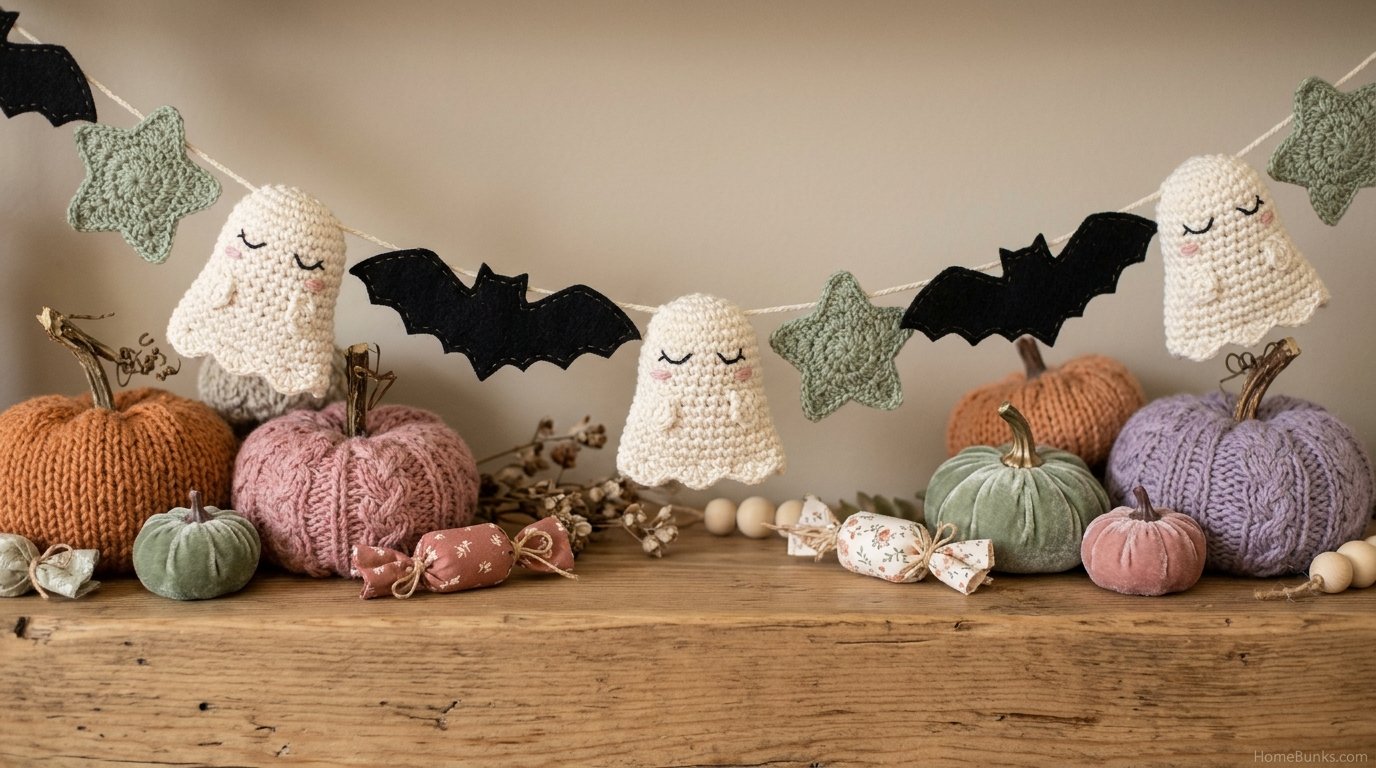
Definition: a Halloween scheme is a register held across the house, built zone by zone in a fixed order, with one hero piece per zone and every idea priced before it is bought.
Key takeaways:
- Choose the register first: cute, classic, vintage, elegant, spooky, or extreme.
- Finish one zone before starting another; the door comes first.
- One hero per zone, everything else plays a supporting role.
- Price every idea in minutes and dollars before it enters the house.
The Register Ladder: Six Styles, One Choice
A register is the style system a scheme holds: its palette, its materials, its scare level, and its sense of humor. Every idea in every list belongs to one, whether the list admits it or not.
|
Register |
Palette |
Hero examples |
Suits |
|
Cute |
Pastel or classic, faces friendly |
Smiling ghost pair, plush pumpkin stack |
Families with young kids |
|
Classic |
Orange, black, white |
Carved pumpkins, paper skeletons |
Most houses, most streets |
|
Vintage |
Aged orange, cream, black |
Smiling blow mold style pumpkins |
Collectors, nostalgic houses |
|
Elegant |
Matte black, cream, brass, plum |
Candelabra, dried floral wreath |
Adult parties, formal rooms |
|
Spooky |
Black, purple, green light |
Fog, animatronics, giant webs |
Older kids, thrill households |
|
Extreme |
Full palette, maximum scale |
12 foot giants, walkthrough scenes |
Display houses, contests |
Registers fail by mixing, not by choice. Any single register held consistently reads as designed; three registers in one room read as a storage accident, even when each piece is lovely.
Choose with the household, not the screenshot. Young children pull the ladder toward cute, a formal dining room pulls it toward elegant, and a competitive street pulls it toward spooky or extreme.
Cute and Classic: The Family Registers
Cute runs the face rule: smiling ghosts, rosy cheeked pumpkins, soft materials, calibrated to the youngest viewer. This site’s cute halloween decor guide owns that system in full.
Pink is cute’s most famous palette dialect, and it has its own complete treatment in the pink halloween decor guide, from blush styling to the dark partner every pink scheme needs.
Classic is the default register: orange and black, carved and uncarved pumpkins, paper and plastic skeletons, friendly enough for the street and spooky enough for older kids.
Vintage and Elegant: The Grown Up Registers
Vintage collects the smiling mid century register: reproduction blow mold style figures, aged graphics, and pumpkins with friendly painted faces. Its buying and styling live in the vintage halloween decor guide.
Elegant strips the palette to matte black, cream, brass, and dried things. One candelabra and a dried floral wreath outperform a cart of bright plastic, because palette discipline is the whole register.
The trend strands agree: vintage looks, moody neutrals, and cottagecore styling keep displacing bright orange and purple plastic in the decor press’s own trend lists.
Spooky and Extreme: The Thrill Registers
Spooky adds atmosphere technology: fog, colored light, sound, and movement. Its heroes are experiences as much as objects, which is why its zones need power and weather planning.
Extreme is spooky at maximum scale: giants, full yard scenes, walkthroughs. It is a legitimate register with a real audience, and it fails only when a household drifts into it accidentally, one oversized purchase at a time.
The Zone Order: Door, Living Focal, Table, Yard
Zones are the decision areas of a house. Decorating succeeds zone by zone, in this order, because each zone’s audience arrives before the next zone’s.
|
Order |
Zone |
Hero |
Finish test |
Typical time |
|
1 |
Door and steps |
Wreath |
Reads finished from the street |
30 to 60 minutes |
|
2 |
Living focal (mantel or entry) |
Garland or candelabra |
Reads finished from the doorway |
30 to 90 minutes |
|
3 |
Table |
Centerpiece |
Seats a meal without moving decor |
30 minutes |
|
4 |
Yard |
Giant or web or scene |
Reads from a moving car |
Half a day |
The order is not a preference; it is audience logic. Every guest and trick or treater meets the door. Half never see the yard up close, and the table matters only on the nights it hosts.
The door to table list at the ArtPix door to table list states the rule in its own preface: finish one zone before starting a second, use two colors plus black, and start where guests look first.
The Door Zone
The door takes a wreath as hero, a doormat, and two pumpkins in the register’s palette. That kit, finished, beats a half decorated house from every angle that matters.
The full door build lives in the halloween door decor guide: wreath making, surrounds, lighting, and the steps. The hub’s only door rule is the order rule: this zone closes before any other opens.
The Living Focal Zone
Indoors, the focal point is the mantel or the entry console, never both at full strength. The mantel formula from the editorial tradition runs four layers: a base drape, height pieces, Halloween accents, and a movement garland.
The whole indoor system, zones and palettes and light, is staged in the halloween home decor guide, and the porch that wraps this zone outdoors is composed in the halloween porch decor guide.
The Table Zone
Tables are events, not displays: the centerpiece must survive a meal, candles must be flameless around elbows and sleeves, and sightlines across the table outrank height.
The tablescape anatomy in full lives in the halloween table decor guide. On the hub’s calendar the table is zone three: after the house reads decorated, before the yard tempts the budget.
The Yard Zone
The yard is where scale honesty rules: pieces must read from the street, which means big, clustered, or lit, and ideally all three.
The yard is staged in its zones, from curb to door, in the outdoor halloween decor guide and the halloween outdoor decor guide. The hub’s warning stands: the yard is zone four because it eats budgets meant for zones guests actually enter.
One Hero Per Zone: The Focal Rule
A hero is the single piece a zone is remembered by: the wreath, the candelabra, the twelve foot skeleton. Everything else in the zone is cast in a supporting role and priced accordingly.
The rule disciplines spending. Heroes deserve the budget and the storage; supporting pieces should be cheap, flat, and replaceable: paper bats, garlands, candles, textiles.
Two heroes in one zone split the eye and halve each other. When a second hero calls, it is not a purchase; it is a zone change or a register decision in disguise.
Buy heroes on the multi year logic: a good five foot skeleton runs about 40 to 60 dollars in one decor guide’s pricing strand and reuses for years, which beats annual small pieces on cost per season easily.
Ideas Priced: Time and Money for the Whole Menu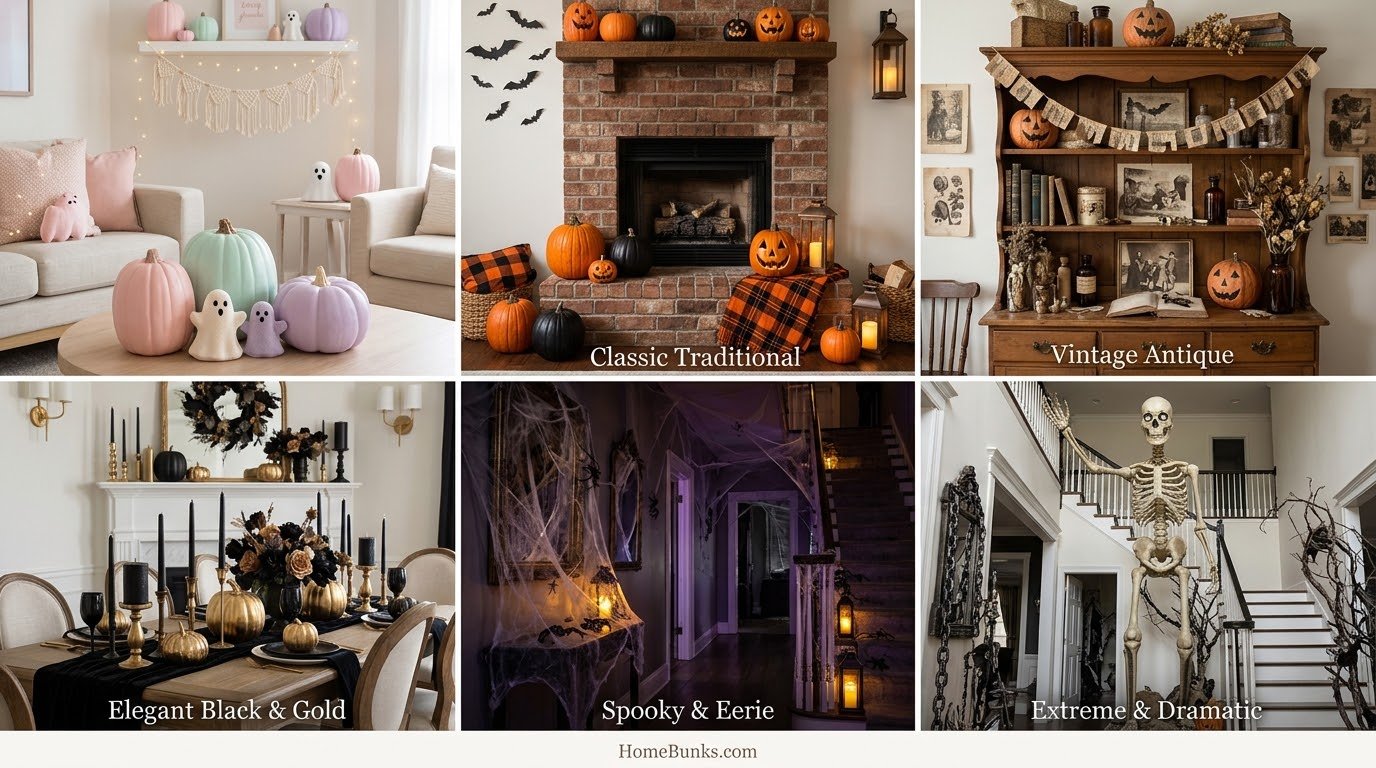
Ideas without prices are how budgets die. Every idea in this hub carries its time and money, with single source figures labeled as strands, never as market data.
One widely read decor guide (Jenna Living) prices the ladder plainly: a mantel or entry refresh takes about 30 minutes, while a full porch, tablescape, or multi surface setup runs 2 to 4 hours.
The same guide’s budget bands: roughly 25 to 75 dollars buys a small tasteful update (pumpkins, a candle cluster, window decals), and 100 to 300 dollars plus covers a styled setup with wreath, lanterns, a skeleton, garlands, and real lighting.
|
Idea |
Time |
Money (strand) |
Storage |
|
Paper bat wall |
About 20 minutes |
A few dollars of cardstock |
One envelope |
|
Cheesecloth ghost garland |
An afternoon |
About 8 to 10 dollars |
One small bag |
|
Pumpkin grouping, steps |
30 minutes |
Seasonal, farm stand pricing |
None (composts) |
|
Mantel four layer setup |
30 to 90 minutes |
Mid band if candlesticks owned |
One bin |
|
Door kit (wreath, mat, pumpkins) |
30 to 60 minutes |
Mid band |
One bin |
|
Yard giant with lighting |
Half a day |
Hero pricing, multi year |
Garage corner |
The DIY collection at the Dizzy Journal DIY collection prices its projects the same honest way, cheesecloth garlands at about 8 to 10 dollars and bulk battery tea lights at about 12 dollars per hundred.
The Best Value Items in the Topic
Paper bats top the value table in guide after guide: near zero cost, flat storage, and a whole wall of effect. Cut from black cardstock with an inexpensive stencil, they replace decal sets costing many times more.
Battery candlelight is the second value: it finishes every zone, flatters every register, and removes the fire question from rooms full of fabric and children.
Pumpkins in groups are the third: three to five in varied sizes and colors, stacked rather than spaced, read as a display where a single pumpkin reads as an errand.
The Idea Menu, by Zone and Register
With decisions made, the menu itself is short. The room by room collection at the Garden Style room by room collection tours the spaces completely; the hub lists only the highest yield ideas per zone.
Door and Porch Ideas
- A register true wreath: spiderweb or twig for classic, dried floral for elegant, smiling pumpkin for cute and vintage.
- A pumpkin story on the steps: clusters in odd numbers, mixed carved and uncarved, faux mixed in against rot.
- A statement doorway: garland arch, cheesecloth drape, or a colored bulb swap, the cheapest porch trick in the topic.
- Path light with a job: lanterns, stake lights, or mummy jar lights marking the walk for small visitors.
Indoor Ideas
- The four layer mantel: base drape, height, accents, movement, in the register’s palette only.
- Floating witch hats or candles: ceiling space is the most ignored surface in decorating, and fishing line makes it free.
- Apothecary styling: jars, labels, and old books convert a shelf into a potion pantry at thrift prices.
- The fireplace spill: pumpkins tumbling from an unused fireplace, playful in classic and cute, sculptural in elegant.
Yard Ideas
- One giant or one giant web: scale that reads from the street, lit warm, anchored against weather.
- Cheesecloth ghosts in a tree: three in one tree beat ten scattered, in every register except extreme, which wants twelve.
- A projector window scene: the one big effect that works for houses with no yard at all.
- Glowing eyes in the hedge: the smallest spooky idea with the longest sightline, two lights and darkness doing the rest.
Mistakes That Undo Good Ideas
Spreading thin is the master mistake: eight started rooms lose to one finished door at the same budget, every season, on every street.
Mixing registers by accident is the second: the pieces are fine and the room is wrong. Hold one register per room at minimum, and per house when possible.
Flat light is the third: overhead white light erases displays that warm candlelight would finish. No display survives its lighting, and lighting is the cheapest fix in the topic.
Buying before pricing is the fourth: the cart fills with supporting pieces, the hero never gets bought, and the zone never passes its finish test.
Ignoring the calendar is the fifth: carved pumpkins bought early rot before the night, heroes bought late cost scarcity prices, and the whole scheme compresses into one stressful weekend.
The 2027 Calendar and the Dated Sibling
Plan 2027 backwards: register and zones chosen by late summer, heroes bought before September scarcity, zones built through September, and the house finished a week before Halloween night, Sunday, October 31, 2027.
Decorating strands commonly start in early to mid September, which suits cute and classic registers; spooky and extreme yards often build later, closer to the night, for weather and effect freshness.
For last season’s record (what sold, what trended, what the survey numbers said), the dated account is kept in the halloween decor 2026 record. The hub plans forward; the record page explains the past, and the two never merge their content.
Post season is a buying season: heroes and durable pieces go on clearance in November, and the household that buys its 2028 hero then decorates next year at half price.
The Register Quiz: Six Questions
Households that cannot name their register can answer their way to it. Six questions, answered honestly, land nearly every house on the ladder.
- Who is the youngest regular viewer? Toddlers point to cute; teenagers open spooky; adults only households may go anywhere.
- What does the house itself look like? Formal rooms flatter elegant; old houses flatter vintage; bright modern rooms flatter classic and cute.
- Do you host, or do you display? Hosts weight the table and living zones; display houses weight the yard and may climb toward extreme.
- What did you love last year? Last season’s favorite piece is the register confessing itself. Build around it rather than replacing it.
- What is the real budget, in money and weekends? Elegant and vintage forgive small budgets; extreme punishes them. Answer with numbers, not hopes.
- What will you still love in year three? Heroes are multi year purchases. The register you pick is the one your storage will keep voting for.
Score the answers and the ladder usually converges on one register, with a second register appearing as the zoning partner for porches or children’s rooms.
Write the register down, with its palette, and tape it inside the storage box. Next year’s shopping then starts from a decision already made, which is the hub’s whole promise.
Worked Schemes at Three Budgets
Budgets below use the strand bands from the pricing chapter as their frame. Each scheme finishes its zones in order; none of them samples every zone thinly.
The 30 Minute, Small Money Refresh
Register: classic. Zones: door only, plus candlelight indoors.
Kit: two pumpkin groupings for the steps, a colored bulb in the porch fixture, paper bats over the mantel, and battery candles in the living room’s existing holders.
Why it works: two zones pass their finish tests for the price of one novelty piece. The house reads decorated on purpose, which is a register and order achievement, not a spending one.
The Styled Weekend Setup
Register: elegant, or vintage where the house is older. Zones: door, living focal, table.
Kit: a made or bought hero wreath, a candelabra or garland hero at the mantel with the four layers run properly, dried florals, taper candles, and a table centerpiece that survives a meal.
Why it works: three finished zones cover every guest’s experience of the house. The yard stays dark, and nobody at the table knows or cares.
The Display House Build
Register: spooky or extreme. Zones: all four, yard first in the build calendar but last in budget priority after the door closes.
Kit: a finished door kit, one yard hero (giant, web, or scene) with anchoring and lighting, fog or projection for atmosphere, and supporting clusters rather than scattered singles.
Why it works: the display is built like a stage set, hero out front, everything else in support, and the door still welcomes the youngest visitors the street sends.
Small Spaces, Rentals, and Shared Houses
Small homes do not need smaller ambitions; they need fewer zones, finished harder. A studio has two zones: the door (or the window, where the door is shared) and one focal surface.
Renters run the no trace kit: decals, covers, garlands on removable hooks, a wreath on an over door hanger, and heroes that stand rather than mount.
Shared houses split registers by territory: personal rooms free, shared rooms negotiated to one register, and the door decided by whoever answers it most.
Apartments with balconies gain a bonus zone. A railing garland and two pumpkins give the building a finished facade at the smallest budget in this guide.
Lighting: The Finisher Every Zone Shares
Every register ends with the same move: turn the overhead light off and let the scheme’s own light work. Displays designed under ceiling light die under it nightly.
The working kit is small: battery tapers and pillars for surfaces, warm fairy lights for garlands and trees, lanterns for paths, and one colored accent (orange for classic, purple for spooky, warm white for elegant) per zone at most.
Timers matter more than brightness. A scheme that lights itself at dusk reads as alive; a scheme waiting for someone to remember switches reads as storage with ambitions.
Judge every zone twice: once at noon for composition, once at dusk for truth. The dusk pass is where heroes prove themselves and where flat displays ask for one more candle cluster.
Safety rides along without drama: flameless near fabric and children, cords taped or routed off paths, outdoor pieces on outdoor rated timers, and real flame only where it is watched, stable, and alone on its surface.
The Supporting Cast Catalog
Heroes get the budget; the supporting cast gets the coverage. Four families of supporters recur in every register, and buying them well is most of decorating.
Garlands span the focal lines: mantels, doorways, banisters, headboards. Felt and paper for cute and classic, dried and dark floral for elegant, cheesecloth for spooky. One garland per zone, in the register’s materials.
Textiles and drapes soften hard rooms: cheesecloth over mirrors and mantels, runners under centerpieces, pillow covers on sofas, a throw in the palette. They are the cheapest square footage in the topic and store flat.
Candles and small lights fill the middle heights heroes and garlands leave empty. Cluster in odd numbers, vary heights within the cluster, and keep the flame question settled before the fabric goes up.
Flat paper and decals deliver disproportionate area: bat walls, window silhouettes, garland banners, door surrounds. They are the first purchase for small budgets and the last storage problem anyone has.
Buy supporters by the zone, not by the cart: a zone’s full supporting cast in one purchase, matched to its hero and palette, beats five trips of attractive fragments.
When the Scheme Meets a Party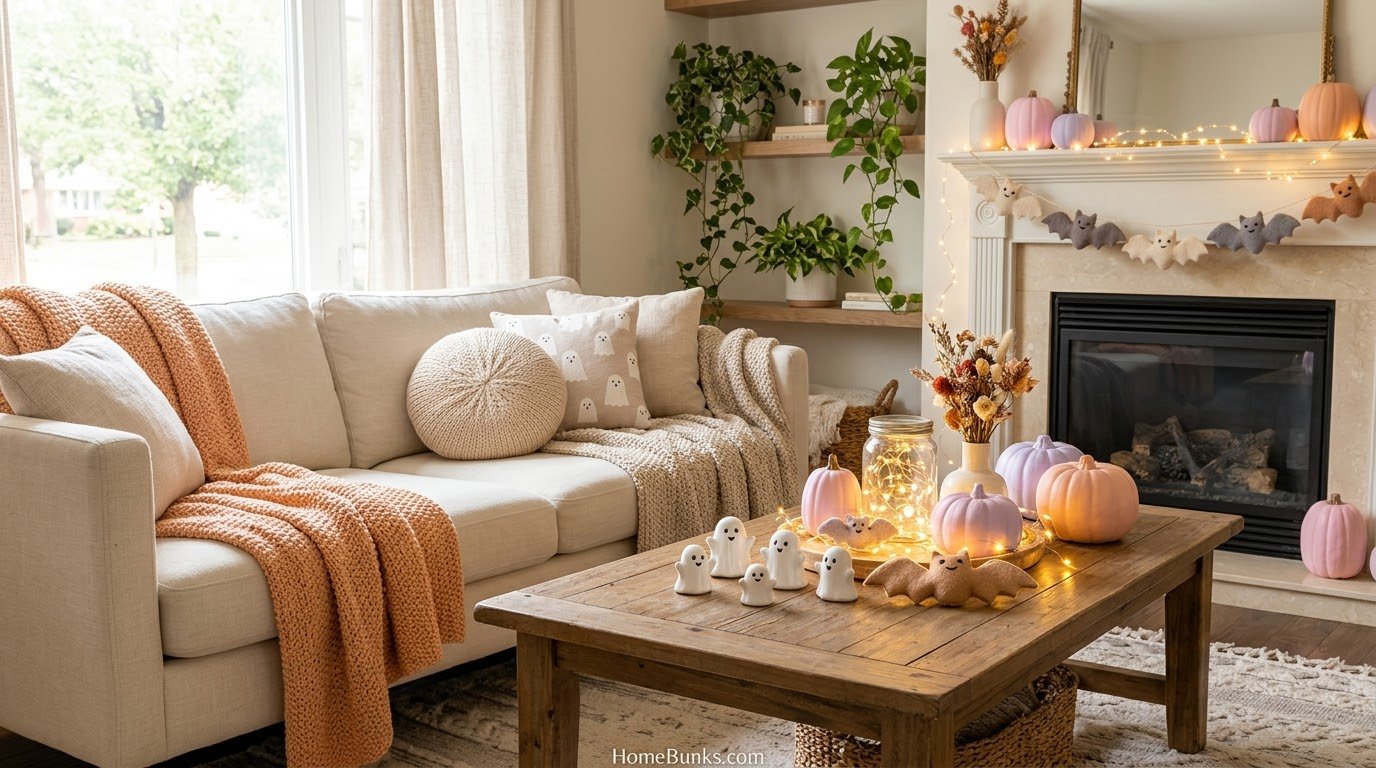
A finished house scheme is 90 percent of a party scheme. The conversion adds function, not decor: a backdrop wall for photographs, a drinks station styled as the register’s set piece, and candy or food presented inside the palette.
Mad scientist bars, potion drink stations, and wizard candle scenes all work because they are table zones with a job, dressed in the house’s register rather than a second theme bought for one night.
Convert in the other direction too: party pieces with real quality (a good backdrop garland, quality candle holders) should be promoted into the house scheme the next season, not stored as party only.
The rule that survives both directions is the hub’s rule: one register. A party that changes the house’s register for a night confuses both events; a party that intensifies the register delights both.
Storage and the November Audit
Storage is a design constraint, not an afterthought: heroes keep their shapes in real space, supporters fold flat, and every box is labeled by zone so next year’s build order is automatic.
Audit in November, while the season’s evidence is fresh. Which zone passed its finish test, which hero earned its storage, and which purchase never found a zone at all?
That audit, written in two lines inside the first box, is the most valuable decorating document the household owns. It converts this year’s spending into next year’s decisions, which is the entire discipline this hub exists to teach.
Frequently Asked Questions
1. What are the best Halloween decor ideas overall?
The ones inside a decided scheme. Choose a register, decorate the door first, give each zone one hero, and price everything.
Inside that frame, pumpkin groupings, wreaths, garlands, and warm candlelight outperform every novelty.
2. Where should I start decorating for Halloween?
At the front door. It is the zone every guest and trick or treater meets, it finishes fastest, and a finished door makes the whole house read decorated while the other zones wait their turn.
3. What is a Halloween decor register or theme?
A register is the style system a scheme holds. Its palette, materials, scare level, and humor, chosen once and kept consistent.
Cute, classic, vintage, elegant, spooky, and extreme are the six working registers.
4. How do I choose a Halloween decor theme?
Match it to the household, not the screenshot. Young children pull toward cute, formal rooms toward elegant, competitive streets toward spooky or extreme.
Then hold the choice house wide; consistency is what reads as designed.
5. How much does Halloween decorating cost?
One guide’s strand prices a small update at roughly 25 to 75 dollars. A styled setup runs 100 to 300 dollars plus.
Heroes bought for multiple years change the math; supporting pieces should stay cheap.
6. How long does it take to decorate for Halloween?
A refresh takes about 30 minutes in one guide’s strand. A full porch, tablescape, or multi surface setup runs 2 to 4 hours.
A yard with a giant takes half a day, mostly anchoring and lighting.
7. What does finish one zone mean?
A zone is finished when it reads finished from its audience’s viewpoint. The door from the street, the mantel from the doorway, the table from a seat.
Until a zone passes that test, the next zone does not start.
8. What is a hero piece in Halloween decorating?
The hero is the one piece a zone is remembered by. The wreath at the door, the candelabra at the mantel, the giant in the yard.
Everything else is supporting cast and should be priced like it.
9. How many Halloween decorations do I need?
Fewer than the lists suggest. One hero, one garland, one textile or drape layer, and candlelight per zone completes most schemes.
Quantity is the supporting cast’s job, and it should be cheap quantity.
10. What are classy Halloween decor ideas?
Matte black, cream, brass, and dried things. A candelabra, a dried floral wreath, neutral pumpkins, and taper candles.
Palette discipline does the work; bright plastic and glitter are what elegant avoids.
11. What are cute Halloween decor ideas?
Smiling faces, soft materials, pastel or classic palettes. Plush and felt ghosts, painted pumpkins with rosy cheeks, balloon ghosts, and flameless light, calibrated to the youngest viewer in the room.
12. What are vintage Halloween decor ideas?
The smiling mid century register. Reproduction blow mold style figures, aged graphics, friendly painted pumpkins, and cream and aged orange palettes.
It mixes naturally with cute because both obey the same face rule.
13. What are spooky but not extreme Halloween decor ideas?
Atmosphere without gore. Fog, colored light, giant webs, animatronics, and sound, kept below the haunted house threshold.
It suits older kids and thrill households that still host a mixed street.
14. What are the best outdoor Halloween decor ideas?
One giant or one giant web, lit and anchored. Add cheesecloth ghosts in a tree, glowing eyes in the hedge, and a projector window if the yard is small.
Scale and light decide everything outdoors.
15. What are the best indoor Halloween decor ideas?
The four layer mantel, floating hats or candles, apothecary shelves. Add a fireplace pumpkin spill and register true textiles.
Indoors rewards layering and light more than scale.
16. What are Halloween porch decor ideas?
A register true wreath, a pumpkin story on the steps, a statement doorway. Finish with path light that does a job.
The door zone is zone one: close it before opening any other.
17. What are Halloween mantel decor ideas?
Base drape, height pieces, accents, movement garland. Run the four layers in one palette and leave breathing room between pieces.
A crowded mantel reads as storage; a layered one reads as a scene.
18. What are Halloween table decor ideas?
A low centerpiece, flameless candles, and sightlines kept clear. Add place level details in the register: bat napkin folds for classic, dried florals for elegant.
The table must survive a meal.
19. DIY or store bought Halloween decor, which is better?
DIY wins on value items, bought wins on heroes. Paper bats, cheesecloth ghosts, and painted pumpkins reward making.
Giants, animatronics, and quality skeletons reward buying once and reusing for years.
20. What are the best value Halloween decorations?
Paper bats, battery candlelight, and pumpkin groupings. Bats cost almost nothing and store in an envelope; candlelight finishes every zone; grouped pumpkins read as a display where a single one reads as an errand.
21. What Halloween decor should I buy first?
Pumpkins and the door hero. Pumpkins anchor nearly every register, and the wreath anchors the first zone.
One decor guide’s strand calls pumpkins the buy first item, and the zone order agrees.
22. One big piece or many small pieces for Halloween?
One hero, almost always. Two focal pieces split the eye and halve each other, while many small pieces read as clutter.
Spend the same money on one hero and cheap supporting pieces instead.
23. What Halloween decor ideas work in a small apartment?
Flat formats and one focal point. Pillow covers, decals, paper garlands, and a windowsill or entry scheme that finishes completely.
Small spaces win by completing one zone perfectly rather than sampling five.
24. What Halloween decor ideas are renter friendly?
Decals, covers, garlands on removable hooks, and a door wreath. Nothing that needs holes, paint, or permanence.
The whole scheme should leave with you in one or two boxes.
25. What Halloween decor ideas suit young kids?
The cute register, calibrated. Friendly faces only, flameless light, no jump scares or sudden sound, and pieces sized so nothing reads menacing at child height.
Toddlers read faces first; give them friends.
26. What Halloween decor ideas suit an adult dinner party?
The elegant register, table first. Matte black and brass, dried florals, taper candles (flameless near sleeves), and a centerpiece that survives service.
Keep the menu’s theater in the food and the decor composed.
27. When should I decorate for Halloween 2027?
For Halloween 2027, build through September. Halloween falls on Sunday, October 31, 2027.
Choose the register by late summer, buy heroes before September scarcity, and finish a week early.
28. How do I make Halloween decor look expensive?
Discipline the palette and matte the finishes. Black, cream, charcoal, and one metal, with dried and natural textures, read expensive at any spend.
Bright glossy plastic is what actually reads cheap.
29. Why does my Halloween decor look cluttered?
Almost always mixed registers spread too thin. Pieces from three styles in eight unfinished rooms cannot compose.
Hold one register, finish the door zone completely, and the clutter verdict usually lifts.
30. Can I mix Halloween decor styles?
Yes, on purpose, by zone. Cute at the door and in children’s rooms, spooky at the yard’s edge, elegant at the table.
Mixing by zone is a decision; mixing inside one zone is an accident.
31. What is the mantel formula for Halloween?
Base, height, accents, movement. A drape or runner across the mantel, tall pieces for height, Halloween accents in the register, and a garland for movement.
Four layers, one palette, breathing room between pieces.
32. How do I decorate a porch for Halloween step by step?
Wreath on the door, mat down, two pumpkins in palette. Add a doorway treatment (arch, drape, or colored bulb), then light the path.
That finished kit is zone one, closed before any other zone opens.
33. What are last minute Halloween decor ideas?
A colored bulb swap, a paper bat wall, a candle cluster. Add a pumpkin grouping by the door and cheesecloth over a mirror.
Thirty minutes and small money produce one genuinely finished zone.
34. What Halloween decor lasts for years?
Heroes and hard goods. Quality skeletons, metal lanterns, candelabras, ceramic figures, and faux pumpkins outlast trends.
Paper, produce, and cheap plush are the annual purchases, priced accordingly.
35. How do I store Halloween decor?
Flat first, heroes wrapped, one palette per box. Decals and paper in envelopes, textiles folded, ceramics wrapped, giants stored assembled where possible.
Label boxes by zone so next year’s order of work is automatic.
36. What Halloween decor should I skip?
Skip duplicate heroes, unpriced novelties, and anything without a zone. Also skip a second focal piece for a zone that has one, and any piece whose storage spot you cannot name at the shelf.
37. Are fog machines and projectors worth it?
For spooky and extreme registers, often yes. A projector is the one big effect that works without a yard, and fog transforms a yard scene.
For cute, classic, and elegant houses they are usually money spent off register.
38. What are Halloween decor ideas for a yard with no porch?
Use the window, the door, and the facade. A projector scene in the window, a finished door zone, and glowing eyes or ghosts at the property line give a yard free house a complete scheme.
39. What are Halloween decor ideas for an office or classroom?
Miniature and tasteful. A small figure or framed print at a desk, paper bats on a monitor, friendly faces only in classrooms.
Check workplace and school policies first; they vary and they win.
40. How is this different from a Halloween decor 2026 list?
The 2026 page is a dated record; this hub is a decision system. The record keeps what sold, what trended, and what the surveys said last season.
The hub plans any season.
They link; they never merge.
41. What Halloween decor trends carry into 2027?
Vintage, moody neutrals, cottagecore, and pastel accents. Those style strands have carried across several seasons of decor coverage.
Registers outlast trends; choose the register and let trends restyle its supporting cast.
42. Where do I find more ideas for my chosen register or zone?
Follow the register and zone guides on this site. Each ladder row and zone row in this hub routes to the guide that owns it: cute, pink, vintage, door, porch, home, table, and outdoor.
Conclusion
Halloween decor ideas stop being overwhelming the moment they are demoted to a menu: choose the register, work the zones in order, crown one hero per zone, and price every idea before it enters the house.
Start at the door this September, finish it completely, and let the rest of the house follow in order. Set the scheme early for Halloween 2027 and the season becomes a sequence of small, finished decisions instead of one large, anxious one.
Keep the register decision written down, and let each year’s audit improve it rather than replace it.
Households that run one register well for three seasons own something no shopping trip provides: a house style for Halloween, recognized by their street, expected by their guests, and cheaper every year it repeats.
That is the real destination of every halloween decor ideas list worth reading: not more ideas, but fewer, better decisions, made once and enjoyed for a month each year.
Choose yours before the next idea arrives, and the ideas that follow will finally have somewhere to belong. The door is waiting, the register is yours to name, and the first finished zone is one afternoon away.


