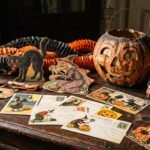
Vintage Halloween decor rewards two kinds of reader at once: the decorator who wants the look, and the collector who wants the truth about a piece.
Both start in the same place. Pick one register (antique paper, mid century party, or blow mold folk) and let it govern every choice after.
Then learn the checks that separate an original from a reissue, because in this category the famous designs are exactly the ones that were copied.
What follows runs in that order: eras, makers, authentication, honest values, styling, and the care that keeps old paper alive.
What Counts as Vintage, and What Only Looks It
Three words get blurred by sellers, so separate them first. Antique properly means about a century old, which covers the earliest paper era.
Vintage means genuinely made in a past era, typically a few decades back or more. The piece itself is old, whatever its condition.
Retro means new made to look old. Retro is a legitimate purchase and a dishonest label, depending entirely on which one the seller uses.
Your eyes can arbitrate: materials, marks, and construction age in ways printing cannot fake. That is why authentication gets its own section below.
The Three Registers
Vintage Halloween is not one style. It is three eras with three material languages, and mixing them carelessly is what makes displays look like a flea market table.
|
Register |
Decades |
Materials |
Anchor Pieces |
Palette |
|---|---|---|---|---|
|
Antique paper |
1900s to 1930s |
embossed cardboard, composition, papier mache, crepe |
die cuts, German lanterns, Bogie Books, postcards |
rust orange, charcoal black, cream, aged gold |
|
Mid century party |
1940s to 1960s |
pressed pulp, honeycomb tissue, crepe, novelty candles |
pulp pumpkins, honeycomb centerpieces, Gurley candles, jointed figures |
classic orange and black, candy accents |
|
Blow mold folk |
1960s to 1990s |
blow mold plastic, simple electrics |
light up pumpkins, witches, haunted houses, ghosts |
porch orange glow, primary brights |
Simple Spaces’ vintage Halloween decor ideas states the governing rule best: commit to one register for the room, then borrow only one or two accents from the others.
Within a register, repeat two or three materials across the display. Paper, ceramic, and glass in one room reads collected; eight materials reads accumulated.
The golden age sits inside the first register: collector coverage puts it at roughly 1910 to the mid 1930s, when German and American production peaked.
The Makers Worth Knowing
The Beistle Company is the American center of the category: founded in 1900 in Shippensburg, Pennsylvania by Martin Luther Beistle, dominant in paper Halloween decor by the 1920s and 1930s.
Its embossed die cut cats, owls, witches, and jointed skeletons hung in classrooms and windows for decades, which is why so many survive, and why so many were reissued.
Dennison Manufacturing of Framingham, Massachusetts sold the party itself: crepe paper, seals, nut cups, and the Bogie Books, annual party guides published from 1909 by some accounts and 1912 by others, into the mid 1930s.
H.E. Luhrs, Beistle’s Shippensburg neighbor and competitor, printed its own die cuts in the middle decades. Home As We Make It’s collector guide to vintage Halloween decorations covers the Luhrs cats and witches most guides skip.
German workshops supplied the top tier: molded, hand painted papier mache and composition lanterns exported to American dime stores from about the 1910s to the 1930s.
American pressed pulp followed in the 1940s and 1950s: pumpkins, cats, owls, and devil heads molded from paper fiber, cheerful and comparatively plentiful.
The plastic era had its own makers: Union Products, General Foam, and Empire blow molded the glowing porch figures of the 1960s to 1990s.
Gurley Novelty candles (witches, pumpkins, ghosts) filled the dime store shelf between pulp and plastic, and now fill collector shelves as display pieces.
Original or Reissue: The Authentication Checklist
Run these checks before money moves. They take five minutes and they are the difference between an original and a souvenir.
- Read the mark. Find the printed company name and copyright line. Compare the wording and placement against a confirmed original of the same design.
- Weigh the stock. Early paper pieces sit on heavier card than later reissues. Thin, bright, flexible stock argues for a modern printing.
- Feel the embossing. Originals carry raised texture you can feel with a fingertip. Flat printed shading pretending to be embossing is a reissue tell.
- Check the printing sides. Many early Beistle pieces are printed on one side with a plain back. Full color backs belong to later production.
- Judge the color. Period inks read slightly muted even when bright. Neon saturation on a supposedly 1920s piece is modern ink confessing.
- Count the parts. Jointed figures need every limb and every metal fastener. Lanterns need their original paper inserts behind the eyes and mouth.
- Ask for provenance. Where it lived, when it was bought, what came with it. Honest sellers answer; vague stories are data too.
Patina’s guide to what old Halloween decorations are worth adds the market context: Beistle reissued classic designs in later waves, reported in 2003 and 2012, so a famous design alone proves nothing about age.
What It Is Worth: Strands, Not Promises
Values in this category are reported ranges, not appraisals, and the sources disagree often enough that printing one number would be a lie.
Start with the honest base rate: Patina’s guide to what old Halloween decorations are worth puts most finds at about $30 to $50, with a middle tier around $100 to $600 and rare early pieces far above it.
|
Category |
Reported Range (strands) |
What Moves It Within the Range |
|---|---|---|
|
Beistle die cuts, pre World War II |
about $40 to $300 across collector guides |
size, design rarity, creases, fading |
|
Jointed skeletons and figures, early |
about $50 into the low hundreds |
completeness of limbs and fasteners |
|
Luhrs die cuts |
about $20 to $150 |
design, condition, collector demand |
|
Dennison Bogie Books |
about $50 to $250, $75 to $300, and $225 to $400 by source |
edition year, covers, page condition |
|
German papier mache lanterns |
about $150 to $600 |
original insert, paint, scorch marks |
|
American pulp pumpkins, 1940s to 1950s |
about $75 to $250 |
character (cats and devils over pumpkins) |
|
Blow molds, working |
about $100 to $600 in appraiser tiers |
maker, size, paint, working light |
Go2Tutors’ roundup of old Halloween decorations now worth money lands in the same neighborhoods category by category, which is why the ranges above are worth trusting as ranges, and worthless as exact prices.
The records sit in a different universe: market coverage reports a 1920s German composition candy container at $33,280 at Bertoia, described as the category record, and a 1930 Beistle Tango Cat honeycomb at $1,303 in April 2025.
Single sales prove a ceiling exists. They say nothing about your box in the attic, which the base rate describes far better.
Condition is the swing factor inside every range: crisp embossing, bright paint, complete figures, original inserts, and sealed packaging pull up; creases, stains, scorch, and replaced parts push down.
Where to Buy: Channels and the Calendar
Estate sales are the hunter’s channel: whole household collections surface at once, prices are set without October fever, and summer sales are the richest.
Antique malls and shops trade a small premium for curation and the chance to handle a piece before paying, which the authentication checklist rewards.
Online marketplaces offer breadth across every register. Price against sold listings only; asking prices are wishes, and October listings carry the spike.
Specialty auctions are for the rare early pieces, where provenance and competition justify the format and the fees.
The calendar is a strategy in itself: buy from November through summer, when demand sleeps, and expect to pay the season tax on anything bought in October.
Styling Vintage Halloween Decor by Room
Styling rules here obey the register system: one era leads, materials repeat, and warm low light does the aging no filter can.
The mantel is the vintage room’s altar: one anchor (a lantern, a framed die cut, a pulp pumpkin), candlesticks or stacked old books for height, one paper garland, nothing glossy.
Oh Oh Deco’s vintage Halloween decor guide builds its rooms on the same discipline: repeat two or three materials and the space reads collected over time rather than bought in a weekend.
The party table belongs to the mid century register: honeycomb centerpieces, crepe, nut cups, paper plates as display, and the old fashioned candy your guests will narrate.
The wall takes framed paper: die cuts and postcards in mismatched warm frames read as a salon of the season, and framing is preservation, which the care section covers.
The porch belongs to blow molds and reproductions, because originals of paper and pulp are indoor materials. A glowing mold pumpkin by the door sets the register before anyone enters.
For a farmhouse register, the harvest end of vintage (worn wood, grain sacks, muted pumpkins) borrows the bones of Farmhouse kitchen ideas and ages them a century.
For a moody register, the antique paper palette against restraint follows the calm of Scandinavian bedroom ideas, with sepia and charcoal doing the work.
The Honest Reproduction Lane
Most readers will never own a 1920s German lantern, and the look does not require one. Faithful reproductions supply the volume that antiques cannot.
Bethany Lowe Designs and Johanna Parker Design lead the vintage style market, with Primitives by Kathy in the primitive register and seasonal vintage style lines from larger importers.
Buy reproductions labelled as reproductions, display them proudly as modern design, and mix them under authentic anchors: one real lantern dignifies a shelf of honest copies.
The lane has one law: a reproduction may borrow the past, but it may not claim it, in your home or in any future sale.
DIY Aging: On New Pieces Only
Aging techniques belong to new decor; aging a genuine antique is vandalism with a craft supply. On new pieces, the era signals are learnable.
Work the palette first: soften orange toward rust, black toward charcoal, and add cream. Matte finishes beat gloss everywhere in the vintage registers.
Age paper honestly: light tea staining on new card stock, slightly softened edges, hand painted faces with a wobble left in. Perfection is the modern tell.
Steal the textures: crepe garlands, honeycomb, and chenille read vintage at arm’s length before any single piece does.
Care, Storage, and Safe Display
Ownership is where vintage pieces are won or lost. These four systems protect both the objects and the house.
Storage: Flat, Dry, and Dark
Store paper flat with acid free tissue between pieces, on rigid support, in a dry interior space. Attic heat and basement damp are the twin executioners.
Honeycomb folds back to its flat state with tissue support and nothing heavy on top. Crepe, the most fragile material here, rides at the top of the box.
Label boxes by register, and photograph each display before teardown so next October starts at assembly.
Cleaning: Almost None
Dust with a soft dry brush or gentle air. No water on papier mache or paper, no sprays, no oils: water swells pulp and lifts paint.
Musty pieces get aired in shade and time. Mildew smell is a condition issue to disclose when selling, never a scent to perfume over.
Real restoration belongs to a paper conservator, and only for pieces whose value justifies the invoice.
Light: LED, Never Flame
Antique lanterns were made for candles, and their interiors carry the scorch marks to prove it. One modern candle evening can end a century old piece and threaten the house.
Use a warm LED candle or low heat LED substitute inside lanterns and blow molds. Through a printed insert, the glow reads identically and the piece survives.
Period wiring and sockets are display only until rewired by a qualified shop. Simple blow mold cords are the easy exception: replace the cord, fit an LED, and light them as made.
Old Paint and Handling
Paint on early painted goods can contain lead, as with most painted antiques of the era. Handle pieces as display objects and wash hands after handling.
Keep antique pieces away from children’s mouths and food surfaces, and never sand, strip, or repaint an original: one rule that protects health and value at once.
Selling Vintage Halloween Decor
Photograph marks, backs, and flaws as carefully as the fronts. Name maker and era only as confidently as your checks allow.
Time the listing to September and October demand, price from sold listings in the same condition, and disclose reproductions, repairs, and replaced parts in plain words.
Rare early pieces justify specialty auctions; common pieces move best where the buyers already browse, with the season working for you instead of against you.
Where This Decor Lived: Classrooms and Dime Stores
Understanding the original habitat sharpens both styling and buying. Beistle die cuts were classroom and window goods: cheap, bright, tacked up for a season of school parties.
That habitat explains the survival pattern. Pieces lived flat in teacher cupboards and store stockrooms, which is why crisp examples surface in estate lots rather than singly.
Dennison’s world was the home party: the Bogie Books taught hostesses to build whole rooms from crepe, which is why crepe goods were used hard and survive worst.
German lanterns were dime store imports, bought for children to carry. Every surviving lantern outlived a childhood, which is why originals are scarce and inserts scarcer.
Blow molds were suburban porch furniture, bought at hardware stores and left glowing for a month each year. Weather, not children, is their survival filter.
Buy with the habitat in mind: classroom paper in lots, party goods in fragments, lanterns one at a time, molds wherever porches are being cleared.
Three More Categories Worth Knowing
Postcards are the affordable door into the golden age: embossed, often artist signed cards with witches, moons, and pumpkins in jewel colors.
Quality singles sit in the middle tier in appraiser guides, while common cards cost less than a modern greeting card costs new. Frame the best behind UV glass.
Tin noisemakers (clickers, ratchets, horns) carried the party’s sound before speakers did. Lithographed cats and witches decorate their tin, and working mechanisms matter.
Category experts quoted in market coverage note noisemakers have cooled from earlier peaks, which makes them a patient buyer’s category right now.
Candy containers are the summit: German composition figures that opened to hold sweets, in pumpkins, devils, and the famous vegetable people.
They anchor the record prices in the values section, and they are the most reproduced summit in the category. The authentication checklist earns its keep here.
Boxed costumes sit adjacent rather than inside decor, but collectors display the boxes (the graphics are pure register) and the masks on walls.
Treat them as ephemera with the same rules: flat, dry, framed or sleeved, and never worn again by anyone who values them.
A Worked Vignette: The 1930s Mantel
Start with the anchor: one German papier mache lantern, or an honest reproduction, centered slightly off middle, with a warm LED candle inside.
Flank it with height: two stacks of aged books, a brass candlestick on one side, a framed Beistle die cut leaning on the other.
Add the paper layer: a crepe garland in rust and cream swagged below the mantel edge, ends pinned where the eye will not travel.
Place one surprise: a single black cat figure, composition if fortune smiled, reproduction if it did not, seated where the garland dips.
Step back and audit by the rules: one register (antique paper), three materials (paper, composition, brass), warm light only, nothing glossy, nothing new pretending.
Photograph it at dusk. The photo is next year’s setup instructions and this year’s proof that restraint beats accumulation.
Mistakes That Cost Money or Pieces
Paying original money for a famous design without the checks. Fame is exactly why it was reissued.
Cleaning with water. One damp cloth can take the paint off a pulp pumpkin and the value with it.
Lighting the lantern. The candle is the one accessory the piece was made for and the one most likely to destroy it.
Storing in the attic. A single hot summer warps, fades, and embrittles what a century of careful owners preserved.
Restoring instead of stabilizing. Amateur repairs erase collector value; honest wear keeps decorator value. Know which buyer you are serving.
1. What counts as vintage halloween decor?
Decorations genuinely made in an earlier era, most usefully grouped in three registers: antique paper and composition pieces from about the 1900s to the 1930s, mid century party goods from the 1940s to the 1960s.
And blow mold folk pieces from the 1960s to the 1990s.
New pieces made in the old style are vintage style or reproductions, which are fine to buy as long as they are labelled honestly.
2. What is the difference between vintage, retro, and antique halloween decor?
Antique properly means about 100 years old, which covers the earliest paper era.
Vintage means genuinely of a past era, typically 20 to 40 plus years old.
Retro means new made to look old.
Sellers blur the words; the maker’s mark, materials, and construction tell the truth.
3. Are old halloween decorations worth money?
Some are, most are modest.
One appraiser guide puts the honest base rate at about $30 to $50 for most finds, with a middle tier around $100 to $600 (working blow molds, Bogie Books, better die cuts) and rare early pieces far higher.
Condition, completeness, and era decide everything; a creased common die cut and a crisp rare one are different objects economically.
4. What are the most valuable vintage halloween decorations?
Early German papier mache and composition pieces sit at the top: reported auction records include a 1920s German composition candy container (a vegetable man) at $33,280 at Bertoia, described in market coverage as the category record.
And a German goblin lantern at $5,179 in an online sale.
Rare Beistle honeycomb and mechanical die cuts from the 1920s and 1930s lead the American paper tier.
All such figures are reported strands from single sales, not price guarantees.
5. How much is a vintage Beistle die cut worth?
Collector guides converge on about $40 to $300 for pre World War II originals depending on design and size, with small common designs from about $20 and large or unusual pieces higher.
Creases, water stains, fading, and missing pieces cut value sharply; the same design reissued later is worth reproduction money, not original money.
6. How can you tell a Beistle original from a reissue?
Check the printed company mark and copyright line, the paper stock (earlier pieces are heavier), the depth of the embossing (originals have raised texture you can feel), printing on one side for early pieces, and color saturation.
Beistle reissued many designs, including notable reissue waves reported in 2003 and 2012, so a famous design alone proves nothing.
7. What is a Dennison Bogie Book?
Dennison Manufacturing of Framingham, Massachusetts published the Bogie Book as an annual Halloween party guide, from 1909 by some accounts and 1912 by others, into the mid 1930s.
Each edition sold the company’s crepe paper and party goods through costume, table, and decorating schemes.
Copies sit in museum and library collections today.
8. How much is a Bogie Book worth?
Sources disagree, so treat the figures as strands: collector guides cite about $50 to $250 in one, about $75 to $300 in another, and $225 to $400 in a third.
With early editions highest (a 1915 edition is reported at $838).
Missing covers, loose pages, and brittle paper pull value down; later reprints are common and worth far less.
9. Why are German papier mache lanterns so prized?
German workshops exported molded, hand painted papier mache and composition lanterns to American dime stores from about the 1910s to the 1930s.
The best have thin printed paper inserts behind the eyes and mouth so a candle made the face glow, and a wire bail handle for carrying.
Hand finishing, survival scarcity, and the glow effect put good pumpkins at a few hundred dollars and rare characters far higher.
10. How much is a German papier mache jack o lantern worth?
Guides put good originals roughly between $150 and $600, with common pumpkins at a few hundred and rare faces or large sizes above that range.
Scorched interiors, flaking paint, and replaced inserts cut the figure dramatically, which is why the original insert is a value centerpiece.
11. What are American pulp jack o lanterns?
Pressed pulp (paper fiber) pumpkins and figures made in the United States in the 1940s and 1950s, the accessible mid century tier.
Guides put common pumpkins at about $75 to $250, with cats, owls, and devil heads higher.
They are the easiest authentic era to start collecting because supply survived in quantity.
12. What is honeycomb halloween decor?
Tissue paper that unfolds into three dimensional pumpkins, cats, and centerpieces, a mid century party staple, with earlier honeycomb features on rare 1920s and 1930s Beistle pieces.
A 1930 Beistle Tango Cat honeycomb is reported sold at $1,303 in April 2025.
Honeycomb crushes easily, so storage decides survival.
13. What are blow mold halloween decorations?
Hollow plastic figures (pumpkins, witches, haunted houses, ghosts) with an internal light, made by Union Products, General Foam, Empire and others from the 1960s into the 1990s, that lit up suburban porches.
Working examples in good paint sit in the roughly $100 to $600 middle tier per appraiser guides, with common faded pieces far less.
14. What are Gurley candles?
Novelty figural candles (witches, pumpkins, ghosts, skeletons) made by the Gurley Novelty Company in the mid twentieth century, sold cheaply in dime stores and now collected as shelf decor.
They are display pieces today: burning them destroys both the figure and its value.
15. What are tin noisemakers?
Lithographed tin clickers, ratchets, and horns made for Halloween parties in the early to mid twentieth century, decorated with witches, cats, and pumpkins.
They are an entry collecting category with active expert coverage; condition of the lithography and a working mechanism drive value.
16. Where is the best place to buy vintage halloween decor?
By goal: estate sales and antique malls for hunting and fair prices on common pieces; online marketplaces for breadth, checked against sold listings; specialty auctions for rare early pieces.
Summer is the hunting season, because October listings carry the seasonal spike.
17. When is the cheapest time to buy vintage halloween?
Off season, roughly November through the summer, and at summer estate sales before dealers stock for fall.
In October every channel prices for the holiday.
The mirror rule applies to selling: list into the September and October demand.
18. How do I know if a seller’s vintage piece is real?
Ask for provenance and clear photos of marks, backs, and construction, then run the authentication checks yourself: maker mark and copyright line, material and stock weight, embossing, one sided printing on early paper, completeness, and original parts.
Compare against sold listings of confirmed originals.
Famous designs are exactly the ones that were reissued.
19. Can I mix real vintage with reproductions?
Yes, and most good displays do: authentic pieces as anchors (one lantern, a framed die cut, a pulp pumpkin) and faithful reproductions for volume (garlands, table paper, honeycomb).
Keep the registers consistent, repeat two or three materials, and never let a reproduction pretend in your own labelling or when you sell.
20. What reproduction brands make vintage style halloween decor?
Bethany Lowe Designs and Johanna Parker Design are the best known names in vintage style Halloween, with Primitives by Kathy in the primitive register and seasonal vintage style lines from larger importers.
Their pieces are collectible in their own right as modern design, priced as new goods.
21. How do I make new halloween decor look vintage?
Copy the era signals: muted palette (softened orange, black, cream), matte finishes, slightly imperfect hand painted faces, aged paper tones (light tea staining on card stock, never on real antiques), crepe and honeycomb textures, and warm low light.
Aging techniques belong on new pieces only; altering a genuine piece destroys value.
22. What colors are vintage halloween?
Orange and black lead, but the vintage register softens them: pumpkin orange aged toward rust, black toward charcoal, plus cream, aged gold, and the pale green of old composition paint.
Mid century adds candy brights in small doses.
Neon and purple belong to the modern register.
23. How do I style a vintage halloween mantel?
Commit to one register, then work in odd numbers: an anchor piece (lantern, framed die cut, or pulp pumpkin), height from candlesticks or stacked old books, one paper element (garland or fan), and warm light.
Repeat the same two or three materials on the mantel and the table so the room reads collected, not scattered.
24. How do I display paper die cuts without ruining them?
Frame the best behind glass (UV glass if the spot is bright), use acid free backing, and never tape, pin, or laminate an original: every hole and adhesive mark is a permanent value cut.
Lesser pieces can hang from clips in shaded spots for the season, then return to flat storage.
25. How should I store vintage paper decorations?
Flat, dry, and dark: acid free tissue between pieces, rigid support so nothing bends, no attic heat and no damp basement, and boxes labelled by register.
Honeycomb stores in its folded state with tissue support, never under weight.
Crepe is the most fragile material in the category and gets the top of the stack.
26. How do I clean vintage papier mache or paper decor?
Almost not at all: a soft dry brush or a gentle air blower for dust, no water, no sprays, no oils.
Water swells pulp and lifts paint; solvents stain paper.
Odor is managed with airy storage and time, and any real restoration belongs to a conservator if the piece justifies it.
27. Is it safe to light candles in vintage lanterns?
Do not.
The inserts are paper, the interiors often show scorch marks from period candles, and one evening’s flame can destroy a century old piece and start a fire.
Use a warm LED candle or a low heat LED bulb substitute; the glow reads the same through the insert and the piece survives.
28. What about old wiring in vintage light up pieces?
Treat period wiring and sockets as display only until a qualified electrician or lamp shop rewires them; cloth insulation and old plugs were not made for unattended modern use.
Blow molds with simple socket cords are the easiest to make safe with modern replacement cords and LED bulbs.
29. Do old painted decorations contain lead?
Paint on early twentieth century painted goods can contain lead, as with most painted antiques of the era.
Handle pieces as display objects, wash hands after handling, keep them from children’s mouths and food surfaces, and never sand, strip, or repaint an original, which is both a health and a value rule.
30. How does condition affect vintage halloween value?
Condition is the swing factor inside every price range: collectors pay for crisp embossing, bright original paint, complete jointed figures with all fasteners, original lantern inserts, and sealed packaging.
Creases, water stains, fading, scorch marks, replaced parts, and mildew move a piece from the top of its range to the bottom or below it.
31. What does complete mean for a jointed skeleton?
Every limb and section present, all original metal fasteners in place, and the figure able to hang and pose as made.
Guides put early complete jointed skeletons at roughly $50 into the low hundreds, with partial figures worth a fraction, since missing parts cannot be honestly replaced.
32. Are vintage halloween postcards worth collecting?
Yes, they are the affordable entry to the golden age: single quality cards sit in the middle tier per appraiser guides (about $100 to $600 for the best names and scenes, far less for common cards).
Artist signed and embossed cards lead.
Frame them behind UV glass and store the rest in acid free sleeves.
33. What is the golden age of halloween collecting?
Collector coverage puts it at roughly 1910 to the mid 1930s, when German composition and papier mache and American embossed paper production peaked in artistry.
Earlier production was thinner, wartime and later decades shifted to pulp, plastic, and mass paper.
Golden age pieces anchor the top of the market.
34. Who was H.E. Luhrs?
A Shippensburg, Pennsylvania maker, neighbor and competitor to Beistle, that printed its own die cut Halloween decorations in the middle decades of the twentieth century.
Collector guides put Luhrs cats and witches at about $20 to $150, and paper specialists seek them to complete the Shippensburg story.
35. How do I start a vintage halloween collection?
Pick one register and one category (pulp pumpkins, or die cuts, or blow molds), learn its authentication checks, buy the best condition you can afford in common pieces, and keep records of prices paid against sold listings.
One category learned deeply beats a shelf of guesses, and your eye is the appreciating asset.
36. Is vintage halloween a good investment?
Treat it as a hobby with a resale market, not an investment: category experts quoted in market coverage note some segments (noisemakers, lanterns, candy containers) have cooled from peaks, while rare early pieces hold records.
Buy what you love at prices checked against sold listings, and any appreciation is a bonus.
37. How do I sell vintage halloween decorations?
Photograph marks, backs, and flaws honestly, name the maker and era only as confidently as your checks allow, and time listings for September and October demand.
Rare early pieces justify specialty auctions; common pieces move best on marketplaces with sold listing pricing.
Disclose reproductions and repairs plainly.
38. What is spooky cute?
The dominant register of early and mid century Halloween: grinning cats, round pumpkins, friendly witches, and party mischief rather than gore.
It is why vintage decor suits family spaces and why the modern horror register looks so different beside it.
Most vintage styling aims at spooky cute with warm light.
39. Can vintage halloween decor go outdoors?
Mostly no for originals: paper, pulp, and composition are indoor materials that water and sun destroy, and their value assumes indoor life.
The outdoor vintage lane is blow molds (made for porches) and reproductions of paper designs.
Keep antique pieces inside, near the door rather than beyond it.
40. How do I get rid of musty smell in vintage decor?
Air and time first: ventilated, shaded airing, then storage with the piece interleaved in clean acid free tissue.
Avoid sprays, ozone gadgets, and sealed plastic, which trap moisture and can stain paper.
A persistent mildew smell signals active mildew, which is a condition problem to disclose, not perfume over.
41. What should I do with a damaged vintage piece?
Stabilize, do not restore: support tears with acid free materials from behind if you are keeping it, keep every fragment and fastener, and photograph the damage.
Honest damage retains decorator value; amateur restoration usually erases collector value.
Valuable pieces justify a paper conservator; common pieces become the craft and display tier.
42. Why do vintage halloween prices spike in October?
Demand is seasonal and supply is fixed: no one makes more 1920s die cuts, and every decorator wants them in the same six weeks.
Prices soften after the holiday and at summer estate sales.
The spike is predictable enough to plan a buying calendar around, which the smart collectors do.
Conclusion
Vintage Halloween decor is a discipline disguised as a decorating style: one register at a time, honest labels on every source, and condition respected as the real price.
Learn the makers, run the checks, and buy the best condition you can afford in pieces you love. The market will do whatever it does; a room that reads 1928 or 1958 on purpose is already the win.
Store it flat, light it with LEDs, and hand it down. For the rest of the house, the guides at HomeBunks bring the same eye for layers and light to rooms that live beyond October.