
Black kitchen ideas come with a contradiction that confuses everyone who researches them. One guide swears black cabinets hide every smudge, the next warns they look dirty all the time.
Both are telling the truth. They are just talking about different dirt and different finishes, without saying so.
A black kitchen is not one decision. It is three decisions, taken in the right order, and this page walks them in that order.
Decision one is the light budget. Decision two is depth. Decision three is sheen. The paint name is step four, not step one.
Get the three decisions right and black is dramatic, practical, and calm. Skip them and you get the cave with fingerprints that the warning articles describe.
You will also get the paint ladder with honest LRV ranges, the sheen ladder in degrees, the dirt table, three worked schemes, and the five questions to ask any cabinet maker before you sign.
The Dirt Paradox: Read This First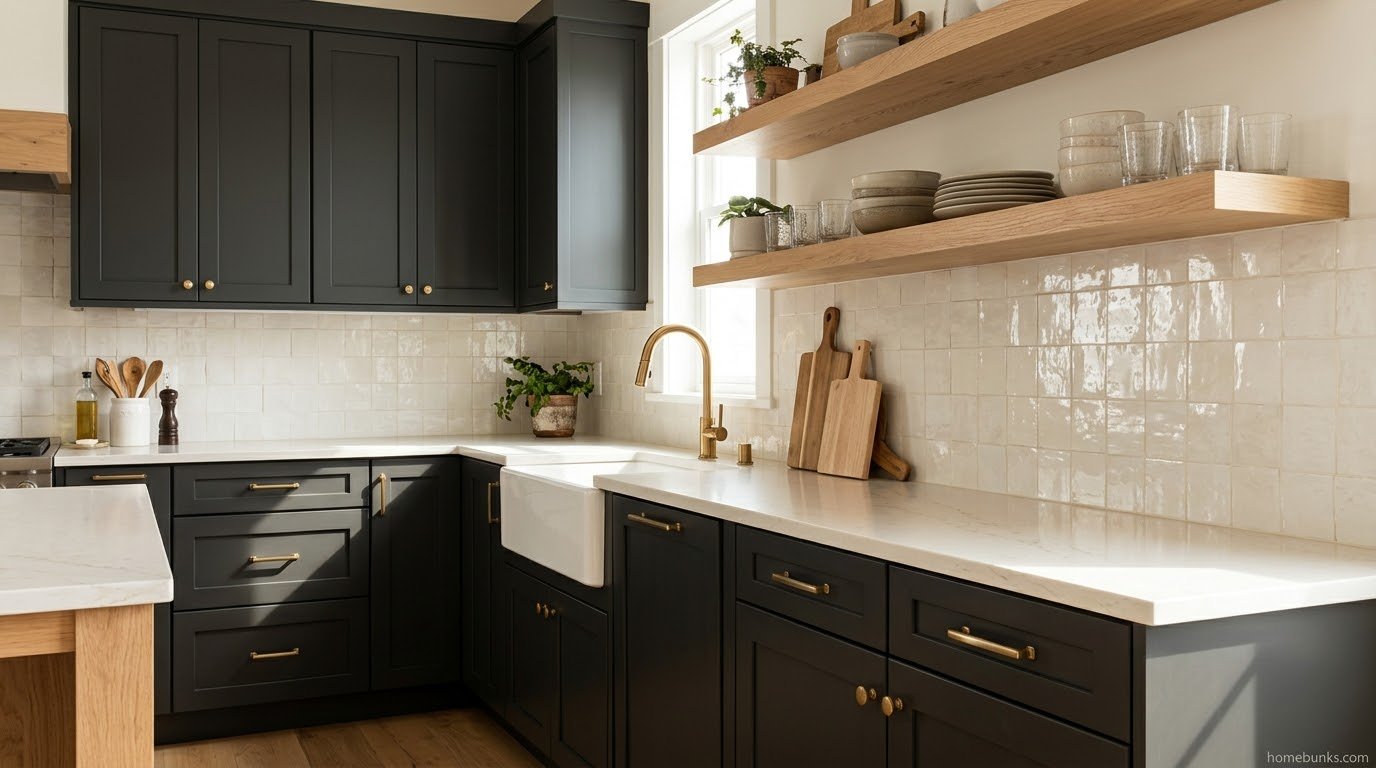
Black hides dark dirt. Stains, grease smears, scorch marks, and minor dings blend into the ground and disappear from casual view.
Black shows light dirt. Dust, flour, salt, and dried water spots sit on the dark surface like chalk on a blackboard.
That single split explains every contradictory review you will ever read. The happy owners cook dark messes; the unhappy ones bake with flour.
Fingerprints are a separate question, decided by sheen and finish, not by color. Gloss prints at a touch; engineered matte resists; satin sits between.
Black is not harder to clean than white. It is more visibly in need of cleaning, sooner, for light colored mess. Budget the wiping, not the scrubbing.
Decision One: The Light Budget
Black surfaces absorb light instead of bouncing it around the room. A black kitchen needs measurably more light than a white one to feel equally bright.
The pro guide at Archziner puts it bluntly: black surfaces are eating the light you pour into the room. One central ceiling fixture is the classic cave mistake.
Plan three layers before you choose anything else. Ceiling ambient light, under cabinet task light at the counters, and pendants or accents for warmth.
Then apply the suitability rule stated cleanly by the cabinet guide at Lily Ann Cabinets. Black works if the kitchen has enough light and at least one light surface.
The light surface can be the counter, the backsplash, the walls, or the floor. One is the minimum; two is comfortable.
If your kitchen fails both tests today, fix the light first or choose a two tone layout. No paint choice can outrun a dark room.
Decision Two: Depth, the Paint Ladder
True black sits at an LRV of roughly 3 to 4. It absorbs almost all light and gives the sharpest, most graphic contrast.
Off black sits at roughly LRV 5 to 10. It carries a visible undertone, keeps depth in shadowed corners, and forgives dust and dim light better.
The taxonomy and maker page data are laid out in the tested guide at Facade Colorizer. A sprayed satin door also reads one to two points darker than the chip.
|
Paint |
Brand and number |
LRV (published range) |
Character |
Best use |
|---|---|---|---|---|
|
Tricorn Black |
Sherwin Williams 6258 |
about 2.5 to 3 |
near neutral true black |
graphic, modern, high contrast |
|
Onyx |
Benjamin Moore 2133-10 |
about 2.9 to 5 |
clean true black |
classic black cabinetry |
|
Inkwell |
Benjamin Moore |
4 |
blue gray undertone |
cool, tailored kitchens |
|
Iron Ore |
Sherwin Williams 7069 |
about 5.5 to 6 |
warm green brown off black |
modern farmhouse default |
|
Peppercorn |
Sherwin Williams 7674 |
about 9.7 to 10 |
soft charcoal black |
islands, dust forgiving depth |
Tricorn Black SW 6258 is the crispest black in the group. Sources print its LRV as 2.45, 2.849, and 3, so this page gives the honest range: about 2.5 to 3.
A Sherwin Williams color director has called it the brand’s blackest black, as quoted in the consultant guide at Paint Color Consultants. Choose it when you want black to just be black.
Iron Ore SW 7069 is the forgiving default. Its green brown warmth keeps it from going cold, and it pairs naturally with white oak, brass, and creamy whites.
Onyx 2133-10 is Benjamin Moore’s clean true black. Published LRVs disagree, about 2.9 in some sources and about 5 in others, so judge it by a sample door, not a decimal.
Peppercorn SW 7674 is the strategist’s pick for islands. As a soft charcoal with balanced RGB, it shows dust less than true black while still reading dark and deliberate.
Inkwell leans blue gray. It suits cool, tailored kitchens and stainless heavy schemes where a warm black would argue.
Decision Three: Sheen
Sheen is measured in degrees, and you can specify it. Zero is dead flat; high numbers are gloss.
The pro guidance is specific: about 20 degrees gives a rich satin matte that cleans far more easily than a true flat. A 0 degree finish is described as a smudge nightmare.
Gloss reflects light and can truly brighten a dim room. The price is total honesty: every touch, scratch, and water spot is on display.
Plain matte paint sits between the marketing and the complaints. It forgives more than gloss, less than its reputation, unless it is engineered fingerprint resistant.
Soft touch and fingerprint resistant matte finishes exist for exactly this problem. If you want matte, specify those words to your cabinet maker.
For most working kitchens the answer is satin, around 20 degrees, or an engineered matte. Save gloss for low traffic, high drama rooms.
Construction and Finish: The Buyer Layer
The finish system matters more than the color name. The industry standard for quality cabinets is conversion varnish, a catalyzed finish sprayed in a booth.
It cures chemically into a hard, non porous surface. It resists scratches, water, and kitchen chemicals, and its sheen is dialed in precisely, which is how the 20 degree target is hit.
Ask about door material before you sign. Pros favor MDF for painted doors: stable, joint free, and smooth, with no grain to show through.
Solid wood shaker doors move with the seasons. On black, the resulting hairline cracks at the joints stand out starkly, because the pale crack line crosses a black field.
Oak grain telegraphs through paint, creating texture you did not order, and heavy grain finishes chip early around the knobs. If you love oak, consider black stained instead, with the grain showing on purpose.
Five questions for any cabinet maker: What finish system? What sheen in degrees? MDF or wood doors? Is the matte fingerprint resistant? What is the touch up provision?
Layouts That Work
Full Black
All cabinets black is the boldest version, and it belongs in rooms with light to spare. Keep counters or backsplash light, and layer the lighting as planned.
In a full black kitchen, separate surfaces by sheen and texture. Matte cabinets, honed stone, and a glossy tile backsplash read as three materials, not one mass.
Two Tone
Black lowers with light uppers grounds the room and keeps the eye level bright. It is the default recommendation for average light.
The reverse, black uppers, is the advanced version. It needs tall ceilings and strong light, or the top of the room feels like a lid.
Black Island Only
A black island in a light kitchen delivers most of the drama at a fraction of the light cost. Peppercorn’s dust forgiveness was practically designed for this job.
Black Lowers, Open Shelves
Skip the uppers and run white oak open shelving over black lowers. The room keeps its drama and loses the mass that closes kitchens in.
The shelves add the warm material black loves. Keep them edited: everyday dishes and glass, not storage overflow.
Small Black Kitchens: The Balance Playbook
Small kitchens fail with black for predictable reasons: one light source, no light surface, true black everywhere. Fix those three and small works.
Use an off black (Iron Ore depth) instead of true black. Its extra reflectance points are worth real brightness at small scale.
Put the black on the lowers or the island, keep counters pale, and light the counters from under the shelves or uppers. That task layer does more than any paint trick.
Gloss is tempting for brightness in small rooms, and it does reflect light. Weigh it against the fingerprint reality of a small, busy kitchen before you commit.
Mirrors and glass front doors help at the margins. The levers that matter are depth, distribution, and light, in that order, every single time.
Counters, Backsplash, Hardware, and Floors
Light counters are the classic partner: white quartz, marble looks, and butcher block supply the required light surface where work happens.
Black counters create the monochrome version. Honed granite and soapstone keep it soft; separate cabinet and counter by finish, matte against honed, so the eye can read both.
The backsplash is your cheapest light surface. White tile, marble, or zellige with its varied glaze bounces light and texture into the room’s center.
Hardware sets the temperature. Brass and gold glow on black and lead most requests; chrome cools; black hardware disappears for the monochrome read.
Floors should usually run light to mid. White oak under black cabinets is the modern farmhouse engine; dark floors under black cabinets demand exceptional light.
If black feels like too much commitment, the same drama exists in softer form in the navy blue kitchen ideas. Navy is black’s nearest neighbor with more forgiveness in dim rooms.
For the opposite direction entirely, the cream kitchen ideas show the light version of a warm, layered kitchen. Many real kitchens land between the poles, black below and cream above.
Black by Style
Modern Black
Slab doors, true black, integrated appliances, and one sculptural light. Restraint in materials, total commitment to the color.
Farmhouse Black
Shaker doors in Iron Ore depth, a farmhouse sink, wood shelves, and brass. This is the dialect that made black mainstream.
If farmhouse warmth appeals more than black’s edge, the cream and warm wood kitchen ideas carry the same wood forward without the dark cabinetry.
Traditional Black
Raised panel or shaker doors, marble counters, crown molding, and brass. Black reads classic, not trendy, when the architecture is formal.
The Green Alternative
Some readers want black’s depth with a hue. The sage green kitchen ideas and the deeper olive green kitchen ideas both deliver grounded, light hungry color with a softer edge.
The Cleaning Routine for Black Cabinets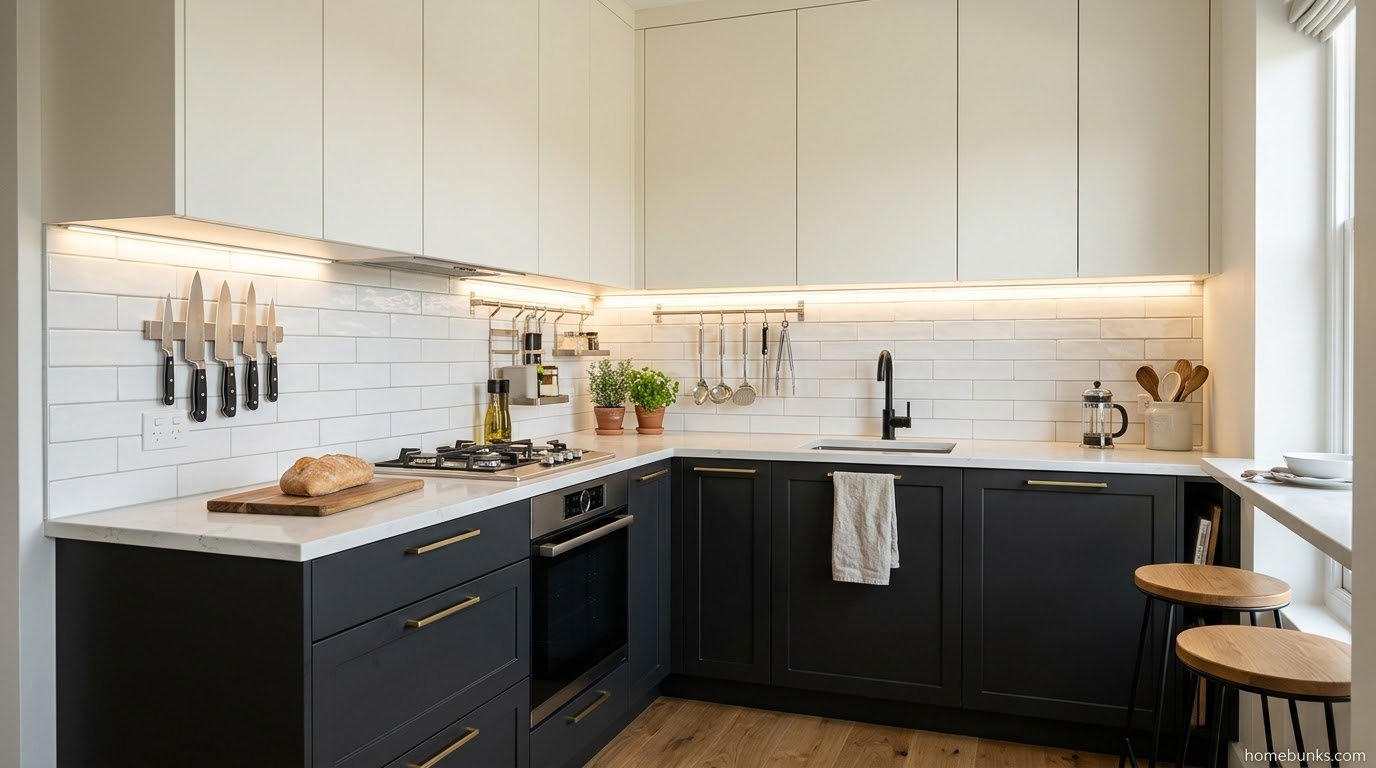
Clean black with a microfiber cloth and mild cleaner. Warm water with a little dish soap is the standard recipe; one cabinet guide adds a splash of white vinegar.
Wipe water spots promptly around the sink and dishwasher. Dried droplets are light dirt, and on black they are the whole complaint.
Avoid abrasive pads and harsh chemicals, which dull finishes unevenly. On matte, also avoid shine adding polishes, which create glossy patches.
Dust with a dry microfiber between cleans. Thirty seconds per run of cabinets keeps the light dirt from ever becoming the story.
Build the wipe into an existing habit: while the kettle boils, while the dishwasher runs, while coffee brews. Black kitchens stay beautiful in households where the cloth is part of a ritual, not a rescue.
Keep the touch up kit from installation day: the exact paint or finish, a fine brush, and the sheen noted. Chips on black show the pale beneath, so speed matters.
Budget Entries Into Black
Paint the island in a quality satin cabinet paint. Add brass or black hardware across the room, and the kitchen reads intentionally black for a fraction of a remodel.
Paint only the lowers if the island route is not available. The two tone effect arrives with half the paint and all of the grounding.
Swap the faucet and pendants to matte black. Hardware scale black is small, but at eye and hand level it registers everywhere.
Live with the accents for a season. If you still want the full treatment, you have tested your light and your tolerance honestly, in your own kitchen, with your own cooking, which is the only test whose results you should fully trust.
The Dirt Table
Keep this where you plan. It is the paradox, itemized.
|
Dirt type |
On black |
On white |
Winner |
|---|---|---|---|
|
Grease smears and cooking stains |
blends in |
shows clearly |
black |
|
Minor dings and scuffs |
hides well |
shows |
black |
|
Dust |
shows quickly |
hides |
white |
|
Flour, salt, powdered sugar |
shows like chalk |
hides |
white |
|
Dried water spots |
shows |
hides |
white |
|
Fingerprints |
depends on sheen |
depends on sheen |
satin, either color |
Read the table by your cooking, not by averages. A household that fries nightly and never bakes lives in the top rows.
A baking household with a dusty street outside lives in the bottom rows. The right color follows the mess you actually make.
The Sheen Ladder
|
Sheen |
Degrees (approx.) |
Fingerprints |
Cleaning |
Best for |
|---|---|---|---|---|
|
Flat matte |
0 to 5 |
smudges unless engineered |
hardest |
showpiece, low traffic |
|
Satin matte |
about 20 |
moderate, manageable |
easiest of the mattes |
working family kitchens |
|
Eggshell to satin gloss |
30 to 45 |
shows more |
wipes fast |
balanced light rooms |
|
High gloss |
60 plus |
shows everything |
wipes fast, buffs often |
dramatic, low traffic |
The ladder’s lesson is that satin is not a compromise, it is the engineered answer. It keeps the matte look at conversational distance and behaves at the sink.
Ask for the degree number when you order. A maker who cannot state it is guessing with your money.
Three Worked Schemes
Scheme One: The Farmhouse Standard
Iron Ore shaker cabinets throughout, white quartz counters, a light zellige backsplash, and brass hardware. White oak shelves replace two uppers.
Light audit: counters and backsplash light, floors mid oak, three lighting layers. This is the scheme that made black safe for the suburbs.
Scheme Two: The Graphic Modern
Tricorn Black slab cabinets, honed black stone counters, stainless appliances, and a white ceiling and floor. Surfaces separate by finish, not color.
This scheme needs the strongest light plan of the three. It rewards it with the sharpest photographs in the cluster.
Scheme Three: The Small Kitchen Save
Peppercorn island, cream perimeter cabinets in the spirit of the cream and warm wood scheme, under shelf lighting, and pale counters throughout.
The black is one deliberate note. The room keeps its brightness and gains a grounded center that stools and pendants can play against.
Black in Open Plan Kitchens
Open plan is black’s best habitat. Large combined spaces can feel unanchored in pale colors; a black kitchen zone gives the whole floor a center of gravity.
Keep the living zone’s textiles warm and mid toned so the transition reads as a gradient, not a border. Repeat the hardware metal in the living zone once.
Sight lines matter: from the sofa you will see the kitchen’s lit counters and shelves more than its cabinet color. Style those surfaces like furniture.
Sampling Black: The Door Test
Never choose a black from a paper chip. Blacks diverge in real light, and small samples hide undertone completely.
Paint or order one full door in each finalist, at the final sheen. Stand them where the cabinets will live for two full days.
Read them at breakfast, at noon, and under your evening lights. Note which one holds its character and which one turns blue, brown, or flat.
Check the finalists against your counter and floor samples in the same light. The trio will spend decades together; introduce them properly.
Keep the winning door. It becomes your touch up reference and the color standard for any future additions.
Black Appliances and Fixtures
Matte black appliances complete the monochrome version and hide their own light dirt no better and no worse than the cabinets. Treat them as one more black surface in the light budget.
Stainless is the classic contrast and the practical middle: it bounces light and breaks the mass. Black stainless sits between the two reads.
The faucet and hood are the fixtures with presence. A black hood over black cabinets disappears; in stainless or plaster it becomes the room’s sculpture.
Sinks follow the same logic. A white apron sink is a light surface and a farmhouse signal in one object; a black sink doubles down on mood.
The Three Decisions, Summarized
|
Decision |
Question |
Default answer |
|---|---|---|
|
Light budget |
Can the room fund layered light and one light surface? |
If not, go two tone or island only |
|
Depth |
True black or off black? |
Off black for most homes; true black for graphic, bright rooms |
|
Sheen |
Which degree? |
Satin about 20 degrees, or fingerprint resistant matte |
|
Then |
Which paint name? |
The ladder member matching the three answers above |
Print this table on the project folder. Every later argument about handles and pendants gets easier once the top three rows are settled.
Notice what the table does to shopping. It turns a hundred product decisions into four, and three of them are about your room, not the store.
Black With Kids and Pets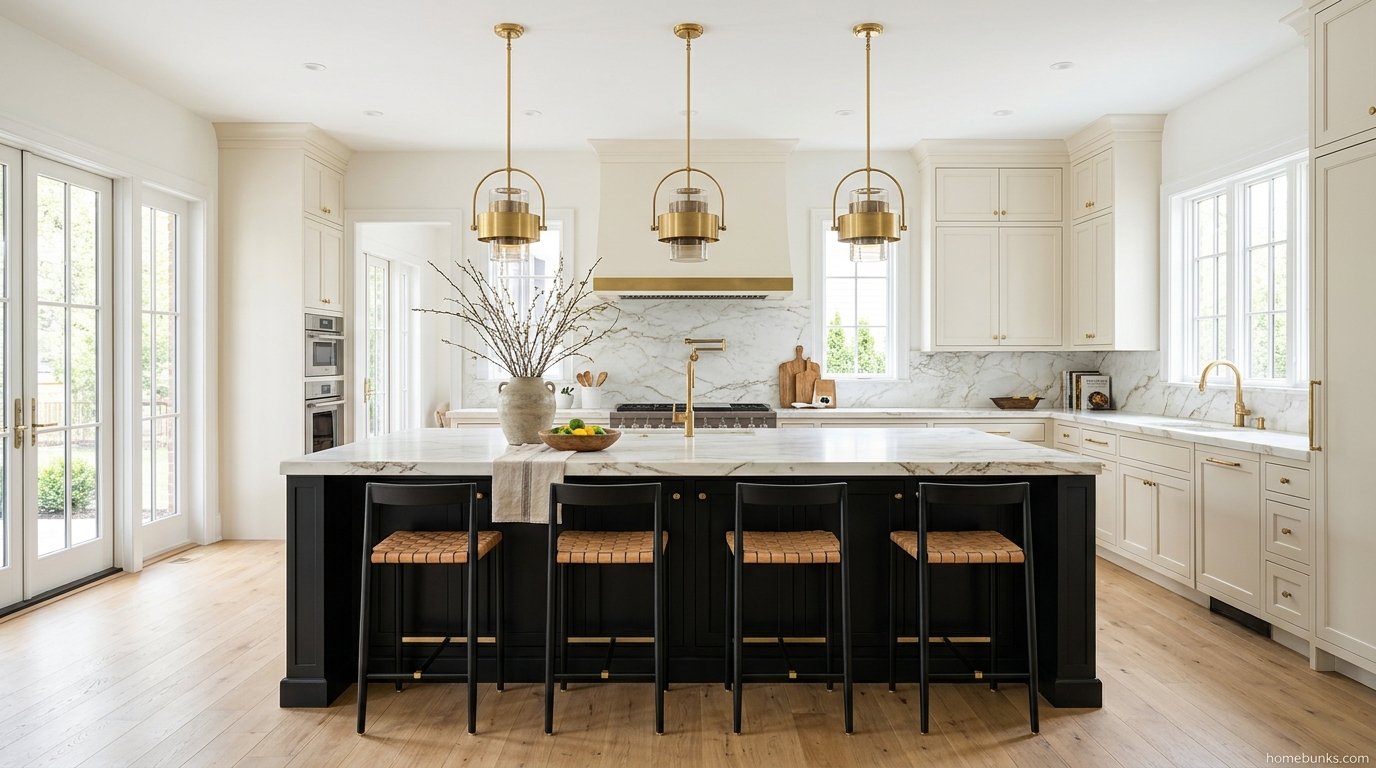
Black’s paradox cuts in a family’s favor more often than expected. The daily evidence of children is mostly dark: crumbs of the brown kind, sticky smears, scuffs from toys.
The light dirt children produce is chalk, flour, and craft dust, and it wipes in seconds. Pet hair splits by the pet: dark hair vanishes, pale hair announces itself.
Choose satin for the family version, keep soft close hinges to prevent slam chips, and store the touch up kit where you can reach it without a ladder.
Lowers take the abuse in every kitchen. If your budget allows one upgrade, spend it on the lowers’ finish quality and keep uppers simpler.
Resale and Photography
Black kitchens photograph dramatically, which is why listings love them. The same drama at a dim evening viewing reads as a cave, which is why the light plan is a resale feature, not a luxury.
If resale is near, put black in the reversible positions: island, lowers, hardware, and lighting. A buyer who dislikes black inherits a weekend project, not a remodel.
Keep the paint and finish records with the house documents. A named black with a known sheen is a feature a buyer can maintain; a mystery black is a liability.
Stage a black kitchen with light textiles and one green plant. The photographs gain scale, life, and the contrast the algorithm rewards.
Mistakes to Avoid
- Choosing the paint first. Light, depth, and sheen come before the name. Reverse order is how caves happen.
- One ceiling light. Black eats light. Without layers, no depth choice will save the room.
- Dead flat matte on a family kitchen. Zero degree finishes smudge at a touch. Specify satin or fingerprint resistant.
- Painting heavy oak and expecting glass smooth. Grain telegraphs. Stain it black or choose different doors.
- No light surface. Counters, backsplash, walls, floor: keep at least one light, two if the room is small.
- Trusting a single LRV decimal. Famous blacks are published with different LRVs by different sources. Sample the door.
How to Start Your Black Kitchen
Audit your light this week: count fixtures, note the windows, and name your light surfaces. That audit decides how much black your kitchen can carry.
Pick your depth from the ladder and your sheen from the degrees. Then, and only then, fall in love with a paint name.
Run the door test before any order is placed. Two days of watching one black door in your own light will teach you more than a month of reading, including every word on this page.
Finally, photograph the finished room at three times of day and keep the set. Those photographs are your baseline for judging light changes, bulb replacements, and every future refresh the kitchen ever needs.
If you are planning the wider home, the kitchen cluster at HomeBunks holds the color family together. Black is the deepest voice in that choir, and it should be placed like one.
Frequently Asked Questions
Are black kitchen cabinets a good idea?
Yes, when two conditions hold: the kitchen has enough light and at least one light surface among walls, counters, backsplash, and floor. Meet both and black reads dramatic, not dark.
Do black cabinets show fingerprints?
It depends on sheen and finish, which is why advice contradicts itself. Gloss shows every touch; plain flat matte can smudge badly; a satin or fingerprint resistant matte is the practical middle.
Do black cabinets show dust?
Yes. Black hides dark dirt (stains, grease smears, dings) but shows light dirt: dust, flour, and dried water spots stand out on the dark ground. It is not harder to clean, just more visibly in need of it.
Matte or glossy black cabinets: which is better?
Matte and satin forgive daily life; gloss reflects light and can brighten a dim room but shows scratches, touches, and spots. Busy family kitchens lean matte or satin; gloss is a low traffic choice.
What is the best sheen for black cabinets?
Pro guidance points to satin, around a 20 degree sheen: rich and matte looking, but far easier to clean than a true flat 0 degree finish, which smudges at a touch. Ask your cabinet maker for the sheen in degrees.
What is the best black paint color for kitchen cabinets?
For a true black, Tricorn Black SW 6258 or Benjamin Moore Onyx. For a forgiving off black, Iron Ore SW 7069 is the modern farmhouse default. Match the choice to your light and countertop contrast.
What is the LRV of Tricorn Black?
Sources place it at about 2.5 to 3: one consultant source gives 2.45, the maker’s page figure is quoted as 2.849, and tables round to 3. All agree it is near the bottom of the scale and absorbs almost all light.
Tricorn Black vs Iron Ore: which for cabinets?
Tricorn is the crisp, near neutral true black (LRV about 3) for graphic contrast. Iron Ore (LRV about 6) is a warm green brown off black that forgives more and pairs with white oak and brass. Severity vs softness is the choice.
What about Benjamin Moore Onyx for cabinets?
Onyx 2133-10 is BM’s clean true black. Published LRVs disagree, about 2.9 in some sources and about 5 in others, so treat it as a true black and judge by the sample door, not the decimal.
Is Iron Ore black or charcoal?
Iron Ore reads black on cabinets in most light, but it is technically a soft charcoal black (LRV about 6) with a subtle green undertone. That softness is exactly why it rarely feels severe.
Will black cabinets make my kitchen look smaller?
They can in a small, dim kitchen. The counters are light surfaces, two tone distribution, open shelving instead of some uppers, and layered lighting. With those, even small kitchens carry black well.
Can I do black cabinets in a small kitchen?
Yes, with the balance rules: black lowers or a black island, light counters and backsplash, and under cabinet lighting. A small all black kitchen with one ceiling light is the version that feels like a cave.
What countertops go with black cabinets?
Light counters (white quartz, marble looks, butcher block) for contrast, or honed black stone and soapstone for a monochrome mood. In all black schemes, let texture and sheen separate the surfaces.
What backsplash works with black cabinets?
A light backsplash is the classic partner: white tile, zellige with its varied glaze, or marble. It supplies the required light surface right where work happens. Dark backsplashes suit large, bright kitchens.
What hardware looks best on black cabinets?
Brass and gold glow against black and are the most requested pairing. Chrome cools it, and black hardware disappears for a monochrome look. All three work; the choice sets the temperature.
What floors go with black cabinets?
Light and mid woods (white oak first) warm and lift black cabinetry. Dark floors with black cabinets need strong light and a light counter to avoid a floor to ceiling cave.
How much light does a black kitchen need?
More than a white one: black surfaces absorb light instead of bouncing it. Plan three layers: ceiling ambient, under cabinet task light, and pendants or accents. One central fixture is the classic cave mistake.
How do I clean black kitchen cabinets?
Use a microfiber cloth with mild cleaner (a little dish soap in warm water works; one guide adds white vinegar). Wipe water spots promptly near the sink, and avoid abrasives and shine adding products on matte finishes.
Are black cabinets hard to maintain?
They ask for more frequent wiping, not harder cleaning. Dust and spots show sooner, so the cloth comes out more often. Satin and fingerprint resistant finishes cut the frequency most.
Should I paint my existing cabinets black?
You can, with honest preparation. The pro warnings: solid wood shaker doors can develop hairline cracks at the joints that show starkly on black, and oak grain telegraphs through paint. A sprayed, durable finish matters more than the color.
What is the best material for painted black cabinet doors?
Pros favor MDF for painted doors: it is stable, has no moving joints, and no grain to telegraph, so the finish stays smooth. Solid wood looks premium but its joints move with seasons.
What finish do professional black cabinets use?
The industry standard is conversion varnish, a catalyzed finish sprayed in a booth. It cures chemically into a hard, non porous surface resistant to scratches, water, and kitchen chemicals, with the sheen dialed in precisely.
Will black paint chip on cabinets?
Any painted cabinet can chip, and on black a chip shows the pale material beneath starkly. Durable finishes, soft close hardware, and a kept touch up kit from day one are the management plan.
Are black cabinets timeless or a fad?
Black casework predates the current wave, and shaker black behaves like a classic. What dates fastest is glossy, trend heavy execution. Matte and satin black in classic door styles have the longest style life.
Do black cabinets hurt resale value?
A balanced black kitchen (light surfaces, good light) photographs dramatically and reads high end. An under lit all black kitchen is the resale risk. When in doubt, put black on the island or lowers only.
What is a two tone black kitchen?
Black on part of the cabinetry, light on the rest: classically black lowers with white uppers, or a black island in a light kitchen. It delivers the drama with half the light cost.
Can I do black uppers instead of lowers?
You can, but it is the advanced version: dark uppers weigh the top of the room. It works with tall ceilings, strong light, and pale lowers and counters. Most kitchens prefer the grounded version, black below.
Black cabinets with no upper cabinets: does that work?
Very well. Black lowers with open wood shelving above keeps the drama and removes the mass that closes rooms in. The shelves also add the warm material black loves.
What wall color goes with black cabinets?
Warm whites and pale neutrals keep the contrast soft; the creamy whites recommended beside Iron Ore are the model. Pure blue white can read cold against warm off blacks.
Do black appliances work in a black kitchen?
Yes, for the monochrome version; stainless is the classic contrast. In an all black scheme, separate surfaces by sheen and texture so appliances, cabinets, and counters do not merge into one mass.
What lighting color temperature suits a black kitchen?
Warm to neutral light (about 3000K) flatters black and wood. Very cool light can make warm off blacks read muddy, and dim warm light deepens the cave. Brightness matters more than temperature: layer it.
How do I add black to my kitchen without new cabinets?
Use black as the accent carrier: paint the island, swap hardware and faucet to matte black, add black pendants and stools. You get the graphic note with full reversibility.
Black kitchen or white kitchen: which is easier to live with?
White hides light dirt and shows dark dirt; black does the reverse. White forgives dim rooms; black forgives stains and dings. Choose by your room’s light and your household’s actual mess, not by photos.
What is the difference between true black and off black cabinets?
True black sits at LRV about 3 to 4, absorbs almost all light, and gives the sharpest contrast. Off black (LRV about 5 to 10) carries an undertone, keeps depth in shadow, and forgives dust and light better.
Does black show scratches?
On gloss, yes, every one. On satin and matte, scratches are far less visible, and black hides minor dings better than light cabinets. The finish choice is the scratch policy.
Can black cabinets work in a farmhouse kitchen?
Black shaker cabinets with wood, brass, and a farmhouse sink are a farmhouse staple. Iron Ore is literally called the modern farmhouse default in paint guidance.
Can black cabinets work in a traditional kitchen?
Yes. Raised panel or shaker doors in black with marble and brass read classic, not trendy. Traditional rooms should keep crown and light counters to hold the formality.
What is the cheapest way to get a black kitchen?
Paint the island or the lowers with a quality cabinet paint in satin, and swap hardware to brass or black. That is the full effect for a fraction of a remodel, and it is reversible.
How much does it cost to add lighting for a black kitchen?
One pro source prices professional recessed light installation at 150 to 300 dollars per light (a tradesperson’s figure, treat as dated guidance). Under cabinet strips are the cheapest high impact layer.
Will a black kitchen date quickly?
The color will not; executions date. Slab gloss with trend hardware dates fastest. Shaker or classic doors in satin black with stone and brass have decades of precedent behind them.
What should I decide first before choosing black cabinets?
Decide the three choices in order: your light budget (fixtures and light surfaces), your depth (true or off black), and your sheen (satin or fingerprint resistant matte). The paint name is step four, not step one.
Where can I verify a black paint’s LRV?
On the brand’s official color page or data sheet. Roundups disagree on famous colors (Onyx appears at about 2.9 and about 5), so print ranges honestly and let a sample door in your light decide.
Conclusion
Black kitchen ideas succeed when the order is respected: light budget first, depth second, sheen third, and the paint name last of all.
Remember the paradox and the fear dissolves. Black hides the dark messes and shows the light ones, and a satin or fingerprint resistant finish decides how often you reach for the cloth.
Start with the audit and the island if you are unsure. When the room holds its drama at every hour of the day, commit fully, and let black do what it has done in classic kitchens for decades: make everything else glow.
Keep the records with the house: the paint name and number, the sheen in degrees, the finish system, and the touch up kit’s location. A black kitchen that can be maintained exactly is a kitchen that stays expensive looking for as long as you own it.
And when friends repeat the contradiction at your counter, you will know the answer they are missing. It was never about the color. It was always about the dirt, the degree, and the light.


