
Peach bathroom ideas begin with a range, not a color. The peach in one photograph may be a pale tint near LRV 85, and in the next a saturated classic near LRV 31.
Both are honestly called peach. What separates them is depth and undertone, and those two facts decide whether your bathroom glows or turns into a sherbet accident.
The pages ahead give the verified paint ladder first, then the three undertone leans, the light rules, and the grounding trick every pastel room needs.
Peach Is a Family, Not a Color
Peach is a tint of orange softened toward pink. Pantone describes its Peach Fuzz shade as a hue nestled between pink and orange, and the whole family lives in that in between.
That is why peach feels warm without weight. It brings the glow of orange at a fraction of the commitment, which is exactly what small, window shy bathrooms need.
In December 2023, Pantone named Peach Fuzz, 13-1023, its Color of the Year for 2024. The announcement put peach back on every paint deck in the industry.
Sherwin-Williams even sells a paint named Peach Fuzz, SW 6344, at about LRV 66. When a paint brand borrows the trend name, the color has fully arrived.
But the family is old, not new. Peach was a fixture era classic mid century and a saturation moment in the 1980s, and its current return runs on muted versions.
Every peach leans one of three ways: pink, orange, or golden. That lean is its undertone, and it matters more than the name on the can, as the ladder shows.
On the cluster’s warmth scale, peach sits in a useful gap: warmer and more personal than cream, softer and less committing than terracotta, and friendlier in dim rooms than either pink or beige.
That middle position is why peach keeps being rediscovered. Each generation finds the same fact: this is the tint that gives a bathroom color without taking its light away.
The Verified Peach Paint Ladder
Peach spans about 56 LRV points, the widest range of any color in this cluster. AweDeco’s peach interior reference sets the two Sherwin-Williams anchors side by side, and the gap is the lesson.
Nearly Peach and Sumptuous Peach share a family name and sit more than 21 LRV points apart. A name tells you the family; the code and LRV tell you the color.
|
Color |
Brand and code |
LRV |
Role in the bathroom |
|---|---|---|---|
|
Sun Kissed Peach |
Benjamin Moore |
85.41 |
A warm tinted white for the palest walls |
|
Peach Rose |
Behr HDC-CT-12 |
About 80 |
Pale peachy pink, cabinetry or accent walls |
|
Peach Nectar |
Benjamin Moore 2168-60 |
About 78 |
Pale peach with a drop of pink |
|
Nearly Peach |
Sherwin-Williams SW 6336 |
75.07 |
The pale wall standard, filed under whites and pastels |
|
Peach Blossom |
Sherwin-Williams SW 6624 |
67.5 |
Light warm peach for walls |
|
Naive Peach |
Sherwin-Williams SW 6631 |
About 69 |
Reads like a warm off white |
|
Certain Peach |
Sherwin-Williams SW 6625 |
58.11 |
Light warm peach with real presence |
|
Sumptuous Peach |
Sherwin-Williams SW 6345 |
53.54 |
The mid peach for full walls with light |
|
Georgetown Pink Beige |
Benjamin Moore, historic deck |
55 |
A peachy pink beige with historic depth |
|
Peaches ‘n Cream |
Benjamin Moore |
30.88 |
The saturated end, accents and small rooms |
Values are manufacturer listed, gathered from the brand citing references in the research. Cross brand matches remain approximations; the ladder compares depths, not formulas.
For full bathroom walls, the working zone is roughly LRV 55 to 78. Brighter than that, peach fades toward warm white; deeper, it becomes a statement that needs anchors.
One famous name is missing on purpose: Farrow & Ball Setting Plaster. Published LRV figures for it are estimates only, so it is admired here as a dusty pink peach and given no number.
The Behr Peach Rose color card adds a practical note from Behr’s own guidance: its pale Peach Rose is recommended for bathrooms as an accent wall or cabinetry, with white tile and brass fixtures.
Historic decks hold the family’s character actors. Benjamin Moore’s Galt Peach and Winthrop Peach come from historical pigments, less bright than modern sherbet tones, per the consultant literature.
Use the ladder as a sampling map, not a shopping list. Choose one pale entry, one mid entry, and one in your room’s undertone lean, then judge all three on the wall.
Owners consistently discover the same thing: the shade that wins in the room is one step paler than the shade that won on the screen or the chip rack.
Choose Your Lean: Pink, Orange, or Golden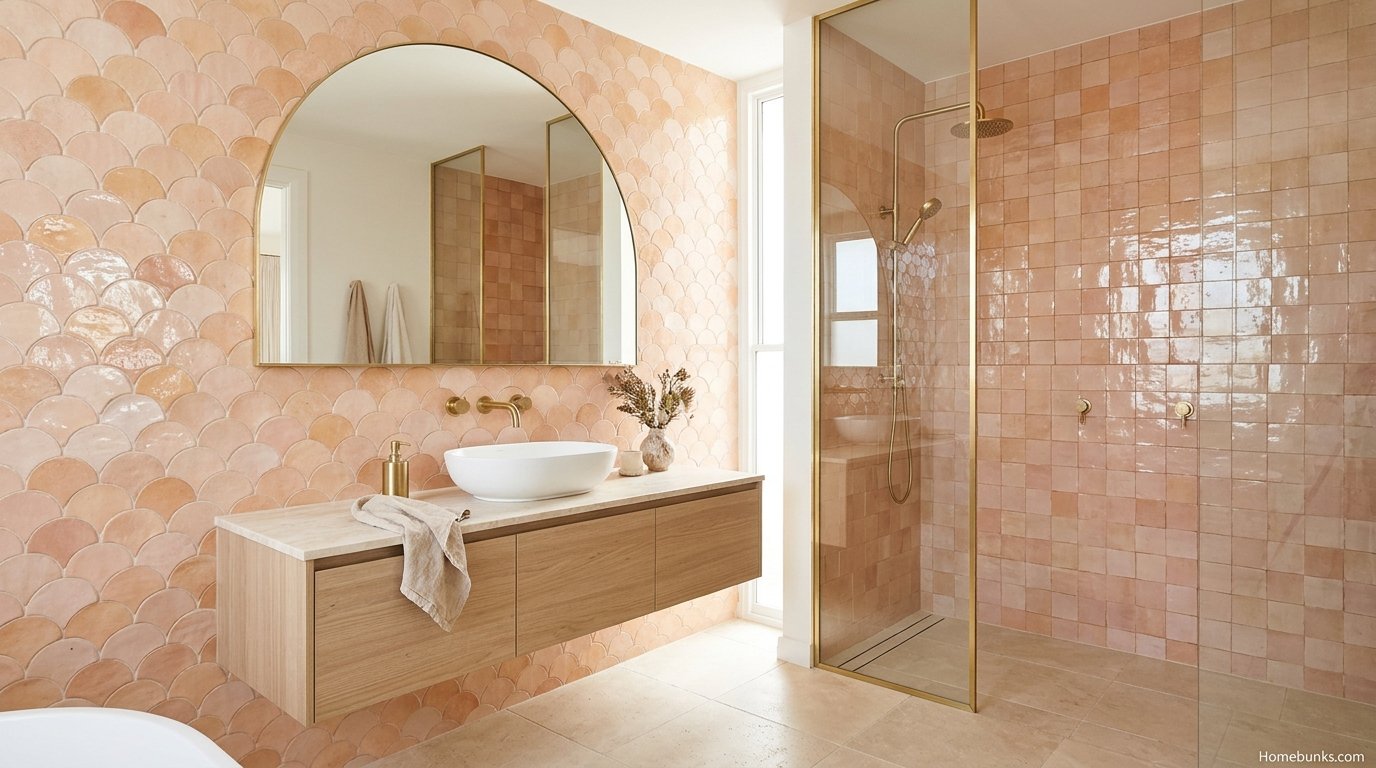
Undertone is the selection method for peach. Decide the lean from the room’s fixed elements, because floors and trim cannot be argued with later.
Pink Leaning Peach
The coolest version of the family. Pink leans sit happily beside marble, white tile and the chrome era fixtures many bathrooms already have.
Peach Nectar is the reference here, described by its maker as a pale peach with a drop of pink. Pink leans keep bright rooms fresh instead of glowing.
Orange Leaning Peach
The true peach of the fruit and the Mediterranean wall. Orange leans want warm whites, natural wood and brass around them, and they repay with glow.
They are also the leans that can tip too orange under strong light or beside yellow toned floors. Sample these at full wall scale before committing.
Golden Leaning Peach
Yellow pushes peach toward apricot and candlelight. Golden leans are the north facing room’s friend, restoring warmth the light withholds.
In south facing rooms they are the risk lean: warm sun intensifies them further, and the room can glow past intention by midday.
Light Decides: North, South, and Evening
Pastel guidance is blunt on this point: pastels shift dramatically between natural and artificial light, more than any other color family. Peach is the most light sensitive color in this cluster.
The Creatives Hour’s pastel bathroom guide builds its whole pastel method on testing in the actual bathroom light before committing, and peach is the reason the rule exists.
North light cools and grays the room. Peach answers with warmth, and the golden and orange leans earn their keep here at mid ladder depths, roughly LRV 55 to 70.
South light does the opposite: it intensifies peach and pushes it golden, per paint guidance gathered in the color references. Bright rooms take paler, pinker or more muted versions.
Evening light is the trap. Warm bulbs flatter most peaches, but a certified color consultant records that Winthrop Peach falls flat and reads almost brown under warm artificial light.
The moral is procedural, not poetic: sample at night. A peach approved only at noon has been approved for half its working life.
Bulbs are a color decision here. Warm 2700 to 3000K light keeps peach glowing; cool bulbs gray it exactly the way they gray every warm color.
The Grounding Rule for Pastel Rooms
Every successful pastel bathroom has one grounding element, a piece with enough visual weight to keep the softness from floating away. This is the pastel guide’s central rule.
The named options are practical: a dark wood vanity, a patterned floor tile, a piece of art in a dark frame, or matte black hardware across the room.
Peach without an anchor reads as sweetness without structure, the nursery effect owners fear. The same peach with a walnut vanity and black taps reads as a spa.
The checkerboard floor is the retro anchor of the family. Black and white geometry under peach walls is a documented classic, and it costs no more than plain tile.
Sophistication has an undertone address too: pastels with gray or brown in them read grown up, while clear, sweet pastels read juvenile at any price.
Choose the anchor before the paint. It is much easier to pick a peach that suits a walnut vanity than to find a vanity that rescues a floating room.
Match the anchor to the room’s job. Powder rooms take the dark framed mirror or art, guest baths take the patterned floor, and primary baths take the dark wood vanity.
Small rooms need the anchor at eye level or below. A heavy element overhead, like a dark ceiling, presses a pastel room down instead of composing it.
Pairings That Work, Pairings That Fight
AweDeco’s peach pairing reference organizes peach partners by undertone, and the bathroom version of the table is simple enough to memorize.
Warm neutrals first. Cream, warm white and warm gray carry peach without competing. Cream bathroom ideas is the softest landing, and warm beige bathroom ideas adds the beige depth for wood heavy rooms.
Greens are the designer partners. Sage green bathroom ideas is the classic pairing, soft against soft, and green and gold bathroom ideas shows the brass warmth that completes both colors.
Pink and green bathroom ideas is peach’s pastel sibling: the two share the warm pink register, with green supplying the cool balance peach cannot give itself.
Terracotta is the tonal depth. Terracotta bathroom ideas is peach’s deep, browned relative, one hue at two depths, and color references list the clay family among peach’s best partners.
Cool contrasts, used once. Dusty blue and navy anchor peach the way black does, with more color. Blue and white bathroom ideas shows the blue family’s bathroom manners; borrow its discipline, deepen the blue.
Emerald is the bold exception. Emerald green bathroom ideas against peach is a deliberate, high contrast scheme; it works when peach is pale and the green is confined to one element.
The fights are thermal. Stark icy whites make peach look fleshy, blue grays make it look dirty, and cold gray floors argue with golden leans all day.
Peach Tile: Subway, Fish Scale, Zellige
Tile gives peach permanence and texture, and three shapes carry the family in bathrooms.
Peach subway tile is the proven combination: soft peach in the shower, laid horizontally to make the wall feel wider, balanced by a light floor, per tile combination guides.
Fish scale tile, the mermaid shape, is the feature wall maker. A soft peach fish scale accent wall is the idea tile sources reach for first in this color.
Zellige gives peach depth through its uneven handmade glaze; no flat tile reflects light in as many directions at once. It is the premium route, priced accordingly.
The pastel guide reports zellige around $15 to $25 per square foot and pastel subway tile around $3 to $6, competitor reported US figures to recheck at purchase.
Gloss finishes bounce light and flatter pale peach. Matte finishes calm stronger peaches. Large format polished pastel tile can read clinical, the guide warns, so keep formats human scaled.
Plain white or cream tile is also a strategy: it lets a peach painted wall lead while the wet zones stay neutral, durable and cheap to change later.
Peach also works at backsplash scale: a band of peach tile behind the vanity, or a peach lined shower niche, gives a white bathroom its color with tile permanence and paint level risk.
Peach With Pattern and Pastel Company
Pattern is peach’s organizing tool. Left alone on four walls, the color is a mood; given a pattern to answer, it becomes a scheme.
Soft florals and stripes in textiles are the traditional company, at home in cottage and guest rooms. Keep the pattern’s colors inside the palette: peach, cream, sage, dusty blue.
Terrazzo and checkerboard are the hard surface patterns, covered with the floors. A third family, the pastel grid, belongs to composition rooms where peach shares the wall.
The pastel composition mixes peach with mint, blush, sky or lavender in grid or checkerboard tile. The pattern disciplines the sweetness, and shared muted undertones keep the colors related.
One pastel must lead in any composition. Equal shares of four pastels is the candy shop effect, charming in a child’s bath and exhausting in a primary one.
Curved shapes are the composition’s modern accent: rounded mirrors, arched niches and oval forms soften the grid and keep a pastel room from reading flat.
Half Walls, Wainscot and Color Capping
The half wall is peach’s classic architecture: color below, warm white above, with the line set by a chair rail, a tile border or the wainscot itself.
It solves two problems at once. The lower wall takes the splashes and scuffs in a durable finish, and the upper wall keeps the room’s light at full strength.
Wainscot height is also a dose control: a strong peach that would overwhelm at full height behaves beautifully at half, which makes it the saturated colors’ safest room entry.
Color capping is the current variation: the ceiling painted in a paler version of the wall color, an effect color consultants describe for enveloping small rooms.
For peach, capping works in powder rooms and small guest baths. In large or low rooms, the warm white ceiling remains the better lift.
Set the half wall line by the fixtures, not the tape measure: align it with the vanity backsplash, the mirror’s lower edge, or the tile line it meets.
Floors Under Peach Walls
The floor is where peach usually meets its grounding element, so choose it as an anchor first and a surface second.
Terrazzo is the current classic: its chips pick up peach, cream and warm gray in one material, and it organizes the whole palette underfoot.
Checkerboard is the retro anchor. Black and white bathroom ideas owns the pattern’s logic on this site, and under peach it keeps the sweetness honest and the room composed.
Warm wood and wood look floors ground peach naturally, in the same move as the dark wood vanity. Bathrooms with dark floors covers the deep end of that logic for stronger schemes.
Pale warm stone looks keep spa schemes quiet. The rule across all four: the floor must be warmer or darker than the walls, never colder.
The Dose Ladder: Textiles to Tile
Peach climbs the same commitment ladder as every color in this cluster, and its lower rungs are unusually effective because the color is so flattering.
- Textiles and a curtain. Peach towels, a bath mat and a peach shower curtain bring the color into a neutral bathroom in one afternoon, fully reversible.
- The vanity only. A muted peach vanity against warm white walls gives the room its color at furniture level commitment, the dose Behr’s own guidance suggests.
- One wall or a wainscot. An accent wall behind the vanity, or peach to wainscot height with warm white above, is the weekend paint transformation.
- Full walls. The powder room and guest bath dose, where the glow is the point and the room is small enough to wear it completely.
- Tile. A peach shower, feature wall or floor is the permanent rung, chosen in the muted versions that survive trend cycles.
Renters and the unsure live well on rungs one and two. Owners promoting peach from the powder room to the primary bath usually climb one rung per season.
Powder Rooms and Guest Bathrooms
Peach may be the best powder room color in the entire cluster. It flatters skin in mirror light, welcomes without formality, and gives a tiny room a remembered identity.
The combination guides single out peach and gold for powder rooms specifically. A gold framed mirror, brass fixtures and pale peach walls are the complete recipe.
Mirror over pedestal sink ideas is where the mirror choice lives on this site; in a peach room the frame does double duty as the metallic accent and the grounding glint.
Guest bathrooms run the same logic with hospitality added: warm peach walls tell a guest the room was considered, and the color photographs softly for the listing minded.
Keep the guest dose at paint and textiles. Guests enjoy saturated peach more than owners do, because they leave before the color can tire.
Small Bathrooms and Kids Bathrooms
Pale peach is a small room asset: at LRV 65 and above it returns light like a warm white while still giving the room a color to remember.
The conditions are a white or pale ceiling, one grounding element, and light that has been tested. Without them, pale peach in a dim room reads as beige with ambitions.
Double vanity ideas for small bathrooms fits the small peach bathroom neatly: two sinks, warm wood below, and the walls free to stay soft and bright above the vanity line.
Kids bathrooms are peach’s friendliest brief. The color is cheerful, forgiving of pastel accessories, and able to grow up with black hardware and wood swapped in later.
Keep kids peach on paint and textiles, not tile. The room will be redecorated by taste long before a tiled peach wall is forgiven.
Retro Peach and Colored Fixtures
Peach colored fixtures are a real, current product category: peach toilets and sinks are sold today for powder rooms and deliberate retro bathrooms, per fixture trade sources.
That fact reframes the old bathroom many owners inherit. A peach tub or toilet is not automatically a renovation emergency; it is a styling brief with a known answer.
Colored suites were once the standard upgrade from plain white, and peach sat in the era’s pastel palette beside pink, blue and mint. The fixtures in these rooms were quality porcelain, built to outlast trends.
That build quality is the opportunity: a sound peach suite with modern company reads as curated vintage, the same way a clawfoot tub does in a white bathroom.
Modernize in place with a five move sequence: warm white walls, black or brass hardware, a patterned or checkerboard floor treatment, a modern mirror and light, and wood with woven texture.
Disciplined company makes colored fixtures read as intentional vintage. The same fixtures beside dated everything read as leftover, which is a styling verdict, not a plumbing one.
Small cabin bathroom ideas shares the retro lesson from the rustic side: honest old materials look chosen when everything around them is deliberate and plain.
Modern Peach, Edited Peach
Modern peach keeps the glow and deletes the sweetness. Pale surfaces, flat lines, one metal, and accessories counted on one hand.
A single peach vanity in a white tiled room, or pale peach walls with a terrazzo floor and black taps, is the whole contemporary recipe.
Dopamine decor roundups show gloss peach rooms reading current when shapes stay curved and simple. The color is joyful; the editing is what makes it adult.
This is also the safest tile route: if peach tile worries you, take the modern dose in paint and let the permanent surfaces stay warm neutral.
In a primary bathroom used twice a day, the modern register is also the durable one. Pale peach, warm white, wood and one metal can be lived with for a decade without dating.
Save the saturated and novelty versions for the rooms with shorter visits. Guests and powder room users get the delight; the daily room gets the calm.
Mistakes That Make Peach Look Wrong
- Choosing by name. Two paints called peach can sit 30 LRV points apart. Order by code and LRV, sample by wall.
- No grounding element. Unanchored pastel floats, and floating pastel reads as a nursery at any budget.
- South room, saturated peach. Strong sun pushes peach golden and loud. Pale, pink or muted is the bright room answer.
- Judging at noon only. The historic peach that reads brown under warm bulbs is the standing warning. Test the evening.
- Stark white trim. Icy trim makes peach look fleshy. Warm white is the only trim family this color trusts.
- Peach on every surface. Walls, vanity, towels and curtain in one depth is the sherbet effect. One seat of honor per room.
- Cold gray floors. Blue gray under golden peach is a temperature argument the room loses daily. Warm the gray or change the floor plan.
Frequently Asked Questions
What color is peach, exactly?
Peach is a tint of orange softened toward pink. Pantone describes Peach Fuzz 13-1023 as a hue nestled between pink and orange. Every peach leans pink, orange or golden, and that lean decides what it agrees with.
What is Peach Fuzz and why is it everywhere?
Peach Fuzz is Pantone 13-1023, the Color of the Year for 2024, announced in December 2023. The halo put peach back on paint decks everywhere; Sherwin-Williams even sells a paint named Peach Fuzz, SW 6344, at about LRV 66.
What is the best peach paint color for a bathroom?
There is a ladder, not a winner. Nearly Peach SW 6336 at LRV 75.07 for pale walls, Sumptuous Peach SW 6345 at 53.54 for presence, Peach Nectar 2168-60 at about 78 for a pink lean.
Pick by light and lean, then sample.
What LRV should a peach bathroom paint have?
Peach spans about LRV 31 to 85, the widest band in this color family.
For full bathroom walls the working zone is roughly 55 to 78: bright enough for small rooms, deep enough to still read as peach on the wall.
Which peach undertone should I choose, pink, orange or golden?
Match the lean to the room. Pink leans sit beside cool whites and marble. Orange leans want warm whites, wood and brass. Golden leans glow in north light but turn too golden in strong south light. Floors and trim decide.
What colors go with peach in a bathroom?
Cream, warm white and warm gray as neutrals; sage, olive and mint as greens; dusty blue and navy as contrasts; terracotta as tonal depth; gold and brass as metals. Stark icy whites and blue grays are the friction.
What metal fixtures suit a peach bathroom?
Brushed brass and gold are the classic partners; pastel guidance calls the pairing vintage luxe. Matte black is the modern anchor. Chrome suits only the pink leaning, cooler versions and can look chilly beside golden peach.
Does peach make a small bathroom look bigger?
Mostly yes, when the peach is pale: walls at roughly LRV 65 and up bounce light like a warm white while adding color. Add a white ceiling, decent light and one grounding element so softness reads designed, not washed out.
Is peach a warm or a cool color?
Warm, always: peach is built from orange. Its pink leaning versions feel cooler than its golden ones, which is why two rooms both called peach can feel different in temperature at the mirror.
Can peach look dated or too 1980s?
The saturated 1980s version dates; the color does not. Modern peach is paler, muted, or gray and brown undertoned, paired with black anchors, real wood and patterned floors instead of matching peach everything.
Peach vs blush vs coral: what is the difference?
A spectrum by pink content and saturation. Blush is pinker and paler, peach sits in the middle, and coral pushes toward saturated pink orange, a statement rather than a pastel. Judge by the chip in your light, not the name.
What floor goes with peach walls?
Terrazzo is the current classic, checkerboard the retro anchor, warm wood the natural ground, and pale warm stone the spa choice. Cold gray floors are the risk: peach needs a warm gray, never a blue one, beside it.
What tile works in a peach bathroom?
Peach subway tile in the shower is the proven combination, fish scale tile makes the feature wall, and zellige gives peach depth through its uneven glaze. Gloss finishes bounce light; matte finishes modernize stronger peaches.
Can I use peach in a kids bathroom?
It is one of the friendliest choices: warm, cheerful, and able to grow up with the child, since the same walls accept black hardware and wood later. Keep peach on paint and textiles so the room evolves cheaply.
What ceiling color goes with peach walls?
Warm white, in almost every case: crisp enough to lift the room, warm enough not to fight the walls. Carrying peach onto the ceiling is the enveloping powder room move.
A paler version of the wall color is the fashionable third option.
How do I add peach to a bathroom without painting?
Textiles first: peach towels and a bath mat, then a peach shower curtain, the largest no paint surface in most bathrooms. Add a framed mirror, plants and warm pots.
Peach agrees with cream, warm white and wood already in the room.
What vanity color works with peach walls?
Natural wood grounds it, warm white keeps it fresh, sage green is the designer pairing, and navy is the bold contrast. A peach painted vanity inverts the scheme on neutral walls.
Avoid a second pastel unless the room is a deliberate composition.
Does peach pair with terracotta?
It is the tonal pairing of the moment: terracotta is peach’s deep, browned relative, so the two read as one color at two depths. Keep the depth gap clear; near matching depths side by side look like a mistake.
What lighting suits a peach bathroom?
Warm light, 2700 to 3000K, keeps peach glowing, and pastels shift dramatically between natural and artificial light. One consultant warns some historic peaches read almost brown under warm bulbs, so sample under your evening light.
What about peach in a north facing bathroom?
North light is where peach earns its keep: it supplies warmth without darkening. Golden and orange leans perform best. Choose the ladder’s middle, roughly LRV 55 to 70, so the color survives weak light on dull days.
And in a bright south facing bathroom?
South light intensifies peach and pushes it golden. Answer with a paler peach, a pinker lean, or a more muted version, plus white at the ceiling. Sample at midday; that is when the sherbet effect shows itself.
Is peach good for a guest bathroom or powder room?
It may be the best room for it: peach is famously flattering to skin in mirror light, welcoming without formality, and strong enough to give a tiny room an identity.
Peach and gold in a powder room is a singled out pairing.
What patterns work with peach?
Checkerboard floors, terrazzo chips, fish scale shapes, and soft florals or stripes in textiles. Pastel compositions organize peach with mint and blush by pattern. One grounding element and one patterned element keep the room composed.
How do I keep peach from looking like a nursery?
Choose a muted peach with gray or brown in it, add one grounding element with real weight, and use grown up materials: brass, marble, terrazzo, real wood. Sweetness comes from context, not from the hue itself.
What white trim works with peach walls?
Warm whites, always. A crisp warm white gives peach a bright edge; blue white and icy trims make it look fleshy or dirty. Creamy whites suit golden peaches. Sample trim and wall together, never separately.
Does peach work with marble?
Warm veined and misty marble, yes: soft veining suits pastel walls. Cold blue gray marble fights golden peach the way cold gray floors do. Travertine and warm stone looks are the safer stones throughout this palette.
Can peach work in a modern bathroom?
Yes, the edited version: pale peach surfaces or a single peach vanity, flat lines, matte black or brass hardware, terrazzo or plain floors, no frills. Modern peach is about the glow, not the sweetness.
What is the difference between peach paint names across brands?
Almost nothing reliable: the same word covers LRVs 30 points apart across brands, and about 21 points inside one brand’s family. Judge every peach by code, LRV and undertone in your light. Cross brand matches are approximations.
How much does a peach bathroom cost?
By layer: textiles are the cheapest change, paint a few hundred dollars, a tiled shower or feature wall mid range. Zellige is the premium end, reported around $15 to $25 per square foot; subway tile a reported $3 to $6.
Is peach a trend or a classic?
Both, on a cycle: a fixture era classic, a 1980s saturation moment, the 2024 Color of the Year halo, and a designer staple again by 2026 in muted forms. Paint level peach is safe; tile belongs in the muted versions.
What grout and finishes suit peach tile?
Warm white or cream grout keeps peach fields soft; pale warm gray defines a modern grid. Avoid stark white grout beside golden peach. Gloss glazes deepen pale peach pleasantly; matte glazes keep stronger peaches calm.
What plants and decor finish a peach bathroom?
Green is peach’s garnish: ferns, pothos and eucalyptus in white, wood or terracotta pots. Add woven textures, warm wood trays and brass or gold frames. Chrome and plastic brights break the mood fastest.
Can I mix peach with other pastels?
Yes, the pastel composition: peach with mint, blush, sky or lavender, organized by pattern and disciplined by shared undertones. Mint and blush are a famously forgiving pair. One pastel must lead; equal shares make a candy shop.
What should I sample before committing to peach?
Three samples, in the room, across a full day: the paint at large scale, the paint against floor and trim, and the paint under evening bulbs.
Peach is the most light sensitive color in this cluster; sampling is not a formality.
Does peach suit a primary bathroom used every day?
Yes, in its calmer registers: pale to mid peach, warm white and wood around it, flattering mirror light twice a day. Everyday use argues for the muted end of the ladder; saturated peach is a guest room pleasure.
What about peach wallpaper or a peach ceiling in a bathroom?
Peach wallpaper is a powder room classic; in full baths use vinyl or keep paper out of steam zones. A peach ceiling over white walls inverts the scheme charmingly in small rooms. Both are commitment light next to tile.
How do I modernize an existing peach bathroom (old peach fixtures)?
Work with the fixtures: warm white walls, black or brass hardware, a checkerboard or patterned floor, modern mirror and lighting, wood and woven texture. Disciplined company makes colored fixtures read as intentional vintage, not leftover.
Is peach feminine? Will it suit a shared or family bathroom?
Peach reads warm before feminine, and styling signs the register: black hardware, wood and terrazzo read earthy and shared; gold, florals and curves lean romantic. Family bathrooms run peach happily with patterned floors and durable textiles.
What resale considerations come with peach?
Paint level peach is low risk and photographs warmly for listings. Peach tile is a taste commitment, safest muted. Colored fixtures are the one genuinely polarizing element; warm whites, wood, brass and terrazzo sit inside mainstream taste.
Can peach be the vanity or cabinet color only?
Yes, one of the smartest doses: a muted peach vanity on warm white walls gives the room its color at furniture level commitment. Behr’s own guidance for Peach Rose suggests cabinetry or an accent wall with white tile and brass.
What is the 60 30 10 split for a peach bathroom?
About 60 percent warm neutral, 30 percent the supporting layer (floor, vanity, textiles), 10 percent accent (terracotta, navy, black, brass). Peach can hold the 60 or the 30 seat; holding all three is where the sherbet effect starts.
Why does my peach wall look different from the chip?
Scale and light: peach intensifies roughly a step on four walls, warm bulbs push it golden or flat, and south windows push it orange. The chip is a small scale noon truth. Big sample, your room, your light, full day.
Conclusion
Peach bathroom ideas succeed on three decisions: a verified depth from the ladder, an undertone lean matched to the room, and one grounding element with real weight.
Get those right and peach does what no other pastel does: it makes the room warmer and larger at once, and it flatters everyone who stands at the mirror.
Start with three samples, one pale, one mid, one in your lean, and live with them through a full day and one evening before anything is decided.
The wider family at HomeBunks places peach between its relatives, from beige bathroom ideas for safety to the deep clay of the terracotta page for drama.
Order the samples first. Peach rewards the patient and punishes the screen shopper, and the right shade at the right dose is the easiest warmth your bathroom will ever gain.


