
Terracotta bathroom ideas start with a material, not a paint chip. The warm clay color in the photographs you love might be real baked earth, glazed ceramic, or porcelain printed to imitate clay.
That distinction decides everything else: whether the tile needs sealing, whether it can enter the shower, and how you will clean it for decades.
The pages ahead sort the three branches first, then give the sealing protocol, the verified paint family, and the pairing rules that keep clay warm instead of orange.
Terracotta Is a Material Before It Is a Color
Terracotta means baked earth in Italian, and the material honors the name. It is natural clay fired at low temperatures, which leaves it porous, matte and colored by the earth itself.
The tones run from soft peach through rust to deep ochre, often inside a single box of tile. That variation is not a defect to apologize for.
It is the entire reason the material looks alive beside flat modern surfaces. Machine made tiles repeat; handmade clay breathes, shifts and settles into a room like wood does.
Because the clay is porous, it drinks water, oils and grout pigment on contact. Every rule in the sealing section exists because of this one physical fact.
Saltillo, the handmade tile from Saltillo, Mexico, is the family’s most famous member: sun dried, kiln fired, unglazed, with rustic texture and irregular edges.
The Mediterranean and Southwestern homes in the classic photographs are built on exactly this tile, sealed and grouted wide, glowing under warm white stucco walls.
Choose Your Branch: Real Clay, Glazed, or Porcelain Look
Every terracotta bathroom belongs to one of three branches. Choose the branch before you fall for a photograph, because the branches share a look and nothing else.
Real Unglazed Clay and Saltillo
This is the authentic material: unmatched variation, real depth underfoot, and a lifespan measured in decades when it is sealed and maintained.
Its price is a permanent duty. Sealing before grouting, resealing on a cycle, gentle cleaners forever. Owners who love the ritual call it patina; everyone else should keep reading.
Glazed Terracotta
A clay body under a fired glass surface. The glaze seals the tile at the factory, so glazed terracotta behaves like any glazed ceramic on walls and splash zones.
It keeps the handmade color play of real clay with a fraction of the upkeep. This is the branch the importers themselves recommend for direct wet areas.
Terracotta Look Porcelain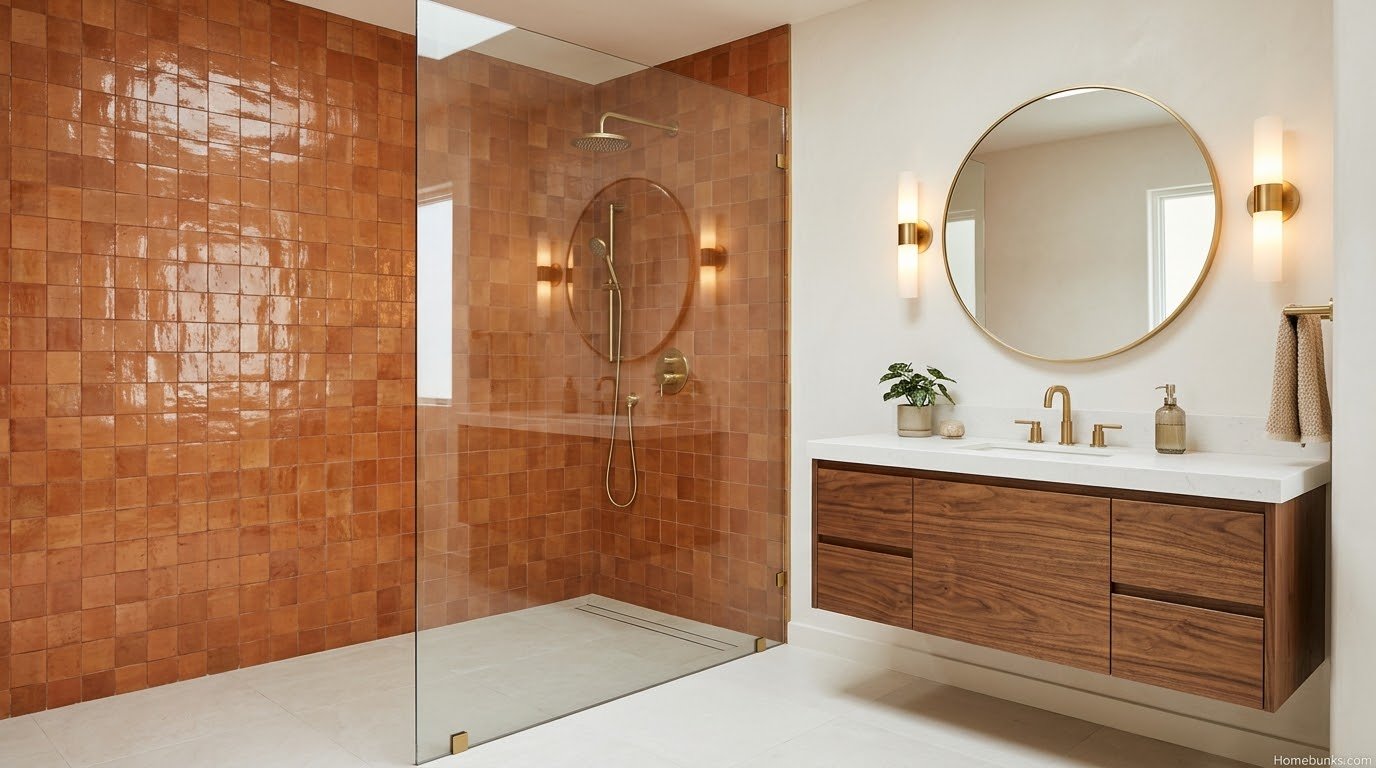
Porcelain prints the clay look onto a waterproof body. No sealing, no special cleaners, and full permission inside the shower, where real clay needs the most caution.
The trade is honesty: the variation is a photograph, however good the printing has become. Beside real Saltillo, a trained eye sees the repeating pattern eventually.
|
Branch |
Sealing |
Shower |
Care |
Best zones |
|---|---|---|---|---|
|
Real clay and Saltillo |
Required, before grout and on cycle |
Sealed only, glazed preferred |
pH neutral, gentle, forever |
Floors, walls beyond splash |
|
Glazed terracotta |
None for the tile face |
Yes |
Standard ceramic care |
Walls, splashbacks, showers |
|
Porcelain look |
None |
Yes, freely |
Easiest of the three |
Showers, floors, everywhere |
The strongest bathrooms often mix branches on purpose: porcelain inside the shower, real sealed clay on the floor and walls beyond it.
Each material works where it is strongest, and the visitor sees one warm room instead of a compromise.
Ordering real clay needs one more decision: buy the whole quantity from a single firing, with overage for cuts and variation.
Handmade batches shift in tone from one firing to the next. A shortage finished from a second batch can leave a visible patch mid floor.
The Sealing Rules That Decide Everything
Sealing is not a finishing touch for real clay. It is the structural step that decides whether the floor looks rich in ten years or stained in ten weeks.
Clay Imports’ Saltillo sealing guide states the core rule without softening it: unsealed Saltillo will permanently stain if exposed to grout, water or debris before sealing.
Work through the protocol in this order:
- Pre seal raw tile before grouting. Grout pigment seeps into open pores and stays forever, so sealing comes first on unsealed tile, and it is non negotiable.
- Install with joints sized for handmade tile. Irregular edges need wider grout joints to align, and the grout field becomes part of the material’s traditional look.
- Apply a compatible topcoat after grouting. The topcoat protects tile and grout together, and it sets the final finish, from natural matte to the classic glossy Saltillo sheen.
- Choose the sealer family deliberately. Penetrating sealers soak in and keep a natural look. Film forming sealers build a surface layer with satin or gloss, and they darken the clay slightly.
- Let it cure before water arrives. Touch dry takes hours, light traffic a day, and full cure up to three days in the importer’s system. Moisture during curing undoes the work.
- Test every year with water drops. A few drops on the surface tell the truth: if they darken the tile quickly, the sealer is spent and resealing is due.
Resealing runs on a one to two year rhythm in wet and busy rooms. It is an afternoon and a modest product cost, and it belongs in the honest budget for real clay.
Where Terracotta Belongs, Zone by Zone
Zone verdicts follow directly from the branch rules. Read your branch down the table before you read another inspiration photograph.
|
Zone |
Real clay |
Glazed |
Porcelain look |
|---|---|---|---|
|
Floor |
Yes, sealed, matte finish |
Yes |
Yes |
|
Walls beyond splash |
Yes, sealed |
Yes |
Yes |
|
Splashback |
Sealed, with care |
Yes |
Yes |
|
Shower walls |
Sealed only, second choice |
Yes |
Yes |
|
Shower floor |
Not recommended |
Small formats only |
Yes |
Floors are terracotta’s home ground. A sealed clay floor under warm white walls is the Mediterranean formula, and its matte grip surprises people who expect rustic to mean slippery.
Walls take clay beautifully at wainscot height and behind vanities, where the color frames mirrors and fixtures instead of competing with them.
The shower is where branches separate. Glazed and porcelain work without argument; real clay stays at the shower’s outer walls in most professional schemes.
Terracotta Paint: Cavern Clay and Its Family
Paint delivers the terracotta look without the sealing contract, and one color anchors the whole family.
Sherwin-Williams Cavern Clay SW 7701 is a warm red orange terracotta with brown rust undertones. The Cavern Clay color reference lists it at HEX #AC6B53 with an LRV of 20.
Sherwin-Williams named it their Color of the Year for 2019, describing ancient, elemental roots and a desert modern soul. The brown in its formula is what keeps it earthy instead of orange.
One caution belongs in print: a few blog copies list Cavern Clay near LRV 24. Every manufacturer aligned reference checked for this page prints 20, and 20 is the number to plan light around.
|
Color |
Brand and code |
LRV |
Role in the bathroom |
|---|---|---|---|
|
Cavern Clay |
Sherwin-Williams SW 7701 |
20 |
The reference terracotta, walls and vanities |
|
Baked Clay |
Sherwin-Williams SW 6340 |
Higher, reported |
The lighter, softer sibling for low light rooms |
|
Rookwood Terra Cotta |
Sherwin-Williams SW 2803 |
Lower, deep |
Historic depth for accents and powder rooms |
|
Baked Terra Cotta |
Benjamin Moore 1202 |
Mid, reported |
The Benjamin Moore route to the same warmth |
|
Audubon Russet |
Benjamin Moore HC-51 |
Deep, reported |
A russet accent for vanities and niches |
At LRV 20, Cavern Clay absorbs most of the light that reaches it. It rewards bright rooms and punishes dim ones, so plan lighting before you plan walls.
Its documented partners are warm whites: Sherwin-Williams Alabaster SW 7008 and Benjamin Moore White Dove OC-17 carry the trim, ceiling and tile free walls.
A tinted primer under clay paint is the professional shortcut reviewers repeat. It cuts the coats a saturated color needs and keeps the undertone even across the wall.
Sample paint beside the floor, never alone. Terracotta paint over a terracotta floor can double the orange past comfort; over a pale floor, the same wall sings.
The Pairing Rulebook: Whites, Woods, Metals, Stone
Terracotta fails in photographs for pairing reasons, almost never because the color itself was wrong. Four rules cover nearly every success and failure.
Warm Whites Only
Clay colors demand creamy, warm whites. Stark blue white trim makes terracotta look dirty or shrill by contrast, the single most common mistake in the whole palette.
Alabaster and White Dove exist in this page’s paint table for this reason. If a white reads crisp and cool on the chip, it will argue with the walls.
Woods With the Right Temperature
Dark walnut grounds the palette and pale white oak lifts it. Reviewer guidance is consistent across the paint literature, and the Mediterranean photographs agree.
Avoid woods with yellow or orange stains. They double the room’s orange load exactly the way a clay floor under clay paint does, and the whole scheme turns monochrome orange.
Warm beige bathroom ideas shows how the site’s softest warm palette balances wood and wall. The same discipline applies here, with more color on the wall.
Metals Ranked by Temperature
Matte black is the modern anchor; paint reviewers call it close to non negotiable for keeping rust tones from reading vintage. It draws a clean line around the clay.
Aged copper is the Southwestern native, and warm brass serves Mediterranean and traditional rooms. Green and gold bathroom ideas explores brass warmth beside green; beside clay it plays the same supporting role.
Chrome finishes last. Its cool shine fights matte earth at every fixture, and mixing chrome with brass in one sightline is the fastest way to make a warm bathroom feel unfinished.
Stone and Green Partners
Travertine is the Mediterranean native stone: its beige and gold veining bridges clay, wood and metal in one material. Warm veined marble works on the same logic.
Cold white and gray marble can clash by temperature unless everything else in the room is firmly warm. When in doubt, choose the stone with gold in its veins.
Greens are clay’s oldest partners. Sage green bathroom ideas pairs softly with a terracotta floor, and Pink and green bathroom ideas shows the two color warmth clay shares from the other direction.
Emerald green bathroom ideas is the saturated exception. It can meet terracotta in deliberate, confident schemes, but one of the two colors must clearly lead.
Style Directions: Mediterranean, Southwestern, Desert Modern, Boho
The same clay builds four different rooms. Pick the direction before you pick products, because each direction edits the palette differently.
Mediterranean and Spanish
Stucco warm whites, Saltillo or hexagon floors, patterned Talavera accents at the splashback or niche, and arches wherever the architecture allows them.
This is the color’s home style, the one in the Spanish and Italian project photographs. Pattern is welcome here, one element at a time.
Southwestern
Saltillo floors with wide joints, copper fixtures, natural wood, and woven textiles in cream and rust. The palette leans deeper and dustier than the Mediterranean version.
Keep the accessories honest: real clay pots, real wool, real wood. Themed novelty decor is what dated this style once, not the colors themselves.
Desert Modern
Large format porcelain look tile, a flat panel wood vanity, matte black fixtures, and terracotta as one strong plane, floor or wall, never both at full strength.
Everything else stays disciplined and plain. The clay supplies all the warmth and texture, which is exactly why the modern version works.
Boho and Rustic
Layered textiles, plants in clay pots, handmade tile, and pattern mixed with a freer hand. Small cabin bathroom ideas shares this direction’s love of honest materials and small warm rooms.
Boho forgives batch variation and mixed formats more than any other direction, which makes it the natural home for reclaimed and handmade tile.
Pattern, Shape and Grout
Shape changes terracotta’s era without changing its color. Hexagons and octagons read traditional, large squares read modern, and mosaics read crafted.
Hexagon floors are the small bathroom classic: a forgiving grid at a human scale, with enough grout lines to give real grip underfoot.
Patterned Spanish and Talavera tiles belong inside the clay scheme as accents: a splashback, a shower niche, a floor border. Plain clay fields make the pattern legible.
Grout color should be a warm mid tone, sand or warm gray beige. It forgives variation, hides the evidence of family life, and never draws a white grid over rustic tile.
Joint width follows the tile, not fashion. Handmade edges need 3/8 inch and up to align; machine made and porcelain tiles can run tight and clean.
Small Bathrooms and Powder Rooms
Warm mid tones advance visually, so a small terracotta bathroom feels cozier and smaller in the same gesture. Powder rooms exploit this; family baths manage it.
The controls are proportion and contrast. A clay floor under white walls warms a small bath without enclosing it, the classic formula for good reason.
One wall, a wainscot height, or a painted vanity gives the color at a dose a small room enjoys. Full walls belong to the powder room, where mood is the assignment.
Double vanity ideas for small bathrooms matters here because warmth plus function is the small bath brief. A wood double vanity under warm white walls carries the palette without a tile bill.
Mirror over pedestal sink ideas offers the other small room lever: the mirror’s shape and frame do decorative work the walls do not have to.
Terracotta Without Renovating
The palette climbs a commitment ladder, and the lower rungs are genuinely good rooms, not consolation prizes.
- Textiles and clay pots. Terracotta towels, a woven runner, and real clay planters bring the palette into a neutral bathroom in one shopping trip.
- Paint one surface. A single wall, a wainscot band, or the vanity itself in Cavern Clay is the weekend transformation, reversible in another weekend.
- Add a tiled moment. A splashback panel or a porcelain look floor cloth of tile in the dry zone adds the material without the renovation.
- Commit the floor. Real sealed Saltillo or quality look porcelain underfoot is the first permanent rung, and for many bathrooms it is also the last one needed.
Renters live happily on rungs one and two. The color agrees with the warm whites and wood tones most rental bathrooms already contain.
Floors With Walls, Walls With Floors
One direction usually comes first in a real project, and the second surface must answer the first instead of matching it.
With a terracotta floor, keep walls warm white, cream, or sage, and let the floor be the room’s color event. Bathrooms with dark floors covers the deep floor logic that clay floors share with dark ones.
With terracotta walls, the floor goes quiet: pale travertine looks, warm wood tones, or cream stone looks. Patterned floors can carry clay walls only in full Mediterranean schemes.
Matching clay to clay, floor and wall in the same strength, is the monochrome trap. If both surfaces wear the color, one must be clearly paler or clearly patterned.
Black and beige bathroom ideas works as the study case for this balance: one dark neutral leads, one warm neutral supports, and neither fights for the same role.
Borrow that discipline here. Clay leads or supports, but it never shares the lead with an equal strength partner.
Light for a Clay Colored Room
Clay colors are light sensitive in a friendly direction. Warm bulbs, 2700 to 3000K, deepen them beautifully; cool daylight bulbs gray them into mud.
At LRV 20, the reference paint needs adequate brightness in the evening. Layer mirror lighting for grooming and let the ambient light stay warm and generous.
North facing rooms treat terracotta kindly: its warmth corrects the cool light instead of fighting it. Sample through a full day, because clay reads peach at noon and rust at dusk.
Windowless bathrooms lean on the warm white partners. Pale ceilings and warm whites at the vanity wall keep a clay room glowing instead of closing in.
Vanity mirrors deserve their own check: stand at the sink at night and read your face, not the walls. That is the light the room will be judged by every morning.
Cost Layers and the Care Budget
Costs arrive in layers, and the layers are honest about what permanence costs.
A US bathroom floor tile comparison lists terracotta tile at roughly $2 to $8 per square foot for the material, with water resistance rated poor until sealed and a lifespan of fifty years or more.
|
Layer |
Typical scope |
Cost character |
|---|---|---|
|
Textiles and pots |
Towels, runner, planters |
Lowest, one shopping trip |
|
Paint |
One wall to full room |
Low, plus tinted primer |
|
Floor tile, installed |
Real clay or quality look porcelain |
Mid range renovation line |
|
Full tile room |
Floors, walls, patterned accents |
Full renovation budget |
|
Care, real clay only |
Sealer and an afternoon |
Small, every 1 to 2 years |
Porcelain look tile moves cost from care into material: more per square foot in some ranges, then nothing to seal, ever. Real clay reverses the trade.
Patterned accent tile is the budget lever in Mediterranean schemes. A splashback of Talavera style tile costs a little and carries the whole style.
Mistakes That Make Terracotta Look Wrong
- Grouting unsealed tile. The stain is permanent and entirely preventable. Pre sealing is the whole game with raw clay.
- Stark white trim. Cool white against clay reads as a mistake in the paint store, and it is the most common one.
- Clay on clay at full strength. Paint matched to a clay floor doubles the orange. Let one surface lead.
- Glossy sealer on floors. The shiny Saltillo look turns slick when wet; matte and satin finishes keep the grip the material is known for.
- Real clay deep in the shower. It can be done sealed, but the trade itself prefers glazed tile there. Take the professionals’ hint.
- Yellow stained wood everywhere. Honey oak and orange stains fight the clay for the same wavelength. One warm wood tone, chosen deliberately, wins.
- Skipping the sample. Clay shifts by batch and by light. A color chosen from a screen is a color chosen blind.
Care Routine for Real Clay
Real clay care is simple and specific, and Clay Imports’ Saltillo care guide reads like a routine card rather than a warning label.
Sweep grit often. Grit under shoes is sandpaper to a sealer coat, and it is the quiet cause of most premature wear.
Mop with mild soap and water or a pH neutral cleaner. Avoid soaking wet mops and steam mops; clay does not love standing water, sealed or not.
Keep acids away entirely. Vinegar cleaners and harsh chemicals break sealers down and dull the finish, trading a clean hour for a resealing weekend.
Wipe spills near sinks and showers quickly, dab topcoat sealer onto any chip that exposes raw clay, and run the water drop test each year.
Matte and satin finishes are more stain prone than glossy ones, a trade the sellers state openly. Choose the finish with your household, not just your eyes.
Frequently Asked Questions
What is terracotta, exactly?
Terracotta is baked earth: the word is Italian for cooked earth. It is natural clay fired at low temperatures, left porous and matte, and colored by the clay itself in peach, rust and ochre. No two handmade pieces match.
Can terracotta tile be used in a bathroom?
Yes, in three forms with different rules. Real clay works on floors and walls when sealed. Glazed terracotta behaves like glazed ceramic. Porcelain look tile is waterproof and shower safe. The mistake is treating the first form like the third.
Does terracotta tile need to be sealed in a bathroom?
Real terracotta, yes, non negotiably. The importers state that unsealed tile stains permanently if grout or water reaches it first, so it is sealed before grouting, with a topcoat after. Glazed terracotta and porcelain look tile need no sealing.
Can terracotta tile go in the shower?
Glazed terracotta and porcelain look tile, yes. Real Saltillo can serve in showers if sealed properly, but the importers themselves prefer glazed tile for direct wet areas. The professional pattern is porcelain inside the shower, real clay beyond it.
How often does terracotta need resealing?
Every one to two years in wet or busy service. Test with the water drop test: drops on the tile that darken it quickly mean the sealer is spent. Clean only with pH neutral products, since acids break sealers down.
What is Saltillo tile?
Saltillo is handmade terracotta from Saltillo, Mexico: natural clay, sun dried and kiln fired, left unglazed, with rustic texture, irregular edges and tones from peach to deep rust. It needs sealing, wide grout joints and an owner who likes variation.
What is the best terracotta paint color for a bathroom?
The reference is Sherwin-Williams Cavern Clay SW 7701: a warm red orange terracotta with brown rust undertones, HEX #AC6B53, LRV 20, and the brand’s Color of the Year 2019. Lighter and deeper siblings exist, covered in the paint section.
Is Cavern Clay too dark for a bathroom?
At LRV 20 it absorbs most light, so it needs a plan: warm white trim and ceiling, decent lighting, and one or two walls in a small bath. In a bright primary bath it can carry full walls.
Sample beside your floor first.
What colors go with terracotta in a bathroom?
The warm neutral family: creamy whites, warm beiges and creams, travertine tones, and natural wood. Accent partners are olive and sage greens, deep browns, mustard and dusty blue. Cool grays and stark blue whites are the documented friction.
What metal fixtures suit a terracotta bathroom?
Matte black is the modern consensus, aged copper is the Southwestern native, and warm brass suits Mediterranean schemes. Chrome is the awkward guest, too cool and shiny for matte earth. Keep one metal consistent across the room.
Real terracotta tile or terracotta look porcelain: which should I choose?
Choose by zone and tolerance. Real clay gives unmatched variation and a fifty year material life, at the price of sealing forever. Porcelain look gives the color with a waterproof body and no sealing. Many bathrooms use both.
Is terracotta tile slippery in a bathroom?
Unglazed and matte sealed terracotta grips well, better than polished ceramic. It is the glossy film forming sealers that can turn slick when wet. Floors should be matte or satin sealed, and small formats add grout line grip.
What grout color works with terracotta tile?
A warm mid tone grout, sand or warm gray beige, forgives the tile’s variation and avoids a white grid over a rustic material. Wide joints are traditional with handmade tile. Very light grout shows staining and noise quickly beside clay.
Does terracotta make a small bathroom feel smaller?
Warm mid tones advance visually, so a full terracotta small bath feels cozier and smaller together. Controls are proportion (floor only, one wall, wainscot height), pale upper walls and good light. A clay floor under white walls warms without enclosing.
How do I add terracotta to a bathroom without renovating?
Paint first: one wall or the vanity in a clay color is the weekend version. Then textiles (terracotta towels, a woven runner), clay pots, framed prints and wood accessories. The color agrees with every warm neutral most bathrooms already have.
What floor pairs with terracotta walls?
Keep the floor quieter than the wall: pale travertine look tile, warm wood tones, cream or light stone looks. Or classic Saltillo if the walls are paint. One clay hero per room is the rule that keeps the scheme calm.
What wall pairs with a terracotta floor?
Warm white and cream walls are the Mediterranean default, warm beige the softer modern read, and sage or olive the earthy two tone scheme. Stark cool white makes clay floors look orange by contrast, so the whites must be warm.
What vanity color works in a terracotta bathroom?
Natural wood is the designer default, white oak light or walnut deep. Warm white vanities keep Mediterranean schemes crisp, and matte black anchors the desert modern version. A clay painted vanity on neutral walls inverts the scheme successfully.
Is terracotta a trend or timeless?
Both, in layers. The material is centuries old and permanent in Mediterranean and Southwestern architecture, while its current surge is a trend wave riding the classic. Paint level terracotta rides waves safely; tile level is a decades decision.
How do I clean a terracotta bathroom?
Sweep or vacuum grit often, since grit eats sealers. Mop with mild soap and water or a pH neutral cleaner. Avoid soaking mops, steam mops and acidic cleaners on real clay. Dab topcoat sealer on any chip exposing raw clay.
Why does my terracotta look pinker or more orange than the photo?
Clay color shifts with batch, firing and light: the same tile reads peach in north light and rust under warm bulbs. Paint terracottas shift with undertones.
The fix is samples in the room, tile boards under your lighting, one batch ordering.
Can terracotta work in a modern bathroom?
Yes, the desert modern version: large format porcelain look tile, a flat panel wood vanity, matte black fixtures and one clay plane. Everything else stays disciplined and plain, so terracotta is the only rustic note in a clean room.
What lighting suits a terracotta bathroom?
Warm light flatters it, 2700 to 3000K, and mid LRV clay needs adequate brightness to stay rich rather than muddy at night. Avoid cool daylight bulbs, which gray the clay. Windowless baths need layered mirror lighting for grooming.
What patterns work with terracotta?
Spanish and Talavera patterned tile as accents against plain clay fields, hexagons and octagons in the clay itself, and checkerboard with cream for the Mediterranean classic. The rule is one patterned element per room when the color is this present.
Does terracotta suit a kids bathroom?
Surprisingly well: it hides family evidence better than white schemes and pairs playfully with patterned tile and bright towels. Real clay floors need current sealing in a splash heavy kids bath, the one argument for porcelain look tile here.
What ceiling color goes with terracotta walls?
The same warm whites as the trim, Alabaster class, in most rooms. In powder rooms, carrying the clay onto the ceiling is the enveloping designer move.
Pale warm tints drawn from the room’s stone or wood are the subtle third option.
How much does a terracotta bathroom cost?
By layer: paint and textiles run a few hundred dollars; real clay or quality look tile for a floor, installed, is a mid range renovation line; full tile rooms sit at full renovation budgets.
Sealing is a small recurring cost for real tile.
Can I mix terracotta with sage green or other greens?
It is one of the palette’s classic moves: clay and olive are Mediterranean siblings. Sage or olive walls with a terracotta floor, or terracotta walls with green plants and textiles.
Keep one clearly dominant so the two earths do not argue.
What window treatments and textiles suit terracotta?
Natural fibers: linen and woven wood in warm neutrals, cream and white towels for freshness, woven runners and baskets for texture. Terracotta textiles inside a neutral bathroom are the rental level entry to the entire palette.
Does terracotta work with marble?
Warm veined marbles and travertine, yes: beige and gold veining bridges clay and metal. Cold white and gray marble can clash by temperature unless everything else is firmly warm. Travertine is the Mediterranean native and the safer stone.
What is the difference between terracotta, rust and clay colors?
A family ordered by depth and brown: terracotta is the mid red orange of the fired pot, rust is deeper and browner, and paint clay usually means the softer, grayer branch. Judge paints by LRV and undertone, not names.
Is terracotta good for resale?
Neutral remains the resale default, but terracotta reads as warmth and architecture in the styles where it belongs, and paint level use reverses in a weekend. Extensive real clay tile is a taste commitment a buyer must share.
What should I check before ordering real terracotta tile?
Five things: whether it arrives pre sealed or raw, one batch consistency, overage for variation and cuts, an installer fluent in wide joints, and the sealer system you will maintain, chosen before the tile goes down.
Can I paint bathroom walls terracotta and keep a white tub and toilet?
That is the classic formula: white porcelain is the Mediterranean scheme’s built in contrast and keeps a clay walled room feeling clean, not themed. Warm the whites you choose (towels, ceiling, trim) and let the fixtures be the bright note.
What about terracotta in a north facing bathroom?
North light cools everything, and terracotta benefits: its warmth corrects the room instead of fighting it. Clay may read slightly grayer and deeper, so sample through a full day and consider the lighter family members if artificial light is weak.
How do I stop terracotta from looking dated or 1990s Southwest?
Fix proportion and company. The dated version was terracotta everywhere with themed accessories. The current version uses clay as one strong plane, clean modern fixtures, plain warm whites and real wood, and skips the novelty decor entirely.
What size and shape terracotta tile suits a small bathroom?
Hexagons and medium squares are the small bath classics, forgiving grids at a traditional scale. Large format look porcelain reads calmer with fewer grout lines. Mosaics belong on shower floors, where their grout adds grip.
Should grout lines be wide with terracotta?
With handmade and Saltillo tile, yes, by necessity: irregular edges need wider joints, often 3/8 inch and up, to align, and the grout field is part of the look.
Machine made and porcelain versions can run tighter joints for a cleaner read.
Can terracotta tile be used on bathroom walls as well as floors?
Yes: real clay on walls outside direct splash zones when sealed, glazed terracotta anywhere on walls, look porcelain everywhere. Applications include full walls, wainscot heights and arched splashbacks. Thick handmade tile needs an experienced installer and sound substrate.
What plants suit a terracotta bathroom?
Green against clay is the palette’s oldest trick: humidity loving ferns, pothos and trailing plants in clay pots or white pots. In windowless rooms, quality faux greenery keeps the note.
Plants also soften tile heavy schemes, which is why styled photos always include them.
Does terracotta change color over time?
Yes, gently, and owners count it a feature: film forming sealers deepen clay slightly from day one, and real Saltillo develops a patina over years.
Blotchy darkening is different: it means moisture or a failing sealer, answered by the water drop test.
What mirror and lighting fixtures finish a terracotta bathroom?
Arched mirrors echo the Spanish and Mediterranean architecture this color comes from, in black or aged metal frames; round mirrors soften modern versions. Lighting in warm metals or black with warm bulbs keeps the room’s temperature unified and calm.
Conclusion
Terracotta bathroom ideas reward the homeowner who chooses the branch before the photograph: real clay with its sealing ritual, glazed tile for wet walls, or porcelain look for a waterproof life.
The color itself is forgiving and old. Cavern Clay on the walls, Saltillo underfoot, warm whites at the trim and matte black at the fixtures is a scheme that has worked for centuries.
Start at the rung your life allows, from towels and paint to a full clay floor, and let the warmest material in the bathroom do what it has always done.
Order paint samples first, Cavern Clay beside one lighter sibling, and live with them through a full day of light before anything permanent is decided.
The wider color library at HomeBunks covers the whole family this palette belongs to, starting with beige bathroom ideas and cream bathroom ideas for softer warm schemes.
For the cool counterpoint, black and white bathroom ideas and blue and white bathroom ideas show what the bathroom looks like when warmth leaves the room entirely.


