
Sage green kitchen ideas begin, almost without exception, at the cabinets.
Sage is the rare color that a kitchen wears on its largest surface and still reads as calm, because it is a green muted by gray until it behaves like a neutral while working like a color.
That dual nature is why the shade needs a system rather than a gallery. Choose it by depth (its LRV band), place it by dose (full run, lowers, island, or walls), and pair it by undertone.
Get those three right and the specific kitchen, farmhouse or slab modern, galley or open plan, takes care of itself.
The color family travels well across a home: our sage green bathroom ideas run on the same ladder logic as everything below. At HomeBunks the kitchen version simply gets the biggest doors in the house to prove itself on.
Sage Green Kitchen Ideas at a Glance
|
Decision |
The Short Answer |
|---|---|
|
Where sage goes first |
Cabinets, in one of four placements |
|
The ladder |
Pale 55+, true sage 40 to 55, mid 25 to 40, deep under 25 (LRV) |
|
Benchmark paints |
October Mist (about 47) and Evergreen Fog (30), both 2022 Colors of the Year |
|
Default layout |
Two tone: sage lowers, warm white uppers |
|
Pairing rule |
Match woods and counters to the sage’s undertone |
|
Biggest traps |
Deep sage in a dark room, blue white partners, chip only sampling |
What Sage Green Is, and Why Kitchens Took It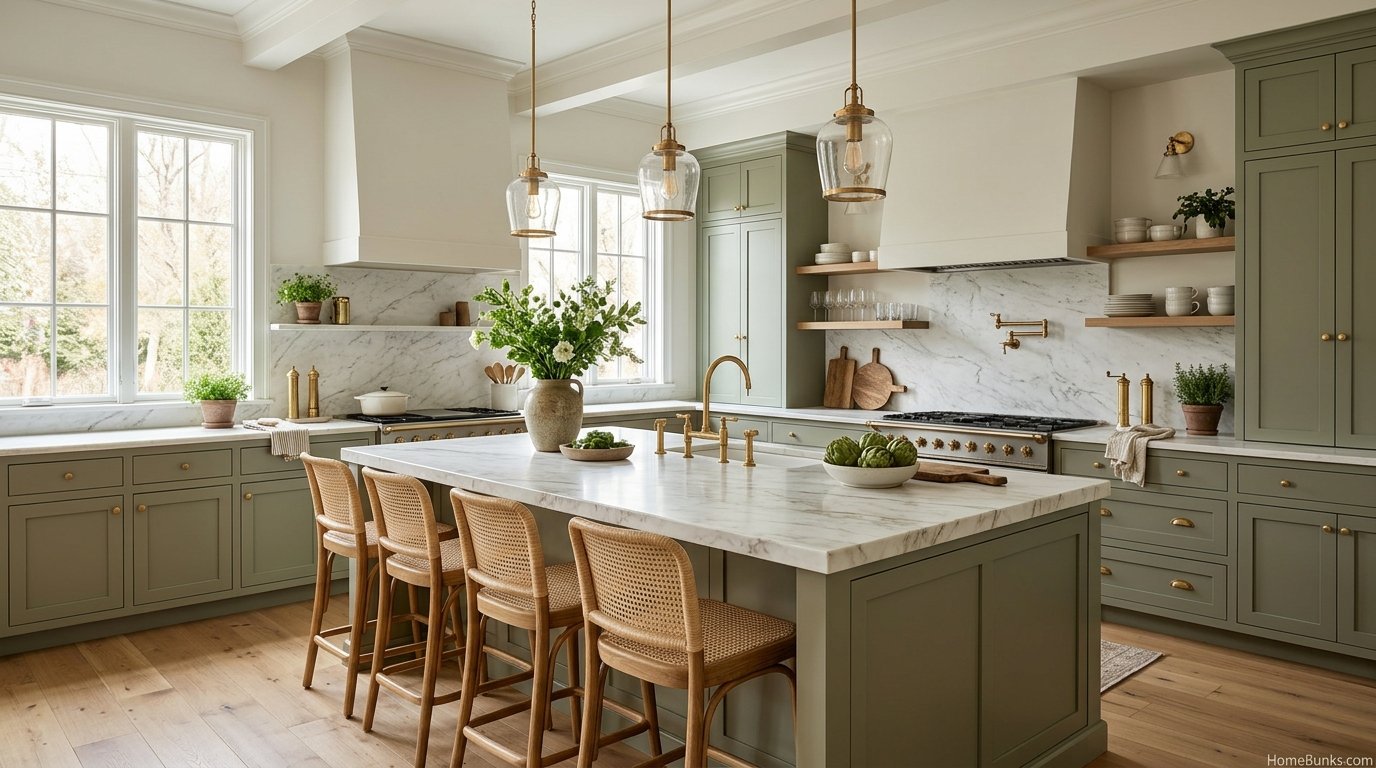
Sage is green with the volume turned down by gray, named for the dusty leaves of the herb.
On a kitchen’s hard surfaces (stone, steel, tile, glass) it does specific work: it softens, it grounds, and it gives a room of rectangles an organic note without a single plant being required.
It also ages kindly. The paint guidance in this niche notes that sage cabinets age more gracefully than white ones show wear, hiding the film and splash marks that white cabinetry advertises.
A working kitchen color that forgives is a practical choice wearing a pretty face.
The 2022 Double Crown
In 2022 both major US paint brands crowned a sage: Sherwin-Williams named Evergreen Fog (SW 9130) its Color of the Year, and Benjamin Moore named October Mist (1495) its own.
Two competitors agreeing on one shade family in one year is the market’s way of saying the color had become infrastructure, and sage has held the kitchen since.
Quiet Minimal’s sage kitchen decision guide assembles the modern ladder and placement math in one place, and it is worth reading alongside the system below.
The Sage Ladder: Paints by Depth
Read the ladder by band, not by name. Each band has jobs it does well and rooms it should avoid, and the bands matter more than any single paint inside them.
|
Band |
Paints (LRV) |
Best Jobs |
|---|---|---|
|
Pale, 55+ |
Sea Salt SW 6204 (63), Comfort Gray SW 6205 (54) |
Dark rooms, walls, pale full runs |
|
True sage, 40 to 55 |
Softened Green SW 6177 (49), October Mist 1495 (about 47), Saybrook Sage HC-114 (45), Clary Sage SW 6178 (41) |
Full runs, two tone lowers, most kitchens |
|
Mid, 25 to 40 |
Evergreen Fog SW 9130 (30) |
Lowers, islands, bright full runs |
|
Deep, under 25 |
Retreat SW 6207 (about 21), Cushing Green HC-125 (16), Rosemary SW 6187 (14), Pewter Green SW 6208 (12) |
Islands, accents, drama in bright rooms |
The Pale Band: Sage for Dark Rooms and Walls
Sea Salt and Comfort Gray sit at the family’s light edge, green enough to tint a room and pale enough to behave like the warm whites’ closest relative.
They are the ladder’s answer to the dark kitchen and the north window, and they are also the wall paints of the family, the shades that carry sage onto plaster behind white or wood cabinets.
Their risk is the opposite of the deep band’s: in a very bright room they can wash toward gray and lose the green entirely.
The warm partners (brass, oak, cream textiles) are what keep a pale sage reading as a color choice rather than a gray that missed.
The True Sage Band Is the Heartland
October Mist is the band’s forgiving center: light, silvery, close to a neutral, and the ladder sources’ first timer pick.
Saybrook Sage runs a touch earthier, and Clary Sage is the warm sibling, its yellow lean making it the natural partner for honey maple and light oak.
Evergreen Fog, the Benchmark
At LRV 30, Evergreen Fog is where sage turns architectural: mid depth, gray green, calm in bright rooms and genuinely moody in dim ones.
It is the strongest choice for lowers and islands and the riskiest for a dark full run, which is a compliment to its depth, not a warning against it.
The Undertone Conflict, and Why You Sample
Evergreen Fog also carries the niche’s most instructive disagreement: Sherwin-Williams describes it as a green gray with a bit of blue, while Paint Color Consultants classes its undertone as a weak yellow.
Both cannot be simply right, and that is the lesson: undertones are light dependent judgments, not facts printed on a can.
So sample like it matters, because it does: a painted door or large board, read morning and night, on the darkest wall, beside the floor and counter samples.
A kitchen run is 150 to 250 square feet of vertical door face; a 2 by 3 inch chip is a rumor about that surface, nothing more.
Farrow & Ball’s sages (Mizzle, Green Smoke, French Gray) join the ladder by reputation rather than data: the brand publishes no LRVs, so any figure attached to them is approximate, and the door sample matters even more.
Placement: Where the Sage Goes
Full Run Cabinets
The complete statement, best in pale and true bands or in bright rooms at mid depth. A full run reads designed and serene, and it asks the most of the room’s light.
Pair it with light counters and the warmest hardware to keep the field awake.
Two Tone: Sage Lowers, Warm White Uppers
The default for a reason. Sage grounds the room at working height, where its wear hiding virtues earn most, and warm white uppers keep the eye line bright and the ceiling feeling tall.
It is also the kindest repaint: the uppers can stay or refresh in place while the lowers carry the change.
Island Only
The deep band’s home. A Pewter Green or Rosemary island inside a white or wood perimeter gives the room an anchor with furniture presence, and the perimeter keeps its light budget intact.
Repeat the island’s hardware finish at the pendants so the island reads as planned, not stranded.
Walls Behind White Cabinets
The inversion: sage on the walls (pale band, or a true sage in a bright room) behind white cabinetry. It suits kitchens whose cabinets should not be painted (good wood, new white doors) and renters with a paintable wall and a cooperative lease.
The sage becomes atmosphere rather than furniture.
The 60/30/10 Split
The placement math underneath all four options: about 60 percent of the room (walls, ceiling, floor) sets the light field, 30 percent (the cabinets) carries the color, 10 percent (hardware and accents) supplies warmth and contrast.
When a sage kitchen disappoints, audit the 60 first: a blue white wall or a gray floor will sabotage a correct sage every time.
Pairings: Counters, Backsplash, Floors
Counters by Undertone
AweDeco’s pairing research on green cabinets with wood countertops states the rule this section runs on: the pairing holds when the wood tone matches the green’s undertone. Sage suits pale maple and oak, olive suits mid tone oak, deep forest suits walnut.
White quartz and marble are the brightening standard and return light to mid sages. Butcher block is the warming standard, governed by the undertone rule above.
Dark counters (soapstone looks, black quartz) belong to deep sages in bright rooms, one dark partner at a time.
Backsplash Matched to Depth
White subway behind mid and deep sages, the grid calming beside shaker frames. Zellige and handmade look tiles add shimmer that flat sage loves at any depth. Tone on tone sage tile behind pale sages makes the quiet, drenched wall.
A marble slab backsplash lets one material do counters and wall where the budget wants simplicity.
Floors and Wood Tones
Pale and mid oak and maple are the defaults, their warmth answering sage’s gray. Mid walnut partners the deep band.
The floor is the largest single piece of the 60 percent, so the sample ritual includes it: the door sample is always read standing on the real floor.
Door Styles: What Sage Does to Shaker, Slab, and Beadboard
Shaker is sage’s home door: the frame and panel give the muted color shadow lines to play across, and the style’s traditional bones keep a gray green from reading as a trend experiment. Most of the kitchens that made sage famous are shaker kitchens.
Slab doors turn sage modern and let it deepen: with no frame to shadow, a flat door field carries Evergreen Fog and deeper calmly, and the color becomes the entire ornament. Integrated handles or minimal pulls complete the argument.
Beadboard and raised panel doors pull sage toward cottage and traditional: the texture warms the gray in the paint, and these doors forgive slightly deeper and warmer sages than slab doors do.
Glass front uppers, clear or reeded, lighten any of the three by giving the green a rhythm of transparency to rest against.
Hardware by Depth
|
Sage Depth |
First Choice |
Also Works |
The Read |
|---|---|---|---|
|
Pale |
Brushed nickel |
Brass |
Tailored, quiet, modern |
|
True sage |
Brass |
Matte black |
Warmth by default, graphic on request |
|
Deep |
Brass |
Matte black |
Brass glows against depth; black goes modern |
Hardware is the 10 percent that warms the other 90. Brass against sage is the era’s signature pairing for a reason: the metal’s warmth answers the paint’s gray in every light.
The relatives of this pairing live nearby in the house too, as green and gold bathroom ideas show in another room’s dialect.
Light: Windows, Kelvin, and the Dark Kitchen Rules
North light adds blue and grays the cool sages first; in a north facing kitchen, choose warm leaning sages (Clary Sage’s family) in the pale and true bands, and expect every sage to read one step cooler than its chip.
South and west light warms and can push warm sages toward olive by evening. The ladder’s mid band was made for these rooms.
After dark, the bulbs take over: 3000K warm white is the specification that keeps sage reading green at night. Cool daylight bulbs undo the paint choice every evening at 7 p.m., which is why so many “wrong color” kitchens are actually wrong bulb kitchens.
Dark kitchen rules, collected: pale band paints, white counters to return light, warm whites rather than bright whites around, layered lighting with real under cabinet task light, and the deep band confined to the island or excused entirely.
The Repaint Protocol: Painting the Cabinets You Own
Most sage kitchens are repaints, so the protocol is part of the color’s story:
1. Degrease without mercy. Kitchen doors wear an invisible coat of cooking film; paint over it and the finish fails. A degreasing cleaner and patience here decide the job.
2. Sand to dull. The goal is a uniform matte surface the primer can grip, not bare wood.
3. Bonding primer. The bridge between old finish and new enamel; skip it and even good paint peels at the handles within the year.
4. Two coats of cabinet enamel, satin finish, with a light sand between coats. Spray for the factory field, or brush with a self leveling enamel for a close second on shaker doors.
5. Cure honestly. Enamel dries in hours and cures in days to weeks. Treat the doors gently through the cure, or budget your disappointment in advance.
Room Recipes
Small and Galley Kitchens
Pale or true sage lowers under warm white uppers, white counters, brass hardware. In a galley the two tone split also lengthens the corridor visually, the grounded base and bright top reading as height the room does not have.
Small kitchens also benefit from sage’s behavior under mixed light: most eat under a window by day and bulbs by night, and the true band holds its identity in both, where a brighter green would shout in one and sulk in the other.
Open Plan Kitchens
Sage is the open plan’s color anchor: strong enough to define the kitchen zone inside a larger room, neutral enough not to fight the living area’s palette.
Extend its warm partners (oak, brass, cream) into the shared space, the same hand off that white and beige living room ideas perform for the living end of the plan.
In open plans the island dose deserves special mention: a deep sage island can be the only green in a white kitchen and still organize the whole ground floor, because the eye files the room under the island’s color.
It is the highest design return per painted door in this entire article.
Farmhouse and Cottage
Warm true sages (Clary Sage, Saybrook Sage) on shaker or beadboard, butcher block counters, brass or black hardware, a farmhouse sink. Cottage sages can run a shade deeper than modern ones; texture forgives depth.
Add the farmhouse light rule to the recipe: these kitchens often sit under one window and warm bulbs, so sample the door at the sink in the morning before the coffee, not under the showroom’s noon.
The warm sages reward the test by glowing; the cool ones quietly excuse themselves.
Modern Slab Kitchens
Cooler or deeper sages (Evergreen Fog, Acacia Haze) on frameless slab doors, integrated or minimal hardware, stone look counters, stainless or black appliances. The flat door field carries depth calmly, and the color itself becomes the ornament.
The calm end of this dialect borders the rooms in Scandinavian bedroom ideas, where sage’s cousins do similar quiet work.
The Rental Decor Dose
No paint: sage dinnerware, textiles, a mixer or kettle, a runner, plants, and shelf styling against the existing kitchen. The palette reads at accessory scale surprisingly well, because sage’s gray base makes even small pieces read as a scheme.
Sage vs Olive vs Forest, and vs White Cabinets
|
Color |
Muting Agent |
Temperature |
Best Wood Partners |
Light Demand |
|---|---|---|---|---|
|
Sage |
Gray |
Cool to neutral |
Pale maple and oak |
Low to moderate by band |
|
Olive |
Brown and yellow |
Warm |
Mid tone oak |
Moderate |
|
Forest |
Depth and gray |
Cool, deep |
Walnut |
High, islands and bright rooms |
|
White |
None |
Any, by undertone |
All |
Lowest, but shows every mark |
The neighboring greens deepen quickly: emerald green bathroom ideas show the family’s saturated end, useful as the contrast that proves sage’s muting is the point.
Against white cabinets, sage trades a little light for a lot of forgiveness: wear, film, and splash marks all but disappear, and the room gains a color identity white has to borrow from its accessories.
The Dose Ladder: Four Ways In
|
Dose |
What Changes |
Commitment |
Best For |
|---|---|---|---|
|
Decor |
Textiles, dinnerware, tools, plants in sage |
An afternoon |
Renters, the undecided |
|
Island |
One piece of furniture in a deep sage |
A weekend repaint |
White and wood kitchens wanting an anchor |
|
Two tone |
Lowers in sage, uppers stay or go warm white |
A repaint project |
Most kitchens, most light |
|
Full run |
Every door in one sage |
The full commitment |
Bright rooms, true and pale bands, designed kitchens |
The ladder’s gift is reversibility in order: each dose can be lived with, judged in real light across real weeks, and either kept, deepened, or walked back before the next dose is spent.
Kitchens punish impulsive color more than any other room, because the surface area is enormous and the repaint is a project, and sage’s ladder is unusually forgiving precisely because its shallow end is decor rather than paint.
Work up it honestly. A household that loves the decor dose but hesitates at the island has learned something true about its courage, and the two tone dose exists to meet exactly that household where it stands.
Styling the Sage Kitchen: Shelves, Textiles, and Green on Green
Open shelving in a sage kitchen holds the styled layer: white and cream ceramics, wood boards, glass jars, and the one category that doubles the color for free, plants and herbs.
A row of herbs on a sage kitchen’s sill is the palette explaining itself, the living original standing next to its painted portrait.
Textiles carry the warm complements in their cheapest form: a terracotta toned runner, linen towels in flax and cream, a navy cushion on the breakfast stool.
These are the 10 percent accents the split budgets for, and they are how the room’s warmth gets tuned seasonally without touching a door.
Keep display honest. Sage kitchens photograph with clear counters, and real ones cook, so style the shelf and the sill, and let the working counter hold only the beautiful tools. The color does the decorating; everything else is cast, not crowd.
That restraint is what makes the room read designed instead of decorated.
Mistakes That Ruin a Sage Kitchen
Deep sage, dark room. The ladder error in its purest form. Bands exist so this does not happen.
Blue white partners. Bright blue white uppers or walls chill sage toward gray. Warm white is not a preference here; it is a specification.
Chip only sampling. Two days with a painted door would have caught it, whatever “it” turned out to be.
The undertone fight. Honey orange floors against a blue leaning sage, at full strength, forever. Test beside the floor; choose the warm sage or accept the negotiation.
Skipped prep. The repaint that peels at the handles by spring. The protocol’s boring steps are the finish’s entire foundation.
Cool bulbs. The 7 p.m. betrayal. Change twelve bulbs before repainting one door if the kitchen only looks wrong at night.
Frequently Asked Questions
What color is sage green?
Sage green is a muted gray green, named for the sage plant’s dusty leaves: green softened by gray until it behaves almost like a neutral.
In paint it spans a ladder, pale gray greens at LRV 60 and up, true sages in the 40s, deep gray greens under 25.
What is the best sage green paint for kitchen cabinets?
By depth and light: October Mist (LRV about 47) for average light full runs, Evergreen Fog (LRV 30) for lowers, islands, and bright rooms, Clary Sage (41) beside honey woods, Sea Salt (63) for dark rooms.
Choose a band first, then a name, then test a door sized sample.
Evergreen Fog or October Mist for cabinets?
A depth decision disguised as a name decision. October Mist (about LRV 47) is lighter, grayer, and forgiving in low light, the first timer pick.
Evergreen Fog (LRV 30) is moodier and more architectural. North facing or small: October Mist. Bright or large: Evergreen Fog.
Is sage green a good color for a kitchen?
Yes, with the depth matched to the light. Sage softens hard surfaces (stone, steel, tile), pairs across marble, quartz, wood, and brass, and hides wear more gracefully than white.
Its one demand is light: deep sages in dark rooms go flat. That is a ladder error, not a color error.
Does sage green make a kitchen look dark?
Only the deep band, and only in low light. Colors under LRV 50 need good lighting to avoid going flat, and deep sages belong on islands or in bright rooms.
Pale and true sages (LRV 41 to 63) brighten like the neutrals they nearly are.
What colors go with sage green kitchen cabinets?
Warm whites and creams around, pale woods (maple and oak), brass, white quartz and marble, and in small doses the warm complements: terracotta, clay, deep navy.
The pairing rule is undertone matching: the wood tone should agree with the green’s undertone.
What hardware goes with sage green cabinets?
By depth: pale sages take nickel (tailored) or brass (warmth); true sages take brass by default or black for contrast; deep sages take brass, which glows against them.
One finish, repeated, as with the cabinets themselves.
What countertop goes with sage green cabinets?
White quartz and marble brighten; butcher block warms, with the wood matched to the sage’s undertone (sage with pale maple and oak).
Dark counters suit deep sages in bright rooms. White counters also return light to a mid sage, which matters.
What backsplash goes with sage green cabinets?
Match the backsplash to the green’s depth: white subway behind mid and deep sages, zellige for texture at any depth, tone on tone tile behind pale sages.
Pattern belongs to the floor or the tile, in dose, not both at volume.
Should I paint all my cabinets sage or just the lowers?
Two tone (sage lowers, warm white uppers) is the standard compromise: grounded below, bright at eye level, and the easier repaint.
Full runs suit larger, brighter kitchens. Island only is the lowest commitment with a real payoff.
Can I use sage green in a small kitchen?
Yes, in the pale and true bands (LRV 41 and up): sage lowers under white uppers, or a pale full run with white counters returning light.
Deep sage in a small dark kitchen is the ladder error to avoid.
What about a sage green kitchen island only?
The island is the deep band’s natural home: Pewter Green, Rosemary, or Evergreen Fog inside a white or wood perimeter.
Treat it as furniture, paneled ends and all, and repeat its hardware finish at the pendants to tie it in.
What wall color works with sage green cabinets?
By the cabinet’s depth: warm white for deep sages, cream or sand for light and true sages (the sage warms and reads greener), greige for a tonal quiet room.
Tone on tone sage walls only with strong light; terracotta as a small warm accent, never all four walls.
What floor goes with sage green cabinets?
Pale and mid oak and maple are the defaults, their warmth answering the sage’s gray; mid walnut suits deep sages; pale tile suits modern builds.
Sample the cabinet color standing on the actual floor, not on a store’s concrete.
Is sage green going out of style?
Sage has led kitchen colors since both big US paint brands crowned sages in 2022, and it behaves like a neutral while reading as a color.
That is the profile of the long lived kitchen colors, not of saturated trend shades. The muted gray greens are the durable end of the family.
Sage green vs olive green: what is the difference?
The gray. Sage is green muted by gray, cool and dusty; olive is green muted by brown and yellow, warm and earthy.
They pair differently, sage with pale maple and oak, olive with mid oak and warmer metals, and they drift differently in north light.
Can sage green work in a north facing kitchen?
Yes: stay in the pale and true bands, prefer warmer leaning sages (Clary Sage’s yellow lean) over blue leaning ones, and add brass, warm white, and 3000K light.
North light adds blue and grays cool sages first. Test the sample on the darkest wall.
Why does my sage green look gray?
Three usual causes: a gray heavy pale formula, weak or north light pulling the green out, or cool bulbs at night.
Fixes: one band warmer or lighter, warmer lighting, and warm partners (brass, wood, cream) that let the eye see the green.
Why does my sage look blue?
Some sages lean blue (Evergreen Fog’s brand description mentions a bit of blue, though consultants class it differently), and blue leanings amplify beside cool floors and north light.
Counter with warm whites, brass, and wood, or move to a yellow leaning sage like Clary Sage.
What paint finish is best for kitchen cabinets?
A cabinet enamel in satin: hard enough to scrub, soft enough not to spotlight door imperfections.
Flat and matte belong on walls. The system matters more: cabinet enamel over bonding primer, on a degreased, sanded door.
Can I paint my existing cabinets sage green myself?
Yes, it is this color’s most common route. The protocol: degrease, sand to dull, bonding primer, two enamel coats with sanding between, and honest cure time.
Spraying gives the factory look; a good brush and self leveling enamel come close on shaker doors.
How much does it cost to paint kitchen cabinets sage green?
By dose, not color: a DIY repaint is paint, primer, and supplies, the cheapest full color change a kitchen can get; a professional repaint is a larger project; new cabinetry is a remodel line.
Get local quotes for numbers. The color itself adds nothing to any tier.
What is the 60/30/10 rule in a sage kitchen?
About 60 percent of surfaces (walls, ceiling, floor) set the light field, 30 percent (cabinets) carry the sage, 10 percent (hardware, accents) supply warmth.
When a sage kitchen feels wrong, the error is usually in the 60, not in the sage.
Does sage green go with stainless steel appliances?
Yes: stainless is a cool neutral and sits quietly against sage, especially the cooler sages.
Match hardware to the steel for the tailored read, or use brass against it, the common designer mix, with brass supplying the warmth steel withholds.
What lighting temperature suits a sage kitchen?
Warm white, around 3000K, keeps the green reading green after dark.
Cool daylight bulbs push sage toward gray blue every evening. Layer it: ambient, under cabinet task light, and pendants in the hardware’s finish.
Can I do a sage green kitchen as a renter?
At the decor dose: sage textiles, dinnerware, a mixer or kettle, curtains, a runner, and plants against the kitchen you have.
The palette reads clearly at accessory scale in a white or wood kitchen, and every piece leaves with you.
What backsplash tile shape suits sage cabinets?
Subway is the default (its grid calms beside shaker frames), vertical stacked subway modernizes it, zellige adds handmade shimmer, large format quiets small kitchens.
Frames want grids; slab doors want large format or a slab backsplash.
Sage green with white cabinets: which goes where?
The classic split is sage below, white above: grounded at working height, bright at the eye line.
Use warm white, not bright blue white, in both directions, or the white chills the sage. The reverse split is rarer and moodier, usually over wood lowers.
What is a good sage for a farmhouse kitchen?
A warm leaning true sage (Clary Sage, Saybrook Sage) on shaker or beadboard doors, with butcher block, brass or black hardware, and a farmhouse sink.
Farmhouse sages run warmer and slightly deeper; their partners are wood and iron, not stone and chrome.
What is a good sage for a modern kitchen?
A cooler or deeper sage (Evergreen Fog, Acacia Haze) on slab doors, with minimal hardware, stone look counters, and stainless or black appliances.
Slab doors carry depth calmly because there are no frames to shadow, so modern builds can go darker.
Can sage green cabinets work with dark countertops?
Yes, in bright rooms: deep sages under soapstone look or black quartz, with brass as the light source, is the dramatic build.
The rule is one dark partner at a time, unless the room is genuinely bright.
How do I test a sage paint before committing?
Paint a spare door or a large primed board, not the chip: a kitchen run is 150 to 250 square feet of door face, and a 2 by 3 inch chip cannot predict it.
Read it morning and night, on the darkest wall, beside floor and counter samples, for two days.
What colors should I avoid with sage green cabinets?
Bright blue whites (they chill it), orange heavy woods at full strength, purple leaning grays, and saturated primaries at volume.
Sage’s partners should share its muting. Terracotta and navy work because their kitchen versions are dusty and deep.
Is sage green good for resale?
Better than most colors: buyers read sage as calm and current, not as a previous owner’s strong taste, and its 2022 double crown makes it mainstream.
Execution decides, as always: a worn repaint hurts more than the color choice ever could.
What is the difference between sage and gray green?
Same family, different commitment: gray green is the umbrella for any green with a strong gray component; sage is its herbal heartland name in kitchen usage.
The paints marketed as sage cluster in the LRV 30 to 50 heartland.
Can I pair sage cabinets with a sage island in a different depth?
Yes: tonal layering, a true sage perimeter with a deep sage island, is the designed version of the family.
Keep the undertone family the same across both depths, or the two greens argue. Rungs in one ladder column share their leaning.
What window treatments suit a sage kitchen?
Natural ones: linen café curtains, woven shades, warm white rollers that filter rather than block.
The kitchen’s light is a working ingredient in the color system, and treatment tones should come from the warm neutral side of the palette.
How do I add sage green without painting cabinets?
In dose order: textiles and dinnerware, sage appliances and tools, a sage wall or backsplash behind white cabinets, shelf styling with sage ceramics and plants.
Bar stools and a runner carry it at floor level. The decor dose is also the landlord proof dose.
What grout and tile tones work behind sage?
Warm white and soft greige grouts keep tile quiet behind sage; tile runs white, cream, or sage tonal.
Dark grout is the graphic farmhouse statement, chosen deliberately. Avoid cool blue gray tiles, which pull sage’s temperature down.
Are sage cabinets hard to keep clean?
Easier than white: sage hides the film and splash marks white cabinets advertise, part of its practical reputation.
Satin enamel wipes clean. Deep sages show dust sooner, the usual dark color tax.
What is the best sage for a dark kitchen with little natural light?
The pale band: Sea Salt (LRV 63) or Comfort Gray (LRV 54), with white counters, warm whites around, and generous 3000K layers.
Pale sages brighten while still reading green beside warm partners. Save the deep band for the island, or skip it.
Sage green kitchen with navy: does it work?
Yes, as the deep guest: navy on the island inside a sage perimeter, navy textiles, or sage cabinets against a navy dining wall in an open plan.
Keep the navy dusty and deep, and let brass be the metal that marries them.
Conclusion
Sage green kitchen ideas succeed when the color is treated as the system it is: a band chosen for the room’s light, a placement chosen for the room’s courage, and partners chosen for the paint’s undertone.
Start with the sample weekend if the ladder feels abstract: one door in October Mist, one in Evergreen Fog, two days of your own light.
The doors will tell you which sage your kitchen has been asking for, and the repaint that follows is the cheapest complete transformation a kitchen accepts.
And expect the color to keep its side of the bargain for years.
Sage was crowned twice in 2022 because it had already become the kitchen’s quiet default, and colors that behave like neutrals while reading like choices do not date the way trend shades do.
Pick the band honestly, place it bravely, pair it warmly, and the kitchen will feel current long after louder colors have been painted over.