
Scandinavian bedroom ideas begin with light, warmth, and calm function, not with a shopping list or a perfect showroom. A successful room feels bright in daylight, soft at night, and easy to use every morning.
Pale surfaces, light wood, and layered textiles work together to create that feeling. No single purchase creates the look, because the system matters more than any one object.
Warmth separates Scandinavian design from cold minimalism in a clear and practical way. A minimalist room can stay bare and cool, while a Scandinavian room must feel soft to touch.
Denmark, Norway, and Sweden form the core Scandinavian region in geographic terms. Finland and Iceland join them under the wider Nordic label, and bedroom design draws on all five traditions.
Long, dark winters shaped the style through a practical need for light and comfort. Pale walls bounce daylight, low furniture keeps rooms open, and warm lamps replace harsh overhead glare.
Hygge describes Danish coziness, with texture, soft light, and quiet comfort at its centre. Lagom describes Swedish enough, with a clear limit on objects, colour, and visual noise.
What Makes a Bedroom Scandinavian
A Scandinavian bedroom follows five linked rules that keep decisions simple and consistent. Light comes first, pale wood adds warmth, textiles add softness, storage stays hidden, and decoration stays limited.
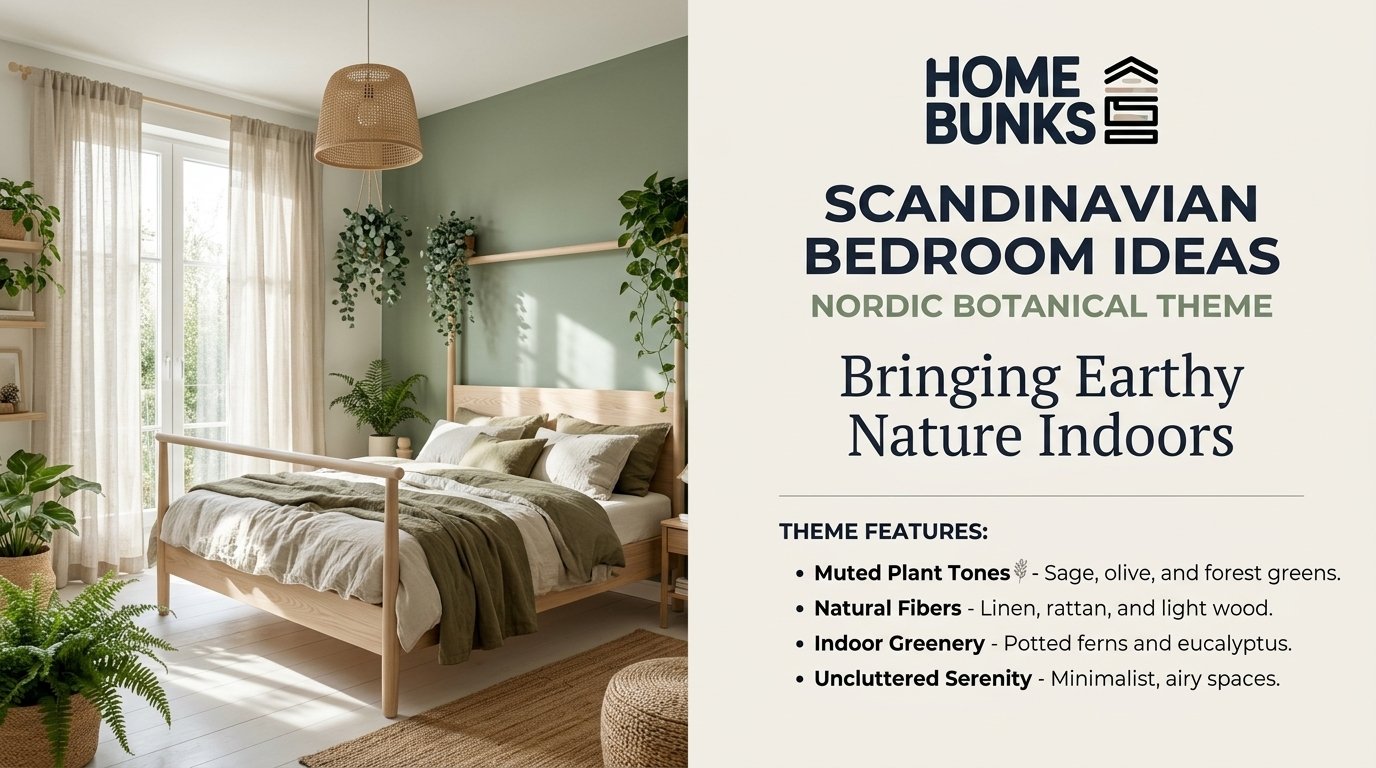
Function guides every furniture choice before style, colour, or trend enters the decision. A bed must sleep well, a nightstand must hold essentials, and a wardrobe must hide clutter without blocking movement.
Negative space counts as a design element, not as empty space waiting for more objects. Clear floor, quiet walls, and clear bedside surfaces help the room feel calm rather than unfinished.
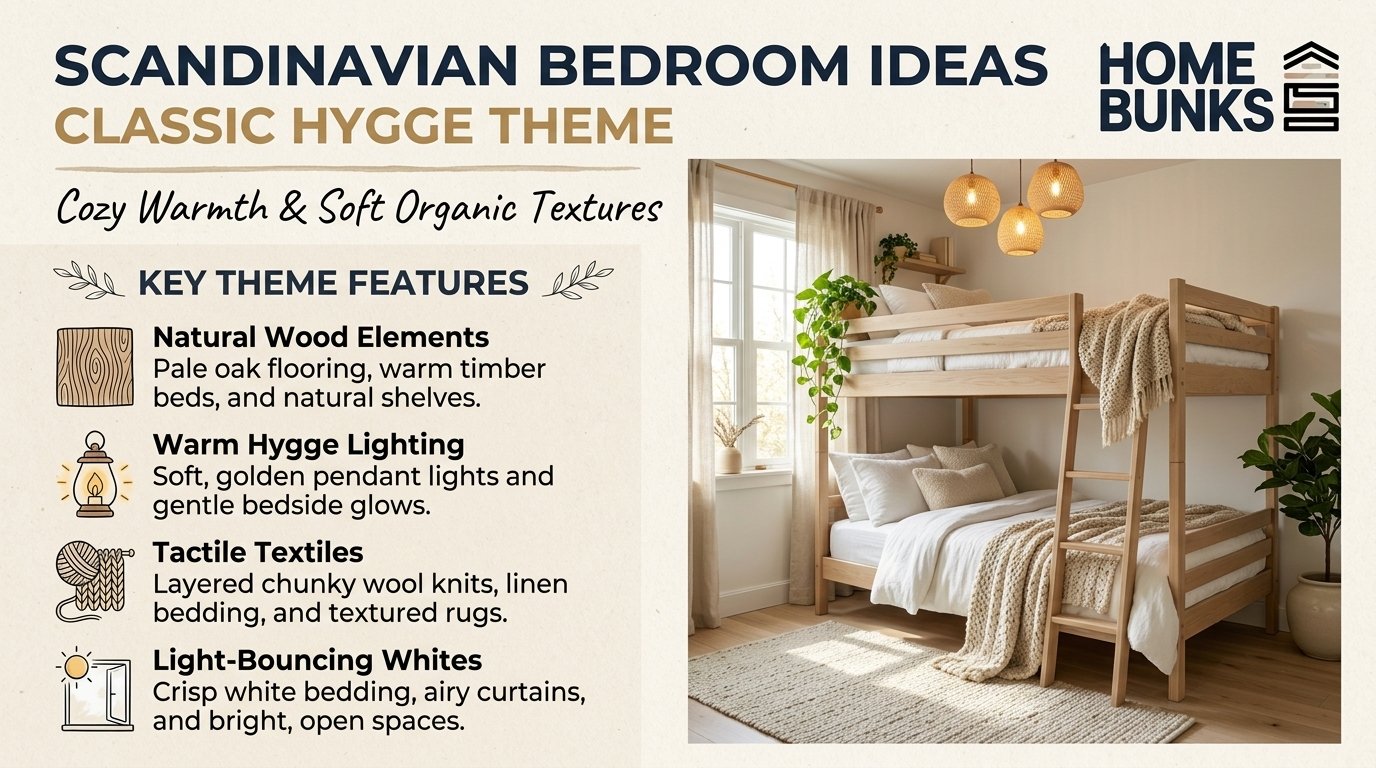
Texture replaces pattern as the main visual interest in most Scandinavian bedrooms. Linen, wool, wood grain, boucle, and woven rugs create depth without loud colour or busy prints.
Colour stays supportive, never dominant, across walls, bedding, and large furniture pieces. One muted accent can add personality, while several strong colours quickly break the calm balance.
Scandinavia Compared With Nordic Design
Scandinavia and Nordic design overlap heavily in everyday interior language, yet the labels differ geographically. Scandinavian strictly means Denmark, Norway, and Sweden, while Nordic adds Finland and Iceland.
Bedroom design borrows from all five countries, so strict country labels matter less than shared principles. Light surfaces, natural materials, simple forms, and cozy warmth appear across the wider region.
Finnish birch work and Icelandic wool traditions both fit comfortably inside the wider Nordic bedroom system. A room can honour those threads without claiming one country invented the whole style.
Gustavian furniture shaped pale painted surfaces through light colours, simple lines, and restrained decoration. Danish modern design added low silhouettes, clean joints, and practical comfort.
History explains the look, but history alone does not furnish a room. Use historical threads to understand pale colour and simple forms, then judge every purchase by light, comfort, and use.
Scandinavian Warmth Compared With Strict Minimalism
Strict minimalism often removes objects until a room feels empty, and that empty result can feel cold. Scandinavian design removes visual noise while keeping warmth through textiles, wood, and warm light.
A bare white room with smooth surfaces and no texture usually fails the Scandinavian test. Add linen, wool, wood, and warm lamps before adding decoration, colour, or extra furniture.
Touch matters as much as sight in a Scandinavian bedroom. Bedding should feel soft, rugs should feel warm underfoot, and wood should feel natural rather than glossy or plastic-like.
One substantial textile layer often beats several small decorations for warmth and calm. A chunky throw, a wool rug, and linen bedding create more comfort than scattered ornaments.
Restraint still matters, because warmth without limits becomes clutter. Keep layers to a clear ceiling, keep surfaces mostly clear, and let each object earn its place.
Start With a Ten Minute Room Audit
A room audit prevents expensive mistakes by revealing light, floor colour, walkway width, and storage pressure first. Stand in the doorway in daylight, then repeat the check with evening lamps switched on.
Photograph the room from the doorway in daylight and again at bedtime. Compare the two images for dark corners, glare, clutter, and surfaces that dominate the view.
Identify the three largest visual areas in each photograph, usually floor, walls, and bed. When all three look pale and smooth, texture matters more than another white object.
When several dark woods, black pieces, and strong textiles compete, simplify contrast before adding decor. Remove one competing element, then reassess before buying anything new.
Measure the narrowest walking route between bed, wardrobe, and door before choosing wider furniture. A bench, nightstand, or storage unit must never block comfortable movement.
Measure Walkways and Bed Clearance
Walkway guidance varies by source, so treat published numbers as planning ranges rather than building codes. Some guides suggest at least 36 inches, while others allow 24 to 30 inches on the entry side.
Protect the entry side first in a small bedroom, because that side carries daily use. Trim the far side, choose a narrower surface, or use a wall-mounted light when space runs short.
Leave enough room to make the bed without climbing over furniture or squeezing past sharp corners. A beautiful layout fails when daily bed making feels awkward or cramped.
Check drawer and door clearance before buying storage beds, wardrobes, or wide dressers. Drawers need full opening space, wardrobe doors need swing space, and sliding doors need clear tracks.
Test the route at night with lamps on and overhead light off. A route that works in daylight can feel tight, dark, or awkward when only bedside light guides movement.
Count Closed Storage Before Buying Decor
Open shelves only work when contents stay visually calm across every shelf and every day. Books, chargers, clothes, and personal items quickly create noise when no closed home exists.
Count exposed storage surfaces and list what currently sits on each one. Move everyday clutter into drawers, wardrobes, or closed boxes before adding baskets or display shelves.
Closed storage protects the calm look far better than prettier open storage in most bedrooms. A plain wardrobe wall often feels lighter than several small cabinets scattered around the room.
Assign a home to chargers, medicines, books, and laundry before styling bedside tables. Visible cables and small piles undermine pale walls and simple furniture faster than colour choices do.
Keep bedside surfaces mostly clear with one lamp, one book, and one small personal item at most. Clear surfaces signal calm, while crowded surfaces signal unfinished storage decisions.
Check Light at Daytime and Bedtime
Turn off the ceiling light at bedtime and judge the room by bedside and wall light alone. Flat, gloomy, or harsh light signals a lighting problem, not a colour problem.
Note window direction, window size, and nearby obstructions during the daylight check. North-facing rooms receive cooler, weaker light, while south-facing rooms receive stronger, warmer daylight.
Note floor colour during the light check, because floors reflect light upward into the room. Pale floors bounce light well, while dark floors absorb light and make walls feel heavier.
Note wall colour under evening lamps, because warm bulbs shift pale colours toward cream and cool colours toward grey. A wall that looks clean in a shop can look cold beside warm wood.
Record lamp count, bulb warmth, and dimmer availability before changing paint or furniture. Lighting fixes often cost less than paint, bedding, or furniture changes.
Choose Your Palette by Room Light
Room light should decide palette before taste, trends, or photographs decide it. Bright rooms can carry deeper accents, moderate rooms suit layered greys, and dim rooms need warm whites.
Warm white forms the safest base for most Scandinavian bedrooms, especially dim and north-facing rooms. Warm white pairs well with pale wood, linen, and warm lamps without turning clinical.
Stark cool white can turn grey and flat in a dim room, even when the same white looks fresh in a bright shop. Test samples in the actual room before committing to a full wall colour.
Greige offers a middle path when pure white feels too stark and cool grey feels too cold. Greige adds warmth without darkness, and pairs well with oak, linen, and muted accents.
Muted sage, dusty blue, and soft blush work best as single accents, not as whole-room colour systems. Use an accent on bedding, one wall, or cushions, then keep other large surfaces quiet.
Warm White, Greige, and Soft Grey
Warm white carries a cream undertone that keeps rooms from reading cold under warm lamps. Look for soft, creamy whites rather than brilliant whites with blue undertones.
Greige blends grey and beige into a warm neutral that suits rooms with moderate daylight. Pair greige with light wood and wool to prevent a flat, muddy result.
Soft grey works when wood and textiles add warmth beside it. Cold grey beside chrome, blue-white bedding, and cool light quickly turns clinical and unwelcoming.
Layer creams on the bed through oatmeal, bone, and ivory tones rather than one flat white. Layered creams add depth while keeping the palette calm and cohesive.
Keep contrast intentional across walls, bedding, floor, and furniture. Each large surface should differ slightly in tone, so the room gains depth without strong colour.
Sage, Dusty Blue, and Blush Accents
Muted sage suits bedrooms that need gentle colour without breaking the calm Scandinavian system. Sage pairs well with light oak, linen, and warm white walls.
Dusty blue traces back to pale painted furniture traditions and suits bedrooms with good daylight. Keep dusty blue to bedding or one wall, then balance it with warm wood.
Soft blush adds warmth without sweetness when used sparingly on cushions or throws. Large blush walls or bedding sets can shift the room toward a different style entirely.
Terracotta can add earthy warmth in moderate and bright rooms, but strong terracotta needs restraint. Use terracotta as a small accent, not as a dominant wall colour.
One accent colour usually beats two competing accents in a Scandinavian bedroom. Choose sage, blue, blush, or terracotta, then repeat it lightly in two places only.
Paint Sampling Protocol That Prevents Regret
Paint a large sample board, not a small wall patch, before buying full cans. Large boards show undertone, depth, and interaction with wood and bedding far better than tiny swatches.
Move the sample board around the room and check it beside the bed, beside wood furniture, and beside bedding. A colour that suits one wall can clash beside a different material.
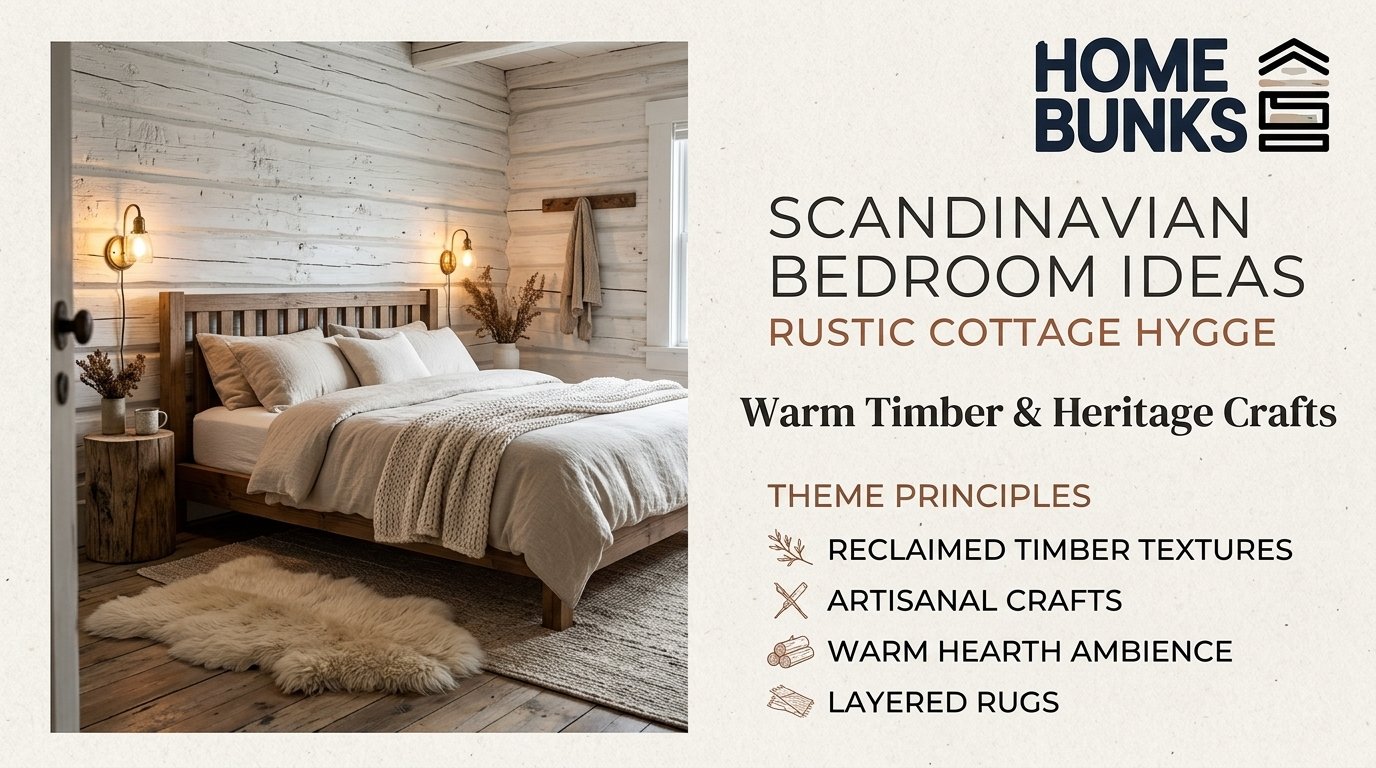
Check the sample at 8 a.m. and again under evening lamps before making a final choice. Daylight reveals cool undertones, while warm lamps reveal cream and yellow shifts.
Live with the sample for two days when possible, because first impressions often change with weather and lamp use. A calm choice after two days usually survives longer than a rushed favourite.
Test paint and textile samples together in the actual bedroom, not separately in a shop. White can read blue beside warm timber, and grey can shift noticeably under warm bedside lamps.
Choose Light Wood That Lasts
Light wood gives Scandinavian bedrooms warmth, nature, and structure without dark heaviness. Birch, ash, oak, and pine each offer different hardness, grain, colour, and dent resistance.
Birch offers pale colour, fine grain, and Finnish design heritage in beds, shelves, and small furniture. Birch suits clean lines and light rooms, and pairs well with linen and wool.
Ash offers pale colour, visible grain, and good strength for bed frames, nightstands, and tables. Ash handles daily use well and keeps a light, natural appearance.
Oak offers warm pale tones, strong grain, and durable surfaces for floors and larger furniture. Light oak floors bounce light well, while white oak furniture adds warmth without darkness.
Pine offers soft pale wood at a lower cost, but pine dents more easily than birch, ash, or oak. Pine suits bed frames and shelves better than high-traffic floors.
Wood Hardness and Dent Risk
Wood hardness helps predict dent risk, especially under chair legs, heels, and heavy furniture. Harder woods resist dents better, while softer woods show marks sooner.
Yellow birch measures harder than Scots pine on standard hardness scales cited by wood databases. That difference matters most on floors, where feet, chairs, and dropped objects strike daily.
Keep pine for bed frames, shelves, and low-impact furniture when dent risk matters. Choose harder wood for floors, desk tops, and surfaces that receive frequent contact.
Whitewashed boards and light oak parquet offer pale floors with more pattern and durability. Herringbone parquet adds visual interest without colour, pattern overload, or dark weight.
Protect wood floors with felt pads, rugs, and careful chair use regardless of species. Pale floors show marks more clearly, so prevention matters more than repair.
One Dominant Wood Rule
Choose one dominant wood tone and repeat it across bed, nightstands, and shelving. One dominant tone connects the room, while several equal tones compete for attention.
Allow one second wood tone only when it supports the dominant tone through contrast or warmth. Two related woods coordinate more easily than several unrelated finishes.
Separate floor tone from furniture tone slightly to prevent a flat, washed-out result. Matching floor and furniture tones exactly often removes depth from pale rooms.
Repeat the dominant wood in two or three places to make mixed tones look intentional. A wooden tray, mirror frame, or bench can echo the bed frame without matching every piece.
Keep existing dark furniture when possible by simplifying what sits on it and repeating one compatible wood or textile elsewhere. Cohesion matters more than owning a complete matching set.
Choose the Bed and Furniture
The bed anchors the room visually and functionally, so bed height, frame material, and headboard choice deserve early decisions. Low frames suit Scandinavian proportions, while tall frames can dominate small rooms.
Low platform beds create calm, horizontal lines and keep the floor visible around the bed. Platform beds also suit storage drawers, though drawers add visual weight compared with legs.
Beds on legs look lighter and less dominant in small and medium rooms. Legs reveal floor beneath the bed, but that lightness trades away under-bed storage space.
Upholstered headboards add softness and a focal point for reading and resting. Some Scandinavian guidance prefers low or no headboard, so treat headboard choice as a preference, not a rule.
Metal frames often clash with the wood-led palette in Scandinavian bedrooms. Wood frames, upholstered frames in neutral fabric, and simple wooden headboards fit the system better.
Nightstands, Dressers, and Wardrobes
Nightstands should stay plain, unembellished, and natural wood in most Scandinavian bedrooms. Simple drawers or shelves hold essentials without ornate hardware or dark finishes.
Match nightstand wood to bed wood when possible, or repeat the dominant wood through a tray or lamp base. Matching wood creates calm, while clashing wood creates visual noise.
Dressers should follow the same clean-line rule with simple fronts, minimal hardware, and light finishes. A dresser top should stay mostly clear, with one or two useful objects only.
Built-in wardrobes with flush doors hide clutter best in small and primary bedrooms. Flush doors remove visual breaks, while mirrored doors can bounce light when placed carefully.
Open clothing racks suit only calm, limited wardrobes with neutral clothes and consistent hangers. Open racks fail quickly when clothes, colours, and accessories pile up without discipline.
Benches, Chairs, and Reading Corners
A simple wooden bench at the foot of the bed adds seating, storage, and a clean Scandinavian touch. Benches suit larger rooms better than small rooms, where floor space matters more.
A reading armchair near a window creates a cozy corner without filling the room. Choose light fabric, simple lines, and a small side table with a warm lamp.
Two light armchairs can form a reading pair in larger primary bedrooms with generous floor space. Small rooms usually suit one chair, not a pair competing with bed clearance.
Keep reading corners textile-led with a wool throw, a cushion, and warm light. Reading corners fail when chairs become dumping spots for clothes, bags, and laundry.
Avoid extra chairs, stools, and decorative furniture when floor space already feels tight. One useful seat beats several decorative seats that block movement and collect clutter.
Layer Bedding for Warmth, Not Bulk
Bedding carries most Scandinavian warmth, because the bed dominates the room and receives daily touch. Layer texture in a clear order, then stop before the bed looks stacked or busy.
Start with a fitted sheet and duvet in a light neutral tone to set the palette. White, oatmeal, bone, or soft grey bases support every later layer without colour conflict.
Add a woven layer next, such as a linen or waffle-weave coverlet folded at the foot. Woven texture adds grain and shadow without adding strong colour or pattern.
Add a soft layer after the woven layer, such as a wool throw, chunky knit throw, or deep-pile blanket. Soft layers provide the warmth people reach for on cold mornings.
Finish with depth through one textured throw rather than several competing throws. Ribbed, rolled, or chunky textures cast soft shadows that keep neutral beds from looking flat.
Linen Compared With Cotton Bedding
Linen bedding suits Scandinavian bedrooms through texture, breathability, and a lived-in look. Linen wrinkles naturally, softens with washing, and pairs well with pale wood.
Cotton bedding suits Scandinavian bedrooms through smoothness, lower cost, and easier care. Cotton feels crisp, washes simply, and suits sleepers who dislike linen texture or wrinkles.
Price ranges differ by material and quality, with linen sets often costing more than cotton sets at similar sizes. Verify current prices live before budgeting, because retailer prices change frequently.
Linen lasts longer with careful washing, but linen can shrink in warm or hot water. Cotton often needs replacement sooner, though cotton handles frequent washing more predictably.
Choose linen for texture and longevity, cotton for smoothness and budget, then keep the colour neutral. Material choice matters more than thread count claims or marketing language.
Pillow Count and Bed Layer Ceiling
Three to four bed layers usually form the ceiling for Scandinavian bedding: base sheet and duvet, one woven layer, and one soft layer. More layers often tip calm rooms into busy rooms.
Two to three cushions in muted tones usually suit a Scandinavian bed better than a large cushion collection. Cushions should echo bedding tones, not introduce competing colours or patterns.
Fold throws in thirds across the foot for a tailored look, or drape one corner loosely for relaxed warmth. Smooth placement suits tailored rooms, while loose bunching can read as clutter.
Swap throw weight by season rather than swapping colour across the whole room. Lighter throws suit warm months, while heavier wool throws suit cold months without changing palette.
Remove one layer when the bed looks stacked instead of adding another decorative pillow. Calm beds invite rest, while stacked beds invite tidying before sleep.
Choose the Rug by Bed Size
Rug size decides whether a rug grounds the room or looks like an afterthought. A rug that stops short under the footboard breaks proportion, even when colour and texture suit the room.
Extend rugs at least 18 inches past each bed side as a practical starting rule cited by several Scandinavian guides. Larger extensions suit larger rooms, while smaller extensions suit tight rooms.
Measure bed width before rug shopping, because rug length and width must relate to bed size, not to shop display size. A queen bed needs a larger rug than a twin bed, even in similar rooms.
Place rugs under the lower two-thirds of the bed when full under-bed coverage feels too large or costly. Front legs and side extensions still need enough rug to step onto softness.
Use one main rug rather than several small rugs in most Scandinavian bedrooms. One rug creates a clear zone, while scattered small rugs create visual breaks and trip risks.
| Bed size | Rug starting point | Extension guidance |
|---|---|---|
| Twin bed | Narrow rug beside bed or under lower portion | At least 18 inches past one side |
| Full bed | Medium rug under lower two-thirds | At least 18 inches past both sides when space allows |
| Queen bed | Large rug under bed and sides | At least 18 inches past both sides |
| King bed | Extra large rug under bed and sides | At least 18 inches past both sides, more in large rooms |
Flat-Weave, Wool, and Sheepskin Rugs
Flat-weave wool rugs suit Scandinavian bedrooms through durability, low pile, and clean lines. Flat-weave rugs handle foot traffic well and pair with light wood floors.
Sheepskin rugs suit Scandinavian bedrooms through softness, warmth, and tactile comfort. Sheepskin works beside beds, beside reading chairs, and layered over larger flat-weave rugs.
Wool rugs shed loose fibres during early months, and several rug guides describe early shedding as normal for handmade wool. Shedding should slow over time, not continue indefinitely.
Jute rugs add natural texture and warmth, but jute feels rougher under bare feet than wool. Jute suits layered looks and high-traffic zones better than primary barefoot zones.
Choose rug texture by barefoot comfort first, then by colour and pattern. A beautiful rug fails when nobody enjoys stepping onto it each morning.
Rug on Carpet and Dark Floor Rules
Rugs on carpet need low pile and firm backing to avoid bunching, sliding, and uneven edges. Flat-weave rugs usually sit better on carpet than thick, soft rugs.
Dark floors benefit from large pale rugs that bounce light upward into walls. A large pale flat-weave rug often brightens a room more than a second lamp.
Check the lower third of a room photograph to judge floor darkness quickly. When the lower third looks dark, the whole bedroom reads heavy regardless of white walls.
Layer sheepskin over a pale flat-weave rug for warmth without replacing a dark floor. Layering adds softness while keeping the pale base that reflects light.
Anchor rugs with furniture legs or rug pads to prevent sliding on hard floors. Sliding rugs create safety risks and break the calm, grounded feeling.
Light the Room in Layers
Layered lighting replaces one harsh ceiling fixture with ambient, task, and accent light. Multiple warm sources create depth, flexibility, and cozy evening atmosphere.
Ambient light provides general glow across the room without bright glare. Low-output lamps, dimmers, and warm bulbs suit bedrooms better than single bright ceiling lights.
Task light supports reading, dressing, and bedside use through wall lights, table lamps, or floor lamps. Task light should focus where needed, not flood the whole room.
Accent light highlights one corner, artwork, or plant through a small lamp or candle-style light. Accent light adds warmth and depth without increasing overall brightness.
Ceiling fixtures become optional when ambient, task, and accent layers cover the room. A simple pendant can still work, provided dimmers and warm bulbs control glare.
Ambient, Task, and Accent Lighting
Ambient lighting should feel soft and even, not bright enough for detailed work. Dimmable lamps, shaded fixtures, and warm bulbs help ambient light stay gentle.
Task lighting should sit close to the activity, such as beside the bed for reading. Wall-mounted reading lights free bedside surfaces and reduce clutter.
Accent lighting should stay low and warm, such as a small table lamp in a corner. Accent light creates glow without competing with task light or ambient light.
Use one or two matching warm fixtures rather than several mixed styles and bulb temperatures. Matching finishes and warmth keep lighting calm and intentional.
Test lighting with the ceiling light off before finalising lamp placement. A room that only works with overhead light still needs better layers.
Kelvin, Dimmers, and Pendant Choices
Colour temperature, measured in Kelvin, shapes evening mood more than brightness alone. Lower Kelvin values look warmer, while higher Kelvin values look cooler and more alerting.
Ambient and bedside lamps suit 2700K as a practical starting point for warm evening light. Reading lights can use 3000K for clearer focus without turning the whole room cool.
Lighting sources disagree on exact bedroom ranges, with some guides favouring lower warmth and others favouring slightly higher warmth. Present ranges as guidance, not as medical rules.
Warm-dim bulbs grow warmer as they dim, mimicking older incandescent dimming behaviour. Warm-dim technology suits bedrooms where evening light should soften gradually.
Pendant lights suit Scandinavian bedrooms when shades diffuse light softly and hang at comfortable heights. Ceramic, paper, and fabric shades diffuse light better than bare bulbs.
Louis Poulsen pendant history illustrates glare control, because early pendant designs shaped light to reduce direct glare. Modern pendants should still prioritise diffusion over bare brightness.
Avoid cool light above 4000K in bedrooms when warm, restful evening light matters. Cool light feels clinical in pale rooms and competes with wood and textile warmth.
Dress the Windows for Daylight
Windows deserve priority in Scandinavian bedrooms, because daylight defines the style more than decoration. Sheer curtains, pale frames, and clear sills maximise light without heavy drapery.
Sheer linen curtains filter daylight softly while preserving privacy and brightness. Sheer curtains suit tall windows, small windows, and rooms with limited daylight.
Floor-length curtains create vertical softness and elongate walls when hung high and wide. Curtains should touch the floor lightly, not pool heavily or stop awkwardly above the sill.
Avoid heavy drapery, dark curtains, and thick valances in most Scandinavian bedrooms. Heavy window treatments block daylight, darken walls, and contradict the light-first system.
Keep window sills mostly clear with one plant or one small object at most. Clear sills let light enter freely and keep the room feeling open.
Curtain Width, Drop, and Privacy
Measure curtain width and drop before ordering, because ready-made sizes often miss tall or wide windows. Width should cover the window plus wall return, while drop should reach floor length.
Hang curtains high and wide to make windows look larger and admit more light. High rods draw eyes upward, while wide rods prevent curtains from blocking glass when open.
Layer sheer curtains with blinds or shades when privacy or darkness matters at night. Sheers handle daylight, while blinds or shades handle night privacy and sleep darkness.
Choose light linen or cotton sheers in white, oatmeal, or soft grey. Heavy patterns, dark colours, and shiny fabrics compete with pale walls and wood.
Check curtain fabric in daylight and lamplight before committing to full window coverage. Sheer fabric can shift colour under warm lamps, just like wall paint.
Store Everything Out of Sight
Storage decisions protect Scandinavian calm more than decoration decisions, because visible clutter breaks pale, simple rooms quickly. Solve storage before styling surfaces.
Built-in wardrobes with flush doors offer the cleanest storage solution for primary bedrooms. Flush doors remove visual breaks, while internal organisers handle clothes, shoes, and accessories.
One wardrobe wall often feels lighter than several small cabinets scattered around a room, even when the wardrobe wall stores more. Concentrated storage reduces visual breaks.
Under-bed drawers suit platform beds and hide seasonal clothes, spare bedding, and shoes. Check drawer clearance carefully, because drawers need full opening space beside the bed.
Lift-up storage beds suit larger rooms with clear side access and strong lifting mechanisms. Lift-up beds fail in tight rooms where side clearance prevents easy opening.
Bedside Surfaces and Cable Control
Bedside surfaces should hold only essentials: one lamp, one book, and one small personal item. Chargers, medicines, and clutter belong inside drawers or closed boxes.
Wall-mounted lights free bedside surfaces and suit small rooms with narrow shelves. Floating shelves can replace nightstands when surface space runs short.
Hide cables behind furniture, inside drawers, or through cable channels before styling bedside tables. Visible cables create visual noise that undermines simple furniture and pale walls.
Assign charging points inside drawers or behind nightstands to keep phones and cables out of sight. Charging stations should support daily use without dominating the bedside view.
Clear bedside surfaces each evening as a simple habit that protects the Scandinavian look. Five minutes of clearing beats constant redecoration or storage purchases.
Open Shelves and Display Limits
Open shelves suit limited, calm displays with neutral ceramics, books, and wooden accents. Open shelves fail when everyday items, colours, and shapes pile up without order.
Limit open display to one or two shelves with breathing space between objects. Crowded shelves read as storage overflow, not as intentional decoration.
Group essentials together in closed boxes before placing decorative objects on shelves. Closed boxes hide visual noise, while open baskets often display clutter through gaps.

Remove duplicate small objects first when a room feels cluttered, before removing useful furniture. Three small lamps, several tiny baskets, or multiple competing prints create more noise than one larger useful piece.
Keep what supports sleep, storage, and lighting, then give those objects enough empty space. Useful objects deserve display space, while purely decorative clutter deserves removal.
Add Art, Plants, and Personal Pieces
Art, plants, and personal pieces finish Scandinavian bedrooms without filling every wall or surface. Choose few, larger pieces rather than many small, competing objects.
One large artwork above the bed creates a clear focal point and lets other walls stay quiet. Large art suits bed walls best, because bed walls already carry visual weight.
One tight grid in simple matching frames offers an alternative focal point for photograph or print collections. Matching frames matter more than image variety for calm results.
Scattered mismatched small frames break the calm rule more than one large piece or one tight grid. Mismatched frames create visual noise across walls that should stay quiet.
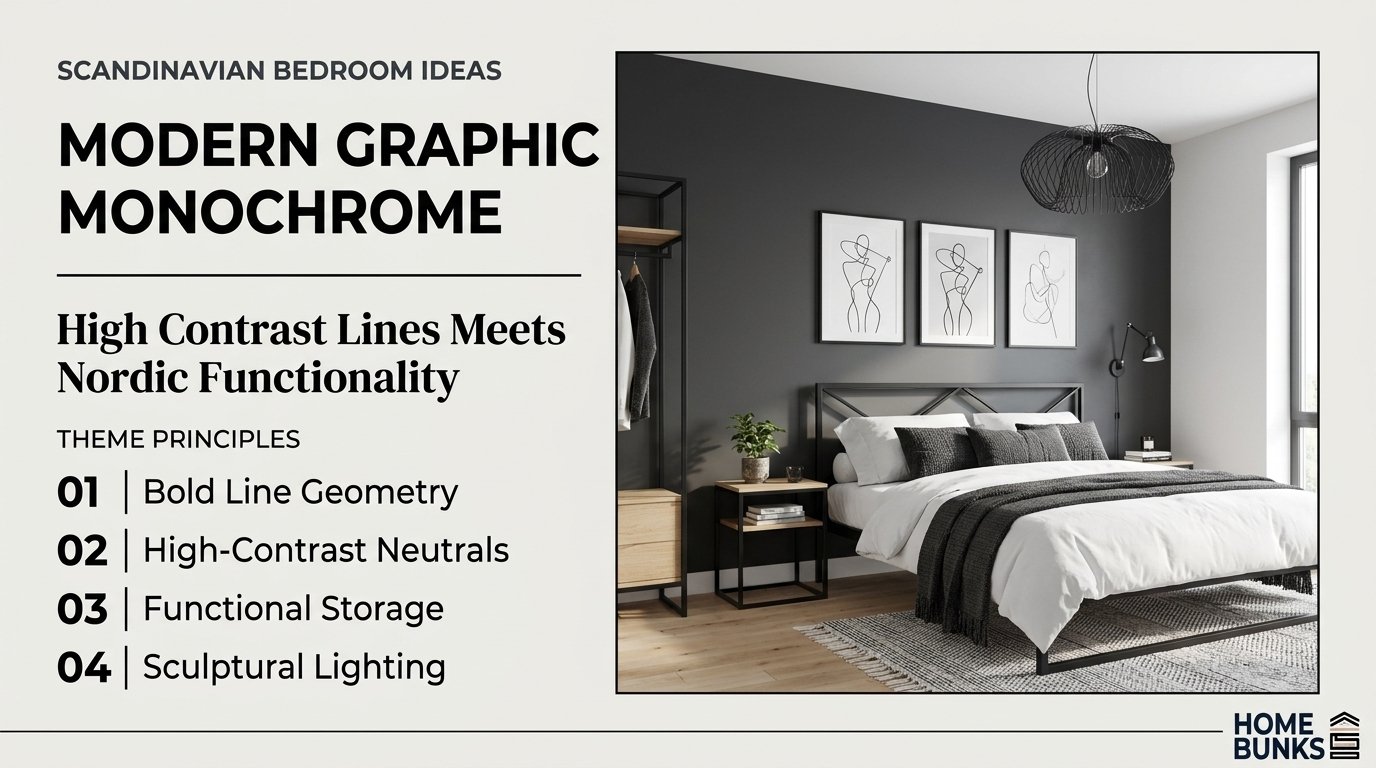
Geometric black-and-white art suits Scandinavian bedrooms through simple contrast without strong colour. Black frames add definition, while white mats keep prints light.
Plants Matched to Bedroom Light
One or two plants usually suit a Scandinavian bedroom better than a large indoor jungle. Plants soften corners, add green life, and connect rooms to nature without clutter.
Match plant species to actual bedroom light, not to photographs or shop displays. North rooms suit low-light plants, while south rooms suit brighter-light plants.
Place plants in ceramic pots with simple, neutral finishes that echo bedding and wood tones. Terracotta, white ceramic, and muted stone pots suit Scandinavian rooms best.
Trailing plants suit shelves and high surfaces when floor space runs short. Floor plants suit corners with enough light and clearance from walkways.
Check pet safety before choosing bedroom plants, because some common houseplants pose risks to cats and dogs. Pet-safe choices matter more than trending plant names.
| Bedroom light | Plant approach | Placement tip |
|---|---|---|
| North, low light | Low-light tolerant plants only | Near brightest window, not dark corners |
| East, morning light | Moderate light plants | Morning sun spot, away from harsh afternoon glare |
| South, strong light | Bright light plants with care | Filtered light through sheer curtains |
| West, afternoon light | Moderate to bright plants | Avoid direct hot afternoon sun on leaves |
Personal Pieces Without Clutter
Personal pieces should tell one clear story, such as travel, family, craft, or reading. One meaningful object beats several generic decorations with no personal connection.
Choose one distinctive lamp, artwork, or muted accent colour to prevent generic neutral rooms. Personal touches should stand out gently, not compete with every other element.
Use trays to group small essentials into one intentional zone on dressers or nightstands. Trays contain visual noise and make small objects look deliberate.
Use mirrors to bounce light and create dressing stations without extra furniture. One tall mirror suits most bedrooms better than several small mirrors.
Rotate personal pieces seasonally when collections grow beyond display limits. Rotation keeps rooms fresh without expanding display space or storage pressure.
Small Scandinavian Bedroom Layouts
Small Scandinavian bedrooms succeed through floor protection, not furniture reduction alone. Low furniture, wall-mounted lights, and concentrated storage matter more than tiny decorative pieces.
Place the bed on the longest wall whenever possible, because longest walls support balanced bedside access and clear walkways. Longest-wall placement also leaves other walls for storage.
Protect the entry side walkway first, then trim the far side when space runs short. Entry-side clearance supports daily use, dressing, and bed making.
Use narrow bedside shelves or wall-mounted lights when conventional nightstands crowd the room. Narrow shelves hold essentials without blocking movement.
Choose storage beds with clear drawer clearance when closet space runs short. Storage beds reduce cabinet needs, but drawers must open fully without hitting walls or doors.
Small Room Furniture Choices
Low-profile furniture keeps small rooms feeling open by revealing more wall and floor. Low beds, low dressers, and low benches suit small rooms better than tall, bulky pieces.
Wall-mounted lighting releases bedside surfaces entirely in very small rooms. Sconces, pendants, and reading lights free surfaces for books, glasses, and water.
Floating shelves suit small rooms when contents stay calm and limited. Floating shelves fail when books, clothes, and personal items pile up without closed storage.
One wardrobe wall beats several small cabinets in small rooms, even when wardrobe walls store more. Concentrated storage reduces visual breaks and floor clutter.
Avoid decorative benches and extra chairs when small rooms already feel tight. Floor space for movement beats decorative seating that blocks routes.
Texture Vertically in Small Rooms
Use curtains, headboards, and wall art vertically to add warmth without adding floor objects. Vertical texture suits small rooms because walls offer unused visual space.
Hang curtains high to elongate walls and draw eyes upward in low or small rooms. High curtains make windows and ceilings feel taller without structural changes.
Use one large artwork instead of many small prints to add personality without wall clutter. Large art anchors walls, while small prints scatter attention.
Use tall mirrors leaning against walls to bounce light and expand visual space. Leaning mirrors suit small rooms better than wall-mounted mirrors that require drilling.
Keep floors mostly clear with furniture and one rug only. Clear floors make small rooms feel larger, while scattered objects make small rooms feel crowded.
Dark Scandinavian Bedroom Rules
Dark Scandinavian bedrooms can feel cozy and restful when contrast, light, and texture stay intentional. Dark rooms fail when walls, furniture, bedding, and floors share the same darkness.
Preserve separation between walls, bedding, floor, and furniture in every dark room. Pale bedding, natural wood, lighter rugs, and warm lamps prevent flat, heavy blocks.
Use dark colour on one or two surfaces, such as one accent wall or a headboard wall. Whole-room dark colour needs strong daylight, large windows, and generous lamp layers.
Pair dark walls with pale bedding to create immediate contrast and brightness. Pale bedding reflects lamplight, while dark bedding absorbs light and deepens heaviness.
Pair dark walls with light wood furniture to prevent furniture from disappearing into walls. Light wood frames, nightstands, and floors create separation and warmth.
Dark Walls, Pale Layers, and Warm Light
Charcoal and deep grey suit dark Nordic rooms with strong daylight and warm lamps. Charcoal walls need pale bedding, warm timber, and amber light to stay inviting.
Deep green and navy accents suit dark branches when paired with pale bedding and wood. Deep colours should appear as accents, not as competing whole-room systems.
Warm lamps matter more in dark rooms than in bright rooms, because dark surfaces absorb light. Multiple warm lamps, dimmers, and pendant lights prevent gloomy corners.
Use amber-toned light at night to enhance dark room coziness without harsh brightness. Amber light suits evening rest, while cool light fights dark wall warmth.
Check dark rooms at night before finalising paint, because dark walls shift dramatically under lamps. A dark wall that looks rich in daylight can look flat under cool light.
When Dark Scandinavian Rooms Fail
Small rooms with one north window rarely support dark walls across all surfaces. Dark paint swallows limited light and removes the brightness Scandinavian design depends on.
Rooms with dark floors and dark furniture need extra pale layers to avoid heaviness. Pale rugs, pale bedding, and light wood become essential, not optional.
Rooms with weak lamp layers fail in dark schemes faster than bright schemes. Add lamps before darkening walls, because dark walls expose lighting gaps.
Rooms with cluttered surfaces feel heavier in dark schemes, because dark backgrounds highlight objects. Clear surfaces and closed storage matter more in dark rooms.
Choose a dark accent wall instead of whole-room dark paint when light, size, or lamps create doubt. Accent walls deliver contrast with lower risk than full dark rooms.
Rental Scandinavian Bedroom, No Paint
Rental bedrooms can achieve Scandinavian warmth without painting walls, floors, or permanent fixtures. Textiles, lamps, wood accents, and removable options carry the style.
Start with bedding, rugs, and curtains as the largest removable changes. Linen bedding, wool rugs, and sheer curtains transform rooms without touching walls.
Add warm plug-in lamps for table and floor lighting when ceiling fixtures feel harsh. Plug-in lamps avoid wiring changes and move easily between rentals.
Use leaning mirrors against walls to bounce light without drilling large fixings. Leaning mirrors suit rental rules better than heavy wall-mounted mirrors.
Use wooden trays, mirror frames, and small wood accents to introduce pale wood without replacing furniture. Wood accents connect bedding, lamps, and existing furniture.
Removable Wall Options and Landlord Rules
Peel-and-stick wallpaper can cover one wall in some rentals, but landlord rules and wall condition vary widely. Check lease terms, test removal, and photograph walls before installation.
Hang one linen panel above the bed as a soft headboard substitute with minimal fixings. Linen panels add texture and warmth without paint, wallpaper, or large holes.
Use removable hooks and picture strips within weight limits for lightweight art and mirrors. Heavy mirrors and shelves need landlord approval and proper fixings.
Photograph walls, floors, and fixtures at move-in to protect deposits and document existing marks. Photographs also help restore rooms accurately at move-out.
Avoid toothpaste, tape, or improvised hole fillers as professional repair methods, because landlords may reject improvised fixes. Use proper filler and paint matching when lease terms allow repairs.
Rental Budget and Weekend Setup
Rental setups can start with a few hundred dollars when beds and lamps already exist, according to competitor-reported rental guides. Verify current prices live before budgeting, because prices change.
Prioritise bedding, one rug, and two warm lamps for the fastest rental transformation. Those three changes affect daily comfort, light, and texture immediately.
Add a leaning mirror, high curtains, and layered creams over following weeks for gradual improvement. Staged changes prevent rushed purchases and allow light testing.
Keep rental purchases portable so bedding, rugs, lamps, and mirrors move to future homes. Portable purchases protect budgets better than rental-specific built-ins.
Skip paint, floors, and permanent storage in rentals unless landlords approve changes in writing. Portable style choices preserve deposits and future flexibility.
Couples, Guest, Kids, and Teen Branches
Room branches share Scandinavian principles, yet each branch changes symmetry, durability, storage, and washability. Couples need balance, guests need simplicity, kids need durability.
Couples bedrooms benefit from matching nightstands and lamps on both bed sides. Matching bedside systems create balance, even when partners prefer different books or devices.
Provide two charging points, two bedside surfaces, and two lamps for couples sharing one room. Shared rooms fail when one side lacks light, storage, or charging access.
Protect walkways on both sides of larger beds when couples share king or queen beds. Both partners need comfortable entry, exit, and bed-making access.
Choose washable bedding layers for guest rooms to simplify turnover between visitors. Guest rooms suit simple layers, clear surfaces, and one warm lamp per side.
Guest Room Simplicity
Guest rooms should feel calm, clean, and easy to use without personal clutter or complex systems. Clear surfaces, fresh bedding, and simple instructions support visitors.
Provide one wardrobe or closet space, one mirror, and one lamp as guest essentials. Guests need storage, light, and dressing space more than decoration.
Use neutral bedding with one wool throw for guest comfort across seasons. Guests can add or remove throws without changing the whole room system.
Keep guest room art simple and quiet, with one large piece or one tight grid. Guest rooms should feel welcoming, not personalised to the host alone.
Check guest room lighting at night before visitors arrive, because guests lack familiarity with switches and lamps. Clear lamp placement prevents fumbling in dark rooms.
Kids and Teen Durability
Kids bedrooms need washable, durable layers that survive play, spills, and frequent washing. Linen blends, cotton bedding, and washable rugs suit kids better than delicate sheepskin alone.
Teen bedrooms need storage for study, clothes, and personal items without losing Scandinavian calm. Closed storage, desk zones, and cable control matter more than decoration.
Choose rounded furniture edges, stable lamps, and secure shelves for kids rooms. Safety and stability matter more than delicate design details in family bedrooms.
Allow one personal accent colour or artwork for kids and teens to express identity. Personal accents should stay limited to bedding, art, or cushions, not whole-room colour.
Use darker, washable rug options in kids rooms when pale rugs face heavy use. Darker rugs still suit Scandinavian rooms when bedding, wood, and lamps stay pale.
Scandinavian Bedroom Budget, Verified Live
Budget decisions should follow comfort impact, not decoration impact. Mattress, bedding, window treatment, and lighting affect daily sleep and use more than decorative objects.
Spend on mattress and bedding first, because sleep quality depends on those layers every night. A good mattress and comfortable bedding beat designer stools or vases.
Spend on one good lamp second, because evening light shapes mood and rest. One warm, dimmable lamp improves more evenings than several decorative objects.
Save on frames, ceramics, and extra cushions when budgets run tight. Simple frames and ceramics support the look without designer prices.
Treat paint as the cheapest large change, because wall colour transforms rooms for relatively low cost. Paint still requires sampling, because wrong undertones waste time and money.
Refresh, Replace, and Full Room Tiers
Refresh tiers suit rooms with usable furniture and focus on bedding, rug, lamps, and paint. Refresh tiers deliver visible change without replacing beds or storage.
Replace tiers suit rooms with worn beds or bedding and focus on bed frame, mattress, bedding, and lighting. Replace tiers improve sleep and structure together.
Full room tiers suit empty rooms or major renovations and include bed, storage, lighting, paint, rug, and textiles. Full room tiers need room audits first to avoid mismatched purchases.
Verify every tier price live at purchase time, with retailer, date, and delivery terms. Competitor-reported prices change frequently and should never serve as current quotes.
Stage full room purchases by comfort impact: mattress and bedding, lighting, paint, bed frame, storage, then decoration. Staging prevents budget exhaustion before comfort improves.
Spend and Save Decisions
Spend where daily touch occurs: mattress, bedding, rug underfoot, and lamp switches. Daily touch justifies higher quality and durability.
Save where visual impact stays low: frames, ceramics, trays, and extra cushions. Simple versions support the look without premium prices.
Save on extra cushions entirely when budgets tighten, because cushions add little sleep value. Two or three cushions suffice for most Scandinavian beds.
Spend on window treatments when daylight control matters, because sheer curtains and shades affect privacy, light, and sleep. Poor window treatments undermine pale walls and bedding.
Avoid designer-looking decorative objects when sleep, storage, or lighting still feel inconvenient. Decorative impact cannot compensate for uncomfortable beds or dark bedside areas.
Care Guide: Linen, Wool, Wood, and Rugs
Care decisions protect Scandinavian investments, because pale textiles and light wood show wear clearly. Follow care labels first, then general material guidance.
Wash linen in cool water to limit shrinkage and preserve fibre strength. Linen can shrink in warm or hot water, according to textile guidance cited by several guides.
Remove linen from dryers slightly damp and hang to finish drying for fewer wrinkles. Linen wrinkles naturally, and damp hanging limits harsh creases without ironing every piece.
Wash cotton bedding according to label temperatures and avoid excessive heat that weakens fibres. Cotton handles frequent washing well, though colours fade with harsh detergents.
Follow wool care labels carefully, because wool care varies by weave, finish, and blend. Some wool throws need gentle cycles, while others need dry cleaning or hand washing.
Wool, Sheepskin, and Boucle Care
Shake wool rugs outdoors regularly to remove dust and loose fibres without harsh vacuuming. Gentle vacuuming without beater bars suits many wool rugs better than aggressive brushing.
Treat wool shedding as normal during early months for handmade wool rugs, according to rug retailer guidance. Persistent heavy shedding after months deserves retailer or maker advice.
Brush sheepskin gently and spot clean rather than soaking or machine washing without label approval. Sheepskin care varies by product, so label guidance overrides general advice.
Keep boucle cushions away from rough surfaces that snag loops and pull fibres. Boucle texture adds warmth, but boucle loops catch on jewellery, zips, and rough wood.
Rotate rugs regularly to distribute wear, sunlight, and foot traffic evenly. Rotation prevents faded patches and uneven pile in high-traffic bedroom zones.
Light Wood and Jute Care
Dust light wood with soft, dry cloths and avoid soaking wood surfaces. Excess water damages finishes, raises grain, and stains pale wood more visibly.
Use coasters, trays, and felt pads to protect wood nightstands, dressers, and floors. Prevention protects pale wood better than sanding or refinishing after damage.
Clean jute rugs by vacuuming and spot cleaning without soaking fibres. Jute absorbs moisture slowly and dries slowly, so wet cleaning risks mould and odour.
Keep light wood away from prolonged direct sunlight when possible, because sunlight shifts pale wood tones unevenly. Sheer curtains filter sunlight while preserving daylight.
Repair small wood marks promptly with maker-approved touch-up methods rather than improvised stains. Improvised stains can darken pale wood unevenly and worsen appearance.
Mistakes That Break the Look
Sterile rooms result from too many smooth white surfaces without texture, wood, or warm light. Add bedding texture, curtains, timber, and rugs before adding decoration.
Cluttered rooms result from small objects spread across every surface, not from useful furniture. Group essentials, move extras into closed storage, and reassess before removing furniture.
Generic rooms result from following one neutral formula without personal touches. Add one personal artwork, distinctive lamp, or muted accent colour to create identity.
Heavy dark rooms result from walls, furniture, and textiles sharing the same value. Introduce lighter layers through bedding, flooring, curtains, or lamps to restore depth.
Crowded small rooms result from too many floor-standing pieces competing for limited space. Replace one floor piece with wall-mounted lighting, shelving, or narrower surfaces.
Fix a Sterile Room
Add one substantial textile layer first, such as a wool throw or chunky knit blanket. Substantial textiles add warmth faster than several small accessories.
Add wood through a tray, mirror frame, or bench to break smooth white surfaces. Wood grain adds natural variation that paint and fabric alone cannot provide.
Add warm lamps and dimmers to soften evening light and reveal textile texture. Warm light changes pale rooms more than additional white objects.
Add one plant in a ceramic pot to introduce life and organic shape. Plants soften corners without adding colour overload or pattern noise.
Remove one smooth white object when texture additions still feel insufficient. Sterile rooms often need subtraction of smooth surfaces, not addition of decor.
Fix a Cluttered or Generic Room
Remove duplicate small objects first, including extra lamps, baskets, and competing prints. Duplicates create noise even when each object looks attractive alone.
Clear bedside surfaces completely, then rebuild with essentials only. Rebuilding from clear surfaces reveals true needs versus accumulated habits.
Choose one accent colour and repeat it lightly to fix generic neutral rooms. Accent repetition creates intention, while random colours create confusion.
Choose one distinctive lamp or artwork to fix rooms that feel like catalogue copies. Distinctive pieces should still respect palette, wood, and light rules.
Reassess after each removal or addition, because small changes shift balance quickly. Patient editing beats wholesale redecoration for most cluttered rooms.
Scandinavian Compared With Other Styles
Style comparisons prevent costly mixing mistakes, because Scandinavian, minimalist, Japandi, boho, and farmhouse share some traits. Shared traits do not make styles interchangeable.
Scandinavian design prioritises light, pale wood, and cozy textiles within a restrained system. Minimalist design prioritises reduction, sometimes at the expense of warmth.
Japandi design blends Japanese and Scandinavian restraint with lower furniture, darker woods, and stricter display limits. Japandi palettes shift warmer and earthier than classic Scandinavian palettes.
Boho design layers pattern, colour, and collected objects into a rich, personal system. Boho opposes Scandinavian restraint, even when both styles use natural materials.
Farmhouse design uses rustic, vintage, and country cues that overlap Scandinavian light only in the Scandinavian farmhouse branch. Classic farmhouse distressing and signage differ sharply from Scandinavian simplicity.
| Style | Base palette | Wood tone | Textile approach | Display approach |
|---|---|---|---|---|
| Scandinavian | Warm white, greige, muted accents | Pale birch, ash, oak | Linen, wool, layered warmth | Few large pieces, closed storage |
| Minimalist | White, grey, black accents | Pale or dark, simple forms | Minimal layers, cool restraint | Very few objects, empty surfaces |
| Japandi | Warm greige, clay, charcoal, olive | Pale plus darker woods | Stone-washed linen, fewer layers | Stricter limits, crafted objects only |
| Boho | Warm neutrals plus rich colour | Mixed woods, rattan | Layered pattern, many textiles | Collected, layered, abundant display |
| Farmhouse | White, cream, muted colour | Distressed, reclaimed, dark accents | Cotton, linen, vintage layers | Vintage signs, collections, rustic objects |
| Mid-century modern | White, warm wood, retro colour | Walnut, teak, warm woods | Simple fabrics, graphic shapes | Iconic pieces, tapered legs |
Scandinavian Farmhouse Branch
Scandinavian farmhouse blends light Scandinavian bases with farmhouse warmth, but the blend remains a branch, not the whole style. Light walls, pale wood, and simple lines dominate the blend.
Avoid barnyard kitsch, heavy distressing, and every-sign decor in Scandinavian farmhouse rooms. Kitsch and heavy distressing push rooms toward classic farmhouse, not Scandinavian calm.
Use shiplap sparingly, usually on one accent wall, rather than all walls in small rooms. One accent wall adds texture without overwhelming light or space.
Use matte black hardware sparingly for modern farmhouse contrast, not as a dominant system. Black hardware should accent pale wood, not compete with it.
Keep farmhouse branches distinct from pure Scandinavian rooms when planning multiple pages or rooms. Distinct branches prevent style confusion and duplicated decisions.
Japandi Branch in Detail
Japandi bedrooms borrow Scandinavian restraint and add Japanese influence through lower furniture, darker accent woods, and earthier palettes. Japandi rooms feel grounded and calm.
Lower platform beds suit Japandi proportions better than mid-height upholstered beds. Low beds create horizontal calm and emphasise floor space.
Darker accent woods add weight and contrast against pale Scandinavian bases. Dark woods should accent, not dominate, otherwise rooms shift toward Japanese minimalism alone.
Display limits tighten in Japandi rooms, with fewer objects and more negative space. One handmade ceramic piece per surface often suits Japandi better than grouped displays.
Choose Scandinavian or Japandi as a primary direction before shopping, because mixed directions create furniture height and wood conflicts. One direction guides bed height, wood, and display consistently.
Decision System for Every Room
A decision system beats a shopping list for Scandinavian bedrooms, because rooms differ by light, size, floor, and budget. Decide light first, then palette, wood, bed, textiles, lighting, and storage.
Light decides palette: bright rooms allow deeper accents, moderate rooms suit layered greys, dim rooms need warm whites. Floor colour adjusts the decision further.
Palette decides wood: warm whites suit pale birch and ash, greige suits oak, dark accents need light wood contrast. Wood choice then guides furniture finishes.
Wood decides furniture: dominant wood repeats across bed, nightstands, and shelving. Furniture height then follows room size and ceiling height.
Furniture decides textiles: bed size decides rug size, bedding colour follows wall colour, throw weight follows season. Textile layers then guide lamp warmth.
Textiles decide lighting: pale bedding reflects warm light well, dark bedding needs more lamps, sheer curtains preserve daylight. Lighting layers then guide art and plant placement.
Storage decides display: closed storage capacity decides open shelf limits, bedside surface rules, and art placement. Display decisions come last, not first.
Room Type Decision Table
| Room type | First decision | Key move | Avoid |
|---|---|---|---|
| Small room | Floor protection | Wall lights, narrow shelves, one wardrobe wall | Extra chairs, small scattered rugs |
| Dark room | Contrast | Pale bedding, light wood, warm lamps | Whole-room dark paint without lamps |
| Rental room | Portability | Bedding, rugs, plug-in lamps, leaning mirror | Paint, permanent storage, heavy fixings |
| Large room | Warmth without bareness | Layered tone, texture, lighting zones | Bare floors, single ceiling light |
| Couples room | Symmetry | Two bedside systems, two lamps, two charging points | One-sided storage or lighting |
| Guest room | Simplicity | Washable layers, clear surfaces, one lamp per side | Personal clutter, complex systems |
Shopping Order That Prevents Waste
Order purchases by daily impact and reversibility: bulbs and bedding first, paint second, bed frame third, nightstands fourth, storage fifth, decoration last. Reversible choices should precede permanent choices.
Bulbs and bedding return to old setups quickly, so wrong choices stay cheap. Paint costs more time, while furniture costs more money and delivery effort.
Paint comes before bed frame purchases when both change, because base colour decides compatible woods and fabrics. Bed frames bought before paint can clash with walls.
Storage comes before decoration, because decoration without storage creates clutter. Closed storage first allows later display decisions to stay calm.
Decoration comes last, after light, palette, wood, bed, textiles, and storage work together. Last decoration decisions reveal true gaps, not imagined needs.
Quick Answers for Common Decisions
Best wall colour for a dim room: warm white, tested on a large board at morning and evening light. Warm white avoids grey, flat results common with cool whites.
Best wood for floors: harder pale woods such as oak or birch, rather than soft pine. Pine suits frames and shelves better than high-traffic floors.
Best bedding material for texture: linen, with cotton as a smoother, lower-cost alternative. Linen wrinkles naturally and softens with washing.
Best rug rule: one rug, at least 18 inches past each bed side, with flat-weave wool for durability. Sheepskin adds softness beside beds or over larger rugs.
Best lighting split: 2700K for ambient and bedside lamps, 3000K for reading lights only. Dimmers help evening light soften gradually.
Best storage rule: closed storage first, open shelves only for calm, limited displays. One wardrobe wall often beats scattered cabinets.
Best rental move: bedding, rug, sheer curtains, plug-in lamps, and leaning mirror. Portable changes transform rooms without paint or permanent fixings.
Best dark room move: pale bedding, light wood, lighter rug, and multiple warm lamps. Contrast prevents dark walls, furniture, and bedding from merging.
Key Takeaways
- Light first: window direction, floor colour, and lamp layers decide palette.
- Warm white first: warm whites beat stark whites in dim rooms.
- One wood first: one dominant pale wood connects bed, nightstands, and shelves.
- Texture first: linen, wool, and wood grain create warmth without colour overload.
- Storage first: closed storage protects calm before decoration begins.
- Layers last: three to four bed layers usually form the ceiling for calm beds.
- Lamps last in planning, first in impact: warm layered lamps transform evenings cheaply.
Frequently Asked Questions
What is a scandinavian bedroom?
A Scandinavian bedroom pairs warm white or greige walls with pale wood, linen and wool layers, warm lamps, and closed storage. Warmth comes from texture and light, not from colour, pattern, or decoration overload.
Scandinavian bedrooms draw on Denmark, Norway, Sweden, Finland, and Iceland traditions, with light surfaces and natural materials at the centre. The wider Nordic label includes Finland and Iceland, while Scandinavia strictly means Denmark, Norway, and Sweden.
What is the difference between scandinavian and nordic design?
Scandinavia strictly means Denmark, Norway, and Sweden, while Nordic adds Finland and Iceland. Interior design uses both labels for shared principles, including light, pale wood, simple forms, and cozy warmth.
Bedroom design borrows across all five countries, so shared principles matter more than strict country labels. Finnish birch and Icelandic wool traditions both fit comfortably inside wider Nordic bedrooms.
Is scandinavian the same as minimalist?
Scandinavian and minimalist styles overlap, but they are not identical. Minimalism can tolerate bare, cool rooms, while Scandinavian design specifically prioritises warmth and comfort within pared-back looks.
A Scandinavian room should feel soft to touch, even when the room looks spare. Linen, wool, wood, and warm lamps separate Scandinavian warmth from cold minimalism.
What is hygge in a bedroom?
Hygge describes Danish coziness through texture, soft layers, and low warm light. Hygge covers mood rather than a shopping list, with comfort, quiet, and tactile warmth at its centre.
Hygge bedrooms use wool throws, linen bedding, candles or candle-style light, and warm lamps. Hygge does not require specific products, only a cozy, lived-in feeling within calm design.
What is lagom in interior design?
Lagom describes Swedish enough, with a clear limit on objects, colour, and visual noise. Lagom sets the stopping point for Scandinavian rooms: a bed, nightstands, rug, lamps, and limited art.
Lagom prevents both clutter and emptiness by asking whether each object earns its place. Objects without comfort, storage, lighting, or personal meaning usually fail the lagom test.
Does a scandinavian bedroom have to be white?
No, a Scandinavian bedroom does not have to be white, though pale rooms remain common. Muted earth tones, grey, green, and darker schemes can work when light, contrast, and texture stay intentional.
Pale rooms dominate because pale surfaces reflect light well, especially in northern climates with limited daylight. Colour choices should follow room light, not photographs alone.
What colors work best in a scandinavian bedroom?
Warm white, greige, soft grey, oatmeal, and bone form the strongest Scandinavian base. Muted sage, dusty blue, blush, and terracotta work as single accents, not as competing whole-room colours.
Charcoal and black suit small doses, such as frames, fixtures, or one accent wall. Small dark doses add definition, while large dark doses need strong light and pale layers.
What is the best warm white paint for a scandinavian bedroom?
The best warm white carries a cream undertone and looks soft under both daylight and warm lamps. Warm whites pair well with pale wood, linen, and wool, without turning blue or grey.
Test warm whites on large sample boards beside wood, bedding, and rugs in the actual room. Sample testing matters more than shade names, because light shifts undertones dramatically.
How do you test warm white paint in a north-facing room?
Paint a large sample board and check it at 8 a.m. and under evening lamps for two days. North rooms receive cooler light, so samples that look clean in shops can turn grey indoors.
Move sample boards beside wood and bedding to check interaction with materials, not just wall colour alone. A warm white should stay creamy beside pale wood and linen.
Can a scandinavian bedroom have dark walls?
Yes, dark walls can work in Scandinavian bedrooms with strong daylight, pale layers, and warm lamps. Dark walls suit medium and large rooms better than small, dim rooms.
Pair dark walls with pale bedding, light wood, lighter rugs, and multiple warm lamps. Contrast prevents walls, furniture, bedding, and floors from merging into one heavy block.
How do you make a dark scandinavian bedroom feel cozy, not heavy?
Preserve separation between walls, bedding, floor, and furniture through pale layers and warm light. Pale bedding reflects lamplight, light wood adds warmth, and lighter rugs lift dark floors.
Use dark colour on one or two surfaces first, such as one accent wall, before painting whole rooms dark. Accent walls deliver contrast with lower light risk.
What wood is best for scandinavian bedroom furniture?
Birch, ash, and oak suit Scandinavian furniture through pale colour, clean grain, and durability. Birch offers fine grain, ash offers strength, and oak offers warm durability for floors and furniture.
Pine suits bed frames and shelves, but pine dents more easily than birch, ash, or oak. Choose harder woods for floors and high-contact surfaces.
Is pine good for a scandinavian bed frame?
Pine works well for bed frames and shelves, where dent risk stays lower than floors. Pine offers pale colour and lower cost, with simple lines that suit Scandinavian design.
Avoid pine for high-traffic floors when dent resistance matters, because pine shows marks under chairs, heels, and heavy furniture. Harder pale woods suit floors better.
Can you mix wood tones in a scandinavian bedroom?
Yes, wood tones can mix when one tone dominates and a second tone supports it. Two related woods coordinate more easily than several equally prominent finishes.
Repeat the dominant wood in two or three places to make mixing look intentional. Separate floor tone from furniture tone slightly to preserve depth.
What is the best bed frame for a scandinavian bedroom?
Low platform beds in pale wood suit most Scandinavian bedrooms through calm horizontal lines and visible floor space. Platform beds also support storage drawers when clearance allows.
Beds on legs suit small rooms by revealing floor beneath the bed and reducing visual weight. Choose legs or platform based on room size, storage needs, and clearance.
Should a scandinavian bed be low or high?
Low beds suit Scandinavian proportions and keep rooms feeling open, especially in small and medium bedrooms. Low beds pair well with low nightstands and simple headboards.
Higher beds suit sleepers who need easier entry, storage, or accessibility, but higher beds can dominate small rooms. Balance height with room size, storage, and visual weight.
What bedding is best for a scandinavian bedroom?
Linen and cotton bedding both suit Scandinavian bedrooms, with linen offering texture and cotton offering smoothness. Choose neutral colours, then layer wool or chunky knit throws for warmth.
Start with light neutral sheets and duvets, add one woven coverlet, then add one soft throw. Three to four layers usually form the ceiling for calm Scandinavian beds.
Linen or cotton bedding for a scandinavian bedroom?
Linen suits texture lovers and long-term use, with natural wrinkles and softening over time. Cotton suits smooth sleepers and lower budgets, with easier washing and crisper feel.
Linen can shrink in warm or hot water, so wash linen cool and remove slightly damp for hanging. Cotton handles frequent washing more predictably, though cotton may need replacement sooner.
How many layers should a scandinavian bed have?
Three to four layers usually form the ceiling: base sheet and duvet, one woven layer, and one soft layer. More layers often make calm beds look stacked or busy.
Swap throw weight by season rather than adding layers indefinitely. Lighter throws suit warm months, while heavier wool throws suit cold months.
How many pillows should a scandinavian bed have?
Two to three cushions in muted tones usually suit Scandinavian beds beyond sleeping pillows. Cushions should echo bedding tones without introducing competing colours or patterns.
Remove cushions when beds look stacked, because sleep comfort matters more than pillow displays. Calm beds invite rest, while crowded beds invite tidying.
What rug size should a scandinavian bedroom have?
Rugs should extend at least 18 inches past each bed side as a practical starting rule. Measure bed width first, then choose rugs that ground the bed without stopping short.
Queen and king beds need large or extra large rugs, while twin and full beds suit narrower rugs. One main rug usually beats several small scattered rugs.
What rug works best on carpet in a scandinavian bedroom?
Low-pile flat-weave rugs work best on carpet, because firm backing and low pile prevent bunching and sliding. Thick soft rugs often bunch on carpet and create uneven edges.
Use rug pads designed for carpet when rugs slide or bunch despite low pile. Rug pads improve safety and preserve the calm, grounded feeling.
How do you light a scandinavian bedroom?
Light Scandinavian bedrooms in layers: ambient glow, task light beside beds, and accent light in corners. Multiple warm lamps replace single harsh ceiling fixtures.
Test lighting with ceiling lights off to judge whether layers cover the room. Rooms that only work with overhead light still need better bedside and wall lighting.
What Kelvin should scandinavian bedroom lamps be?
Ambient and bedside lamps suit 2700K, while reading lights can use 3000K for clearer focus. Warm-dim bulbs grow warmer as they dim, mimicking older incandescent dimming.
Lighting guides disagree on exact bedroom ranges, so treat Kelvin ranges as guidance, not medical rules. Avoid cool light above 4000K when warm evening rest matters.
Do you need a ceiling light in a scandinavian bedroom?
No, ceiling lights become optional when ambient, task, and accent layers cover the room. Simple pendants can still work, provided dimmers and warm bulbs control glare.
Ceiling pendants should diffuse light softly through ceramic, paper, or fabric shades. Bare bulbs create glare that fights Scandinavian calm and warmth.
What curtains suit a scandinavian bedroom?
Sheer linen curtains suit Scandinavian bedrooms through soft daylight filtering, privacy, and vertical softness. Floor-length sheers elongate walls when hung high and wide.
Avoid heavy drapery, dark curtains, and thick valances, because heavy treatments block daylight and darken pale rooms. Layer sheers with blinds or shades for night privacy.
Conclusion
Scandinavian bedroom ideas succeed when light, pale wood, layered textiles, warm lamps, and hidden storage work as one system. Bright rooms, dim rooms, small rooms, dark rooms, and rental rooms all share those principles, with different first moves.
Start with a ten minute room audit, then test warm white samples, choose one dominant wood, and layer bedding to a clear ceiling. Add warm lamps, protect walkways, hide clutter, and finish with one large artwork or one tight grid.
Choose Scandinavian bedroom ideas for calm mornings, cozy evenings, and easy daily use, not for showroom perfection. A room that feels soft, bright, and organised will serve sleep, dressing, reading, and rest far better than a room that only photographs well.
Begin with bulbs and bedding this weekend, sample paint on a large board, and measure walkways before buying furniture. Small, reversible decisions first will protect budgets, deposits, and long-term comfort while the full Scandinavian look comes together.