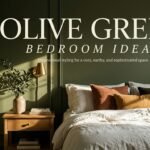
Olive green bedroom ideas start with a muted earthy yellow-green colour that feels warm, grounded, and calm without turning dark, muddy, or military. The right olive brings nature indoors, softens a stark room, and pairs easily with cream, wood, brass, and terracotta.
An olive bedroom works when undertone and light are chosen first, and paint names are chosen last. A chip that looks perfect in a store can read yellow by day, brown at night, grey in cool light, or heavy in a small room.
What an Olive Green Bedroom Really Is
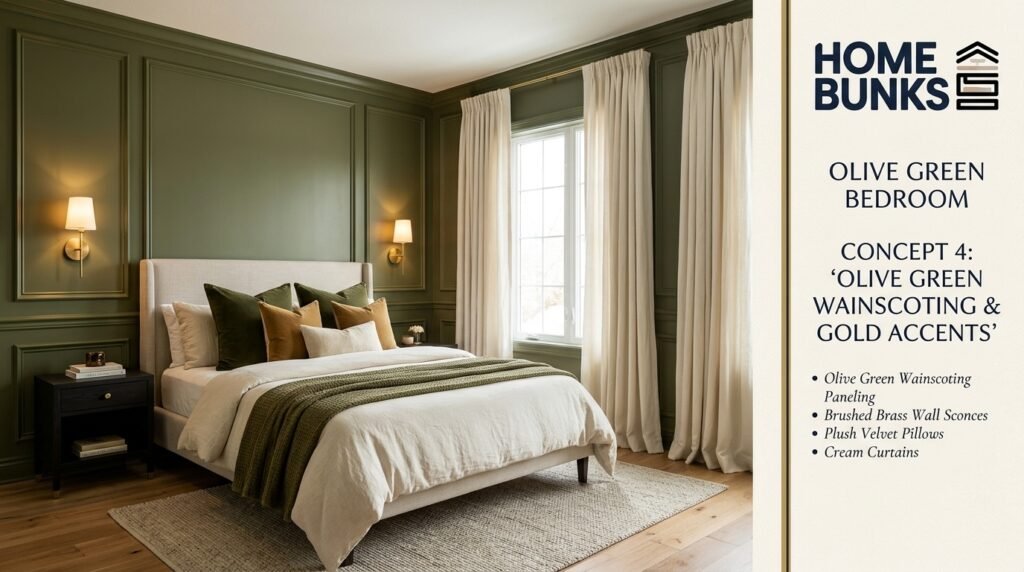
Olive as a Muted Earthy Yellow-Green
Olive green is green with a hint of yellow or brown, much like the colour of a green olive, according to Dulux. It is a traditional colour of peace, and it reads as versatile, sophisticated, and timeless in a bedroom.
An olive bedroom is not a sage bedroom with a new name, and it is not a forest bedroom toned down. The best olive schemes keep olive as the earthy warmth layer, then balance it with cream, beige, wood, and warm metal.
Olive Versus Sage, Emerald, Forest, Hunter, Moss, and Eucalyptus
Sage green is cooler, with more gray or blue undertones, while olive leans warmer toward yellow or brown undertones, according to Melanie Jade Design. Emerald green is saturated with blue undertones, closer to teal, while forest green is deeper, darker, and more dramatic.
Hunter green is classic, deep, and slightly cooler, while moss green is softer and greyer, and eucalyptus green is cooler and more blue leaning. Olive sits in the warm, earthy middle, which is why it suits Mediterranean, rustic, and organic modern bedrooms best.
| Green | Undertone and depth | Best bedroom use |
| Olive | Muted yellow-brown, LRV 20 to 35 typically | Earthy, organic, Mediterranean, rustic rooms |
| Sage | Gray-green, cooler, LRV 40 to 55 typically | Calm, airy, spa-like rooms in almost any light |
| Emerald | Saturated blue-green, jewel tone | Glam accent walls and statement bedding |
| Forest | Deep dark green, LRV 6 to 15 typically | Cocooning accent wall or well-lit rooms |
| Hunter | Classic deep green, slightly cooler | Traditional, sophisticated, timeless rooms |
| Moss | Soft grey-green, muted | Spa, calm, and nature-led rooms |
| Eucalyptus | Cool grey-blue green | Coastal, modern, and fresh rooms |
Why Undertone Matters More Than the Name
Undertone is the yellow, brown, grey, or blue lean hiding inside an olive paint. A warm yellow-brown olive suits walnut wood, brass, and cream bedding, while a cool blue-gray olive suits modern furniture, black accents, and crisp white trim.
Warm olives feel cozy and vintage inspired, while cooler olives come across as more modern and sophisticated, according to Melanie Jade Design. Neither is better, but the wrong undertone against a warm oak floor or a cool grey sofa can make olive look muddy or flat.
The Army Green and Avocado Bathroom Problem
Army green is a saturated military olive, while modern olive is muted, greyed, or browned, and paired with clean lined furniture. A deep, saturated olive with no grey or brown softening can read as army surplus, especially with dark wood and no cream bedding.
Avocado bathroom is a 1970s association that many readers still mention when olive is discussed, according to Melanie Jade Design. Modern olive avoids that read with muted shades, matte or satin finishes, rattan or linen textures, and contemporary lighting, not with shag carpets or excessive wood panelling.
Choose Olive Paint by LRV and Undertone
LRV in Plain Language
LRV, or Light Reflectance Value, is a 0 to 100 scale that shows how much light a paint bounces back. A higher LRV means more light reflection, while a lower LRV means a deeper, darker read on the wall.
Olive paints sit mostly in the low to mid LRV band, which is why light matters so much. FacadeColorizer places olive and earthy green at typical LRV 20 to 35, versus soft sage at LRV 40 to 55, smoky gray-green at LRV 28 to 35, forest at LRV 6 to 15, and mint at LRV 60 to 75.
The Olive Paint Shade Ladder
Light muted olive suits small rooms, dark rooms, and north-facing rooms, while mid olive suits rooms with steady daylight. Deep olive below LRV 20 suits one accent wall, a door, or furniture, not all four walls of a small dark bedroom.
All paint codes and LRV values below are competitor reported, and should be verified on manufacturer pages before buying. Brands can rename, reformulate, or discontinue shades, so a code checked at writing time is not a purchase guarantee.
| Shade and code | LRV, competitor reported | Best use |
| Benjamin Moore Spanish Olive 1509 | 52.55 | Light warm muted green, small and bright rooms |
| Valspar Dusty Olive 6005-4A | About 34 | Light dusty olive, full room in steady light |
| Valspar Blanched Thyme 6001-4A | About 27 | Light grey-green olive, calm full room |
| Farrow and Ball Olive No. 13, estimate only | About 26 | Light olive, warm full room, sample first |
| Benjamin Moore Olive Moss 2147-20 | 25.66 | Mid olive, warm full room or accent wall |
| Behr Oregano Spice PPU9-23 | 24 | Mid olive, warm full room or accent wall |
| Benjamin Moore Springfield Sage 510 | 23.02 | Mid olive sage crossover, calm rooms |
| Behr Green Scene S350-5 | 23 | Mid olive, warm rooms with good light |
| Behr Ecological S380-6 | 22 | Mid olive, organic modern rooms |
| Sherwin-Williams Artichoke SW 6179 | 21 | Mid olive, warm rooms, good daylight |
| Sherwin-Williams Olive Grove SW 7734 | 20 | Mid olive, accent wall or well-lit room |
| Farrow and Ball Sap Green No. 199, estimate only | About 19 | Mid olive, warm rooms, sample first |
| Sherwin-Williams Secret Garden SW 6181 | 18 | Deep olive, accent wall or cocoon room |
| Benjamin Moore Chopped Dill 496 | 18.01 | Deep olive, accent wall or cocoon room |
| Benjamin Moore Shady Lane 497 | 18.01 | Deep olive, accent wall or cocoon room |
| Behr Truly Olive S350-6 | 17 | Deep olive, accent wall or cocoon room |
| Benjamin Moore Avocado 2145-10 | 16.52 | Deep olive, accent wall, modern furniture |
| Sherwin-Williams Relentless Olive SW 6425 | 16 | Deep olive, accent wall or cocoon room |
| Sherwin-Williams Rosemary SW 6187 | 14 | Deep muted olive, accent wall, grey undertone |
| Benjamin Moore Tate Olive HC-112 | 13.52 | Deep olive, accent wall, doors, furniture |
| Benjamin Moore Dark Olive 2140-30 | 13.52 | Deep olive, accent wall, doors, furniture |
| Sherwin-Williams Oakmoss SW 6180 | 13 | Deep olive, accent wall or cocoon room |
| Farrow and Ball Bancha No. 298, estimate only | About 13 | Deep olive, accent wall, sample first |
| Sherwin-Williams Ripe Olive SW 6209 | 6 | Very deep olive, one wall only, bright room |
Farrow and Ball LRV Warning
Farrow and Ball does not publish LRVs, so Bancha No. 298, Sap Green No. 199, and Olive No. 13 LRV values above are third-party estimates only. Do not quote one Farrow and Ball LRV as official, and do not compare it directly with a Sherwin-Williams or Benjamin Moore LRV without a sample.

Treat Farrow and Ball olives as sample first, decide second colours, especially in a small or north-facing bedroom. A sample on a wall, checked at morning, afternoon, and night, tells more than any estimated LRV number.
The North-Facing Light Conflict, Presented Honestly
North-facing rooms receive cooler, flatter light, which can make olive look dull or muddy if the shade is too deep or too cool. Warmer greens like olive or teal with yellow undertones usually work better in north-facing rooms, according to I Love Wallpaper, and a golden olive holds its character better in north light, according to Awedeco.
A second view, from Alibaba DIY, warns that olive requires warm, natural light to showcase its depth, and in north-facing or artificially lit rooms it can appear muddy. Both views agree on the practical answer, which is to sample a lighter, warmer olive first in a north room, and limit deep olive to one accent wall or textiles only.
South-facing rooms get more natural warmth, so they can comfortably use cooler greens or deeper shades without feeling cold, according to I Love Wallpaper. Golden olive needs a closer look in south light, because Sherwin-Williams warns against a colour that is too warm for a south-facing room, according to Awedeco.
Facing Table for Every Direction
East and west rooms swing through the day, with cooler morning light and intense golden afternoon light in west rooms. Olive shifts with that swing, reading fresher and more yellow by day, and deeper and browner under lamps at night.
| Facing | LRV band to sample | Undertone lean | Lighting note |
| North | Light muted olive, LRV 27 to 52, plus one accent test | Yellow leaning, warm | 2700K to 3000K, layered, white ceiling |
| South | Mid to deep olive, LRV 13 to 35 | Cooler olive test, not too warm | 2700K at night, sheer curtains by day |
| East | Light to mid olive, LRV 20 to 35 | Neutral warm, not too yellow | Check at morning and evening |
| West | Mid olive, LRV 20 to 35 | Pink leaning test to calm golden afternoons | Dimmer essential for evening warmth |
Sample Protocol That Prevents a Wrong Paint Choice
Step 1: Order three samples, one lighter, one middle, and one deeper, from the same olive family. Step 2: Paint a large 12 by 12 inch swatch behind the bed and on one other wall, with two coats, not a single thin coat on a small chip.
Step 3: Check the swatch at 7 am, mid-afternoon, and at night under normal bulbs, because olive shifts from yellow by day to brown at night. Step 4: Watch dim corners, where green turns gray, and check the sample against actual trim, floor, and bedding.
Step 5: Leave the sample up for at least one full day, and look at it in morning light, evening light, and lamp light. Step 6: Buy full paint only after the sample still looks right at night, because bedrooms are used most in low light.
Trim, Ceiling, Floor, and Finish
Warm White Trim Versus Crisp White Versus Tonal Trim
Warm white trim suits most olives, such as Sherwin-Williams Alabaster SW 7008 or Benjamin Moore White Dove OC-17, according to FacadeColorizer. Warm white flatters sage and olive without going stark, and it is the safe pairing nine times out of ten.
Crisp white trim sharpens deep forest greens and gray-greens for a tailored edge, but it can flatten an earthy olive if the white is too cool. Tonal trim, painted the same olive or a half-strength version, gives a soft, enveloped, current look, especially with deep olives.
Ceiling Colour for an Olive Bedroom
Warm white ceilings keep a sage and olive bedroom bright, while a tonal or soft white ceiling stops a dark olive room feeling top-heavy, according to FacadeColorizer. For dark olive, keeping the ceiling lighter for balance is the safer choice, unless a true cocoon is wanted.
A 50 percent wall strength ceiling is a compromise cited by Reimagine Home for moody rooms, giving a lighter ceiling without a stark white contrast. In most olive bedrooms, a warm white ceiling is the simplest, brightest choice.
Floor Undertones and Furniture Wood
Light oak, walnut, and natural wood suit olive best, because they share warmth and earthiness. Dark walnut against olive walls looks grounded, especially with brass lamps and cream bedding, according to InteriorCurated.
Cool grey washed wood and chrome push olive colder, according to FacadeColorizer, and can flatten an earthy olive. If grey furniture is already in the room, choose a cooler olive or add warm wood, brass, and cream textiles to bridge the gap.
Paint Finish Table
Matte or eggshell suits bedroom walls, with matte giving a soft, cocooning look for dark olive, and eggshell balancing softness with wipeability. Satin suits higher traffic areas, while semi-gloss suits trim, doors, and cabinets, not large walls.
| Finish | Best bedroom use | Coverage note, competitor reported |
| Matte or flat | Soft look, cocoon rooms, ceilings | Up to 400 sq ft per gallon per coat |
| Eggshell | Main bedroom walls, best balance | About 350 to 400 sq ft per gallon per coat |
| Satin | Walls with more traffic, kids rooms | About 350 to 400 sq ft per gallon per coat |
| Semi-gloss | Trim, doors, cabinets, not large walls | About 250 to 300 sq ft per gallon per coat |
How Much Paint an Olive Bedroom Needs, and Primer for Dark Colours
One gallon of interior paint covers roughly 350 to 400 sq ft per coat, according to ArtFasad typical figures, so an average bedroom needs about 2 gallons for two coats. A 12 by 12 ft room has about 384 sq ft of wall once a door and window are deducted, which means two coats need slightly more than 2 gallons in practice.
Dark colours under LRV 10 often need an additional primer coat for full coverage, according to ArtFasad, which increases material cost and labour time. Primer also matters when painting over a dark colour, a glossy finish, or a repaired wall, and a high quality primer gives olive a more even colour.
Paint cost, competitor reported by ArtFasad, runs roughly 53 dollars per gallon for Sherwin-Williams and 57 dollars per gallon for Benjamin Moore at standard price, with a typical bedroom accent wall needing one to two gallons. These are not current quotes, so verify locally before budgeting.
Olive Colour Pairings With Share of Room
The 60-30-10 Rule for Olive
Light olive can be the 60 percent wall colour, while deep olive should be 30 percent or 10 percent of the room. The 60-30-10 rule gives 60 percent to a dominant colour, 30 percent to a secondary colour, and 10 percent to an accent colour.
Walls come first in this rule, because there is more wall than anything else in a scheme. A light olive room therefore reads as olive, while a deep olive room reads as an olive accent room, even if the deep olive is on one wall only.
Pairing Matrix With Share
| Pairing colour | Share of room | Best use |
| Cream and ivory | 30 to 60 percent, bedding, trim, curtains | Softness, brightness, and balance |
| Beige | 30 percent, bedding, rug, furniture | Warm neutrality, earthy calm |
| Warm white | 30 to 60 percent, ceiling, trim, bedding | Brightness, crispness, and balance |
| Warm grey | 30 percent, furniture and bedding | Modern calm, definition, and contrast |
| Terracotta | 10 to 30 percent, pillows, pots, ceramics | Warmth, rustic depth, and Mediterranean feel |
| Rust and ochre | 10 percent, pillows, throws, art | Visual interest, single accent colour |
| Gold and brass | 10 percent, lamps, mirrors, frames | Warmth, elegance, and light reflection |
| Black, matte | 10 percent or less, frames, chair, hardware | Definition, modern edge, and focus |
| Lavender, pale | 10 percent, bedding or art accents | Romantic contrast, soft colour pairing |
| Muted blue, turquoise | 10 percent, throws and art | Cool nature contrast, contemporary feel |
| Natural wood, walnut and oak | 30 percent, furniture and floors | Grounding, warmth, and organic texture |
Olive and Cream, the Classic Combination
Olive and cream is the most reliable olive pairing, with cream bedding, cream trim, and cream curtains keeping olive warm without heaviness. InteriorCurated shows deep olive walls with soft white and ivory bedding, where small shade shifts between off-white, crisp white, and ivory read as depth.
Cream bedding should be layered in different textures, such as washed cotton, linen, and sateen, so a neutral bed does not look flat. Add olive pillows and a throw in 2 to 3 pieces, so olive repeats without dominating every surface.
Olive and Grey, the Modern Combination
Olive and grey works when grey is warm, not cool, with grey neutral walls plus a fresh olive colour block as a focal point, according to Dulux. Other shades of grey around the room add warmth, while wooden accents keep the natural intentions of olive alive.
Cool greys and pure whites flatten olive warmth, according to Courtneys World, so avoid icy grey bedding and chrome hardware with a warm olive. Choose warm grey furniture, oatmeal textiles, and brass hardware to keep olive grounded.
Olive and Terracotta, Olive and Gold, Olive and Black
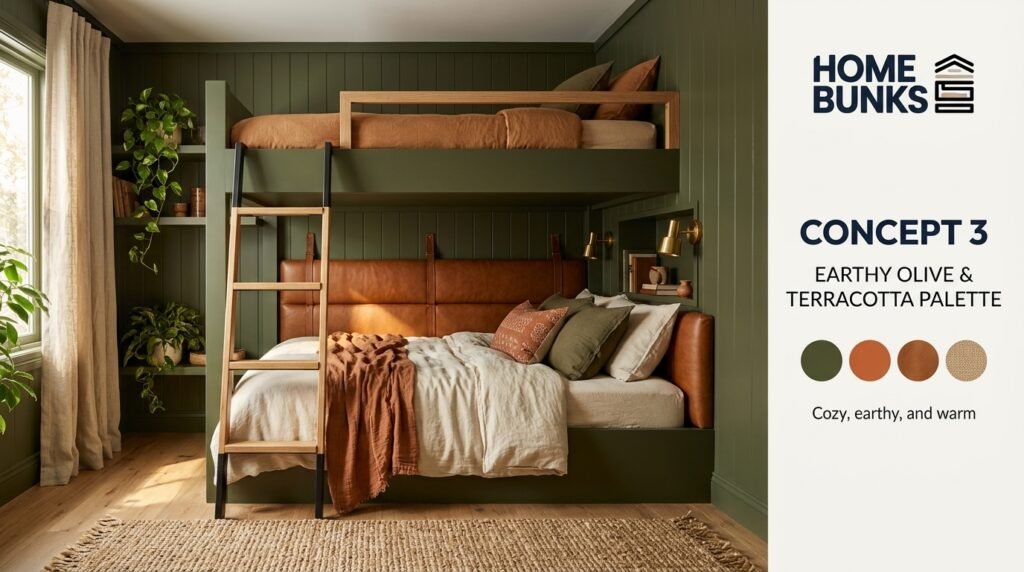
Olive and terracotta is a top earthy pairing, with terracotta planters, ceramics, and pillows warming olive walls, according to The Wow Edit and Courtneys World. Terracotta adds Mediterranean warmth, while olive adds nature calm, so the pair suits rustic and organic modern bedrooms.
Olive and gold adds luxury, with gold lamps, chandelier, frames, and hardware catching light against olive walls. Olive and black, in matte black accessories, photo frames, candle holders, or a bedside chair, gives depth, according to Dulux and Homestyler, but too much black plus deep olive can feel heavy in a small room.
Full Walls Versus Accent Wall Versus Textiles Only
Full olive walls suit light olives in a room with good light, and give the strongest earthy identity. One olive accent wall, usually behind the bed, suits deep olive, and gives drama with less paint and an easier repaint.
Olive textiles only suits renters, small budgets, and white rooms that need warmth without painting. One cushion alone reads as a stray colour, so repeat olive in 2 to 3 pieces, such as bedding, curtains, and a rug, to make the colour feel intentional.
| Approach | Paint needed | Commitment | Best for |
| Full olive walls | About 2 gallons for two coats, average bedroom | High, hardest to change | Light olive, good light, long term rooms |
| One accent wall | About 1 to 2 gallons, depending on wall size | Medium, easy to repaint | Deep olive, small rooms, first time olive users |
| Textiles only | No paint | Low, seasonal swap | Renters, budget rooms, white minimalist rooms |
| Colour drenching, walls plus trim | More paint, plus extra primer for dark shades | High, cocoon effect | Bright rooms, confident designers, statement rooms |
20 Olive Bedroom Ideas by Style
1. Olive Accent Wall Behind the Bed
Olive accent wall behind the bed gives instant focus without overwhelming the room, and it frames the bed as the focal point. Choose a deep olive, such as Tate Olive or Artichoke, against warm white walls, with cream bedding and brass lamps.
Style notes: Use warm white trim, walnut nightstands, and a landscape art piece above the bed to keep the accent wall sophisticated. Avoid olive bedding in the same exact shade, because matching wall and bedding in one shade can look flat.
2. Full Room Light Olive
Full room light olive suits a master bedroom with steady light, and creates a calm, earthy room that feels warm at night. Choose LRV 27 to 52, warm white ceiling, and light wood furniture, with cream bedding and linen curtains.
Style notes: Add a jute rug, rattan accents, and brass lighting to keep the room airy. Avoid deep olive on all four walls in a small room, because it can close in by evening.
3. Olive Bedding Paradise
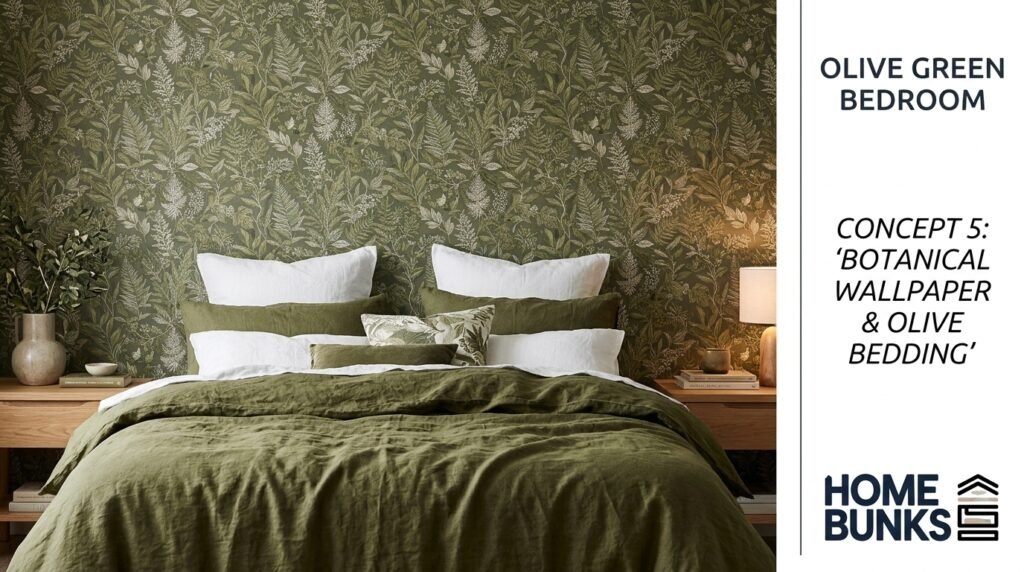
Olive bedding transforms a white or cream room into an olive bedroom without any paint. Start with crisp white sheets, add an olive duvet or comforter, then layer cream, beige, and olive pillows for depth.
Style notes: Use velvet, linen, and cotton textures together, because texture prevents olive bedding from looking flat. Avoid olive bedding, olive curtains, and olive rug all in the same exact shade.
4. Olive Curtains and Soft Light
Olive curtains filter light into a soft, earthy glow, and they suit linen and textured fabrics best in bedrooms. Choose light, textured curtains in a similar tone to bedding, so windows do not compete with the headboard, according to InteriorCurated.
Style notes: Hang rods high and wide to soften the window wall, and add blackout lining for sleep darkness. Avoid heavy olive curtains plus deep olive walls plus olive bedding, because the room loses its focal point.
5. Olive Furniture Statement Piece
Olive furniture, such as a velvet headboard, upholstered bench, or painted dresser, creates a bold focal point without painting walls. Choose one key piece, such as a deep olive velvet headboard, and pair it with cream bedding and wood furniture.
Style notes: Style the piece with brass hardware and terracotta accents, so olive furniture reads as custom, not random. Avoid olive furniture plus olive walls plus olive bedding, because the room loses contrast.
6. Olive Lighting Ambiance
Olive lighting comes from warm bulbs, brass lamps, and layered light at different heights, not from olive coloured bulbs alone. Use dimmer switches for control, and place bedside lamps, floor lamps, and a chandelier or pendant at different heights.
Style notes: Choose warm white LED bulbs at 2700K to 3000K, and linen or cream lampshades to soften the glow. Avoid cool daylight bulbs beside the bed, because they can push olive toward grey or blue at night.
7. Olive Artwork and Wall Decor
Olive artwork turns walls into a gallery without painting them, and it suits renters and budget rooms best. Choose one large landscape piece above the bed, with forest greens and golden light echoing olive walls, according to InteriorCurated.
Style notes: Leave a generous margin of wall around the frame, and add a slim picture light above it for evening focus. Avoid many small frames above a headboard, because one large piece reads more intentional than a gallery of small frames.
8. Olive Throw Pillows and Textures
Olive pillows layer texture and shade, and they are the cheapest way to test olive in a room. Put oversized olive pillows at the back, floral prints in front, and one long lumbar across the middle, according to InteriorCurated.
Style notes: Mix velvet, linen, chenille, and faux fur in different olive shades, sizes, and patterns, then add cream pillows for balance. Avoid pillows all in the same olive shade and same fabric, because the bed will look flat.
9. Olive Rug Foundation
Olive rug grounds the room, ties wall colour to bedding, and adds warmth underfoot. Choose a rug in muted browns, beige, or natural jute, and let the front legs of the bed rest on the rug to anchor it.
Style notes: Choose low pile and washable for easy maintenance, or plush for comfort, and use a high quality rug pad for safety. Avoid a rug that is too small, because a small rug can make an olive room feel disconnected.
10. Olive Botanical and Plant Styling
Olive botanical styling uses plants, woven baskets, ceramic pots, and botanical art to carry olive naturally through the room. Add ferns, snake plants, or pothos in woven baskets, and place a small herb garden on a windowsill for scent and life.
Style notes: Use terracotta planters for herbs like rosemary, and artisanal ceramics for character, according to The Wow Edit. Avoid plastic planters and high gloss finishes with olive, because natural textures suit olive best.
11. Olive Vintage Charm
Olive vintage suits romantic, antique, and traditional bedrooms, with dark wood furniture, vintage brass bed frames, and antique dressers. Pair olive walls with vintage brass, aged wood, and cream linens for a collected, not decorated, feel.
Style notes: Use warm brass lighting and landscape art to keep olive warm, and display vintage books or ceramics in olive tones. Avoid too many small vintage trinkets, because clutter can make olive look fussy rather than collected.
12. Olive Minimalist Approach
Olive minimalist uses olive as a subtle accent in a mostly cream or beige room, with clean lined furniture and plenty of empty space. Add one or two olive elements, such as a throw, pillow, or art piece, and keep accessories to a minimum.
Style notes: Choose natural wood or white furniture, simple block colours, and quality over quantity in olive accents. Avoid olive on every surface in a minimalist room, because minimalism needs restraint to stay calm.
13. Olive Boho Paradise
Olive boho layers olive with macrame, rattan, jute, plants, and patterned textiles in olive, gold, and cream. Start with olive as a main wall colour or bedding choice, then add woven baskets, tapestries, and floor seating with olive cushions.
Style notes: Mix vintage and handmade accessories, and use plants in woven baskets or macrame hangers for a natural counterweight. Avoid too many competing patterns, because boho needs a shared warm palette to stay cohesive.
14. Olive Glamour Statement
Olive glamour uses deep olive with gold or brass metallics, velvet textiles, and crystal or metallic lighting. Add a gold chandelier on a dimmer, mirrored furniture to reflect light, and velvet pillows for luxury, with cream bedding to keep the room bright.
Style notes: Keep olive glamour to one or two rich tones, not five competing olives, and balance velvet with smooth metal. Avoid olive glamour in a very small room without mirrors and light, because deep olive plus dark velvet can feel heavy.
15. Olive Mediterranean Vibes
Olive Mediterranean brings sunlit villa warmth into a bedroom, with olive walls, warm gold accents, vintage brass bed frames, and antique wooden dressers. Add cream linens with subtle olive patterns, amber glass lamps, terracotta planters, and woven baskets.
Style notes: Use velvet throw pillows, chunky knit blankets, and a handwoven rug with a geometric pattern for texture. Avoid dark navy walls plus deep olive walls together in a small Mediterranean room, because the room loses its sunny feel.
16. Olive Scandinavian Style
Olive Scandinavian keeps olive muted and grounded, paired with cream, light grey, and natural wood. Use olive through bedding or a subtle wall colour, not through saturated olive on every surface, to stay within Nordic calm.
Style notes: Add linen, jute, and unfinished wood textures, and keep the room bright with white accents. Avoid vibrant olive plus many colours, because Scandinavian style needs a limited palette to feel peaceful.
17. Olive and Terracotta Bedroom
Olive and terracotta is a warm, earthy pairing that suits master, guest, and rustic bedrooms. Use olive walls, terracotta pillows, pots, and ceramics, cream bedding, and walnut or oak furniture, with brass lighting to bridge the pair.
Style notes: Keep terracotta to 10 to 30 percent, so olive stays the main green and terracotta stays the warm accent. Avoid bright orange plus olive, because the contrast can feel loud in a bedroom.
18. Olive and Black Bedroom
Olive and black gives drama and focus, with matte black frames, candle holders, or a bedside chair sharpening soft olive walls. Use black as a 10 percent accent, not as a second wall colour, and add brass lighting to bridge warm olive and cool black.
Style notes: Choose cream bedding to sit between olive and black, and keep black pieces in matte finishes, not high gloss. Avoid black curtains plus black bedding plus black rug, because black can overwhelm olive in a small room.
19. Olive Kids and Nursery Bedroom
Olive kids bedroom suits light olive, cream bedding, and terracotta or wood accents, with olive on one wall or in textiles for small rooms. Pastel olive with cream and natural wood feels calm, while deep olive on all four walls can feel heavy for a small kids room.
Style notes: Keep patterns large and simple, not fussy, and use white trim to keep the room bright. Avoid army green plus dark wood plus no cream bedding, because that combination can read as military rather than playful.
20. Olive and Lavender Bedroom
Olive and lavender is a romantic pairing, with lavender walls plus olive bedding, throws, and glassware, according to Dulux. Add dark wood furniture for sophisticated contrast, and use luxurious cotton bedding and heavy knitted throws for texture.
Style notes: Keep lavender pale and olive muted, so the pair reads romantic, not competing. Avoid saturated purple plus deep olive, because the room can feel too dark and too colourful at once.
Lighting for an Olive Bedroom
Warm 2700K to 3000K as the Bedroom Standard
2700K warm white suits olive bedrooms, according to Courtneys World, because muted greens need warm colour temperature bulbs to avoid feeling cold or institutional. Alibaba DIY gives a 2700K to 3000K range for olive rooms, to mimic daylight warmth in low light spaces.
3500K true white gives a balanced look, neither cool nor warm, according to Behr guidance cited by Awedeco, while 5000K daylight bulbs enhance blue, green, and gray tones. For warm olives, 5000K can push olive toward grey or blue, so keep daylight bulbs out of the bedroom.
Layered Lighting System
Layered lighting uses ceiling light, bedside lamps, and accent light together, rather than one bright ceiling light alone. Ceiling light gives general light, bedside lamps give task and wind down light, and a chandelier or picture light gives soft accent light.
Dimmable lighting gives flexibility, from a bright morning room to a soft evening unwind, and a chandelier on a dimmer works in a bedroom when sized for the bed width and ceiling height, according to InteriorCurated. Choose dimmers even for simple lamps, because an olive room that cannot dim will feel too bright at night and too flat in the evening.
Blackout, Sheer, and Reading Light
Blackout shades plus warm sheers give maximum darkness at night and soft illumination by day, and they suit olive bedrooms with large windows. Blackout lining also stops curtains from glowing in sun, which matters in a south-facing olive room.
Reading light should be a warm task lamp beside the bed, with a small vase of greenery and room for a book or a glass of water, according to InteriorCurated bedside guidance. Keep each bedside to three things, a lamp, a small vase, and room for a book, so the bedside stays calm.
Olive by Room, Size, and Light
Master Bedroom, Guest Bedroom, and Couples Bedroom
Master bedroom olive suits a full light olive room or a deep olive accent wall behind the bed, with cream bedding, walnut furniture, and brass lighting. Couples bedrooms need a neutral bridge, such as cream bedding, so olive does not read as one person’s colour alone.
Guest bedroom olive creates a welcoming, nature-led room, with olive pillows, throw, or rug adding warmth without overwhelming the space. Keep guest olive to textiles and one accent wall, so guests feel welcomed, not surrounded by a strong colour.
Small Bedroom, Dark Bedroom, and Studio Apartment
Small bedroom olive needs light olive, white ceiling, warm white trim, and light bedding, with olive kept to 30 percent of surfaces in one page claim from Alibaba DIY, or to one accent wall in another page claim. A small room with deep olive on all four walls can feel closed in by evening, even if it looks rich at noon.
Dark bedroom olive needs light olive or olive textiles only, plus layered 2700K lighting, white ceiling, and light bedding, because paint alone cannot fix a lack of daylight. Studio apartment olive can define a sleep zone, with an olive wall or rug setting apart the bed area while keeping the overall room light and cohesive.
Room Size by Light Decision Table
| Room type | Olive choice | Trim and lighting |
| Small, north-facing | Light muted olive, LRV 27 to 52, or textiles only | Warm white trim, white ceiling, 2700K layered |
| Small, south-facing | Light to mid olive, LRV 20 to 35 | Warm white trim, sheer curtains, 2700K at night |
| Large, bright | Mid to deep olive, LRV 13 to 35 | Warm white or tonal trim, brass lighting |
| Dark, limited daylight | Light olive, LRV 35 to 52, or textiles only | White ceiling, layered 2700K, light bedding |
| Master, steady daylight | Light to mid olive, LRV 20 to 35 | Cream bedding, walnut furniture, brass lamps |
| Guest, short stay | Textiles plus one accent wall | Cream bedding, olive pillows and rug |
| Kids, bright room | Light olive, LRV 27 to 52 | White trim, terracotta or wood accents |
| Nursery, soft light | Light muted olive, LRV 35 to 52 | Cream trim, terracotta or ochre accents |
| Teen, small room | Light olive or sage crossover, LRV 27 to 35 | White trim, black or brass contrast |
| Studio, multifunctional | One olive wall or rug, LRV 27 to 35 | Cream bedding, light wood, layered light |
Renter Friendly Olive Without Painting
Renter olive uses removable wallpaper, slipcovers, peel and stick tiles, olive bedding, curtains, rug, and pillows, according to Homestyler. Textiles and removable decor swap with the season and need no paint commitment.
Olive bedding, lamps, then rug and art is the budget order recommended by InteriorCurated, with pillow covers and a throw as the cheapest ways to test olive before committing to paint. Lighting makes a bigger difference than most people expect, so swap in warm bulbs early.
Budget, Shopping List, and Cost
Budget Versus Luxury Olive Bedroom
Budget olive uses textiles only, one accent wall, or a sample led paint choice, with existing furniture and cream bedding. Luxury olive uses full room paint, linen bedding, brass lighting, walnut furniture, and custom art, with an olive and gold or olive and terracotta palette.
| Level | Paint and walls | Bedding and textiles | Lighting and furniture |
| Budget | Textiles only, or one accent wall | Olive pillows, throw, and rug | Existing lamps, warm bulbs, dimmer plugs |
| Mid range | Light full room paint, two coats | Linen or cotton olive bedding, curtains | Brass lamps, walnut nightstands |
| Luxury | Full room paint, limewash or wallpaper accent | Velvet, silk, and linen layers, custom art | Brass chandelier, mirrored furniture, walnut headboard |
Shopping List for a 12 by 12 Ft Room
Paint and tools for an average bedroom include about 2 gallons for two coats, primer if painting over dark or glossy walls or using a dark olive under LRV 10, rollers, brushes, painter’s tape, and drop cloths. Bedding and textiles include white sheets, an olive duvet or throw, 2 to 3 olive pillows, cream pillows, and a rug pad.
Lighting includes warm white 2700K bulbs, dimmer switches or dimmer plugs, bedside lamps with linen or cream shades, and blackout lining for curtains. Decor includes one large landscape art piece, an olive vase, and a small plant, with at least one surface left clear.
Cost Honesty for Olive Paint
Paint cost varies by brand, finish, retailer, and region, so no single US price is quoted here as a current price, except for the competitor reported ArtFasad figures above. Coverage figures, 350 to 400 sq ft per gallon per coat, are competitor reported typical figures, not quotes, and should be checked against the paint can at purchase time.
Painter labour, primer, and repair costs can exceed paint cost in a large or damaged room, especially for dark olives that need an extra primer coat. Get a local quote for labour, and budget for primer, tape, and tools separately from paint gallons.
Mistakes to Avoid and Expert Tips
10 Numbered Mistakes to Avoid
- Choosing olive from a phone screen without a 12 by 12 inch, two coat sample checked at morning, afternoon, and night.
- Using deep olive below LRV 20 on all four walls in a small, dark, or north-facing room.
- Matching olive walls, bedding, curtains, and rug in the same exact shade, which makes the room flat.
- Using cool grey bedding and chrome hardware with a warm olive, which flattens olive warmth.
- Mixing 2700K with 5000K bulbs in one room, which makes olive shift between warm and grey-blue.
- Painting only one coat and expecting even olive coverage, because most walls need two coats, and dark olives may need primer plus two coats.
- Using high gloss finishes with olive, which fights the organic, muted character of olive, according to Alibaba DIY.
- Adding a third saturated colour to an olive and terracotta room, when cream or natural wood would tie the palette better.
- Using olive as a feature piece and as an accent everywhere at once, which removes the focal point.
- Copying a UK paint name or price from Dulux UK guides, without checking US availability and US pricing, because UK catalogue names are not US paint codes.
10 Numbered Tips for a Better Olive Bedroom
- Order three samples in one olive family, one lighter, one middle, and one deeper, before buying full gallons.
- Hold samples against trim, floor, and bedding, because fixed surfaces decide undertone success.
- Use light olive for the 60 percent wall colour, and deep olive for the 30 percent or 10 percent layers.
- Repeat olive in 2 to 3 pieces when using textiles only, so the colour feels intentional.
- Use warm white ceiling and trim to keep light bouncing in small and dark rooms.
- Layer lighting at different heights, with dimmers, so olive glows softly at night.
- Pair olive with one warm counterweight, such as terracotta, gold, or brass, to avoid a green wash.
- Add texture before adding colour, with linen, velvet, rattan, jute, and wood, to keep olive sophisticated.
- Leave one surface clear in an olive bedroom, so the room still feels restful.
- Verify every paint code and LRV on manufacturer pages, such as Sherwin-Williams, Benjamin Moore, Behr, Valspar, and Farrow and Ball, before ordering, because codes and LRVs can change.
Who Should Skip Full Olive Walls
Full olive walls may not suit a reader who wants a very cool, grey, or minimalist bedroom, because olive adds warmth even in its lightest muted form. A reader with a very dark, north-facing room and no budget for lighting may prefer olive textiles over full olive walls, until lighting can be layered.
Deep olive walls may not suit a reader who dislikes warm colour at night, because deep olive can feel stronger and browner in lamp light than in daylight. In that case, a light olive accent wall, or olive bedding with cream walls, gives warmth without a full room commitment.
Sources Named in Plain Text, No Clickable Links
High authority sources named for verification include Sherwin-Williams for olive paint codes and LRV values, Benjamin Moore for olive paint codes and LRV values, Behr for olive paint codes, Valspar for olive paint codes, and Farrow and Ball for olive colour description, with a note that Farrow and Ball does not publish LRVs. Editorial sources named for pairing, light, and room guidance include FacadeColorizer, Awedeco, ArtFasad, Melanie Jade Design, InteriorCurated, Dulux, I Love Wallpaper, Homebuilding, and Homestyler.
Competitor reported figures in this article, including LRV values, coverage per gallon, 12 by 12 ft wall area, 2700K to 3000K lighting guidance, and ArtFasad paint prices, should be checked against manufacturer pages and paint cans before buying. Health and space claims, including Alibaba DIY 15 percent stress reduction and 25 percent perceived space reduction figures, are page claims, not verified studies, and are not presented here as research findings.
Frequently Asked Questions
What is an olive green bedroom?
Olive green bedroom means a bedroom built around a muted earthy yellow-green colour, on walls, bedding, or textiles, paired with cream, beige, wood, and warm metal. The best olive bedrooms balance warmth with a neutral bridge, such as cream bedding, so olive does not read as one flat colour.
Is olive green good for a bedroom?
Yes, olive suits bedrooms when undertone and LRV fit the room light, with light olives suiting most bedrooms and deep olives suiting one accent wall or well-lit rooms. Olive feels warm, grounded, and calming, but it needs warm lighting and texture to avoid looking muddy.
Is olive green too dark for a bedroom?
Olive can feel too dark if a deep shade below LRV 20 is used on all four walls of a small dark room without warm lighting. Light olives, one accent wall, or olive textiles give the same earthy feel without heaviness.
Is olive green the same as sage green?
No, olive is warmer than sage, with yellow or brown undertones, while sage is cooler with gray or blue undertones, according to Melanie Jade Design. Some olives can lean cool with blue-gray undertones, so compare samples, not labels, before choosing.
What shade of olive green is best for a bedroom?
Light muted olive, LRV 27 to 52, is the safest bedroom shade for most rooms, with mid olive, LRV 20 to 35, suiting bright rooms and steady daylight. Deep olive below LRV 20 suits one accent wall, a door, or furniture, not all four walls of a small room.
What LRV should olive green bedroom paint be?
LRV should match light and room size, with light muted olive at LRV 35 to 52 for small and dark rooms, mid olive at LRV 20 to 35 for steady daylight, and deep olive below LRV 20 for one accent wall or well-lit rooms, according to FacadeColorizer family bands.
Does olive green suit a small bedroom?
Yes, light olive suits small bedrooms when paired with a white ceiling, warm white trim, light bedding, and layered 2700K lighting. Keep deep olive to one accent wall or textiles only, and avoid deep olive on all four walls, because it can close in a small room by evening.
Does olive green suit a dark bedroom?
Yes, light olive or olive textiles suit dark bedrooms, but paint alone cannot fix low daylight. Add layered warm lighting, white ceiling, light bedding, and mirrors to reflect light, and test the sample at night before buying.
What trim goes with olive green bedroom walls?
Warm white or cream trim suits most olive walls, such as Sherwin-Williams Alabaster SW 7008 or Benjamin Moore White Dove OC-17, according to FacadeColorizer. Crisp white sharpens deep greens, while tonal trim gives an enveloped look with deep olives.
What bedding colour goes with olive green walls?
Soft white, ivory, cream, or beige bedding suits olive walls, with olive in pillows, throws, and a lumbar, not in every layer. Crisp white bedding keeps deeper greens from feeling heavy, according to InteriorCurated.
What curtain colour goes with an olive green bedroom?
Light, textured curtains in a similar tone to bedding suit olive bedrooms, so windows do not compete with the headboard, according to InteriorCurated. Sheer curtains filter light softly, while blackout lining gives sleep darkness.
How do I sample olive green paint correctly?
Paint a large 12 by 12 inch swatch behind the bed and on one other wall, check it at 7 am, mid-afternoon, and at night under normal bulbs, according to FacadeColorizer. Watch dim corners, where green turns gray, and check the sample against trim, floor, and bedding.
Why does olive green paint look different on the wall than on the chip?
Light, undertone, finish, and neighbouring colours shift olive, with daylight bringing out yellow and lamp light deepening olive toward brown, according to FacadeColorizer. Morning light versus afternoon light can change the read completely, according to Melanie Jade Design.
What lighting is best for an olive green bedroom?
Warm white at 2700K to 3000K, layered with bedside lamps, ceiling light, and dimmers, suits olive bedrooms best, according to Courtneys World and Alibaba DIY. Do not mix 2700K with 5000K in one room, because olive will shift between warm and grey-blue.
What finish should olive green bedroom paint be?
Matte or eggshell suits bedroom walls, with matte giving a soft, cocooning look for dark olive, and eggshell balancing softness with wipeability. Satin suits higher traffic areas, while semi-gloss suits trim, doors, and cabinets, not large walls.
How much paint do I need for an olive green bedroom?
One gallon covers roughly 350 to 400 sq ft per coat, according to ArtFasad typical figures, so an average bedroom needs about 2 gallons for two coats. A 12 by 12 ft room has about 384 sq ft of wall after a door and window are deducted, so budget slightly more than 2 gallons for two coats.
How do I stop an olive green bedroom looking muddy?
Choose a warmer yellow leaning olive in cool light, add warm 2700K lighting, use warm white trim, and avoid cool grey and chrome, which flatten olive. Test swatches under actual room lighting before full implementation, according to Alibaba DIY.
How do I stop an olive green bedroom looking like army green?
Use a muted olive with grey or brown undertones, not a saturated military olive, pair it with cream bedding, brass, and natural textures, and keep olive to an accent wall or textiles if the room is small. Clean lined furniture modernises olive, according to Alibaba DIY.
How do I stop an olive green bedroom looking dated?
Pair olive with clean lined furniture and organic textures like rattan or linen, avoid 1970s shag carpets and excessive wood panelling, and use matte or satin finishes, not high gloss, according to Alibaba DIY. Modern olive reads as organic modern, not avocado bathroom, when the room is edited.
Is an olive green bedroom good for adults?
Yes, olive suits adults when it is muted and paired with wood, linen, and brass. Deep olive paneled walls with white bedding and walnut nightstands read as sophisticated, not childish, according to InteriorCurated.
Is an olive green bedroom good for couples?
Yes, olive suits couples with light or mid olive walls, cream or beige bedding, wood furniture, and warm lighting, plus one accent in terracotta, gold, or black. Cream bedding acts as a neutral bridge, so olive does not read as one person’s colour alone.
Is an olive green bedroom good for kids?
Yes, light olive suits kids bedrooms with cream bedding and terracotta or wood accents, but deep olive on all four walls can feel heavy for a small kids room. Use olive on one wall or in textiles for kids, with light neutrals for the rest.
Is an olive green bedroom good for a nursery?
Yes, light muted olive suits nurseries with cream bedding and natural wood, plus soft terracotta or ochre accents. Keep olive pale and lighting warm, so the nursery reads calm, not dark.
Can I use olive green in a rental bedroom without painting?
Yes, renter olive uses removable wallpaper, slipcovers, peel and stick tiles, olive bedding, curtains, rug, and pillows, according to Homestyler. Repeat olive in 2 to 3 pieces, so the room reads as olive, not as one stray olive cushion, and choose textiles that swap with the season.
Does olive green go with grey in a bedroom?
Yes, olive and warm grey is an elegant pairing, with grey neutral walls plus a fresh olive colour block as a focal point, according to Dulux. Avoid cool greys and pure whites, which flatten olive warmth, according to Courtneys World.
Does olive green go with terracotta in a bedroom?
Yes, olive and terracotta is a top earthy pairing, with terracotta planters, ceramics, and pillows warming olive walls, according to The Wow Edit and Courtneys World. Keep terracotta to 10 to 30 percent, so olive stays the main green.
Conclusion
Olive green bedroom ideas work best when undertone is chosen against trim and flooring, LRV is chosen against room light, and lighting is chosen for night use, not just for daylight. Light muted olive, LRV 27 to 52, warm white trim, cream bedding, walnut or oak furniture, and 2700K layered lighting is the safest starting point for most bedrooms, with deep olive reserved for one accent wall or textiles.
Order three olive samples, paint two coats on a 12 by 12 inch swatch, check them at morning, afternoon, and night, and buy full gallons only after the sample still looks right in lamp light. Verify every paint code and LRV on manufacturer pages, such as Sherwin-Williams, Benjamin Moore, Behr, Valspar, and Farrow and Ball, before ordering, and start with one accent wall if a full olive room feels like too big a commitment.