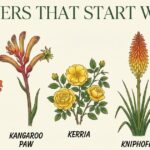
Flowers that start with K are some of the most overlooked names in gardening, yet they include showstoppers like Kangaroo Paw, Kniphofia, and Kalanchoe. This guide brings together every popular and rare K flower in one place.
You will find plant names, colors, bloom times, growing zones, and simple care tips. Whether you are planning a border, a bouquet, or a windowsill garden, this list makes it easy to pick the right K flower for your space.
Everything below is organized so you can scan fast or read deep. Tables cover the quick facts, while the detailed sections explain how to actually grow each flower.
Quick Answer: What Are K Flower Names?
K flower names refer to any flowering plant whose common or botanical name begins with the letter K. This includes garden perennials, annual bedding flowers, indoor houseplants, and even a few wildflowers.
Some, like Kalanchoe, are common in nurseries worldwide. Others, like Kirengeshoma, are rare and mostly grown by collectors. The letter K covers a small but varied group across many plant families.
Alphabetical Quick List
Here is a scannable list of flowers that start with K, arranged alphabetically by common name.
- Kaffir Lily (Clivia)
- Kalanchoe
- Kalimeris
- Kalmia (Mountain Laurel)
- Kangaroo Paw
- Karoo Violet
- Katie Ruellia
- Kenilworth Ivy
- Kentucky Wisteria
- Kerria
- King Protea
- King’s Spear (Asphodeline)
- Kingcup (Marsh Marigold)
- Kingfisher Daisy
- Kirengeshoma (Yellow Waxbells)
- Kiss Me Quick (Centranthus)
- Knapweed (Centaurea)
- Knautia
- Kniphofia (Red Hot Poker)
- Knotweed (Persicaria)
- Kohleria
- Kolkwitzia (Beauty Bush)
- Korean Angelica
- Korean Chrysanthemum
- Korean Lilac
- Kousa Dogwood (flowering tree)
- Kudu Lily
- Kudzu Vine
- Kunzea
- Kwanzan Cherry
- Kansas Gayfeather (Liatris)
That is more than 30 named types, and several of these, like Kalanchoe and Kniphofia, come in multiple color varieties, pushing the real count well past 35.
K Named Flowers: At A Glance
| Flower Name | Plant Type | Native Region |
| Kangaroo Paw | Perennial | Australia |
| Kniphofia | Perennial | South Africa |
| Kalanchoe | Succulent houseplant | Madagascar |
| Kaffir Lily (Clivia) | Perennial bulb | South Africa |
| Knautia | Perennial | Europe |
| Kolkwitzia | Flowering shrub | China |
| Korean Chrysanthemum | Perennial | Korea, East Asia |
| King Protea | Shrub | South Africa |
| Kerria | Flowering shrub | China, Japan |
| Kingcup | Perennial wildflower | Europe, Asia |
This table gives a fast snapshot before you dive into detailed profiles later in the article.
Bloom Time And Growing Zones At A Glance
Bloom time varies a lot across K flowers because they come from such different climates. Some, like Kingcup, bloom in early spring, while others, like Korean Chrysanthemum, bloom in fall.
| Flower | Bloom Time | USDA Zone |
| Kangaroo Paw | Spring to summer | 10 to 12 |
| Kniphofia | Summer to fall | 5 to 9 |
| Kolkwitzia | Late spring | 4 to 8 |
| Kerria | Early to mid spring | 4 to 9 |
| Knautia | Summer | 4 to 9 |
| Korean Chrysanthemum | Fall | 4 to 9 |
| Kingcup | Early spring | 3 to 7 |
| King Protea | Late winter to spring | 9 to 11 |
Checking your zone against this table before buying helps avoid wasted money on plants that will not survive winter outdoors.
Plants Vs Flowers That Start With K
Not every K name on garden lists is technically a flower. Some are plants best known for foliage, fruit, or overall form, even though they do flower at some point.
- True flowering plants: Kangaroo Paw, Kniphofia, Knautia, Kalanchoe are grown mainly for their blooms.
- Plants with secondary flowers: Kudzu Vine and Kentucky Wisteria are often grown for vines or coverage, with flowers as a bonus.
- Flowering trees: Kwanzan Cherry and Kousa Dogwood are trees, not border flowers, but their blossoms are the main attraction each spring.
Knowing this distinction matters if you are shopping for a flower bed specifically, since a tree or vine needs very different space and planning.
Types of Flowers That Start With K
K flowers fall into a few practical categories for gardeners: perennials that return yearly, annuals that complete their cycle in one season, and standout purple varieties popular in cottage gardens.
Perennials That Start With K
Perennial K flowers come back year after year, making them a strong long term investment for any garden bed.
- Kniphofia (Red Hot Poker): Tall spikes in orange, red, or yellow that attract hummingbirds.
- Kangaroo Paw: Unusual tubular flowers shaped like small paws, popular in warm climate gardens.
- Knautia macedonica: Small wine red pincushion blooms that flower for months.
- Kirengeshoma (Yellow Waxbells): Soft yellow, bell shaped flowers suited to shady woodland gardens.
- Kalimeris: Small daisy like blue or white flowers, useful as a low maintenance filler plant.
Most of these perennials prefer well drained soil and at least partial sun. They are a good choice if you want a garden that requires less replanting each spring.
Annual Flowers That Start With K
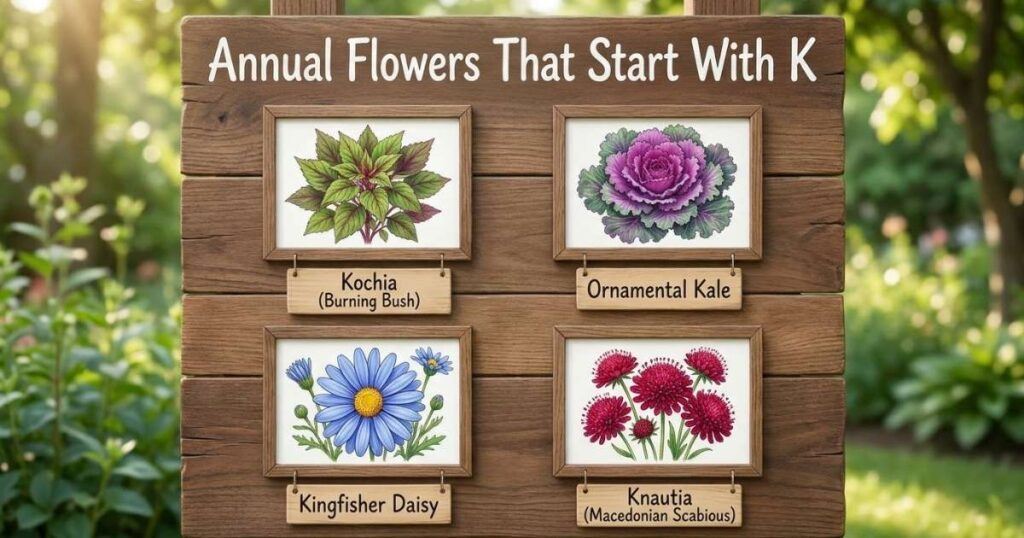
Annual K flowers are fewer in number but still offer good options for seasonal color.
- Kingfisher Daisy (Felicia): Bright blue daisy flowers, often grown as an annual outside its native climate.
- Katie Ruellia: Compact purple flowering bedding plant, popular in southern US gardens.
- Kochia: Grown mostly for its foliage color, though it does produce tiny inconspicuous flowers.
Annuals like these are ideal if you want fast color for a single season without a long term commitment.
Purple Flowers That Start With K
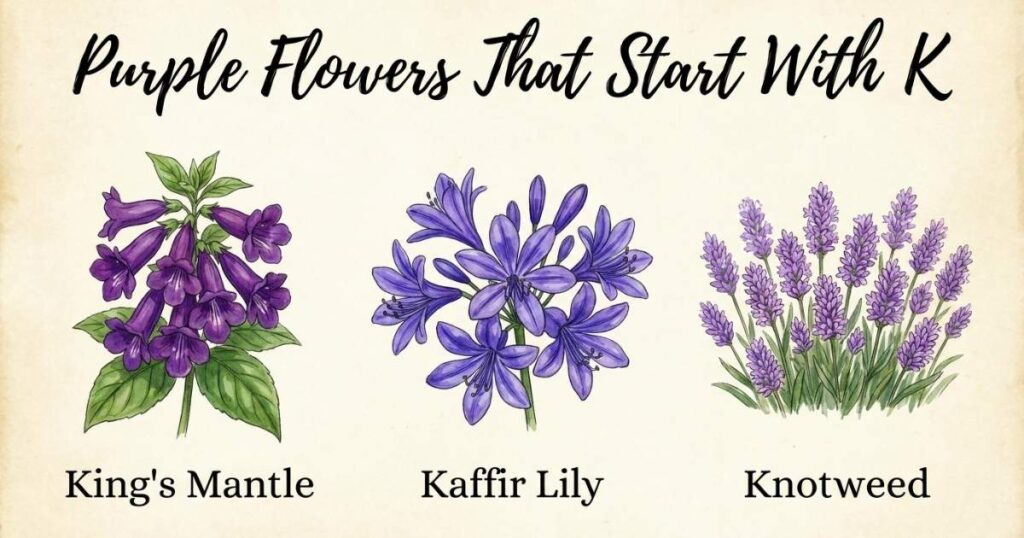
Purple is one of the most common colors among K flowers, which makes this a useful subgroup for cottage and pollinator gardens.
- Knautia macedonica in deep wine purple tones.
- Katie Ruellia with violet purple trumpet shaped blooms.
- Korean Angelica with clustered lavender purple flower heads.
- Karoo Violet, a South African wildflower with soft purple petals.
Purple K flowers pair especially well with yellow or white companion plants for strong visual contrast in a mixed border.
K Flower Names By Color
Color is often the first thing gardeners search for, so here is a simple breakdown.
| Color | K Flowers |
| Red or Orange | Kniphofia, Kangaroo Paw (red varieties) |
| Yellow | Kirengeshoma, Kingcup, King’s Spear |
| Purple | Knautia, Katie Ruellia, Karoo Violet |
| Pink | Kalanchoe, Kolkwitzia, Kwanzan Cherry |
| White | Kerria (white cultivars), Kousa Dogwood |
| Blue | Kingfisher Daisy |
This table is a fast reference if you are designing a garden bed around a specific color palette.
Are There Indoor Flowers That Start With K?
Yes, several K flowers grow well as houseplants, especially in colder climates where outdoor planting is not an option.
- Kalanchoe: The most common indoor K flower, sold widely with clustered red, pink, orange, or yellow blooms.
- Kohleria: A gesneriad relative of African violets, with tubular spotted flowers, grown indoors in most regions.
- Kaffir Lily (Clivia): Often grown as a container plant indoors during winter, then moved outside in summer.
These three are the most reliable choices for anyone wanting a flowering K plant on a windowsill or patio.
Which K Flowers Are Good For Beginners?
Beginners should look for K flowers that tolerate some neglect and do not need precise conditions.
- Kalanchoe tolerates low water and thrives in average indoor light.
- Kniphofia is drought tolerant once established outdoors.
- Kerria shrubs need minimal pruning and resist most pests.
Starting with one of these three is a low risk way to get comfortable growing K flowers before moving on to fussier types like Kirengeshoma.
Best K Flowers By Use
Different K flowers suit different garden goals, from cutting bouquets to ground cover.
- Cut flowers: Kniphofia and Knautia hold up well in vases for about a week.
- Ground cover or edging: Kenilworth Ivy spreads low and tolerates foot traffic near walls.
- Hedging or screening: Kolkwitzia and Kerria both work as informal flowering hedges.
- Container gardening: Kalanchoe and Katie Ruellia both do well in pots on patios.
Matching the flower to its intended use before planting saves time and prevents disappointment later in the season.
Fragrant And Pollinator Friendly K Flowers
Fragrance and pollinator appeal often overlap, since scent is what draws bees and butterflies in the first place.
- Korean Lilac: Strongly fragrant, one of the more scented K flowers available.
- Kolkwitzia (Beauty Bush): Light honey scented flowers that attract bees heavily in late spring.
- Kniphofia: Not fragrant to humans, but a major hummingbird and bee magnet due to nectar volume.
- Knautia: A favorite of butterflies and bees throughout its long summer bloom period.
If pollinator support is your main goal, Kolkwitzia and Knautia are the two strongest picks on this list.
Common Flowers That Start With K
Some K flowers show up in nearly every garden center, making them the most accessible starting point.
- Kalanchoe: Sold in almost every grocery store floral section.
- Kniphofia: A staple in perennial borders across temperate climates.
- Kerria: Common in older gardens and easy to find at local nurseries.
- Kingcup (Marsh Marigold): Common along pond edges and wet garden areas in temperate zones.
These four are the safest bets if you want a K flower that is easy to source locally without ordering online.
What Are Rare Flowers That Start With K?
A handful of K flowers are genuinely hard to find, usually because they need specific climates or are simply less commercially popular.
- Kirengeshoma palmata: Rare outside specialist nurseries, needs shaded, acidic, woodland conditions.
- King Protea: South Africa’s national flower, rare outside frost free warm climates.
- Kudu Lily (Adenium relatives): Uncommon succulent flowering plant, mostly found through specialty growers.
- Karoo Violet: A South African native rarely cultivated outside its home range.
If you want a genuinely unique addition to your garden, these rare K flowers are worth seeking out through specialty seed suppliers.
Before Planting K Flowers: Safety, Invasive, And Climate Notes
Not every K flower is safe or harmless to plant without research first.
- Toxicity: Kalanchoe and Kalmia (Mountain Laurel) are both toxic if ingested by pets or livestock. Keep them away from grazing animals and curious pets.
- Invasive risk: Kudzu Vine is classified as invasive in much of the southeastern United States and should be avoided entirely in that region.
- Climate mismatch: Kangaroo Paw and King Protea are not frost hardy and will die in freezing winters without protection.
Checking your local extension office guidelines before planting any unfamiliar K flower is a smart, low cost safety step.
Growing Snapshot
Here is a condensed care summary for the most popular K flowers covered in this guide.
| Flower | Sun Needs | Water Needs | Difficulty |
| Kniphofia | Full sun | Low once established | Easy |
| Kalanchoe | Bright indirect | Low | Easy |
| Kangaroo Paw | Full sun | Moderate | Moderate |
| Kolkwitzia | Full sun to part shade | Moderate | Easy |
| Knautia | Full sun | Moderate | Easy |
| Kirengeshoma | Part to full shade | Consistent moisture | Difficult |
This snapshot is meant as a quick planning reference before you commit to buying seeds or starter plants.
Sun, Soil, Water, And Bloom Season Patterns
Most K flowers prefer well drained soil, since few of them tolerate standing water at the roots. Full sun is the most common requirement, though shade lovers like Kirengeshoma are a clear exception.
Watering needs are generally moderate. Drought tolerant types like Kniphofia only need supplemental watering during extended dry spells once established.
Bloom seasons span the full calendar. Kingcup opens in early spring, Knautia and Kolkwitzia carry the summer months, and Korean Chrysanthemum closes out the season in fall.
Common Growing Mistakes
Even easy K flowers fail when a few basic mistakes are made repeatedly.
- Overwatering Kalanchoe, which leads to root rot faster than underwatering does.
- Planting Kangaroo Paw in heavy clay soil, which drowns the roots in wet weather.
- Ignoring pH needs of Kirengeshoma, which struggles in alkaline soil.
- Skipping deadheading on Knautia, which shortens the overall bloom period.
Avoiding these four mistakes solves most of the problems new gardeners run into with K flowers.
Best Garden Uses
K flowers work across nearly every garden style, from formal beds to relaxed cottage plots.
Beds, Borders, Containers, And Bouquets
- Beds and borders: Kniphofia and Kolkwitzia both work well as structural background plants.
- Containers: Kalanchoe and Katie Ruellia thrive in pots on patios or balconies.
- Bouquets: Knautia and Kniphofia both cut well and last close to a week in water.
- Edging: Kenilworth Ivy softens the edges of paths and low walls.
Choosing the right placement for each K flower based on its natural growth habit prevents overcrowding later in the season.
Garden Style Matches
| Garden Style | Best K Flowers |
| Cottage garden | Knautia, Kolkwitzia, Korean Lilac |
| Modern minimalist | Kniphofia, Kalimeris |
| Woodland shade garden | Kirengeshoma, Kingcup |
| Tropical or warm climate | Kangaroo Paw, King Protea |
| Indoor or patio | Kalanchoe, Kohleria |
Matching flowers to an existing garden style keeps the overall design cohesive instead of scattered.
FAQ’s
What is the most popular flower that starts with K?
Kalanchoe is the most widely sold K flower globally, found in almost every garden center and grocery store.
Is Kniphofia easy to grow?
Yes, Kniphofia is drought tolerant and thrives in full sun with minimal maintenance once established.
Are there any K flowers safe for pet owners?
Kniphofia and Knautia are generally considered non toxic, though Kalanchoe and Kalmia should be avoided around pets.
Do K flowers work well in bouquets?
Yes, Kniphofia and Knautia both hold up well as cut flowers, lasting roughly a week in a vase.
Which K flower is best for shade gardens?
Kirengeshoma palmata is the top choice for shaded, woodland style garden beds.
Can Kangaroo Paw survive cold winters?
No, Kangaroo Paw needs a frost free climate and should be grown as an annual or container plant in colder zones.
Is Kudzu Vine safe to plant in a home garden?
No, Kudzu is invasive across much of the southeastern United States and should be avoided there entirely.
Conclusion
Flowers that start with K cover a surprisingly wide range, from tiny purple Knautia blooms to towering orange Kniphofia spikes. There is a K flower suited to almost every climate, garden style, and skill level.
Start with an easy, common option like Kalanchoe or Kniphofia if you are new to this letter’s plant family. Once you feel confident, rare picks like Kirengeshoma or King Protea make excellent next steps for expanding your garden’s variety.
Whatever you choose, matching the flower to your zone, sunlight, and soil conditions from the tables above will give it the best chance to thrive.