
Flowers that start with L cover an unusually wide range of shapes, colors, and uses. This letter gives gardeners everything from the calming Lavender spike to the towering Lily bloom and the pond-loving Lotus.
This guide lists 55+ verified L flowers, explains what each one means, and shows where it fits in a garden, bouquet, or pot. Botanical names are included so you can shop for the exact plant, not a look-alike.
Whether you need a fragrant border plant, a cut flower for a bouquet, or a rare bloom for a collector’s garden, this list is organized by use so you can find an answer fast.
This guide also separates true flowers from foliage only plants, explains how the list was curated, and flags safety notes for pets and children, so you get decision ready information instead of a generic name list.
Quick Answer: What Are Flowers That Start With L?
Flowers that start with L are blooms whose common English name begins with the letter L, such as Lavender, Lily, Lilac, Lotus, and Lisianthus.
They span multiple plant families, including Lamiaceae (Lavender), Liliaceae (Lily), Oleaceae (Lilac), and Nelumbonaceae (Lotus), so they do not share one growth habit or climate need.
Most L flowers fall into three broad groups:
- Fragrant border and herb plants, like Lavender and Lavatera
- Structural garden or cut flowers, like Lily, Lisianthus, and Larkspur
- Water or pond flowers, like Lotus and Lily of the Nile relatives
Some names on this list, such as Lily of the Nile, are common name overlaps rather than true botanical relatives of the Lily genus. This guide flags those overlaps wherever they matter so you can shop with confidence.
In total, this list covers more than 55 confirmed L flowers, spanning shrubs, bulbs, annuals, perennials, and one true aquatic plant, Lotus.
This letter also includes several flowers that are frequently mistaken for one another due to similar names, such as Lily and Lily of the Valley, so accurate identification matters before planting or buying.
Best L Flowers By Use
Picking the right flower often depends on the job it needs to do, not just its name. This table gives a fast, scannable answer for the most common garden goals.
Use this table as a shortlist before reading the full profiles further down the page. Each recommendation is based on real growing habits, not just popularity.
| Use | Best L Flower | Why It Works |
| Fragrance | Lavender | Strong, calming scent, dries well |
| Cut flower bouquets | Lisianthus | Long vase life, rose-like petals |
| Pond or water feature | Lotus | Grows in still water, large blooms |
| Pollinator garden | Liatris | Attracts bees, butterflies |
| Shade garden | Lily of the Valley | Tolerates low light, ground cover |
| Beginner gardeners | Lantana | Heat tolerant, low maintenance |
| Containers or balconies | Lobelia | Compact, trailing habit |
| Cottage garden borders | Lupine | Tall spikes, cottage look |
55 Flower Names With L
Below is the full list of 55 flowers that start with L, with common and botanical names side by side for accurate identification.
| Common Name | Botanical Name |
| Lavender | Lavandula angustifolia |
| Lily | Lilium spp. |
| Lilac | Syringa vulgaris |
| Lobelia | Lobelia erinus |
| Lotus | Nelumbo nucifera |
| Liatris | Liatris spicata |
| Lantana | Lantana camara |
| Lisianthus | Eustoma grandiflorum |
| Lupine | Lupinus polyphyllus |
| Lobster Claw | Heliconia rostrata |
| Larkspur | Consolida ajacis |
| Lace Flower | Ammi majus |
| Lady’s Slipper Orchid | Cypripedium spp. |
| Lily of the Valley | Convallaria majalis |
| Lily of the Nile | Agapanthus africanus |
| Linaria | Linaria vulgaris |
| Limonium | Limonium sinuatum |
| Love in a Mist | Nigella damascena |
| Love Lies Bleeding | Amaranthus caudatus |
| London Pride | Saxifraga x urbium |
| Lenten Rose | Helleborus orientalis |
| Leopard’s Bane | Doronicum orientale |
| Lewisia | Lewisia cotyledon |
| Leucanthemum | Leucanthemum x superbum |
| Leucojum | Leucojum aestivum |
| Lachenalia | Lachenalia aloides |
| Lady’s Mantle | Alchemilla mollis |
| Lamb’s Ear | Stachys byzantina |
| Chinese Lantern | Physalis alkekengi |
| Lace Cactus | Echinocereus reichenbachii |
| Lipstick Plant | Aeschynanthus radicans |
| Snail Vine (Corkscrew) | Vigna caracalla |
| Loosestrife | Lysimachia punctata |
| Texas Bluebonnet | Lupinus texensis |
| Tree Mallow | Lavatera trimestris |
| Lithodora | Lithodora diffusa |
| Lilyturf | Liriope muscari |
| Cardinal Flower | Lobelia cardinalis |
| Lacecap Hydrangea | Hydrangea macrophylla |
| Ladybird Poppy | Papaver commutatum |
| Sheep Laurel | Kalmia angustifolia |
| Wild Lupine | Lupinus perennis |
| Blackberry Lily | Iris domestica |
| Leopard Lily | Lilium pardalinum |
| Spider Lily | Lycoris radiata |
| Honesty (Lunaria) | Lunaria annua |
| Ligularia | Ligularia dentata |
| Flax Flower | Linum usitatissimum |
| Ice Plant | Lampranthus spectabilis |
| Madonna Lily | Lilium candidum |
| Lily Magnolia | Magnolia liliiflora |
| Lesser Celandine | Ficaria verna |
| Lavender Cotton | Santolina chamaecyparissus |
| Lacy Phacelia | Phacelia tanacetifolia |
| Livingstone Daisy | Cleretum bellidiforme |
Common Flowers That Start With L
Common L flowers are the ones most gardeners already recognize on sight. They are widely sold at nurseries, easy to find as seeds, and well suited to home gardens in most climates.
This group includes Lavender, Lily, Lilac, Lobelia, Lotus, Liatris, Lantana, Lisianthus, Lupine, and Lobster Claw. Each one is covered in more detail below, with quick facts for fast reference.
These ten flowers cover a wide range of needs, from full shade tolerant options to those built for hot, dry climates, so most gardeners can find at least one that fits their existing yard conditions without major soil changes.
Featured L Flowers With Quick Facts
The table below summarizes the ten featured flowers before the detailed sections that follow.
| Flower | Bloom Color | Bloom Season | Sun Need | Meaning |
| Lavender | Purple, blue | Summer | Full sun | Calm, devotion |
| Lily | White, pink, orange | Summer | Full to part sun | Purity, rebirth |
| Lilac | Purple, white | Spring | Full sun | First love, renewal |
| Lobelia | Blue, purple, white | Summer to fall | Part sun | Malevolence, negativity (historic) |
| Lotus | Pink, white | Summer | Full sun | Enlightenment, purity |
| Liatris | Purple, pink | Summer | Full sun | Happiness, joy |
| Lantana | Orange, yellow, pink | Summer to frost | Full sun | Rigor, strict harmony |
| Lisianthus | Purple, pink, white | Summer | Full sun | Appreciation, charisma |
| Lupine | Blue, purple, pink | Late spring | Full sun | Imagination, admiration |
| Lobster Claw | Red, orange | Year round (tropics) | Full to part sun | Tropical beauty |
Lavender
Lavender is a woody, aromatic shrub grown for its silvery foliage and purple flower spikes. It belongs to the mint family and is one of the most recognized fragrant plants worldwide.
The scent is used in essential oils, sachets, and culinary dishes. Gardeners plant it along borders and paths because brushing past the leaves releases fragrance.
English Lavender is the most cold hardy type, while French and Spanish Lavender offer showier blooms but need milder winters to survive outdoors.
- Symbolism: calm, devotion, silence
- Bloom time: early to late summer
- Best for: fragrance gardens, dried bouquets, pollinator beds
Lily
True lilies grow from bulbs and produce large, trumpet shaped or star shaped flowers on tall stems. Popular types include Asiatic, Oriental, and Trumpet lilies.
Lilies are a staple in florist bouquets because of their bold color and strong presence. Some varieties carry a heavy, sweet fragrance, while Asiatic types are nearly scentless.
A single lily bulb can produce blooms for several weeks each summer and often multiplies underground, giving a larger cluster of stems in following years.
- Symbolism: purity, rebirth, motherhood
- Bloom time: early to late summer
- Best for: cut flowers, formal beds, gifting
Lilac
Lilac is a spring flowering shrub known for its dense clusters of small, fragrant flowers. It is a classic cottage garden and heritage landscape plant.
Lilac blooms only once a year, but the display is dramatic and the scent carries across a yard. It needs a cold winter period to flower well.
Pruning right after the flowers fade helps set next year’s buds, since Lilac blooms on old wood formed the previous season.
- Symbolism: first love, youthful innocence, renewal
- Bloom time: mid to late spring
- Best for: hedges, cut flowers, cold climate gardens
Lobelia
Lobelia is a low growing annual or short lived perennial with small, star shaped flowers in blue, purple, or white. It is common in hanging baskets and window boxes.
The trailing habit makes it a favorite filler plant in container arrangements alongside taller flowers.
Lobelia often slows down in peak summer heat and can be trimmed back lightly to encourage a second flush of blooms once temperatures cool.
- Symbolism: historically linked to negative feelings, though modern use is decorative
- Bloom time: summer through fall
- Best for: containers, edging, hanging baskets
Lotus
Lotus is an aquatic perennial that grows from a rhizome in mud and rises above water on tall stems. Its large, layered petals open in the morning and close at night.
Lotus holds deep meaning in Buddhist and Hindu traditions, representing purity that rises above murky water.
Unlike water lilies, which float on the surface, Lotus flowers and leaves rise well above the waterline on sturdy stems, giving the plant a more upright, dramatic form.
- Symbolism: enlightenment, purity, rebirth
- Bloom time: mid to late summer
- Best for: ponds, water gardens, symbolic plantings
Liatris
Liatris, also called blazing star, produces tall, bottlebrush shaped flower spikes that bloom from the top down, which is unusual among garden flowers.
It is a North American native prairie plant and a strong pollinator attractor, especially for butterflies.
Because it grows from a corm and tolerates poor soil, Liatris is often used in low maintenance roadside and meadow restoration plantings.
- Symbolism: happiness, joy, expression
- Bloom time: mid to late summer
- Best for: pollinator gardens, prairie style beds, cut flowers
Lantana
Lantana is a heat loving, drought tolerant plant that produces clusters of small flowers, often with multiple colors on the same cluster.
It blooms continuously from summer until the first frost and is a common choice for hot, dry climates where other flowers struggle.
In frost free regions, Lantana can become woody and shrub like over time, while in colder zones it is usually grown as a fast blooming annual.
- Symbolism: rigor, strict harmony, sensitivity
- Bloom time: summer to frost
- Best for: hot climates, low maintenance beds, butterfly gardens
Lisianthus
Lisianthus produces rose like flowers on slender stems, often in soft purple, pink, or white. It is a favorite in the wedding and event floral industry.
Unlike many cut flowers, Lisianthus holds its shape and color for one to two weeks in a vase, making it a high value cut flower crop.
Its double flowered varieties resemble garden roses so closely that Lisianthus is often used as a more affordable substitute in wedding arrangements.
- Symbolism: appreciation, charisma, outgoing nature
- Bloom time: summer
- Best for: bouquets, weddings, cut flower gardens
Lupine
Lupine produces tall, dense flower spikes in blue, purple, pink, or bicolor, with palm shaped leaves below. It is a striking cottage garden plant.
Wild Lupine and Texas Bluebonnet, both in this genus, are important native and regional wildflowers in North America.
As a legume, Lupine can fix nitrogen in the soil through its root system, which can benefit neighboring plants in a mixed border.
- Symbolism: imagination, admiration, dejection (mixed historic meanings)
- Bloom time: late spring to early summer
- Best for: cottage gardens, native plant beds, pollinator support
Lobster Claw
Lobster Claw, part of the Heliconia genus, produces bright red or orange, claw shaped bracts that hold small true flowers inside. It is a tropical plant.
It is grown outdoors only in frost free climates and is popular in tropical floral arrangements and landscaping.
The showy part of the plant is technically a bract, a modified leaf, while the true flowers are small and tucked inside the colorful structure.
- Symbolism: tropical beauty, exotic elegance
- Bloom time: year round in tropical climates
- Best for: tropical gardens, exotic bouquets, warm zone landscaping
Rare Flowers That Start With L
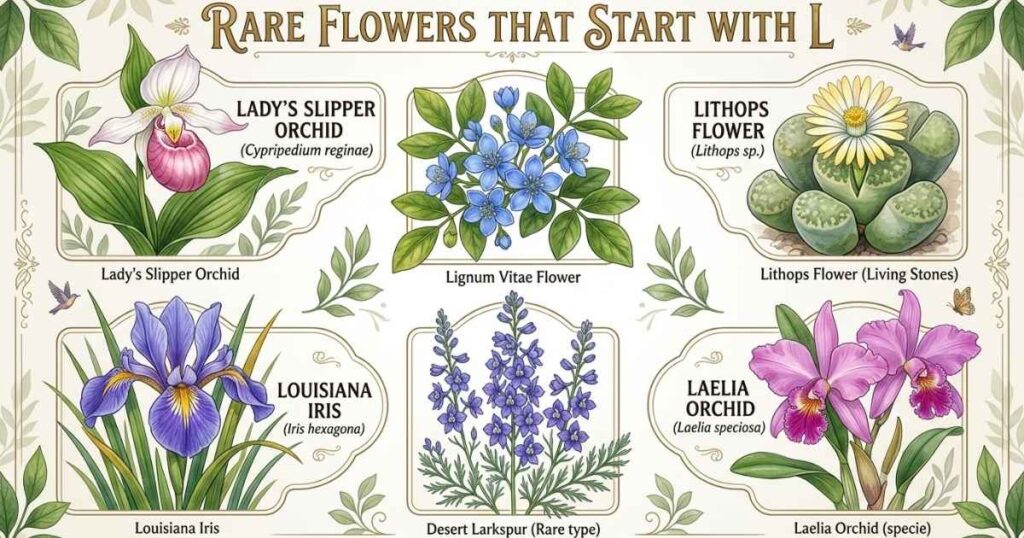
Some L flowers are far less common in home gardens, either because they need specific climates or because they are simply less commercially available at general nurseries.
Collectors and specialty growers often seek these out through mail order bulb suppliers or native plant societies rather than big box garden centers.
- Lady’s Slipper Orchid grows wild in cool, shaded woodlands and is protected in many regions, making it illegal to dig up in the wild.
- Lachenalia is a South African bulb with tubular, colorful flowers, mostly grown by bulb collectors outside its native range.
- Lithodora produces intensely blue, small flowers and needs acidic, well drained soil to thrive.
- Livingstone Daisy is a South African succulent flower with a daisy shape that only opens fully in bright sun.
- Leopard Lily is a wetland native lily with spotted, recurved petals, less common than Asiatic or Oriental hybrids.
- Lewisia is a rock garden succulent with jewel toned flowers that struggles in humid, wet climates.
- Leucojum, sometimes confused with Snowdrops, produces bell shaped white flowers tipped in green in early spring.
These rare picks reward patient gardeners but often need specific soil, light, or climate conditions that common L flowers do not require. Buying from a reputable specialty nursery reduces the risk of receiving a mislabeled or unsuitable variety.
How This 55 Flower List Was Curated
This list was built to be accurate and useful, not just long. Every entry was checked against a common name and a matching botanical name before inclusion.
Sources were cross referenced against horticultural references and regional native plant records to avoid including outdated or regionally inaccurate common names.
Inclusion Rules
- The flower’s common English name must start with the letter L
- A verifiable botanical or scientific name must exist for the plant
- The plant must produce a recognizable flower, not just decorative foliage
- Regional name variants were merged under their most common English name
What Was Not Counted As A Main Flower
- Plants known mainly for foliage, such as Lamb’s Ear, were noted but not counted as primary flower entries
- Fictional or trademarked cultivar names without a botanical basis were excluded
- Duplicate species listed under two different common names were merged into one entry
- Generic marketing names used only by individual retailers, without a recognized common name, were left off the list
Symbolism And Cultural Recognition
Flower meanings come from a mix of Victorian flower language, religious symbolism, and regional folklore, so the same flower can carry different meanings in different cultures.
Lily is tied to purity in Christian tradition and often appears at Easter services. Lotus holds a central place in Buddhist and Hindu art as a symbol of spiritual awakening.
Lilac is associated with first love in Victorian flower language, while Lavender has carried a reputation for calm and healing since ancient Roman times, when it was added to bathwater.
- Lily: purity, motherhood, sympathy
- Lotus: enlightenment, purity, spiritual rebirth
- Lilac: first love, renewal
- Lavender: calm, devotion, healing
Lupine’s symbolism is more mixed across sources, with some Victorian guides linking it to imagination and others to dejection, so context and region matter when reading flower meanings.
Because meanings shift by culture and era, treat flower symbolism as a helpful tradition rather than a fixed rule when choosing flowers for a gift or event.
Cultural recognition also shapes how these flowers are used at events. Lily is a common choice at funerals in Western countries, while Lotus appears frequently in temple offerings across South and Southeast Asia.
Plants Vs Flowers That Start With L
Not every plant with an L name is grown mainly for its flower. Some, like Lamb’s Ear, are grown for foliage, and the flower is a minor feature.
A flower entry earns its place on a flower list when the bloom itself is the main reason gardeners grow the plant. A plant entry may still flower, but the foliage, fruit, or form is the main draw.
This distinction matters when shopping, since a plant sold under an L name for its foliage may disappoint a buyer expecting a showy, long lasting bloom.
| Type | Example | Main Feature |
| Flower focused | Lily, Lilac, Lotus | Bloom is the main attraction |
| Foliage focused | Lamb’s Ear | Soft leaves, flower is secondary |
| Fruit or pod focused | Chinese Lantern | Papery seed pod, not the flower |
Common And Botanical Name
Using both the common and botanical name avoids buying the wrong plant. Several L flowers share common names across unrelated species.
- “Spider Lily” refers to both Lycoris radiata and Hymenocallis, two unrelated plants
- “Lily of the Nile” is Agapanthus, not a true lily and not from the Nile region
- “Ice Plant” can refer to Lampranthus or the unrelated Mesembryanthemum crystallinum
Always check the botanical name on a plant tag before purchase, especially for mail order bulbs and seeds, since a mismatched common name can lead to the wrong climate expectations or care routine.
When in doubt, search the botanical name rather than the common name, since scientific names are standardized worldwide and do not change between regions or retailers.
Types Of Flowers That Start With L
L flowers can be grouped by growth habit, bloom season, color, and garden use. The sections below break the full list into practical planning categories so you can build a garden plan without cross referencing multiple sources.
Many flowers appear in more than one category below, since a plant can be both a perennial and a purple bloomer, for example, so use these lists together rather than in isolation.
Perennials That Start With L
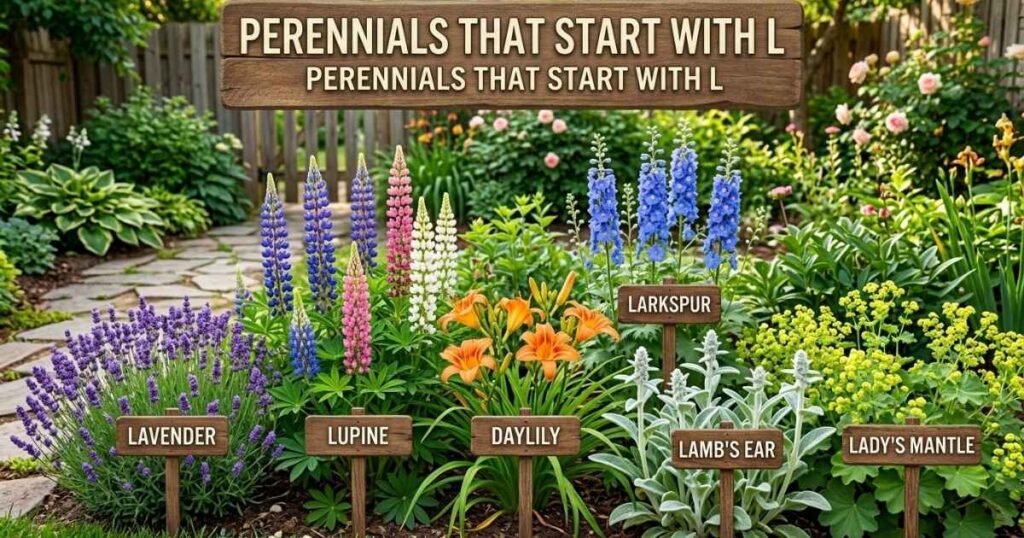
Perennials return year after year without replanting, making them a lower maintenance long term choice.
- Lavender
- Lily
- Lilac
- Liatris
- Lupine (in most zones)
- Lily of the Valley
- Ligularia
- Lily of the Nile
Most perennial L flowers need a dormant winter period to reset for the following season, so gardeners in frost free zones may need to treat some of these as short lived plants instead.
Annual Flowers That Start With L
Annuals complete their life cycle in one season and need replanting each year, but they often bloom faster and longer.
- Lobelia
- Lisianthus (grown as annual in most climates)
- Larkspur
- Love in a Mist
- Ladybird Poppy
- Lacy Phacelia
Annuals are a good choice for gardeners who want to change color schemes each year or fill gaps while slower growing perennials establish.
Purple Flowers That Start With L
Purple is one of the most common colors among L flowers, appearing across several plant families.
- Lavender
- Lilac
- Liatris
- Lupine
- Lisianthus
- Lithodora
Purple toned L flowers pair well together in mixed borders since their bloom times overlap from spring through late summer, giving a long lasting color theme.
Fragrant L Flowers
- Lavender carries the strongest and most recognized scent in this group
- Lilac produces a sweet, heavy fragrance during its short spring bloom
- Lily, especially Oriental types, has a strong, sweet scent that can fill a room
- Lily of the Valley has a light, delicate fragrance popular in perfumery
Fragrant flowers work well planted near seating areas, doorways, or windows, where the scent can be enjoyed without needing to walk into the garden bed.
Beginner Friendly Choices
- Lantana tolerates heat, drought, and poor soil with minimal care
- Lobelia is easy to grow from seed or nursery starts in containers
- Larkspur self seeds and often returns without replanting
New gardeners should start with one or two of these low maintenance options before adding more demanding rare varieties to a garden plan.
Indoor Or Protected Space Picks
- Lipstick Plant grows well as a hanging houseplant in bright, indirect light
- Lachenalia can be grown as a potted bulb in cool, bright indoor spaces
- Lady’s Slipper Orchid can be grown indoors under controlled humidity and light
These indoor picks suit gardeners in cold climates or apartment settings without outdoor garden beds.
Container And Small Space Picks
- Lobelia
- Lantana (dwarf varieties)
- Lavender (compact cultivars)
- Livingstone Daisy
Compact cultivars are worth seeking out by name, since standard sized varieties of the same species can quickly outgrow a small pot or balcony rail.
Pollinator Friendly And Meadow Picks
- Liatris attracts butterflies and bees in large numbers
- Lupine supports native bee species and some butterfly larvae
- Lacy Phacelia is a strong honeybee forage plant used in cover cropping
- Lavender draws bees consistently through its long bloom window
Grouping these flowers into a dedicated pollinator patch, rather than scattering single plants, tends to attract more consistent bee and butterfly activity.
Cut Flower And Bouquet Favorites
- Lisianthus
- Lily
- Larkspur
- Limonium (Statice)
- Love Lies Bleeding
Limonium is especially useful for dried arrangements, since its papery petals hold color and shape long after cutting, unlike most fresh cut flowers on this list.
Water And Pond Flower Picks
- Lotus is the primary true aquatic flower in this list, suited to ponds and water gardens
- Lily of the Nile, despite the name, is not aquatic and grows in regular garden soil
Quick Planning: Growing And Garden Planning
Planning an L flower garden works best when bloom time, light, and safety needs are mapped out before planting day, rather than figured out after plants are already in the ground.
Use the tables and notes below to sketch a rough layout before buying seeds or starts, so sun loving and shade loving flowers do not end up competing for the same bed.
Bloom Season And Color Planning
| Season | L Flowers In Bloom | Common Colors |
| Spring | Lilac, Leucojum, Lily of the Valley | Purple, white |
| Summer | Lavender, Lily, Lisianthus, Liatris, Lotus | Purple, pink, white, orange |
| Fall | Lantana, Lobelia | Orange, yellow, blue |
Light, Soil, And Zone Notes
- Most L flowers, including Lavender, Liatris, and Lantana, need full sun and well drained soil to thrive
- Lily of the Valley and Ligularia prefer part shade and consistently moist soil
- Lotus needs standing water and full sun, and cannot grow in regular garden beds
- Cold hardiness varies widely, so check the USDA zone rating on the plant tag before buying
- Well drained soil matters more than soil richness for most L flowers, since several, including Lavender and Lantana, dislike constantly wet roots
- Container grown L flowers generally need more frequent watering than the same species planted directly in garden beds
Pollinator, Pet, And Safety Points
- Lily is highly toxic to cats, even in small amounts such as pollen or vase water, and should be kept out of homes with cats
- Lupine seeds are toxic to livestock and humans if eaten in quantity
- Lavender, Lisianthus, and Lantana flowers are generally low risk around pets in small contact amounts, though Lantana berries are toxic if ingested
- Always check a current toxicity database before bringing a new flower into a home with pets or small children
If a pet ingests any part of a Lily plant, treat it as an emergency and contact a veterinarian immediately, since symptoms of kidney failure can appear within hours.
FAQ’s
What flower starts with the letter L and means love?
Lilac is often linked to first love. Lily is linked to purity and devotion rather than romantic love specifically.
Is Lily of the Valley a true lily?
No, Lily of the Valley belongs to a different genus, Convallaria, despite sharing the word lily in its common name.
Are lilies poisonous to cats?
Yes, true lilies are highly toxic to cats, and even small pollen exposure can cause kidney failure.
What is the most fragrant L flower?
Lavender is generally considered the most fragrant and widely used L flower for scent products.
Can Lotus grow in a regular garden without water?
No, Lotus requires standing water and cannot be grown in dry garden soil like most other L flowers.
What L flower is best for beginners?
Lantana is one of the easiest L flowers to grow, tolerating heat, drought, and low maintenance care.
Do all L flowers need full sun?
No, some, like Lily of the Valley and Ligularia, prefer partial shade and moist soil instead of full sun.
Conclusion
Flowers that start with L offer something for nearly every garden goal, from Lavender’s calming fragrance to Lotus rising above a quiet pond. This list of 55+ verified flowers, with common and botanical names, gives you a reliable starting point for planning, shopping, or simply learning.
Match your pick to your light, soil, and space before buying, and double check pet safety if lilies or lupines are on your shortlist. With the right L flower in the right spot, your garden or bouquet gains both beauty and meaning.
Bookmark this guide before your next visit to the nursery, so you can compare botanical names, bloom seasons, and care needs on the spot rather than guessing from a plant tag alone.