
Flowers that start with H are some of the most varied in the plant world. This letter covers fragrant climbers, tall garden classics, shade lovers, and rare wildflowers.
Whether you are planning a garden bed, naming a baby, choosing a tattoo idea, or writing a school project, this guide gives you a complete, easy to use list.
You will find common names, Latin names, growing tips, and quick answers to the most searched questions about H flowers.
Quick Answer: What Are Flowers That Start With H?
Flowers that start with H include popular garden plants like Hydrangea, Hibiscus, Hyacinth, Hollyhock, and Honeysuckle. This letter also includes shade plants like Hosta and Heuchera, and rare finds like the Himalayan Blue Poppy.
Most H flowers grow well in temperate gardens. Some are shrubs, some are bulbs, and a few are annual vines.
Below is a full list of 76 flower names starting with H, followed by details on the most useful ones for home gardens.
76 Flower Names That Start With H
Here is the complete list of flowers that start with H, in one place for quick scanning.
| Flower Name | Flower Name |
| Hydrangea | Houttuynia |
| Hibiscus | Hunnemannia |
| Hyacinth | Hyoscyamus |
| Hellebore | Hypoestes |
| Hollyhock | Halesia |
| Heliotrope | Hamamelis |
| Honeysuckle | Helonias |
| Heather | Heliopsis |
| Helenium | Rhodanthe (Helipterum) |
| Hosta | Hesperantha |
| Heuchera | Heterotheca |
| Hesperis | Hardy Hibiscus |
| Harebell | Homeria |
| Houstonia | Horsemint |
| Haemanthus | Hottonia |
| Hairy Toad Lily | Hyacinthoides |
| Hippeastrum | Hymenocallis |
| Helichrysum | Hymenoxys |
| Hypericum | Hypoxis |
| Honeywort | Hardy Orchid |
| Honesty | Hedge Bindweed |
| Hebe | Hoary Stock |
| Hawkweed | Hoary Alyssum |
| Himalayan Blue Poppy | Hare’s Ear |
| Hyssop | Hairy Vetch |
| Hoya | Hydrocotyle |
| Hepatica | Hakea |
| Helianthus | Hollyhock Mallow |
| Helianthemum | Hedge Woundwort |
| Hemerocallis | Hound’s Tongue |
| Hardy Geranium | Heartsease |
| Himalayan Balsam | Highbush Cranberry |
| Horned Violet | Helxine |
| Heath | Hairy Bittercress |
| Hyacinth Bean | Hoop Petticoat Daffodil |
| Hedysarum | Hedge Mustard |
| Hemp Agrimony | Hairbell Poppy |
| Hottentot Fig | Hardy Amaryllis |
Flowers That Start With The Letter H: A Glance
This table gives a snapshot of the most common H flowers, their type, and their main growing condition.
| Flower | Type | Sun Need | Bloom Season |
| Hydrangea | Shrub | Partial shade | Summer |
| Hibiscus | Shrub or Annual | Full sun | Summer to Fall |
| Hyacinth | Bulb | Full sun | Spring |
| Hellebore | Perennial | Shade | Winter to Spring |
| Hollyhock | Biennial | Full sun | Summer |
| Heliotrope | Annual | Full sun | Summer |
| Honeysuckle | Vine | Full sun to partial shade | Summer |
| Heather | Shrub | Full sun | Fall to Winter |
| Helenium | Perennial | Full sun | Late Summer |
| Hosta | Perennial | Shade | Summer |
Common Flowers That Start With H
The flowers below are the most searched and most planted H flowers. Each one includes basic care details you can use right away.
Hydrangea
Hydrangeas are shrubs known for their large, round flower clusters. Some varieties even change color based on soil pH.
- Acidic soil often produces blue blooms.
- Alkaline soil often produces pink blooms.
- They need consistent moisture, especially in summer heat.
Hydrangeas do best in morning sun with afternoon shade. They are a top pick for cottage gardens and cut flower arrangements.
Hibiscus
Hibiscus flowers are large, trumpet shaped, and often tropical in appearance. Tropical hibiscus is grown as a houseplant in cold climates.
Hardy hibiscus can survive frost and comes back every year in many regions. Both types need full sun to bloom well.
Hibiscus flowers usually last only one day, but the plant produces new blooms continuously through the season.
Hyacinth
Hyacinths are spring bulbs known for their strong, sweet fragrance. The flower spikes come in purple, pink, white, and blue.
Plant hyacinth bulbs in fall for spring blooms. They need a cold period to flower properly, so gardeners in warm climates often chill the bulbs before planting.
Hellebore
Hellebores, sometimes called Lenten Rose, bloom in late winter when little else is flowering. They thrive in shady spots under trees.
- Hellebores are deer resistant.
- They tolerate poor soil once established.
- Flowers often nod downward, so planting on a slope helps display them.
This makes hellebore a smart choice for early color in shaded gardens.
Hollyhock
Hollyhocks are tall, old fashioned flowers that can reach six feet or more. They grow as biennials, meaning they flower in their second year.
They work well against fences and walls for support. Hollyhocks self seed easily, so once planted, they often return year after year without replanting.
Heliotrope
Heliotrope is grown for its vanilla like fragrance and deep purple flower clusters. It is often grown as an annual outside of warm climates.
This flower attracts butterflies and does well in containers near patios where its scent can be enjoyed up close.
Honeysuckle
Honeysuckle is a fast growing vine with tube shaped flowers that attract hummingbirds. It is highly fragrant, especially in the evening.
Some honeysuckle species can become invasive, so check whether the variety is native or well behaved before planting near natural areas.
Heather
Heather is a low growing shrub that produces small bell shaped flowers. It is popular in rock gardens and as ground cover.
Heather prefers acidic, well drained soil. Many varieties bloom in fall and winter, giving color when most other plants are dormant.
Helenium
Helenium, also called Sneezeweed, produces daisy like flowers in warm shades of orange, red, and yellow. It blooms in late summer through fall.
Despite its name, it does not cause allergies. Helenium is a strong pollinator plant and pairs well with ornamental grasses.
Hosta
Hostas are grown mostly for their leaves, but they also produce tall flower spikes in summer. Flowers are usually white or lavender.
Hostas are one of the best shade perennials available. They are low maintenance but attractive to slugs and deer in some regions.
Heuchera
Heuchera, also called Coral Bells, is grown for colorful foliage and delicate flower spikes. The tiny bell shaped flowers attract hummingbirds.
This plant works well in shade gardens and container combinations. Foliage color ranges from deep purple to bright lime green.
Hesperis
Hesperis, commonly called Dame’s Rocket, produces fragrant purple or white flowers in late spring. It resembles phlox but blooms earlier.
This plant self seeds readily and naturalizes well in cottage style gardens and along woodland edges.
Harebell
Harebell is a delicate wildflower with nodding, bell shaped blue flowers. It grows well in rock gardens and meadow plantings.
This flower is native to many parts of the Northern Hemisphere and tolerates poor, rocky soil with ease.
Houstonia
Houstonia, also called Bluets, is a tiny native wildflower with pale blue to white flowers. It grows in low clumps or mats.
It is often found in lawns and meadows in early spring, making it a good choice for naturalized plantings.
Haemanthus
Haemanthus, also called Blood Lily, produces striking round clusters of red or white flowers on a thick stem. It grows from a bulb.
This plant is native to Africa and is often grown as a houseplant or in warm climate gardens.
Hairy Toad Lily
Hairy Toad Lily produces speckled, orchid like flowers in shades of purple and white. It blooms in late summer to fall.
This unusual flower does best in shaded, woodland style gardens with rich, moist soil.
Hippeastrum
Hippeastrum is the correct botanical name for what is commonly sold as Amaryllis. It produces large trumpet shaped flowers on a tall stalk.
This bulb is popular for winter indoor blooming and is often given as a holiday gift plant.
Helichrysum
Helichrysum, also known as Strawflower, has papery petals that hold their color even when dried. It is a favorite for dried flower arrangements.
It thrives in full sun and tolerates dry, poor soil better than most flowering annuals.
Hypericum
Hypericum, also called St. John’s Wort, produces bright yellow flowers followed by decorative berries. Some varieties are used in herbal remedies.
It is a hardy shrub that tolerates a range of soil types and needs minimal care once established.
Honeywort
Honeywort, also known as Cerinthe, has unusual blue green foliage and dangling purple blue flowers. It is a favorite of bees.
This annual flower reseeds easily and works well in cutting gardens and cottage borders.
Honesty
Honesty, or Lunaria, is grown both for its purple spring flowers and its papery, translucent seed pods used in dried arrangements.
It is a biennial that self seeds and naturalizes well in woodland edges and informal gardens.
Hebe
Hebe is an evergreen shrub with small flower spikes in shades of purple, pink, or white. It is popular in coastal gardens.
Hebe tolerates salt spray and wind, making it a strong choice for exposed garden locations.
Hawkweed
Hawkweed produces small, dandelion like yellow or orange flowers. It grows in meadows and along roadsides.
Some hawkweed species are considered invasive in certain regions, so it is worth checking local guidelines before planting.
Himalayan Blue Poppy
Himalayan Blue Poppy is prized for its rare, true blue flowers. It is considered a challenging plant to grow outside of cool, moist climates.
- It needs consistently cool summers.
- Soil must stay moist but well drained.
- It struggles in hot or humid regions.
Gardeners in the Pacific Northwest and similar climates have the best success with this flower.
More Flowers That Start With H
There are many more H flowers beyond the most common names. This section covers lesser known but still garden worthy options.
Familiar But Less Common Garden Flowers
These flowers are easy to find at nurseries but are grown less often than the classics above.
- Hyssop: an herb with spiky purple flowers that attract bees and butterflies.
- Hoya: a houseplant vine with waxy, star shaped flower clusters.
- Hepatica: an early spring woodland flower in blue, pink, or white.
- Helianthus: the botanical name for sunflower, including perennial types.
- Helianthemum: known as Rock Rose, a low growing plant with papery flowers.
- Hemerocallis: the botanical name for daylily, a tough and reliable perennial.
- Hardy Geranium: not related to common geranium, this perennial has simple, saucer shaped flowers.
- Himalayan Balsam: a tall annual with pink flowers, considered invasive in parts of Europe.
- Horned Violet: a compact viola relative with small, spurred flowers.
- Heath: closely related to heather, with similar bell shaped blooms.
These plants are good options when you want variety beyond the most typical garden center choices.
Latin Flower Names That Start With H
Many H flowers are better known by their common name, but their Latin name is often what you will find on plant tags.
| Common Name | Latin Name |
| Hydrangea | Hydrangea macrophylla |
| Hibiscus | Hibiscus rosa-sinensis |
| Hyacinth | Hyacinthus orientalis |
| Hellebore | Helleborus niger |
| Hollyhock | Alcea rosea |
| Heliotrope | Heliotropium arborescens |
| Honeysuckle | Lonicera |
| Heather | Calluna vulgaris |
| Helenium | Helenium autumnale |
| Amaryllis | Hippeastrum |
Why Common Names and Latin Names Get Mixed Together
Common names differ by region, but Latin names stay the same worldwide. This is why the same flower can be called different things depending on where you live.
For example, Hollyhock is commonly used, but its scientific name, Alcea rosea, does not even start with H. Meanwhile, Amaryllis is a common name, but its correct Latin name is Hippeastrum.
Knowing both names helps when buying plants online or from international sellers.
Best H Flowers by Garden Need
Choosing a flower is easier when you filter by what you actually need. Below are H flowers grouped by purpose.
Purple Flowers That Start With H
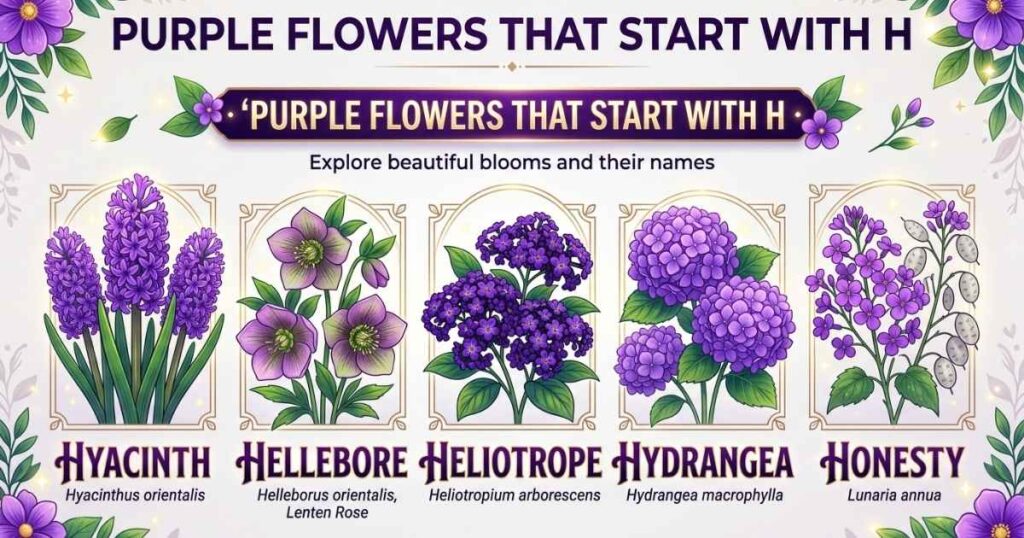
- Heliotrope
- Hyacinth
- Hollyhock
- Hesperis
- Harebell
Perennials That Start With H
- Hosta
- Heuchera
- Hellebore
- Hardy Geranium
- Helenium
Annual and Annual-like Flowers
- Heliotrope
- Honeywort
- Hyacinth Bean
- Himalayan Balsam
Indoor and Container-Friendly H Flowers
- Hippeastrum (Amaryllis)
- Hoya
- Hibiscus (tropical types)
- Hypoestes
Fragrant H Flowers Worth Growing
- Hyacinth
- Honeysuckle
- Heliotrope
- Hesperis
Beginner Friendly H Flowers
- Hosta
- Hemerocallis (Daylily)
- Hollyhock
- Heather
H Flowers That Attract Pollinators
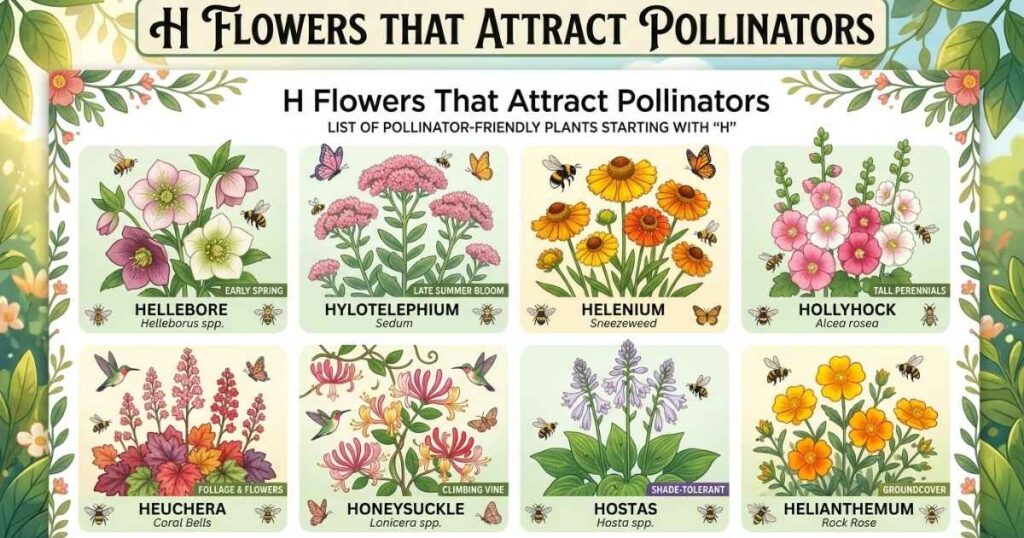
- Honeysuckle
- Hyssop
- Helenium
- Honeywort
- Hypericum
Unusual And Rare Flowers That Start With H
- Himalayan Blue Poppy
- Hairy Toad Lily
- Haemanthus
- Helonias
What To Know Before You Plant H Flowers
Before adding any H flower to your garden, check a few basic details first.
- Confirm your hardiness zone, since some H flowers like Himalayan Blue Poppy only thrive in cool climates.
- Check whether the plant is invasive in your region, especially Honeysuckle and Himalayan Balsam.
- Match soil type to the plant, since Heather and Hypericum prefer acidic soil while others tolerate wider ranges.
Taking a few minutes to check these details saves time and prevents wasted plants.
How To Choose the Right H Flower
Picking the right flower depends on more than just appearance. Consider the following factors together.
Plants vs Flowers That Start With H
Some H names refer to the whole plant, such as Hosta or Heather, while the flower is just one feature. Others, like Hyacinth, are grown specifically for the flower itself.
This distinction matters if you want year round interest versus a plant that is only attractive during bloom time.
Match The Flower To Light And Bloom Season
Shade lovers like Hosta and Hellebore will not perform well in full sun. Sun lovers like Hibiscus and Hollyhock need at least six hours of direct light.
Staggering bloom times, such as Hellebore in winter and Helenium in fall, keeps color in the garden across seasons.
Shrubs, Vines, Bulbs, and Perennials Play Different Roles
- Shrubs like Hydrangea and Hebe add structure.
- Vines like Honeysuckle add vertical interest.
- Bulbs like Hyacinth and Hippeastrum give seasonal bursts of color.
- Perennials like Hosta and Heuchera return yearly with steady growth.
Mixing plant types creates a more balanced, layered garden design.
Which H Flowers Need More Care Before Planting
Some H flowers are more demanding than others.
| Flower | Care Level |
| Himalayan Blue Poppy | High |
| Hairy Toad Lily | Moderate |
| Hydrangea | Moderate |
| Hosta | Low |
| Heather | Low |
Choosing low care flowers first is a smart way to build confidence before trying harder species.
Flower Meanings and Symbolism
Many H flowers carry specific meanings that make them popular for gifts and events.
- Hydrangea often symbolizes gratitude and heartfelt emotion.
- Hibiscus represents delicate beauty and is linked to new experiences.
- Hyacinth symbolizes sincerity and playfulness, and appears in Greek mythology.
- Honeysuckle is associated with devoted affection and bonds of love.
- Hollyhock traditionally symbolizes ambition and fruitfulness.
These meanings make H flowers common choices for bouquets, weddings, and sympathy arrangements.
FAQ’s
What flower starts with the letter H and is most popular?
Hydrangea and Hibiscus are the most commonly grown and searched flowers starting with H worldwide.
Is Hyacinth a spring or summer flower?
Hyacinth is a spring blooming bulb that flowers shortly after winter ends.
Are all H flowers easy to grow?
No, most are easy, but a few like Himalayan Blue Poppy need very specific cool, moist conditions.
What is the Latin name for Amaryllis?
The correct Latin name for Amaryllis is Hippeastrum, even though it is commonly sold under a different name.
Which H flowers grow well indoors?
Hoya, Hippeastrum, and tropical Hibiscus all grow well as indoor container plants.
Do H flowers attract bees and butterflies?
Yes, Honeysuckle, Hyssop, and Helenium are especially good for attracting pollinators.
Can Hollyhock and Hosta grow in the same garden?
Yes, but Hollyhock needs full sun while Hosta needs shade, so plant them in different areas of the same garden.
Conclusion
Flowers that start with H offer something for nearly every garden style, from fragrant vines to shade loving perennials.
Use this guide as a starting point, then pick two or three flowers that match your light, soil, and care level. Starting small makes it easier to build a garden you can maintain with confidence.
With names like Hydrangea, Hibiscus, and Hosta already proven as reliable choices, your H flower garden has a strong foundation to grow from.