
Flowers that start with D bring some of the most recognizable blooms into gardens worldwide. Think of the cheerful daffodil announcing spring, or the dahlia stealing the show at a fall wedding.
This guide covers over 90 D flowers. You will find their names, colors, growing needs, and meanings. Whether you garden in pots, beds, or a vase on your kitchen table, there is a D flower here for you.
Each entry includes practical details you can actually use. No filler, just the facts a home gardener or flower lover needs to pick, plant, and enjoy these blooms.
Quick Answer: Popular D Flower Names
If you only remember a handful of D flowers, start with these:
- Daffodil – bright yellow spring bulb
- Dahlia – large, showy summer to fall bloom
- Daisy – simple white petals with a yellow center
- Delphinium – tall spikes of blue or purple
- Dianthus – fragrant, frilly-edged pink or white flowers
- Daylily – trumpet-shaped bloom that lasts one day
- Dendrobium Orchid – elegant, long-lasting indoor bloom
These seven cover the range most people search for: common garden favorites, cut flowers, and houseplants.
Full Alphabetical List Of Flowers That Start With D
Here is a complete reference list of D flowers, common and lesser known.
| Flower Name | Type |
| Daffodil | Bulb |
| Dahlia | Tuber |
| Daisy | Perennial |
| Dandelion | Wildflower |
| Daylily | Perennial |
| Delphinium | Perennial |
| Dianthus | Perennial or annual |
| Digitalis (Foxglove) | Biennial |
| Dicentra (Bleeding Heart) | Perennial |
| Dutch Iris | Bulb |
| Dendrobium Orchid | Epiphyte |
| Desert Rose | Succulent shrub |
| Daphne | Shrub |
| Dogwood Blossom | Tree flower |
| Drummond Phlox | Annual |
| Drumstick Allium | Bulb |
| Douglas Aster | Perennial wildflower |
| Damask Rose | Shrub rose |
| Diascia | Annual or perennial |
| Dietes (Fortnight Lily) | Perennial |
| Datura | Annual or perennial |
This list is a starting point. Some names, like Damask Rose, sit outside the core list but deserve a mention later in this guide.
Common Flowers That Start With D
The flowers below are the ones most gardeners will actually grow or recognize. Each profile gives you what it looks like, how to grow it, and where it fits in a garden.
Daffodil
Daffodils are one of the first flowers to bloom after winter. Their trumpet-shaped center is usually yellow, though white and orange varieties exist too.
They grow from bulbs planted in fall. Daffodils prefer well-drained soil and full sun to light shade.
- Bloom time: early to mid spring
- Height: 6 to 20 inches depending on variety
- Deer and rodent resistant
Daffodils naturalize well, meaning they multiply and return year after year with little care.
Dahlia
Dahlias produce some of the largest and most varied blooms in the flower world. Sizes range from small pompon types to dinner-plate dahlias over 10 inches wide.
They grow from tubers planted after the last frost. Dahlias need full sun and consistently moist, well-drained soil.
- Bloom time: mid summer through first frost
- Height: 1 to 5 feet depending on type
- Popular for weddings and cut flower gardens
In cold climates, dahlia tubers should be dug up and stored indoors over winter.
Daisy
The classic daisy has white petals surrounding a yellow disc. Shasta daisies are the most common garden variety.
Daisies are easy to grow and tolerate a range of soil types. They prefer full sun.
- Bloom time: late spring through summer
- Height: 1 to 3 feet
- Attracts bees and butterflies
Daisies are a good starting flower for beginner gardeners because they rarely fail.
Dandelion
Dandelions are often labeled weeds, but their bright yellow flowers serve an important role for early-season pollinators.
They grow almost anywhere, including cracks in pavement. No special care is needed.
- Bloom time: spring through fall
- Height: 2 to 12 inches
- Entire plant is edible, including leaves and root
Dandelions are one of the first food sources for bees emerging in early spring.
Daylily
Daylily blooms open in the morning and close by evening, lasting only one day per flower. The plant produces many buds, so blooming continues for weeks.
Daylilies tolerate poor soil, drought, and neglect better than most perennials.
- Bloom time: early summer to late summer
- Height: 1 to 4 feet
- Comes in nearly every color except true blue
They are one of the lowest maintenance perennials available for new gardeners.
Delphinium
Delphiniums produce tall spires packed with blue, purple, pink, or white flowers. They are a favorite for cottage gardens and English-style borders.
These plants need rich, well-drained soil and protection from strong wind.
- Bloom time: early to mid summer
- Height: 2 to 6 feet
- May need staking due to height
Delphinium is toxic if ingested, so keep it away from pets and small children.
Dianthus
Dianthus, sometimes called pinks, has a light clove-like fragrance and fringed petal edges. Colors range from white to deep red.
It grows well in containers, borders, and rock gardens. Dianthus prefers full sun and alkaline soil.
- Bloom time: late spring through summer
- Height: 6 inches to 2 feet
- Many varieties are reblooming
Dianthus works well as edging along walkways due to its compact habit.
Digitalis
Digitalis, commonly called foxglove, has tall spikes lined with tubular, bell-shaped flowers. Colors include purple, pink, white, and yellow.
It grows best in partial shade with moist, well-drained soil.
- Bloom time: early summer
- Height: 2 to 5 feet
- Biennial, meaning it blooms in its second year
Every part of the digitalis plant is toxic if eaten. Handle with gloves and keep away from pets.
Dicentra
Dicentra, known as bleeding heart, has heart-shaped pink or white flowers that dangle from arching stems. It is a shade garden favorite.
It prefers cool, moist, well-drained soil and partial to full shade.
- Bloom time: mid spring
- Height: 1 to 3 feet
- Foliage dies back in summer heat
Bleeding heart pairs well with hostas and ferns in a woodland-style bed.
Dutch Iris
Dutch Iris produces slender stems topped with elegant, three-petaled flowers in blue, purple, yellow, or white. It is a favorite for cut flower arrangements.
Plant bulbs in fall in well-drained soil with full sun.
- Bloom time: late spring
- Height: 18 to 24 inches
- Long vase life once cut
Dutch Iris multiplies over time, making it a good investment bulb for cutting gardens.
Dendrobium Orchid
Dendrobium orchids are popular houseplants known for long sprays of waxy, long-lasting blooms in white, pink, purple, and yellow.
They need bright, indirect light and a well-draining orchid mix rather than regular soil.
- Bloom time: varies, often winter to spring
- Height: 1 to 3 feet
- Blooms can last 6 to 8 weeks
Dendrobium orchids prefer to dry out slightly between waterings, unlike many other houseplants.
Desert Rose
Desert Rose, or Adenium, is a succulent shrub with a thick trunk and trumpet-shaped pink or red flowers. It is grown as a houseplant in cooler climates.
It needs full sun, sandy well-drained soil, and very little water.
- Bloom time: spring through summer
- Height: 3 to 9 feet outdoors, smaller in pots
- Sap is toxic if ingested
Desert Rose is a good choice for gardeners who tend to forget to water.
Daphne
Daphne is a compact shrub prized for its intensely fragrant clusters of pink or white flowers. A single plant can perfume an entire garden corner.
It prefers well-drained soil and dislikes having its roots disturbed once planted.
- Bloom time: late winter to early spring
- Height: 2 to 4 feet
- Slow growing but long lived
All parts of daphne are toxic, so place it away from areas where pets or children play.
Dogwood Blossom
Dogwood blossoms appear on flowering dogwood trees in spring, before or alongside new leaves. The showy white or pink bracts surround a small central cluster of true flowers.
Dogwoods prefer partial shade and moist, well-drained, slightly acidic soil.
- Bloom time: early to mid spring
- Height: 15 to 25 feet as a tree
- Followed by red berries in fall
Dogwood blossoms are a signature sight in woodland gardens and along forest edges.
Drummond Phlox
Drummond Phlox is a low-growing annual covered in clusters of small, star-shaped flowers in pink, red, purple, and white.
It grows easily from seed in full sun and average, well-drained soil.
- Bloom time: spring through fall in mild climates
- Height: 6 to 18 inches
- Reseeds itself readily
This phlox is a strong choice for filling gaps in beds or spilling over container edges.
Drumstick Allium
Drumstick Allium produces small, egg-shaped clusters of deep burgundy flowers atop slender stems, resembling drumsticks.
It grows from bulbs planted in fall, in full sun and well-drained soil.
- Bloom time: early summer
- Height: 1.5 to 2.5 feet
- Deer and rodent resistant
The dried seed heads look striking left standing through late summer for texture.
Douglas Aster
Douglas Aster is a native wildflower found across western North America, with lavender-blue, daisy-like flowers that bloom late in the season.
It thrives in full sun to part shade and adapts to both moist and dry soil.
- Bloom time: late summer to fall
- Height: 1 to 3 feet
- Important late-season food source for pollinators
Douglas Aster is a strong pick for native plant gardens and pollinator meadows.
Other D Flowers Worth Knowing
A few more D flowers deserve a mention even though they are less commonly searched.
- Damask Rose: A fragrant heirloom rose used to make rose oil and rosewater.
- Diascia: A trailing annual with small pink flowers, great for hanging baskets.
- Dietes: Also called fortnight lily, blooms every two weeks with iris-like flowers.
- Datura: A striking trumpet-shaped flower, but highly toxic in all parts.
- Dampiera: An Australian native with blue, star-shaped flowers.
These flowers may not be household names, but they offer unique options for gardeners looking to diversify their beds.
Types Of D Flowers By Growth Habit And Garden Use
D flowers fall into a few practical categories based on how they grow and what role they play in a garden.
- Bulbs: Daffodil, Dutch Iris, Drumstick Allium
- Perennials: Daylily, Delphinium, Dianthus, Dicentra, Douglas Aster
- Annuals: Drummond Phlox, Diascia
- Shrubs and trees: Daphne, Dogwood
- Houseplants: Dendrobium Orchid, Desert Rose
Knowing the growth habit helps you plan where each flower fits, whether that is a border, a pot, or a permanent spot in the landscape.
Perennials That Start With D
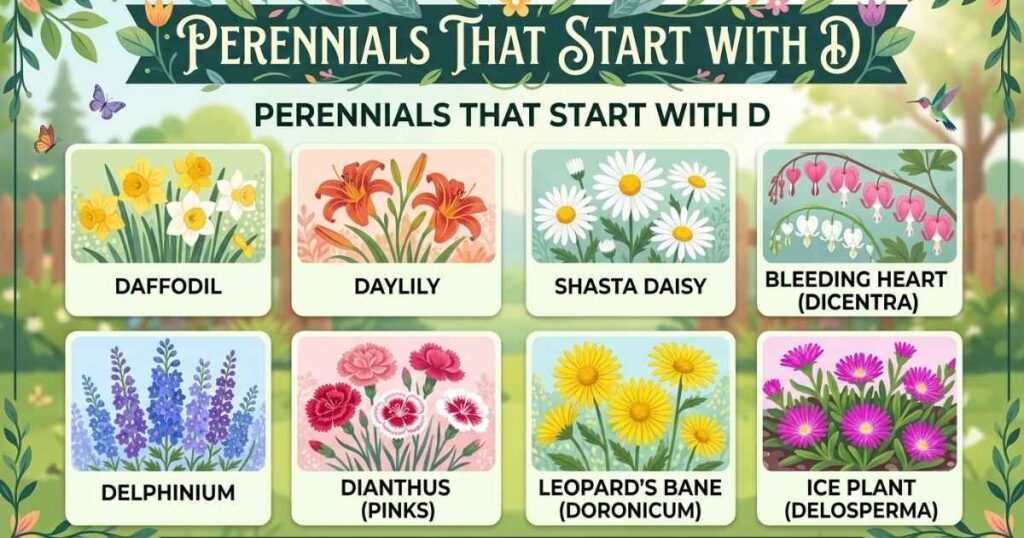
Perennials return year after year, making them a solid long-term investment for any garden.
| Perennial | Sun Needs | Bloom Season |
| Daylily | Full sun to part shade | Early to late summer |
| Delphinium | Full sun | Early to mid summer |
| Dianthus | Full sun | Late spring to summer |
| Dicentra | Part to full shade | Mid spring |
| Douglas Aster | Full sun to part shade | Late summer to fall |
| Dietes | Full sun | Repeats every two weeks |
These plants establish over one or two seasons and then require minimal replanting effort.
Annual Flowers That Start With D
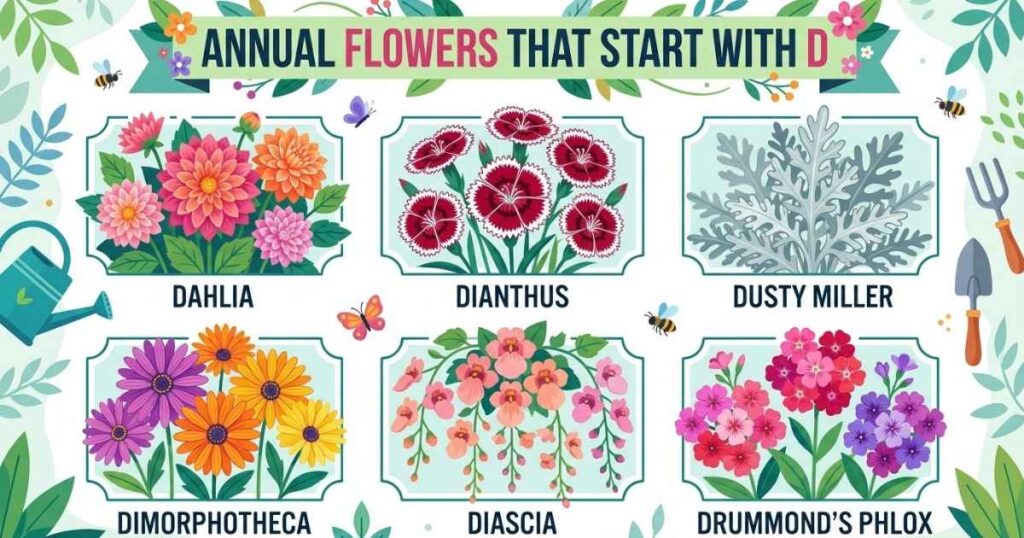
Annuals complete their life cycle in one growing season, but they often bloom longer and more continuously than perennials.
- Drummond Phlox: Fast growing, self-seeding, great for filling gaps
- Diascia: Ideal for hanging baskets and window boxes
- Datura: Dramatic but requires careful placement due to toxicity
Annuals are useful for gardeners who want quick color or plan to redesign beds each year.
Beginner Friendly Choices
Some D flowers are more forgiving than others for gardeners just starting out.
- Daffodil: Plant once, enjoy for years, almost no maintenance
- Daisy: Tolerant of different soils and light levels
- Daylily: Handles drought, poor soil, and neglect
- Dandelion: Grows without any help at all
These four are nearly impossible to kill, making them a safe entry point for new gardeners.
Color Filters
Choosing flowers by color helps when designing a themed bed or matching a specific palette.
Purple Flowers That Start With D
- Delphinium
- Dutch Iris
- Drumstick Allium
- Datura (some varieties)
Yellow Flowers Names Starting With D
- Daffodil
- Dandelion
- Dahlia (yellow varieties)
- Digitalis (yellow foxglove)
White Flowers Names Starting With D
- Daisy
- Dogwood Blossom
- Dianthus (white varieties)
- Daphne (white varieties)
Blue Flowers Names Starting With D
- Delphinium
- Dutch Iris
- Dampiera
- Douglas Aster
Pink, Red, And Orange D Flowers
- Dahlia (many shades)
- Dicentra (pink)
- Desert Rose (pink to red)
- Daphne (pink)
Color filtering makes it easier to plan a coordinated flower bed or bouquet using only D-named flowers.
Indoor And Container-Friendly Choices
Not every D flower needs a garden bed. Several thrive indoors or in pots on a patio.
- Dendrobium Orchid: Ideal windowsill bloom with long-lasting flowers
- Desert Rose: Suited to bright indoor spots or sunny patios
- Dianthus: Compact enough for containers, fragrant near seating areas
- Diascia: Excellent trailing plant for hanging pots
These options bring D flowers into apartments, balconies, and small outdoor spaces.
Best D Flowers For Pots And Small Spaces
For gardeners working with limited space, these D flowers perform well in containers.
| Flower | Container Depth Needed | Notes |
| Dianthus | 6 to 8 inches | Fragrant, compact |
| Daffodil | 8 to 10 inches | Plant bulbs in fall |
| Diascia | 6 inches | Great for trailing over edges |
| Desert Rose | 10 to 12 inches | Needs excellent drainage |
Container-grown D flowers still need drainage holes and regular watering, since pots dry out faster than garden beds.
Fragrance, Pollinators, And Use In The Garden
D flowers offer more than just visual appeal. Several bring scent, support wildlife, or perform well in a vase.
Fragrant D Flowers
- Daphne: One of the most fragrant shrubs available, noticeable from several feet away
- Dianthus: Light, spicy clove scent
- Damask Rose: Classic rose fragrance used in perfumery
Fragrant D flowers work best planted near doorways, windows, or seating areas where the scent can be enjoyed.
Pollinator Friendly And Meadow Picks
- Dandelion: Early spring food source for bees
- Douglas Aster: Late season nectar source
- Daisy: Attracts bees and butterflies throughout summer
- Drummond Phlox: Draws hummingbirds and butterflies
Including a mix of early, mid, and late season D flowers helps support pollinators across the full growing season.
Cut Flower And Bouquet Favorites
- Dahlia: Long-lasting, dramatic focal flower
- Dutch Iris: Elegant and long vase life
- Delphinium: Adds height and structure to arrangements
- Daffodil: Best cut alone since its sap can affect other flowers in the same vase
For mixed bouquets, cut daffodils separately and let them sit in water for a few hours before combining with other blooms.
Flower Meanings And Symbolism For D Flowers
Flowers carry symbolic meaning that varies by culture and tradition. Here are commonly recognized meanings for D flowers.
| Flower | Common Meaning |
| Daffodil | New beginnings, rebirth |
| Dahlia | Elegance, inner strength |
| Daisy | Innocence, purity |
| Dianthus | Affection, love |
| Delphinium | Openness, positivity |
| Daphne | Immortality, glory |
| Dicentra (Bleeding Heart) | Passionate love, romance |
These meanings make D flowers popular choices for specific occasions, such as daffodils for new starts or dahlias for anniversaries.
Growing Requirements For D Flowers
Most D flowers fall into a few general care categories. Use this table as a quick reference before planting.
| Flower | Sun | Water Needs | Soil Type |
| Daffodil | Full sun to part shade | Low once established | Well-drained |
| Dahlia | Full sun | Moderate to high | Rich, well-drained |
| Daisy | Full sun | Moderate | Average, well-drained |
| Delphinium | Full sun | Moderate | Rich, well-drained |
| Dianthus | Full sun | Low to moderate | Alkaline, well-drained |
| Digitalis | Part shade | Moderate | Moist, well-drained |
| Dicentra | Part to full shade | Moderate | Cool, moist, well-drained |
Matching each flower to its preferred conditions is the single biggest factor in whether it thrives or struggles.
Water And Pond Flower Picks
Not all D flowers grow in soil. A few thrive in or near water features.
- Dwarf Papyrus: Often grouped with D water plants, suited to pond edges
- Duckweed: A tiny floating plant, not a true flower but common in pond planting lists
These are worth noting for gardeners building a water garden and searching specifically for D-named options.
Broader D Bloomers, Caution Notes, And Common Mix Ups
Beyond the core list, a handful of D flowers show up in specialty gardens or specific regions. Examples include Dampiera in Australian native gardens and Diascia in cool-summer climates like the Pacific Northwest. These regional picks are worth exploring if the common D flowers already thrive in your garden.
Toxic Or Caution-Worthy Entries
Several popular D flowers are toxic if ingested. This does not mean avoiding them, but it does mean placing them thoughtfully.
- Digitalis (Foxglove): Toxic to humans and pets, all parts
- Delphinium: Toxic if eaten, especially young growth
- Daphne: Berries and sap are toxic
- Datura: Highly toxic and can cause severe reactions
- Dieffenbachia (sometimes confused as a D flower): Toxic sap causes irritation
Keep these plants out of reach of pets, young children, and grazing animals. Wearing gloves while pruning is a good habit with any of these.
Common Mix Ups In D Flower Lists
A few names get confused with true D flowers. Clearing these up helps with accurate identification.
- Dieffenbachia is a foliage houseplant, not a flower, though it is often listed by mistake.
- Damask Rose is technically a rose variety, not a standalone flower species.
- Duckweed is a floating plant without a showy bloom, included mainly in pond lists.
- Dogwood refers to the tree; the “dogwood blossom” is the correct term for the flower itself.
Knowing these distinctions helps avoid confusion when searching for or buying D flowers.
Conclusion
Flowers that start with D range from the drought-tough daylily to the delicate, fragrant daphne. Whether you want a low-maintenance bulb, a fragrant shrub, or a dramatic cut flower, there is a D flower suited to nearly every garden style and skill level.
Start with beginner-friendly picks like daffodils and daisies if you are new to gardening. Once established, branch out into dahlias, delphiniums, or a dendrobium orchid indoors. With the right sun, soil, and water conditions from the tables above, most D flowers are straightforward to grow and reward you with color for months at a time.
FAQ’s
What is the most popular flower that starts with D?
The daffodil is the most widely recognized D flower, known for its bright yellow spring bloom. Dahlia is a close second for summer gardens.
Are dahlias easy to grow for beginners?
Dahlias are moderately easy but need full sun and regular watering. In cold climates, tubers must be dug up before frost.
What D flower is best for a shady garden?
Dicentra, also called bleeding heart, thrives in partial to full shade with moist soil. Digitalis also tolerates part shade well.
Which D flowers are toxic to pets?
Digitalis, Delphinium, Daphne, and Datura are all toxic if ingested by pets. Keep these planted away from areas pets access.
Can daffodils be grown in containers?
Yes, daffodils grow well in containers at least 8 to 10 inches deep. Plant bulbs in fall for spring blooms.
What is the meaning behind the daisy flower?
The daisy commonly symbolizes innocence and purity. It is often given as a simple, cheerful gift for any occasion.
Do D flowers attract bees and pollinators?
Yes, dandelions, daisies, and Douglas asters are strong pollinator plants. They provide nectar across spring, summer, and fall seasons.