
The Pale System: One Wood, Warm White, Matte Everything
Start with warm white, and learn the undertone lesson first. The Scandinavian kitchen design principles guide names the family: cream, milk, vanilla, ivory, eggshell.
Blue white is the enemy. Stark cool whites read clinical in kitchens, especially under the wrong bulbs, and they are the first cause of the cold Scandi complaint.
Then choose one pale wood and repeat it without apology. Light oak leads the field; birch, ash, and pine are the understudies.
|
Wood |
Tone |
Best use |
Note |
|---|---|---|---|
|
Light oak |
Pale honey, visible grain |
Cabinets, floors, shelves |
The default; forgiving and available |
|
Birch |
Pale cream, fine grain |
Shelves, fronts, stools |
The quietest grain of the set |
|
Ash |
Pale with bold grain |
Fronts, tabletops |
Grain becomes the room’s pattern |
|
Pine |
Warm pale, knots |
Shelves, tables, benches |
Softest; dents are part of its charm |
|
Walnut |
Deep brown |
One accent only |
A dose, never the lead |
Mixing woods is the amateur error. Two pale species at slightly different temperatures read as a mistake the eye keeps finding.
Matte finishes complete the system. Gloss reflects glare and reads formal; matte reads natural, which is the entire point.
Veneer on a stable core is the practical construction for tall pale fronts. It resists movement and lets the grain match across a run.
Painted warm white fronts and pale wood fronts can share one kitchen. The classic split is white uppers, wood lowers, or the reverse by light.
The Black Dose: Two or Three Pieces
Pale rooms need grounding, and matte black is the standard anchor. The rule is a dose, not a theme: two or three matching pieces.
The classic trio is pendant lights, faucet, and pulls. Together they draw the room’s outline without darkening its weather.
A fourth and fifth black element start the slide. The palette tips from Nordic calm toward high contrast modern, a different style with different promises.
Brushed brass is the sanctioned alternative anchor. It warms where black sharpens, and it suits north facing rooms that already run cool.
Whichever anchor you choose, commit to one. Black pendants over a brass faucet reads as indecision at eye level.
The Light Discipline: Daylight First, Then Layers
Scandinavian design is daylight engineering. Winters at Nordic latitudes offer a handful of bright hours, so the style evolved to catch and multiply light.
Pale floors are the first instrument. The style’s own field teaching calls them close to non negotiable, because the floor is the room’s largest reflector.
White walls with a dark floor is a named Scandi mistake. The room’s light dies at ankle height and never recovers.
Keep windows nearly bare. Sheer linen at most, so the glass stays a light instrument instead of a decorated frame.
After dark, the layers take over. Ambient ceiling light, under cabinet task strips, pendants over the table or island, and one small warm source like a counter lamp.
Temperature is a rule, not a taste: 2700K to 3000K. The Creating a Scandinavian kitchen guide is strict here, banning 4000K and above as clinical, the fastest way to kill hygge.
Candles belong to this layer honestly. In Nordic homes they are infrastructure for winter evenings, not a styling prop borrowed for photographs.
The Function Discipline: Everything Earns Its Place
Scandinavian design began as functionalism, and the kitchen is where it shows. Every object must work, be used daily, or be deliberately beautiful.
This is the discipline the copies skip. They buy the palette and skip the behavior, then wonder why the room clutters by Thursday.
Storage is planned, not hoped for. Deep drawers, a tall pantry run, and closed homes for the machines keep counters clear without daily effort.
The work triangle still governs underneath: sink, stove, and refrigerator on short, unblocked legs, whatever the fronts look like.
Keep about 42 inches of clearance around an island. That is the minimum the Creating a Scandinavian kitchen guide sets for a one cook kitchen to stay graceful.
Open Shelving: The Placement and Proportion Rules
Open shelves are the style’s signature and its trap. Done by the rules, they create the light gallery effect; done casually, they collect grease and guilt.
Rule one is placement. Shelves belong by the sink or dishwasher, where daily dishes unload in one motion.
Never beside the stove. Grease travels, no hood fully stops it, and styled shelves near cooking become sticky displays within months.
Rule two is proportion. About 80 percent functional, 20 percent decorative: daily plates, bowls, glasses, and jars, plus one plant or one loved object.
Rule three is editing. Three objects with breathing room beat nine objects in a row; the eye should cross a shelf without working.
Glass jars of grains, white stoneware, and one wood board are the standard cast. Everything else auditions from a closed cabinet.
Hardware: Bar Pulls, Push to Open, and the Leather Pull
Scandi hardware stays simple but visible. This is a real difference from minimalism, which prefers hardware to disappear entirely.
Simple bar pulls are the mainstream answer, named in the glossary tradition. Slim, matte, and repeated without variation across the kitchen.
Push to open suits a few light uppers. On heavy drawers it becomes a daily irritation tax, the same lesson every handleless guide learns.
The signature choice is the leather pull. The 20 Scandinavian kitchen design ideas highlights cognac and tan leather pulls as common in Danish and Swedish kitchens.
Leather adds warmth and a handcrafted note metal cannot. It also ages honestly, darkening where hands touch it, which the style counts as beauty.
Hygge Is Work, Not Styling
Hygge is the Danish practice of coziness, pronounced roughly hoo ga. In kitchens it is built from textiles, light, and a place to linger.
Textiles carry warmth that hard surfaces cannot. Linen curtains and towels, a wool runner between island and counter, sheepskin on a bench or chair.
Wool earns its place practically: its natural lanolin resists stains, a point the Creating a Scandinavian kitchen guide makes when recommending flat weave wool runners.
The bench nook is hygge’s engine room. Built in seating with storage underneath, a simple table, and cushions create the spot where mornings slow down.
The 20 Scandinavian kitchen design ideas gives the nook its numbers: seating for four to six in less floor space than separate chairs demand.
Lagom is hygge’s Swedish sibling: just the right amount. Enough storage, enough objects, enough light, and nothing performing for show.
The Palette Doses: Sage, Blue, and Pastel in Their Place
Scandi color is dosed, not banned. Muted sage, soft blue, and gentle pastels all hold citizenship in the pale system.
Placement decides whether a dose works. Muted color belongs mostly below eye level: lower cabinets, chair cushions, tiles, and textiles.
Above the counter line, color competes with daylight. Pushed too high and too strong, soft blue turns nursery, the caution one white kitchen field guide repeats.
Sage green kitchen ideas is the cluster’s color dose page. Its muted green behaves as a neutral with a pulse inside a pale shell.
Cream kitchen ideas is the warm alternative base. Cream fronts deliver the same calm with the temperature turned up for cool rooms.
Layout: The Kitchen Diner and the Nook
The kitchen diner is the style’s social floor plan. Cooking and eating share one calm space, zoned by light and rugs rather than walls.
A light wood table, simple chairs, and statement pendants mark the dining zone. Mixed simple seating is normal; matched heavy sets fight the brief.
In small homes the bench nook replaces the diner. One wall, one bench, one table, and the room’s warmest square meters are decided.
Open shelving, the tall pantry, and the nook together form the classic triangle of the style: display, storage, and lingering, each in its own zone.
Budgets: Where the Money Goes in a Scandi Kitchen
The style is unusually budget honest, because its expensive ingredient is restraint. Money goes to wood, light, and storage, in that order.
Tier one is the refresh: paint, bulbs, textiles, shelves, and pulls. It buys the palette and the warmth, and it is reversible if tastes change.
Tier two is flat pack and semi custom: pale fronts, a butcher block or quartz counter, and real storage internals. Most successful Scandi kitchens live here.
Tier three is custom millwork: matched grain veneer runs, integrated appliances, and stone. The premium buys invisible joins, not more style.
Spend on the floor early if it is dark. A pale floor lifts every later decision, and replacing it after cabinets is the costliest sequence error.
Save on decor objects, because the style needs almost none. The daily tools, well chosen in wood, ceramic, and glass, are the decoration.
One caution on figures: any single price quoted online for a Scandi remodel is one market’s snapshot. Treat ranges as orientation and let local quotes decide.
The No Remodel Scandinavian Refresh
Most kitchens can borrow the style for hundreds, not thousands. The refresh is subtraction, light, and one wood, in that order.
Step one: change the light temperature. Warm bulbs at 2700K to 3000K are the cheapest transformation in this entire article.
Step two: paint or not, warm the white. If walls are blue white, a warm white repaint is the single biggest correction available.
Step three: add one pale wood. A shelf run, a butcher block section, or a set of boards and stools carries the wood note.
Step four: edit the surfaces. Counters down to the daily and the beautiful; shelves restyled to the 80/20 rule.
Step five: place the black dose. Two or three matte black pieces, matching, placed where the eye lands: pendants, faucet, pulls.
Step six: dress one seat. A sheepskin, a cushion, linen at the window, and herbs in terracotta where the light story is told.
Step seven: test it at night. Cook one dinner under the new warm layer, candles lit, counters clear. If the room feels like a place to linger, the refresh has landed.
If it still reads cold, the diagnosis is usually one missing layer: wood, textile, or warm light. Add the missing one before spending on anything else.
Small, Family, and Rental Branches
The Small Kitchen Branch
Small kitchens are the style’s home turf. Pale palettes enlarge, flat fronts calm, and shelves lighten the upper zone.
Adaptations for compact apartments repeat the same moves: veneer fronts, integrated appliances, and storage engineered so surfaces stay clear.
The Family Branch
Choose matte finishes that hide marks and honed surfaces that forgive. Closed storage does the clutter control that willpower cannot.
The bench nook suits families directly: wipeable cushions, storage under the seat, and a table that hosts homework and breakfast alike.
The Rental Branch
Everything in the refresh is reversible. Warm bulbs, textiles, shelf styling, plants, and boards deliver the feeling with no construction at all.
Living in It: Grease, Marks, and the Reset
Grease management is the shelf discipline’s second half. Keep the hood filters on a rhythm and the stove wall closed, with shelves on the wet side.
Pale floors show dirt honestly. The style’s answer is a washable runner at the sink run and shoes off habits, not a darker floor.
Leather pulls darken where hands land. That patina is the style working as intended; uniform perfection is a showroom value, not a Nordic one.
Pine dents, linen wrinkles, and butcher block wants oiling on a rhythm. Honest materials age visibly, and the style prefers that record.
The nightly reset is small: dishes to the shelves, counters clear, candle or lamp on. Ten minutes returns the room to its morning state.
The Style Family, Honestly
Minimalism is the strict sibling: reduction first, warmth optional. Scandi keeps textiles, plants, and visible simple hardware that minimalism edits out.
Minimalist bathroom ideas carries that stricter doctrine in the bathroom. The comparison clarifies both pages: choose by how much warmth layer your household wants.
Japandi is the warmer dialect, mixing light and dark woods with earthier tones. Scandi stays paler and more daylight driven, dark wood only as a dose.
Farmhouse kitchen ideas is the rustic cousin. It warms with patina and display where Scandi warms with textiles and light.
Cream and warm wood kitchen ideas runs the closest neighboring recipe. Cream plus warm wood is Scandi’s palette with the wood turned deeper.
And Scandinavian bedroom ideas with Scandinavian bathroom ideas complete the whole home set. One doctrine, three rooms, no redecorating of the idea between them.
Cabinets in Detail: Fronts, Splits, and Finishes
Flat fronts are the doctrine’s default, in pale wood, veneer, or painted warm white. Slim frames are tolerated; heavy shaker profiles belong to other styles.
The two tone split is the classic composition: one tone above, one below, with the lighter tone usually taking the uppers to keep the top zone airy.
Tall units take the pantry and the ovens, freeing the counter run. Their fronts should match the room’s one wood or one paint without a third voice.
Open shelf sections replace at most a cabinet or two. A full wall of shelves breaks the storage discipline the style depends on.
Finish sheen is a rule: matte or satin everywhere. Gloss in a pale kitchen doubles glare and halves the calm the palette bought.
Counters, Backsplashes, and Sinks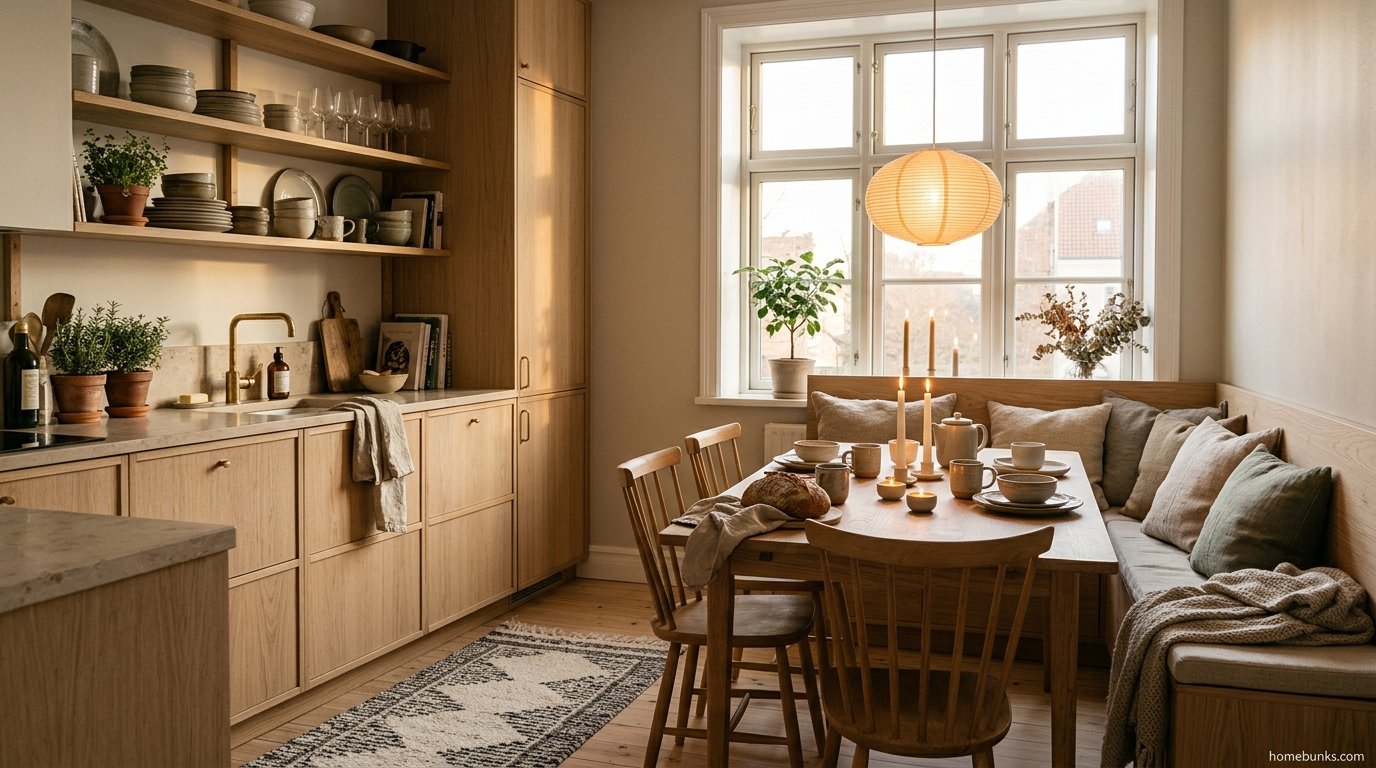
Butcher block is the warm default counter, usually on one run or the island. It asks for oiling and returns the room’s friendliest surface.
Honed quartz or pale stone is the durability answer. Run it up the wall as the backsplash and the kitchen gains one material instead of two.
Subway tile is the classic backsplash: white or pale, simple grid, grout doing the quiet pattern work. It suits the refresh budget as well as the remodel.
Sinks stay undermount and quiet, faucets in the room’s anchor finish. Three branded bottles at the sink is advertising; a single dispenser is styling.
Dining Furniture and the Table
The table is light wood, sized honestly to the room. Extendable designs suit the lagom rule: enough, expandable, never grandiose.
Chairs mix simply: two designs at most, with sheepskin or cushions doing the comfort work. Benches take one side wherever the nook logic applies.
Pendants center the table and drop lower than island lights, into the conversation zone. Their glow is the evening’s main event.
Tableware stays stoneware and glass, stored visibly on the shelves. The kitchen’s beauty is mostly its daily tools, well chosen.
Plants, Herbs, and the Windowsill
Green against white is a signature, and the windowsill is its stage. Herbs in terracotta are practical beauty: basil, thyme, and mint at arm’s reach.
A trailing plant softens a shelf end. Eucalyptus branches in a tall vase last for weeks when fresh plants are not your gift.
Plants sit where the light story is told: at windows, never in dark corners performing optimism. One healthy plant beats five struggling ones.
Winter and Summer Modes
The style has two seasons built into it. Winter mode adds the textiles, the candles, the runner and the throws, and leans on the layered light.
Summer mode subtracts: linen only, windows fully open to daylight, shelves lighter, and the palette left to breathe.
Designing both modes at once is the trick. Storage must swallow the winter layer in April, or summer mode never arrives.
North facing kitchens live closer to permanent winter mode. Their doses run warmer: brass over black, cream over stark white, wood over paint.
Storage in Detail: The Tall Pantry and the Drawer Rules
Scandi storage looks effortless because it is engineered. The tall pantry run takes food, small machines, and the overflow that otherwise colonizes counters.
Inside it, pull out columns beat fixed shelves for narrow goods. Bottles and jars stay visible in one layer instead of hiding in rows.
Drawers rule the base cabinets. Pots, pans, and dishes live in deep drawers where their contents show from above, ending the kneeling search.
Cutlery and tools take shallow drawers at the prep zone. The rule is one motion: open, see, take, with nothing stacked on anything else.
The bin bank hides inside a base cabinet near the sink. Two streams, one pull, and the room loses its ugliest object entirely.
A charging drawer near the table parks phones and tablets. Family clutter gathers there instead of spreading across the island.
The Morning Ritual: Designing for the First Hour
Nordic kitchens are designed around the first hour of the day. Coffee, porridge, packed lunches, and daylight, real or simulated, arriving together.
Place the coffee station where morning light lands, or where the warm lamp layer concentrates. The ritual spot should be the room’s brightest corner at 7 a.m.
The bench nook earns its keep here: a seat, a cushion, a sheepskin in winter, and ten unhurried minutes built into the floor plan.
Breakfast goods live in one zone: jars on the shelf, bowls below, machine on the counter section that never hosts prep.
Design the first hour well and the whole style makes sense. Scandi is not minimalism with cushions; it is a kitchen arranged around how mornings should feel.
Ceilings, Windows, and the Fifth Wall
The ceiling stays plain and pale, a reflector rather than a feature. Beams added for rustic charm belong to the farmhouse promise, not this one.
Windows are treated as light instruments. Deep reveals get painted the same warm white so the opening itself glows at midday.
Where privacy demands cover, linen cafe curtains cover the lower half only. The top half keeps delivering sky light to the room.
Curtains in heavy fabrics drink the daylight the palette worked to gather. The style’s restraint at windows is engineering, not coldness.
Three Worked Kitchens
The compact apartment kitchen. Warm white fronts, one birch shelf run by the sink, pale laminate floor, 2700K layers, and a two seat nook where a table would crowd.
The family kitchen diner. Light oak lowers, white uppers, butcher block island, bench nook with storage, matte black trio, and textiles doing daily warmth.
The refresh conversion. Existing cabinets painted warm white, one wood shelf, warm bulbs, edited surfaces, leather pulls swapped in, and the room reading Nordic for the price of paint and patience.
Scandinavian Kitchen Mistakes
The all white box. White cabinets, walls, and counters with no wood and no texture is the mistake the Common Scandinavian kitchen design mistakes lists first. The fix is contrast, not more white.
Daylight bulbs. Cool 4000K plus light turns the palette grey blue and kills the warmth the style is bought for.
Shelves by the stove. Grease coats styled displays; placement is a rule, not a preference.
Dark floors under white walls. The light dies at the floor and the room reads top heavy forever.
Too many small objects. Shelves crowded with decor break the calm; three objects with air is the working standard.
Fake materials. Plastic pretending to be wood and laminate pretending to be marble betray the honesty the style is built on.
Copying minimalism instead. Stripping the textiles and layers out produces the cold room people then blame on Scandinavia.
Before You Commit: The Order Checklist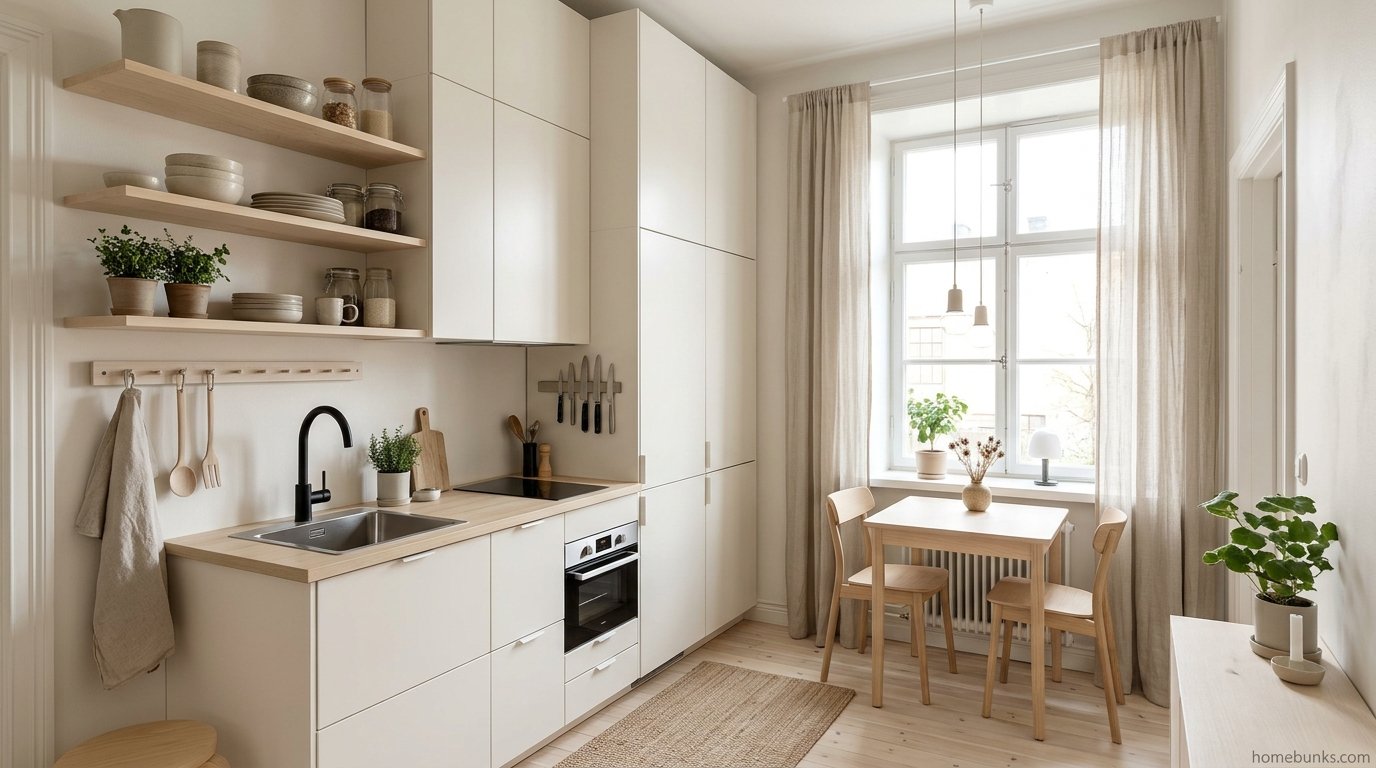
- Fix the white first. Warm undertones on walls and fronts, tested in your own light.
- Choose the one pale wood. Cabinets, shelves, floor, or table: the species repeats, the temperature holds.
- Set the floor pale. It is the room’s light engine and the hardest element to change later.
- Place shelves by the sink. Daily wash items only, 80/20, away from the stove.
- Dose the black. Two or three matching pieces, or commit to brass instead.
- Wire the layers warm. 2700K to 3000K, dimmers on the evening layer.
- Build the lingering spot. Nook, bench, or table with textiles: hygge needs an address.
Frequently Asked Questions
What is a Scandinavian kitchen?
A kitchen built on pale wood, warm white, natural materials, and functional design, warmed by textiles and layered light. It comes from Nordic homes designed to maximize scarce winter daylight while staying cozy, functional, and uncluttered.
What are the key elements of a Scandinavian kitchen?
Light wood cabinets or accents, warm white walls, flat fronts with simple hardware, open shelving used with discipline, layered warm lighting, natural textiles, plants, and a small dose of matte black for contrast.
What colors define a Scandinavian kitchen?
Warm whites (cream, milk, ivory, eggshell undertones), pale greys, and one pale wood. Muted color appears as a dose: sage, soft blue, or pastel on a lower run, textiles, or ceramics, kept mostly below eye level.
What wood is used in Scandinavian kitchens?
Light oak, birch, ash, pine, and beech, usually in matte finishes that show the grain. Walnut or dark oak appear in moderation as contrast. The rule is one pale lead wood, not a mixture of many tones.
Are Scandinavian kitchens the same as minimalist kitchens?
No. Minimalism is reduction for its own sake; Scandinavian design keeps warmth and layers: textiles, visible simple hardware, plants, and objects chosen for daily use.
The Australian style field states it plainly: Scandi is not minimalism, it is warmth in restraint.
What is the difference between Scandinavian and Japandi kitchens?
Japandi blends Scandinavian lightness with Japanese craft: it mixes light and darker woods and earthier, warmer palettes. Scandinavian kitchens stay paler, brighter, and more daylight driven, with darker wood only as an accent dose.
What is hygge in a kitchen?
The Danish practice of coziness: warm layered light including candlelight, natural textiles, a place to sit and linger, and unhurried rituals like morning coffee at a bench nook. In a kitchen it is functional warmth, not decoration piled on.
How do I make a Scandinavian kitchen feel warm, not cold?
Warm white undertones instead of blue white, one pale wood repeated, textiles (linen, wool, sheepskin), warm bulbs at 2700K to 3000K, and a small black or stone contrast. Cold Scandi kitchens are missing the warmth layer, not the white.
What white paint suits a Scandinavian kitchen?
Warm whites with creamy or greige undertones, the direction the Corner Renovation palette guidance gives (cream, milk, vanilla, ivory, eggshell). Stark blue whites are the common error; they read clinical, especially under cool light.
Are open shelves right for a Scandinavian kitchen?
Yes, with discipline: everyday dishes and glasses that wash daily, placed near the sink or dishwasher, never beside the stove where grease coats them (Maison Ly’s designer rule). A working split is about 80 percent functional, 20 percent decorative.
What hardware do Scandinavian kitchens use?
Simple bar pulls, slim finger pulls, push to open, or the signature leather pull in cognac or tan that Kitchen Seer highlights from Danish and Swedish kitchens. Hardware stays quiet but visible; Scandi does not require it to disappear.
Do Scandinavian kitchens have upper cabinets?
Both patterns work. Many replace some uppers with open shelves for the light gallery effect; small kitchens keep flat front uppers for capacity. The tall wall of full height storage is the other classic answer.
What countertops suit a Scandinavian kitchen?
Butcher block for warmth, honed quartz or pale stone for quiet durability, often with the stone run up as a simple backsplash. Glossy dramatic veining fights the calm palette; matte and honed finishes lead.
What backsplash fits a Scandinavian kitchen?
White or pale subway tile is the classic, alongside the counter stone run full height or a simple plastered wall. Pattern stays minimal; grout lines and texture do the visual work.
What flooring works in a Scandinavian kitchen?
Pale wood floors are close to non negotiable in the style’s own teaching: they bounce daylight through the room. Light stone look tile is the practical alternative. Dark floors with white walls are a named Scandi mistake.
What lighting does a Scandinavian kitchen need?
Layers: ambient ceiling light, under cabinet task strips, pendants over island or table, and small warm sources like a counter lamp or candles for evening.
Warm temperature, 2700K to 3000K; 4000K and above reads clinical and kills hygge (Maison Ly’s strict range).
Why is light so important in Scandinavian design?
Nordic winters offer few daylight hours, so the style evolved to capture and multiply light: pale reflective surfaces, pale floors, uncluttered windows, and layered artificial warmth after dark.
Can a small kitchen be Scandinavian?
Small kitchens are the style’s home turf: pale palettes enlarge, flat fronts calm, open shelves lighten the upper zone, and storage is engineered so surfaces stay clear. Regional adaptations for compact apartments repeat the same moves.
How much does a Scandinavian kitchen cost?
It spans the same tiers as any kitchen: cosmetic refreshes can be modest, flat pack pale cabinetry sits mid range, and custom pale wood millwork runs high.
No verified single average exists, so get local quotes and treat any one figure as a snapshot.
Can I create a Scandinavian kitchen on a budget?
Yes: paint cabinets warm white, add light wood open shelves or a butcher block section, swap to warm bulbs, add linen and a wool runner, edit surfaces, and place plants at windows. Accent swaps can stay small and reversible.
What is the black accent dose in a Scandinavian kitchen?
A few matching matte black pieces, typically two or three: pendants, faucet, or pulls. Black grounds the pale palette; spread across everything it flips the room toward high contrast modern, away from Scandi calm.
Can a Scandinavian kitchen have color?
Yes, dosed: sage or muted green lowers, a soft blue textile set, pastel ceramics. Keep stronger color mostly below eye level (ArtFasad’s placement rule); color above the counter line competes with daylight and can read nursery like if overdone.
What is a Scandinavian kitchen diner?
The open plan arrangement where cooking and dining share one calm space: a light wood table, simple chairs, and statement pendants marking the dining zone (Wren’s framing). The bench nook is its compact version.
What is a bench nook in a Scandinavian kitchen?
Built in bench seating, often with storage beneath, paired with a simple table (Kitchen Seer). It seats four to six in the footprint of fewer chairs and creates the lingering spot hygge needs.
Are Scandinavian kitchens good for families?
Yes: the style is functionalist at its root. Choose durable honed surfaces, matte finishes that hide marks, closed storage for clutter control, and washable textiles. The bench nook and kitchen diner layouts suit family gathering.
How do I add Scandinavian style without remodeling?
Warm white paint, one light wood shelf run, warm bulbs, linen towels and a runner, edited open surfaces, plants at the window, and two or three black accents. The refresh chapter most guides skip is mostly subtraction plus light temperature.
What are Scandinavian kitchen cabinets made of?
Commonly pale woods or veneers (oak, birch, ash) and painted warm white fronts, flat panel or minimal frame. Veneer on a stable core is the trade choice for tall fronts; humidity adaptations abroad use the same construction.
Should Scandinavian cabinets be handleless?
Optional. The field splits: some guides specify handleless for seamless lines, others (A Grateful Kitchen’s glossary) specify flat fronts with simple bar pulls. Either passes if the hardware stays simple; leather pulls are the warmest choice.
What plants suit a Scandinavian kitchen?
Herbs in terracotta on the windowsill, a trailing plant on a shelf, or eucalyptus branches in a tall vase (Maison Ly). Green against white is a signature of the style; plants sit at windows where the light story is told.
What textiles belong in a Scandinavian kitchen?
Linen curtains and towels, a wool or flat weave runner (wool resists stains naturally via lanolin, per Maison Ly), sheepskin on a bench or chair, and woven placemats. Textiles carry the warmth hard surfaces cannot.
What are the most common Scandinavian kitchen mistakes?
All white with no contrast or texture, cool daylight bulbs, open shelves by the stove or crammed with decor, dark floors under white walls, too many small objects.
And fake materials imitating wood or stone (Corner’s mistakes guide and DreamHouse AI agree on the core list).
Is IKEA the same as Scandinavian style?
No. IKEA is a Swedish retailer whose flat pack lines can serve the style well; the style itself is a design discipline older than the store. DIY Decorator’s boundary is blunt: IKEA is a brand, Scandi is a discipline.
What is lagom in kitchen design?
The Swedish idea of just the right amount: neither stark nor cluttered. Where hygge is the warmth, lagom is the measure, enough storage, enough objects, enough light, and nothing performing for show.
Can Scandinavian kitchens have an island?
Yes, commonly in pale wood or warm white with a stone or butcher block top, clearances of about 42 inches around it (Maison Ly’s minimum for a one cook kitchen), and a pendant group as its only decoration.
What dining furniture suits a Scandinavian kitchen?
A light wood table, simple chairs (often with sheepskin or cushions), and a bench on one side. Mixed simple seating is normal; matched heavy sets fight the light brief.
How do I keep a Scandinavian kitchen clean?
The style helps: flat fronts wipe flat, open shelves hold only daily wash items, and edited counters clean in seconds. The discipline is the reset: everything visible is either used daily or deliberately beautiful.
Do Scandinavian kitchens date quickly?
The pale, honest material core has been stable since the mid 20th century Nordic tradition. Dated versions are usually trend doses (a pastel phase, a black phase) rather than the discipline itself.
What window treatments suit a Scandinavian kitchen?
Minimal: sheer linen or nothing where privacy allows, because windows are light instruments first. Heavy curtains fight the daylight brief; a simple linen cafe curtain is the compromise.
Can renters create a Scandinavian kitchen?
Yes: warm bulbs, linen textiles, a light wood board and shelf styling, plants, edited surfaces, and removable warm white touches. Nothing in the refresh layer requires construction.
What is the difference between Scandinavian and farmhouse kitchens?
Farmhouse keeps visible life: apron sinks, open display, rustic patina. Scandinavian edits harder, keeps fronts flatter and paler, and warms with textiles and light rather than with objects and age.
What appliances suit a Scandinavian kitchen?
Integrated or quietly finished appliances that do not interrupt the pale run; one statement range is the tolerated exception. Function leads: the style began as functionalism, so performance outranks concealment.
Where should I start with a Scandinavian kitchen?
Palette and light first (warm white, one pale wood, warm layered light), then storage and shelves discipline, then textiles and the black dose. The order matters because each layer assumes the previous one is calm.
Conclusion
Scandinavian kitchen ideas work when the style is treated as three disciplines, not a shopping list. Set the pale system with one wood and warm white, engineer the light from floor to bulbs, and let function edit everything else.
Dose the black, place the shelves by the sink, and give hygge an address in a nook or at a table. The room will read calm at noon and warm at eight in the evening, which is the whole test.
Start with the refresh if a remodel is not on the table. Warm bulbs, one wood, and edited shelves will tell you within a weekend whether the full build deserves your money and your patience this year.


