
Farmhouse kitchen ideas come with an argument attached, and you have probably heard both sides. One headline declares the style dead; the next gallery shows forty farmhouse kitchens as if nothing happened.
Both are half right. The style’s bones (shaker cabinets, the apron sink, real wood, room to gather) are as current as ever. Its costume (shiplap everywhere, barn doors, word signs) now dates a kitchen to about 2015.
This page runs the audit honestly, element by element. Keep what solves real problems, retire what only signals a theme, and your farmhouse kitchen lands exactly where the market is heading.
You will get the verdict with its survey data, the keep and retire table, the working rules, real cost anchors, and the refresh sequence that updates a dated farmhouse kitchen without replacing it.
The 2026 Verdict: Evolving, Not Dead
Start with the number everyone cites and few explain. Reporting on the NKBA 2026 kitchen trends work, covered in the analysis at Our WabiSabi Life, puts transitional style as the favorite of 72 percent of surveyed participants.
Farmhouse did not lose to a rival look. It is becoming the blend: transitional lines, warm minimalism, and what the NKBA coverage calls organic and earthy aesthetics, materials you can touch and feel.
Apply the survivor test the trend coverage itself uses. Elements that solve real problems stay: the apron sink swallows roasting pans, the big table gathers people, wood hides wear.
Elements that only decorate a theme go: shiplap as wallpaper, barn doors as punctuation, signs that say gather in a room built for gathering.
Design to that test and the obituaries stop applying to your kitchen. You are not behind the trend; you are where it landed.
One more data point keeps the verdict honest: white remains the top cabinet color in Houzz survey reporting, though its dominance has slipped a few points in recent years.
Farmhouse’s core palette is not collapsing; it is warming and diversifying, which is what healthy styles do.
The Audit: Keep the Bones, Retire the Costume
|
Element |
Verdict |
Why |
|---|---|---|
|
Shaker cabinets |
keep |
the foundation profile; suits classic, modern, and transitional alike |
|
Apron front sink |
keep |
the style’s strongest signal and a genuinely better sink |
|
Real wood (oak, butcher block, beams) |
keep |
warmth, wear hiding, and the current material direction |
|
Gathering layout (island, eat in table) |
keep |
the function the style exists for |
|
Warm whites and wood tones |
keep, warmed |
stark all white uniformity is the dated version |
|
Subway and handmade tile |
keep |
classic pattern, current textures |
|
Shiplap on every wall |
retire |
reads as costume; ration to one surface or replace with plaster and paneling |
|
Decorative barn doors |
retire |
functional sliders stay; themed ones date the room |
|
Word art signs |
retire |
replaced by real art, vintage finds, and personal photographs |
|
Faux distressed everything |
retire |
genuine patina is the current standard |
|
Galvanized industrial overload |
retire |
lighting and metal direction has moved to brass, ceramic, and glass |
Read the table as a budget tool as much as a style tool. Most dated farmhouse kitchens need the costume removed and almost nothing structural replaced.
Notice what is absent from the retire list: nothing you cook with. The audit protects every working element and spends its criticism entirely on decoration.
Cabinets: Profiles, Colors, and the Two Color Rule
Shaker is the foundation profile for a reason: a framed panel that reads traditional in cream and modern in charcoal. Slim shaker is its current refinement; beadboard serves the cottage branch.
Color has moved in two directions at once. Warm whites still lead (their temperature rose: creamy, not stark), and natural oak has returned as a full cabinet color, not just an accent.
Color belongs on islands and lowers: sage, charcoal, navy, and deep green carry the current farmhouse palette while the field stays warm and calm.
Obey the rule stated cleanly in the comparison guide at Designing Idea: two paint colors maximum. Perimeter in one, island in the other; a third color is where farmhouse kitchens start to look busy.
Pricing sets the cabinet decision more than taste does. A small kitchen data guide puts stock shaker units at about 368 to 520 dollars per unit in 2025 retail pricing, with semi custom and custom multiplying from there.
For the softest version of the farmhouse palette, the cream kitchen ideas show the warm light field on its own, and the cream and warm wood kitchen ideas show cream and oak sharing the room, which is modern farmhouse’s favorite ratio.
The Apron Sink: Farmhouse’s Beating Heart
If one object carries the style, it is the apron front sink: a deep basin with an exposed front, built for roasting pans, sheet trays, and canning pots.
It is also the style’s best practical argument. Farmhouse survives its trend cycles partly because this sink simply works harder in daily use than a standard undermount.
Learn the ordering rule before anything else: buy the sink before the cabinets are built. Apron sinks need a custom or specified base cabinet, and discovering that late is the classic farmhouse project injury.
Materials set the tier. Fireclay is the classic white, stain resistant and heavy. Stainless and matte black serve the modern branch; hammered copper develops living patina for the rustic branch.
The price ladder, from the retailer snapshots in the small kitchen guide at ArtFasad: entry fireclay 30 inch models start around 263 dollars, while the premium fireclay class (the Kohler Whitehaven tier) runs about 800 to 1,100 dollars.
|
Sink material |
Look |
Strength |
Watch out |
|---|---|---|---|
|
Fireclay |
classic white, glossy |
stain resistant, iconic |
heavy; needs the right base; premium tiers cost |
|
Stainless steel |
modern farmhouse |
durable, lighter |
water spots; choose a quality gauge |
|
Matte black |
moody, contemporary |
hides wear, pairs with black hardware |
shows pale residue; newer category |
|
Hammered copper |
rustic, living |
patina develops character |
patina is a commitment; price |
Counters and Backsplash
Butcher block is farmhouse’s warmth engine and its budget hero. The same retail data puts big box butcher block at about 10 to 25 dollars per square foot DIY installed, the cheapest real warmth in the room.
Marble look quartz is the practical partner: the tailored look without marble’s sealing diary. Honed stone serves the modern branch where the budget allows.
The classic backsplash is 3 by 6 subway tile in running bond, materials about 2 to 15 dollars per square foot. It suits every layout and never argues with the cabinets.
The current texture upgrade is handmade look zellige: gentle variation that keeps subway’s calm and loses its uniformity. Brick adds rustic weight; beadboard serves cottage budgets.
Pair by contrast, as the classic schemes do: a painted base under a thick wood or stone top. One warm surface and one calm surface is the farmhouse counter formula.
Floors and Lighting
Floors follow one rule from the comparison guides: matte over gloss, always. Shiny floors show every footprint, and farmhouse kitchens are built for traffic.
Wide plank white oak leads the style, with hickory and pine in the rustic branches. Porcelain that reads like limestone serves the European branch and shrugs off water.
Lighting shows the evolution in a single fixture swap. The trend table at Hackrea puts it plainly: industrial barn lighting is out, unlacquered brass, ceramic, and rattan are in.
Keep the farmhouse silhouettes (pendants over the island, swing arm sconces over the sink window) and change the material temperature. The shape stays welcoming; the galvanized glare goes.
Ceiling beams follow the honesty rule. Structural or honestly built boxed beams are architecture; thin applique beams in a low ceiling are costume, and the audit retires them.
Hardware and Metals: The Mixed Metal Method
Matte black is the modern farmhouse default for hardware and faucets: cup pulls, simple knobs, and a spring neck faucet. It grounds white and oak without shine.
Unlacquered brass is the rising warmth: hardware, sconces, and pendants that patina with the household instead of staying showroom bright.
The collected look depends on mixing deliberately. A proven combination from current designs: black hardware, brass lighting, stainless appliances, each metal repeated at least twice.
What reads as a mistake is not mixing; it is matching everything to one themed finish or scattering four metals with no repeats. Intention is visible.
Size hardware generously on drawers. Farmhouse drawers are wide and worked hard; oversized pulls are both the look and the ergonomics.
Layouts: Gathering First
Farmhouse is a layout style before it is a decor style. The room is designed around feeding people: a big island with seating, an eat in table, or both.
Islands carry the social load and the storage load together. A wood topped or color painted island in a warm white kitchen is the modern farmhouse postcard for a very good reason.
Eat in space is non negotiable in the classic branch: banquette, farm table, or counter seating that fits the whole household at once, not in shifts, because gathering is the function this entire style was invented to serve.
Open shelving belongs to this section, not decor. Shelves earn their place when they hold daily dishes within reach of the dishwasher, styled by use.
The Small Kitchen Playbook
Small farmhouse works, and the budget guides prove it at about 80 square feet. The formula: off white shaker, subway tile, and the apron sink as anchor, with decor rationed hardest.
A full upper run in a small galley can come in under 3,000 dollars in stock cabinet materials on the 2025 figures. Small is where the bones framework pays fastest.
Farmhouse by Dialect
Modern Farmhouse
Slim shaker or flat panel in white or charcoal, fewer uppers, more drawers, stainless or matte black sink, pale oak. The Gaines era look, cleaned of its costume.
Classic Farmhouse
Cream, sage, or duck egg shaker and beadboard, fireclay sink, plank floors, visible craftsmanship. The branch for actual older homes and traditional architecture.
Coastal Farmhouse
Farmhouse bones in a seaside palette: weathered oak, seagrass, linen, blues and greens. Its own material vocabulary, not just farmhouse near water.
Moody and European Farmhouse
The 2026 iterations: charcoal, olive, and burgundy tones, plaster and limewash textures, brass and ceramic light. Same bones, deeper palette, more cottage than barn.
The Transitional Blend
Farmhouse warmth with contemporary cleanliness is where the survey data points. Design farmhouse with transitional discipline and the room is future proofed by construction.
The color dialects have full treatments in this cluster: the sage green kitchen ideas for the softest farmhouse green, the deeper olive green kitchen ideas for the moody branch, and the navy blue kitchen ideas for the classic island color.
If the farmhouse direction wins you over, carry it consistently into the bathroom with the edited approach in the farmhouse bathroom ideas, where the same bones and costume audit applies.
Budget Farmhouse: The Refresh Sequence
Work in this order; each step is a weekend, and the sequence is designed so no step is wasted if you stop early.
- Remove the costume. Word signs, excess distress, themed clutter. This step costs nothing and dates the room backwards the least.
- Swap the hardware. Matte black or brass throughout, one finish family, generous sizes. A few hundred dollars, a new register.
- Warm the paint. Cabinets warm white or one farmhouse color on the island; walls creamy. Paint is the cheapest temperature change available.
- Add one wood surface. Butcher block island top, oak shelves, or a farm table. Wood is the warmth proof the room was missing.
- Fix the light temperature. Brass or ceramic pendants, sconces at the window. The room’s evening mood changes more here than anywhere else.
The Cost Anchors
All figures below are 2025 retailer snapshots from the named small kitchen data guide. Treat them as planning anchors, not quotes; prices drift and regions differ.
|
Item |
Snapshot anchor |
Source context |
|---|---|---|
|
Stock shaker cabinet unit |
about 368 to 520 dollars per unit |
2025 retail pricing |
|
Small galley upper run (materials) |
under about 3,000 dollars |
stock units, small kitchen |
|
Fireclay apron sink, entry 30 inch |
from about 263 dollars |
big box retail |
|
Fireclay apron sink, premium class |
about 800 to 1,100 dollars |
Kohler Whitehaven tier |
|
Butcher block counter |
about 10 to 25 dollars per square foot |
big box, DIY installed |
|
Subway tile materials |
about 2 to 15 dollars per square foot |
ceramic 3 by 6 |
Read the table against the audit. The bones are affordable at stock level; the costume was never where the money needed to go.
Semi custom and custom cabinets multiply the stock figures several times over. That is a craft decision, not a style requirement: farmhouse reads correctly at every tier.
Three Worked Schemes
Scheme One: The Classic White, Warmed
Warm white shaker throughout, white quartz counters, exposed or painted brick, matte black faucet and hardware, oak floors. The 2015 postcard, rebuilt at 2026 temperature.
The warming moves are small: creamy white instead of stark, wood underfoot, brick for texture instead of shiplap. Nothing structural changed; the costume came off.
Scheme Two: Oak and White Modern
Natural oak lowers, white shaker uppers, brass sconces over the window, white apron sink, black hardware. Three woods and metals, mixed on purpose.
This is the collected method in one room: nothing matches as a set, everything rhymes by temperature. It photographs like a magazine and lives like a farm kitchen.
Scheme Three: The Moody Island
Warm white perimeter, a deep green or charcoal island, butcher block on the island, brass pendants, vintage runner. The field stays farmhouse calm; the island carries the 2026 palette.
This scheme is the cheapest dialect change available to an existing white farmhouse kitchen: one island repaint and two pendants.
The Collected Method: Styling That Looks Lived In
The difference between collected and catalog is provenance. Collected rooms mix woods, metals, and eras because real households accumulate; catalogs match because warehouses do.
Style shelves with daily objects: stacked ceramics, glass jars, cookbooks, cutting boards, one plant. Against farmhouse whites, clutter shows doubled, so edit like you mean it.
Replace word art with real art, vintage finds, and family photographs. The room keeps its warmth and loses its expiration date in the same afternoon.
Textiles do quiet work: a vintage runner, linen curtains, woven stools. They soften the room’s hard surfaces and carry color without commitment.
Farmhouse With Kids and Daily Life
Farmhouse is the most forgiving style for real family mess, which is part of why it refuses to die. Matte finishes hide fingerprints; wood grain hides crumbs; patina hides history.
Butcher block and fireclay improve with use in appearance terms, or at least forgive it. Gloss white minimalism does the opposite, which families discover quickly.
Choose satin cabinet paint, soft close hardware, and stools that wipe clean. Store the touch up paint where you can reach it during real life, not renovation life.
The gathering layout pays daily rent: homework at the island, prep beside it, everyone in one room. That function is the style’s deepest retention mechanism.
Farmhouse Through the Seasons
Farmhouse styling rotates cheaply because the bones are neutral and warm. The seasonal layer is textiles, produce, and greenery, not new decor sets.
Fall asks for wood, amber glass, and the harvest table treatment. Winter adds evergreen, candlelight, and wool. The room was practically designed for both.
Spring lightens the textiles and shelf styling; summer opens the windows and lets the garden in. A farmhouse kitchen should always look one season away from a meal outside.
Windows, Textiles, and the Soft Layer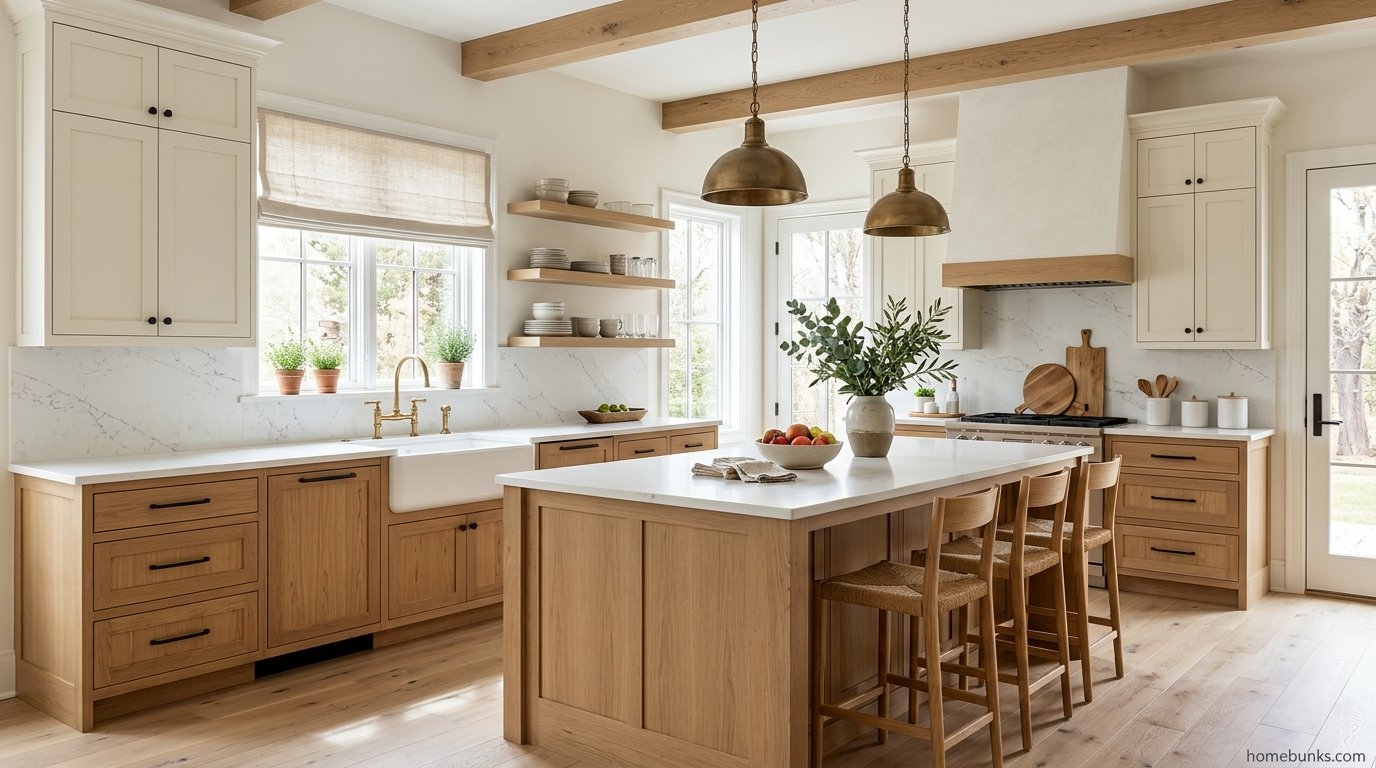
Farmhouse kitchens are hard surface rooms: cabinets, stone, tile, steel. The soft layer is what separates the welcoming ones from the echoing ones.
At the window, keep it simple: linen curtains, a roman shade, or a bare window with sconces flanking it. Heavy valances and themed prints belong to the costume layer.
On the floor, the vintage style runner is the style’s hardest working textile: warmth underfoot, color without commitment, and a forgiving pattern for a working room.
At the island, woven or wood stools soften the seating line. Upholstered stools in linen or leather serve the tailored branch and wipe clean in the family branch.
Towels, aprons, and a folded throw on a banquette are not clutter when they are the household’s real ones. Farmhouse styling is mostly the discipline of letting real life be the decoration, edited.
The Farmhouse Decisions, Summarized
|
Decision |
Question |
Default answer |
|---|---|---|
|
Audit |
What solves problems here, what only signals theme? |
Keep the solvers, retire the signals |
|
Sink |
Which apron sink, ordered when? |
Fireclay classic or steel modern, ordered before cabinets |
|
Cabinets |
Which profile and how many colors? |
Shaker family, two colors maximum |
|
Wood |
Where does warmth live? |
Floors, one counter or shelves, island top |
|
Metals |
Which finishes, how mixed? |
Black default or brass warmth, each repeated twice |
|
Light |
What temperature do fixtures carry? |
Brass, ceramic, glass; galvanized retired |
Print this table on the project folder. Farmhouse projects go wrong in the order of decisions far more often than in the decisions themselves.
Notice the first row. Every later argument about tile and textiles gets easier once the room’s existing bones are named and its costume is scheduled for removal.
Open Shelving: The Honest Guide
Open shelves are farmhouse’s most debated element, and the debate is really about housekeeping honesty. Shelves display what you own, including the parts you would rather hide.
They work when they hold daily dishes and cooking tools in warm materials: ceramics, wood boards, glass jars, cookbooks. Use creates the styling; styling alone creates dust collectors.
Depth matters: shelves at 10 to 12 inches hold dinner plates and stay visually light. Deeper shelves invite stacking, and stacking invites the clutter the style cannot afford.
Limit shelves to one run in most kitchens, beside the sink or range where their contents work hardest. A full wall of shelves is a pantry problem disguised as a design choice.
If your household’s honest answer is closed storage, take it without guilt. Glass front uppers deliver the same lightness with doors, and the style loses nothing.
Farmhouse and Resale
A balanced farmhouse kitchen is the easiest style for buyers to read. It photographs warm, signals a gathering home, and asks nothing of a buyer’s imagination.
The resale risk is the heavy themed version, which now timestamps the renovation. Buyers do not think dated kitchen; they think 2015 kitchen, and they price the correction.
If resale is near, spend on the bones buyers can verify: the sink, the hardware, warm paint, wood. Remove costume pieces before listing; they cost nothing to retire and photograph as clutter.
Keep records of the paint colors and cabinet maker with the house documents. A farmhouse kitchen that can be touched up exactly reads as cared for, and cared for is the style’s whole promise.
Mistakes to Avoid
- Buying the costume first. Signs, barn doors, and distress before cabinets and sink is theme park order. Bones first, always.
- Ordering cabinets before the sink. Apron sinks need their specified base. The sink decision comes first.
- Three cabinet colors. Perimeter, island, and stop. The third color is where busy begins.
- Glossy floors. Matte over gloss, always. Farmhouse traffic will prove the rule weekly.
- Stark white on white. The dated version of the palette. Warm the whites, add wood and one color.
- Matching everything. One themed finish across every object reads catalog. Mix with intention instead.
How to Start Your Farmhouse Kitchen
Run the audit on your own kitchen first: list what solves problems and what only signals theme. Most people find the bones already present and the costume doing the damage.
Fix the order of decisions: sink before cabinets, two colors maximum, matte finishes, one wood surface, warm light. That sequence prevents nearly every classic farmhouse injury.
Spend where the audit points: hardware and paint for register, the sink for function, wood for warmth.
The refresh sequence above is the budget version of the same logic, and it works in a rental of weekends as comfortably as in a single planned renovation.
If you are planning the wider home, the kitchen cluster at HomeBunks holds the color family together, and farmhouse is its warmest dialect. Build it on bones, and it will outlast every headline about its death.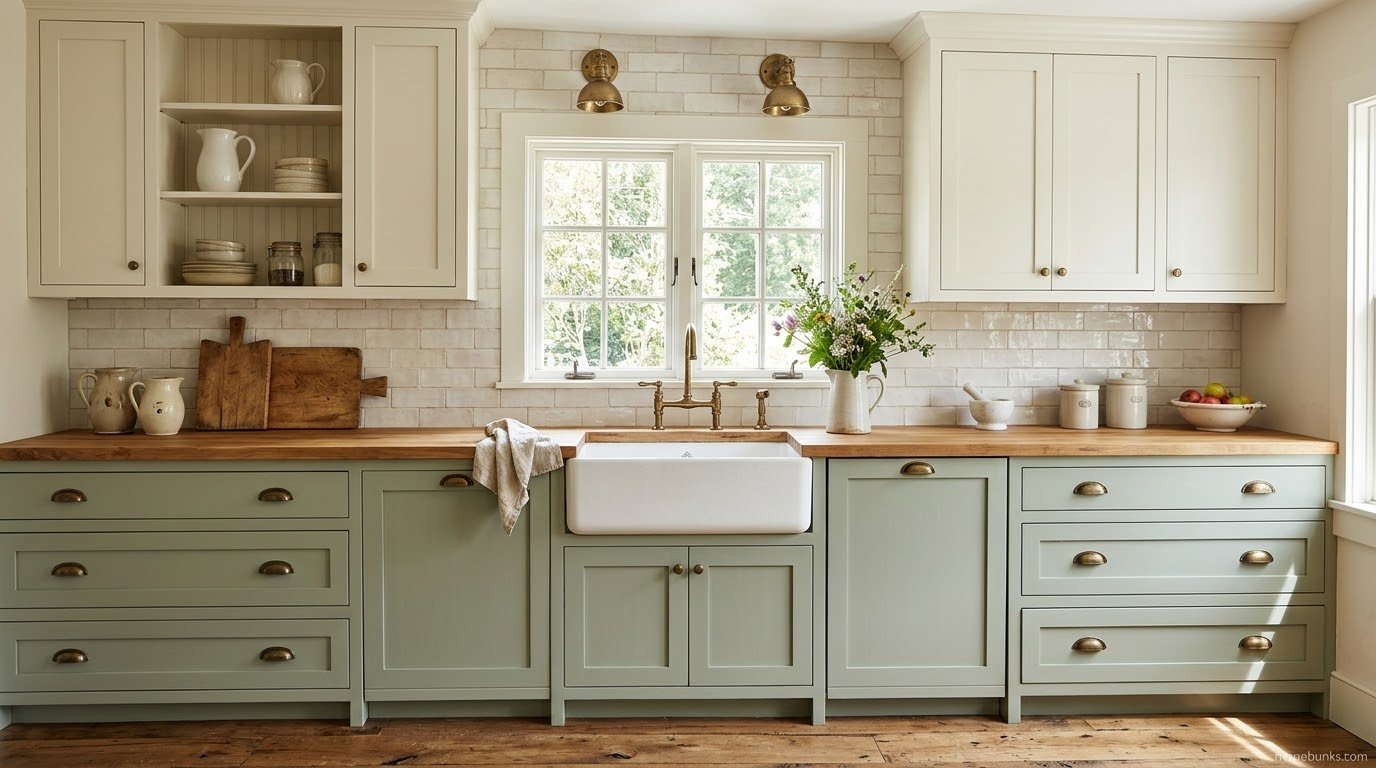
Frequently Asked Questions
What is a farmhouse kitchen?
A kitchen built on working farm kitchen bones: shaker or simple cabinetry, a deep apron front sink, wood surfaces, and a layout made for gathering. The modern version keeps those bones with cleaner lines and warmer, less themed styling.
What are the key elements of a farmhouse kitchen?
Shaker cabinets, an apron front sink, wood (counters, shelves, floors, or beams), a large island or table for gathering, and warm matte metals. Two or three strong elements signal the style; you do not need all of them.
Is farmhouse style outdated in 2026?
The costume is, the bones are not. Industry reporting on the NKBA 2026 trends work shows transitional style now the favorite (72 percent of participants), while farmhouse’s themed layer (shiplap everywhere, barn doors, word signs) reads dated.
Shaker cabinets, apron sinks, and wood remain current.
What is replacing farmhouse style?
Transitional design and warm minimalism: cleaner lines, creamy whites, natural wood, earthy accents like sage and terracotta, and matte finishes. Farmhouse is evolving into that blend rather than disappearing.
What farmhouse elements are dated now?
Shiplap on every wall, decorative barn doors, word art signs, faux distressed everything, galvanized industrial overload, and stark all white uniformity. Designers now describe the heavy version as signaling about 2015.
Is shiplap outdated?
As a whole room treatment, largely yes. As a single rationed accent (an island front, one wall, vertical application) it can still work. Plaster, limewash, and vertical paneling are the current texture alternatives.
Are barn doors outdated in kitchens?
Decorative barn doors are out; functional ones solving a real swing problem remain fine. The verdict from trend coverage is consistent: a barn door as a space solution is a tool, as a costume it dates the room.
What cabinets are best for a farmhouse kitchen?
Shaker is the foundation profile, in warm white, natural oak, or a color. Slim shaker and flat panel serve the modern branch. Stock shaker units run about 368 to 520 dollars per unit in 2025 retailer pricing.
What color cabinets suit farmhouse kitchens?
Warm whites lead, with natural oak rising fast. Color belongs on islands and lowers: sage, charcoal, navy, and deep green all work. Keep the scheme to two paint colors maximum.
What is an apron front sink and do I need one?
A deep basin sink with an exposed front panel, the single most recognizable farmhouse fixture. It is also genuinely practical for large pots. Order it before cabinets are built: apron sinks need a custom or specified base cabinet.
How much does a farmhouse sink cost?
Retailer snapshots from 2025: entry fireclay 30 inch models start around 263 dollars at big box stores, while a premium fireclay like the Kohler Whitehaven class runs about 800 to 1,100 dollars. Stainless and matte black versions widen the range.
What countertops suit a farmhouse kitchen?
Butcher block for warmth (IKEA class pricing runs about 10 to 25 dollars per square foot DIY), marble look quartz for practicality, and honed stone for the tailored branch. Pair painted cabinet bases with a wood or stone top for contrast.
What backsplash works in a farmhouse kitchen?
Classic 3 by 6 subway tile in running bond (materials about 2 to 15 dollars per square foot), handmade look zellige for the current version, brick for rustic weight, and beadboard for cottage budgets.
What flooring is best for a farmhouse kitchen?
Wide plank white oak leads; hickory and pine serve rustic branches; porcelain that reads like limestone serves the European branch. Matte over gloss, always: shiny floors show every footprint.
What hardware suits farmhouse cabinets?
Matte black is the modern default; unlacquered brass is the rising warm choice; cup pulls and simple knobs fit the profile. Mixed metals are fine when deliberate: black hardware with brass lighting is a proven combination.
Can I mix metals in a farmhouse kitchen?
Yes, and the collected look depends on it. The rule is intention: repeat each metal at least twice and keep temperatures balanced (warm brass light softening black hardware and stainless appliances).
How do I make a farmhouse kitchen feel modern?
Edit the costume: remove word signs and excess distress, keep shaker and the apron sink, warm the whites, add one color or wood note, and clean up lines (fewer uppers, more drawers). That is the transitional drift in practice.
How do I do farmhouse on a budget?
Paint cabinets warm white, swap hardware to matte black or brass, add a butcher block or wood look counter at refresh scale, style open shelves, and lay a vintage style runner. The bones can arrive one weekend at a time.
What is the cheapest farmhouse upgrade with the biggest impact?
Hardware and paint, in that order of effort. A full hardware swap plus warm white cabinet paint changes the room’s register for a few hundred dollars before any construction.
Can a small kitchen be farmhouse?
Yes, and the data pages prove it: small farmhouse guides build full character in about 80 square feet using off white shaker, subway tile, and the apron sink as the anchor. Ration decor harder at small scale.
Are open shelves practical in farmhouse kitchens?
For daily use objects, yes; for storage overflow, no. Shelves styled with everyday dishes and ceramics look right and stay honest. Dust is the price, paid weekly.
What lighting suits a farmhouse kitchen?
The current version trades galvanized industrial fixtures for unlacquered brass, ceramic, and rattan or glass pendants and sconces. Swing arm sconces over the sink window are a signature current detail.
What is modern farmhouse versus classic farmhouse?
Classic: cream, sage, or duck egg shaker and beadboard, visible hinges, fireclay sink, plank floors. Modern: slim shaker or flat panel in white or charcoal, fewer uppers, stainless or matte black sink, pale oak. Both share the bones; lines and palette differ.
What is transitional style and how does it relate?
Transitional blends traditional and contemporary: farmhouse warmth with modern cleanliness. It is where farmhouse is heading, which is why designing farmhouse with transitional discipline (edited, warm, uncluttered) future proofs the room.
Do farmhouse kitchens hurt resale?
A balanced farmhouse kitchen reads instantly familiar to buyers. The risk is the heavy themed version, which now signals a dated renovation year. Bones heavy, costume light is the resale safe formula.
What wall color suits a farmhouse kitchen?
Warm and creamy whites, soft plaster tones, and limewash finishes. Stark blue white and cool gray fight the style’s warmth and are part of the dated 2010s package.
Can farmhouse work with color?
Yes: sage, deep green, navy, and charcoal islands or lowers are the current color story, with burgundy and olive appearing in the moody branch. Keep the field warm and neutral around the color.
What is moody farmhouse?
The 2026 iteration trading bright white for charcoal, olive, and burgundy tones, plaster textures, and brass or ceramic lighting. Same bones, deeper palette, more European and cottage than barn.
What is coastal farmhouse?
Farmhouse bones in a seaside palette: blues and greens, weathered oak, seagrass and linen, beadboard details. It is a dialect, with its own material vocabulary, not just farmhouse near water.
How do I add farmhouse style without remodeling?
Swap hardware, add wood shelving or a wood island top, hang a runner, style with ceramics and cutting boards, and paint one element (island or lowers) a farmhouse color. Signals stack quickly.
Are white kitchens still okay for farmhouse?
White remains the top cabinet choice in Houzz survey data, though its dominance has slipped a few points. The update is temperature: warm white plus wood and color notes, not stark white on white.
What windows and treatments suit farmhouse kitchens?
Simple and soft: linen curtains, roman shades, or bare windows with a sconce pair. Heavy valances and themed prints belong to the costume layer.
Should I use exposed beams?
If they are structural or honestly built, yes; beams are architecture, not decor. Thin applique beams in a low suburban ceiling read as costume. Boxed beams at real scale are the defensible middle.
What appliances suit a farmhouse kitchen?
Stainless remains standard and mixes fine with warm mediation. Panel ready appliances serve the tailored branch; retro styled ranges serve the classic branch. Avoid matching every appliance to a theme color.
How do I style farmhouse open shelves?
Daily objects in warm materials: stacked ceramics, glass jars, cookbooks, a plant. Edit ruthlessly; against farmhouse whites, shelf clutter shows doubled.
What is the two color rule for farmhouse cabinets?
A practical rule from comparison guidance: perimeter in one color, island in the other, and stop. A third cabinet color is where farmhouse kitchens start to look busy.
Butcher block counters: are they practical?
With sealing and honest care, yes for most households; they are also the most budget accessible warm counter (about 10 to 25 dollars per square foot DIY in big box pricing). Keep them away from direct sink splash zones or seal diligently.
How much does a farmhouse kitchen remodel cost?
It scales with cabinet class: stock shaker runs about 368 to 520 dollars per unit (2025), semi custom multiplies that, and full custom multiplies again. Sinks, tile, and counters have wide ranges; the article’s anchors let readers phase the spend.
Can I paint my existing cabinets farmhouse style?
Yes, warm white or a farmhouse color over sound cabinets is the budget backbone. Shaker style can be approximated with trim kits on flat doors. Pair with new hardware for the full register change.
What makes a farmhouse kitchen feel authentic rather than themed?
Real materials aging honestly (oak, brass, fireclay), restraint in signals, and objects with use behind them. The test from trend coverage: lived in, not staged.
Farmhouse or modern kitchen: which ages better?
Farmhouse bones (shaker, apron sink, wood) have outlasted several modern cycles already. High gloss minimal kitchens date by their technology and finishes. The edited farmhouse, drifting transitional, is the longevity play.
Where can I verify current farmhouse trend direction?
The NKBA 2026 Kitchen Trends reporting is the industry reference (transitional favorite at 72 percent, organic and earthy themes). Trade coverage of the report is widely available; treat single site trend claims as opinion unless they cite survey work.
Conclusion
Farmhouse kitchen ideas survive their obituaries because the bones were never fashion. Shaker cabinets, a sink that swallows roasting pans, wood that hides wear, and a table that gathers people solve problems in every decade.
Retire the costume without regret: the shiplap walls, the decorative barn doors, the signs. What remains is warmer, cleaner, and pointed exactly where the survey data says kitchens are going.
Start with the audit this week. Remove one costume piece, warm one surface, and watch the room get younger, not older. That is the whole method: keep the bones, and let the farmhouse grow up.
Ready to begin? Order the sink first, choose your two colors, and let the bones do what they have done for two hundred years of farm kitchens.
Keep the records with the house when you finish: the paint names, the sink model, the cabinet source, and the hardware finish. A farmhouse kitchen that can be maintained exactly keeps its welcome intact, and the welcome was always the point.


