
Outdoor Halloween decor works when it is planned like a system, not bought like a pile. The displays people photograph share a structure anyone can copy.
That structure has three layers: the porch and door, the yard scene, and the light that joins them after dark.
Around the layers sits one theme, repeated at least three times, so the house reads designed from the curb instead of assembled from a cart.
And underneath sits the math nobody prints: decor is a multi year asset, so the right question is never just the price. It is the cost per Halloween.
How Americans Decorate: The 2026 Numbers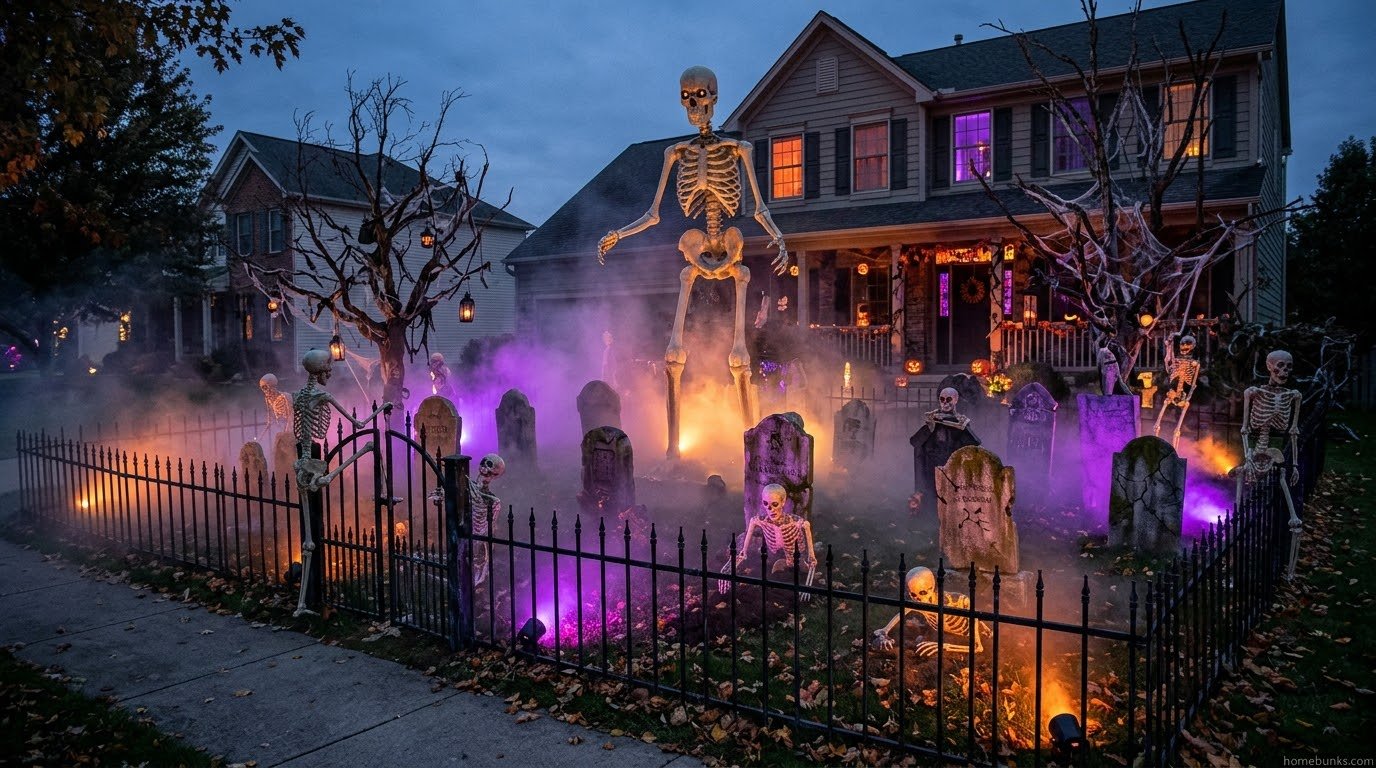
Halloween decorating is now a mass habit with a serious budget. The National Retail Federation’s 2026 survey puts decoration spending at $4.3 billion nationally.
The World Data’s Halloween spending roundup tracks the growth: decorations climbed from $2.7 billion in 2019 to $4.3 billion in 2026, with 78 percent of Halloween shoppers buying decorations.
The same survey says 42 percent of celebrants decorate their home or yard. Decorating is now as common as carving a pumpkin.
Read the figures honestly, though. The survey covered 7,889 adults in early September 2026 and measures planned spending, so these are intentions, not receipts.
Per person, decorations run about $36.61 of the average $115.14 Halloween budget. Households that decorate spend more than households that do not.
The Plan: Three Layers From Curb to Door
A display is read from the street, at night, in seconds. The three layers match that reading order, which is why the system works.
4FeldCo’s outdoor Halloween decorating guide, written by an exterior contractor, plans displays the same way: porch, yard, and lighting layered from the curb to the door.
|
Layer |
Job |
Anchor Pieces |
Typical Share of Budget |
|---|---|---|---|
|
Porch and door |
The close up: what visitors stand inside |
wreath, doormat, pumpkins, lanterns |
about 30 percent |
|
Yard scene |
The story: what the street reads |
hero prop, tombstones, ghosts, inflatables |
about 45 percent |
|
Light |
The joiner: what makes it read after dark |
string lights, pathway markers, spots, colored bulbs |
about 25 percent |
Layer One: The Porch and Door
The porch is where every visitor actually stands, so it earns detail the yard cannot: layered doormats, a wreath with one strong idea, pumpkins in odd numbered clusters.
Nikki’s Plate’s outdoor Halloween decorations guide builds its porch on exactly these pieces, including floating witch hats hung on fishing line from a covered porch ceiling.
Lanterns with battery candles flank the door. They give the porch its glow without a single open flame near costumes and paper.
Keep the door itself clear to swing and the steps visible. A beautiful porch that trips a vampire has failed its only job.
Layer Two: The Yard Scene
The yard carries one story: a graveyard, a skeleton scene, a ghost gathering, a spider takeover. One story, told with a hero and supporting pieces.
Space is part of the design. GrapcyHub’s Halloween outdoor decor guide makes the point well: choose one or two focal points and leave room for people to move.
Repeat the theme’s elements at three scales (large, medium, small) and the scene reads intentional from every distance.
Ground pieces should sit where the light layer can reach them. A tombstone outside the light is a gray lump by 7 p.m.
Layer Three: Light
Light is not an accessory; it is the layer that decides the night read, and most trick or treating happens after dark.
Work in three parts: string or spot light for the scene, pathway markers for the route, and colored porch bulbs for the mood.
Orange is classic, purple is the modern favorite, green reads witchy. One color family plus warm white reads designed; every color at once reads spilled.
End with the walk test: walk the route at night, in the dark, and fix every spot where your own feet cannot see the ground.
One Theme, Three Repeats: Choosing the Mood
Nikki’s Plate’s outdoor Halloween decorations guide states the rule plainly: choose one mood and repeat three elements across door, porch, and yard.
The mood menu is short: cute and kid friendly, spooky farmhouse, haunted graveyard, classic orange and black, or moody neutral.
Farmhouse Halloween borrows the harvest palette (hay, corn stalks, mums, worn wood), the same bones Farmhouse kitchen ideas builds a kitchen on, moved outdoors.
Moody neutral is the grown up register: black, bone, and dried grasses, the outdoor cousin of the restraint Scandinavian bedroom ideas brings indoors.
Whatever the mood, the repeats do the work. Bats at the door, bats on the garage, bats in the tree read as a decision; one of everything reads as a sale rack.
The Scare Dial: Kid Friendly to Extreme
Scare is a setting, not a rebuild. The same yard turns on three dials: activation, sound, and gore.
Low setting: figures static, sound off, funny epitaphs, warm light everywhere. Skeletons become photo ops and the littlest visitors stay.
Middle setting: one motion activated piece on the route, low sound, a fog machine on still evenings, light slightly cooler.
High setting: activation, jump scares, gore details, strobe used sparingly and away from the walkway, plus a visible opt out path for anyone who wants candy without the show.
Set the dial by your street, not your taste: a young neighborhood at high setting decorates for an audience of parked parents.
The Hero Props, With Cost Per Halloween Math
Hero props are assets, not expenses, and should be bought like assets: price divided by the Halloweens they will serve.
CalculatorAI’s Halloween cost analysis runs the frame on the category’s hero: a 12 foot skeleton at a $299 reference price kept five years costs about $60 per Halloween.
|
Hero Prop |
Reference Price (snapshot) |
1 Halloween |
3 Halloweens |
5 Halloweens |
|---|---|---|---|---|
|
12 ft skeleton |
$299 |
$299 |
about $100 |
about $60 |
|
Large inflatable |
$79 |
$79 |
about $26 |
about $16 |
|
Mid animatronic |
$199 |
$199 |
about $66 |
about $40 |
|
Resin tombstone set |
$89 |
$89 |
about $30 |
about $18 |
Prices are dated snapshots for the math, not standing offers. The pattern is the lesson: durability, not discount, decides what a hero really costs.
The 12 Foot Skeleton and Poseable Skeletons
The giant skeleton (nicknamed Skelly) turned a product into a neighborhood landmark. Its value is presence: it reads from three houses away, day and night.
Buy it with its storage plan attached: it breaks down, but the box still needs a garage corner or a very large bin.
The 5 foot poseable skeletons are the scene builders: seated in chairs, carrying pumpkins, mowing, fishing, posing for the selfie station.
Stake and secure every skeleton. Tall pieces catch wind, and a fallen giant across a walkway is a liability, not a photo.
Inflatables: Easy, Loud, and Wind Sensitive
Inflatables are the fastest yard in a box: cheerful, kid magnet, set up in minutes, stored in almost nothing.
Their weakness is weather honesty. Fall wind flattens under anchored inflatables, and rain plus fans is a short friendship.
Use every tether and stake in the box, add sandbags in exposed yards, and deflate ahead of storm warnings instead of testing the anchors.
Run them on timers (dusk to late evening). Fans last longer on a schedule, and the street gets its sleep back.
Animatronics: The Maintenance Purchase
Animatronics deliver the jump, the voice, and the story that static props cannot. They are also the only decor category with moving parts to fail.
Buy them like appliances: test before the season, keep the manual and spare parts, store dry and upright, and expect a repair someday.
One good animatronic outperforms three cheap ones that die by October 20. Place it where its sensor sees the route and its sound stays on your property.
Tombstones and the Graveyard Kit
The graveyard is the best value scene in decorating: foam or resin stones, a low fence section, ground clutter, and low light build a whole world cheaply.
Stagger stones at mixed heights and slight angles. Perfect rows read fake; cemeteries lean.
Funny epitaphs set the dial low; weathered blank stones and a rising skeleton arm set it higher. The kit is the same.
Foam is light, cheap, and storage friendly, but needs weighting in wind. Resin costs more, lasts longer, and shrugs off weather foam hates.
Pumpkins, Plants, and the Fall Crossover
Real pumpkins are the universal base: about 42 percent of celebrants carve one, and uncarved clusters carry a porch from late September.
The crossover trick extends the season: pumpkins, gourds, mums, corn stalks, and hay read as harvest decor once the ghosts come down, carrying the porch to Thanksgiving.
Carved pumpkins are the short lived element: days, not weeks. Carve late, light with battery candles, and compost the remains promptly.
Faux pumpkins cost more once and then cost nothing forever, which is why the cost per Halloween table favors them for anyone decorating yearly.
Finder’s strand, carried in news coverage, priced the average carving pumpkin at $5.35 in 2026, up from $5.26. Small money, but it is annual money.
DIY Outdoor Decor That Survives Weather
DIY wins where scale matters more than finish: a graveyard of foam board stones costs less than one resin set and covers more lawn.
The classics are proven: tomato cage ghosts in cheesecloth, pallet fences painted black, cheesecloth ghosts hung from trees on fishing line, zombie hands rising from flower beds.
Build for the weather you actually get: foam needs sealing and weighting, fabric ghosts are fair weather pieces, and cardboard belongs under a covered porch.
DIY the statics, buy the electrics. Anything with a motor, fan, or plug deserves a manufacturer’s rating and a warranty.
Safety and Weather Engineering
This section is the difference between a display and a liability with lights. Four systems, all cheap, all skipped by most galleries.
Wind Anchoring
Anchor everything tall or inflatable as if a storm is scheduled, because in October one usually is.
Use full tether sets at the manufacturer’s angles, ground stakes rated for your soil, and sandbags where stakes cannot bite.
After any storm night, walk the display before the street does: re stake, re tie, and retire anything cracked.
Outdoor Electrics: GFCI, Ratings, Timers
Outdoor rated is a specification, not a vibe: weather resistant construction and plugs designed for exterior use.
Plug into GFCI protected outlets, keep connections elevated and sheltered, and never run cords across the walkway without a cover.
Timers on everything: dusk to late evening covers the audience, cuts wear, and removes the 2 a.m. glowing yard problem.
Indoor rated electrics belong indoors or under full cover only. When the tag is silent, assume indoor.
No Damage Mounting
4FeldCo’s outdoor Halloween decorating guide‘s contractor warning deserves its own rule: never nail or screw into vinyl siding, because holes let water behind the panels.
Use no hole siding hooks that clip into seams, gutter clips, brick clips, and removable hooks rated for the load.
Most decor needs no fastener at all: pieces stand, lean, hang from over door hooks, or clip to gutters and railings.
Renters inherit the same system for free, which is why no damage mounting is the default method, not the compromise.
Walkway Safety and Fire Rules
The walkway is a safety system wearing a costume: continuous visible light, cords covered or rerouted, steps lit, decor pulled back from the path’s edge.
Battery candles replace open flames in every jack o lantern. Costumes, hay, and paper near real flames is the classic Halloween fire triangle.
Keep strobes away from the route and use them sparingly anywhere; photosensitive visitors are a real audience, not an edge case.
Fog goes downwind and low, never blowing across the path where visitors walk blind.
Small Spaces: Porch Only and Balcony Displays
Small spaces run the same three layers, compressed: door layer in full, one vertical yard element, and light doing double duty.
Vertical is the small space currency: hanging bats, a door ghost, a skeleton in the porch chair, string lights tracing the railing or roofline.
GrapcyHub’s Halloween outdoor decor guide rates the porch only kit honestly: pumpkins, a wreath, and lanterns make a complete simple display, not a failed big one.
Balconies add one rule: nothing hangs loose over the drop. Everything clipped, tied, or weighted, with the downstairs neighbor in mind.
The Calendar: September Selection, November Clearance
Decor buying has a price curve and a selection curve, and they move in opposite directions all season.
August to September: widest selection. Seasonal stores open (the flagship openings anchor August), big box decor lands, and NRF found 49 percent of shoppers start in September or earlier.
October: the experience month. Buy only replacements and the piece the display is missing; prices are at their peak and so is your information.
November 1: clearance. The cheapest buying day of the year for next season, with picked over selection as the trade. Hero props with cult followings rarely survive to clearance; buy heroes early, everything else late.
Teardown, Storage, and Next Year’s Setup
Teardown is part of the purchase, and the displays that return yearly are the ones stored like systems.
Before anything moves, photograph every layer at dusk from the curb. Ten minutes of photos turns next year’s setup into assembly, not archaeology.
Clean and dry everything, then box by layer: porch box, yard box, lights box, with cord routes and anchor points noted on the lid.
Inflatables fold only when fully dry; animatronics store upright in their boxes; the giant skeleton returns to its corner, photographed in its packed state.
Trees, Rooflines, and the Garage: The Vertical Layer
Height is what separates a decorated yard from a decorated house. Trees, rooflines, and the garage door are free display surfaces most people ignore.
Trees take light pieces high and heavy pieces low: cheesecloth ghosts and bats on fishing line drift at branch height, while webs stretch from trunk to ground.
Keep anything over the walkway light and doubly secured. A hanging prop above a visitor’s head is held to a higher standard than one in the flower bed.
Rooflines take string lights and silhouette pieces: a bat colony across the garage door or a witch silhouette against a lit window reads from the whole street.
The garage is a stage when open: a backdrop, one animatronic, fog and light, with the car moved out and cords kept clear of the driving path.
Second story windows take projections: a ghost or shadow scene in an upstairs window costs one projector and outperforms most ground props after dark.
Vertical pieces also solve the small yard problem from the other direction: when the lawn is tiny, the display grows up the house instead of across the grass.
A Worked Front Yard, Step by Step
- Choose the theme and the dial. Graveyard, middle setting, funny epitaphs: one decision that settles every purchase after it.
- Place the hero first. The poseable skeleton scene or the tombstone cluster goes where the curb sightline lands, before anything else competes with it.
- Build the yard scene. Stones staggered, fence section set, ground clutter scattered, all inside the reach of the light layer.
- Dress the porch. Wreath, layered mats, pumpkin clusters in odd numbers, lanterns with battery candles flanking the door.
- Lay the light. Spots on the scene, markers on the path, one colored porch bulb, everything on timers and GFCI outlets.
- Anchor and proof. Every tether set, every stake, cords covered, then the night walk test in the dark.
- Photograph at dusk. Curb shots of every layer, notes on the box lids, and the shopping list for November 1 written while the gaps are visible.
1. What is outdoor Halloween decor?
Outdoor Halloween decor covers every decoration placed outside the home for the season: porch and door pieces, yard scenes, inflatables and animatronics, lighting, and pathway markers.
The working system is three layers (porch, yard scene, and light) built around one theme, repeated at least three times across the front of the house.
2. How much do Americans spend on Halloween decorations?
The National Retail Federation’s 2026 survey puts decoration spending at $4.3 billion nationally, with 78 percent of Halloween shoppers buying decorations and about $36.61 per celebrating person.
The survey covered 7,889 adults in early September 2026 and measures planned spending, so treat the figures as intentions, not receipts.
3. How many people decorate their home or yard for Halloween?
NRF’s 2026 survey says 42 percent of celebrants plan to decorate their home or yard, level with carving a pumpkin and watching scary movies as a celebration activity.
Decorating households also outspend others on decor in the Halloween & Costume Association’s cut of the data (about $54.95 versus $46.69).
4. When should I put up outdoor Halloween decorations?
Most neighborhoods read late September to early October as the sweet spot: early enough to enjoy, late enough to avoid fatigue.
Retailers open and stock from August, and 49 percent of shoppers start buying in September or earlier according to NRF coverage.
Check HOA rules if you have them; some cap how early displays may go up.
5. When should Halloween decorations come down?
The etiquette standard is within the first week of November, sooner for gory pieces, and many HOAs set a hard date.
November 1 itself is the clearance shopping day for next year’s pieces.
Pumpkins and natural materials should go first, since rot and wildlife arrive on their own schedule.
6. What are the best outdoor Halloween decorations to start with?
Start with the three layer basics: pumpkins and a wreath or doormat at the door, one yard focal point (a skeleton, tombstone set, or ghost group), and outdoor rated lights that connect them and keep the walkway visible.
Add a hero prop only after the basics hold together.
7. Is the 12 foot skeleton worth it?
Run the cost per Halloween: at a $299 reference price, a giant skeleton kept five seasons costs about $60 per Halloween, less than many families spend on candy yearly.
It is worth it if you have the storage (it breaks down but stays bulky), a level spot with anchoring, and a neighborhood that enjoys a landmark.
It is not worth it for a one season display.
8. How do I keep Halloween inflatables from blowing away?
Use every tether and stake in the box, placed at the angles the manual specifies, and add sandbags at the base in exposed yards.
Deflate during storm warnings rather than trusting anchors.
Position inflatables with some shelter from the house or fence where possible; flat inflatables are almost always an anchoring or wind exposure failure, not a fan failure.
9. Are outdoor Halloween decorations waterproof?
Outdoor rated means weather resistant for the season, not submersible or storm proof.
Check the product’s rating, keep plugs and connections elevated and sheltered, plug electrics into GFCI protected outlets, and bring paper, cardboard, and non rated items in when rain is forecast.
Cheesecloth and fabric ghosts are fair weather pieces by nature.
10. How do I decorate outside without damaging my siding or doors?
Never nail or screw into vinyl siding: holes let water behind the panels, as exterior contractors warn.
Use no hole siding hooks that clip into seams, gutter clips, brick clips, and removable adhesive hooks rated for the load.
Wreaths hang from over door hooks, and most porch pieces can stand or lean without a single fastener.
11. What lights are best for outdoor Halloween displays?
LED string lights, pathway markers, and spotlights in orange, purple, or green do most of the work, with colored porch bulbs as the cheapest mood change available.
Choose outdoor rated cords on timers, keep the walkway itself visibly lit for trick or treaters, and avoid strobe effects that can trouble photosensitive visitors and annoy neighbors.
12. Battery candles or real candles in jack o lanterns?
Battery candles, every time outdoors.
Open flames in pumpkins near costumes, hay bales, and paper decorations are the classic Halloween fire risk, and wind makes flames gutter onto surroundings.
Battery candles also survive the whole evening without relighting, which is why the decorating guides recommend them as the default.
13. How do I make my yard scary but still kid friendly?
Use the scare dial: keep figures static (no motion activation), turn sound off or low, choose funny epitaphs and friendly faces, and light the walkway warmly.
The same skeleton that terrifies with a strobe and a scream track reads as a photo op in warm light with a pumpkin.
Reserve the extreme setting for a marked zone or later hours.
14. What is a good outdoor Halloween theme for beginners?
Classic orange and black, or a friendly graveyard.
Both repeat easily (pumpkins, tombstones, bats), tolerate mixed pieces from any store, and read clearly from the curb.
One theme repeated three times across door, porch, and yard looks designed; five themes at once looks like a storage unit.
15. How do I decorate a small front yard or porch only?
Compress the three layers: door layer (wreath, doormat, pumpkins), one vertical element (hanging bats, a ghost, or a skeleton in a chair), and light (string lights plus a colored porch bulb).
Small spaces reward height and light over ground pieces.
Apartment balconies can run the same system at railing scale.
16. DIY or store bought: which outdoor decor is better?
They do different jobs.
DIY (foam tombstones, cheesecloth ghosts, pallet fences) gives scale and character cheaply and suits the graveyard and ghost categories.
Store bought wins for hero props, electrics, and anything with a motor or fan, where safety certification and repairability matter.
Most strong displays mix both.
17. How much does it cost to decorate a yard for Halloween?
Budgets stratify cleanly: a porch refresh runs on pumpkins and lights for well under $100; a mid yard with one hero prop lands in the low hundreds; full scenes with animatronics run higher.
Nationally, the average celebrating person budgets about $36.61 for decorations (NRF 2026), and decorating households budget more (about $54.95 in the HCA cut).
18. When is the cheapest time to buy Halloween decorations?
November 1 clearance, when seasonal retailers cut decor prices deeply to clear space, is the cheapest day of the year for next season’s pieces; the trade off is picked over selection.
In season, the widest selection is September.
Hero props with cult followings sell out in season and rarely reach clearance, so buy those early and everything else late.
19. How do I store outdoor Halloween decorations?
Clean and dry everything before boxing, photograph each scene before teardown, and store by layer (porch box, yard box, lights box) so next year’s setup follows the photos.
Inflatables fold once fully dry; animatronics store upright in their boxes where possible; giant skeletons break down into their storage footprint but still need a garage corner or large bin.
20. How do I protect outdoor decorations from theft?
Anchor hero props visibly (cable locks through frames to fixed objects), keep the most valuable pieces closer to the house and lit, and bring small high value items in overnight if your street has a history.
Most theft is opportunistic; a tethered, lit, close to the house display is a hard target compared to a dark curb placement.
21. Can Halloween decorations stay up through Thanksgiving?
The fall crossover pieces can: plain pumpkins and gourds, mums, corn stalks, hay bales, and warm wreaths read as harvest decor once the ghosts, tombstones, and orange lights come down.
Rotate the Halloween specific pieces out in the first November week and the harvest layer carries the porch to Thanksgiving.
22. What about fog machines outdoors?
Fog is an atmosphere multiplier on still evenings and a disappointment in wind, so place the machine on the downwind side of the display, low among the tombstones, and time bursts rather than running constantly.
Use outdoor appropriate fluid, keep the machine sheltered from rain, and warn that fog plus low light needs an extra clear walkway for visitors.
23. Are animatronics worth buying?
They are the highest impact and highest maintenance category: motors, sensors, and fabrics that need dry storage and occasional repair.
Buy them as multi year assets (the cost per Halloween math applies), test them before the season, and keep manuals and spare parts.
A single well placed animatronic outperforms three cheap ones that fail by October 20.
24. How do I light the walkway safely for trick or treaters?
Keep a continuous, visible path: pathway markers or luminaries with battery candles, no cords across the walking route (tape or cover unavoidable crossings), steps and level changes lit, and decorations pulled back from the path’s edge.
The display can be as dark and moody as you like away from the route; the route itself is a safety system.
25. What do I do with real pumpkins after Halloween?
Uncarved pumpkins last longest and can move to compost or garden waste after the season; carved ones should go within days of the 31st.
Never leave rotting pumpkins on porches (wildlife and stains).
Check local rules on yard waste and wildlife feeding; some areas ask that pumpkins not be left for animals.
26. How long do faux pumpkins and foam props last?
Years, with dry storage: faux pumpkins are effectively permanent, foam tombstones last many seasons if stored flat and dry, and inflatables typically give several seasons before fan or fabric failure.
Durability is exactly why the cost per Halloween on reusables beats annual fresh purchases for anything beyond real pumpkins and mums.
27. Can I leave outdoor decorations plugged in all night?
Put everything on timers instead: dusk to late evening covers the audience, saves power, respects neighbors, and reduces wear and unattended electrical risk.
Outdoor rated equipment on GFCI outlets is designed for the season, not for 24 hour duty, and inflatable fans in particular last longer on a schedule.
28. What are the most popular outdoor Halloween decorations?
Pumpkins and jack o lanterns are the universal base (about 42 percent of celebrants carve a pumpkin, NRF 2026), skeletons are the modern hero category led by the 12 foot skeleton.
And inflatables and tombstone graveyards round out the big four.
Lights are the connective tissue in nearly every display that photographs well.
29. How do I decorate trees for Halloween?
Hang light pieces high and heavy pieces low: cheesecloth ghosts and bats on fishing line for the floating effect, eyeball ornaments and lanterns on sturdy branches, and webs stretched between trunk and ground.
Use rated fasteners that will not girdle branches, and keep anything over the walkway secured and light.
30. What if my HOA restricts Halloween decorations?
Read the rules before buying the hero prop: common limits cover display dates, size, sound, lighting, and gore level.
Design inside them (static, warm, date compliant displays rarely draw complaints), talk to neighbors early, and keep documentation of the rules with your decor boxes so next year’s setup starts compliant.
31. How do I make a front yard graveyard?
Set foam or resin tombstones at mixed heights and slight angles (perfect rows read fake), add a low fence section, skeleton arms or a rising figure at the edge, scattered leaves or mulch for ground cover.
And low warm light hugging the ground.
Funny epitaphs keep it kid friendly; fog on a still night finishes it.
32. What colors of lights work best for Halloween?
Orange is the classic, purple is the modern favorite, and green reads toxic or witchy.
One color family plus warm white reads designed; all colors at once reads like a light spill.
Colored porch and coach bulbs are the cheapest whole house mood change, as contractor guides note.
33. How early do Halloween decorations go on sale?
Seasonal retailers build displays from August (Spirit Halloween’s flagship opening anchors the calendar), big box decor lands late August into September, and NRF found 49 percent of shoppers start in September or earlier.
Clearance begins November 1.
The selection curve and the price curve move in opposite directions all season.
34. Can outdoor decor work for a Halloween party, not just trick or treat?
Yes: add a photo backdrop (skeleton scene or oversized letters), interactive pieces (ring toss, selfie station), party lighting zones, and a candy or drinks station in the porch layer.
The three layer plan is the same; the yard layer trades pure scare for social space.
35. How do I keep decor looking good in rainy or windy regions?
Weight the plan toward static, anchored, and rated pieces: resin or weighted foam, staked inflatables you are willing to deflate on storm nights, covered connections, and fabrics that can dry.
In wet climates, schedule the most delicate pieces (cheesecloth, paper) for the final week only.
36. What should I photograph or note for next year?
Photograph each layer at dusk from the curb, note bulb colors and timer settings, cord routes, anchor points, and which pieces drew comments.
Ten minutes of documentation turns next year’s setup from a rebuild into an assembly, and the photos double as your shopping list for clearance day.
37. Is it better to buy one big piece or many small ones?
One hero plus basics beats many small pieces at the same budget: the eye needs a focal point, and small pieces without an anchor read as clutter.
The exception is the pumpkin and light categories, where quantity is the effect.
Spend on the hero, the lights, and storage; save on fillers.
38. How do I involve kids in outdoor decorating safely?
Give them the daylight jobs: placing pumpkins, arranging tombstones, hanging bats from low hooks, designing epitaphs, and the skeleton’s pose and costume.
Adults keep ladders, electrics, carving tools, and anchoring.
Battery candles let kids light the jack o lanterns themselves, which is the job they actually want.
39. What is the difference between indoor and outdoor rated decorations?
Outdoor rated pieces use weather resistant materials, sealed or protected electrical components, and cords and plugs designed for exterior use on GFCI circuits.
Indoor pieces can fail, short, or degrade outside.
When in doubt, the rating is printed on the tag or box; unrated electrics belong indoors or under full cover only.
40. Can I use Christmas lights for Halloween?
Warm white and single color strings cross over well, and smart bulbs can simply change color for the season.
Orange and purple strings are Halloween specific purchases but store with the same systems.
Keep the Halloween specific pieces (projectors, inflatables) on Halloween timers and storage, and the shared lights earn their keep twice a year.
41. How do I do a haunted garage or driveway display?
Treat the garage as a stage: door open scenes with a backdrop, one animatronic, fog and light, and the car moved out.
Driveway edges take tombstones and lights while keeping vehicle access if needed.
Check sightlines so drivers on the street are entertained, not blinded, and keep actors and cords out of the driving path.
42. What trends should I watch for next Halloween?
Track retailer lineups when they drop in summer: the giant prop category keeps extending (taller and more animated heroes), licensed character pieces follow the year’s films, and smart lighting integration grows.
Treat any specific prediction as a strand until the catalogs publish; the evergreen system (layers, theme, hero, light) survives every trend cycle.
Conclusion
Outdoor Halloween decor rewards the decorator who thinks in layers, themes, and seasons. Three layers from curb to door, one theme repeated three times, a scare dial set for the street you actually live on.
Spend like an owner, not a renter of the season: heroes bought once and amortized, basics bought well, everything else bought on November 1 for next year.
Engineer the boring parts (anchors, outlets, hooks, walkway light) and the display survives weather, wind, and its own success. Then photograph it, box it by layer, and let next October start at assembly.
For the rooms waiting inside after the last trick or treater, our style guides at HomeBunks carry the same layered thinking indoors.


