
Halloween window decor is the one display in the house that gets designed twice. Every other surface is arranged from the room it sits in, but a window faces two audiences at once: the people living with it and the street walking past it.https://homebunks.com/halloween-window-decor/
That double audience is why most window displays disappoint. A scene that looks rich from two feet away can vanish from the sidewalk, and a scene built only for the street can leave the room staring at tape, cords and the back of a poster.
The fix is a system, not a longer idea list. Compose for the street first, run the window in two shifts, day and night, and choose every format by what it leaves on the glass when October ends.
The wider cluster sits around this page: our halloween decor ideas hub indexes the whole Halloween family, and our halloween house decor guide reads the home as one connected plan, with the window as its street facing chapter.
When the window sits inside a room decorated as a scene, the room is not this page’s territory: our halloween indoor decor guide owns room scenes end to end, and this page takes over only at the glass, where the second audience begins.
Halloween Window Decor in One Answer: One Scene Per Window, Built for Two Audiences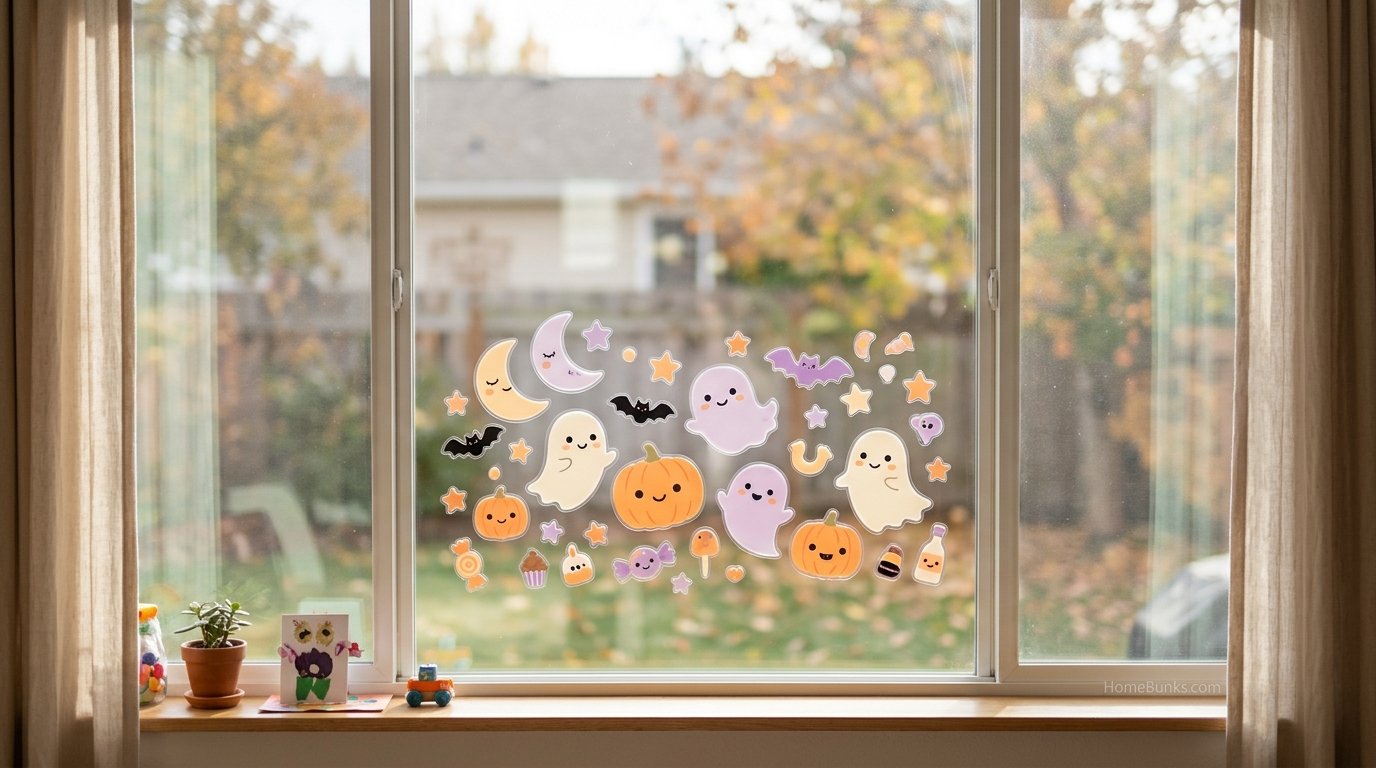
The quick answer is one focal scene per window, built for two shifts. By day, color and surface carry the window: clings, gels, translucent paper and washable paint. At night, light carries it: backlit silhouettes, tapers and projections.
Egress is the non-negotiable inside the answer. Bedroom and basement windows must stay fully operable no matter what decor they carry, and that rule shapes format choice before any style decision gets made.
Compose for the Street: Scale, Contrast and One Focal Scene
Start at the sidewalk, not at the glass. Walk to where a passerby actually stands, look back at the window, and design for that distance. Most failed displays were composed at arm length for a viewer who never gets that close.
Scale is set by viewing distance. A silhouette has to fill most of the window height to register from the street; one technique source puts the working figure at 60 to 70 percent of window height, a strand rather than a standard, but the direction is right.
One focal scene per window is the composition rule: the Halloween Explorer window ideas guide states the same one main idea per window discipline in its technique notes, and it is what keeps a window readable as a single picture instead of a collage.
Repeat one motif across the front windows instead of inventing a new scene for each: our black cat halloween decor guide builds a whole page on one cat at different scales, and repetition makes a row of windows read as one house with one idea.
The Day Shift: Clings, Gels, Paint and Posters by Daylight
Daylight is the surface shift. Color, shape and coverage do all the work, because light based effects do almost nothing in full sun. The day formats are clings, gels, translucent paper, washable paint and posters.
Static clings are the default day format: the Hunker guide to removing and reusing window decals sets out how they hold by static alone on smooth glass, with no adhesive, peel from a corner, leave no gummy residue and go back on their backing sheets for next year.
Gel clings carry the strongest color in the cling family. The trade is on the glass: the HomeSteady guide to removing a gel cling stain documents the film and stains they can leave after sun exposure, with alcohol and a vinegar cleaner as the cleanup.
Washable paint is the hand drawn day format. Tempera or washable craft paint draws bats, moons and lettering straight on the pane and washes off with glass cleaner and a sponge. Glass paint is the trap in this format, because it can stick permanently.
The Night Shift: Backlighting, Silhouettes, Tapers, String Lights and Timers
Night is the light shift, and it runs on contrast. A dark shape against a lit background is the whole mechanism: the lamp or light source sits behind the silhouette, never in front of it, or the shape greys out and disappears.
Paper and foam board silhouettes are the strongest cheap night read. Cut one bold shape, hang it inside the glass, and backlight it. The shape prints black against the glow, and the format costs almost nothing while outperforming detailed scenes after dark.
LED tapers on the sill are the cluster standard candle. They give the classic candle in the window read with no flame near curtains or sheers, and the timer versions switch themselves on at dusk and off before bed.
Window Projections: Screen, Brightness, Flipping and the Hot Spot
Rear projection is the window method for a moving scene. The projector sits inside the room, a translucent screen covers the window, and the image is read from the street. It is the strongest night read on this page, and the blankest window by day.
The room behind the screen must be dark. Ambient light is the washout mechanism: a lit room behind the screen greys the blacks and kills the contrast the street sees. Turn the room lights off, close the door light leak, and judge the result from outside.
The screen ladder runs from a bedsheet to holographic mesh:
|
Screen material |
Cost position |
What it needs |
Image character |
|---|---|---|---|
|
White bedsheet |
Already owned |
The darkest room of the ladder |
Soft image, visible weave at close range |
|
White shower curtain liner |
Lowest bought rung |
A dark room |
Smoother than a sheet, slight sheen |
|
Dedicated rear projection material |
Mid |
Moderate darkness |
Sharper image, even brightness |
|
Holographic mesh |
Highest |
Moderate darkness |
The floating ghost effect, scene appears in the room |
Brightness claims need suspicion, not faith: the Hallowmix window displays guide warns, reporting manufacturer guidance, that some budget brands quote unscientific marketing lumens. A small screen in a dark room needs less light than a yard projection anyway.
Flip the image or the street reads it backwards. Rear projection shows the back of the picture, so text and handed shapes reverse. Use the projector rear or mirror setting, or a scene made for window mode, and verify from the sidewalk before the night itself.
The hot spot is an angle problem, not a brightness problem. The bright lens point shows through the screen when the audience looks straight into the projector. Raise the projector, lower it or offset it to one side, and the spot moves out of the picture.
The Format Table With Honest Limits: Day Read, Night Read, Privacy, Egress, Residue, Reuse
|
Format |
Reads by day |
Reads at night |
Privacy effect |
Egress safe |
Residue risk |
Reuse |
Cost tier |
|---|---|---|---|---|---|---|---|
|
Static clings (inside glass) |
Strong: color and shape on the pane |
Needs light behind it or it goes dark |
Low: the room stays visible |
Yes: glass only, opening unchanged |
None: no adhesive |
Yes: store flat on backing sheets |
Low |
|
Gel clings |
Strongest color of the cling family |
Needs light behind it |
Low |
Yes: glass only |
Film or stain possible, especially after sun |
Limited: film risk grows with heat and time |
Low |
|
Washable paint (tempera, never glass paint) |
Strong: hand drawn scenes and bats |
Moderate: reads when backlit |
Low to medium by coverage |
Yes: on the glass only |
None with the right paint; glass cleaner removes it |
No: repainted each year |
Near zero |
|
Paper and foam board silhouettes |
Weak alone: a dark shape on bright glass |
Strongest cheap night read when backlit |
Medium: blocks part of the pane |
Yes if hung clear of the sash path |
None |
Yes if stored flat |
Near zero |
|
Window posters and full covers |
Strong: one printed scene |
Flat unless backlit |
High: blocks the room view completely |
Only if never taped across an egress frame |
Tape and adhesive risk at edges |
Limited |
Mid |
|
Rear projection |
Blank or screen only: needs a second day format |
Strongest night read on the page |
High while running: the screen covers the pane |
Yes: screen inside, sash kept operable |
None |
Yes: equipment and screen store |
Highest |
|
Sheers, gauze and lace layers |
Soft: a diffused scene layer |
Glows when lit from behind |
High: the privacy layer itself |
Yes if hung clear of the sash path |
None |
Yes |
Low to mid |
|
LED tapers and string lights |
Weak: a daytime garnish only |
Strong: the sill and frame read |
None by themselves |
Yes if cords route beside the frame |
None |
Yes |
Low to mid |
Read the egress column before the day column. Every format on this page can be used well, but only the glass only formats are automatic on a bedroom or basement window. Anything that crosses a frame or enters a window well has to pass the safety section first.
The chooser logic in one line: the Callie window decorations chooser guide leads its guide with a format chooser table for the same reason this page does, because the format decision made first makes every later decision, scene, light and cleanup, fall into place.
Window by Window: Picture, Bay, Arched, Basement, Apartment and Storefront Style
|
Window type |
Best first format |
Watch out for |
|---|---|---|
|
Picture window |
One backlit silhouette scene at street scale |
Sampler clutter: many small motifs merge at distance |
|
Bay window |
Layered diorama on the deep sill |
Layers blocking the sash operation |
|
Arched window |
A silhouette cut to the curve |
Rectangle formats leaving dead corners |
|
Basement window |
Glass only clings or paint |
Decor in the well; the opening must stay clear |
|
Bedroom window |
Glass only clings, paint or an interior silhouette |
Anything fixed across the frame or sash |
|
Apartment and high rise |
Interior static clings and sheers |
Building rules on exterior visible decor |
|
Storefront style front window |
Poster, full cover or rear projection |
Night flatness: backlight or project, never leave it unlit |
|
Second story window |
Interior clings, silhouettes and timer lights |
Any plan that needs a ladder outside |
The Picture Window: The Street Scene Window
The picture window is the one window the whole street reads. It gets the strongest single idea at full street scale: one silhouette scene, a backlit layer for the night shift, and sill vignettes kept low so they do not chop the scene into bands.
Resist the sampler instinct on this window. Its size tempts people into one of everything, and at street distance that reads as clutter. If a dining room picture window carries the scene, our halloween table decor guide owns what happens on the table behind it.
The Bay Window: The Layered Diorama
Use the depth a bay gives you. A bay sill is furniture depth, so it carries the layered diorama: a backlit backdrop at the glass, a mid layer of shapes, and small lit pieces at the front edge. A bay is built for layering.
The Arched Window: Silhouette Territory
The arch decides the format before you do. Rectangles leave dead corners on a curve, so the arch belongs to silhouettes cut to its shape: a moon and cat following the top curve, or a haunted house profile fitted into the full outline.
Basement Windows and Window Wells: Egress Rules First
A basement window is an escape opening with a well in front of it. The decor rule is absolute: nothing enters the well, nothing stacks against the glass from outside, and nothing fixed crosses the sash. The well is part of the escape route, not a display shelf.
Apartment and High Rise Windows: Inside Only
High rise windows are decorated entirely from the room. Interior static clings, interior silhouettes, sheers and timer tapers: nothing exterior to mount, nothing adhesive to remove and no ladder anywhere in the plan. The glass takes the weather; the decor never meets it.
Storefront Style Front Windows: Posters, Covers and Projection
Wide flat glass is retail territory, and retail rules apply. One poster or full cover carries the day shift in minutes, and rear projection owns the night shift on the same pane. It is the one window type where the two premium formats beat the cling family outright.
The kitchen sink window, from the window side: clings and splash tolerant pieces only, because the sink is the water zone, and our halloween kitchen decor guide owns the room behind it.
The frosted bathroom window, from the window side: its frosting becomes the screen, a silhouette lit from behind glows through it, and our halloween bathroom decor guide owns that room.
Privacy by Design: Sheers, Frosted Looks and One Way Effects
A fully lit, fully decorated front window is also a fully visible room. That is the trade no idea list prints: the same backlight that makes a silhouette read from the street turns the room behind it into a lit stage for everyone passing.
Frosted looks are the strongest privacy format that still decorates. A frosted film or a frosted effect layer hides the room at full coverage and turns the whole pane into a glowing screen at night, so a shape placed behind it reads as a shadow in lit glass.
Party nights change the calculation for one evening: our halloween party decor guide covers scenes guests see from inside, and on those nights the inside audience matters as much as the street, so a sheer layer that reads softly from the room earns its place twice.
Lighting From Inside: Lamp Placement, Color Family and Heat Near Fabric
The lamp sits behind the silhouette, low and off to one side. Behind prints the shape black against the glow. In front, the same lamp washes the shape out. Low and offset keeps the bulb itself out of the picture and out of the fabric.
Keep one color family across all front windows. Warm white behind one silhouette and cold blue behind the next reads as two houses. Pick the family, warm amber for the classic haunted read or one accent color, and hold it across tapers, string lights and backlights alike.
Heat near fabric is the lighting limit that matters. ESFI, the electrical safety foundation, warns in its Halloween guidance that light materials can be ignited by heat from a nearby bulb, and window fabric, curtains, sheers and gauze, is the lightest material in the house.
LED and flameless sources retire most of that risk. An LED backlight makes almost no heat, which is why the cluster default is flameless on every sill and LED behind every silhouette. Hot bulbs near sheers are a solved problem; do not use them.
Cute registers light differently from scary ones: our cute halloween decor guide builds the friendly cluster version for young kid streets, brighter, warmer and smaller in scale, while the scary register runs one dark shape and lets the glow threaten.
Do the work yourself where the work is the fun: our halloween DIY decor guide carries the build sheets, and a hand cut shape at true street scale beats a bought mini set on the same window every time.
The Safety Envelope: Egress First, Then Cords, Ladders and Weather
Egress comes first because it is the rule with a code behind it. Basements, habitable attics and every sleeping room must have at least one operable emergency escape opening. A decorated window that cannot open fully is not a display; it is a blocked exit.
The opening numbers, with their caveat: the LegalClarity egress window requirements guide sets out a 5.7 square foot minimum net clear opening, 24 inches minimum height, 20 inches minimum width, and a sill no more than 44 inches above the floor. Local editions vary.
|
Risk |
The rule on this page |
Source |
|---|---|---|
|
Blocked bedroom or basement egress |
Decor stays on the glass; nothing fixed, taped across the sash or stacked in the well may stop the window opening fully and immediately |
IRC Section R310, via the LegalClarity explainer; local editions vary |
|
Window well obstruction |
Decor never enters the well; wells need 9 square feet clear, with a ladder or steps where the well is deeper than 44 inches |
IRC Section R310, same explainer |
|
Candle or bulb heat near curtains and sheers |
Flameless on every sill; any real candle keeps at least 12 inches from anything that can burn |
NFPA candle guidance |
|
Decoration fires overall |
Design so decor never sits close to a heat source; about one third of decoration fires start with candles |
NFPA Halloween page, whole home figures |
|
Cord pinched in a closing frame |
Route cords beside the frame, never where the window closes on them |
Halloween Explorer technique text; ESFI cord inspection guidance, credited in words |
|
Damaged light sets and overloads |
Use tested sets only, discard cracked sockets and frayed wires, never overload extension cords |
CPSC 2023 Halloween release |
|
Falls at second story windows |
Decorate second story windows from inside only; no exterior ladder work for decor |
CPSC 2023 Halloween release, falls strand |
|
Exterior pieces in weather |
Exterior items must be weather rated and securely mounted, or the display moves inside the glass |
Outdoor sibling owns exterior ratings |
The fire figures, with their scope welded on: the NFPA Halloween safety page reports an average of 835 home structure fires per year began with decorations from 2020 to 2024, about 47 percent starting too close to a heat source, about one third by candles.
Those are whole home figures, and the limit matters as much as the number. No window specific decoration fire figure exists, and this page does not invent one. The honest window lesson: keep decor away from heat, and keep flame off sills entirely.
An earlier cut of the same series exists and is never blended with it: the Illinois release carrying the NFPA Halloween figures carries the 2018 to 2022 version of the figures, cited separately wherever it appears, because merging years manufactures a number nobody published.
The light strand checks come from the safety release itself: the CPSC 2023 Halloween safety release advises using only lights tested by a recognized testing laboratory, discarding sets with broken sockets, frayed wires or loose connections, keeping candles away from curtains and decorations, and never overloading extension cords.
Weather closes the envelope. Exterior pieces face wind and rain interior formats never meet, and our outdoor halloween decor guide owns exterior ratings and mounting for the cluster. Inside the glass, the storm stays on the other side of the pane.
Renters and HOA: Check the Rules, Prefer Interior Glass
No universal rule settles what a renter or HOA household may put in a window. Rules vary by lease, building and association, and no primary legal source fetched for this page settles it generally. So this page prints a procedure instead of invented law.
The procedure is three checks, in order. Read the lease or association rules for exterior visible decor before buying anything. Ask, or check the building notice, if the rules are silent and the display is large. Keep the display interior and removable until the answer is clear.
Budget is a renter constraint too, and the cheap tier is genuinely good here: our cheap halloween decor guide anchors the cluster budget page, and its near zero paper silhouette tier is the strongest cheap night read in the format table.
Removal, Cleanup and Storage: The Format Decides the Cleanup
Removal is the second half of the buying decision, made in October and paid in November. Every format in the table carries its cleanup inside its row, and this section is the method layer behind those rows, sourced from the cleaning authorities rather than from decor blogs.
General surface method rules live with the cluster surface guide, named here in one line only. This page owns the glass consequences: what each format leaves behind, and how it comes off.
Static clings are the clean exit. Peel from a corner, wash in warm soapy water if the grip has faded, and store flat on the backing sheet or wax paper. Flat storage is the whole secret: a folded cling curls, and a curled cling never holds properly again.
Gel cling film is the one cleanup with a sequence: the HomeSteady guide to removing a gel cling stain sets out rubbing alcohol first, then a vinegar and cornstarch cleaner for the stain sun exposure sets. Test in a corner before a full pane.
Adhesive residue is the heavy end of the scale: the American Home Shield guide to removing sticker residue from glass lists isopropyl alcohol, a vinegar soak, citrus remover, hot soapy water and a blow dryer, and advises checking coatings with the manufacturer before solvents or blades.
Plan the front as one composition next season too: our halloween porch decor guide composes porch and front windows as one street read, our halloween door decor guide starts the sequence, and our halloween yard decor guide sets the scale the windows answer to.
One buying note for the houses that shop a big box craft run: our Hobby Lobby halloween decor guide explains that store’s fall only policy, and its window alternatives paragraph is the natural companion read before a decor run.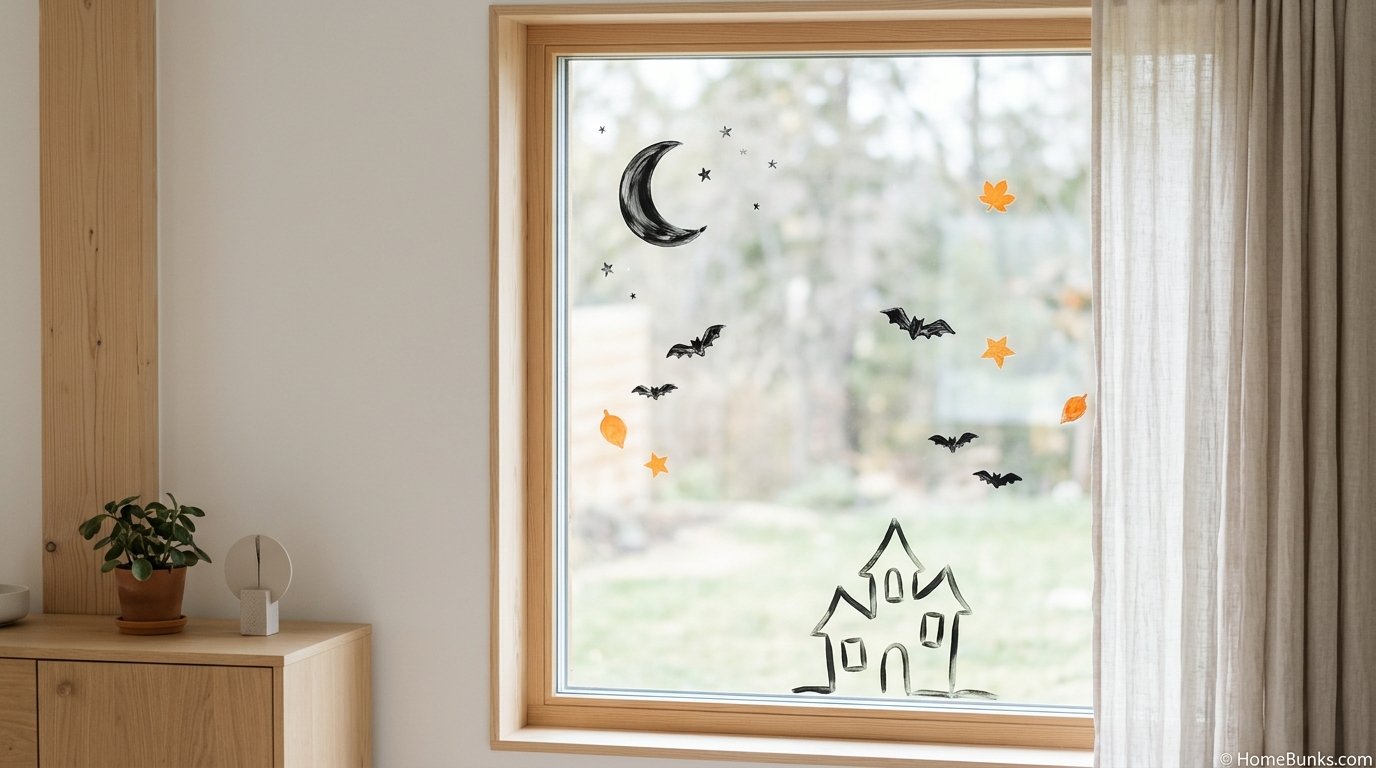
Frequently Asked Questions
1. How do you decorate a window for Halloween so it reads from the street?
Compose for the street first: one focal scene, one bold shape, strong contrast. Scale is set by viewing distance, not arm length, and one strong shape beats five small ones that merge into noise from the sidewalk.
2. What is the best Halloween window decor for daytime?
Surface and color formats: static clings, gel clings, translucent paper and washable paint. Daylight is the day shift, light effects do almost nothing in it, so shape and color on the glass carry the daytime read.
3. What Halloween window decor works best at night?
Light based formats: backlit silhouettes, glowing eyes, LED tapers on timers, string lights and rear projections. The night shift runs on contrast, so the light sits behind the silhouette, never in front of it.
4. How big should a window silhouette be to read from the sidewalk?
Big enough to fill most of the window height. A technique source puts the working figure at 60 to 70 percent of window height, a strand rather than a standard; shapes sized at arm length disappear at street distance.
5. How many scenes should one window carry?
One scene per window. One focal scene is the composition rule the strongest technique competitor also states, and it keeps the window readable as a single image from the street.
Save the second idea for the next window.
6. Do window clings show from outside or only inside?
Both, with a difference. A cling on the inside face reads from the street through the pane, which is why interior application is the default.
Color reads by day; at night a cling needs light behind it.
7. Are gel clings or static clings better for Halloween windows?
Static clings for most windows. They hold by static with no adhesive, peel from a corner, leave no residue and reuse after flat storage, per Hunker.
Gel clings give stronger color but can leave a film or stain.
8. Do gel clings stain glass or leave a film?
Yes, they can. HomeSteady documents gel cling film and stains, particularly after sun exposure, with rubbing alcohol then a vinegar and cornstarch cleaner as the cleanup.
Test a gel cling in a corner first.
9. Do static clings leave residue on glass?
No gummy residue: static clings use no adhesive at all, per Hunker. They can leave a clean dust outline that washes off.
Adhesive decals are the opposite case and may need soapy water, a razor blade and heat.
10. How do you clean glass after Halloween window clings?
By format. Static clings peel clean, and gel film responds to rubbing alcohol then a vinegar cleaner, per HomeSteady.
Adhesive residue needs alcohol, a vinegar soak or heat, per American Home Shield, which advises checking coatings first.
11. How do you store window clings so they work next year?
Flat, on their backing sheets or on wax paper, per Hunker. Flat storage decides whether a set works next season; folded clings curl and stop holding.
Washing a faded cling in warm soapy water restores its grip.
12. Why do my window clings keep curling or falling off?
Usually the glass or the application. Static clings need smooth, clean, nonporous glass, and condensation breaks the hold.
Clean the glass first, apply large pieces to wet glass and smooth them out with a card, per Hunker.
13. Do window clings work on textured or frosted glass?
Static clings need smooth glass, so textured panes defeat them and heavy frosting weakens the hold. On a frosted window, use a sheer scene layer inside, or a silhouette lit from behind the frosting itself.
14. Can window clings damage tinted or coated windows?
Test first. American Home Shield advises checking coatings with the manufacturer before solvents or blades, and the same caution applies before applying any format.
A corner test with a no adhesive static cling is the lowest risk check.
15. What is a Halloween window projection and how does it work?
Rear projection: the projector sits inside, a translucent screen covers the window, and the street reads the image. The room behind the screen must be dark or the picture washes out, per the Hallowmix technique guide.
16. What do you need for a rear projection Halloween window?
A projector, a translucent screen, a dark room and the image flipped. Rear projection shows the back of the image, so text reverses unless the rear or mirror setting is used.
Check the result from the street first.
17. Can you use a bedsheet or shower curtain as a projection screen?
Yes: they are the first two rungs of the screen ladder. White bedsheet, white shower curtain liner, then dedicated material, then holographic mesh, per Hallowmix.
Cheaper screens need a darker room and give a softer image.
18. How bright does a projector need to be for a window display?
Less than a large outdoor projection needs, because the screen is small and the room is dark. Treat bare lumens claims with suspicion: Hallowmix, reporting manufacturer guidance, warns some budget brands use unscientific marketing lumens.
19. Why does my window projection look washed out?
Ambient light. The room behind the screen must be dark or the picture washes out, per Hallowmix.
Turn the room lights off, close the door light leak, and judge the result from outside, not from the room.
20. How do you stop the projector hot spot showing in the window?
Move the projector: raise it, lower it or offset it. The hot spot is the bright lens point showing through the screen, per the manufacturer guidance Hallowmix reports, and angle, not brightness, is what fixes it.
21. Do you need to flip the image for a window projection?
Yes, unless the scene is pre flipped. Rear projection shows the back of the image, so text reads reversed from the street.
Use the rear or mirror setting, or a window mode scene, and verify from the sidewalk.
22. Are Halloween window posters a good alternative to clings?
For a storefront style or very wide window, yes: one printed scene covers the pane in minutes. A poster blocks the room view completely and reads flat at night unless backlit.
Never tape one across an egress window frame.
23. How do you light a Halloween window from inside?
Place the light behind the scene, on a timer. The lamp behind the silhouette prints it dark against the glow, and a timer makes the dusk switch on automatic.
Keep one color family across all front windows.
24. Where should a lamp sit behind a silhouette?
Behind the silhouette and off to one side, never in front of it and never touching fabric. Light in front greys the shape out.
ESFI warns light materials can be ignited by heat from a nearby bulb, credited in words.
25. Can you put real candles in a Halloween window?
The cluster rule is flameless on sills. NFPA guidance keeps candles at least 12 inches from anything that can burn, and a sill with curtains or gauze behind it is exactly that geometry.
An LED taper gives the same read.
26. How far should candles and bulbs stay from curtains?
At least 12 inches from anything that can burn, per NFPA candle guidance, applied here to curtains, sheers, gauze and lace. Bulb heat follows the same logic, which is why LED and flameless sources are the window default.
27. Are LED string lights safe around curtains and sheers?
Safer than flame or hot bulbs, with the standard checks. Use lights tested by a recognized laboratory, inspect for broken sockets, frayed wires and loose connections, and never overload extension cords, per the CPSC 2023 release.
28. How do timers help a Halloween window display?
They run the night shift. A timer or smart plug switches backlighting, tapers and projection on at dusk and off at a set hour, so the window performs every evening unattended.
Timers also cap how long lights run.
29. Can you run a light cord through a window frame?
Do not route a cord where the window closes on it. The frame can pinch or damage the insulation, per Halloween Explorer technique text.
Route cords beside the frame and plug outdoor items into GFCI protected circuits.
30. How do you decorate a picture window for Halloween?
Treat it as the street scene window: one focal scene at street scale. Add a backlit layer for the night shift, and keep sill vignettes low so they do not chop the scene into bands.
31. How do you decorate a bay window for Halloween?
Use the depth. A bay sill is furniture depth, so it carries a layered diorama: backdrop at the glass, mid layer shapes, small lit pieces at the front edge.
Keep every layer clear of the sash operation.
32. How do you decorate second story windows without a ladder?
From inside only: clings on the inside face, interior silhouettes and lights placed from the room. The CPSC 2023 release ties about a quarter of its Halloween emergency visit estimate to falls during decorating, the argument against exterior ladder work.
33. How do you decorate apartment windows for Halloween?
Interior glass formats only: static clings, interior silhouettes, sheers and timer tapers. Nothing exterior to mount, nothing adhesive to remove, no ladder work.
Check the building rules first, because some restrict exterior visible decor.
34. Are window clings renter friendly?
Static clings are the renter format: no adhesive, no residue, no tools, peeling from a corner when the season ends, per Hunker. Gel clings are a step down for film risk, and renters should skip adhesive decals entirely.
35. Can an HOA or landlord ban Halloween window decor?
Rules vary by lease, building and association, so this page prints the procedure, not invented law. Check the rules before exterior visible work.
Some buildings restrict window clings and changed bulbs, so interior glass formats are the safest default.
36. How do you keep privacy with Halloween window decor?
Build the privacy layer into the scene: sheers, frosted looks and one way effects. They diffuse the room while the silhouette reads from the street.
A fully lit decorated window is also a fully visible room, so decide on purpose.
37. Can you decorate a bedroom egress window for Halloween?
Yes, on the glass only. Bedroom and basement windows are escape openings under IRC Section R310, and nothing fixed, taped across the sash or stacked in the well may stop one opening fully and immediately.
Local editions vary.
38. What Halloween decor is safe on an egress window?
Formats that live on the glass: static clings, gel clings and washable paint. Unsafe on an egress window: posters taped across frames, boarded up looks, anything wedged into the sash path, and decor stacked in a window well.
39. What Halloween window decor survives rain and wind outside?
Very little of the standard set, which is why the default is inside the glass. Static clings are not weather resistant and belong inside, per Hunker.
Exterior pieces need weather rated construction and secure mounting to survive outside.
40. Should Halloween window decor go inside or outside the glass?
Inside, by default. Interior application dodges weather, keeps renters inside their rules, removes the ladder, and still reads from the street through the pane.
Outside mounting is the exception, for rated pieces on ground floor windows.
41. How do you paint bats on a window and wash them off?
Use tempera or washable craft paint that is not intended for glass; glass paint can stick permanently. That is the Apartment Therapy project rule, credited in words.
Removal is glass cleaner and a gentle scrubbing sponge.
42. How much does Halloween window decor cost by format?
Only as labelled competitor strands, never as verified prices. One competitor format table puts paper silhouettes at 1 to 5 dollars, clings at 3 to 10 and projections at 25 to 80, all unsourced.
Compare by tier instead.
Conclusion
Halloween window decor works when the window is designed twice: once from the room and once from the street. One focal scene per window, surface formats by day and light by night, is the whole system in one sentence.
The limits are what make the system trustworthy. Egress windows stay fully operable, flame stays off sills, cords never cross a closing frame, and every fire figure on this page keeps the whole home scope its source printed.
Choose the format by what it leaves on the glass. Static clings peel clean and store flat, gel clings can leave a film, and the format table grades every option before a dollar is spent on any of them.
Walk your own street at dusk before Halloween night, Saturday, October 31, 2026, and fix what the sidewalk sees. Then browse the full cluster from the HomeBunks home page and give every window in the house its one scene.