
Halloween kitchen decor works differently from decor in every other room, because the kitchen never stops being a workplace. Food is prepped, burners run, water splashes and people move through it all day.
The idea lists miss that difference completely. They scatter pumpkins, candles and cobwebs across counters and stoves as if the room were a mantel, and the result fails the first real cooking session.
The fix is a zone system, not a longer shopping list. Nine zones cover the whole room, and each zone carries three things: what goes there, its safety limit and its washability rule.
Safety comes from named sources, not from guesswork. Fire figures print with the exact scope their publishers gave them, and prices print as dated strands per retailer, never merged into an average.
The room-by-room family sits around this page: our halloween decor ideas hub indexes the whole Halloween cluster, and our halloween house decor guide reads the home as one connected plan.
Halloween Kitchen Decor in One Answer: Zones First, Gallery Second
The quick answer is nine zones with three rules each. Counters, island, cabinets, fridge, sink window, stove surround, open shelving, coffee station and breakfast nook divide the room into decisions.
One zone is restricted, and it changes everything else. The stove surround takes functional swaps only, because towels, paper and dried material near burners are exactly what fire guidance warns against.
Every fabric item answers a washability question. Working towels wash and absorb, display towels hang away from prep, and anything near food must survive soap and hot water.
Every price answers a retailer and a date. A towel figure from Target and a towel figure from Williams Sonoma are different markets, so they print separately with the check date attached.
Styling still matters, and it comes after the rules. Palette, texture and restraint decide how the room looks once the zones have decided where anything is allowed to sit.
The rooms around the kitchen follow their own scene rules: our halloween indoor decor guide styles the living spaces as finished scenes, while this page keeps the one room that has to keep working.
The Nine Zones of a Halloween Kitchen
The zone table is the whole system on one screen. Read across for what belongs in a zone, the limit that keeps it safe and the wash rule that keeps it hygienic.
|
Zone |
Best decor |
Safety limit |
Washability rule |
|---|---|---|---|
|
Counters and prep run |
One tray or tiered tray vignette |
Prep triangle stays clear |
Wipeable and washable pieces only |
|
Kitchen island |
Tray, flameless light, serving space |
No real flame on a serving surface |
Tray lifts away and wipes clean |
|
Cabinets |
Door wreaths, removable bats, top-run garland |
Nothing hangs within burner reach |
Decals remove clean, pieces dust weekly |
|
Fridge |
Magnets, door banner, magnet sets |
Keep handles and seals clear |
Magnets wipe clean with a damp cloth |
|
Sink and window |
Dispenser swap, clings, sill minis |
Paper and fabric stay minimal near water |
Everything tolerates splashes and washing |
|
Stove surround |
Spoon rest, trivet and crock swaps only |
Restricted zone, nothing that can burn |
Working pieces wash after cooking sessions |
|
Open shelving |
Canisters, potion bottles, mugs, minis |
Webs stay away from food storage |
Shelf pieces wash before food use |
|
Coffee station |
Tray, themed mugs, mini pumpkin, sign |
Keep cords and water away from decor |
Mugs and trays wash like daily dishes |
|
Breakfast nook |
Runner and one low centerpiece |
Keep the surface clear for daily meals |
Runner machine washes through the season |
The table is a map, and the sections below walk it. Each zone gets its own heading, its own limit stated in words and its own wash rule in practice.
Zone 1: Counters and the Prep Run, Tray Contained Only
One tray equals one object on a working counter. A tray or tiered tray holds the entire vignette, reads as a single piece and lifts away in one move when cooking starts.
The prep triangle stays clear, without exceptions. The run between sink, stove and fridge is where knives, boards and hot pans travel, and decor never narrows that path.
Counter pieces earn their place by wiping clean. Ceramic pumpkins, glass jars and sealed canisters survive splashes, while paper, loose glitter and dried botanicals belong in drier zones.
Zone 2: The Kitchen Island, Serving Station With Flameless Light Only
The island is a serving station that decorates, not a display shelf. One tray or tiered tray carries the theme, and the rest of the surface stays empty for platters and people.
Flameless light is the only light on the island. Battery candles and LED pieces give the glow without a flame near sleeves, napkins, paper goods and reaching children.
Real candles on an island are the field’s signature mistake. Ranking competitors photograph them there while their own safety text says otherwise, and this page names that as what not to do.
Party nights raise the stakes on the same surface. Food served from the island follows the two-hour perishable rule covered in the party section below, chilled until the moment it goes out.
Zone 3: Cabinets, Doors, Tops and Glass Fronts
Cabinet doors are the kitchen’s biggest free canvas. Small wreaths, removable bat decals and hanging signs cover the doors without touching a single inch of counter space.
The top run takes garland and lightweight pieces. The space above the cabinets holds a garland line and light figurines, placed from a sturdy step stool rather than a chair.
Adhesive is a finish risk on painted cabinets. Tape, hooks and putty can lift or mark painted finishes, so test in a hidden spot or hang pieces from handles and hooks instead.
Nothing hangs within reach of burner heat. The cabinet doors flanking the stove stay plain or carry only flat decals, because hanging fabric and paper belong outside the stove zone.
Zone 4: The Fridge, the Biggest Free Surface in the Room
The fridge door is free, flat and already magnetic. Magnet sets, a posing skeleton and a door banner cover the largest unbroken surface in the kitchen for almost no money.
Fridge decor costs zero counter space and zero damage. It removes in seconds, leaves no marks and survives every cooking session because it never enters a work zone.
Keep the handles and the door seals clear. Magnets crowd the flat panels instead, so the door still opens fast and seals cold air the way it should.
Zone 5: The Sink and the Window Over It, the Water Zone
The sink zone swaps two working objects and calls it done. A themed soap dispenser and a fresh drying mat change the most-used square foot of the kitchen without adding clutter.
The swap pattern is proven in the room next door: our halloween bathroom decor guide runs the same dispenser and towel logic in the bathroom, where water rules the decor choices too.
The window over the sink takes clings and a frame garland. Clings sit on the glass, a small garland traces the frame and mini pieces line the sill where they stay dry.
Paper and fabric stay minimal in the water zone. Splashes are constant at a sink, so everything here is glass, plastic, ceramic or washable textile that dries fast.
Zone 6: The Stove Surround, the Restricted Zone
The stove surround is the restricted zone, and its rule is simple. Nothing that can burn goes near the burners: no fabric, no paper, no webs and no dried material of any kind.
The rule is sourced, not stylistic: the USFA cooking pictographs page lists towels, oven mitts, wooden utensils, food packaging and curtains as things that can catch fire and belong away from the stovetop.
The same guidance draws a three-foot safety zone around the stove. Decor respects that zone the way children and pets are taught to, by staying outside it while cooking happens.
Decor here means functional swaps only. A Halloween spoon rest, a themed trivet and a crock for utensils change the look while doing the jobs the zone actually needs.
Oven handle towels follow one condition. A display towel may hang on the handle when the oven is off, and it moves before cooking starts, never draped toward a lit burner.
A jack-o’-lantern on the stovetop is the clearest never on this page. Competitor galleries photograph exactly that, and it places a candle housing on a heat source inside the restricted zone.
Zone 7: Open Shelving, Display Between Working Dishes
Open shelves are the display zone, styled between working dishes. Canisters, potion bottles, mugs and mini pumpkins sit in small groups among the plates and bowls the kitchen uses daily.
Odd numbers and breathing room do the styling work. Groups of three or five, with empty space around them, read as curated instead of stored, even on a working shelf.
Webs stay away from anything that stores food. Shelf webs belong on the shelf edge and the wall side, never draped over canisters, jars or dish stacks that feed people.
Shelves collect dust and cooking grease all season. Anything that held a display role washes before it holds food again, a rule the washability section below states in full.
Zone 8: The Coffee Station, the Highest Yield Small Zone
The coffee station is the highest yield zone in the room. A tray, themed mugs, one mini pumpkin and one small sign turn a daily ritual corner into the kitchen’s focal point.
Every competitor includes this zone, and readers expect it. Mugs rotate by the day, the tray contains the whole arrangement and the machine keeps working exactly as it did in September.
Licensed character mugs are the premium version of this zone. Peanuts and similar collections anchor the Williams Sonoma price strand below, while own-brand mugs carry the same formula for less.
In a kitchen with no island, this zone carries the room. Backed by the fridge and the cabinet doors, a strong coffee station gives a small kitchen its whole Halloween read.
Zone 9: The Breakfast Nook, the Shared Edge With the Table Page
The nook takes a runner and one low centerpiece, nothing more. The surface still hosts breakfast every morning, so its decor stays flat, washable and easy to slide aside.
Full settings live on the sibling page, by design: our halloween table decor guide owns tablescapes, centerpieces as settings and place settings for a seated Halloween meal.
The line between the pages is the line between working and hosting. This page styles the kitchen that cooks the meal, and the table guide styles the surface where guests sit down to it.
Kitchen Fire Safety: The Verified Figures and Their Exact Scope
The headline figure is real, and its scope is wider than its reputation: the NFPA Halloween safety page counts an annual average of 835 home structure fires that began with decorations, across 2020 to 2024.
That count covers the whole home across the whole year. It also counts an annual average of 3 deaths, 29 injuries and 18 million dollars in direct property damage.
No kitchen-specific decoration fire figure exists. No NFPA, USFA or CPSC material publishes one, so this page prints that gap plainly instead of dressing the whole-home figure as a kitchen number.
The splits inside the count point at the fixes. About 47 percent of those fires began with decorations too close to a heat source, and about one third were started by candles.
Cooking is the fire risk the kitchen already owns: the USFA Prevent Kitchen Fires handout states that cooking is the main cause of home fires and home fire injuries, before any decor enters the room.
That is why the kitchen rules are stricter than the living room rules. The room adds open heat, grease, water and constant traffic to the same decorations other rooms hold safely.
The candle rule fits in one line. Flameless first everywhere, and any real candle stays attended, on a stable surface, at least 12 inches from anything that can burn.
The Consumer Product Safety Commission adds the lighting checks. Use only light sets tested by a recognized testing laboratory, discard sets with cracked sockets or frayed wires and never overload extension cords.
The Washability System: Working Towels, Display Towels and Food Contact Rules
Towels split into two jobs, and confusing them is the core hygiene error. Working towels dry hands, dishes and counters, while display towels exist to be looked at on a handle or a hook.
Working towels are cotton terry or flour sack weaves. They absorb, they machine wash and they rotate daily, and Target own-brand listings state 100 percent cotton and machine washable in plain product text.
The working end of the towel market is one click deep: the Target Halloween kitchen towel selection shows the own-brand terry and flour sack range the washability rules are written for.
Display towels are thinner, prettier and worse at drying. Embroidered novelty towels draw the same review pattern across retailer pages: lovely print, low absorbency, best kept out of the dish rotation.
Display towels never dry anything that touches food. A towel that cannot be washed hot and often has no business on dishes, produce or hands during prep.
Canisters follow a food storage test, not a looks test. A canister stores food only when it is sold as food storage with a sealed lid, and it gets washed before its first filling.
Novelty jars that fail that test stay display only. They hold wrapped candy, cotton balls or nothing at all, and loose flour, sugar or snacks never go inside them.
Cookie jars get the same three checks. Sold as food storage, lid intact and sealing, washed before filling, and the same wash runs between batches through the season.
One verified listing shows the range the rules sort: the Amazon DII Halloween towel listing carries cotton towel sets in the same Halloween kitchen assortment as the jars and canisters.
Webs and glitter stay out of prep and storage zones. Loose fibers and glitter shed into food and onto prep surfaces, so web decor lives on cabinet fronts, window frames and walls instead.
Real pumpkins on counters are produce, with a produce clock. They sit on a tray off the prep surface, get checked for soft spots and mold, and leave at the first sign of rot.
The post-party routine is wash, dry, then store. Textiles wash before they bin, ceramics wipe down, and nothing stores damp, because a sealed bin turns leftover moisture into next year’s smell.
What Things Cost: Dated Price Strands by Retailer (Checked November 18, 2026)
Every price below carries its retailer and its check date. The strands were captured on November 18, 2026, after the season, so several are sale or clearance figures and print with that context attached.
No average kitchen price exists on this page. A two-dollar own-brand towel and a thirty-dollar licensed towel are different products in different markets, and merging them would invent a number nobody charges.
|
Retailer and item |
Strand on November 18, 2026 |
Capture note |
|---|---|---|
|
Target own-brand kitchen towel, single |
2.55 dollars |
Own-brand seasonal line, listed price |
|
Target own-brand hand towels, 2 pack |
4.25 dollars |
One cats, bats and skulls 2 pack listed at 3 dollars |
|
C&F Home flour sack towels at Target |
15.49 dollars |
Branded marketplace tier at the same retailer |
|
DII towel sets on Amazon |
12.99 to 13.99 dollars |
Deal-mirror reported strands, sets of 3 |
|
Pottery Barn Peanuts tea towels, set of 2 |
26.99 dollars on sale, 34.50 regular |
Retailer named in words, page text only |
|
Williams Sonoma licensed towels, set of 2 |
29.95 dollars |
Retailer named in words, page text only |
|
Walmart kitchen rug set |
26.99 dollars |
Extract captured strand, page bot blocked |
|
Walmart table runner, 12 by 71 inches |
4.99 dollars clearance, was 9.99 |
Post-season clearance strand |
|
HomeGoods ceramic kitchen pieces |
Mostly under 25 dollars |
In-store reported, editorial and social strands |
Target runs a two-tier towel market in one aisle. Own-brand singles start the ladder at 2.55 dollars, and branded flour sack sets at the same retailer reach 15.49 dollars and beyond.
Pottery Barn and Williams Sonoma anchor the premium tier in words. Their pages block automated checks, so their strands print as retailer-named text: Peanuts towels on sale at Pottery Barn, licensed towels at 29.95 dollars at Williams Sonoma.
Walmart’s strands are clearance-shaped, and they say so. A runner at 4.99 dollars in mid-November is a post-season price, useful for stocking the 2027 kitchen and useless as a September budget figure.
HomeGoods has no online store for this assortment. Its cookie jars, canisters and Rae Dunn pieces are in-store finds that vary by location and sell out fast, so every HomeGoods figure here is labelled in-store reported.
The budget assembly behind these strands lives on its own page: our cheap halloween decor guide builds priced scenes for small money, while this page keeps the per-retailer strands a kitchen shopper actually compares.
The forward buying note is a date, not a tip. Halloween 2027 falls on Sunday, October 31, 2027, and the clearance strands above are how a patient kitchen stocks it for the least money.
Small Kitchens and Rentals: The Per Zone Survival Version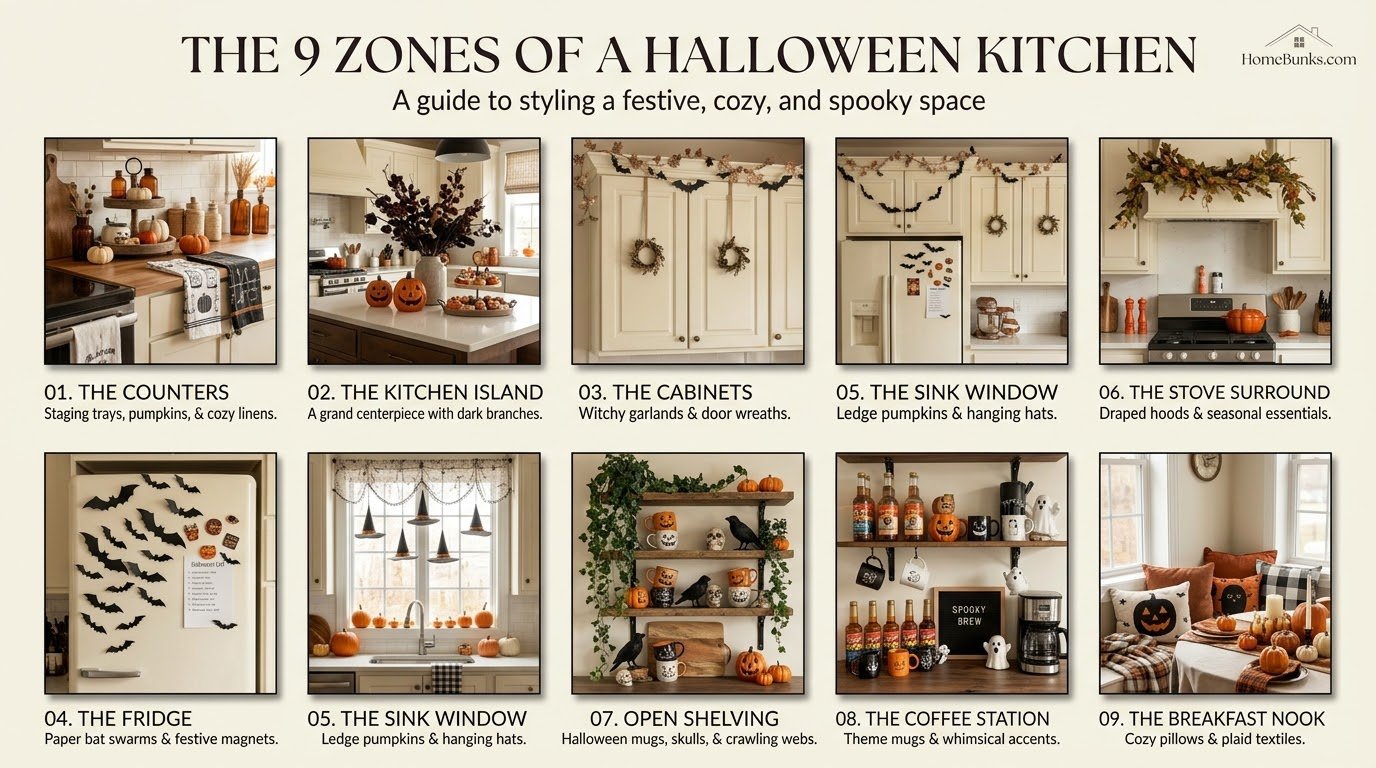
A small kitchen keeps five of the nine zones. Fridge, cabinets, sink window, coffee station and one counter tray survive, while the island and open shelving zones simply drop out.
The system degrades gracefully because zones are independent. Dropping two zones breaks nothing in the other seven, and the safety limits and wash rules travel with each zone that remains.
Vertical surfaces carry a small kitchen’s whole theme. Cabinet doors, the backsplash line, the above-cabinet run and the window frame hold decor that a counter never has to host.
Swaps beat additions when space is the constraint. A towel swap, a dispenser swap and a canister lid swap change the room’s read without adding a single object to it.
Renters get the zero-damage version of every zone. Magnets, removable decals, window clings, tension-rod garlands and tray centerpieces come down clean, with nothing nailed, painted or permanently stuck.
The witchy lane compresses the same way: our halloween witch decor guide owns the full witch theme, and a small kitchen borrows only its palette and one apothecary jar on the shelf.
Paper bats are the renter’s DIY shortcut: our halloween DIY decor guide owns the build sheets, and the kitchen version is a cabinet-door flock that tapes nothing and stores flat.
Party Night in the Kitchen: The Treat Station Rules
The island becomes the treat station when guests arrive. Its tray decor slides to one end, and the cleared surface runs drinks, cups and the food that follows the rules below.
Perishables get two hours out, and no more. FoodSafety.gov Halloween guidance, credited here in words because its page is text only, sets two hours as the limit, and one hour above 90 degrees.
Chill until serving is the working half of that rule. Dips, cheese and cut fruit wait in the fridge, come out in small batches and return to the cold between rounds.
Serve pasteurized cider only, per the same guidance. The unpasteurized farm-stand jug is a fall tradition the food safety page retires, and apples for bobbing get rinsed first.
Character themes pour into this room through licensed lines: our disney halloween decor guide owns the character decor system, and the kitchen borrows it as mugs and towels rather than a full theme takeover.
Kitchen Native vs General Decor: What Is Actually Kitchen Specific
Two kinds of decor fill a Halloween kitchen, and only one kind is kitchen decor. Kitchen-native pieces do a kitchen job, while general pieces are living room decor photographed beside a stove.
|
Kitchen native, does a job |
General decor placed in a kitchen |
|---|---|
|
Dish towels and oven mitts |
Loose pumpkins on counters |
|
Canister sets and cookie jars |
Candles and candelabra |
|
Soap dispensers and drying mats |
Garlands and webbing |
|
Spoon rests, trivets and utensil crocks |
Skeletons and figurines |
|
Mugs, shakers and kitchen rugs |
Signs and framed prints |
The native list is the shopper’s real checklist. Towels, mitts, canisters, cookie jars, dispensers, shakers, spoon rests, trivets, drying mats and kitchen rugs exist as kitchen assortments at every major retailer.
The general list is styling, and it follows zone rules or leaves. A pumpkin earns counter space on the tray, a skeleton earns the fridge door and a garland earns the cabinet run or nothing.
Mistakes to Avoid in a Halloween Kitchen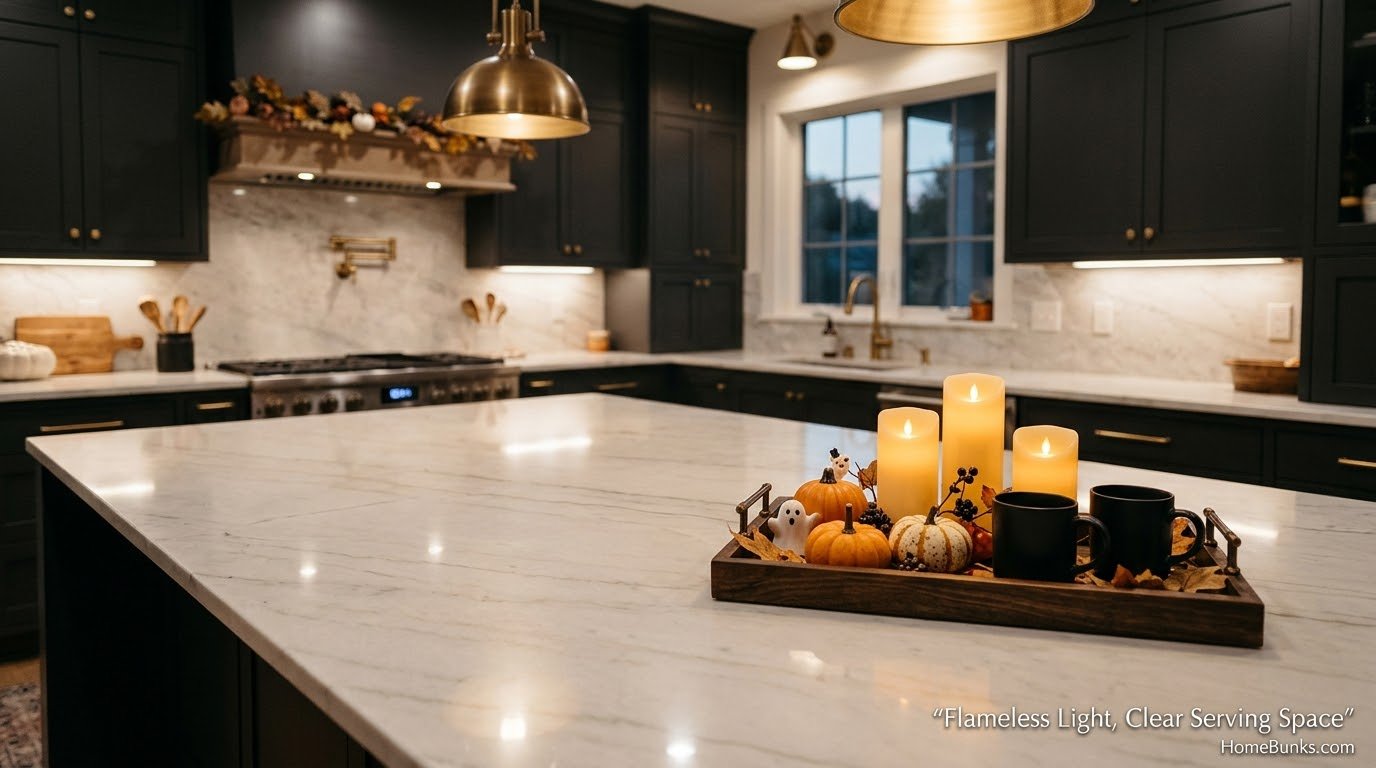
Most Halloween kitchen failures are placement failures, not taste failures. The same pieces succeed inside the zone rules and fail outside them, in a predictable order.
- A candle burning on the island or the counter run. Sleeves, napkins and paper goods pass within inches of it all night, and flameless pieces give the same glow without the exposure.
- Fabric, paper or webs inside the stove zone. Towels draped toward burners, garlands over the range and webs near the toaster repeat the exact list USFA guidance keeps away from the stovetop.
- Display towels doing working towel jobs. A thin novelty towel on dish duty spreads moisture instead of absorbing it, and its dyes and lint belong nowhere near food.
- Food stored in a jar that was never food storage. A novelty canister without a sealed lid or a food storage label is a prop, and loose ingredients expose the difference fast.
- Scattered small items instead of one contained tray. Ten loose minis read as clutter and block prep, while the same ten pieces on one tray read as a single styled object.
- Perishable party food riding past two hours. The island spread looks fine long after it stops being safe, and the clock, not the appearance, makes the call.
- Adhesive decor trusted on painted cabinets without a test. One hidden test patch protects a whole door run, and handles and hooks carry the pieces that adhesives would risk.
Every mistake above has the same shape. A good piece sat in the wrong zone, and the zone table at the top of this page is the whole correction.
Frequently Asked Questions
1. Can I use real candles in Halloween kitchen decor?
Flameless candles are the default in every working kitchen zone. Real candles stay attended on a stable surface, at least 12 inches from anything that can burn, and never on the stove run.
2. How many home fires start with decorations each year?
An average of 835 home structure fires per year began with decorations from 2020 to 2024. The NFPA count also averages 3 deaths, 29 injuries and 18 million dollars in damage each year.
3. What starts most decoration fires?
Decorations too close to a heat source start the largest share. NFPA puts that share at 47 percent, and about one third of decoration fires were started by candles themselves.
4. Is there a kitchen-specific decoration fire statistic?
No kitchen-specific decoration fire statistic exists. The NFPA figure is whole home and year round, and no NFPA, USFA or CPSC material publishes a kitchen-only count for decorations.
5. Why is the kitchen riskier for decor than other rooms?
Cooking is already the leading cause of home fires, per USFA. The kitchen adds open heat, grease, water and daily traffic, so decor that is harmless elsewhere needs stricter limits here.
6. Can I hang a garland over the stove or range hood?
No garland belongs over the stove or the range hood. USFA lists towels, oven mitts and curtains among things that can catch fire near a stovetop, and a garland is the same material class.
7. Are faux cobwebs safe in a kitchen?
Faux cobwebs stay away from heat and food in a kitchen. Synthetic web is flammable decor, so it belongs on cabinet fronts and walls, never near burners, ovens, toasters or prep surfaces.
8. Where can towels hang safely in a Halloween kitchen?
Towels hang on the oven handle or a hook away from burners. They never drape toward a lit burner, and a display towel moves before cooking starts on the stove.
9. How far should a candle be from towels or paper decor?
A candle stays at least 12 inches from anything that can burn. That distance is hard to guarantee on a working counter run, which is why flameless pieces are the kitchen default.
10. Are LED candles safer for a kitchen island?
Yes, LED candles are safer for a kitchen island. There is no flame to reach a sleeve, a napkin or a paper bat, and NFPA and CPSC both recommend flameless Halloween lighting.
11. What should I check on Halloween string lights in a kitchen?
Use only light sets tested by a recognized testing laboratory. Check for cracked sockets, frayed or bare wires and loose connections, discard damaged sets and never overload extension cords near water.
12. Can I put a jack-o’-lantern on the kitchen counter?
Yes, on a tray, away from the stove zone, with a battery light inside. Carving care matters too, since pumpkin carving accounts for about 55 percent of Halloween emergency room injuries.
13. Should decor block a kitchen exit or doorway?
No, decor never blocks a kitchen exit or doorway. NFPA guidance keeps exits clear of decorations, and a kitchen doorway is also the room’s busiest working traffic path.
14. Are Halloween kitchen towels for working or display?
Both kinds are sold, and telling them apart is the core skill. Working towels are cotton terry or flour sack that absorb and machine wash, while thin embroidered towels are display first.
15. How do I wash Halloween kitchen textiles?
Machine wash cotton towels before first food use and through the season. Anything fabric within splash reach of prep must be washable cotton, because a towel that cannot wash hot cannot work.
16. Can I store food in a decorative Halloween canister?
Only when the canister is a food storage item with a sealed lid. Wash it before filling, and keep novelty jars without food storage labelling as display pieces holding wrapped items only.
17. Is a Halloween cookie jar food-safe?
Retail cookie jars sold as food storage are, after a wash. Check the lid seals, wash before filling and repeat between batches, while purely novelty jars stay display only.
18. Can faux spiderwebs touch food or prep surfaces?
No, webs and loose glitter never touch food or prep surfaces. Their fibers shed where food is made and stored, so webs belong on cabinet fronts, window frames and walls instead.
19. How long can Halloween party food sit on the island?
Perishables get two hours out at most, and one hour above 90 degrees. FoodSafety.gov Halloween guidance, credited in words, also says to chill perishables until the moment of serving.
20. Can I serve unpasteurized cider at a Halloween party?
No, serve pasteurized juice or cider only. FoodSafety.gov states the rule in its Halloween guidance, credited here in words because that page is text only, and it adds rinsing apples before bobbing.
21. Do real pumpkins belong on a prep counter?
Real pumpkins sit on a tray, off the direct prep surface. A pumpkin is produce that softens, leaks and molds, so it gets checked through the season and removed at any rot.
22. Should shelf decor be washed before it holds food again?
Yes, shelf pieces wash before they hold food again. Open shelves collect dust and cooking grease all season, so a jar or dish returning to food use gets washed first.
23. What are the zones of a Halloween kitchen?
Nine zones organize the whole room. Counters, island, cabinets, fridge, sink window, the restricted stove surround, open shelving, coffee station and breakfast nook each carry a safety limit and a wash rule.
24. How do I decorate kitchen counters without losing prep space?
One tray equals one object on the counter. A tray or tiered tray holds the whole vignette, lifts away in one move for cooking and keeps the prep triangle completely clear.
25. How do I style a kitchen island for Halloween?
One tray or tiered tray, flameless light and serving room left empty. The island doubles as the party serving station, so its decor shares the surface with food on the two-hour rule.
26. How do I decorate the fridge for Halloween?
Magnets, a door banner and skeleton magnet sets do the whole job. The fridge is the biggest free surface in the room, costing zero counter space and zero damage.
27. How do I decorate a window over the sink?
Clings on the glass, a small frame garland and dry sill minis. The sink is the water zone, so paper and fabric stay minimal and everything used tolerates splashes and washing.
28. What is the coffee station formula?
A tray, themed mugs, one mini pumpkin and one small sign. The coffee station is the highest yield small zone, and it can carry a kitchen with no island and no shelves.
29. How do I decorate open shelves for Halloween?
Small groupings in odd numbers, set between the working dishes. Keep webs away from food storage pieces, and wash any shelf piece before it returns to holding food.
30. What decor works on a breakfast nook?
A runner and one low centerpiece, kept clear for daily meals. Full tablescapes and place settings belong to the live table decor sibling, and the nook is the shared edge between the pages.
31. What colors make Halloween kitchen decor look elegant?
A tight palette reads elegant fastest. Black with white or cream and one metallic, or muted orange and brown tones, beats bright orange across every zone in the room.
32. How do I keep Halloween kitchen decor from looking childish?
Limit the palette and choose texture over cartoons. Matte ceramics, real textiles and one zone carrying the theme read grown up, while plastic novelties on every surface read childish.
33. How do I decorate a small kitchen for Halloween?
Vertical first, swaps not additions, three small moments. Cabinet doors, the backsplash and the window frame carry the theme, while towel and dispenser swaps change the room without adding objects.
34. What if my kitchen has no island or open shelves?
The coffee station carries the room, backed by fridge and cabinets. Drop the island and shelving zones and the system still works, because each zone carries its own rules independently.
35. What Halloween kitchen decor is renter-friendly?
Magnets, removable decals, tension rod garlands, clings and tray pieces. Nothing nailed, painted or permanently stuck, and the fridge and cabinet doors give renters two large removable surfaces.
36. Will adhesive decals damage painted cabinets?
They can lift or mark painted finishes. That caution comes from a UK source and is flagged as such, and hanging pieces from handles and hooks avoids the risk entirely.
37. What are the cheapest Halloween kitchen decor ideas?
A towel swap, a tray of mini pumpkins and printed signs in owned frames. A Target own-brand towel started at 2.55 dollars on the November 18, 2026 check, anchoring the cheap end.
38. What are the best Halloween kitchen decor items to buy first?
Towels first, then a food storage canister or cookie jar. Add mugs for the coffee station and one tray piece, and the highest touch swaps in the room are covered.
39. How much are Halloween kitchen towels at Target?
Target towel prices print as dated strands, never standing prices. Own-brand singles sat at 2.55 dollars and 2 packs at 4.25 dollars on November 18, 2026, with branded flour sack towels at 15.49 dollars.
40. Does HomeGoods sell Halloween kitchen decor online?
No, HomeGoods sells this assortment in store only. Cookie jars, canisters and Rae Dunn pieces vary by location and sell out fast, and their prices are in-store reported strands.
41. How do I store Halloween kitchen decor after October?
Wash textiles first, then bin by zone with labels. Bins stored by the nine zone order make next year’s setup follow the same sequence, and paper pieces store flat.
42. When should I put up Halloween kitchen decor?
Early to mid October, fall base first and spooky layer after. Pumpkins, textiles and branches go up first, and the ghosts, bats and webs join once the base is set.
Conclusion
Halloween kitchen decor holds up when the room still cooks. Nine zones, one restricted stove surround, washable textiles and food contact rules turn a gallery idea into a kitchen that works all October.
Start with the swaps, then add the showpieces. A towel swap, a dispenser swap and one counter tray change the room today, and the fridge, cabinets and coffee station layer in as time allows.
Keep every figure on this page attached to its owner. Fire counts keep the scope NFPA printed, prices keep their retailer and check date, and no kitchen-specific fire number was invented to fill a gap.
Browse the wider Halloween cluster from the HomeBunks home page before the clearance shelves empty. A washable, storable kitchen bought at November strands is the cheapest version of next October, and Halloween 2027 lands on Sunday, October 31, 2027.