
Indoor halloween decor works best when it is planned by surface, not by room: every wall, mantel, shelf and rail gets a load, a method and a rule before a single piece goes up.
Rooms decide the mood, but surfaces decide the outcome. A garland stays up or falls, paint survives or peels, and storage works or tangles, all at the plane the decor touches.
Whole home planning sits with the halloween house decor hub, and the room scenes sit with the halloween indoor decor room guide. This page owns the method layer underneath both: what each surface can hold, hang and store.
Ten surfaces carry almost every indoor display: walls, mantel, banister, shelves, tabletops, windows, doors, ceiling, light fixtures and floor. Each one below gets its capacity, its damage free method, its heat rule and its pack away form.
The Short Answer: Plan the Surface, Not the Room
Surface first decorating means four decisions per surface: the load it can hold, the attachment method rated for that load, the clearance rule that keeps it safe, and the storage form it packs into.
Get those four right and the display goes up fast, stays up all October, and comes down without a single hole, peel or tangle. Get them wrong and even beautiful decor becomes repair work in November.
The order matters too. Decorate the highest sightline surface first, usually the mantel or main shelf, then the wall behind it, then one horizontal surface. Ceilings, doors and windows amplify a scene that works.
The Surface Map: Ten Surfaces at a Glance
The table below is the whole system on one screen. Every surface has a capacity verdict, a first choice method, and a hard rule that never bends.
|
Surface |
What it can hold |
First choice method |
Hard rule |
|---|---|---|---|
|
Walls |
Paper, light frames, garlands |
Removable strips, putty dots |
Stay under the per pair rating |
|
Mantel and surround |
Anything it can stand |
Leaning, tucked garland ends |
Surround is a heat surface |
|
Banister and rail |
Light garlands, paper pieces |
Ties at the balusters |
Handrail grip stays clear |
|
Shelves and bookcases |
Heavy low, light high |
Putty, trays, bookends |
Nothing tall where it can topple |
|
Tabletops and sideboards |
Clusters on trays |
One movable base per cluster |
Surface stays usable |
|
Windows and glass doors |
Clings, silhouettes, light pieces |
Static clings, rated hooks |
Suction only for the lightest pieces |
|
Interior doors |
Flat pieces, light wreaths |
Over door hooks |
Door must swing clean |
|
Ceiling |
Paper and foam pieces only |
Rated hooks, fishing line |
Never over a walkway |
|
Light fixtures |
Nothing draped |
Decorate around, never on |
Bulbs are heat sources |
|
Floor and mat zone |
Heavy pieces at the edges |
Freestanding weight |
Walk lines stay clear |
Read the map as a shopping and setup order as well. Surfaces near the top of the table carry the display; surfaces near the bottom support it quietly and punish mistakes fastest.
Before Anything Goes Up: Load, Heat and Lease Checks
Three checks take ten minutes and prevent nearly every failure. Weigh the heavy pieces, walk the room for heat sources, and, if you rent, read the lease clauses that govern holes, flame and displays.
Fire safety guidance is consistent across sources. The NFPA halloween fire safety tips warn that dried flowers, cornstalks and crepe paper catch fire easily and must stay away from flames and heat.
The same guidance, also carried in the NFPA halloween safety tip sheet, favours battery operated candles in jack-o-lanterns and clear exits. The National Fire Protection Association publishes the wider decoration fire record behind those rules.
That record is whole home, and it is labelled that way here: an annual average of 835 home structure fires began with decorations in the 2020 to 2024 window, about 47 percent involving a heat source too close and about one third started by candles.
No indoor only fire figure exists in the sources checked, and none is invented on this page. The rules below are built from guidance and clearances instead.
The Adhesive Ratings That Govern Half the Surfaces
Removable adhesive is the default fastener indoors, so its real ratings matter more than any styling tip. The table uses 3M’s published figures for its Command range, checked in November 2026.
|
Product |
Rating |
Notes |
|---|---|---|
|
Small picture hanging strips |
1 lb per pair |
Paper and the lightest frames |
|
Medium picture hanging strips |
3 lb per pair |
Small framed prints |
|
Large picture hanging strips |
4 lb per pair |
Four pairs hold 15 lb in total |
|
Large strips, frame limit |
Frames to 24 x 36 in |
Use the full set for big frames |
|
Mini hooks |
0.5 lb each |
Single light pieces |
|
Jumbo hooks |
7.5 lb each |
The heaviest single hook rating |
Two application rules decide whether those ratings hold: press firmly for 30 seconds, then wait one hour before loading. Removal is a slow pull straight down on the tab, which stretches the strip until the bond releases clean.
Treat bigger numbers found elsewhere with suspicion. Secondary sources sometimes print inflated per pair claims that confuse a whole set’s total with one pair’s rating. The manufacturer figures above are the only ones this system uses.
Walls: Bat Swarms, Gallery Swaps and Garlands
Walls hold paper and light frames on rated adhesive, and they are the most forgiving surface to decorate and the easiest to damage with the wrong removal. Sound, clean, fully cured paint is the condition everything assumes.
The bat wall is the signature wall display: cardstock bats on putty dots, wings bent forward for shadow. Plan the flight path in painter’s tape, photograph it, then place bats from the centre outward.
For framed pieces, count glass at full weight and divide by the per pair rating, rounding up. A leaning frame on a shelf or mantel beats strips for anything heavy, because it asks the wall for nothing at all.
Wall failures follow a pattern: load before the cure hour, dusty or greasy paint, or a piece hung out from the wall so a shear load becomes a peel load. Fix the cause, not just the hook.
Mantel and Fireplace Surround: The Heat Governed Surface
The mantel holds anything it can stand and nothing it must hang. Lean the anchor piece, run the garland along the shelf with its ends tucked behind it, and cluster flameless candles where the eye lands first.
The surround below is a different material with a different job: it is a heat surface, not a shelf. When the fireplace is in use, fabric, paper, dried botanicals and webbing come off the surround and off the mantel front.
Near a lit firebox, only ceramic, metal and glass belong. Real candles never share the mantel with draped fabric, and the 12 inch clearance between flame and anything combustible is the minimum, not a target.
Banister and Stair Rail: Garlands That Keep the Grip Clear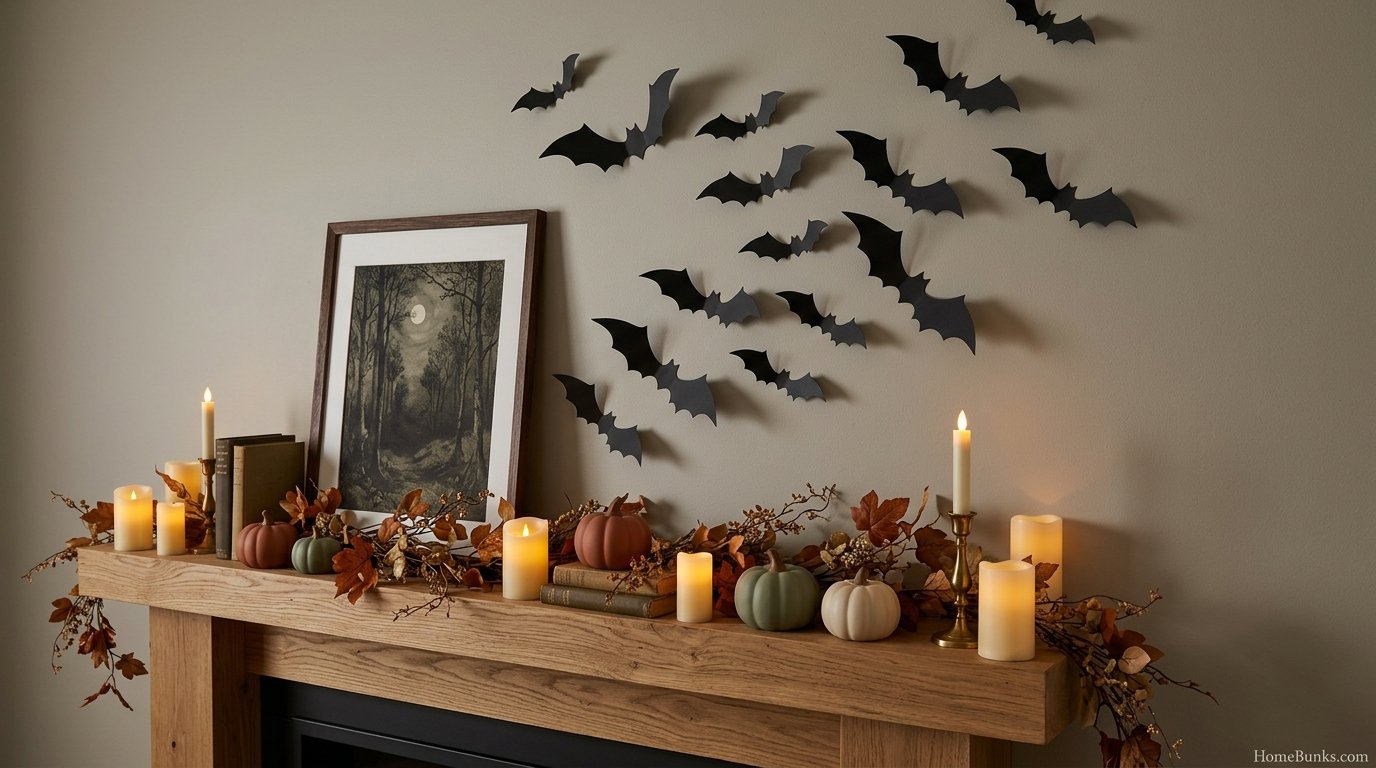
Stair decor has one non negotiable rule: the handrail grip stays clear for its full length. A hand sliding down the rail in the dark must meet wood or metal only, from the first step to the last.
Attach garlands to the balusters or the rail’s outer face with short, snug ties at every third or fourth baluster. Weight carried low and close to the structure never sags into the grip line.
Keep treads completely empty and anything electrical battery powered, so no cord crosses a step. The newel post cluster stays below hand height, leaving the first grab of the rail bare.
Shelves and Bookcases: Vignettes With a Tipping Limit
Shelf decor rarely fails on load; it fails on tipping and sliding. Heavy pieces go low and toward the back, light pieces go high, and tall narrow pieces stand against the shelf back or a bookend.
A pea of mounting putty under a base, or a cluster grouped on a tray or book stack, gives light resin and ceramic pieces one wide, stable footprint. Putty also stops the slow creep that vibration causes on glass shelves.
Cat households should plan shelf surfaces first. The repeated cat motif in the black cat halloween decor guide works best where a real cat cannot reach, with putty under every light piece a paw can test.
The top of a tall bookcase takes light pieces only: garlands, paper and foam. Anything glass or ceramic up high must be lifted down over your head in November, which is exactly how breakage and injury happen.
Tabletops and Sideboards: Trays, Clusters and Working Space
One boundary first: the dining table is excluded from this surface set, because it is a working surface with its own system in the halloween table decor guide. This section covers sideboards, consoles and side tables.
The tray rule keeps these surfaces honest: every cluster sits on one movable base, a tray, board or book stack. The whole vignette lifts off in one move for cleaning, serving or a mid month rearrange.
Leave the surface usable around the scene. A sideboard that cannot hold a drink or a set of keys has stopped being furniture. Kitchen worktops follow the same logic under their own rules in the halloween kitchen decor guide.
Windows and Glass Doors: Clings, Silhouettes and Suction Limits
Static clings are the renter’s best window tool: they hold by static, peel off by hand and leave nothing behind. Adhesive backed decals are a different product and can leave residue, so the pack decides, not the picture on it.
Silhouettes read from the street when the room behind them is lit warm after dark. Fix bold black card shapes to the inside face of the glass and keep detail large, because fine lines vanish at street distance.
Suction cups hold single light pieces on clean, smooth glass and fail predictably on cold, textured or dirty panes. Keep them well under a pound, check them weekly, and use a rated adhesive hook for anything above a walkway.
Interior Doors: Wreaths and Wraps on a Moving Surface
A door is the only surface that moves several times a day, so everything on it must be flat, light and clear of the frame. Over door hooks with felt backing are the reliable default for a light wreath.
Nothing goes on the hinge side, nothing at handle height, and fabric wraps get taped at the back face so edges cannot catch. After decorating, run ten open and close cycles; anything that shifts gets reworked immediately.
Ceiling: Hanging High Without Holes
Ceilings take paper and foam pieces only, each on its own rated removable hook or secure existing point. Fishing line makes bats, hats and ghosts appear to float, and one piece per line keeps every load honest.
Placement is the safety system here: hang pieces over furniture or along walls, never over a walkway, and keep the lowest piece above head height with margin. Ceiling adhesive works against gravity, so stay well under its rating.
Light Fixtures: Decorate Around, Never On
Nothing drapes over a lamp, shade or chandelier. Bulbs and shades are heat sources, and fire guidance names light bulbs directly. Fabric, paper and webbing touching a fixture is the fastest route from decor to damage.
Decorate around fixtures instead: silhouettes on the wall the light washes, a garland on a cool chain only where the manufacturer allows it, and the glow itself as the effect. LED bulbs run cooler, but the rule survives the next bulb change.
Floor and the Entryway Mat Zone: The Surface That Stays Clear
The floor is a traffic surface first and a decor surface last. The door swing, the mat zone and every walk line stay completely clear, with pieces placed only at edges furniture already interrupts.
No cords cross floors. A piece that needs power goes where an outlet hides behind furniture, or it becomes a battery piece. Heavy pumpkins sit where a stumble cannot reach them, and nothing tall stands where a coat or bag swing can topple it.
The Damage Free Renter Layer: Decorate Without Risking the Deposit
Renters can run this whole system, because it is built on no penetration and no residue. The deposit risks are specific: holes, paint peeled by fast removal, tape residue, wax and soot marks, and dye transfer from cheap drapes.
Four lease clauses decide what is allowed: rules on nails and wall penetrations, bans or conditions on candles and open flame, rules on displays visible from outside, and the duty to restore surfaces at move out. Terms vary, so your own lease is the authority.
Anything beyond removable adhesive, such as a ceiling screw or a rail fitting, needs landlord permission in writing first. A short question before October costs nothing; a deduction argument in November costs the deposit.
- Photograph every wall, door and surface before decorating, dated and from fixed angles.
- Build the no penetration kit: strips, hooks, putty, over door hangers, tension rods and clings.
- Keep real candles out entirely where the lease bans flame; flameless carries the same scenes.
- Remove everything by the slow pull method, then rephotograph the same angles.
- Roll any residue away with putty first; solvents only after a hidden spot test.
The before and after photos do double duty. They document pre existing marks for the deposit, and they become the takedown checklist and next year’s setup plan.
The Pack Away Layer: Storage by Surface
Storage is a system, not a tip: one labelled box or flat pack per surface, packed in takedown order, so next year’s setup runs in the same sequence. Decor packed by surface goes back up where it came from, without re sorting.
|
Surface |
Storage form |
Packing rule |
|---|---|---|
|
Walls |
Flat pack |
Bats and cutouts between card sheets, putty in the same envelope |
|
Mantel |
Boxed |
Garland wound on a card labelled with its span |
|
Banister |
Boxed flat |
Garland on a card, ties kept with it |
|
Shelves |
Boxed |
Putty renewed, pieces grouped as clusters |
|
Tabletops |
Boxed |
Tray stacks with its cluster intact |
|
Windows |
Flat pack |
Clings on their backing sheets, silhouettes between card |
|
Doors |
Flat or hung |
Wreath flat in a shallow box, hook stored with it |
|
Ceiling |
Flat pack |
Paper pieces flat, lines untied and discarded |
|
Fixtures |
None |
Nothing stored; the surface itself was the decor |
|
Floor |
Boxed |
Heavy pieces low in the box, nothing crushable beneath |
Batteries come out of every flameless candle, remote and motion piece before storage. Stored batteries leak and corrode contacts over a year, which is the most common reason last year’s decor fails its first test.
String lights get coiled around a card, plug end taped to the coil, and tested before packing. A failed strand is replaced in November, while clearance stock still exists, not discovered next October.
Finish with the November 1 routine: swap layer out first, crossover pieces stay, every surface photographed bare, and each box labelled with surface, room and contents. That label is next year’s shopping list and setup order combined.
Buying for Surfaces: Kits, Crossovers and the 2027 Calendar
Buy by surface, not by theme. One attachment kit (strips in three sizes, hooks, putty, over door hangers) serves every surface in the house, and the flameless candle set removes the clearance problem everywhere at once.
Build the crossover layer on purpose: unthemed pumpkins, warm lights, plain wreaths and autumn textiles stay up into November, while bats, ghosts and labelled pieces form a swap layer that leaves in one box on November 1.
Spending context, kept dated: the National Retail Federation survey for 2026 put total halloween spending at $13.5 billion, decorations at $4.3 billion, with 78 percent of celebrators buying decorations. No indoor only split is published, and none is claimed here.
One sourcing reality saves a wasted trip: some big craft retailers stock no halloween aisle at all, as the hobby lobby halloween decor guide documents. Halloween 2027 falls on Sunday, October 31, 2027, and the first October weekend gives four full weekends of display.
FAQs
What is indoor halloween decor when it is planned by surface?
It is the same decorating, organised by the plane the decor touches instead of by room. Each surface gets four decisions: what load it can hold, which damage free method is rated for that load, what heat or clearance rule applies, and how the pieces store.
Which surface should I decorate first indoors?
Start with the mantel or the main shelf, the highest sightline surface in most homes, because it sets the scale for everything else. Second comes the wall above it, which carries the backdrop. Third, one horizontal surface such as a sideboard. Ceilings, doors and windows are amplifiers, added only after the first three surfaces read as one scene.
How much weight can a removable adhesive strip actually hold?
Use the manufacturer per pair ratings, not the biggest number on the pack. 3M rates its picture hanging strips at about 1 lb per pair for small, 3 lb for medium and 4 lb for large. Hooks run from about 0.5 lb for mini to 7.5 lb for jumbo. Weigh the piece, count glass at full weight, and stay under the rating with margin.
How many picture hanging strip pairs does a framed halloween print need?
Work from the frame’s total weight including glass, divide by the per pair rating and round up. A 6 lb framed print on large strips rated 4 lb per pair needs two pairs minimum at the top corners; three pairs is safer. A leaning placement needs no strips at all.
Why did my adhesive hook fall off the wall?
Almost always one of four causes: the load went on before the adhesive cured, the wall was dusty, greasy or freshly painted, the piece hung out from the wall and turned a shear load into a peel load, or heat and steam softened the bond.
How long should adhesive strips cure before I hang decor on them?
Plan on one hour between application and loading, per the manufacturer’s own instructions: clean the surface, press firmly for 30 seconds, then leave the strip unloaded for a full hour so the bond builds. Put every hook and strip up first, do the room’s other work during the cure hour, and hang last.
Which surfaces should removable adhesive never go on?
Never on fresh paint, wallpaper or delicate paper surfaces, exposed brick and rough stone, unfinished or flaking wood, or any surface already peeling. Paint needs its full cure first, commonly a week or more. On those surfaces use the no contact methods instead: over door hooks, tension rods, leaning frames, plate stands and freestanding pieces.
How do I remove adhesive strips without peeling paint?
Pull the tab slowly straight down along the wall, never out toward you. The strip stretches and releases its bond as it elongates; pulling outward converts the release into a peel that lifts paint. Hold the frame lightly with the other hand so it does not drop. If a strip snaps, warm the pad gently and work dental floss behind it instead of prying.
Can I hang a halloween wreath on an interior door without a nail?
Yes, three ways, in order of reliability: an over door hook with felt on its back, a removable adhesive hook rated for the wreath’s weight with margin, or fishing line run from a hook on the door’s back face. Then run the swing test: open and close the door fully and check clearance.
How do I hang a garland on a banister without blocking the handrail grip?
Attach the garland to the balusters, or to the underside and outer face of the rail, never draped across the top where hands slide. Tie it at every few balusters so no span sags into the grip line, and keep the swag on the room side. The test is simple: in the dark, a hand must run the full rail without meeting decor.
What is the safest way to attach decor to a stair rail?
Short, snug ties at frequent intervals beat long loose drapes: floral wire, zip ties or removable rail clips at every third or fourth baluster, with the weight carried low and close to the rail structure. Keep treads completely empty, keep anything electrical battery powered so no cord crosses a step, and keep the newel post cluster below hand height.
How do I decorate a mantel without drilling into the surround?
The mantel shelf is a standing surface, so nothing needs to attach: an anchor piece leaning against the wall, a garland run along the shelf with its ends tucked behind the anchor, and clusters in front. For the wall above, use picture strips rated for the piece. Removable hooks on the shelf’s front edge carry light garland drops. Seasonal weight never needs a drill.
Can I put decor on a fireplace surround that gets hot?
Treat the surround as a heat surface, not a shelf. When the fireplace is in use, keep fabric, paper, dried botanicals and webbing off the surround and the mantel front, and well clear of the firebox opening. The National Fire Protection Association flags dried flowers, cornstalks and crepe paper as highly flammable. Near a lit fireplace, only ceramic, metal and glass pieces belong.
How much weight can a bookshelf shelf hold for decor?
More than seasonal decor will ever ask, in most cases. The binding limit is rarely the shelf’s load rating; it is tipping and sliding. Keep heavy pieces low and toward the back, light pieces high, and nothing tall and narrow where it can topple. Particleboard shelves with long spans are the exception: keep loads modest and centred over the supports.
How do I stop shelf decor from tipping or sliding?
Three cheap fixes: a small ball of mounting putty under the base of light resin and ceramic pieces, grouping pieces on a tray or stack of books so the cluster has one wide footprint, and keeping tall pieces against the shelf back or a bookend. Putty also stops the slow creep vibration causes on glass shelves. Everything is removable and leaves no mark.
How do I decorate the top of a bookcase or tall cabinet safely?
Only with pieces you can place and retrieve without leaning your weight on the furniture, and light enough that a fall would not injure anyone: garlands, paper pieces, foam pumpkins, empty bottles. Anchor garland ends so nothing dangles within a child’s or cat’s reach. Never put glass or ceramic up high where it must be lifted down over your head.
Are window clings really residue free?
Static clings, yes: they hold by static and surface tension, peel off by hand and leave nothing behind, which makes them the first choice for renters and glass doors. Adhesive backed decals are a different product and can leave residue, so read the pack. Clings need a clean, dry pane, applied from the centre outward, and they store flat and reusable for years.
How do I hang silhouettes inside a window so they read from the street?
Cut shapes from black card or use ready silhouettes, fix them to the inside face of the glass with small loops of removable tape or dots of putty, and put a warm light source in the room behind them after dark. The lit room backlights the shape for the street. Keep the design bold and large: fine detail disappears at street distance.
Can suction cups hold decor on glass doors all October?
They hold light pieces on clean, smooth, non porous glass well, and fail predictably on cold, textured or dirty glass and under real weight. Use them for single pieces well under a pound, pressed onto cleaned, dried glass, and check them weekly. For anything heavier, an adhesive hook rated for glass is safer.
How do I decorate an interior door that still has to open and close?
Design for a moving surface: flat or low profile pieces only, nothing that changes the door’s clearance at the frame, nothing on the hinge side, and nothing at handle height. Tape fabric wraps at the back face so edges cannot catch. Then run ten full open and close cycles; if anything shifts, rework it now.
Can I hang decor from a ceiling without hooks or holes?
Light pieces only, and from the right points: removable adhesive ceiling hooks rated for the load, tension lines in narrow halls, or existing secure points. Fishing line carries paper bats, hats and ghosts invisibly. Keep every hanging piece over furniture or along walls, never over a walkway, and stay well under the hook rating, because ceiling adhesive works against gravity full time.
How do I hang floating witch hats from the ceiling safely?
Use one hat per fishing line, each line to its own rated removable hook, with heights staggered so no two hats share a load point. Foam and fabric hats weigh almost nothing, so the risks are placement, not weight. Keep the lowest hat above head height with margin, and away from ceiling lights and sprinklers.
Can I drape decor over a lamp or chandelier?
No. No fabric, paper or webbing over or touching a lamp, shade or chandelier. Bulbs and shades are heat sources, and fire safety guidance names light bulbs as a heat source decorations must stay away from. Decorate around fixtures instead, and let the glow itself be the effect. LED bulbs run cooler, but the rule stays, because the next bulb fitted may not be LED.
How close can fabric decor sit to a candle or bulb?
For real candles, use the 12 inch rule: at least 12 inches between a flame and anything that can burn, and never leave a lit candle unattended. For bulbs and heaters, treat any contact or near contact as too close for fabric, paper, dried botanicals and webbing. The simpler system is flameless candles inside scenes, which removes the clearance problem on every surface at once.
How do I keep floor decor out of walkways and the entry mat zone?
The floor is a traffic surface first: keep the door swing, the mat zone and every walk line completely clear. Place floor pieces only at the edges where furniture already interrupts the path. No cords across floors; a piece that needs power goes where an outlet sits behind furniture, or becomes a battery piece. Heavy pieces sit where a stumble cannot reach them.
What is the most damage free way to make a bat wall?
Paper or cardstock bats, each fixed with a small dot of mounting putty or a removable adhesive dot at the body, wings bent forward for shadow. Plan the flight path with painter’s tape first, photograph it, then place bats from the centre outward. Removal is a lift and a roll of the putty, and the bats store flat.
Will mounting putty hold paper bats all month?
Yes, for paper weight on sound, clean paint: a pea sized piece per bat, pressed flat, holds cardstock indefinitely indoors. Putty struggles on dusty, greasy, textured or freshly painted walls and in steamy bathrooms, where removable adhesive dots are the better choice. Warm rooms can soften putty over weeks, so the largest bats get two dots. Test one bat overnight before building a whole swarm.
Can renters decorate for halloween without risking their deposit?
Yes, with a no penetration, no residue system: removable adhesive used within its ratings and removed by the slow pull method, over door hooks, tension rods, clings, putty and leaning pieces. The deposit risks are specific and avoidable: holes, peeled paint, tape residue, wax and soot marks, and dye transfer from cheap drapes.
What should I check in my lease before decorating indoors?
Four clauses matter: any rule on nails, screws or wall penetrations, any ban or condition on candles and open flame, any rule about door and window displays visible from outside, and any duty to restore surfaces at move out. Lease terms vary by landlord and jurisdiction, so read your own document. A short written question to the landlord before October beats a deduction argument in November.
Should I photograph my walls before hanging seasonal decor?
Yes. A dated photo set of every surface you plan to decorate takes five minutes and does two jobs: it documents pre existing marks for deposit purposes, and it becomes your takedown checklist in November. Take the same angles again after removal; the photos also record which method went where, which is next year’s setup plan.
What halloween decor should renters avoid completely?
Anything that penetrates (nails, screws, staples), anything that bonds permanently (construction adhesive, hot glue on woodwork, standard tape on paint), real candles where the lease bans flame, and heavy pieces on adhesive alone above beds, sofas or walkways. Avoid dye heavy cheap drapes against light walls, and anything on a hot surround. The renter kit stays short by design.
How do I get adhesive residue off a wall or door?
Start with the least aggressive method: roll the residue with a fingertip or a ball of the same putty, which lifts most removable adhesive cleanly. For stubborn film, warm it briefly with a hairdryer on low and roll again. Avoid solvents on paint until you test a hidden spot. Residue usually comes from a strip pulled outward instead of stretched down; the slow pull prevents it.
How do I store garlands so they do not tangle or crush?
Wind each garland around a flat card or storage reel, secure the ends with a soft tie, and lay it flat in the box for its surface. Never stuff a garland loose into a bin: the tangle costs more time next year than the winding costs now, and wired garlands kink permanently. Label the card with the surface and span it covered.
How do I pack paper bats and cutouts so they stay flat and reusable?
Flat, dry and unbent: stack bats and cutouts between sheets of card in a shallow box or document wallet, wings folded back to flat, largest on the bottom. A rigid envelope or art portfolio is ideal and takes almost no space. Keep the putty or dots in the same envelope, so the whole wall system stores as one flat pack, ready to rebuild.
How do I store flameless candles and string lights?
Flameless candles: wipe, switch off, and store upright in a divided box so flame tips do not snap, grouped by surface. String lights: coil each strand around a card or reel, tape the plug end to the coil, and test before packing, not after. A failed strand gets replaced in November, while clearance stock exists.
Should batteries come out before storing halloween electronics?
Yes. Remove batteries from flameless candles, remotes and motion or sound pieces before storage: stored batteries leak and corrode contacts over a year, the most common reason last year’s decor fails. Store each piece with a note of its battery size and keep a fresh pack with the boxes. Check that button battery compartments close with a screw, per Reese’s Law, before pieces go back up.
How do I label halloween storage boxes by surface?
One box or flat pack per surface, labelled with the surface, the room and the contents: WALL, living room, bats and putty. MANTEL: garland, anchor print, candle set. The label doubles as next year’s shopping list and setup order, since surfaces go up in the order they came down. Photograph each decorated surface before takedown; labels plus photos rebuild the whole display without guesswork.
How long can indoor halloween decor stay up?
As long as it stays safe and in the way of nothing: most households run early October to November 1, and surface discipline extends the safe window because nothing sits near heat, blocks a route or peels mid month. Pieces near a working fireplace, real candles and fresh botanicals set shorter limits. The crossover layer can stay into November by design.
Which indoor pieces cross over to Thanksgiving, and how do I store the swap?
Unthemed pumpkins, warm white lights, plain wreaths, dried botanicals and autumn textiles cross over. Bats, ghosts, potion labels, spiders and anything with a halloween word on it are the swap layer. Store the swap layer as its own small, clearly labelled box inside the main storage, so the November 1 change is one box out and ten minutes of removal, with nothing to re sort.
Is there data on how many fires indoor halloween decorations cause?
No indoor only figure exists in the sources checked, and any page quoting one should be distrusted. The published window is whole home: an annual average of 835 home structure fires beginning with decorations in the 2020 to 2024 window, about 47 percent involving a heat source too close and about one third started by candles. The rules here are built from guidance, not an invented indoor statistic.
What is the difference between decorating by room and decorating by surface?
By room answers what should this space feel like; by surface answers what can this plane hold, how it attaches, what rule keeps it safe, and how it stores. The room view produces scenes; the surface view produces scenes that stay up, come down clean and pack away flat. The two work together: room scenes live on the partner page, and this system is the method layer underneath.
When should indoor halloween decor go up for the 2027 season?
Halloween 2027 falls on Sunday, October 31, 2027, so the first weekend of October 2027 gives four full weekends of display, and prep can happen in late September. Put strips and hooks up a day ahead where you can, so cure time never compresses the decorating session. Neutral crossover pieces can go up in September and turn halloween when the swap layer is added.
Conclusion
Indoor halloween decor planned by surface asks more questions up front and far fewer in November: what can this plane hold, how does it attach, what rule keeps it safe, and how does it pack away.
Start with one surface this season, most naturally the mantel or main shelf, run the four decisions honestly, and let the system spread only as far as it stays clean. The room pages and the hub at HomeBunks supply the scenes; the surfaces make them stay up, come down clean and store flat.
When you are ready to build your own kit, begin with the attachment basics and a flameless candle set, decorate the highest sightline surface first, and label the first box before the season ends. Next October will thank you for all three.