
Halloween office decor succeeds or fails on one decision made before any shopping: permission. A display your manager approved, in a zone where it belongs, survives the season. A display nobody cleared gets removed by Friday.
The workplace is not a small house. Desks sit on exit routes, walls belong to a landlord, and a colleague who never agreed to a haunted cubicle works three feet away from yours.
Halloween falls on Sunday, October 31, 2027, so most offices celebrate on Friday, October 29, 2027. That single working day shapes everything here: the ask, the build, and the teardown on Monday, November 1.
For whole home decorating, our Halloween house decor hub owns the residential plan. This page owns the workplace only: permission first, then zones, then the party layer.
Halloween Office Decor in One Answer: Permission First, Then Zones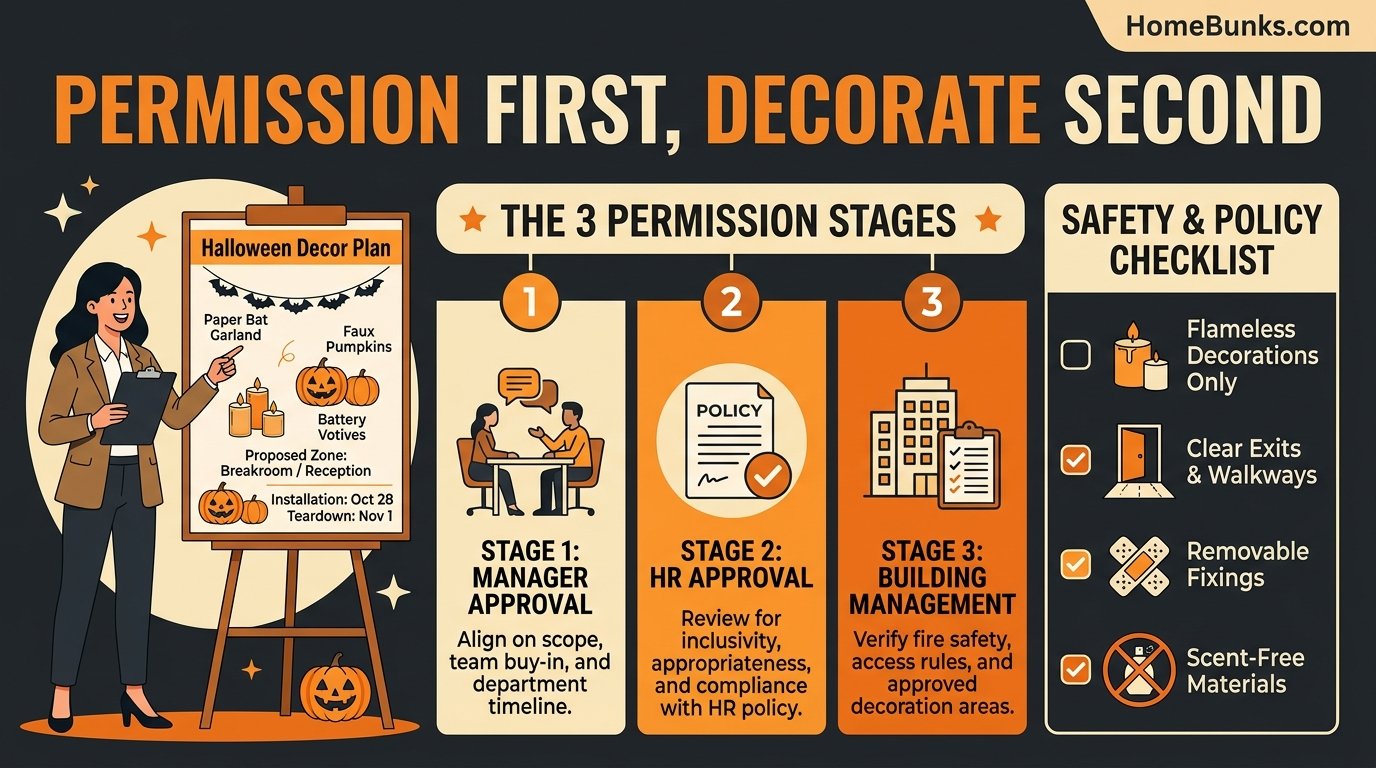
Halloween office decor is decorating by permission and zone: clear the display with your manager, HR and building rules first, then decorate six zones that each carry different limits.
The zones are your desk, the cubicle, reception, the break room, the conference room and shared corridors. A piece that is welcome at your desk can be banned in reception, where clients form their first impression.
Three registers keep the peace: autumnal, spooky and scary. Client facing zones run autumnal or mild spooky, back office desks can run spookier, and scary belongs almost nowhere at work.
Everything on this page follows general information, not legal advice. Your employer policy, your building lease and your local fire code always outrank any general guide, including this one.
The Permission Layer: HR, Building and Fire Rules
Permission is three separate approvals, not one casual yes. Your manager controls your team space, HR owns workplace appropriateness, and building management controls walls, ceilings, corridors and anything electrical.
Ask in that order and keep the answers. A manager yes does not override a lease rule, and a lease rule does not override fire code. The strictest layer wins every time.
The Four Line Permission Email
The ask that works is short and specific. Four lines cover what managers and facilities staff actually need, and the format below is the asset readers reuse every October.
1. The pieces. Name exactly what goes up: a paper bat garland, two faux pumpkins, one battery votive. Specific lists get approved; vague requests for spooky stuff invite a vague no.
2. The zone. State where it lives: your cubicle panels, the reception counter, the break room wall. Zones let a manager approve one area without approving the whole floor.
3. The dates. Give the up date and the down date: up Monday, October 25, down Monday, November 1, 2027. A teardown date in writing is the single strongest trust signal in the email.
4. The safety lines. Close with your commitments: flameless only, exits and signs clear, removable fixings, scent free. You are telling the approver the risks are already handled.
What the Lease and Building Manager Control
Most office leases and building rule books quietly govern walls, ceilings and corridors. Common clauses ban tape and pins on painted surfaces, anything hung from ceilings or sprinklers, and displays in shared lobbies without approval.
Facilities teams also control electrical load and ladders. Temporary wiring has its own rules, and the Illinois OSHA holiday decorating guidelines warn against daisy chained cords, cords through doorways, and cords hidden under rugs.
Ceiling hung swirls are the classic trap: retail lists love them, buildings remove them. Nothing attaches to sprinkler heads, pipes, detectors, cameras or light fittings, whatever the product photo shows.
When a building rule and a team tradition conflict, the building wins. Ask facilities before the team spends money, not after the display is already hanging.
Fire Rules That Are Not Negotiable
Federal exit route law sits underneath every office display. Under OSHA 29 CFR 1910.37, exit routes must stay free and unobstructed, exit doors must not be obscured by decorations, and safeguards such as alarms must stay in proper working order.
That means no covered exit signs, no narrowed doorways, no draped corridors, and nothing stored in an exit path even overnight. It is the legal spine of this whole page, quoted from the regulation itself.
Open flame fails the same test. The NFPA Halloween safety guidance directs battery operated candles or flashlights in jack-o-lanterns and warns that dried flowers, cornstalks and crepe paper catch fire easily near heat sources.
One honest scope note: published decoration fire data covers homes, not offices, and no office specific decoration fire statistic exists in the NFPA, OSHA or US Fire Administration sources. This page prints no office fire number, because none was found.
So the office rule is simple: flameless only, everywhere. Battery votives, LED string lights and glow pieces give the same read with none of the flame, smoke or insurer problems.
|
Zone |
Who approves |
Hard limits |
|---|---|---|
|
Your own desk |
Your manager |
Desk sized, scent free, nothing on shared sightlines |
|
Cubicle |
Manager, building for fixings |
Inside your panels, removable fixings, nothing on the top rail |
|
Reception and lobby |
Manager plus building |
Autumnal register, low profile, sign in surface clear |
|
Break room |
Manager, facilities for electrics |
Food off prep surfaces, allergen labels, wipeable pieces |
|
Conference room |
Manager |
Table centre only, lifts off in one move |
|
Corridors and doors |
Building management |
Exit routes clear, signs uncovered, doors closable |
The Zone Map: Six Zones, Six Rule Sets
Zones are the system competitors skip: they style one blended office, while real buildings run six spaces with six audiences. Decorate zone by zone, and most complaints never happen.
|
Zone |
Register |
Hero piece |
Never in this zone |
|---|---|---|---|
|
Own desk |
Spooky allowed |
Mini pumpkin or desk skeleton |
Scent, sound, anything on a shared desk |
|
Cubicle |
Spooky, contained |
Paper garland inside the panels |
Top rail hangings, neighbour sightlines |
|
Reception |
Autumnal |
Console vignette with flameless votives |
Gore, clutter on the sign in surface |
|
Break room |
Spooky, wipeable |
Labelled candy station, one centrepiece |
Cobweb over counters, unlabelled food |
|
Conference room |
Autumnal to mild spooky |
Low table centrepiece |
Hanging pieces, blocked screen sightlines |
|
Corridors |
Autumnal, flat only |
Paper or cling designs on doors |
Narrowed paths, covered signs |
Your Own Desk
Your desk is the freest zone you own, and still not fully yours. Keep pieces desk sized, low profile and inside your own footprint, so a hot desking neighbour or a cleaning crew can work around them.
The standard desk formula is one functional piece plus one flat piece: a ghost pen holder or mini pumpkin that earns its space, plus a paper bat set or small banner that stores flat.
A single desk sized piece from our black cat Halloween decor guide crosses into work easily. Motifs travel; room sized scenes do not, and the home versions stay on that page.
Sound, motion and flashing items fail here even when size passes. In open plan space, your decoration is your neighbour’s environment, and an animated piece taxes everyone within earshot all day.
Cubicle Walls and the Top Rail
Cubicles reward flat, light and removable. Paper bats, cardstock garlands and felt banners fixed with removable strips or clips suit fabric panels and leave no damage claim behind at teardown.
Attachment method is its own craft at home; our indoor Halloween decor by surface guide owns that depth. At work, the rule is shorter: if it can mark the panel, it does not go up.
Stay inside your own panel line. The top rail is a hard boundary: sprinklers, lights and detectors live above it, and anything draped over the rail reads as shared space to the colleague behind you.
Contest cubicles can run fuller, with a backdrop inside the panels and a theme carried across your own three walls. The contest section below covers judging; the zone rule stays contained or disqualified.
Reception and Lobby: The Client Register
Reception is the strictest zone in the building. Clients, patients and interview candidates read it as the company itself, so it runs autumnal: pumpkins without faces, leaves, wheat, amber light and one calm vignette.
Build it like a console display, not a scene: a low grouping on the counter or side table, nothing blocking the sign in surface, phones or visitor sightlines, and nothing a guest must touch or walk through.
Our Halloween mantel decor guide owns console composition at home; the office version borrows the grouping logic and drops the scale by half. Smaller and calmer is the whole adjustment.
Glass at reception takes clings, not scenes. Our Halloween window decor guide covers home glass in full; at work, a few static clings on ordinary panes are the limit, and exit route glass stays bare.
Break Room and the Potluck Station
The break room is a food zone with workplace rules, not a home kitchen. Decor stays off prep surfaces, pieces near food stay wipeable, and the candy or potluck station carries ingredient and allergen labels as standard.
Home food zone styling lives on our Halloween kitchen decor page. The office difference is labelling and shared use: colleagues with allergies read your table before they eat from it.
Crepe paper and faux cobweb shed fibres and block cupboard doors, so they belong on the far wall, never over counters. A tablecloth, one centrepiece and wall pieces above splash height cover the room.
Potluck tables are labelled food stations, not tablescapes. Our Halloween table decor guide owns dining table styling at home; here, the label card outranks the centrepiece every time.
Conference Rooms That Still Meet
Meetings continue through Halloween week, so conference room decor is table centre only: a low runner, flameless votives and one centrepiece that leaves table ends, screen sightlines and cable paths clear.
Everything must lift off in one move before a client call. If a display takes ten minutes to clear, it is not conference room decor; it is a meeting problem waiting for a diary clash.
Nothing hangs over chairs or presenters. A garland behind a speaker reads as clutter on camera and worse in a screenshot, so walls stay bare and the table carries the whole theme.
Corridors, Doors and Shared Routes
Corridors are exit routes first and decoration last. Flat paper or cling designs on doors are the safe ceiling here: doors stay closable, handles and closers stay clear, and vision panels stay uncovered where the building requires it.
Room by room scenes for hallways at home live on our Halloween indoor decor page. At work, the corridor test is one question: could everyone leave fast past this display, in the dark, without touching it?
Wreaths and hanging props fail office doors more often than paper does. They swing, they snag bags, and on an exit route door they collide with the rule that exit doors stay free of obscuring decorations.
The Professional Read: Autumnal, Spooky or Scary
Most office Halloween arguments are really register arguments. Naming the three registers in the permission email ends them before they start, because everyone approves the same word.
|
Register |
What it uses |
Where it runs |
Where it never runs |
|---|---|---|---|
|
Autumnal |
Pumpkins, leaves, wheat, plaid, amber light |
Reception, lobbies, client floors |
Nowhere banned; the universal fallback |
|
Spooky |
Ghosts, bats, skeletons, black cats, no threat |
Desks, cubicles, break rooms |
Patient and client first contact areas |
|
Scary |
Gore, jump scares, horror references, fake blood |
Closed contest builds, if allowed at all |
Shared zones, client zones, corridors |
Spooky uses Halloween symbols without threat: a smiling ghost, a paper bat, a small skeleton. Scary adds blood, body parts, weapons or horror imagery, and each addition is a complaint risk with a name attached.
The client facing against back office split does the deciding. Internal floors can run spooky at desks; any space a visitor enters drops one register, and medical or client care settings drop to autumnal only.
When a manager hesitates, offer the autumnal fallback by name. Pumpkins without faces, harvest colours and warm light keep the October refresh and remove every gore, scare and religious objection in one move.
Sourcing matters less than register, but one strand is worth knowing: our Hobby Lobby Halloween decor guide explains why that chain sells no Halloween stock at all, which shapes where office kits get bought.
Inclusion by Design: Voluntary, Scent Free, Allergy Aware
Inclusion is a design input, not a debate. The SHRM Ask HR guidance on workplace Halloween makes participation voluntary, respects personal and religious reasons for opting out, and supports non participants equally.
Apply the same lines to decor. Never decorate a colleague’s desk or a shared surface they cannot avoid, never mock religious or cultural identities in a display, and let anyone opt out of a contest or photo without explanation.
Scent free is the default in shared zones. Scented candles, sprays, potpourri and heavily spiced food are common migraine and allergy triggers, and many workplaces run scent free policies all year, not just in October.
Food follows the label rule from the break room section: ingredients and common allergens on every dish, food kept in the break room rather than at desks, and no pressure on anyone to eat. Individually wrapped candy is the lowest risk default.
Accessibility closes the section: keep walkways and wheelchair turning space fully clear, keep floor pieces out of shared routes, and check that nothing new blocks a colleague who navigates by touch or by chair.
Contests and Parties Without Complaints
Contests fail on unpublished rules, not on weak entries. Publish the criteria before anyone builds, judge inside work hours, and make joining in voluntary with a fall theme category beside the Halloween one.
|
Criterion |
What judges reward |
Automatic problem |
|---|---|---|
|
Zone compliance |
Display inside its zone and panel line |
Blocked exit, covered sign, ceiling fixing |
|
Register fit |
Register matches the zone audience |
Gore in a shared or client view |
|
Creativity |
A clear theme carried with few pieces |
Bought scene with no idea behind it |
|
Craft |
Clean fixings, tidy edges, working lights |
Damage to walls, panels or paint |
|
Teardown readiness |
Kit packs into one tote, fast |
Pieces with no storage home |
Disqualification lines belong in the same note: open flame, fog, blocked routes and wall damage end an entry regardless of creativity. Announcing them early protects the keenest builders most, because they build biggest.
The party layer stays brief by design. One potluck with labelled dishes, one photo spot that packs flat, and a trick or treat trail between consenting desks cover the celebration without swallowing the working Friday.
Prizes stay small and equal in spirit: a trophy that travels year to year beats a cash prize that turns a morale event into a grievance. Photograph displays, not colleagues who opted out, and keep names in shared posts only with consent.
Spending context, stated honestly: the National Retail Federation Halloween hub reports 2026 Halloween spending at 13.5 billion dollars overall, with 4.3 billion on decorations and 115.14 dollars per person, from a survey of 7,889 consumers run September 1 to 9, 2026. Those are general consumer figures, never office figures, and this page uses them only as background.
Remote and Hybrid: The Video Call Background
Hybrid teams need a parallel surface, or remote staff watch Halloween happen to other people. A styled shelf behind the camera, a team supplied virtual background, and a shared photo thread put home desks and office desks in the same event.
Keep the background to one shelf and three objects: a small pumpkin, a dark book stack, one bat or ghost at shoulder height. Nothing moving, flashing or backlit, and nothing gory behind your head in a client call.
Test on your own camera before the first meeting. Backlighting from a window turns good pieces into silhouettes, and a display that reads well in the room can vanish or loom on screen.
Home office depth stays light here on purpose: the background is the workplace surface, while the full room belongs to residential guides. One shelf is the whole assignment for remote staff, and that smallness is the inclusion.
Buy Once: The Reusable Office Kit
The cheapest office Halloween is the one bought once and stored flat. A felt or fabric banner, flat paper or vinyl bat sets, faux pumpkins, battery votives and one labelled tote rebuild in minutes and pass most policies every year.
Retail price strands, dated US 2026 and never averaged: single desk pieces such as a ghost pen holder, a tabletop sign or a mini pumpkin sit under 10 dollars in FestTree picks, with desk ranges of 10 to 20 dollars in the same guide, while Kaveesh puts a styled cubicle kit at 20 to 40 dollars. Each figure belongs to its retailer strand only.
Real pumpkins are the exception that proves the kit rule: fine uncarved, on a tray, for a short window, then removed before they soften, smell and attract pests in a heated office. Carved pumpkins belong to contest day only, if at all.
Reuse is normal behaviour, not a compromise. The NRF 2026 research reports that 73 percent of shoppers repurpose about half or more of their decorations, a general consumer strand that matches how office kits actually live: one tote, many Octobers.
Pack-Away: Teardown Deadline and the Office Tote
Teardown is part of the permission, not an afterthought. Shared zones clear on Friday, October 29, 2027 after the celebration, or on Monday, November 1 at the latest, and one named owner answers for each zone.
|
Step |
Action |
Owner |
|---|---|---|
|
1 |
Photograph each finished display for next year |
Zone owner |
|
2 |
Remove batteries from every light and votive |
Zone owner |
|
3 |
Flat paper pieces into a labelled folder |
Zone owner |
|
4 |
Pieces into one tote per zone, photo inside the lid |
Zone owner |
|
5 |
Confirm exits, signs and surfaces back to normal |
Facilities walk round |
Store the tote in the supply cupboard only with facilities agreement; otherwise the kit lives at home with its owner. A tote with no agreed home becomes corridor clutter, which is the one decoration offence every building agrees on.
Close the loop with a two line note to your manager: displays down, surfaces clean, tote stored. That note is next year’s permission email half written, and it is why trusted decorators get faster yeses.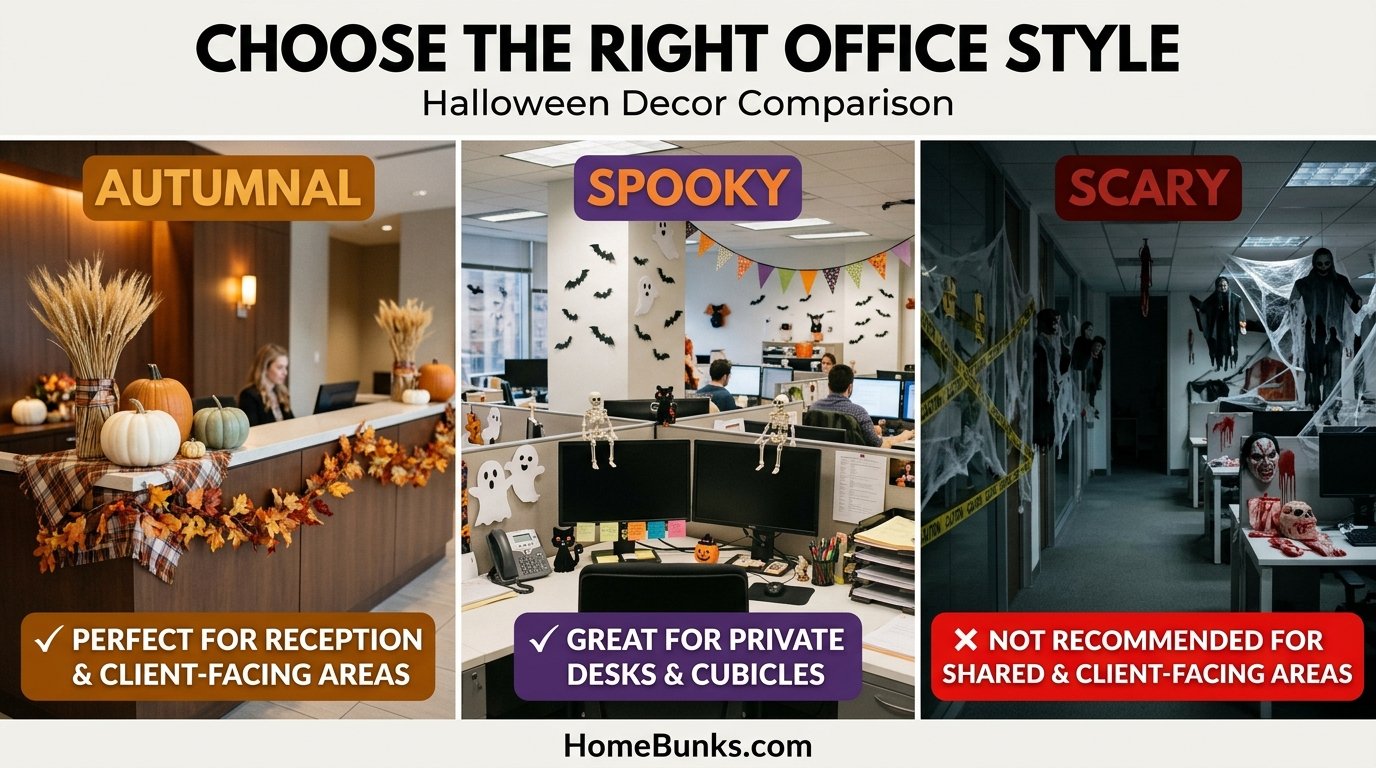
Frequently Asked Questions
1. Do I need permission to decorate my desk for Halloween?
In most workplaces, yes, or at least a quick check first. Ask your manager or HR before decorating shared or visible space, and follow any written seasonal policy. A short email naming what you plan, where it goes and when it comes down prevents almost every removal order.
2. What Halloween decor is safe on a cubicle wall?
Light, flat and removable pieces: paper bats, cardstock garlands and banners fixed with removable strips or clips that suit fabric panels. Keep everything inside your own panel line, off the top rail where sprinklers and lights sit, and out of your neighbour’s sightline.
3. Can I use real candles or a lit jack-o-lantern at work?
No. Treat open flame as banned in offices even where nobody has said so in writing: buildings, insurers and fire guidance all push the same way. NFPA Halloween guidance directs battery operated candles in jack-o-lanterns, so the office version of the rule is flameless only.
4. Are fog machines allowed for an office Halloween party?
Usually no, and ask facilities first. Fog can trigger smoke alarms, cut visibility on exit routes and bother colleagues with asthma or scent sensitivity. OSHA exit route rules require safeguards such as alarms to stay in proper working order, which is why most building managers refuse fog outright.
5. How gory can office Halloween decor be?
Keep client facing and shared zones at spooky or autumnal, never gore: no fake blood, body parts, crime scenes or weapons. SHRM guidance stresses voluntary participation, appropriateness and cultural sensitivity. Stronger themes, if allowed at all, belong in a closed contest cubicle away from visitors.
6. What is the autumnal fallback if Halloween themes are not welcome?
Swap characters for season: pumpkins without faces, leaves, wheat, plaid, amber light and harvest signage. It keeps the October refresh, drops every religious, gore and scare objection, and still reads professional in photos. Reception areas run this register by default on this page’s system.
7. How do I handle colleagues who do not celebrate Halloween?
Make participation voluntary, keep shared zones mild, and never decorate someone else’s desk or a surface they cannot avoid. SHRM advises respecting personal and religious reasons for opting out and supporting non participants equally. A fall themed shared display plus opt in desk decor is the standard compromise.
8. What are the rules for scented Halloween items at work?
Default to scent free. Scented candles, sprays, potpourri and strongly spiced food are common migraine and allergy triggers, and many workplaces run scent free policies year round. Keep any scented item inside a closed private office only, and only if policy allows it.
9. How should candy and potluck food be handled at the office?
Label everything with ingredients and common allergens, keep food in the break room rather than at desks, and never pressure anyone to eat. Allergen labelled dishes are a repeat failure point in workplace party checklists. Individually wrapped candy in a shared bowl is the lowest risk default.
10. Can decorations cover windows, doors or exit signs?
Never cover exit signs, alarm pulls, extinguishers, sprinklers or detectors, and never narrow a doorway or corridor. OSHA 29 CFR 1910.37 requires exit routes free and unobstructed and exit doors free of obscuring decorations. Window clings on ordinary office glass are fine; anything on an exit route is not.
11. How much clearance do decorations need from sprinklers and lights?
Nothing hangs from sprinkler heads or pipes, nothing drapes over lights or heaters, and paper stays away from heat. NFPA guidance warns that dried flowers, cornstalks and crepe paper are highly flammable near open flames and heat sources including light bulbs and heaters.
12. Are string lights allowed in a cubicle?
Often yes, with conditions: battery operated, or plugged directly into an approved outlet or power strip, undamaged, and switched off at close. Illinois OSHA holiday guidance warns against daisy chained extension cords, cords through doorways or ceilings, and cords under rugs. Mains sets left on overnight are the version facilities removes.
13. When should office Halloween decor go up and come down?
A practical window is mid October up, down within one to two working days after October 31, or by the teardown date your manager sets. In 2027 Halloween falls on Sunday, October 31, so offices celebrate Friday, October 29 and clear shared zones that day or on Monday, November 1.
14. Who pays for office Halloween decor?
Whoever the plan says, agreed in advance: desk items are normally self funded, shared zone displays come from a team or office budget, and contest builds follow contest rules. US 2026 retail strands run from under 10 dollars for single desk pieces to 20 to 40 dollars for a styled cubicle kit, per retailer guides, not as an average.
15. How do I decorate a reception desk clients see?
Use the mildest register: autumnal or elegant spooky, low profile, nothing blocking the sign in surface, phones or visitor sightlines, and nothing a client must touch or walk through. Ranking guides style reception as a console vignette rather than a scene, which matches the permission logic exactly.
16. What works in a conference room that still has meetings?
Table centre only: a low runner, flameless votives and one centrepiece that leaves table ends, screen sightlines and cable paths clear, and lifts off in one move before a client call. Avoid wall to wall themes, hanging items over chairs, and anything appearing behind a presenter on camera.
17. How do remote and hybrid staff join office Halloween decor?
Give them a parallel surface: a styled shelf or wall section behind the camera, a seasonal virtual background supplied by the team, and a photo thread where office and home desks are judged together. Home guidance stays at background depth here; the full home office room belongs to residential guides.
18. What makes a good video call Halloween background at work?
One shelf, three objects maximum, nothing moving, flashing or backlit, and nothing gory behind your head in a client call. A small pumpkin, a dark book stack and one bat or ghost at shoulder height reads seasonal on camera and still looks deliberate in a screenshot. Test it before the first meeting.
19. How should a cubicle decorating contest be judged fairly?
Publish criteria before anyone builds: zone compliance, creativity, craft and teardown readiness, with disqualification for blocked exits, open flame, gore in shared view or wall damage. Judging inside work hours, with an opt out and a fall theme category, keeps the contest inclusive for everyone.
20. Can I decorate a shared or hot desk?
Only with items that leave with you, or that the whole desk group agreed in writing. Hot desking kills fixed displays: choose one portable piece, photograph the agreed layout if your team rotates, and never leave food, scent or personal items on a desk someone else books tomorrow.
21. What Halloween decor works in a medical or client care office?
The strictest version of the system: autumnal only, no latex balloons where allergy policy bans them, no small parts in waiting areas, no scent, nothing on clinical surfaces, and infection control beats theme every time. A patient safety or facilities officer’s word replaces every general rule here.
22. How do I decorate a break room without creating a mess?
Keep food zones wipeable and decor off prep surfaces: a tablecloth, one centrepiece, a labelled candy or potluck station and wall pieces above splash height. Crepe paper and cobweb material shed into food and block cupboard doors, so they belong on the far wall, not over the counter.
23. Are real pumpkins allowed at work?
Usually for a short window, uncarved, on a tray, and removed before they soften; carved pumpkins rot, smell and attract pests in heated offices. Many teams swap to faux pumpkins for reception and keep one real pumpkin for a carving contest day only. Check cleaning and pest rules with facilities if food is nearby.
24. What should a permission email to my manager actually say?
Four lines: what you want to put up, exactly which zone, the dates up and down, and the safety lines you will follow: flameless, exits clear, removable fixings, scent free. HR and facilities guidance consistently rewards specifics; a vague ask for spooky stuff invites a vague no.
25. Can my employer make me remove office Halloween decor?
Yes. Desks and walls are employer property in most workplaces, and managers can require removal for policy, safety, client or complaint reasons; this is general information, not legal advice. Written permission, zone compliance and a teardown date make removal unlikely, and painless if it comes.
26. Is Halloween decor a religious issue at work?
It can be, in both directions: some colleagues object to Halloween themes, others object to being excluded. HR guidance answers with voluntary participation, mild shared zones, fall alternatives and no mockery of religious or cultural identities in decor or costumes. Treat sensitivity as a design input, not a debate.
27. What decor is safe around office electronics?
Nothing draped over monitors, vents, printers or chargers, no liquids or real pumpkin moisture near cables, and no adhesive on screens or painted equipment. Heat and airflow are the issue: the NFPA heat source logic applies to office kit too, and IT removes anything that traps heat or drips.
28. How do I store office Halloween decor for next year?
One labelled tote per zone, flat paper pieces in a folder, battery items with batteries removed, and a photo of each finished display taped inside the lid. Store in the supply cupboard only with facilities agreement; otherwise the kit lives at home. NRF 2026 reports 73 percent of shoppers repurpose about half or more of their decor, a general strand, not an office figure.
29. What are quick Halloween desk ideas under 10 dollars?
US 2026 retail strands put single pieces under 10 dollars: a ghost pen holder, a small tabletop sign, one mini pumpkin or a paper bat set, per FestTree picks. One functional piece plus one flat piece is the standard desk formula the better lists converge on.
30. Can decorations hang from the ceiling in an office?
Ask facilities first and expect conditions: nothing on sprinklers, detectors, cameras or lights, nothing low enough to touch heads or block signs, and fixings that leave no marks. Retail top picks include ceiling swirls, but ranking pages rarely check the building layer, which is exactly where displays get removed.
31. What if a client visit clashes with our Halloween display?
Build the teardown into the plan: shared zone pieces that lift off in five minutes, a stored tote nearby, and a named owner for the reset. Client facing teams often run autumnal only during visit weeks and save contest builds for internal floors; that is a scheduling decision, not a creativity loss.
32. How do I decorate an office door for Halloween?
Keep the door closable, the handle and closer clear, the vision panel uncovered where your building requires it, and the swing path empty. Flat paper or cling designs beat wreaths and hanging props on office doors, and exit route doors fall under the rule that exit doors stay free of obscuring decorations.
33. Are Halloween lights and inflatables suitable indoors at work?
Small battery lights, yes, with the cord rules followed. Indoor inflatables are almost always a no: they block routes, need constant power and fans, shed noise, and read as outdoor pieces. Few ranking pages separate the two, which is why inflatable photos keep misleading office readers.
34. What is the difference between spooky, scary and autumnal office decor?
Spooky uses Halloween characters and symbols without threat; scary adds jump, gore or horror references; autumnal uses only the season. Offices run spooky at desks, autumnal in client zones, and scary almost nowhere. Naming the three registers is the fastest way to agree a display with a manager.
35. How do I keep Halloween decor from hurting productivity?
Cap the build window, keep work surfaces fully usable, ban sound, motion and flashing items in open plan areas, and finish teardown on time. Agreeing the limits before the build, inside the permission ask, is the half most guides miss; apologising afterwards is the expensive version.
36. Can I use leftover home Halloween decor at the office?
Some of it: flat, clean, flameless, scent free pieces in good condition. Leave behind real candles, outdoor inflatables, strobe lights, gore props, scented items and anything too large for your zone. The residential cluster pages own the home displays those pieces came from; this page only decides what crosses into work.
37. What Halloween decor suits a small office with no cubicles?
One shared zone done well beats five desks done separately: a reception or kitchen vignette, a team photo backdrop that packs flat, and optional single desk pieces. Small offices feel crowding faster, so the zone map shrinks to two zones and the storage plan matters more, not less.
38. How should managers set Halloween decor rules for a team?
Publish a short written note covering zones, registers, banned items (flame, fog, gore in shared view), food labelling, dates and teardown owner, and say plainly that joining in is voluntary. SHRM guidance on clear, early, specific guidelines for workplace Halloween is the model; general information only, not legal advice.
39. Do Halloween office decorations affect customers or patients?
Yes, which is why the zone system grades displays by audience: internal floors can run spookier than any space a customer enters. Party and retail guides style lobbies like living rooms; employer and HR sources style them like workplaces. When in doubt, the visitor experience wins.
40. What are the best reusable office Halloween pieces to buy once?
A felt or fabric banner, flat paper or vinyl bat sets in a folder, faux pumpkins, battery votives and one tote. They survive storage, pass most policies and rebuild in minutes. Price strands stay per retailer and dated, under 10 to 20 dollars per piece in US 2026 retail picks; no fetched source publishes an average office spend.
41. How do I photograph and share our office display safely?
Photograph the decor, not colleagues who opted out, client screens, documents or security features, and follow your employer’s social media policy before posting. Contest photo threads work best on internal channels, with names included only where people consented.
42. What is the fastest office Halloween setup that still looks planned?
The 15 minute zone kit: one flat wall piece, one desk or table piece, one flameless light, all in one palette, inside one zone, with the tote stored ready for teardown. Small contained pieces are where the best desk lists converge; the permission line and teardown date are what make it repeatable.
Conclusion
Halloween office decor works when it is treated as a workplace decision before a decorating one: permission from manager, HR and building, then six zones, three registers, and a teardown date agreed before anything goes up.
Start with the four line email this week, while October 2027 is still far away. For the home side of the season, the HomeBunks Halloween cluster starts at the house hub linked above and covers every room this page deliberately left alone.