
Emerald green bathroom ideas fail in the gap between the photograph and the paint store: the rooms look effortless, and nothing in them tells you the color’s name, how dark it really is, or how much of the room it covered.
This page closes that gap.
Every idea below sits on a coverage ladder, from emerald towels to a fully drenched powder room, and each level carries its specification: the exact paint (Benjamin Moore makes a color literally named Emerald, 2039-20, LRV around 17), the tile that produces the shimmer, and the pairing rules that keep the jewel tone warm instead of cold.
One fact governs everything that follows. LRV 17 means the color reflects roughly a sixth of the light it receives, so an emerald bathroom is a lighting project wearing a color.
Plan the light and the color behaves like the photographs; skip it and the same color reads as a cave.
Quick Answers: The Emerald Rules in One Table
|
Decision |
The rule |
|---|---|
|
Metal |
Warm metals only: brass, gold, champagne bronze. Chrome clashes; matte black is the modern exception |
|
Tile finish |
Glossy on walls (it returns light), matte on floors (grip and forgiveness) |
|
Light |
Warm bulbs, 2700 to 3000K, layered at the mirror; a single dim ceiling light is the one failing setup |
|
White |
Crisp warm white: Chantilly Lace OC-65 is Benjamin Moore’s own suggested partner for its Emerald |
|
Green discipline |
One dominant green per room; other greens enter only as quiet textiles |
|
First move |
Paint the vanity emerald and change its hardware to brass: the designer formula at the smallest surface |
The Coverage Ladder: Seven Ways In
Level 1: textiles and accents only
Emerald towels, a bath mat, plant pots and artwork over an existing neutral bathroom. Zero commitment, and the honest test of whether you enjoy living with the color at all.
In a beige or white room the accents read as a deliberate jewel note; our warm beige bathroom ideas shows the warm neutral base this level usually starts from.
Level 2: the painted vanity
The highest leverage move in this entire color family: paint the vanity emerald, fit brass hardware, keep everything else.
It borrows the exact formula of the designer rooms (deep green cabinetry, warm metal, white counter) at the smallest surface in the room, and it reverses in a weekend if tastes change.
Cabinet paint in satin, a tinted primer under a color this deep, and two patient coats.
Level 3: one emerald wall
The wall behind the vanity, painted emerald, with the mirror and sconces mounted on it.
This is the level most primary bathrooms should stop at: the color is the backdrop for the daily routine, mirrors multiply it, and the remaining walls stay light enough for grooming.
Our mirror over pedestal sink ideas covers the sink and mirror arrangements that sit on such a wall.
Level 4: wainscot height emerald
Tile or paint to wainscot height (roughly a third to halfway up), lighter wall above. The traditional structure: it suits long narrow bathrooms, gives the color a horizontal architecture, and keeps the upper room bright.
Emerald beadboard below white walls is the cottage version; emerald tile below plaster is the tailored one.
Level 5: the emerald shower
The jewel box inside a calmer room: emerald tile floor to ceiling in the shower, glass keeping it visible, the rest of the bathroom light.
This is where zellige earns its price, because a full shower of handmade glossy tile moves with the light all day. Expect the squeegee habit; dark glossy tile shows water honestly.
Level 6: full tile or full paint
All walls emerald, usually in a powder room or guest bath where immersion is the point. With tile, this is the Moroccan spa version; with paint, the moody traditional version.
Our green and gold bathroom ideas explores this level’s natural partner palette, green carried by gold at full strength.
Level 7: the total drench
Walls, trim and ceiling in one emerald, warm metal and mirror glow inside it. Maximalist, deliberate, and best kept to powder rooms, where the joke and the luxury are the same thing.
Choose this level on purpose or not at all; it is the only rung that punishes hesitation.
The Emerald Paint Table
|
Paint |
Brand and code |
LRV |
Character |
Best use here |
|---|---|---|---|---|
|
Emerald |
Benjamin Moore 2039-20 |
About 17 |
The true jewel: saturated, slight blue undertone |
Vanities, accent walls, powder rooms |
|
Hunter Green |
Benjamin Moore 2041-10 |
Very low (deep) |
Traditional dark green, classic depth |
Traditional baths, wainscot, cabinetry |
|
Rookwood Dark Green |
Sherwin-Williams (verify code before ordering) |
Low |
Historic deep green used across designer emerald rooms |
Walls in traditional and Deco schemes |
|
Chantilly Lace |
Benjamin Moore OC-65 |
High (crisp white) |
The white partner BM itself suggests beside its Emerald |
Trim, ceilings, fixtures’ painted company |
|
Edgecomb Gray |
Benjamin Moore HC-173 |
Mid |
Warm greige bridge when full white feels stark |
Adjacent walls in open plans |
The paint reference for Benjamin Moore Emerald 2039-20 lists the 2039-20 data (hex, LRV, undertones) and the brand’s suggested pairings, and it carries the warning this table repeats: cross brand “matches” are approximations.
A rival brand’s nearest emerald is a different color that happens to be close; sample the actual paint you will buy.
Two naming traps deserve print. Sherwin-Williams sells a paint line called Emerald (a premium interior paint with an antimicrobial film) that has nothing to do with the emerald color.
And deep green codes get miscopied between blogs: one widely repeated Sherwin-Williams emerald room credit appears with two different codes in different sources. Order from the brand’s own listing, never from a blog’s caption.
For bathrooms specifically, the paint product matters as much as the color: a bathroom grade formula (Benjamin Moore’s Aura Bath and Spa is the matte reference; satin or semi gloss in standard lines) resists the moisture that deep colors show mercilessly, and a tinted primer keeps a saturated green from needing a third and fourth coat.
Emerald Tile: Zellige, Subway and the Gloss Rule
Zellige is the material behind the most shared emerald bathrooms: handmade Moroccan clay tile, each piece glazed individually, so no two tiles match and the wall shifts as you move past it.
The zellige maker’s emerald tile documentation states the craft plainly, natural clay from the Fez region with a hand applied glossy emerald glaze, and names its partners: brass and gold fittings, white marble, dark wood.
The variation is not a defect to inspect away; it is the entire effect, and it cannot be had from a uniform tile at any price.
The accessible alternative with a similar soul is emerald ceramic with a handcrafted style finish: a documented emerald bathroom roundup documents a bathroom built on Bedrosians’ Cloé tile in Green with champagne bronze hardware, a combination designers repeat because the tile’s soft variation flatters the metal.
Below that, standard glossy emerald subway tile delivers the color and the shine at commodity prices, with the layout doing the design work.
Layouts, in order of effect: vertical stacked subway raises the ceiling visually (the trick for standard 8 foot baths); herringbone adds movement for floors and feature walls; scallop shapes lean Moroccan; hexagon and penny belong on floors and in niches; large glossy squares read modern and minimize grout.
One pattern per room: emerald’s color is already the second idea.
The gloss rule bears repeating because it decides the room: glossy finishes on walls return light to an LRV starved color; matte finishes on floors give grip and hide the water spots that dark glossy surfaces display so honestly.
The Pairing Rulebook: Metals, Marble, Wood and White
Metals. Warm metals complete emerald because the color leans cool jewel (a slight blue undertone) and needs warming: brass, gold, champagne bronze and copper all qualify, and unlacquered brass adds a living patina that deepens the traditional and Moroccan versions. Matte black is the sanctioned modern alternative. Chrome is the clash: cool, blue gray and clinical against emerald, it cheapens the palette in a way designers call out by name, and chrome faucets beside brass hardware in one sightline is the specific accident to avoid. our black and beige bathroom ideas shows how black behaves as a grounding neutral when a scheme wants dark without green.
If chrome is already installed and staying, the rescue is proportion: keep it to the faucet set, then warm everything around it (wood vanity top or shelves, brass in the mirror frame and lighting, warm bulbs) until chrome is a minor note rather than the room’s voice.
Marble. White marble is emerald’s structural partner: its gray and gold veining bridges the green and the brass, which is why marble topped vanities anchor nearly every high end emerald room. Honed finishes soften; polished lean formal.
Marble look porcelain and quartz print the same bridge without sealing and etching duties, and in showers they are usually the wiser buy.
Wood. Walnut for depth, white oak for lightness: wood is the warmth layer that keeps tile and paint from reading cold, as a vanity, shelving or a simple stool.
Our pink and green bathroom ideas demonstrates green’s temperature management from the other direction, pairing green with pink’s built in warmth.
White. Fixtures stay white almost by law in this palette; for painted whites, crisp and warm beats blue and stark.
The test is always in the room: a white that looks clean beside emerald at noon and at eight in the evening, under your own bulbs, is the right white, whatever its name.
Floors. Under emerald walls, floors go light (pale marble looks, light terrazzo) or classically patterned (black and white vintage tile).
The inversion, an emerald floor under light walls, is covered by the same contrast logic, and our guide to bathrooms with dark floors works through the dark floor version of the balance problem.
Two darks together, walls and floor, is the combination that needs exceptional light to survive.
Lighting a Dark Green Bathroom
Treat lighting as a layer cake, because at LRV 17 the room cannot borrow brightness from its walls:
- Ambient: a ceiling fixture bright enough to be the room’s daylight substitute, on a dimmer for evening.
- Task: sconces or a lit mirror at face height on both sides of the mirror; this is the layer that decides whether the room works for shaving and makeup.
- Glow: the warm metal and glossy tile are reflectors, not sources; they multiply the two layers above, which is why they cannot rescue a single bulb room.
Bulb temperature stays warm, 2700 to 3000K: cooler light pushes emerald toward teal black and flatters nobody at a mirror.
In a windowless bathroom this stack is not an upgrade path, it is the entry fee, and powder rooms (no grooming standard to meet) get the most forgiveness.
North facing rooms get the sternest sampling advice in this color family: cool daylight strips emerald’s warmth, so judge the paint swatch morning and evening, and lean harder on wood and warm metal in the pairings.
Emerald and Its Neighbors: Forest, Hunter and Sage
|
Green |
Character |
Where it wins |
|---|---|---|
|
Emerald |
Saturated jewel, blue undertone, LRV in the teens |
Powder rooms, guest baths, confident statements |
|
Forest |
Deeper, grayer, woodsy |
Large primary baths, modern moody schemes |
|
Hunter |
Traditional dark green, classic depth |
Period homes, traditional fixtures |
|
Sage |
Soft green gray neutral |
Low light primaries, resale caution, calm schemes |
Our sage green bathroom ideas covers the sage end of this family, the green that behaves like a neutral.
The two also layer deliberately (emerald dominant, sage quiet in textiles), and our blue and white bathroom ideas shows how the site’s other cool color family handles the same temperature questions with white.
Choose emerald when the room’s job is impact; choose its neighbors when the job is calm at 7 a.m. every day.
Small Rooms, Kids Baths and the Maintenance Truth
Small is emerald’s home turf provided the light stack is real: powder rooms and guest baths are where the jewel box effect lives, and our double vanity ideas for small bathrooms handles the layout side of small bathrooms that need to work harder.
In a small primary bath, levels 2 to 5 of the ladder (vanity, one wall, wainscot, shower) beat full coverage for daily use.
Kids change the styling, not the color: emerald with white fixtures, a patterned floor and mustard towels is a documented designer formula for family baths, and glossy ceramic in this depth hides the visual noise of a working bathroom better than any pale scheme.
The full color tour of the house’s calmer rooms runs through our beige bathroom ideas and our cream bathroom ideas, the palettes emerald rooms usually sit beside.
The maintenance truth, before any tile is ordered: dark glossy surfaces show water spots and soap film as light marks, so an emerald shower asks for a squeegee habit or a textured finish; light grout beside dark tile shows staining first; and handmade tile’s variation means replacement pieces never match exactly, so order overage and keep the spares.
None of these end the project. All of them belong in the decision.
Keep Reading on HomeBunks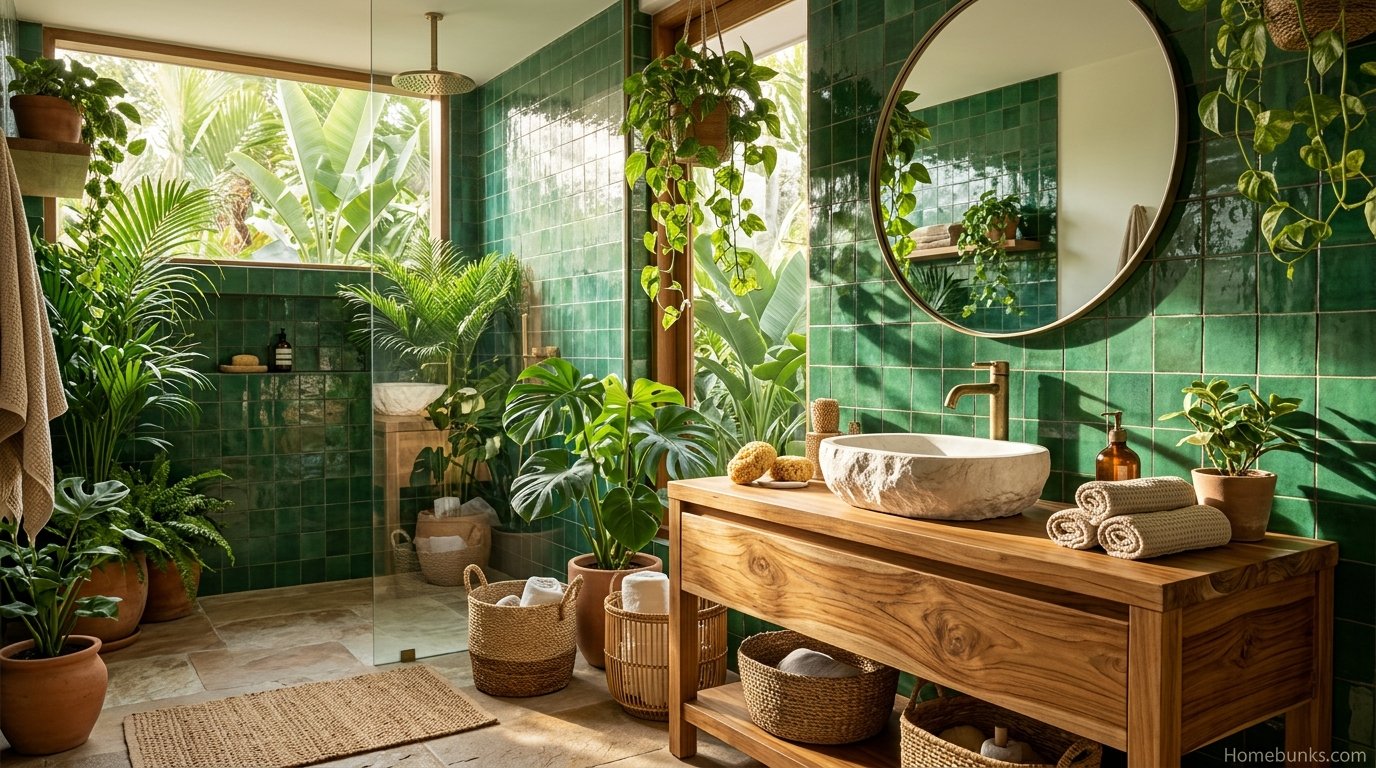
This page is the jewel anchor of the bathroom color cluster at HomeBunks: emerald for impact, its green relatives for calm, and the neutrals for the rooms in between.
Stay in the greens with our sage green bathroom ideas and the metallic version in our green and gold bathroom ideas, or tour the two tone rooms in our pink and green bathroom ideas, our black and white bathroom ideas and our blue and white bathroom ideas.
Balance dark choices with our guide to bathrooms with dark floors and the deep neutral scheme in our black and beige bathroom ideas, then warm the rest of the house with our warm beige bathroom ideas, our beige bathroom ideas and our cream bathroom ideas.
Frequently Asked Questions
What colors go with emerald green in a bathroom?
Warm whites and crisp white fixtures, veined white marble, natural wood (walnut and oak), and warm metals are emerald’s proven partners. Black works as a sharp accent; blush pink or mustard are the deliberate contrast accents in designer rooms.
The failures are cool grays fighting the richness and other saturated greens competing beside it; one dominant green is the working rule.
Does emerald green make a small bathroom look smaller?
Deep colors absorb light, so emerald can make a small room feel enclosed, but in powder rooms and guest baths that enclosure is the point: the jewel box effect reads intentional and luxurious rather than cramped.
Glossy tile, good lighting, a light floor and a crisp white ceiling keep it cocooning instead of cave like. In a primary bath used for makeup, judge it by the lighting plan, not the square footage.
What is the best emerald green paint color for a bathroom?
The literal answer is Benjamin Moore Emerald 2039-20, a saturated jewel green with a slight blue undertone and an LRV around 17, firmly dramatic territory (always cite brand and code together, names repeat across brands).
Deeper alternatives in designer use include Benjamin Moore Hunter Green 2041-10 and Sherwin-Williams Rookwood Dark Green. Sample any of them on the wall in the room’s own light first.
What metal finish goes best with emerald green?
Warm metals: brass (lacquered or unlacquered), gold and champagne bronze are the consensus pairing across designer sources, because emerald is a warm leaning jewel tone and warm metal completes it. Matte black is the accepted modern alternative.
Cool chrome is the finish designers repeatedly warn against beside emerald; it reads cold and cheapens the palette, and mixing chrome with brass is the specific clash to avoid.
Should emerald green tile be glossy or matte?
Glossy on walls, matte on floors is the standard split. Gloss reflects light back into a dark colored room, which is why the famous emerald zellige and ceramic looks are glossy, and the handmade variation in zellige multiplies that shimmer.
Floors need the grip and the forgiveness of matte: matte hides water spots better and is safer underfoot in a wet room.
What is zellige tile and why is it used for emerald bathrooms?
Zellige is handmade Moroccan clay tile, each piece individually glazed, so no two tiles are identical and the surface shifts in color and reflection as light moves.
In emerald it produces the jewel wall effect that flat ceramic cannot imitate, and sellers note it pairs with brass and gold fittings, white marble and dark wood.
The trade offs are price, installation skill, and variation you must genuinely like, since consistency is not available at any price.
Can I use emerald green in a bathroom with no window?
Yes, with a lighting plan doing the window’s job: layered light (ceiling plus sconces at the mirror), warm bulbs around 2700 to 3000K so the green reads rich rather than cold, and glossy surfaces to bounce it.
Emerald at LRV around 17 reflects little light of its own, so a single dim ceiling fixture is the one setup that fails. Powder rooms without windows are the most common emerald rooms of all.
What floor goes with emerald green bathroom walls?
Light floors balance dark walls: white or pale marble and marble look porcelain, light terrazzo, pale wood tones, or classic black and white patterned tile for a vintage note.
An emerald floor is the bolder inversion (light walls above), and all dark floors under all dark walls is the combination that tips most rooms from moody to murky unless the lighting is exceptional.
What color should the vanity be in an emerald green bathroom?
Three proven directions: natural wood (walnut or white oak) for warmth, which is the designer default against emerald tile; white for crisp contrast and a traditional read; or emerald itself when the walls are neutral, making the vanity the room’s single green statement.
Black vanities work in modern schemes with matte black hardware. What fails is a second, different green on the vanity beside green walls.
What color grout works with emerald green tile?
Match the intent: a grout close to the tile color makes the wall read as one jewel surface (the zellige look); a light grout draws the grid and suits subway layouts where the pattern is the feature; dark grout with emerald tile deepens the mood and hides staining best.
In showers, grout color consistency matters more than the choice itself, since light grouts show soap and mineral staining fastest.
Is emerald green a timeless choice or a trend?
Emerald is a recurring classic with trend surges: Pantone named Emerald (17-5641) its Color of the Year in 2013, and jewel tone bathrooms cycle back roughly with each maximalist wave, the current one included.
The timelessness test is application: emerald paint and a vanity are reversible in a weekend; emerald tile is a decade commitment, which is why tile versions should be chosen on love of the material, not on the trend calendar.
How do I add emerald green to a bathroom without renovating?
In ascending commitment: emerald towels and a bath mat, a painted mirror frame or stool, plants in emerald pots, artwork with the color, then the two real levers, painting the vanity and painting one wall.
A vanity repaint in emerald with brass hardware is the highest impact weekend change available and the one most before and after features are built on.
What white paint pairs with emerald green?
A warm to neutral crisp white keeps emerald rich: Benjamin Moore Chantilly Lace OC-65 is the pairing paint sources themselves suggest alongside Emerald 2039-20.
Very blue whites can make emerald look muddy by contrast, and creamy yellows can push it toward olive; test the trim, ceiling and fixture whites together in the room rather than trusting chips separately.
What lighting temperature suits an emerald bathroom?
Warm light, around 2700K to 3000K, is the consensus for jewel tones: it deepens emerald and flatters skin at the mirror. Cool daylight bulbs (4000K and up) push emerald toward teal black and make the room feel clinical.
Whatever the temperature, brightness matters more in a dark room: layered fixtures at the mirror are non negotiable for a grooming bathroom.
Does emerald green work with marble?
It is the classic pairing: white marble’s gray and gold veining bridges emerald and brass, which is why marble topped vanities appear in nearly every high end emerald room. Honed marble softens the scheme; polished marble leans formal.
Marble look porcelain delivers the same bridge at lower cost and maintenance, and in showers it avoids natural stone’s sealing and etching upkeep.
Can emerald green work in a kids bathroom?
Yes, and cheerfully: emerald reads playful with white fixtures, patterned floors and bright towel colors (mustard is a designer favorite for exactly this), and its depth hides the visual noise of a family bathroom better than pale colors do.
Glossy ceramic tile wipes clean easily. The adult jewel box and the kids bathroom are the same color at different styling volumes.
What about an emerald green ceiling or color drenching?
Color drenching (walls, trim and sometimes ceiling in one emerald) is the maximalist version and it works best in powder rooms, where total immersion is the joke and the luxury at once.
In larger baths, drenching the walls while keeping the ceiling crisp white preserves height. A painted emerald ceiling over neutral walls is the rarer inversion; it demands strong lighting below it.
How much does an emerald green bathroom cost?
By coverage level: towels plus paint for a vanity or one wall runs to a few hundred dollars in materials; a painted four wall powder room with new hardware and lighting sits in the low thousands; emerald tile in a shower or full room with professional installation is a renovation budget, with handmade zellige at the top of the tile price range.
The ladder in this article exists so the budget levels stay visible.
What patterns suit emerald green tile layouts?
Vertical stacked subway raises the ceiling visually (a designer favorite in standard baths); herringbone adds movement on floors and feature walls; hexagon and penny formats suit floors and niches; scallop (fish scale) shapes lean Moroccan and spa.
Large glossy squares read modern. The pattern should be one idea per room: emerald’s color is already the second idea.
Are dark green tiles hard to keep clean?
They show two things honestly: water spots and soap residue read lighter on dark glossy surfaces, so shower walls in emerald need a squeegee habit or a matte textured finish to stay pristine; and light grout beside dark tile shows staining first.
Neither is a deal breaker, but both belong in the decision, especially for a hard water household choosing a full emerald shower.
What is the difference between emerald, forest and hunter green bathrooms?
Temperature and depth. Emerald is the saturated jewel: blue leaning, vivid, LRV in the teens for true versions. Forest green is deeper and grayer, more muted and woodsy.
Hunter green is the traditional dark green (Benjamin Moore’s 2041-10) with a classic, slightly yellow leaning depth. They photograph similarly and behave differently in north facing light, which is why samples matter more in this family than in any other.
Can I mix emerald green with navy or other jewel tones?
Deliberately, yes, in maximalist schemes: emerald with sapphire tile in a shower is a documented designer combination, and emerald with blush or burgundy accents is a classic jewel palette.
The rule is proportion: one dominant jewel, the other as accent, with metals and whites holding the structure. Equal measures of two saturated colors is where jewel schemes turn chaotic.
What style is an emerald green bathroom?
Emerald is a style chameleon with four native homes: Art Deco and Hollywood Regency (brass, marble, symmetry), Moroccan spa (zellige, scallops, warm wood and copper), traditional (hunter depths, white fixtures, classic tile), and modern moody (matte black hardware, large format tile, minimal grout lines).
The color does not choose the style; the fixtures and tile shape do.
Should I paint all four walls emerald or just one?
Powder rooms and guest baths: all four, the immersion is the effect.
Primary baths: one or two walls (or tile in the shower plus a painted vanity wall) usually serves better, because daily grooming light matters and mirrors multiply whatever color surrounds them.
The halfway option, tile or paint to wainscot height with a lighter wall above, suits long narrow baths particularly well.
What towels and textiles work in an emerald bathroom?
White towels are the hotel answer and keep the room crisp; mustard and blush are the designer accent answers; black and white stripes lean traditional.
Because emerald is deep, textiles are where the room’s lightness can be tuned seasonally without touching paint or tile, which is also the cheapest refresh the room will ever get.
Is emerald green good for resale?
Neutral bathrooms remain the safer resale play, but a well executed emerald powder room photographs as a feature rather than a flaw, and paint level emerald is a one weekend reversal for a seller who wants neutrality.
Tile level emerald is the commitment to weigh: it narrows the buyer pool to people who love it, while often making those buyers love the house more.
What paint finish is best for emerald in a bathroom?
Bathroom grade paint in satin or semi gloss for most walls, or a bathroom specific matte (Benjamin Moore Aura Bath and Spa is the category reference) where a flat look is wanted with moisture resistance.
Deep colors show every wall flaw and roller mark more than pale ones, so surface prep and a tinted primer matter as much as the sheen choice.
Can emerald green work with chrome fixtures I already have?
It can, with lowered expectations: chrome reads cool and clinical against emerald, and designer sources consistently steer to warm metals for this color.
If replacing fixtures is not in the budget, warm the room elsewhere (wood, warm lighting, brass in the mirror frame and accessories) so chrome is a minor note.
Do not mix chrome faucets with brass hardware in the same sightline; that specific mix reads as an accident.
What size tile suits a small emerald bathroom?
Both ends work for different reasons: small formats (subway, penny, hex) give handmade texture and forgiving grout grids; large format glossy tile minimizes grout lines and reflects more light per tile, reading calmer.
The middle sizes in matte finishes are the ones that most often disappoint in small dark rooms, offering neither shimmer nor scale.
How do I test emerald paint before committing?
On the wall, not the chip: paint a large swatch (or use a peel and stick sample) on two walls, and live with it through a full day and evening under the room’s actual bulbs.
Deep greens shift more between daylight and warm artificial light than any other family, and the LRV around 17 means the evening version is the true color in most bathrooms. Judge at the hour you actually use the room.
What countertop colors work with an emerald vanity?
White marble and marble look quartz are the default (bright surface over a deep cabinet), warm veined stones bridge to brass hardware, and black counters create the modern moody version.
Wood counters warm traditional schemes but need diligent sealing in a wet room. Avoid green veined stones that compete with the cabinet color; the counter should be a rest, not a rival.
Does emerald green suit a traditional bathroom?
It is arguably its original home: hunter and emerald depths with white porcelain fixtures, classic subway or hex tile, and brass or polished nickel is a period palette that predates the trend cycle by a century.
Traditional emerald rooms lean on symmetry, framed mirrors and classic shapes rather than on the color alone for effect.
Can I use emerald wallpaper instead of tile or paint?
Yes: an emerald botanical or geometric wallpaper above wainscoting or on all walls of a powder room delivers the color with pattern included, and vinyl or moisture rated papers suit bathrooms.
Keep it out of direct shower splash zones, run the exhaust fan faithfully, and treat seams in steamy full baths as the weak point; powder rooms are the safe and classic application.
What plants suit an emerald green bathroom?
Humidity loving greens on green is the layered look: ferns, pothos and philodendron against emerald walls, in white or brass pots for contrast. In a windowless emerald room, high quality faux plants do the visual job without the light problem.
Plants also soften tile heavy schemes, which is why they appear in nearly every styled emerald shower photograph.
What mirror shape works in an emerald bathroom?
Round and arched mirrors in brass or gold frames are the designer default: the curve relieves the room’s saturated rectangles and the warm frame repeats the fixture metal. Black framed mirrors suit the modern version.
Rectangular medicine cabinets in white or wood keep traditional rooms calm. The mirror is the largest reflective surface after the tile, so its frame metal matters disproportionately.
How do I keep an emerald bathroom from feeling cold?
Warmth is added in layers the color cannot supply: warm light (2700 to 3000K), warm metals, natural wood, and textiles with texture.
Emerald’s slight blue undertone is what reads cold in north facing or cool lit rooms; the countermeasures are all in the pairing layers, not in choosing a different green, unless the room also lacks any warm material, in which case a yellower forest green may serve better.
What is the cheapest emerald bathroom update with real impact?
Painting the vanity emerald and swapping its hardware to brass: a quart of cabinet paint, new pulls, and a weekend.
It borrows the exact formula of the designer rooms (deep green cabinetry, warm metal) at the smallest possible surface area, and it is reversible in a way tile never is.
Can emerald green tile go in the shower only?
It is one of the strongest applications: the shower becomes the jewel box inside a calmer room, especially with the tile running floor to ceiling and the glass keeping it visible.
Pair with a light bathroom around it, repeat the brass in the shower fixtures and the vanity hardware to tie the zones together, and expect the squeegee habit dark glossy tile asks for.
What ceiling color suits emerald walls?
Crisp white is the default for height and light bounce. In drenched powder rooms, the emerald itself continues onto the ceiling for total immersion.
A pale warm tint drawn from the room’s marble or wood is the subtle third option in large baths. Black ceilings appear in maximalist versions and belong to rooms with exceptional lighting.
How does emerald behave in north facing light?
Cooler and deeper: north light strips warmth, so emerald leans teal and darker, which some rooms wear beautifully and others find cold. The fixes are warm bulbs for evening balance and warm materials beside the color.
If a north facing primary bath must feel warm at 7 a.m., sample the exact paint through a full day before deciding, and consider forest green’s gray warmth as the alternative.
Emerald green vs sage green bathroom: which should I choose?
Different jobs: sage is a soft neutral that behaves like a warm gray green and suits primary baths, low light and resale caution; emerald is a statement jewel for powder rooms, guest baths and confident primary suites.
They also pair well together (emerald dominant, sage in textiles) in the layered two green schemes designers use, provided emerald clearly leads.
What window treatments suit an emerald bathroom?
Privacy with softness: white or natural linen cafe curtains and Roman shades keep light while adding the textile warmth the color needs; woven wood shades deepen the spa and Moroccan versions.
In tile drenched showers, no treatment at all (frosted glass) is cleaner. Match the treatment’s temperature to the room: warm whites and naturals, not blue grays.
Conclusion
Emerald green bathroom ideas work when they are treated as a specification rather than a mood: one dominant jewel green, chosen from a named paint with its LRV understood or a tile whose variation you genuinely love, carried at exactly the coverage level your budget and your light can support.
Warm the metal, gloss the walls and matte the floors, light the room in warm layers, and let white, marble and wood do their bridging work.
Do that, and emerald stops being the risky color in the fan deck and becomes what the photographs promised: the smallest luxury in the house.


