
Emerald green kitchen ideas hide a naming problem that quietly ruins more kitchens than any paint mistake. The word emerald is used for three different colors.
One emerald is the saturated jewel tone of the photographs. Another is a blue leaning deep green that drifts teal. The third is a black based hunter green that reads emerald at noon and near black at dinner.
Pick the wrong family and every later choice fights you. The metal looks cold, the marble looks gray, and the room reads forest shadow instead of jewel.
This page names your emerald first. Then it runs the temperature system every successful emerald kitchen obeys: warm metals only, a 60 percent warm neutral field, and light funded well enough to keep the green green.
You will get the paint ladder with honest LRV bands, the marble veining ladder, three worked schemes, and the door test that settles every emerald argument in two days.
The Three Emeralds: Name Yours First
|
Emerald family |
Character |
LRV band |
Reads as |
Best for |
|---|---|---|---|---|
|
True jewel emerald |
saturated, clean, gemstone bright |
about 10 to 15 |
unmistakably green, day and night |
modern glam, islands, statement kitchens |
|
Blue leaning deep green |
deep green with a blue cast |
about 6 to 10 |
emerald in sun, teal in cool light |
contemporary rooms with strong daylight |
|
Black based hunter green |
green carried on a black base |
about 4 to 6.5 |
emerald by day, near black by night |
classic, tailored, farmhouse kitchens |
True jewel emerald is what the search photographs promise. It carries the highest pigment load and stays green after dark, which is why it anchors the glam schemes.
Blue leaning emeralds are the surprise family. Beside cool light or gray stone they slide toward teal, which delights some owners and betrays others.
Black based hunter greens are the professionals’ emerald. They deliver depth and lineage, and they ask the most of your lighting in return.
One label warning before the ladder: a well known muted, smoky green is sold in top ranking guides under the emerald label. It is a fine color, but it is not saturated, and it will not give you the jewel photograph you saved.
The Emerald Paint Ladder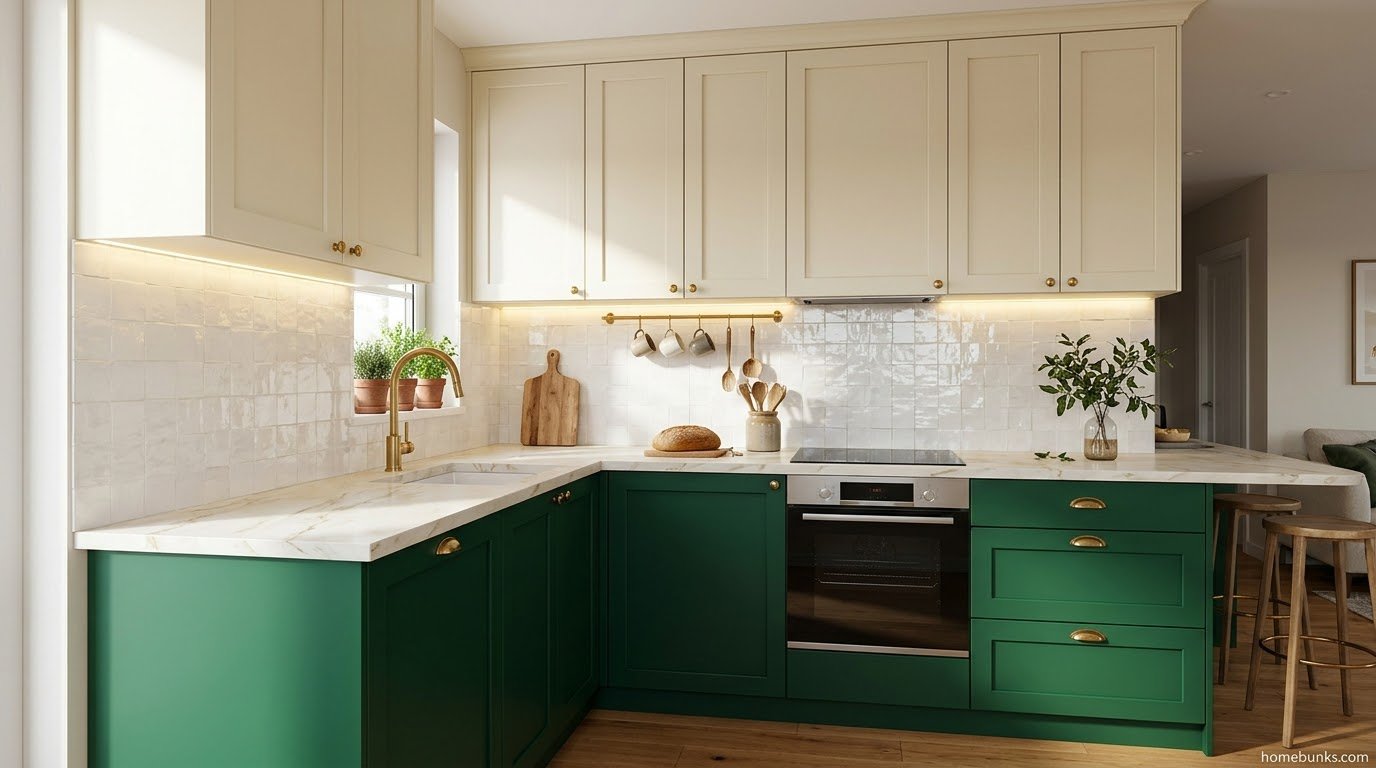
|
Paint |
Brand and number |
LRV (published) |
Family |
Best use |
|---|---|---|---|---|
|
Hunter Green |
Benjamin Moore 2041-10 |
about 4 to 6.5 (sources conflict) |
black based |
tailored cabinets, designer proven |
|
Essex Green |
Benjamin Moore HC-188 |
5.64 |
black based |
near black emerald, dramatic schemes |
|
Dard Hunter Green |
Sherwin Williams SW 0041 |
about 6 |
black based, warmer |
craftsman and farmhouse kitchens |
|
Pewter Green |
Sherwin Williams SW 6208 |
12 |
bridge green |
softer depth, dimmer rooms |
|
Jewel emerald types |
various makers |
about 10 to 15 |
true jewel |
glam cabinets and islands |
Benjamin Moore Hunter Green 2041-10 is the cluster’s anchor color. Sources print its LRV as 4.31 in one paint database and 6.39 in a manufacturer anchored roundup, so this page prints the band and lets your light decide.
Benjamin Moore Essex Green HC-188 sits at LRV 5.64, nearly black, inspired by ivy covered historic estates. Designer panels have picked both Essex and Hunter for real client kitchens, which tells you where professionals land.
Sherwin Williams Dard Hunter Green SW 0041 is the warmer twin, about LRV 6, with a yellow olive base. In icy northern light it resists turning blue better than its Benjamin Moore counterpart.
Sherwin Williams Pewter Green at LRV 12 is the bridge. It is earthier and lighter, the choice when you want emerald’s family feeling with twice the light return.
The hunter family’s numbers and undertones are compared in the guide at At Lane and High. Read the comparisons there, then test on a door, because decimal points do not cook dinner in your kitchen.
The Temperature System: Warm Metals Only
Emerald is a warm hearted color in every family, and it punishes cool partners. This is the rule the successful schemes share, whether they state it or not.
Brass and gold are the canonical metals. They glow against the green, warm the room’s temperature, and age into patina that suits emerald’s vintage glamour.
Copper is the warm rustic branch of the same system. A copper hood over emerald cabinets reads collected and old world, especially in the hunter family.
Chrome and polished nickel are the documented clash. Independent guides warn against them by name: their coolness makes emerald feel cold and dated instead of rich.
Stainless appliances really sit in between. They work when warm elements mediate: brass hardware, warm whites, and wood between the steel and the green.
|
Metal |
Temperature |
Verdict with emerald |
|---|---|---|
|
Unlacquered brass |
warm, living patina |
the default choice |
|
Polished brass and gold |
warm, formal |
glam schemes |
|
Copper |
warm, rustic |
hunter and farmhouse schemes |
|
Matte black |
neutral dark |
single accent only |
|
Chrome, polished nickel |
cool |
avoid in emerald schemes |
|
Stainless steel |
cool neutral |
use with warm mediation |
The scheme collection at Dallas Pro List states the same rule from the other direction. Avoid mixing chrome or nickel finishes with this palette; warm antique brass and copper are what keep deep green from feeling cold.
The 60 Percent Rule: Emerald’s Neutral Field
The most useful number in emerald design comes from the practitioner guide at Jenna Living. Balance the drama by keeping 60 percent of surfaces in warm neutrals.
Creamy whites and honey toned woods form that field. The cabinets carry the color; walls, counters, and floors carry the calm.
The rule explains the photographs you love. In nearly all of them, emerald occupies less than half the room, whatever the headline promises.
Warm white names that recur in proven schemes include Chantilly Lace, Pure White, and Alabaster types. Stark blue whites are the ones that fight the green.
Apply the rule by surface, not by square foot perfection. If the cabinets and island are emerald, let walls and counters be warm and light, and you are already close.
Light: Keeping Emerald Green After Dark
Every emerald absorbs most of the light that hits it. The family’s LRV band, roughly 5 to 15, means the room’s brightness is a design input, not an afterthought.
The same practitioner guide states the threshold plainly: emerald needs daylight or a bulb above 3000K to read as green instead of forest shadow. Treat it as a working rule from experience, and test it in your room.
Layer the light in three bands. Pendants over the island for presence, under cabinet light at the counters, and ambient ceiling light to lift the corners.
North facing kitchens run cool and dim. They favor the jewel family or Pewter depth, warmer bulbs, and a lighter neutral field than the standard 60 percent.
Judge your emerald after dark before you commit. A color that is glorious at noon and muddy at seven in the evening is a color chosen for the wrong hours.
Marble and Stone: The Veining Ladder
White marble is emerald’s classic counter because it supplies light, luxury, and pattern in one surface. The choice inside marble is a veining decision.
The ladder is laid out clearly in the ideas collection at Best Collections. Carrara offers subtle veining that will not compete, Calacatta brings drama, and Statuario provides the middle ground.
Calacatta Gold deserves its own mention. Its warm gold veining rhymes with brass hardware, which is why it headlines the glam schemes so often.
Green marble is the maximal move: emerald cabinets under green stone with white veining. The room becomes a single jewel, and everything else must go quiet.
Marble look quartz is the honest alternative. It delivers most of the look with almost none of the etching and sealing, and good guides recommend it without judgment.
|
Stone |
Veining |
Effect with emerald |
Care |
|---|---|---|---|
|
Carrara marble |
subtle gray |
emerald stays the star |
seal, watch etching |
|
Calacatta and Calacatta Gold |
bold, warm |
stone shares the stage |
seal, watch etching |
|
Statuario |
medium |
balanced drama |
seal, watch etching |
|
Green marble |
white on green |
monochrome jewel |
seal, specialist stone |
|
Marble look quartz |
printed calm |
90 percent of the look |
minimal |
Layouts That Work
Full Emerald: The Jewel Box
All cabinets emerald is the committed version. It belongs in rooms with light to spare and a neutral field disciplined enough to hold it.
The boldest variant paints the ceiling the same emerald, a move the Dallas collection recommends for coffered ceilings. The room stops being dark by accident and becomes dramatic on purpose.
Two Tone: Emerald Below, Warmth Above
Emerald lowers with warm white uppers is the cluster’s default recommendation. The green grounds the room while the eye level stays bright and calm.
Wood uppers or open shelves play the same role with more texture. The scheme at many top guides pairs emerald lowers with light wood uppers for exactly this balance.
Emerald Island Only
The island is the lowest risk entry: the jewel note at the room’s center, a neutral perimeter, and full reversibility if tastes change.
It is also the best first step for the undecided. Live with one emerald object at full saturation, in your light, before ordering a room of it.
Small Emerald Kitchens
Small rooms fail with emerald for one reason: full saturation plus dim light. Fix either variable and small works beautifully.
Choose the jewel family or Pewter depth instead of a black based green. The extra reflectance points are worth real brightness at small scale.
Distribute by the two tone rule: emerald lowers or island, warm white uppers and walls, light counters, and task lighting that actually reaches the worktop.
Keep the metal system warm and singular. One brass note repeated (hardware, pendants, faucet) reads designed; three competing metals read cluttered at small scale.
If even that feels like too much color commitment, the softer end of the family lives in the sage green kitchen ideas. Sage is emerald’s muted cousin, calm where emerald is dramatic.
Backsplash, Floors, and Fixtures
Warm white zellige is the current default backsplash: handmade variation, gentle light bounce, and a warm temperature that never fights the green.
Emerald or green marble backsplashes extend the jewel. Use them in the full and glam schemes, where the room has the light budget to carry double saturation.
White oak floors are the default partner: warm, light, and grain rich. Walnut deepens the jewel box; herringbone adds pattern energy under either.
For seating, brass framed stools with leather or emerald velvet are the scheme’s signature. Velvet doubles the jewel note deliberately; leather keeps it grounded.
If you want emerald’s depth with an earthier, yellower soul, the olive green kitchen ideas carry the same grounded weight with a rustic accent.
Emerald by Style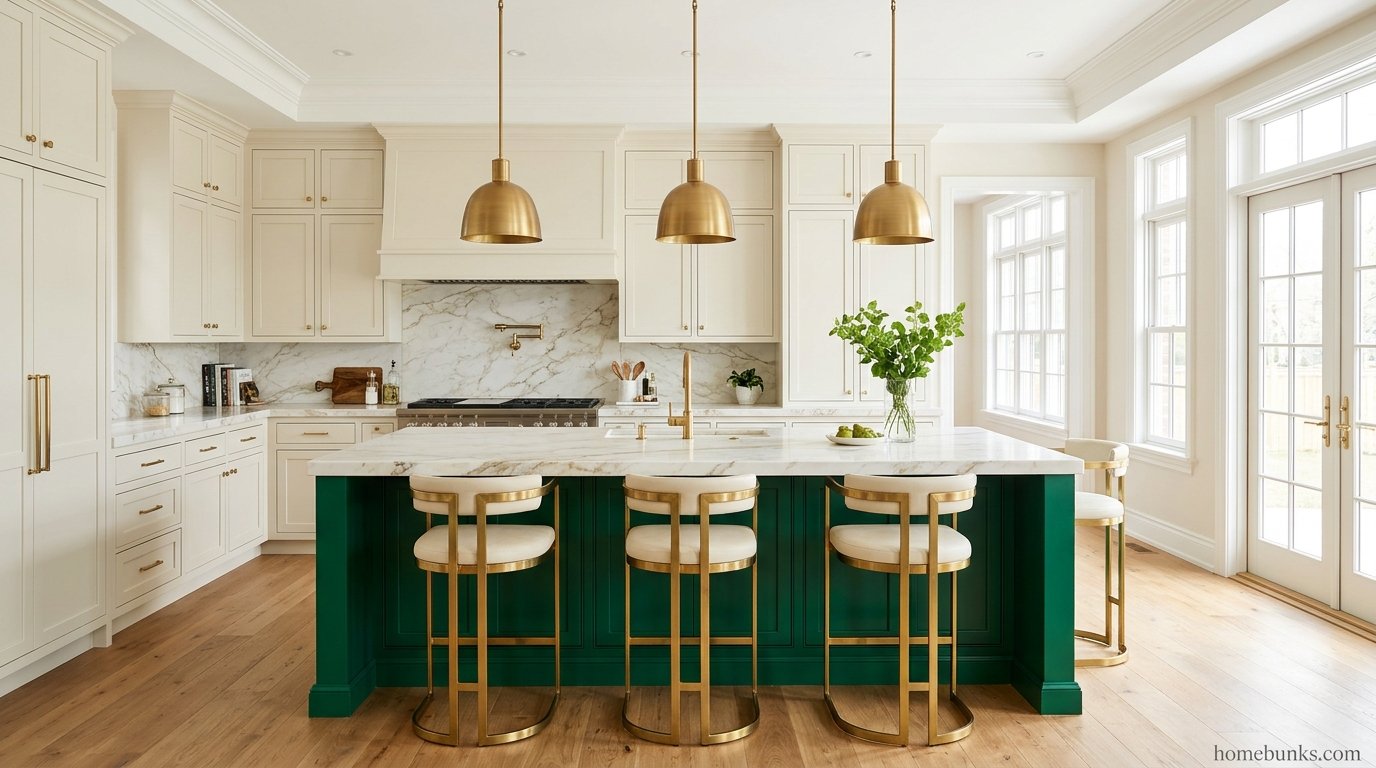
Modern Glam
Flat panel or high gloss lacquer emerald, polished brass, Calacatta Gold, and crystal or globe lighting. This is the dialect the photographs are made of.
Classic Tailored
Shaker doors in a black based emerald, unlacquered brass, Carrara, and warm white walls. The hunter family’s centuries in libraries and clubs do the persuading here.
Farmhouse Hunter
Dard Hunter depth, apron sink, oak shelves, aged brass. Emerald’s hunting green lineage makes farmhouse a homecoming, not a stretch.
The nearest jewel neighbor is not another green at all. Readers torn between drama colors should compare the navy blue kitchen ideas, which carry similar depth with a cooler temperature.
For the opposite pole, the cream kitchen ideas show the warm light version, and many real kitchens land between: emerald below, cream above.
The warm middle path between the two poles lives in the cream and warm wood kitchen ideas, where cream cabinetry and wood do the balancing that emerald schemes must arrange by hand.
Care for Saturated Color
Saturated lacquer shows chips clearly, because the pale material beneath contrasts with the deep color. Keep the exact paint, sheen, and a touch up kit from day one.
Clean with a microfiber cloth and mild cleaner. Gloss finishes show every touch and want buffing; matte and satin lacquer hide more and clean with a wipe.
Dust reads light on dark, the same law as black kitchens. A weekly dry wipe keeps emerald looking freshly painted instead of freshly neglected.
Build the wipe into an existing ritual: while the kettle boils, while coffee brews, while the dishwasher hums.
Saturated kitchens stay beautiful in households where the cloth is a habit, not a rescue, and emerald rewards that habit more visibly than any pale color can.
Record the scheme as you build it: paint name and number, sheen, stone, and hardware finish. A saturated kitchen that can be maintained exactly stays expensive looking for years.
Budget Entries Into Emerald
Paint the island in a jewel emerald, add brass hardware across the room, and hang two brass pendants. The color note lands at full strength for a fraction of a remodel.
Paint only the lowers if there is no island. Two tone arrives with half the paint and all of the grounding.
Swap the faucet and hardware to brass before any paint decision. Hardware scale warmth changes how every existing color in the room reads.
Live with the accents for a season. If the jewel still calls, you have tested your light and your taste honestly, in your own kitchen and your own light, before the full commitment.
Three Worked Schemes
Scheme One: Modern Glam
Jewel emerald flat panels, Calacatta Gold counters, polished brass hardware and pendants, white oak floors. The neutral field is the stone and the floor; the green owns the walls of cabinetry.
Light plan: strong daylight or a bright layered scheme. This is the scheme that photographs like a magazine and demands the most of small rooms.
Scheme Two: Classic Tailored
Hunter Green shaker cabinets throughout, honed Carrara counters, unlacquered brass, warm white walls, and a vintage runner. The room reads expensive and calm, never theatrical.
This is the designer default the expert lists keep choosing. It suits traditional architecture and ages the slowest of the three schemes.
Scheme Three: The Small Kitchen Jewel
Pewter depth or jewel emerald lowers, warm white uppers, marble look quartz counters, brass hardware in one finish. The green is a grounding band, not a room filling flood.
Under shelf lighting is non negotiable here. It is what keeps the jewel family green at working hours, which in a kitchen is most of them.
Sampling Emerald: The Door Test
Emerald has a documented swatch trap. In a real case from the practitioner guide, a homeowner ordered green lowers and white uppers, and the shop shipped green for both.
The full wall of emerald grew on her by the second week, but the lesson stands: emerald reads bolder across a whole kitchen than on any swatch.
So test at door scale. Paint one full cabinet door in each finalist, at the final sheen, and stand them where the cabinets will live.
Read them at breakfast, at noon, and after dark under your own bulbs. Note which family each finalist truly is once your light has its say.
Keep the winning door. It becomes your touch up reference and the standard for the pantry, the bathroom vanity, or any later addition.
Emerald in Open Plan Kitchens
Open plan rooms can feel unanchored in pale colors. An emerald kitchen zone gives the whole floor a jewel toned center of gravity that furniture can orbit.
Keep living zone textiles warm and mid toned so the eye travels by gradient. Repeat the brass once in the living zone to tie the metals.
From the sofa, you will mostly see the kitchen’s lit counters and open shelves. Style those surfaces like furniture, because in an open plan they are.
Emerald Beyond the Cabinets
The pantry door is emerald’s favorite supporting role: a single saturated door in a neutral kitchen, cheap to paint and easy to love.
A butler’s pantry or coffee station in full emerald turns a service space into a jewel box you visit daily. Small rooms forgive saturation that big rooms must ration.
Range cookers and hoods in deep green exist for the committed. They work in the hunter family best, where the appliance reads as furniture, not novelty.
If the color wins you over completely, it travels well to the bathroom. The family’s tile and vanity versions live in the emerald green bathroom ideas, where the same temperature rules apply.
Emerald and Resale
A balanced emerald kitchen photographs richly and reads custom built. Listing photographs love saturation, and emerald is the most photogenic of the deep greens.
The resale risk is the unbalanced version: full saturation, cool metals, dim light. That kitchen photographs like a cave and shows like one too.
If resale is near, choose reversible positions: island, lowers, pantry door, hardware. A buyer who dislikes emerald inherits a weekend project, not a remodel.
Keep your paint and finish records with the house documents. A named emerald with known sheen is maintainable, and maintainable reads as quality to buyers.
The Emerald Decisions, Summarized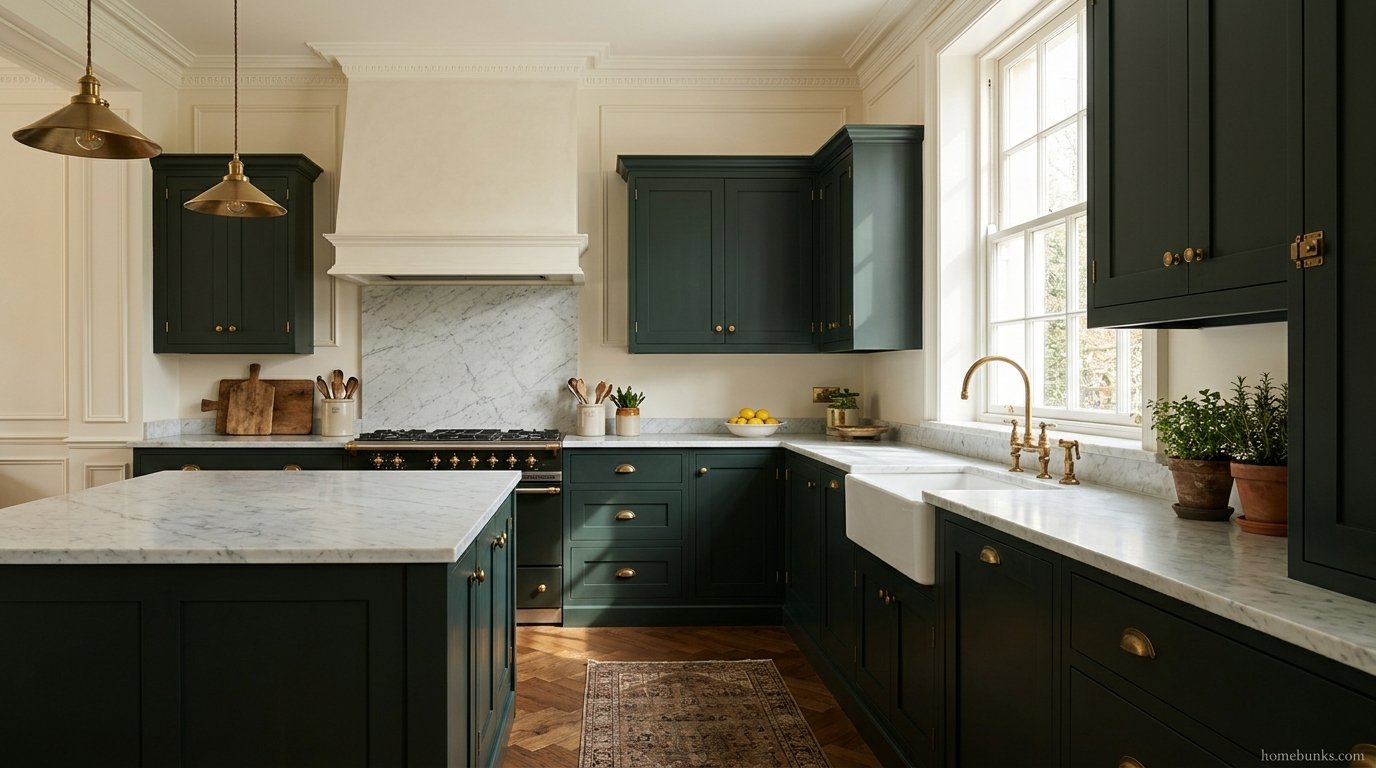
|
Decision |
Question |
Default answer |
|---|---|---|
|
Family |
Jewel, blue leaning, or black based? |
Jewel for glam and small rooms; hunter for classic rooms |
|
Paint |
Which name matches the family? |
Hunter or Essex (tailored); a saturated jewel paint (glam) |
|
Metal |
Which finish family? |
Brass; chrome banned from the scheme |
|
Field |
Is 60 percent warm neutral? |
Creamy whites, oak or walnut, light stone |
|
Light |
Does green survive after dark? |
Layered light, bulbs at or above 3000K |
Print this table on the project folder. Every later argument about stools and splashbacks gets easier once the five rows are settled in order.
Notice what the table does to shopping. It turns a hundred product decisions into five, and four of them are about your room, not the store.
Emerald With Kids and Daily Life
Saturated color is kinder to family life than its reputation suggests. The daily evidence of children is mostly dark and sticky, and deep green hides it gracefully.
The visible enemies are the pale ones: flour, dust, and chalky handprints. They wipe off lacquer in seconds, and a satin sheen makes the wiping invisible.
Choose satin or matte lacquer for the family version, soft close hardware to prevent slam chips, and stools in leather rather than pale fabric.
Keep the touch up kit where you can reach it without a ladder. On saturated color, a chip fixed the same day never becomes the room’s story.
Emerald Through the Seasons
Emerald is the rare kitchen color that improves in winter. Against early darkness and warm lamplight, the jewel family glows like a room designed for evenings.
In summer, lighten the styling, not the scheme: pale linens, lemons and herbs on the counters, and the green reads as a garden brought indoors.
Holiday styling needs almost nothing. Emerald is already the season’s color; add brass, candlelight, and one red note and the kitchen is dressed.
Spring is the moment for the field, not the cabinets: refresh runners, towels, and shelf styling in warm whites, and the emerald feels new again.
Mistakes to Avoid
- Choosing from a chip. Emerald intensifies at scale. Test a door, in your light, for two days.
- Chrome hardware. The documented clash. Emerald’s warmth needs brass, gold, or copper.
- Cool gray counters. They fight the green’s temperature and make both look muddy.
- Full saturation in a dim room. The jewel needs light funding; otherwise it reads as forest shadow.
- Trusting the label. Muted smoky greens are sold as emerald. Check the family and the LRV band.
- Stark blue white walls. Creamy warm whites are the field; blue whites make emerald look dirty.
How to Start Your Emerald Kitchen
Name your family first: jewel, blue leaning, or black based. That single decision disciplines every paint chip and product photo you will meet.
Pick your paint from the ladder and order sample doors, not sample pots. Two days of watching them will teach you more than a month of scrolling.
Set the metal system before the stone: brass family chosen, chrome banned, stainless mediated. Then choose marble by the veining ladder.
Budget the light like a material. Pendants, under cabinet strips, and bulbs at the right temperature are part of the color, not accessories to it.
If you are planning the wider home, the kitchen cluster at HomeBunks holds the color family together, from sage’s calm to black’s depth. Emerald is the jewel in that crown, and it should be set like one.
Frequently Asked Questions
Is emerald green a good color for kitchen cabinets?
Yes, when it is balanced: keep about 60 percent of the room’s surfaces in warm neutrals (creamy whites, honey woods), use warm metals, and fund the light. Emerald fails as a full saturation room with cool gray partners, not as a color.
What exactly counts as emerald green in a kitchen?
Three families share the label: true jewel emerald (saturated, LRV roughly 10 to 15), blue leaning deep greens (which can drift teal), and black based hunter greens (LRV roughly 4 to 6) that read emerald in daylight and near black at night.
Name your family before choosing a paint.
What is the best emerald green paint for kitchen cabinets?
For jewel emerald, look at saturated mid depth greens and test at door scale. For the tailored, near black emerald, Benjamin Moore Hunter Green 2041-10 and Essex Green are designer proven cabinet picks. The right answer depends on which emerald family you want.
What LRV do emerald green paints have?
Most emerald family paints sit between LRV 5 and 15, absorbing most of the light that hits them. The black based end (Essex Green, about 5.6) needs funded light; the jewel end (around 12) returns more color and brightness.
What is the LRV of Benjamin Moore Hunter Green?
Sources conflict: one paint database profile gives 4.31 while a manufacturer anchored roundup gives 6.39. Treat it as a very dark green in the 4 to 6.5 band and judge brightness by a sample in your own light, not by a single decimal.
What is the difference between emerald green and hunter green?
Emerald is the saturated jewel family; hunter is its black based, traditional branch (deep, warm yellow brown undertones, LRV around 6). Hunter reads as emerald in bright light and as near black in shade.
Emerald vs forest green kitchen: what is the difference?
Forest green is the cooler, nature first family; emerald is more saturated and jewel like. In paint terms they overlap heavily at the dark end, which is why naming the exact paint matters more than the family label.
What colors go with emerald green cabinets?
Warm whites and creams (Chantilly Lace, Pure White, Alabaster families), white oak and walnut, white marble, and warm metals. The pairing rule is temperature: warm partners, always.
What hardware goes with emerald green cabinets?
Brass and gold are the canonical pairing, unlacquered if you want living patina. Copper works in rustic glam schemes. Chrome and polished nickel clash with emerald’s warmth and are the metal to avoid in this scheme.
What countertops go with emerald green cabinets?
White marble is the classic: Carrara for subtle veining that will not compete, Calacatta for drama, Statuario between. Green marble creates the monochrome jewel version. Marble look quartz is the honest low maintenance alternative.
Carrara or Calacatta with emerald cabinets?
Carrara’s quiet gray veining keeps emerald as the star; Calacatta’s bolder, warmer veining (especially Calacatta Gold) shares the stage. Choose by how much drama the stone should carry.
What backsplash works with emerald cabinets?
Warm white zellige is the current default: handmade variation, gentle light bounce, warm temperature. White subway works plainly; green marble or emerald tile is the drench option for committed schemes.
Does emerald green make a kitchen look dark?
It can: the family absorbs light (LRV 5 to 15). The counters are layered light, warm white large surfaces, and two tone distribution. A jewel emerald at LRV 12 reads far brighter than a black based one at LRV 5.
Can I use emerald green in a small kitchen?
Yes, with balance: emerald on lowers or the island only, warm white uppers and walls, light counters, and real task lighting. Full emerald in a small dark kitchen is the version that overwhelms.
What lighting does an emerald kitchen need?
Emerald needs light to read as green. One practitioner guide states it plainly: emerald needs daylight or bulbs above 3000K to read green instead of forest shadow. Layer pendants, under cabinet light, and ambient light.
What light bulb temperature suits emerald cabinets?
At or above 3000K per the practitioner rule above, with enough brightness to hold the color after dark. Very warm dim bulbs push emerald toward murky forest.
Two tone emerald kitchen: which cabinets get the green?
Lowers classically: emerald grounds the room while warm white uppers keep eye level bright. Emerald uppers are the advanced version and need height and light.
Can I do just an emerald island?
Yes, it is the lowest risk entry: the jewel note at the room’s center, neutral perimeter, full reversibility. Pair it with brass stools or pendants to complete the note.
Should emerald cabinets be matte or glossy?
Both exist: high gloss lacquer is the glam dialect and shows every touch; matte and satin lacquer are the liveable default. Choose gloss only where traffic is low or wiping is welcome.
Are emerald green cabinets timeless or trendy?
The jewel saturation cycles with trends, but deep greens (hunter, library, Essex) carry centuries of use in tailored rooms. A classic door style in a black based emerald ages slowest.
Do emerald cabinets hurt resale?
A balanced emerald kitchen photographs richly and reads custom. The risk is an unbalanced one (full saturation, cool partners, dim light). Island only and two tone versions are the resale safe entries.
What flooring goes with emerald cabinets?
White oak is the default partner: warm, light, and grain rich. Walnut deepens the jewel box; herringbone adds pattern energy. Very dark floors plus black based emerald need exceptional light.
What wall color goes with emerald cabinets?
Warm whites and soft creams. Stark blue whites and cool grays fight emerald’s temperature; the warm white family (Chantilly Lace, Pure White, Alabaster types) is the safe field.
Can emerald cabinets work with stainless steel appliances?
Yes, with warm mediation: brass hardware, warm whites, and wood between the green and the steel. Practitioners warn that stainless plus emerald with no warm accents can read clinical.
What about black accents with emerald?
One black note (matte black pulls, a black sink base) sharpens emerald. A second dark system (black counters plus black appliances plus black based emerald) collapses the jewel into darkness.
Emerald green ceiling in the kitchen: good idea?
The jewel box move: painting a coffered ceiling the same emerald as the cabinets makes the room feel intentionally dramatic. It belongs in dining kitchens with height and funded light.
How do I test emerald before committing?
At door scale, not chip scale: emerald reads bolder across a full kitchen than on a swatch (a documented shipping accident taught one homeowner exactly this). Live with one painted door for two days of light.
Can I paint my existing cabinets emerald?
Yes. Deep saturated colors are forgiving of minor prep flaws in low sheens but show everything in gloss. Use a cabinet grade enamel or lacquer, and test the color on one door first.
What is the 60 percent rule for emerald kitchens?
A practitioner rule from emerald kitchen guides: keep about 60 percent of surfaces in warm neutrals so the green reads intentional, not overwhelming. Cabinets carry the color; walls, counters, and floors carry the calm.
Emerald vs sage green kitchen: which should I choose?
Temperature and energy: sage is muted, grayed, and calm; emerald is saturated, jewel like, and dramatic. Sage forgives dim light; emerald demands light and rewards it.
Emerald vs olive green kitchen?
Olive is warm, yellowed, and earthy; emerald is cleaner and more saturated. Olive suits rustic and Mediterranean rooms; emerald suits tailored, glam, and classic rooms.
Does emerald green work in a farmhouse kitchen?
In its hunter branch, yes: deep warm greens have farmhouse lineage (hunting greens, painted country cabinetry). Pair with oak, apron sinks, and aged brass rather than polished glam metals.
Does emerald work in a modern kitchen?
Yes, as flat panel lacquer with brass or black accents and marble. The modern glam dialect is emerald’s most published current form.
What stools and seating suit an emerald kitchen?
Brass framed stools with leather or emerald velvet seats are the scheme’s signature. Oak stools warm it; velvet doubles the jewel note deliberately.
How do I style open shelves in an emerald kitchen?
White oak shelves, everyday ceramics, cookbooks, and one trailing plant. Against emerald, shelf styling shows doubled: keep it edited and warm.
What is green marble and does it suit emerald cabinets?
Green marble (deep green stone with white veining) creates the monochrome jewel kitchen: emerald cabinets, green marble counters or splash. It is the maximal version and needs the calmest floor and walls.
Is marble worth it with emerald, or should I choose quartz?
Marble gives the veining and depth the classic schemes are built on, with etching and sealing as the price. Marble look quartz gives 90 percent of the look with near zero upkeep; several guides recommend it without judgment.
How do I clean and care for emerald lacquer cabinets?
Microfiber and mild cleaner; gloss shows touches and needs buffing, matte lacquer hides more and cleans with a wipe. Keep the exact paint and sheen recorded for touch ups; saturated colors show chips clearly.
What is the cheapest way to get an emerald kitchen?
Paint the island or the lowers in a jewel emerald, add brass hardware and two brass pendants. The color note lands at full strength for a fraction of a remodel.
Why does my emerald sample look teal?
Blue leaning emeralds drift teal under cool light and beside blue grays. If teal is not the goal, move toward the yellow warm branch (hunter family) and retest under your own bulbs.
Why does my emerald kitchen look black at night?
Black based emeralds (LRV around 5) lose their green when light drops; that is their known behavior, emerald by day and near black by night. Raise light levels and temperature (3000K plus) or choose a higher LRV jewel emerald.
Where can I verify an emerald paint’s LRV?
On the brand’s official color page. Roundups conflict even on famous colors (Hunter Green appears at 4.31 and 6.39), so treat decimals as approximate and let a door sample decide.
Conclusion
Emerald green kitchen ideas reward the cook who starts with the definition. Name your emerald, jewel, blue leaning, or black based, and half the hard decisions make themselves.
Then run the temperature system without exceptions: warm metals only, a 60 percent warm neutral field, marble chosen by its veining, and light funded until the green stays green after dark.
Start with the island or the lowers if you want proof before commitment. When the room holds its jewel at every hour of the day, commit fully, and enjoy the deepest, richest color the kitchen cluster offers.
Ready to choose your emerald? Order two sample doors today, one from the jewel family and one from the hunter family, and let your own light pick the winner this week.
Keep the records with the house when you finish: the paint name and number, the family, the sheen, and the stone.
An emerald kitchen that can be maintained exactly stays jewel bright for as long as you own it. That is the whole point of choosing a color with this much character.


