
Halloween table decor works when it is built like a system, not gathered like a haul.
A great Halloween table has four layers in a fixed order, one height rule, and exactly one register.
The anatomy comes first on this page, then the sightline rule, the candle discipline, and six full registers.
Sizes and stack orders are printed as the sources specify them, and testimonial figures are labeled as testimonials.
Build the layers in order and the table photographs well and dines well, which are not the same achievement.
Each register ahead is specified completely enough to shop and thrift from, with the budget lines mapped honestly to the registers they can carry, season after season, without apology or overspend.
The Anatomy of a Halloween Table
The clearest statement of the structure sits in the Halloween tablescape guide at Morella-Ulalume, which names the layers in build order.
|
Layer |
What it is |
Its rule |
|
Cloth, runner, or kraft |
Goes down first, sets the foundation |
|
The hero arrangement |
Everything radiates outward from it |
|
Tapers, pillars, votives |
Non negotiable, the light is the mood |
|
Plates, napkins, glassware |
Connects the decor to the dining |
Layer one is the base: a cloth runner, a length of fabric, kraft paper, or a bare table chosen deliberately.
It sets the foundation for everything, and it is also the cheapest register switch the table owns.
Layer two is the centerpiece, the hero: the most dramatic element, anchoring the eye at the table’s center.
Layer three is candlelight, which the anatomy calls non negotiable, because flicker is what makes the rest read spooky.
Layer four is the place settings, plates, cutlery, glasses, and napkins, completing the connection to the meal.
Build in that order. Most failed tables were assembled settings first, with the centerpiece squeezed into what remained.
The Sightline Rule
One number disciplines the whole topic, and it comes from the step by step Halloween tablescape guide at Kaveesh as a working instruction.
Cut the arrangement so it sits below 10 inches tall, so guests can chat without craning their necks.
The rule exists because a dinner table has a job: conversation across it, all evening, at seated eye level.
Anything above the line taxes every sentence exchanged across the table, however beautiful it photographs.
Low and long beats tall
The professional answer to the height limit is low and long: spread the drama along the table, not up it.
The gothic specification does exactly this: low vessels spaced along the center, rather than one tall arrangement.
Splitting one arrangement into two or three low vessels keeps the volume and loses the wall.
Tall notes are not banned; they move to the ends or to candlesticks, whose thin profile sightlines pass around.
Why photographs lie about height
Photographed tables are shot standing, empty, and lit for the camera, three conditions no dinner shares.
Boards full of towering centerpieces are advertising for a product, not evidence about a meal.
Judge every inspiration image by asking where the guests’ eyes would be, and what they would see.
Usually the answer is a vase. The sightline rule is how real hosts keep the photograph and the dinner.
Candlelight Discipline
The idea set in the 21 Halloween table decoration ideas at DreamInspo summarizes the method as palette, centerpiece, and layers of texture, with candlelight first among them.
Candlelight on a Halloween table is engineered, in three moves: heights, color, and the safety perimeter.
Heights and drips
Vary the heights deliberately: a tall candelabra or taper cluster, short pillars, and tiny votives along the runner.
Matched sets at one height read store bought. Mismatched holders at uneven heights read collected over time.
In the gothic register, let the wax drip and even build up on holders; the drips are part of the aged aesthetic.
Candle color follows the register: black, deep burgundy, and ivory carry the gothic palette on their own.
One styling guide specifies the ambience as a moody 2200K warmth, its own strand for how warm the glow should feel.
The flameless perimeter
Real flame and Halloween materials are natural enemies: kraft paper, gauze runners, dried florals, and napkins all burn.
The rule from the idea set is direct: use flameless LED versions near anything flammable.
Build a perimeter in your head: inside the runner’s fabric and paper zone, flameless only.
Real tapers belong in clear zones, stable holders, away from the runner’s puddled ends and hanging decor.
Tealights inside carved pumpkins follow the same logic, and battery versions have quietly won that job.
The Registers
A register is the table’s chosen world: palette, hero, light, and mood decided once, before shopping.
|
Register |
Palette |
Hero |
Light |
|
Elegant gothic |
Black, burgundy, brass |
Low dark florals |
Black tapers, drips |
|
Classic |
Orange, black, kraft |
Pumpkin cluster |
Orange pillars, tapers |
|
Witch |
Black, green notes, crimson |
The cauldron |
Fog or fairy glow |
|
Farmhouse |
Burlap, galvanized, wood |
Trays and jars |
Fairy lights, votives |
|
Glamour |
Black and gold |
Velvet pumpkins |
Gold caught candlelight |
|
Black and white |
Black, white only |
White pumpkin cluster |
Black tapers in brass |
|
Kid friendly |
Orange, purple, candy colors |
Mini cauldrons |
Flameless everything |
Six registers cover nearly every photographed table in the set, plus the kid table as the seventh practical one.
Mixing registers per place setting is the incoherent haul at table scale. One table, one world.
Elegant gothic: the full specification
The gothic register is the set’s most specified build, per the Halloween tablescape guide at Morella-Ulalume, and it earns a complete recipe.
Base: a black velvet or deep charcoal linen runner, or a full black tablecloth as the canvas.
Centerpiece: deep burgundy and black florals, roses, dahlias, and anemones, in dark ceramic or tarnished silver.
The vessels sit low and spaced along the center, which is the sightline rule wearing formal dress.
Candles: tall black tapers in antique brass or pewter at varying heights, with burgundy pillars clustered between.
Settings: black plates, or for maximum drama a black charger under a white dinner plate.
This is also the register a 2026 retail collection named Hallowed Halls, the gothic library at table scale.
Classic: orange, kraft, and the cluster rule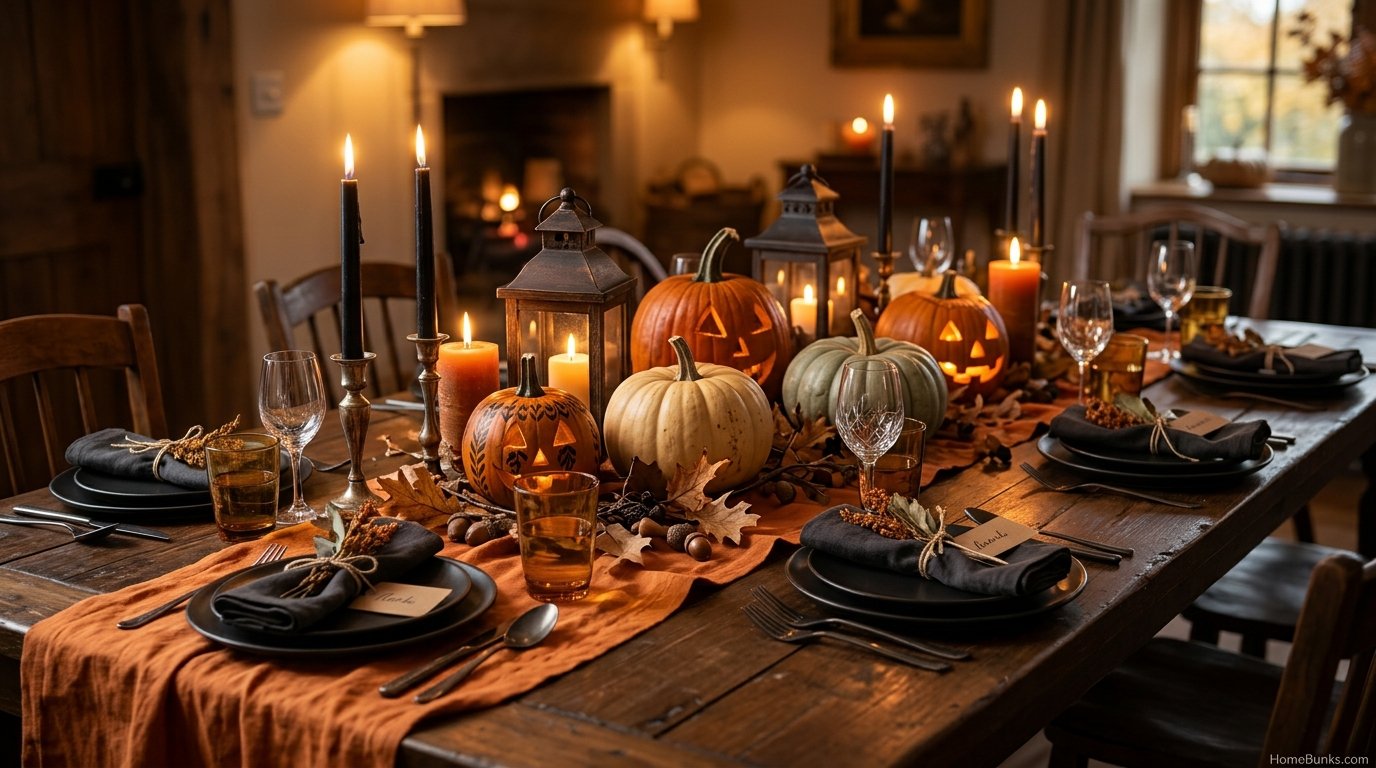
The classic register runs a deep orange linen runner, or kraft paper the guests can write and draw on.
Its centerpiece is a cluster of carved and painted pumpkins in varying sizes, tea lights glowing in the carved ones.
The cluster rule from the 21 Halloween table decoration ideas at DreamInspo: group in odd numbers, three, five, or seven, mixing shapes and heirloom colors.
Orange pillars mixed with black tapers warm the light layer, and the kraft base makes cleanup a single fold.
The witch’s table: the cauldron
The witch register centers a large cauldron, a real cast iron pot or a decorative one, at the table’s heart.
Filled with dry ice, it fogs dramatically; filled with black ornaments and battery fairy lights, it glows safely.
Dry ice at a dinner table needs its standard care: handle with gloves, keep the room ventilated, never seal it in.
The glow version loses nothing at photograph distance and wins on safety and refills, so it is the default recommendation.
Around it, the settings take potion cues: dark glass, apothecary bottles marching down the center as a runner alternative.
Farmhouse, glamour, black and white, kid
Farmhouse runs a natural linen or burlap runner, galvanized trays, wooden crates, and mason jars of candy corn or fairy lights.
Glamour runs black and gold: velvet pumpkins, gold rimmed chargers, metallic flatware, and black tapers in gold holders.
Its height note is black dyed branches or gold tipped pampas, dramatic and thin enough to keep sightlines.
Black and white refuses orange entirely: white cloth, black plates, striped napkins, and a white pumpkin cluster.
The kid table runs the classic register at playful volume: kraft base, mini cauldron favors, candy corn votive colors, all flameless.
The Place Setting Stack
The setting is where guests touch the decor, so its stack order is worth printing exactly.
Per the step guide’s build: a matte black charger anchors the place, 13 inches across in its checklist.
A cream stoneware dinner plate sits on the charger, the contrast doing the register’s work at every seat.
A folded charcoal frayed linen napkin rests on the plate, and one baby boo pumpkin crowns the stack.
The baby boo is the setting’s signature object: small, real, and identical at every place, which reads as intention.
Glassware goes above the knife: smoky black and amber goblets placed to catch the nearby taper light.
From the 29 Halloween tablescape ideas at Seasonal Home Magic come the zero cost moves: a folded ghost napkin needs no purchase at all.
A mini cauldron at each place, filled with candy, turns the setting into a favor that leaves with the guest.
And one faux raven near the host’s place gives the table a story without a novelty at every seat.
The Kit List and the Budget Lines
Buy the table as a kit by layer, and every layer has a thrift or grocery alternative that keeps the register.
|
Layer |
The buy |
The budget line |
|
Base |
Velvet or linen runner |
Gauze, lace, or kraft paper |
|
Hero |
Compote and florals |
Grocery dark florals, pumpkin cluster |
|
Light |
Tapers and holders |
Thrifted brass, flameless sets |
|
Settings |
Chargers and stoneware |
Etched look chargers, existing plates |
|
Signature |
Baby boos, mini cauldrons |
Seasonal aisle, per piece pricing |
Thrifted brass is the gothic register’s famous supply line: mismatched aged holders at charity shop prices.
A host testimonial inside the step guide describes a five star gothic banquet look on a 35 dollar budget.
That figure is one host’s testimonial, printed here as a strand, not as a price promise for your table.
What is solid underneath it: the supply lines are real, and grocery florals in burgundy and black tones carry the hero cheaply.
The dollar aisle carries the kid and classic volume: kraft, candy corn, cloths, and small pieces at party scale.
Variants: Small Tables and Every Night
A small table does not need a smaller idea; it needs the footprint budget respected.
Keep the center strip narrow: one low vessel or a three pumpkin cluster, and let the settings own their depth.
Skip the runner’s puddle on small tables, run placemat scale bases per setting instead, and keep flame fully flameless.
The everyday October table runs the anatomy at minimum: one runner, one cluster, one candle trio, lit nightly.
Whole room context for that table sits in halloween home decor ideas, the indoor companion in the HomeBunks cluster.
The base swap is the kit’s party trick: the same pieces on a black cloth read gothic, on kraft read classic.
Two registers from one kit doubles the season’s value without a second purchase, if the pieces stay neutral enough.
Mistakes and Rescues
Tall. A centerpiece above the sightline turns dinner into a hedge row. Rescue: split it into low vessels.
Tacky. Novelty at every place with no palette underneath. Rescue: choose the register, remove a third of the pieces.
Flooded. Orange everywhere with no counterweight. Rescue: add black and metal until the orange reads as an accent again.
Flammable. Real flame inside the paper and gauze zone. Rescue: rebuild the perimeter with flameless, keep flame in clear zones only.
Cluttered. The footprint ate the settings. Rescue: measure the center strip first next time, and shop to its width.
Each rescue is one decision reversed, which is why the anatomy order matters: early layers are cheap to fix.
Halloween Tables Across the HomeBunks Guides
The table’s room context lives in halloween home decor ideas, where the indoor season is built wall to wall.
The door that guests pass before the table is dressed in halloween door decor ideas, wreath to threshold.
Yard scale versions of the same discipline sit in outdoor halloween decor ideas, one focal piece under the sky.
The vintage register’s room sized deep dive is in vintage halloween decor ideas, Americana piece by piece.
The pastel register’s full palette runs in pink halloween decor ideas, the pretty second Halloween.
The season’s whole record, lanes and all, is indexed from the HomeBunks Halloween and home guides.
The Base Layer, Compared Properly
The base deserves its own comparison, because it is the register switch and the budget lever at once.
|
Base |
Register pull |
Cost pattern |
Cleanup |
|
Full black cloth |
Gothic, glamour |
One cloth, reused yearly |
Launder and store |
|
Velvet or linen runner |
Gothic, elegant |
Mid, one length |
Launder, roll to store |
|
Gauze or cheesecloth |
Texture first, any dark register |
Cheapest per foot |
Replace when tired |
|
Spiderweb lace |
Pattern forward |
Low |
Stores flat in a drawer |
|
Kraft paper |
Classic, kid |
Pennies per table |
Fold and recycle |
A full cloth commits the whole table to the register, which is why it is the fastest drama move.
A runner lets the wood show and suits tables whose surface is part of the room’s furniture story.
Gauze puddles, pooling slightly at the ends, and the puddle is a styling move, not carelessness.
Lace over a solid base doubles the pattern without a single extra prop, per the trick lists.
Kraft is the only base that participates: guests write, draw, and sign it, and the table keeps the evidence.
Choose the base by cleanup and register together; it is the layer you will handle most.
Fresh Versus Faux Dark Florals
The gothic hero raises the topic’s one real materials argument, and a week’s distance settles it.
Fresh dark florals win the dinner: real dahlias and roses carry scent, irregularity, and depth no replica matches.
They want buying close to the day, two days ahead at most, with stems cut and water kept sweet.
Faux dark florals win the season: the everyday table, the porch, and any build that must hold for weeks.
The professional compromise runs faux structure, fresh accents: permanent dark foliage underneath, fresh blooms on the day.
Color discipline matters more than origin in this register: burgundy and near black tones only, no bright reds.
A single bright stem in a dark arrangement reads as a mistake at candlelight distance, every time.
Suspended Decor: The Height Exception
One height move escapes the sightline rule entirely, because it leaves the table’s surface alone.
Suspended branches, bats, or candle holders above the table add drama at ceiling level, not eye level.
The rule transfers rather than breaks: keep the seated sightline band empty, roughly the middle three feet of air.
Anything hanging must clear standing height at the ends where guests rise, and stay clear of flame below.
Use suspension when the table is long and the room is tall; small rooms read it as clutter at head height.
It is also the renter friendly height move, since it hangs from removable hooks and touches nothing.
The Buffet and Serving Table Variant
A serving table runs the same anatomy with one layer promoted: the hero becomes functional.
The cauldron graduates from centerpiece to candy or punch station, the set’s own example of decor that serves.
Height rules relax on a buffet, because nobody dines across it; tall pieces can anchor the back row.
The sightline that matters is the label line: dishes named at reading height, in the register’s hand.
Keep the flameless perimeter wider here, because serving traffic brushes past the light layer all night.
Registers hold on buffets exactly as on dining tables, and a matched pair of tables photographs as one event.
The Outdoor Table Variant
Porch and patio tables take the anatomy outdoors with two substitutions and one promotion.
Flame becomes flameless almost everywhere, because wind is a perimeter problem no holder solves.
Weight becomes a feature: heavy vessels and chargers stay put, and gauze is pinned or traded for linen.
The promotion is the centerpiece’s durability: faux florals and pumpkins outlast fresh stems in sun and chill.
The full yard context for the outdoor table sits in outdoor halloween decor ideas, one focal piece over the whole scene.
An outdoor table under a lit focal yard needs less of everything, because the landscape is doing the drama.
Setting the Table: The Timeline
A Halloween table is built in three sittings, and knowing which pieces wait is the host’s real skill.
Days ahead: the base, the hero’s structure, the candle hardware, and the dry settings without napkins’ final fold.
The day before: florals arranged and watered, pumpkins placed, glassware polished and set, favors filled.
The final hour: fresh napkins folded, perishables and ice, flameless switched on, real flame lit last of all.
Guests should meet a finished table, not a build in progress; the timeline is what makes that calm possible.
Photograph the table in the last ten minutes before guests, in its candlelight, before the meal edits it.
Table Shapes and Guest Counts
The anatomy flexes by shape, and the flex is mechanical rather than stylistic.
A rectangular table takes the textbook build: a center strip, spaced vessels, and settings in two facing rows.
A round table takes a single central hero, low and wide, with the candle trio orbited inside its footprint.
A square table for four takes the small table protocol: one cluster, four settings, no runner puddle.
Guest count changes repetition, not design: the stack repeats identically, and identical repetition is what reads as luxury.
Above eight guests, add a second hero of the same family rather than enlarging the first past the sightline.
Long tables forgive more candle hardware; short tables forgive none, because every object competes for the strip.
Why the Gothic Palette Works
The gothic register’s endurance is color mechanics, not fashion, and the mechanics are worth naming.
Black removes the table’s visual noise, so every remaining color appears richer by contrast.
Burgundy sits at the darkest warm step before black, close enough to read as shadow with a pulse.
Brass and tarnished silver return the candlelight as warm reflections, multiplying one flame into many glints.
Ivory and cream appear once, in the plate or the candle, as the single light note the darkness needs.
Any palette that follows the same structure, dark field, deep warm, metal, one light note, will read as elegant.
That is also why the glamour register works: it keeps the structure and swaps burgundy for gold’s brightness.
The Kid Table as a Full Build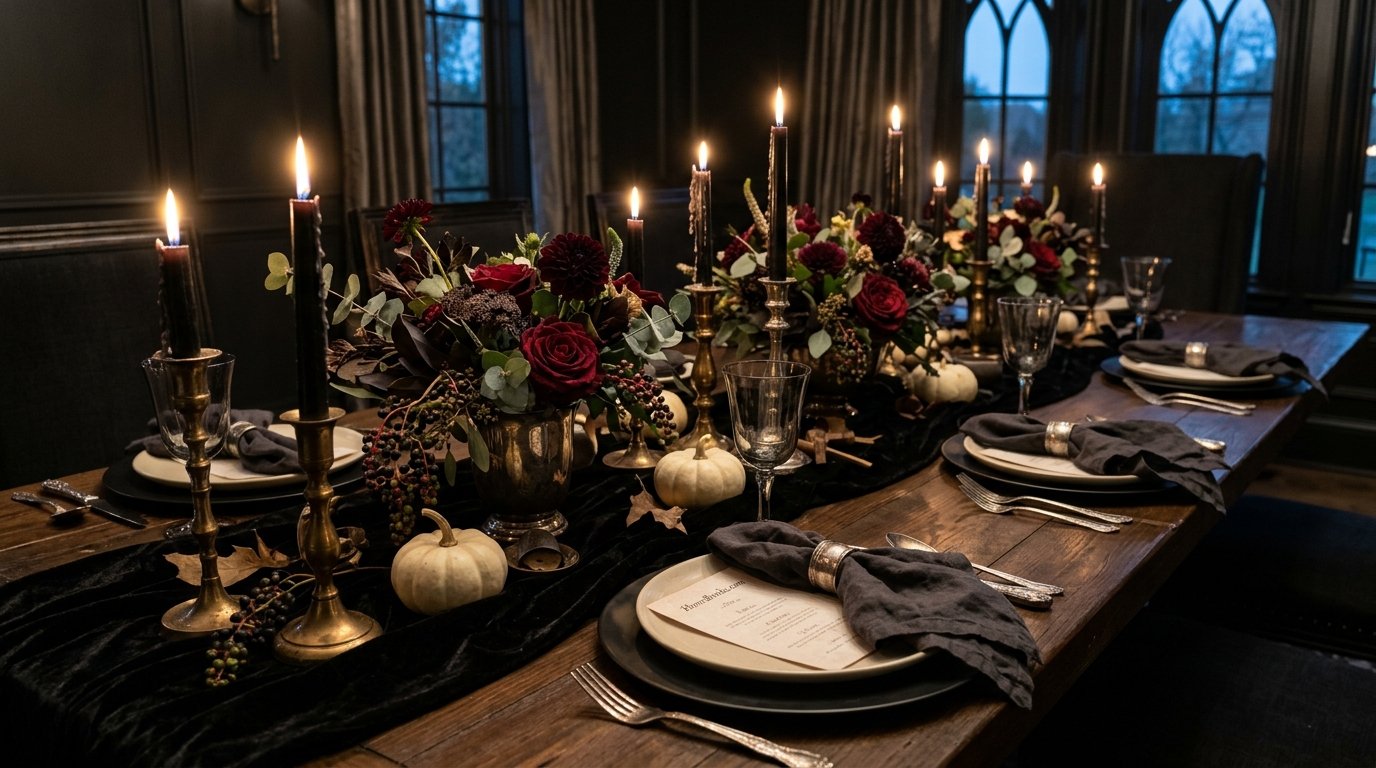
The kid table deserves the same engineering, because children read effort per seat as clearly as adults do.
Base: kraft paper, with markers at each place, so the table’s first activity is built into its foundation.
Hero: a small pumpkin cluster with painted faces, low enough for small sightlines, which are lower than adult ones.
Light: flameless everything, votives in candy corn colors, white, orange, and yellow layered like the candy itself.
Settings: a mini cauldron per child, filled before the meal, because a favor that waits is a distraction that works.
Seating cards become potion labels with names, the witch register’s stationery at a child’s scale.
The build’s discipline is identical to the gothic table’s; only the register and the flame rule change.
The Pretty Table: Pastel and Threshold Pieces
The second Halloween runs a table of its own, and the 2026 season gave it retail form.
Its palette is pink, pastel, and white, with the spooky shapes kept and the darkness removed.
Its light layer in the 2026 record was bleeding taper candles and ghost tealights, pretty enough to leave out all month.
Its settings run white and blush with one black note kept small, a charger or a ribbon, as the contrast anchor.
The pretty table photographs in daylight as happily as candlelight, the only register with that property.
Its room sized version runs in pink halloween decor ideas, where the same palette discipline covers a whole interior.
Menu Cards, Place Cards, and Paper in Register
Paper is the layer hosts forget to register, and unregistered paper breaks the spell cheapest.
A menu card in the register’s palette and typeface costs pennies and sits inside every photograph of the setting.
Place cards carry the seating plan, which is a hosting tool disguised as decor: conversation is seated, not random.
In the witch register they become potion labels; in the classic, tags tied to the mini pumpkin stems.
Handwriting beats printing at this scale, because the table’s whole claim is that a person made these choices.
Keep paper inside the flameless perimeter in your planning, since it is the most flammable layer on the table.
Storing the Table Kit
A tablescape is a repeating asset, and its storage decides whether next year’s build starts at zero.
Store by layer, not by shopping trip: one bin for bases and cloths, one for candle hardware, one for settings pieces.
Wax comes off brass with warm water and patience; clean holders before storage, not before the next dinner.
Cloths store rolled or folded with tissue, because a year of crease sets into linen like a memory.
Chargers scratch in stacks, so felt or paper between each is the cheapest insurance in the whole kit.
Label the kit bin with the register it serves, and the base swap pieces in their own marked bag.
A labeled kit is why experienced hosts set a full table in under an hour while beginners shop for a week.
The Five Minute Summary
Decide the register first, because palette, hero, light, and mood all hang from that one choice.
Lay the base second, build the hero below the sightline third, and choreograph the candles fourth.
Stack the settings last, identically at every place, with one signature object crowning each stack.
Keep flame inside its perimeter and paper inside the plan, and the table is safe as well as beautiful.
Five decisions in that order produce every strong table in this category. Skipping the order is the mistake.
The Drinks and Dessert Transition
A well built table survives its own meal, because the layers were placed to be lived with.
Serve drinks from a side station in the same register, so bottles and pitchers never colonize the centerpiece.
Dessert resets the hero cheaply: the cluster stays, and one element changes, a cake stand where the compote stood.
Coffee and tea take ivory and metal in the gothic register, keeping the palette intact at the meal’s end.
The flameless layer dims rather than dies as the evening ends, and votives can be gathered to one end for the last hour.
A table that ends as composed as it began is the mark of the anatomy working under real conditions.
A Note on Rental and Borrowed Pieces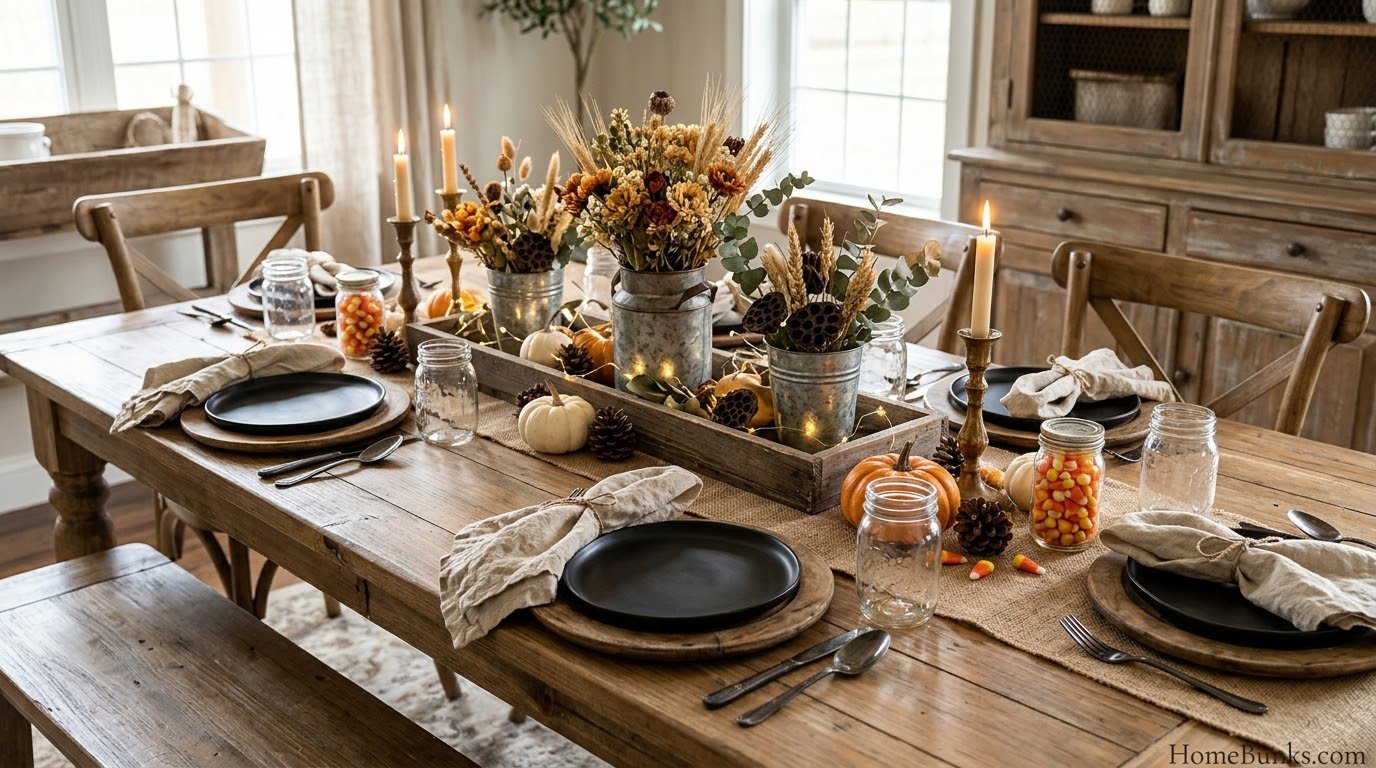
Not every table needs owning, and the kit logic extends naturally to borrowing with intention.
Hosts in the same circle can pool the hardware: one owns the brass, one the chargers, one the black cloth.
Borrowed pieces return cleaned and counted, with the charger separators and the candle wax already handled.
Rental houses stock the glamour register’s chargers and glassware for weddings, and Halloween inherits that supply.
The register you host in most is the register worth owning; the others can stay borrowed indefinitely.
Frequently Asked Questions
1. What are the layers of a Halloween tablescape?
Four layers, in order. The base goes down first, then the centerpiece hero, then candles, then the place settings that connect decor to dining.
2. What goes on a Halloween table first?
The base layer. A cloth, runner, or kraft foundation sets the register and gives every later layer something to sit on.
3. What makes a good Halloween centerpiece?
One dramatic hero inside the sightline. A low cluster of pumpkins, dark florals, or a cauldron that anchors the eye without blocking the guests.
4. How tall should a Halloween centerpiece be?
Below 10 inches, per the step styling guide. Cut stems short or split the arrangement into low vessels spaced along the center.
5. Why do centerpiece height rules exist?
So guests can talk across the table. Seated eye level is the constraint, and anything above it taxes every sentence of the dinner.
6. What candles are best for a Halloween table?
Black tapers at varied heights for gothic, orange pillars for classic. Add votives along the runner, and keep colors inside the register.
7. Are real candles safe on a Halloween table?
Only inside a clear perimeter. Keep real flame away from kraft, gauze, dried florals, and napkins, and use stable holders in clear zones.
8. Where should flameless candles be used on a table?
Anywhere fabric, paper, or dried material sits. The runner zone, pumpkin tea lights, and the kid table all belong to flameless.
9. What is the elegant gothic Halloween table look?
Black and burgundy with brass. A black base, low dark florals in tarnished vessels, black tapers at varied heights, and black plates.
10. How do I make a Halloween table elegant, not tacky?
Register discipline fixes tacky. Choose one palette, repeat it at every place, and let texture and candlelight supply the richness.
11. What is a charger plate and do I need them?
A charger is the large underplate anchoring each setting. The step guide’s checklist uses matte black 13 inch chargers under stoneware plates.
12. What order does a Halloween place setting go in?
Charger, dinner plate, folded napkin, signature object. A baby boo pumpkin crowns the stack in the step guide’s photographed build.
13. What do you put at each place setting for Halloween?
One small signature object. A mini pumpkin, a mini cauldron of candy, or a folded ghost napkin gives every guest the same intentional note.
14. What is a baby boo pumpkin used for on a table?
It crowns the place setting stack. One small white pumpkin per place reads as intention and costs almost nothing per seat.
15. How do you style a pumpkin centerpiece?
Cluster pumpkins in odd numbers. Groups of three, five, or seven, mixing sizes, shapes, and heirloom colors down the table’s center.
16. Why group pumpkins in odd numbers?
Odd groups read as styled, even groups as stored. The eye reads odd clusters as arrangements and even rows as inventory.
17. What is a cauldron centerpiece and is dry ice safe?
A cauldron is the witch register’s hero. Fill it for fog with dry ice under standard care, or for glow with ornaments and fairy lights.
18. What can I use instead of dry ice in a cauldron?
Battery fairy lights and black ornaments. The glow version photographs the same, needs no refills, and removes the handling questions entirely.
19. What table runner is best for Halloween?
The one that matches your register. Velvet or linen for gothic, gauze for texture, spiderweb lace for pattern, kraft for classic and kids.
20. Is a tablecloth or a runner better for Halloween?
A cloth sets a stronger register, a runner keeps the table visible. Choose cloth for gothic drama, a runner when the wood should show.
21. What is a gauze or cheesecloth runner used for?
It is the table’s spine at low cost. Crushed gauze or cheesecloth puddles down the center, adding texture under every other layer.
22. How do I do a black and white Halloween table?
White base, black plates, striped napkins, white pumpkins. Refuse orange entirely and let graphic contrast carry the whole table.
23. How do I do a Halloween table without orange?
Run black and white, gothic burgundy, or pastel. The registers that skip orange entirely are chic, gothic, and the pretty lane.
24. What is the farmhouse Halloween table style?
Burlap, galvanized metal, wood, and mason jars. The farmhouse register layers natural textures with candy corn and fairy light fills.
25. What is the black and gold Halloween table style?
Black velvet pumpkins and gold everything else. Gold rimmed chargers, metallic flatware, and black tapers in gold holders define the glamour register.
26. How do I decorate a Halloween table for kids?
The classic register at playful volume. Kraft paper to draw on, mini cauldron favors, candy corn colors, and flameless light throughout.
27. How do I do Halloween table decor on a budget?
Yes, with the supply lines mapped. Thrifted brass, grocery florals, and dollar volume pieces carry the gothic and classic registers cheaply.
28. Where do I find cheap brass candlesticks?
Thrift and charity shops are the famous source. Mismatched aged brass at low prices is exactly what the gothic register wants.
29. Can grocery store flowers work for a gothic centerpiece?
Yes, dark tones are a grocery staple in fall. Burgundy dahlias and roses carry the gothic hero at dinner party prices.
30. How do I decorate a small dining table for Halloween?
Respect the footprint budget. One narrow low cluster, placemat scale bases, and fully flameless light keep a small table working.
31. What Halloween table decor works every night in October?
One runner, one cluster, one candle trio. The anatomy at minimum, lit nightly, gives the everyday table the season without a rebuild.
32. How do I stop a Halloween table looking cluttered?
Edit by the register. Remove everything that cannot name its layer or its register, and the table usually loses a third of its pieces.
33. Too much orange on my Halloween table, how do I fix it?
Add black and metal as counterweights. Chargers, holders, and a black base turn orange from a flood back into an accent.
34. What glassware suits a Halloween table?
Smoky black and amber glass suits the light. Goblets placed above the knife catch taper light, per the step guide’s styling.
35. What napkins work for a Halloween table?
Frayed linen in charcoal or a folded ghost. Cloth napkins carry texture, and the ghost fold costs nothing at all.
36. What is a ghost napkin fold?
A napkin folded into a small ghost at each place. The idea lists count it as a zero cost whimsy move with real charm.
37. What are apothecary bottles used for on a table?
They march down the center as a runner alternative. Amber and dark bottles read as a potion shop and replace the pumpkin centerpiece elegantly.
38. How far ahead can I set a Halloween table?
The base and hero keep for days, the settings hours. Build the center early, add perishables and place settings on the day.
39. What Halloween table pieces are worth buying on clearance?
Chargers, tapers, holders, and cloths. The hard kit stockpiles well on clearance, while fresh florals and trend pieces do not.
40. Can I reuse the same pieces in a different Halloween style?
Yes, with a base swap. The same pieces on a black cloth read gothic and on kraft read classic, if the pieces stay neutral.
41. What is the difference between a centerpiece and a tablescape?
A tablescape is the whole styled table. A centerpiece is only its hero layer, one of four in the full anatomy.
42. How do I photograph a Halloween table?
Shoot at dusk in candlelight. Frame the hero first, keep one shot with the settings complete, and let the glow do the work.
Conclusion
Halloween table decor reduces to an order and a number: four layers built in sequence, and nothing tall across the sightline.
Choose the register before the pieces, build base, hero, light, settings, and keep the flame inside its perimeter.
Start with the kit by layer: one base, one low hero, one candle trio, and one signature object per place.
Add the chargers and brass on clearance for next season, and the table you own gets better every year.
Set it once for a dinner party, then run the everyday version all October. The anatomy scales down gracefully.


