
Cream and warm wood kitchen ideas describe a pairing, not a palette: one warmth is painted on, in cream’s yellow undertone, and the other is grown in, in the wood’s grain.
The pairing works when the two undertones agree in temperature, and nearly every failure comes from choosing the partners separately.
Three systems run this page: a wood depth ladder, a tone count that includes the floor, and an undertone matching chart.
The cream half of the pairing follows the warm white ladder in this site’s cream kitchen ideas guide; here the paint is treated briefly and the wood gets the depth.
Two Warmths, One Temperature
Cream’s warmth is a decision: white paint warmed with yellow or beige pigment, landing between LRV 74 and 90. Wood’s warmth is a fact of species: white oak grows tan, walnut grows chocolate, cherry grows salmon and deepens.
Because one warmth is chosen and the other is inherited, the matching direction matters. You pick the cream to suit the wood you have or want; you rarely pick a species to suit a paint chip, because the wood is the expensive partner.
Temperature agreement is the whole test. A yellow cream beside a yellow warm wood reads as one system; the same cream beside a pink red oak reads as an argument neither side started.
The Wood Depth Ladder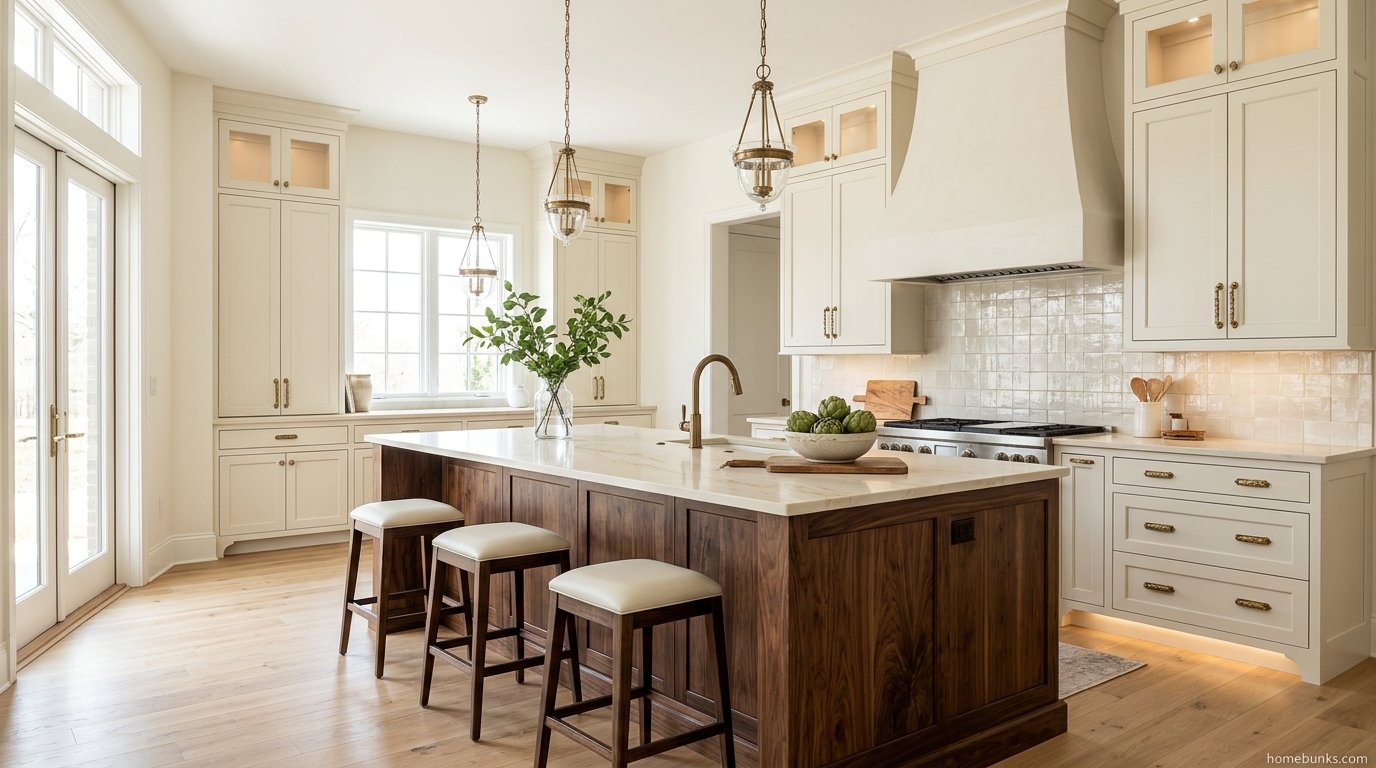
Woods sort by depth the way creams sort by LRV, and the ladder is the pairing’s map. Every kitchen in this scheme is a choice of one rung to lead and, at most, one rung to support.
|
Rung |
Woods |
Character |
Best cream partners |
|---|---|---|---|
|
Pale |
White oak, maple, ash |
Light, calm, modern friendly |
White Dove, Alabaster class muted creams |
|
Mid |
Honey oak, wheat stained oak, aged cherry |
Golden, traditional, present |
Muted creams, never saturated |
|
Deep |
Walnut |
Chocolate, formal, anchoring |
Simply White, White Dove bright creams |
White oak leads the pale rung because its undertone is the most neutral of the warm woods, tan with a slight olive calm. It is the wood least likely to fight any cream on the ladder.
Walnut owns the deep rung alone at this quality level. Its depth is the pairing’s built in anchor, which is why walnut so often takes the island while cream takes everything else.
The mid rung is the renovation rung, where existing honey oak and aging cherry already live. Most real kitchens start here, whether they planned to or not.
The Tone Count
Count every wood tone in the room, including the floor, and hold the total to two or three. One tone leads by surface area, one supports, and a third may appear only as a repeated accent.
Houzz’s documented wood cabinet remodels prove the count can stretch to three beautifully. One documented kitchen runs rift sawn white oak cabinets, a walnut island, and red oak floors together, and it works because the three form a ladder rather than a crowd.
The same feature documents the subtler move: those red oak floors were refinished with a hint of whitewash. The floor was edited toward the ladder, which is what you do to a tone that belongs but does not yet behave.
The overflow valve is paint. When a fourth wood tone appears (a table, a hutch, inherited stools), painting it cream keeps the count honest without discarding the piece.
Undertone Matching: The Chart That Decides
Match temperature first, depth second, and use the species’ undertone, not its marketing name. This chart is the pairing’s decision in one view, built from the designer pairings and documented kitchens in the research.
|
Wood |
Undertone |
Cream to choose |
Cream to avoid |
Note |
|---|---|---|---|---|
|
White oak |
Tan, near neutral |
White Dove, Alabaster |
None strongly |
The forgiving partner |
|
Walnut |
Chocolate, cool brown warmth |
Simply White, White Dove |
Deep creams |
Needs brightness against it |
|
Maple |
Honey, gentle yellow |
Muted creams |
Saturated yellows |
Sameness risk in warm light |
|
Honey oak |
Orange, strong |
White Dove class muted |
Cloud White class warm |
Moderate with matte finish |
|
Red oak |
Pink to red |
Greige mediators, Shoji White |
Yellow creams |
Refinish toward wheat if fixed |
|
Cherry |
Salmon, deepening |
Muted creams |
Matching to year one color |
It will darken; plan for year three |
The chart’s hardest row is red oak, the floor in millions of homes. Its pink is the undertone least compatible with yellow cream, which is why refinishing it toward the ladder is a documented move rather than a defeat.
Cut and Grain: The Quiet Differentiator
Two kitchens in the same species can look unrelated because of how the log was sawn. Plain sawn boards show cathedral grain, the arched figure most people picture as wood; rift sawn boards run straight and linear.
The rule this page promotes to doctrine comes from designer Carrie Lucke’s cabinet finish guidance: choose the cabinet cut to contrast the floor cut. Most floors are plain sawn, so rift or quarter sawn cabinets differentiate the cabinetry from the floor beneath it.
Modern walnut follows the same logic: rift or quarter cuts, straighter grain, cooler neutral browns. Traditional walnut runs plain sawn, with cathedral movement and redder browns, warmer and heavier by cut as much as by species.
In a cream kitchen the cut choice is also a style choice. Straight grain keeps the wood calm enough for minimal rooms; cathedral grain belongs to traditional rooms where movement is welcome.
Finish Is a Color Decision
The finish changes the wood’s temperature after every other decision is made. Clear matte or satin water based finishes seal white oak while keeping it light, which is why the current wood look reads pale and natural.
Oil based finishes amber the wood, pushing pale oak toward honey and honey toward orange. That may be the plan in a traditional room, but it must be chosen, not discovered after installation.
The 1990s oak that gives wood kitchens a bad name is largely a finish artifact: orange stain under gloss. Today’s warm wood is the same family of species under matte, natural finishes, a different era produced by a different topcoat.
Sample the species with its actual finish, always. Showroom wood is unfinished or differently finished, and the finish is half the color you are buying.
Placements: Where the Wood Goes
The island is wood’s headline placement, rationing the deep or mid rung to the room’s center. Melanie Jade Design’s warm wood kitchen ideas catalogues the placement logic well: a wooden island changes a pale kitchen’s balance completely, without touching the perimeter.
Wood lowers with cream uppers ground the room: the wood takes the wear zone and the visual weight, cream keeps the eye level bright. Glass front uppers in cream frames, with seeded glass as in the documented oak kitchen, extend the scheme upward.
Open shelves are the small budget’s best wood: high visibility, daily use, and texture at hand scale. A shelf rail in the lead wood warms a cream kitchen more honestly than any accessory.
The range hood is the focal placement: white oak or reclaimed wood against cream cabinetry, or the documented alternative, a cream plaster hood against wood cabinetry, as in the maple kitchen discussed below.
Beams, stools, and boards are the repetition layer. The island’s wood should reappear at least once, usually at the stools, because wood used once reads as an accident and wood used twice reads as a scheme.
The Island and Floor Rule
The pairing’s most expensive mistake is matching the island to the floor. Same species, same tone, same cut: the two largest horizontal surfaces merge into one wood mass and the room’s architecture flattens.
Differentiate by at least one variable: tone (walnut island over oak floor), cut (rift island over plain floor), or material (painted island over wood floor). Every documented kitchen in the research differentiates, including by refinishing.
If the floor is the fixed mid rung wood, the island should usually be cream or walnut, the two exits from the middle. A mid wood island on a mid wood floor is the matchy slab at its most expensive.
Counters and Backsplash: The Bridge Materials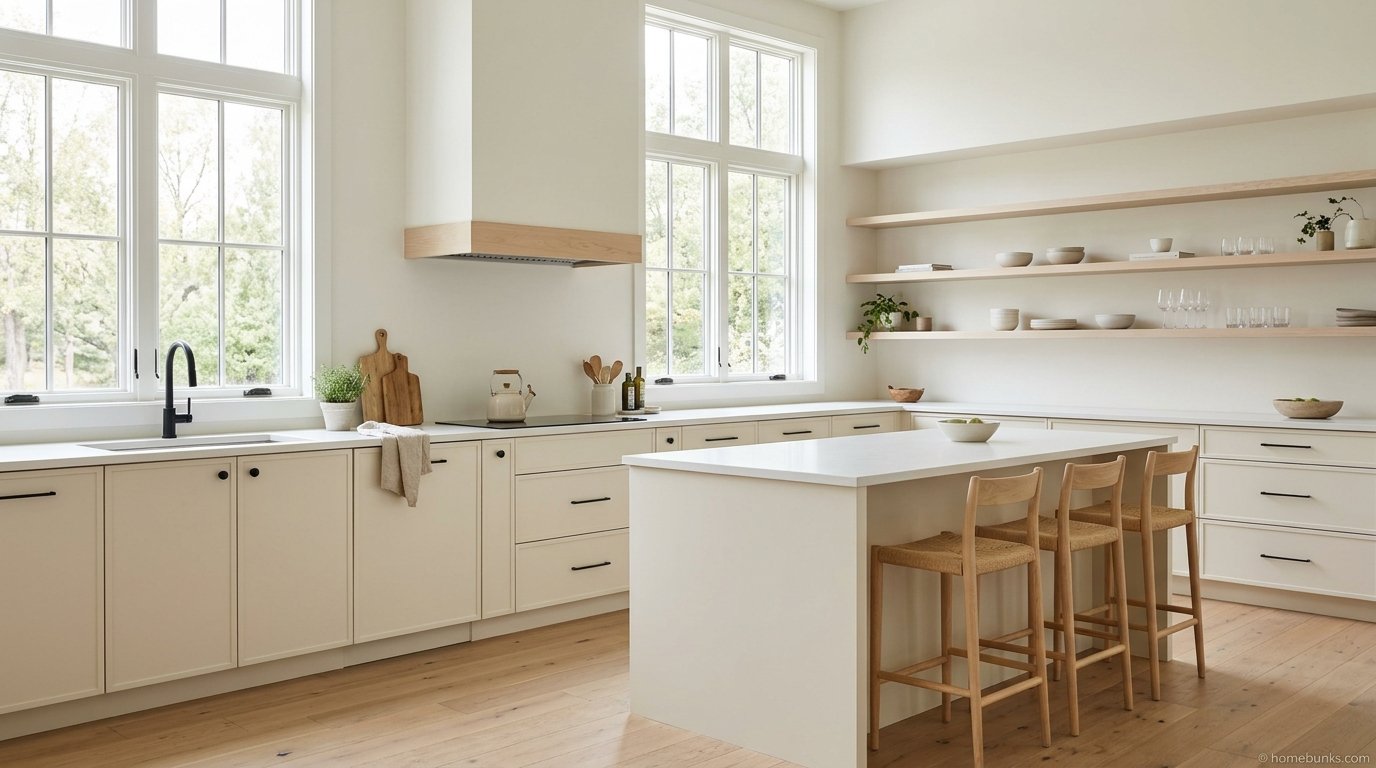
Taj Mahal quartzite is this scheme’s signature stone because its ground is creamy and its veining is amber: cream’s color and wood’s warmth in a single surface. Creamy quartz with faint amber veins makes the same bridge beside walnut in the designer pairing tables.
Butcher block doubles the wood where the ladder has room for it, usually as a section rather than a full run. Black counters are the documented depth move, supplying the contrast in the maple kitchen where everything else is pale and warm.
The backsplash should let grain stay the loudest texture: handmade zellige style tile in cream or warm white, its variation rhyming with grain rather than competing. One texture leads; the tile supports with sheen.
Metals: The Third Temperature
Hardware is where the scheme’s temperature gets handled daily, so it follows the same rule. Unlacquered brass and antique bronze are the documented warm choices, with bronze appearing in the maple kitchen’s credits.
Matte black is the modern accent, documented against light oak and pale cabinets. It works because black is temperature neutral; it anchors without cooling, the metal version of the walnut move.
Polished chrome is the leak: a cool, blue bright metal in a warm system. One chrome faucet will not ruin a kitchen, but chrome everywhere quietly reopens the stark era this scheme replaced.
Two Rooms Read Closely
The all maple kitchen in Houzz’s documented wood cabinet remodels runs maple Shaker cabinets as the lead wood, a cream colored plaster range hood breaking the uppers, zellige style tile, and black Silestone counters for depth.
Cream here is the mediator, wood is the room, and black is the punctuation.
Its lesson is the dose inversion: when wood leads at full run, cream does not need cabinets at all. A hood, walls, and textiles in cream are enough to keep a wood kitchen from going heavy.
The oak and walnut kitchen by Verce Design runs the ladder itself: rift sawn white oak perimeter, walnut island, whitewashed red oak floor. Three woods, three rungs, one temperature, and a glass front tower matching the island to give the deep rung its repetition.
Its lesson is hierarchy: the pale wood does the square footage, the deep wood does the focus, and the floor is edited to support both. Nothing matches; everything agrees.
Styles: The Pairing in Four Registers
Warm minimalism is the modern register: slab veneer fronts, book matched grain as the only ornament, cream walls, matte everything. The pairing is doing the decorating that objects do in other styles.
Scandinavian takes the palest version: ash and white oak, the brightest creams, grain kept quiet. The same pale wood and warm white discipline organizes Scandinavian bedroom ideas, where the pairing rests instead of cooks.
Japandi admits the deep rung and moodier creams, mixing light and dark woods on purpose. The boundary is discipline: Japandi is curated contrast, not permission for a fourth tone.
Farmhouse and traditional registers carry the mid rung proudly: honey and maple, beadboard, apron sinks, bronze. These styles can hold more wood than modern rooms because abundance is their contract, but the temperature rule still governs.
Renovation One: Add Wood to a Cream Kitchen
Start with the audit of what is already warm: floors, stools, a table. Many cream kitchens already own one wood tone and only lack the decision to repeat it deliberately.
Then add in order of visibility: shelves or a shelf rail, stools in the floor’s family, a butcher block section, and only then the island conversation. Each step is livable and reversible until the scheme proves itself.
The white kitchen version of this renovation fills Melanie Jade Design’s warm wood kitchen ideas, and the cream version is easier: cream is already warm, so the wood needs to supply texture and depth, not rescue the room from cold.
Renovation Two: Add Cream to a Wood Kitchen
The reverse rescue serves the heavy wood room: good cabinets, too much grain, not enough light. Keep the wood run and add cream at the walls, the hood, or a painted island or hutch.
Painting the island cream is the single highest leverage move: it breaks the wood mass at the room’s center and gives the remaining wood a pale partner to play against.
This is also the honey oak rescue in full: perimeter painted cream, island or floor kept as the mid rung lead, gloss swapped for matte, hardware moved to brass or bronze. The oak stays; the era leaves.
The Three Failures
Undertone anarchy is partners chosen separately: orange oak, pink toned cream, gray floor, each fine alone. The cure is the chart, applied to the fixed elements first, because the survivors vote loudest.
Wood soup is the count broken: five tones, no lead, a lumber aisle with appliances. The cure is hierarchy surgery: demote by paint, refinish toward the ladder, repeat the survivor until it reads chosen.
The matchy slab is island and floor merged. The cure is one variable of differentiation, cheapest by refinishing the floor or painting the island, and it transforms rooms that felt vaguely wrong for years.
Paired Sampling
Sample the pairing as a pair: the painted cream board against the actual wood sample, with its actual finish, at cabinet height, across a full day. Add the counter and the hardware to the same session before deciding anything.
Judge at the warmest hour and again under evening bulbs, because this scheme lives for its evening glow and must not tip orange to earn it. Relationships cannot be sampled one material at a time.
The same temperature discipline runs through cream bathroom ideas, where warm whites meet wood vanities under the same rules. One ladder for the house, learned once, applied everywhere.
Costs, in Kind
No verified dataset prices this pairing, so the honest structure stands in for figures. Paint is the cheap warmth and wood is the expensive one, and the scheme’s budget is mostly the decision of how much wood, of what species, at what cut.
Rift sawn white oak and walnut sit at the custom end; paint grade cream cabinetry and a staged wood plan sit at the other. The standard path buys the island first and lets shelves and stools arrive as the budget recovers.
An open plan carrying this scheme into white and beige living room ideas spends the wood once and warms two rooms with it. Continuity is not only an aesthetic rule here; it is the budget’s best friend.
Wood in the Wet and Hot Zones
Kitchen wood has zones of risk, and placing it well means respecting them. The splash zone behind the sink and the steam zone at the range punish finishes and joints, which is why tile and stone hold those walls in most documented rooms.
Shelves and hoods sit safely above the splash line. Butcher block accepts the work zone knowingly, trading scheduled oiling and eventual sanding for warmth exactly where hands spend the day.
Cabinet wood beside the dishwasher and sink lives on its finish system, not on hope. Modern conversion varnish and waterborne cabinet finishes are engineered for this; site finished wood in wet spots is the gamble to avoid.
Antique and Reclaimed Wood
An antique wood piece is the accent tone with a biography: a farmhouse table as island, a reclaimed pine shelf run, an old hutch painted cream on its outside and left wood within.
The galleries return to this move because age is texture no mill can fake.
Reclaimed wood needs the same discipline as new: count it in the ladder, check its undertone against the chart, and repeat it once. A single storied piece can lead the room if the other woods step back to support.
Its practical cautions are real: verify lead era finishes before sanding old painted wood, and expect reclaimed boards to move and vary. In this scheme, variation within one tone is character; variation across tones is soup.
The Staged Wood Budget
Wood money spends best in order of visibility per dollar. Shelves and stools arrive first, warming the room at hand scale for the price of a single cabinet.
1. Shelves, stools, boards: the repetition layer, bought in a weekend.
2. The hood or a beam: the focal layer, one carpentry project.
3. The island: the commitment layer, species and cut chosen with the ladder in hand.
4. The full wood run: the final dose, usually part of a full renovation rather than an addition.
Each stage is a complete room if the budget pauses, because the ladder was decided before stage one. Staging fails only when pieces are bought without the ladder, which is wood soup acquired in installments.
Open Plan: One Ladder, Two Rooms
Open plan homes make the tone count stricter, not looser, because the living room’s furniture joins the count visually. A walnut island, oak floors, and a teak media unit are three tones before a single dining chair arrives.
The discipline that works: the kitchen’s lead wood becomes the open floor’s lead wood, repeated in the dining table or shelving, and the living side’s other woods stay at accent scale.
Cream is the peacemaker here, covering the surfaces that would otherwise demand to be wood. The more open the plan, the more valuable the overflow valve becomes.
Grain Direction and Scale
Grain has a direction, and the room reads it. Vertical grain on tall cabinets stretches the room upward; horizontal grain on an island’s long face stretches it outward, which is why island panels usually run their grain along the island’s length.
Scale matters as much: wide cathedral figures suit large traditional fronts, while small shaker frames want quiet, straight grain that does not crowd the rails. Slab modern fronts want the straightest grain of all, or book matching to make the figure intentional.
Mixing grain scales carelessly is the quiet version of wood soup: one species, two scales, no agreement. Decide the grain story per placement the way you decide tone per room.
When Paint Grade Is the Right Wood
Not every cabinet in this scheme should be a species showcase. Paint grade wood (maple or poplar built to be painted) is the honest material under cream, smoother than grain telegraphing through enamel.
The scheme’s craft rule: spend species money only where grain will show. Painted perimeters in paint grade, island in rift oak, is not a compromise; it is the ladder expressed in the budget.
Veneer sits in the same honest family: stable, book matchable, and premium where the figure matters. Solid wood everywhere is a preference, not a quality threshold, and in wide slab panels it can be the less stable choice.
Pantries and Second Spaces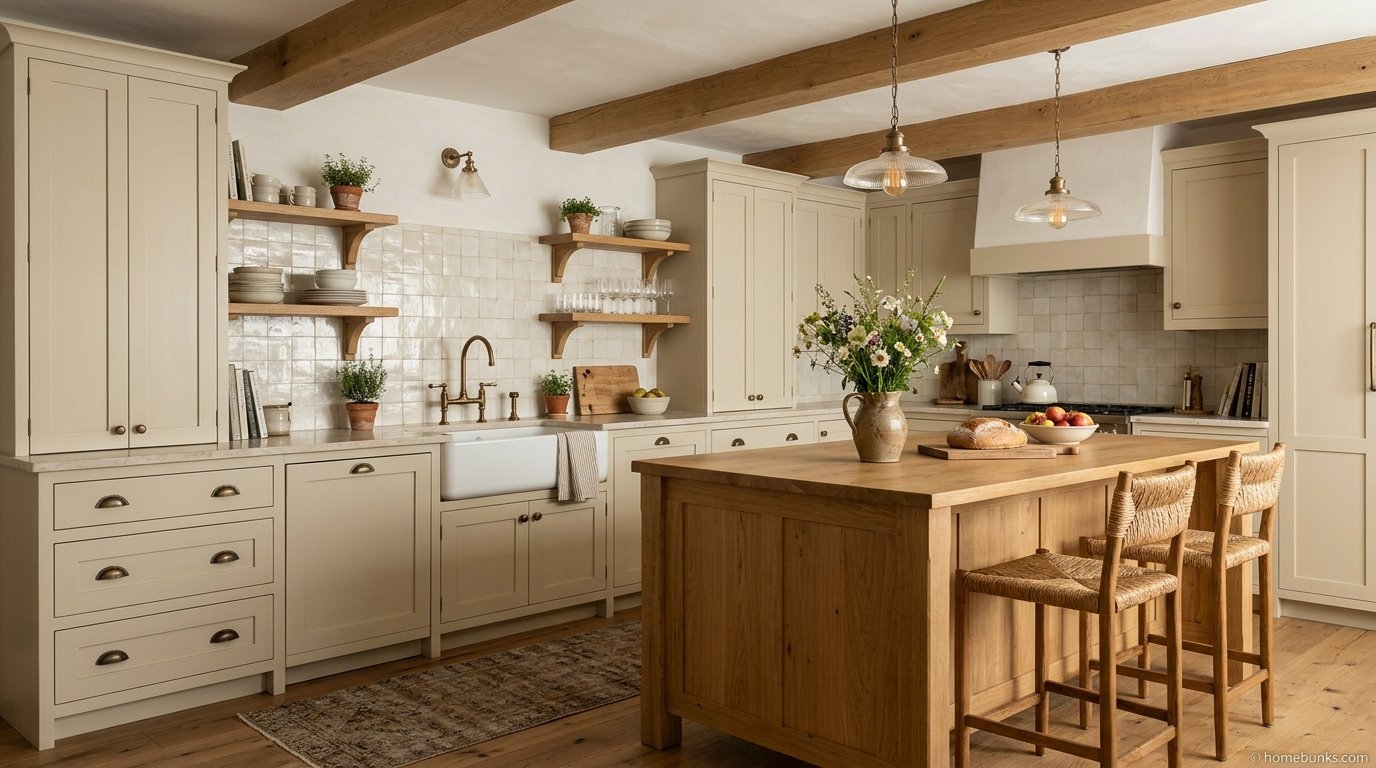
The pantry is the pairing’s playground: a small room where a deeper wood or a bolder dose costs little and teaches much. Walnut shelving inside a cream pantry is the scheme in miniature, and it previews an island decision at shelf prices.
Laundry and mudroom cabinetry extends the ladder into the house’s working rooms, usually at the pale rung where light is scarce. Cream uppers over a wood bench is the two tone at its most practical.
Treat these rooms as samples at architectural scale: live with the pairing where the stakes are low, and the kitchen decision becomes a confirmation instead of a gamble.
A Note on Wood Look Materials
Wood look laminates and textured melamines have earned a place in this scheme at the budget and rental end. The honest rules: their printed grain repeats, so keep them at small scale (drawer banks, a pantry) where the repeat stays invisible.
Judge them by the same chart: undertone temperature first, and a matte finish always, because gloss is where imitations confess. Beside real wood, place them at a different rung so the eye compares depth, not authenticity.
Used this way they are the overflow valve’s cousin: warmth where solid species money makes no sense, inside a ladder that keeps them honest.
Carrying the Temperature Through the Home
The pairing generalizes: warm white plus one warm material, repeated with discipline, is a house language. Kitchens take it at full dose, baths at vanity scale, bedrooms in oak and linen.
The warm neutral half of the language at bathroom scale lives in warm beige bathroom ideas. The wood half scales down to a vanity, a mirror frame, a stool, the same ladder at smaller square footage.
And for the reader whose warmth eventually wants a color attached, sage green kitchen ideas is the cluster’s other exit, where the same warm whites hand the room to a gray leaning green instead of a wood.
The wider HomeBunks library treats every room this way: one temperature, chosen for the light, carried honestly. Learn the pairing once and the whole house starts agreeing with itself.
Frequently Asked Questions
What is a cream and warm wood kitchen?
A kitchen pairing warm white cabinetry or walls with natural warm wood as the second material: island, floors, shelves, beams, or a full wood run.
It works because both share a temperature: cream’s warmth is painted, the wood’s is grown.
What wood goes best with cream cabinets?
White oak is the current default: pale, warm, straight grained, bright enough for cream.
Walnut is the depth choice and maple the traditional one. Match the wood’s undertone temperature to your cream.
White oak or walnut with cream cabinets?
Choose by light and job. White oak keeps the scheme pale and modern and suits small or dim kitchens.
Walnut supplies the anchor: contrast and formality for larger, brighter rooms. One documented kitchen runs both.
What is rift sawn white oak, and why does it matter in a kitchen?
A sawing method producing straight, linear grain with minimal cathedrals, so cabinetry reads modern and calm.
It also differentiates cabinets from plain sawn floors. Designer guidance: contrast the cabinet cut with the floor cut.
Can you mix wood tones in a kitchen?
Yes, with a hierarchy: one lead wood, at most two supporting tones including the floor, all in one temperature family.
Mixing fails when two woods share a depth but not an undertone: the wood soup effect.
How many wood tones should a kitchen have?
Two to three, counting the floor. One lead, one support, optionally one accent repeated in small pieces.
Beyond three, paint the newcomer cream: the pairing’s built in overflow valve.
What cream paint pairs with white oak?
The muted warm creams: White Dove OC-17, LRV 83.16, is the trade default beside white oak.
Alabaster and the greige mediator Shoji White also pair well. Sample the board against the actual oak.
What cream paint pairs with walnut?
Brighter creams, to hold walnut’s contrast: Simply White, LRV 89.52, and White Dove lead.
The cream must be clearly brighter than the walnut is deep, or the pairing goes muddy in the middle.
Does honey oak work with cream?
Yes: it is the renovation pairing. Paint some elements cream and keep the oak where it performs.
Use a muted cream, because honey oak’s orange undertone is the strongest temperature in the room. Matte finishes moderate it.
Are 1990s orange oak cabinets fixable into a cream and wood kitchen?
Often, by reduction: keep oak at the island or floors, paint the perimeter cream, swap gloss for matte, update hardware to brass or bronze.
The era’s problem is finish, glossy and orange, before it is species.
What countertop works in a cream and wood kitchen?
Warm veined stone bridges: Taj Mahal quartzite and creamy quartz with amber veins carry cream’s color and wood’s warmth together.
Butcher block doubles the wood. Black counters are the documented depth move.
What backsplash suits cream and wood?
Handmade character tile leads: zellige style in cream or warm white, its variation echoing the wood’s grain.
Warm white subway is the quiet default. A wood panel section is the bold move, kept off the wettest zone.
What hardware works with cream and wood?
Warm metals: unlacquered brass, antique bronze, brushed copper tones, completing the temperature system.
Matte black is the modern accent. Polished chrome is the cooling risk this scheme replaced.
What flooring works in a cream and wood kitchen?
The floor is a tone in the count: pale oak under walnut islands, mid oak under cream cabinets, cut or tone differentiated from wood cabinetry.
Handmade clay and limestone look tiles are the documented non wood floors.
Should the island match the floor?
No: match is the failure mode. Same species, tone, and cut read as one wood mass and flatten the room.
Differentiate by tone, cut, or material. Documented kitchens all differentiate, one by whitewashing its floor.
Cream cabinets with a wood island or wood cabinets with cream walls?
Both, at different doses. Cream cabinets with a wood island stay lighter and read resale neutral.
Wood cabinets with cream walls run warmer and more crafted. Dim rooms favor cream leading.
What about wood lowers with cream uppers?
The grounded two tone: wood lowers carry the wear zone and weight, cream uppers keep the eye level bright.
Glass front uppers in cream frames extend it. Keep both undertones in one temperature.
Can cream and warm wood work in a small kitchen?
Yes, at the pale end of both ladders: bright creams with white oak or maple rationed to shelves, stools, and a block section.
One wood, repeated three times small, warms without spending the room’s light.
Can cream and warm wood work in a modern kitchen?
It is modern’s current form: warm minimalism. Slab wood veneer fronts, cream walls, matte finishes, honed stone.
The discipline is grain control: rift cuts, minimal cathedrals, no rustic distressing.
What is the difference between white oak and red oak in a kitchen?
Undertone and grain. White oak runs tan brown, slightly neutral, tighter grained, and takes clear finishes without pink.
Red oak runs pink to red with open, cathedral prone grain: the pairing risk beside yellow creams.
Does cherry wood work with cream?
With knowledge: cherry starts salmon pink and darkens with light toward deep red brown over months to years.
Young cherry’s pink can clash with yellow creams; aged cherry pairs like a mid walnut. Expect the deepening.
What finish keeps white oak looking light?
Clear matte or satin water based finishes: they seal without adding amber.
Oil based finishes amber the wood toward honey. Sample the species with the actual finish before ordering.
How do I match a stain to my cream?
Temperature first, depth second: hold the stained sample against the painted cream board in the room’s light.
Honey, caramel, and wheat stains sit naturally with creams. When in doubt, go paler and matter.
What is wood soup and how do I fix it?
Too many unrelated wood tones at similar depths: the kitchen reads as a lumber aisle, nothing leading.
Fix by hierarchy surgery: pick the lead, paint one tone cream, refinish one toward the ladder, repeat the survivor.
Where should wood appear if I can only add a little?
At hand and eye scale: open shelves, stools, a butcher block section, then a hood or beam.
Wood used once reads as an accident. Even small wood must appear at least twice.
What metals and stone complete the scheme?
The supporting cast, all warm: brass and bronze, Taj Mahal quartzite and warm veined marble, handmade cream tile, linen and cane.
Every material should answer one question: is your undertone warm?
Is cream and warm wood a trend or timeless?
The materials are timeless; the current configuration is the trend expression. NKBA’s 2027 reporting, via trade coverage, keeps natural wood a leading direction.
Build the timeless version and photographs will call it the trend.
What does a cream and warm wood kitchen cost?
No dataset prices the pairing, so the answer is structural: painted cream is the budget lever, natural wood the premium lever.
Staging the wood, island now and shelves later, is the standard budget path.
Can I keep my wood cabinets and just add cream?
Yes: the reverse renovation. Keep the wood run, add cream at walls, hood, or a painted island.
Cream supplies the light the heavy wood room lacks, and the undertone audit makes it a scheme.
What lighting suits cream and wood?
The 3000 to 3500K band, with a wood note: warm light enriches grain, and the evening glow is this scheme’s best hour.
Judge the pairing at the warmest hour, as with cream alone.
How do I care for wood in a kitchen?
By zone: butcher block needs scheduled food safe oil and renews by sanding; cabinet finishes need gentle cleaning only.
Water is the enemy at joints and end grain. Maintenance is the patina’s price.
What is book matched veneer and where is it used?
Veneer leaves from one log opened like a book so grain mirrors across the seam, used on slab fronts and island panels.
It is the modern register’s signature: quality veneer on stable cores is a premium material, not a compromise.
Cream and wood in a farmhouse kitchen?
The native register: cream shaker cabinetry, a wood island, open shelves, apron sink, brass or bronze, handmade tile.
Farmhouse can carry deeper woods and more of them. The temperature rule still governs.
Cream and wood in a Scandinavian or Japandi kitchen?
Scandinavian: palest woods, ash and white oak, brightest creams, maximum light.
Japandi: deeper and earthier, walnut enters, creams go moodier. Dark gray cabinets pull a scheme out of the pairing.
What backsplash tile color bridges cream and wood?
Cream tile a step brighter or deeper than the cabinets, warm white handmade tile, or the stone carried up.
Let sheen supply contrast so the grain stays the loudest texture. One texture leads.
How do I sample cream and wood together?
As a pair, never separately: painted board against the actual wood sample with its actual finish, at cabinet height, across a full day.
Relationships cannot be sampled one material at a time.
What window treatments and textiles suit the scheme?
Linen cafe curtains or shades, woven wood and cane accents, rugs in warm natural fibers.
Textiles are the softness budget. Cool gray textiles are the common leak in a warm room.
Is a wood range hood practical with cream cabinets?
Yes: a documented move, the wood as a surround with a standard metal liner and ventilation inside.
The finish must be kitchen rated. The cream plaster hood is the alternative when the wood budget is spent.
What stools and furniture suit a cream and wood island?
Wood stools in the island’s tone or one step off, woven seats in cane, rush, or leather, linen upholstery for comfort.
The stool is usually the island wood’s required second appearance.
Can cream and wood work with stainless appliances?
Yes: steel is neutral enough when warm materials outvote it, and panel ready appliances are the full commitment.
The risk is cumulative cool: steel plus chrome plus gray counters can outvote a modest wood dose.
What is the biggest mistake in cream and wood kitchens?
Undertone anarchy: partners chosen separately, each lovely, together at war. Second is wood soup; third, the matchy island and floor.
All three are relationship failures, not product failures.
Will cream and wood date like the all white kitchen did?
The structure will not: painted cabinetry plus natural wood is centuries old. The details that date are the trend expressions, a slat profile or stain name.
Choose by your house’s light, and the kitchen ages like furniture.
Conclusion
Cream and warm wood kitchen ideas succeed on one agreement: two warmths, one temperature, the cream chosen for the wood, the wood counted with the floor, and the cuts and finishes treated as color decisions.
Get the agreement right and the materials do the decorating for decades.
Start with the pair, not the pieces: one cream board, one wood sample with its real finish, one full day of light. Then count your tones, name your lead, and let every later purchase answer to the ladder.