
Halloween bedroom decor carries a rule no other room in the house has: whatever you build in the afternoon still has to work at 11 pm, when someone is trying to sleep in it.
That single fact reorganizes everything. The bedroom is not a small living room. It is the one room judged twice, once for how it looks and once for how it sleeps.
Two halves do the decorating. Bedding does one half, because the bed is the largest surface in the room. Light does the other half, because the room is mostly experienced after dark.
This page runs those halves under a set of sleep rules, then calibrates the same system three ways: for a grown-up bedroom, for a kids room that must stay nightmare free, and for teens and guests.
For the whole house version, zones and palettes across every room, the cluster’s halloween home decor page is the parent system this room plugs into.
Halloween Bedroom Decor: The Short Answer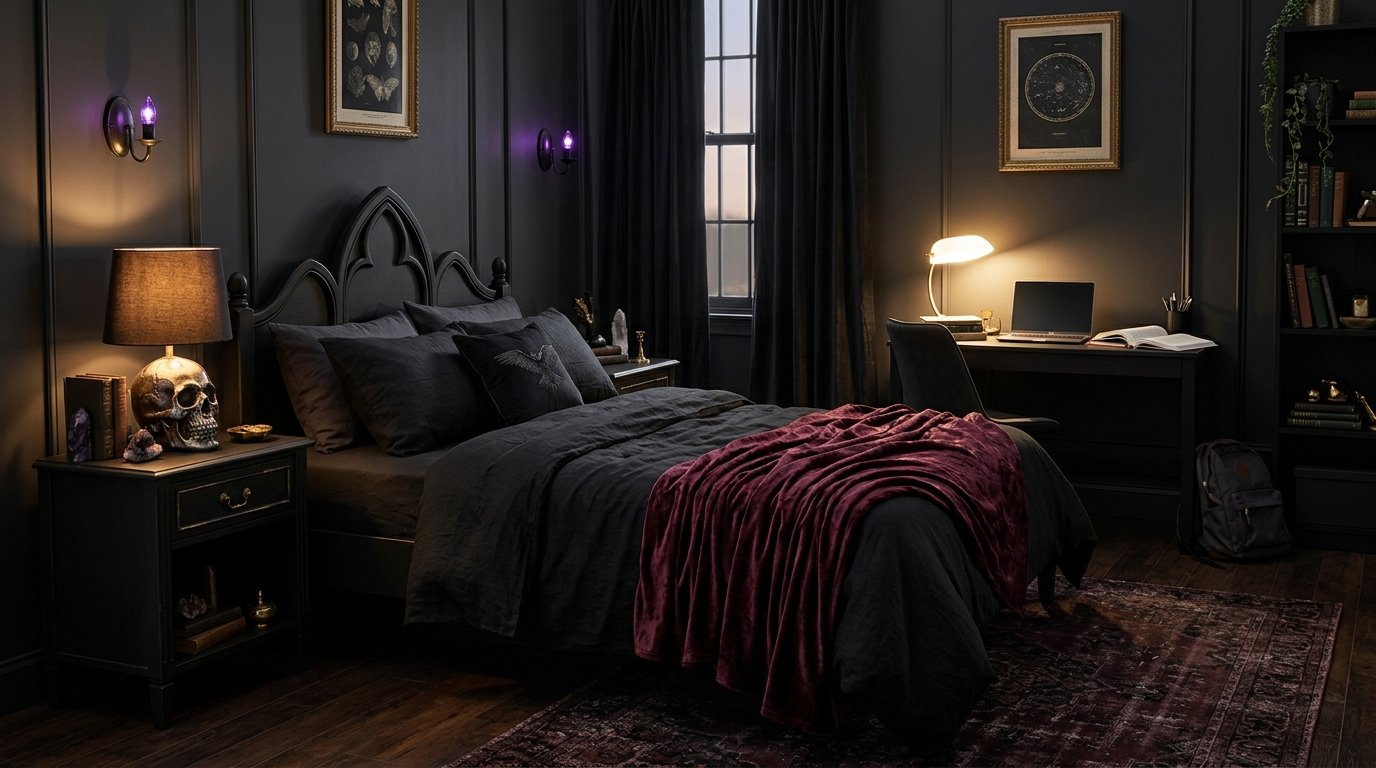
Swap the bedding, fix the light, style one or two surfaces, and pass every piece through the sleep test: would this help or hurt someone sleeping here tonight?
|
Decision |
The working answer |
|---|---|
|
Where the effect comes from |
Bedding about half, light about half, surfaces the rest |
|
Cost tiers (Jenna Living strand) |
Basics $25 to $75; a real makeover $100 to $250 |
|
Time |
About 30 minutes for a refresh; 2 to 4 hours for a full styling |
|
Surfaces that matter |
Bed and headboard, nightstands, dresser, mirror, windowsill, shelves, reading corner, door |
|
Candle rule in a bedroom |
Flameless by default; real flame is not a bedroom material |
|
Kids rule |
Friendly faces, warm white glow, nothing that startles in the dark |
The cost and time figures come from the Jenna Living bedroom guide, the only top ranking source that prices and times the room. They are her strands, printed as hers.
The Sleep Rules
Every piece in this article answers to five rules. They are what separate a bedroom from a display.
Rule One: Light Goes Down, Not Up
Halloween light in a bedroom must be dimmer than normal light, never brighter. Warm fairy lights, a colored bulb at low output, flameless clusters: all of them sit below the brightness of the lamp they replace.
Anything that flashes, strobes or pulses fails the rule outright. In a living room it is atmosphere; in a bedroom at midnight it is a sleep problem wearing a costume.
Rule Two: Timers End the Night
Bedroom lights run on timers, so the glow is a phase of the evening, not the state of the night. The room is lit for the wind down and dark for the sleep.
The Modern Caves bedroom guide makes the same point from the decorating side: set headboard lights on a timer so the bedroom glows by itself at dusk, and by extension, stops glowing on its own later.
Rule Three: Scent Stays Light or Leaves
A bedroom is where fragrance has the least room to hide. Strong scented candles that work in a living room sit six feet from a pillow here, all night.
The working rule: scent in a bedroom is one faint source or none, and flameless or unlit pieces carry the look. Jenna Living notes her own version of the fatigue: she switched to a cedarwood candle after getting sick of pumpkin spice by week two, three years running.
Rule Four: Nothing Loose Over the Bed
Garlands, bats and suspended pieces over a bed get anchored at both ends and the middle, hung above head height when sitting up, and checked with a tug before the first night.
Anything that can drift, swing into a face, or drop onto bedding fails. Over the bed, decor is fixed or it does not go up.
Rule Five: Blackout Still Wins
If the room sleeps behind blackout curtains or shades, the decor works around them, never against them. Clings go on the glass the blackout does not cover, lights stay inside the room’s own surfaces, and nothing wedges a curtain open for the sake of a glow.
Half One: The Bedding Swap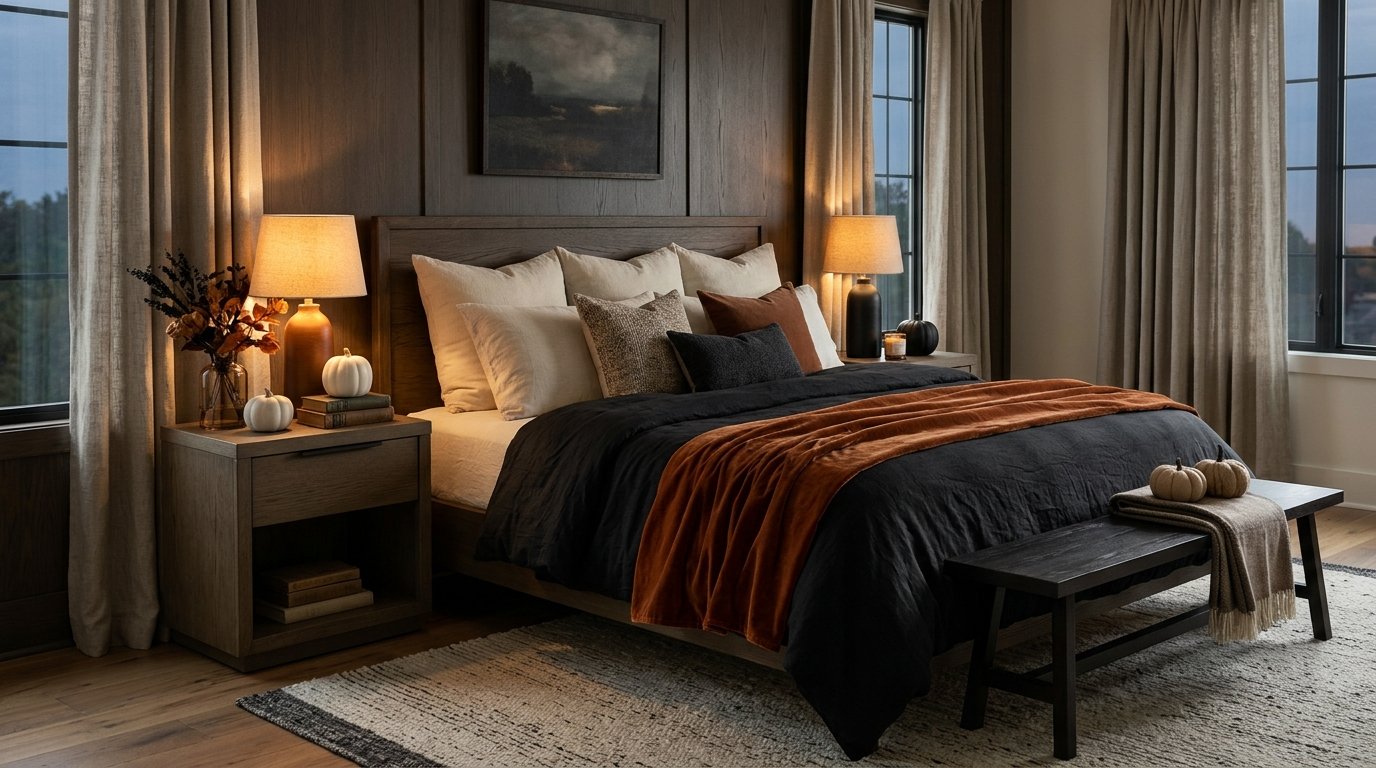
Jenna Living leads with bedding every year, in her words, because it is the biggest surface in the room and sets the tone before anyone looks at the walls. The Modern Caves guide gives textiles the same weight: roughly half the transformation.
The Duvet Cover Move
The core swap is a duvet cover, not a whole new set. Black or charcoal resets the room’s mood in one move, makes fairy lights glow brighter, and turns orange pumpkins into high contrast accents.
The Modern Caves guide adds the two disciplines that keep it livable: layer dark bedding with a lighter throw so the bed does not feel like a void, and keep the texture soft, washed cotton or velvet, so the bed invites sleep instead of staging a scene.
The Throw and Pillow Count
One throw across the foot of the bed carries the color story: burnt orange, deep rust or pumpkin, velvet or chunky knit, draped casually rather than folded flat.
Jenna Living counts the pillows: 2 to 4 throw pillows plus one throw does more work than ten small objects. Covers, not new pillows, keep the swap cheap and the storage flat.
Layers and Heat
October bedding fails in one predictable way: it gets too hot. Flannel sheets plus a chunky throw plus a duvet is a winter stack wearing a Halloween print.
Match the layers to the room’s actual temperature. In a warm room, the Halloween layer is the cover and the throw only, over the sheets you already sleep in.
Half Two: The Light
Fairy Lights Over the Headboard
A string of bat or pumpkin shaped fairy lights draped along the headboard is, in the Modern Caves guide’s words, the single fastest Halloween transformation a bedroom can get.
Its disciplines: drape in a loose swag rather than a tight line, choose warm white or amber because multicolor reads party rather than cozy, and prefer battery operated versions so no cord trails across the pillow.
The Colored Bulb Swap
Unscrewing the bedside bulb and fitting a purple or amber bulb is a five second change with an outsized effect. Purple reads gothic and playful; amber reads cozy and autumnal.
Keep one warm white bulb in the drawer for reading nights, per the same guide, and dim the colored bulb if it saturates. A little color goes a long way in a small room.
The Dresser Cluster
Flameless candles in amber glass holders, clustered at different heights on the dresser, give the bedroom its flickering heart with zero fire risk. Amber glass warms the light and hides the LED source.
Put the cluster on a tray so the arrangement moves as one unit, and run it on timers like every other bedroom light.
The Palette and Motif System
One palette and one motif run the whole room. Jenna Living’s cohesion rules are blunt: pick one anchor palette and stick to it across bedding, walls and tabletop pieces, pick one motif and repeat it rather than mixing all five, and keep big furniture neutral.
|
Lane |
Palette |
Motif that carries it |
Best for |
|---|---|---|---|
|
Cozy spooky |
Cream, black, rust |
Pumpkins |
Warm wood rooms, couples |
|
Moody gothic |
Black, burgundy, gold |
Bats or ravens |
Grown-up primary rooms |
|
Soft neutral |
Rust, tan, beige, touches of black |
Pumpkins and stems |
Fall-first households |
|
Cute kids |
White, orange, soft black |
Friendly ghosts |
Kids and shared rooms |
|
Pink |
Blush, cream, champagne |
Ghosts and soft bats |
Teens, playful rooms |
The motif repeats at three scales: large on the bedding or garland, medium on a surface piece, small on a decal or print. Repetition at scale is what makes a bedroom read designed rather than stocked.
The Surface Map
Jenna Living lists where a bedroom’s decor actually works: the bed and headboard, nightstands, dressers, mirrors, windowsills, shelves, a reading corner, and the bedroom door. Nothing on the ceiling, nothing on the floor.
|
Surface |
The piece |
The bedroom rule |
|---|---|---|
|
Bed and headboard |
Bedding swap, fairy lights |
The centerpiece; anchored lights only |
|
Nightstand |
Tray with mini pumpkins, one lantern or candle |
Keep the working half clear: water, book, alarm |
|
Dresser |
Vignette: lantern, amber bottle, books, one accent |
One accent object, not five |
|
Mirror |
Cobweb corner, ghost garland swag |
One corner, stretched thin |
|
Windowsill |
Mini pumpkins in groups of 3, clings on the glass |
Respect the blackout |
|
Shelves |
One styled shelf among the normal ones |
Restraint is the style |
|
Reading corner |
Throw, candle, seasonal books |
The quiet zone |
|
Bedroom door |
Small wreath on the inside |
Zero floor space, greets on entry |
Her styling order builds the room in this sequence: bedding first, lighting second, nightstand and dresser as small stages third, wall details fourth, windowsill and mirror finishes last.
Her nightstand warning is the cluster’s most quoted bedroom line in spirit: a surface crowded with tiny skulls reads as a crime scene of objects, and her own room looked better the year she edited it down to a third of the pieces.
Calibration One: The Grown-Up Bedroom
The grown-up room runs on restraint and materials. Jenna Living’s rule decides it: velvet and linen are what separate a styled bedroom from a decorated one, because plastic reads as decoration and a linen cover reads as a room.
Pick two or three colors and stop. Her palette discipline names the working sets: black, white and orange; black and cream; sage, black and silver. Five colors in one bedroom reads as a costume shop.
Pick one motif and repeat it: bats, pumpkins, ghosts, witches or black cats, never all five in one room. The furniture stays neutral; the small swappable pieces do the seasonal work.
Three grown-up lanes cover the range: cozy spooky (cream, black and rust over warm wood), moody gothic (black and burgundy, gold candleholders, heavier drapery), and soft neutral Halloween (fall tones with a few black details).
For surfaces beyond the bed, the surface by surface system lives on the cluster’s halloween indoor decor page.
Calibration Two: Kids Rooms, Nightmare Free
Kids intent is roughly a fifth of this search, and it runs on the opposite calibration: friendly faces, warm glow, nothing that changes character in the dark.
The Age Bands
Toddlers get soft and simple: plush pumpkins, a friendly ghost pillow, one warm night light. No small detachable parts, nothing hanging within reach, nothing with a face that could read differently at 2 am.
Preschoolers get characters: smiling ghosts, friendly skeletons, pumpkin string lights, glow in the dark stars and bats that glow softly rather than startle. The kids sources are consistent that warm white beats flashing colors at this age.
School age kids get participation: their own paper bats, handprint ghosts, a garland they hung, a reading nook with Halloween storybooks on display.
The Modern Caves Kids Corner, Applied
The Modern Caves guide builds its kid friendly corner on the same discipline: friendly ghosts only, a smiling ghost plush, glow in the dark stars, one string of pumpkin lights, everything glowing warm rather than green or purple.
Its three working rules transfer directly: let the child place their own decorations so the room feels theirs, avoid motion activated or sound making items entirely, and test every light in the dark room with the child present before committing to it.
The cute lane in full, pieces and palettes, lives on the cluster’s cute halloween decor page, and the craft pieces kids make themselves sit with the cluster’s DIY Halloween decor projects.
When the Room Scares Its Owner
It happens even with friendly decor: a silhouette at night is not the object it was at noon. The fix sequence is remove first, discuss second: the piece comes down the same night, the child chooses its replacement in daylight, and the room is retested dark before the next bedtime.
A child who helped place the decor rarely fears it. A child who woke up to a changed room sometimes does. No surprises after lights out is the rule that prevents the whole problem.
Calibration Three: Teen Rooms and the Guest Room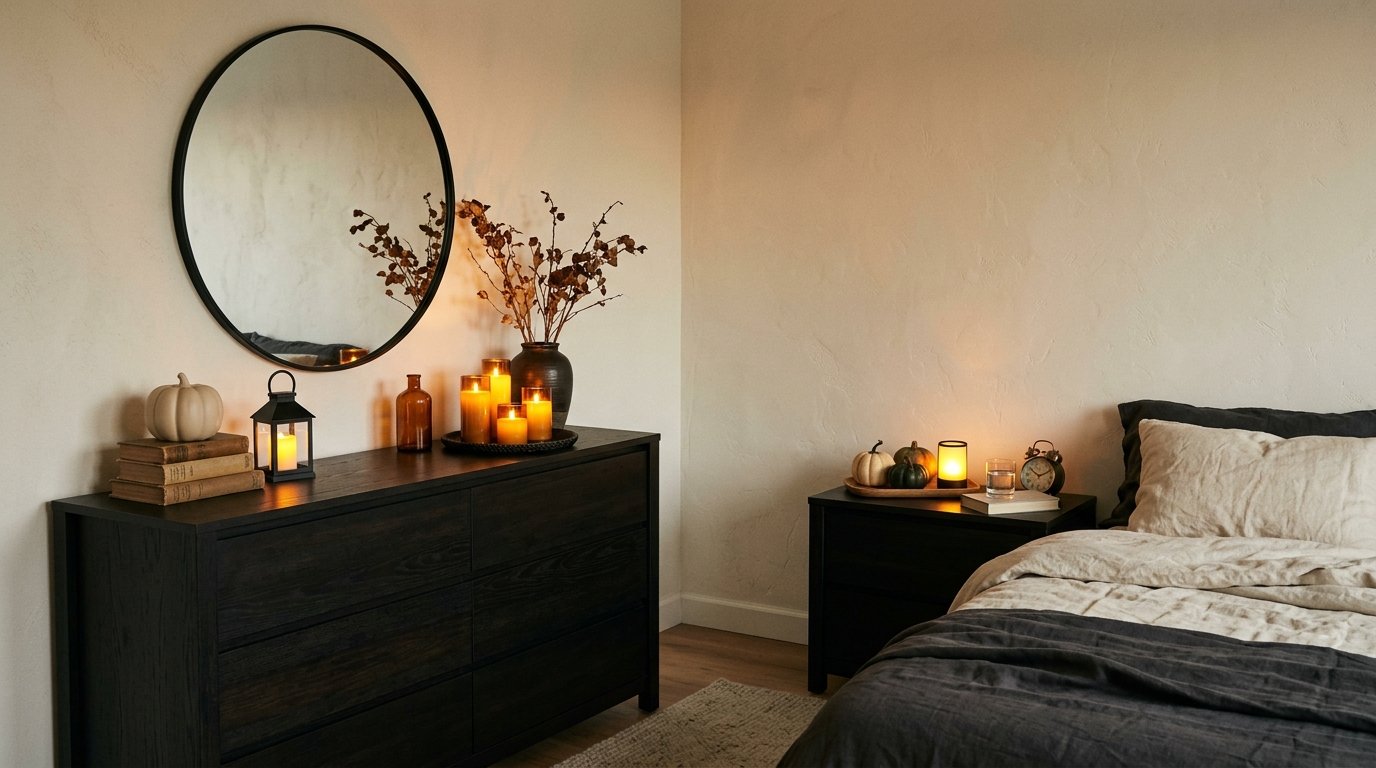
The Teen Dark Aesthetic
Teens want the opposite of cute: black bedding, one statement lamp, a moody purple bulb, minimal clutter. The Modern Caves guide notes the look relies on restraint, photographs well, and tears down to a normal bedroom in minutes.
Its practical rules hold: anchor everything on the bedding, keep the desk area normally lit so homework stays possible, and agree the teardown date in advance so the reset is not a negotiation.
The pink Halloween variant belongs in this calibration too: blush bedding, pink pumpkin lights, friendly ghost pillows and soft tone bat decals, festive with no dark element at all, and reusable into winter once the decals swap for garlands.
The Guest Room: Welcoming, Not Startling
No top ranking competitor serves the guest bedroom, and it is the calibration with the strictest limits. A guest meets the room tired, in the dark, in an unfamiliar house.
The guest rules: one styled surface maximum, a clear path from door to bed to bathroom, a night light that helps rather than haunts, and nothing positioned to be misread by a half asleep stranger, no figures by the door, no faces over the bed.
Halloween in a guest room is a welcome note, not an exhibit: the bedding swap, the warm light, one pumpkin trio on the dresser, and the room’s ordinary kindnesses, water, a spare charger, luggage space, left fully intact.
Small, Rental and Dorm Bedrooms
Jenna Living’s size finding runs against instinct: small to medium bedrooms do better at Halloween than large ones, because the pieces that matter are compact and vertical, and a huge room swallows small accents until the effort looks thin.
The rental kit is the swap kit: duvet covers, pillow covers, window clings that stick with static and leave zero residue, removable decals tested on a hidden patch first, and art prints slipped into existing frames.
The Modern Caves guide stores the original prints inside the frame behind the seasonal ones, which makes the reset a one minute job and the storage problem disappear.
Dorm rooms add one rule: the roommate is a stakeholder. The calibration is negotiated like the guest room, welcoming rather than imposed, with lights on timers both sleepers agree to.
The Build Order, Timed
The room assembles in Jenna Living’s five steps, with the sleep audit bolted onto the end. Timings are hers: about 30 minutes for the refresh version, 2 to 4 hours for the full build.
- Decide the lane first. Cozy spooky, gothic, neutral fall or kid friendly cute, chosen against the room you have, not the room in a photograph. Her own small warm wood room took cozy spooky because gothic would have fought the furniture.
- Clear before adding. Everyday clutter leaves the nightstand and dresser first, because seasonal decor needs breathing room to read as styled instead of piled on.
- Measure the surfaces. Nightstand, dresser top and mirror frame get measured before anything is ordered, so the garland fits instead of bunching.
- Build in order. Bedding, then lighting, then the two styled surfaces, then wall details, then the windowsill and mirror finishes.
- Run the sleep audit. Lights dim and timed, garland tug tested, blackout closing cleanly, scent judged from the pillow. Anything failing comes down the next morning.
The Budget Tiers and the $0 Restyle
|
Tier (Jenna Living strand) |
What it buys |
The room it makes |
|---|---|---|
|
Basics, $25 to $75 |
Pillow covers, battery tea lights, paper bat decals, grocery store mini pumpkins |
A genuine refresh |
|
Makeover, $100 to $250 |
Full bedding swap, a garland, framed art, a styled dresser vignette |
The complete system |
|
Higher end, $250 plus |
Velvet and linen textiles, coordinated curtains, ceramic pumpkins, amber glass |
A room styled for the season, not decorated for it |
The $0 restyle runs underneath all three tiers: restyle the books and bottles you own into the dresser vignette, move the best throw in the house onto the bed, swap prints between frames, and let the colored bulb, often already in a drawer, do the light half.
Seasonal spend discipline for the whole house sits on the cluster’s cheap halloween decor page.
Safety in a Sleeping Room
Flame. Bedrooms are where the flameless rule stops being a preference. People fall asleep in this room; no real candle burns unsupervised in a room designed for unconsciousness. The cluster’s standing guidance, following the National Fire Protection Association, is battery operated candles in decorations.
Lights and bedding. Fairy lights over a headboard are battery operated or low heat LED, secured so no strand rests against pillows or hangs where it can be pulled into the bed.
Webs and detectors. Faux cobweb stays off smoke detectors and vents, per the Modern Caves guide, and gets tossed after the season rather than stored.
Decals and paint. Removable adhesive gets tested on a hidden patch first, especially on matte paint. A wall that needs repainting is the most expensive outcome in this article.
Pets in the bedroom. Anything chewable, dangling or scented stays out of pet reach, and candy dishes in bedrooms with pets get lids, the same discipline the kids version uses.
Teardown and Storage: Bedding In, Decals Backed
The Modern Caves promise is teardown in minutes on November 1, and the bedroom is where that promise is easiest to keep, because almost everything here is a swap with a known home.
The order: lights down and coiled with their timers, decals back onto their backing sheets, prints rotated back inside their frames, bedding washed and stored with the room’s decor in one labeled bin, so next October opens as one box, not a hunt.
The fall conversion is built in: black bedding and amber glass read as moody fall without a single bat, which is why Jenna Living keeps her amber holders and black ceramic pumpkins out until Thanksgiving.
More combinations for the next build live in the cluster’s halloween decor ideas roundup on HomeBunks.
Mistakes That Wreck a Bedroom
- Starting with props instead of the room, the tackiness trap Jenna Living names first.
- Five colors and five motifs in one small room.
- Every surface styled, until the nightstand cannot hold a glass of water.
- Overhead light only, which kills the mood the decor built.
- A real candle left as the bedroom’s flicker source.
- Lights without timers, glowing into the small hours.
- Surprising a child with a changed room after lights out.
- Decorating against the blackout, trading sleep for a window display.
A Worked Example: One Small Bedroom, Two Tiers
Take a small primary bedroom, warm wood furniture, one dresser, two nightstands, a mirror. The build follows Jenna Living’s own worked logic, including her palette choice for exactly this room.
Palette and lead: cozy spooky in cream, black and rust, because black and burgundy gothic would have fought the warm wood. Textiles lead; walls support.
At the basics tier (about $50 of her $25 to $75 band): black pillow covers, paper bats ascending over the headboard, grocery store mini pumpkins in threes on the nightstand tray, battery tea lights in the dresser cluster, the rust throw already owned moved onto the bed. Thirty minutes, and the room passes the sleep test because every light is dim, warm and timed.
At the makeover tier (about $180 of her $100 to $250 band): add the black duvet cover, the felt ghost garland across the mirror, one framed vintage print slipped into the existing frame, and the amber glass holders that will stay out through Thanksgiving. Two hours more, and the room is the complete system, still with its working nightstand half clear.
The sleep audit on night one: timers off by the household’s bedtime, scent none, garland tug tested, blackout closing cleanly over the clings. Anything failing the audit comes down the next morning without debate, which is what makes the system trustworthy enough to build bigger next year.
Key Takeaways
- Sleep first, spooky second: every piece passes the 11 pm test.
- Two halves: the bedding swap and the light, surfaces only after both.
- Timers, flameless, anchored: the three bedroom non-negotiables.
- Calibrate the room: grown-up restraint, kids nightmare free, guests welcomed.
- Teardown in minutes, because swaps have homes and decals keep their backing.
FAQs
What is Halloween bedroom decor?
Decorating a bedroom for Halloween, built here on one rule: sleep first, spooky second. A bedding swap, warm dim light on timers, one or two styled surfaces, and calibration for who actually sleeps in the room.
How do you decorate a bedroom for Halloween and still sleep well?
Pass every piece through the sleep test: dimmer than normal light, nothing flashing, flameless only, nothing loose over the bed, scent faint or none, and all glow on timers that end before deep sleep.
What are the sleep rules for a Halloween bedroom?
Five: light goes down not up, timers end the night, scent stays light or leaves, nothing loose hangs over the bed, and the blackout still wins over any window display.
What bedding works best for a Halloween bedroom?
A duvet cover swap in black, charcoal or deep plum over your existing set, soft textured fabric, with a lighter throw across the foot so the bed invites sleep rather than staging a scene.
Does a black duvet cover really change the whole room?
Yes, it is the single biggest surface change available. Dark bedding resets the mood, makes fairy lights glow brighter, and turns orange pumpkins into high contrast accents, per the Modern Caves guide.
How many throw pillows should a Halloween bed have?
Two to four pillows plus one throw, per Jenna Living, does more work than ten small objects. Use covers over your existing pillows so the swap stays cheap and stores flat.
How do you layer bedding for Halloween without overheating?
Count the layers against the room’s real temperature. In a warm room the Halloween layer is the cover and throw only over everyday sheets; flannel plus duvet plus chunky knit is a winter stack.
What lights work best in a Halloween bedroom?
Fairy lights over the headboard, a colored bulb in the bedside lamp, and a flameless cluster on the dresser. Warm white or amber, dim, and on timers. Lighting does roughly half the room’s transformation.
Are fairy lights safe over a headboard?
Yes, with disciplines: battery operated or low heat LED, draped in a loose swag, secured so no strand rests against pillows or can be pulled into the bed, and set on a timer.
Should bedroom Halloween lights be on timers?
Yes, timers are a bedroom non-negotiable. The glow belongs to the evening wind down; the night itself should be dark. Timers also end the display without a last round of the room.
What goes on a Halloween nightstand?
A tray with a mini pumpkin cluster and one lantern or flameless candle, on one half of the surface. The working half stays clear for water, a book, glasses and the alarm.
How do you style a dresser for Halloween?
As a small stage: a black lantern, an amber glass bottle, a stack of books, and one accent object such as a small skull or faux raven, per Jenna Living’s vignette formula. One accent, not five.
How do you decorate a bedroom mirror for Halloween?
One cobweb corner stretched thin, or a felt ghost garland in a shallow swag across the top. Mirrors multiply the room’s glow, so a single corner does the work of a whole wall.
What Halloween decor works on windowsills and windows?
Mini pumpkins in groups of three on the sill, and static window clings clustered in one corner of the pane. Clings leave zero residue, and the blackout curtain still closes over or beside them.
How do you decorate a kids bedroom for Halloween without scaring them?
Friendly faces only: smiling ghosts, friendly skeletons, pumpkin lights, glow in the dark stars. Warm white glow over flashing colors, no motion activated or sound making items, and the child helps place everything.
What Halloween decor suits a toddler’s bedroom?
Soft and simple: plush pumpkins, a friendly ghost pillow, one warm night light. No small detachable parts, nothing hanging within reach, and nothing whose face could read differently in the dark.
What Halloween decor suits a preschooler’s bedroom?
Characters with cheerful expressions: pumpkin string lights, felt garlands, glow in the dark bats and stars that glow softly. Enchanted Kids Moment’s calibration is warm white lights instead of bright flashing colors.
Are glow in the dark decals good for kids bedrooms?
Yes, they are a kids room staple: they charge in daylight and glow softly after lights out, which reads as magic rather than alarm. Arrange them as one scene, a bat flight or a star field, not a scatter.
What if my child is scared of their Halloween room at night?
Remove the piece the same night, no debate, and let the child choose a replacement in daylight. Retest the room dark together before the next bedtime. Prevention is simpler: no surprises after lights out.
How do you decorate a teen bedroom for Halloween?
The dark aesthetic: black bedding as the anchor, one statement lamp such as a skull lamp, a moody purple bulb, minimal clutter, and the desk kept normally lit so the room still functions.
How do you do a pink Halloween bedroom?
Blush or rose bedding, pink pumpkin lights, friendly ghost pillows, soft tone bat decals, with cream and champagne accents to keep it intentional. Keep pinks soft and warm; hot pink tips toward party decor.
How do you decorate a guest bedroom for Halloween?
As a welcome, not an exhibit: the bedding swap, warm light, one pumpkin trio, a helpful night light, a clear path, and the ordinary kindnesses, water, charger, luggage space, untouched. Nothing that startles a stranger at 2 am.
How do you make a Halloween bedroom cozy, not creepy?
Lead with textiles and warm light: knit and velvet layers in autumn tones, flameless glow, and motifs with friendly or elegant faces. Textures read as a styled room; printed scary faces read as decoration.
How do you make a Halloween bedroom look elegant?
Materials and restraint: velvet and linen over plastic, ceramic and amber glass over novelty, two or three colors, one motif, and big furniture left neutral while small pieces carry the season.
What colors work in a Halloween bedroom?
Pick two or three and stop: black, white and orange; black and cream; sage, black and silver; or the soft neutral set of rust, tan and beige with black details, per Jenna Living’s palette discipline.
How much does Halloween bedroom decor cost?
Jenna Living’s tiers: $25 to $75 for the basics, $100 to $250 for a real makeover with a bedding swap, and $250 plus for velvet, linen, curtains and ceramic pieces. The $0 restyle underneath uses what you own.
What can you do for Halloween in a bedroom for free?
Restyle owned books and bottles into the dresser vignette, move the house’s best throw onto the bed, rotate prints inside existing frames, cut paper bats, and swap in a colored bulb you already own.
How long does it take to decorate a bedroom for Halloween?
About 30 minutes for a refresh of pillow covers, a candle and a mini pumpkin, and 2 to 4 hours for a full styling with bedding, lighting, wall decor and vignettes, per Jenna Living’s snapshot. Decal scenes can take half a day.
How do you decorate a small bedroom for Halloween?
Small rooms do better, not worse: the key pieces are compact and vertical. Bedding, headboard lights, one surface and the door carry a small room completely, and nothing needs the floor or ceiling.
What are renter friendly Halloween bedroom ideas?
Covers, clings and swaps: duvet and pillow covers, static window clings with zero residue, removable decals tested first, prints slipped into existing frames, and battery lights that need no wiring or hooks in walls.
Do wall decals damage bedroom paint?
Good removable decals should not, but test adhesive on a hidden patch first, especially on matte paint, per the Modern Caves guide. Paper bats on removable dots come down in one pass when tested properly.
How do you hang a garland over a bed safely?
Anchor it at both ends and the middle, hang it above sitting up head height, and tug test it before the first night. Over a bed, decor is fixed or it does not go up.
Can you use real candles in a Halloween bedroom?
Treat the answer as no. Bedrooms are rooms designed for falling asleep in, and the cluster’s standing guidance, following the National Fire Protection Association, is battery operated candles in decorations. Flameless in amber glass reads as real candlelight anyway.
Should you use scented candles or fragrance in a Halloween bedroom?
Lightly or not at all. A pillow sits six feet from the dresser all night, so the bedroom gets one faint source or none. Jenna Living’s own fatigue note: she moved to cedarwood after tiring of pumpkin spice by week two.
How do you decorate a bedroom reading nook for Halloween?
A chair, a dark throw, a side table with a flameless candle and a basket of real spooky books, and one warm focused light. It is the one corner guests and residents actually use, so it earns its pieces.
What Halloween decor works on a bedroom door?
A small wreath on the inside of the door: dried orange slices, mini pumpkins or black foliage. It greets whoever enters, costs zero floor or surface space, and works in the smallest rooms.
How do you keep Halloween bedroom decor safe with a pet in the room?
Keep chewable, dangling and scented pieces out of reach, anchor anything a cat can bat at, and give candy dishes lids. If the pet sleeps on the bed, the garland rules double: fixed, high, tug tested.
How do you balance Halloween decor with blackout curtains?
The blackout wins. Clings go where the curtain does not cover, lights live on the room’s own surfaces, and nothing props a curtain open. A window display that costs sleep is a bad trade in this room.
What Halloween bedroom pieces are worth buying once?
Amber glass holders, ceramic pumpkins, a good garland, quality pillow covers and one set of dark bedding. Jenna Living keeps her amber holders and black ceramic pumpkins out until Thanksgiving because they do not scream Halloween.
When should Halloween bedroom decor come down?
The system is built for a November 1 teardown in minutes: swaps reverse, decals return to backing sheets, prints rotate back. Pieces that convert to fall, dark bedding and amber glass, may stay by choice.
How do you store Halloween bedding and bedroom decor?
Wash the bedding and store it in the same labeled bin as the room’s decor, decals on their backing sheets and lights coiled with their timers, so next October opens as one box.
Can Halloween bedroom decor convert to fall afterwards?
Yes, that is the design. Remove the bats, ghosts and overt motifs, and black bedding, rust throws, ceramic pumpkins and amber glass read as moody fall through Thanksgiving.
Conclusion
Halloween bedroom decor is the easiest decorating in the house once the room’s real job is respected: the bed does half the work, the light does the other half, and the sleep rules keep both honest.
Start tonight with the bedding swap and one timer. The room will look like Halloween by dinner and sleep like your bedroom by eleven, which is the whole point.