
At home Halloween decor usually gets built for an audience that never arrives: the street, the camera, the neighbors passing the porch.
This page builds it for the audience that is actually there: the people inside the home, on the one night the home itself is the venue.
A Halloween night in, a dinner, a movie, a houseful of your own people, is decorated differently from a season display. It runs on layers and a timeline, not on more objects.
Five layers do the work: light, textile, object, scent and sound. Each one is cheap, most of them are swaps rather than purchases, and together they change how a home feels more than any single decoration.
For the season-long version of home decorating, zones, themes and palettes, the cluster’s halloween home decor page is the system this night plugs into.
At Home Halloween Decor: The Short Answer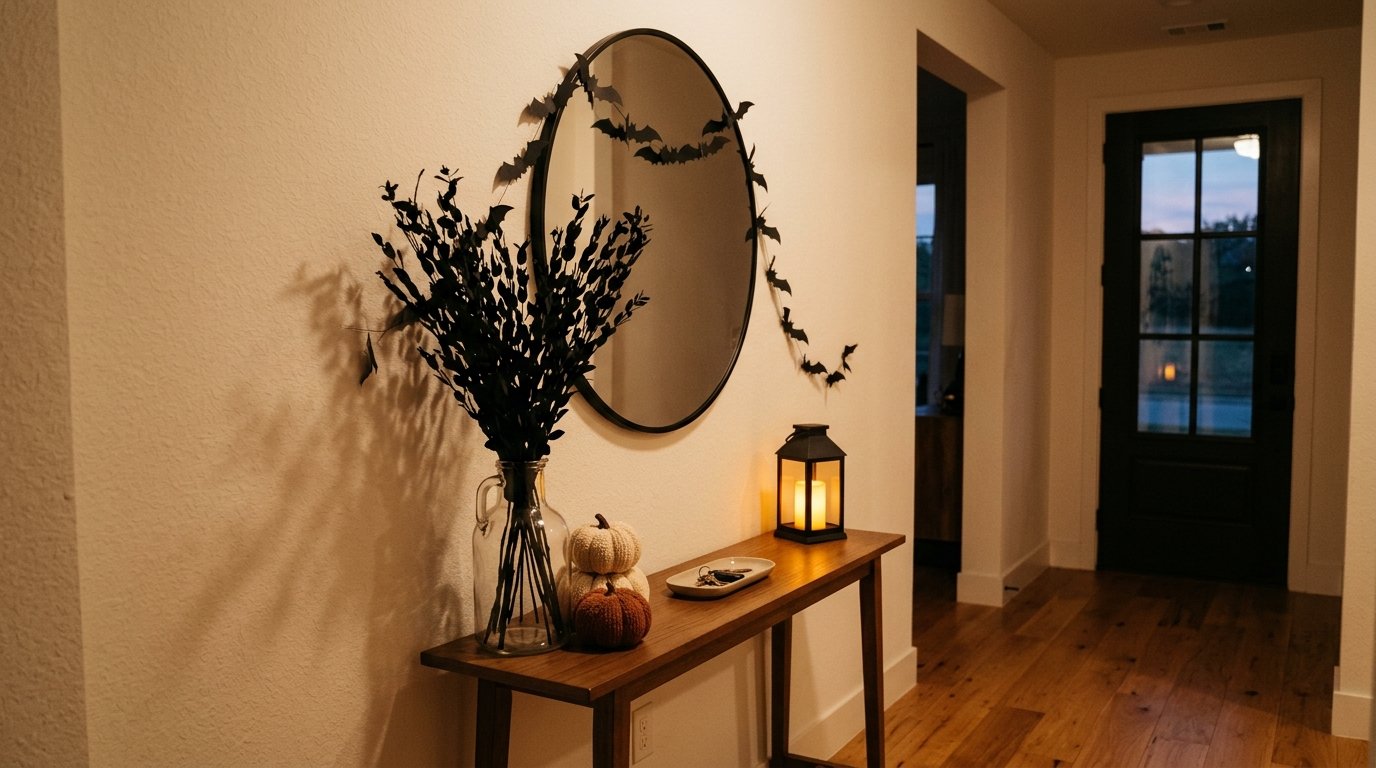
Decorate the night, not the house: swap bulbs to warm amber, swap textiles to your palette, set five focal spots, add one scent and one sound layer, and run it on an evening timeline.
|
Layer |
The change |
Cost shape |
|---|---|---|
|
Light |
Amber bulbs at 2200 to 2700K, flameless candles, overheads off |
A few bulbs; the biggest effect per dollar |
|
Textile |
Pillow covers and throws swapped to the palette |
Covers, not pillows; store flat |
|
Object |
Five focal spots only, swapped not added |
Mostly pieces you own or reuse yearly |
|
Scent |
One scent family: a simmer pot or one candle scent |
Near zero for a simmer pot |
|
Sound |
Low ambient sound under conversation |
Free; a speaker you own |
Sunflowers and Stories states the governing rule of the whole build in its room by room indoor Halloween guide: good indoor setups come down to a tight palette, warm low lighting, and swapping existing accessories rather than piling new ones on top.
Layer One: Light, Because Light Goes First
Every serious source in this research leads with light, and one states it as a principle: light before objects. A room lit wrong makes good decor look like a shop display; a room lit right makes almost nothing look haunted.
The Kelvin Rule
Work in warm white, roughly 2200 to 2700 kelvin. The Sunflowers guide gives the same range for its amber bulb swap, and Perfection Cleaner’s living room guide aims for 2200 to 2700K in lamps as its first and easiest idea.
Cool white bulbs are the enemy of the night in. Swap the lamps in the rooms you will use, and keep one brighter task light available so the mood stays a choice, not a trap.
Smart bulbs add the night-in trick: schedule them amber for the evening only, normal by day and haunted after sunset, so the house transforms on a timer instead of on your effort.
The Flameless Layer
Flameless candles carry the flicker: clusters on the mantel, tapers on the table, pillars in a non-working fireplace. Perfection Cleaner groups them in threes and fives with real height differences, and advises buying one brand so the flicker and color match.
Two safety facts ride with them. Even flameless candles can overheat when enclosed for many hours, so use the timer function, especially in a firebox. And the National Fire Protection Association recommends battery operated candles or glow sticks for Halloween decorations, which is why real flame appears on this page only at one supervised place: the dinner table, and even there the flameless version is the default.
Layer Two: Textiles, the Two-Minute Transformation
Textiles are the fastest seasonal change a room accepts: pillow covers and a throw, swapped to black, charcoal or deep plum, set the palette foundation in minutes.
Perfection Cleaner’s rule is to buy covers, not whole pillows: cheaper, they store flat, and they swap in seconds. Mix textures inside the dark palette, velvet against knit against linen, so dark reads rich rather than flat.
The textile layer is also where the night in stays livable. The sofa still has to be sat on for three hours of movie; a throw people actually use beats a display blanket nobody may touch.
Layer Three: Objects, Swapped Not Added
The Swap Rule
Sunflowers and Stories gives the rule its sharpest form: a mantel that already holds six things does not need six more. Take three away, put three Halloween pieces in their place, and the surface reads decorated rather than cluttered.
Apply it to every surface the night touches. Each surface ends the edit holding the same number of objects it held in September. Halloween arrives as a substitution, not an accumulation.
Five Focal Spots, Not Twenty
The same guide caps the home at five focal spots: the entryway, the mantel or main shelf, the coffee table, the dining table, and one bedroom or bath. Every other surface stays exactly as it is.
For a night in, the five spots are not just a decorating cap; they are the guest’s route through the evening: arrival, gathering, drinks, dinner, and the one surprise in the bathroom.
Suggestion Over Literal
Perfection Cleaner’s grown-up rule: suggestion over literal depictions. A single brass skull on a stack of books says more than a dozen novelty items, and a matte ceramic or resin piece reads as sculpture where glossy plastic reads as toy.
Keep each vignette to odd numbers, varied heights and breathing room, on a tray where the surface allows it. The coffee table version: vintage looking books, an apothecary bottle, a candle, one intriguing object, nothing more.
The surface-by-surface version of this layer lives on the cluster’s halloween indoor decor page.
The Palette for a Night In
A night in runs on one palette for the whole home, because the guest moves through all of it in one evening. Room-by-room palettes are a season luxury; a single night wants continuity.
|
Palette |
Colors |
Where it shines |
|---|---|---|
|
Grown-up classic |
Black, cream, rust or deep plum accent |
Dinner and movie in family homes |
|
Moody modern |
Charcoal, deep plum, pewter |
Apartments and modern rooms |
|
Elegant |
Black, cream, brass |
Adult dinners, mantel-led rooms |
|
Cute family |
White, orange, soft pink |
Homes with small children |
The Sunflowers guide builds its elegant system on the first row: black and cream do most of the work, and one warm accent ties the rooms together. Perfection Cleaner runs the same discipline from the taste side: two or three sophisticated colors, and the room stays recognizably yours.
Apply the palette as a filter on swaps: a pillow cover, candle or pumpkin that falls outside it does not enter the night, however good it looks alone in a shop.
Repeat the accent in small amounts across rooms, a plum throw in the living room echoing plum napkins at the table. Repetition across the route is what makes a home feel designed rather than decorated room by room.
Layer Four: Scent, the Invisible Decor
Guests remember how a Halloween home smelled long after they forget what it looked like. Scent is a full layer of the night, and it obeys one rule: one scent family only, woody and smoky or sweet and spiced, never both competing.
The working tool is the stovetop simmer pot: water, orange peel, cinnamon, cloves and a little vanilla, at the barest simmer. Perfection Cleaner prices it at almost nothing and adds the standing caution: never leave a simmer pot unattended.
At the dinner table, scent steps back. Strong fragrance over food fights the meal, so the pot simmers in the kitchen or entry during arrival and gets turned down when plates land. The live home page’s strand agrees from the other side: warm, woodsy simmer pots over sweet candy scents for an elegant table.
Dried orange slices and cinnamon sticks in a glass jar, from the Sunflowers kitchen notes, give the scent layer a visible form for counters and windowsills between simmer sessions.
Layer Five: Sound, the Layer Nobody Lists
Sound is the layer most guides omit and one indoor guide in this research names outright as an immersion tool. A night in has a soundtrack whether you plan it or not; plan it.
Keep ambient sound under conversation level: a low loop of wind, distant bells or a crackling fire recording in the living room, nothing with jump scares in a home with kids or nervous guests.
Sequence it with the evening: arrival music at the door, near silence at dinner, and the ambient layer returning under the movie’s quiet scenes. The volume knob is a decorating tool; treat it like one.
The Five Focal Spots, Assigned for a Night In
|
Spot |
Its job in the evening |
The build |
|---|---|---|
|
Entryway |
The arrival moment |
Tall jug of black branches, pumpkin stack, bat garland on the mirror |
|
Mantel or main shelf |
The gathering backdrop |
Pumpkins in odd numbers and three heights, tapers, one tall element |
|
Coffee table |
The drinks and movie surface |
Tray vignette: books, bottle, candle, one object |
|
Dining table |
The dinner stage |
Low centerpiece, tapers at two heights, room for plates |
|
Bathroom |
The one surprise |
Black hand towel, amber soap, one small print or taper |
Sunflowers and Stories builds the entry the same way: one strong moment, a tall jug of dried branches painted matte black, a small stack of pumpkins, a paper bat garland along the mirror, and the key tray left in place, because an entryway still has to work every day.
The bathroom earns its spot precisely because guests spend a minute there alone. One playful detail lands harder there than a sixth object on the mantel ever could.
Room by Room for the People Inside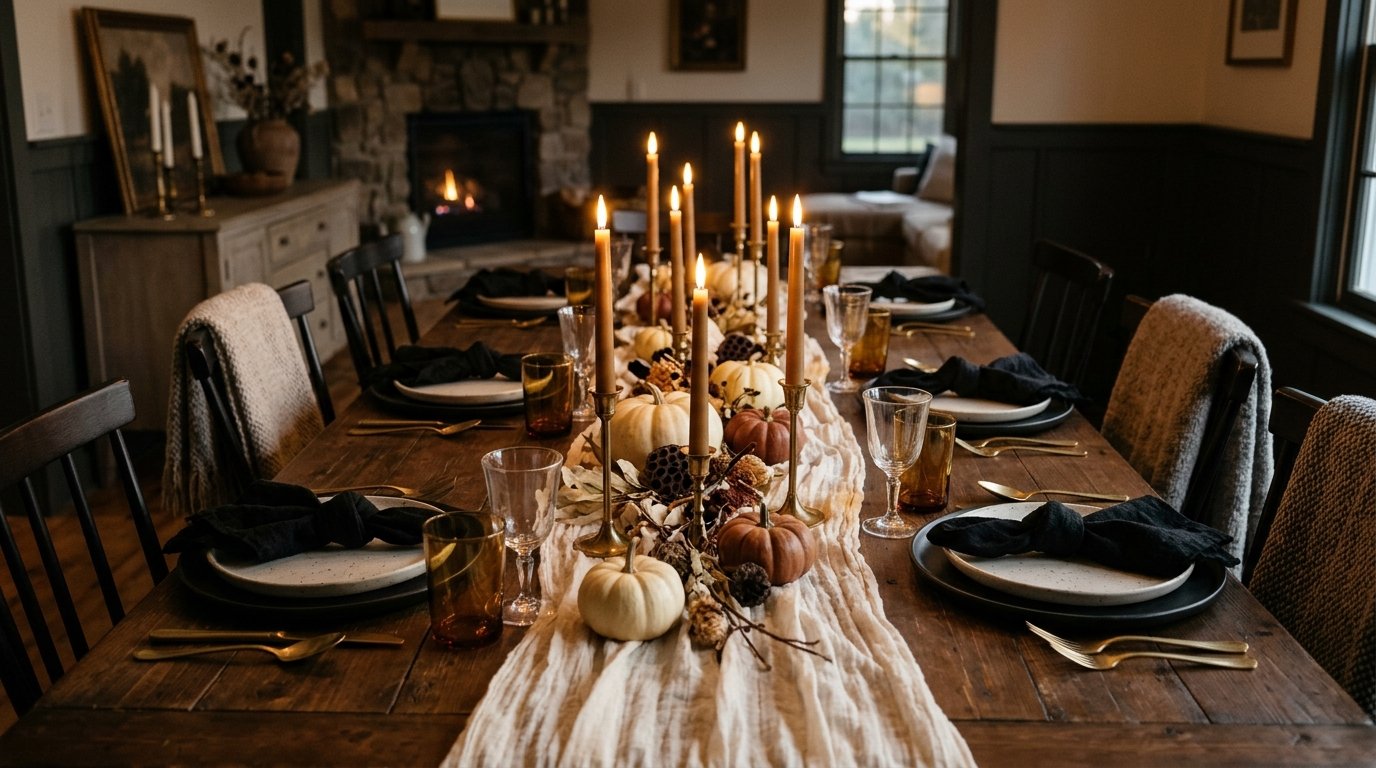
The Entryway: Arrival in Thirty Seconds
Guests decide how the night feels in the first thirty seconds. The entry build is one vignette and one glow: the console moment from the focal table, a flameless lantern or candle at tray height, and clear floor.
If the entry is small, Sunflowers moves the moment up: a black wreath on the inside of the front door and the floor left clear. Vertical beats floor space in every small home on this page.
The Living Room: Built Around Seats, Not Walls
The living room carries the night, so it is styled from the seats outward. The mantel formula from the Sunflowers guide: pumpkins grouped in odd numbers and three heights, tall tapers in brass holders, one tall element such as dried branches to finish.
Pillow covers swap with a small embroidered motif rather than a large print, per the same guide, and the throw lands in the accent color. Bookshelves get the restraint treatment: a few books turned so the cream page edges face out, one small black pumpkin or brass candlestick tucked in, and stop there.
The reading nook is the living room’s quiet zone: a corner chair, a dark throw, a side table with a candle and real spooky books in a basket. Perfection Cleaner notes guests pick the books up, which makes the nook the only decor on this page that entertains by itself.
The Dining Table: Dinner Is the Show
The table rules are measurements, not vibes. Sunflowers keeps a dining centerpiece under about 12 inches tall so guests can see each other, and leaves about 10 inches clear at each place setting for serving dishes.
The build: a length of cheesecloth run down the center, small pumpkins scattered along it, tapers at two or three heights. Because cheesecloth catches fire easily, the same guide specifies flameless LED tapers on this table, which settles the candle question for the night’s main event.
Place settings stay simple: one themed detail per plate and a black napkin outperforms a table where everything is themed.
The Kitchen: Touches That Respect the Work
The kitchen is where the night gets produced, so its decor stays small and off the counters that work: a bowl of small pumpkins on the island, a black dish towel with a simple moon or bat print, the scent jar by the window.
Sunflowers adds the practical note: keep real pumpkins off the stove side of the kitchen, because heat shortens their life. The simmer pot is the kitchen’s real contribution, and it belongs to the scent layer, supervised.
Bedrooms and Kids Rooms: Calibrated, Not Excluded
Bedrooms stay restful: color and one or two objects. A throw in deep plum or charcoal, one small pumpkin on the nightstand, an amber bulb in the bedside lamp, per the Sunflowers bedroom notes.
Kids rooms run the fun not frightening calibration: friendly ghosts, their own paper crafts, a warm string of lights. The rule from the live home page holds by room: cute in kids spaces, gothic material kept to adult zones.
For the full cute lane, pieces and palettes both, the cluster’s cute halloween decor page is the reference.
The Evening Timeline
A season display is static. A night in moves, and the decor moves with it.
|
Time |
Phase |
Light state |
What changes |
|---|---|---|---|
|
Afternoon |
Setup |
Daylight |
Swaps done, spots built, pot ready, sound checked |
|
Arrival |
Guests land |
Amber lamps on, flameless lit |
Entry glow on, simmer pot at full, arrival music low |
|
Dinner |
Plates down |
Table tapers lead, lamps dimmed |
Scent turned down, sound near silent, centerpiece under 12 inches doing its job |
|
Movie |
Lights down |
One warm lamp plus piece glow |
Screen wall rules apply, throws in use, nook lamp off |
|
Late |
The wind down |
Timers take over |
Flameless on timers, pot off, house settles |
The lights down moment is the night’s signature: the deliberate minute where overheads die, the amber and flicker layers take the room, and the home visibly becomes the venue. Do it once, on purpose, when everyone is in the room.
The Screen Wall: Decorating Around the TV
Movie night makes the television the room’s real focal point for two hours, and no competitor guide in this research decorates for that fact. Three rules fix it.
Keep the screen wall quiet. Silhouettes and garlands belong on the side walls; anything busy beside the screen competes with the film and loses.
Glow low and to the sides. A flameless cluster at each end of the media console gives the room its light without a reflection on the glass. No candle, real or flameless, sits where its flicker reflects in the screen.
Let the movie do the scary. The decor’s job during the film is the frame, not the picture: dark textiles, low amber edges, and the room disappearing around the screen.
Hosting at Home: Guest Flow and Small Mercies
Hosting at home runs on flow: coats need a landing spot that is not the entry vignette, drinks need a station that is not the coffee table vignette, and the bathroom surprise only works if the bathroom also simply works.
The drink station is a vignette with a job, the bar cart formula from the live home page: two dressed bottles, one small pumpkin, a candle, and clear space to actually pour.
Budget thinking for the whole night sits with the cluster’s cheap halloween decor page; the night in is mostly swaps, so its spend concentrates in the kit below.
The Buy Once Kit for Nights In
|
Kit piece |
Why it earns its place |
Night-in note |
|---|---|---|
|
Amber or smart bulbs |
The light layer, every room, every year |
Schedule the evening transformation |
|
Flameless tapers and pillars, one brand |
Flicker that matches across rooms |
Timers run the late phase for you |
|
Pillow covers and one throw |
The textile layer |
Covers store flat between seasons |
|
Velvet or ceramic pumpkins |
Focal spots, tables, entry |
Neutral finishes convert to fall |
|
One good garland |
Mantel and mirror backdrop |
The backdrop every vignette stands against |
|
A hero object |
The sculptural skull, the candelabra |
One per home; suggestion over literal |
Paper and cloth consumables, bats, cheesecloth, streamers, are the only yearly repurchase, the same kit logic the live home page runs for the season.
Safety at Home: Flames, Cords, Kids and Pets
Flames. The NFPA recommendation carried through this cluster is battery operated candles or glow sticks in decorations, and the CPSC advises keeping open flames away from costumes, curtains and other combustibles. Cheesecloth specifically catches fire easily and never drapes over a hot bulb or near a flame; the Sunflowers guide routes it to shelves, tables and mantels with LED nearby.
Cords and lines. Keep cords, fishing line and garland ends out of walkways, especially on stairs and at doors, and anchor anything dangling against cats.
Kids. Small pieces stay out of toddler reach, scary is calibrated by room, and the projects kids make for the night follow the adult jobs and kid jobs split on the cluster’s DIY Halloween decor page.
Pets. Chocolate and candy decor stays out of pet reach, stretch webbing stays away from pet height, and the simmer pot’s ingredients stay on the stove, supervised, never on a counter a pet can reach.
The Season Around the Night
The night in is the peak, not the whole build. The same five spots, lit lower and lived with daily, carry the home from the first weekend of October to the thirty-first.
That is the economic point of the swap system: nothing on this page is single-use staging. The amber bulbs burn every evening, the covers stay on the cushions all month, and the night itself only adds the timeline, the table at full dress, and the simmer pot.
Build the season once, then raise it for the night rather than building twice.
Teardown: Back to Fall in Twenty Minutes
The night in is built on a fall base, so teardown is an edit, not a demolition. Sunflowers and Stories times the full Halloween to Thanksgiving switch at about 20 minutes on November 1.
Remove only what says Halloween outright: black pumpkins, bats, black tapers, spooky prints. Keep the pumpkins in cream, rust and natural tones, the throws, the dried stems and the warm bulbs, and the home is in its fall state before the dishes are done.
One storage fact from the same guide: an uncarved pumpkin lasts several weeks indoors in a cool spot away from heat, while a carved one softens within days, which is why this page’s pumpkins were never carved.
Store the Halloween pieces by focal spot, one labeled section per spot, so next year’s setup starts from the photograph you took before teardown. More combinations for next year sit in the cluster’s halloween decor ideas roundup on HomeBunks.
Mistakes That Make a Home Feel Like a Store Aisle
- Adding instead of swapping, until every surface holds September plus Halloween.
- Cool white light left in the main lamps, flattening everything under it.
- Twenty focal spots, which is the same as none.
- Two scent families competing, or full scent over the dinner plates.
- Sound with jump scares in a home that wanted cozy.
- Literal over suggestion: a pile of novelty where one sculptural piece would do.
- Decorating the screen wall like a mantel, then fighting the film all night.
- No timeline, so the house peaks at setup and fades before the guests arrive.
A Worked Example: One Apartment, One Night
Take a one-bedroom apartment, two hosts, four guests, a movie after dinner. The whole build uses four of the five spots and stays inside the renter rules.
Swaps (30 minutes): amber bulbs into the two living lamps and the entry lamp; black pillow covers onto the sofa cushions; the everyday coffee table objects into a drawer, replaced by the tray vignette from the bookshelf’s own stock.
Spots: the entry gets the mirror garland and a flameless lantern; the mantel is a shelf, running pumpkins in three heights and two tapers; the table seats six with the cheesecloth runner and the centerpiece kept at plate height; the bathroom gets the towel and the small print.
Timeline: the pot simmers from the first doorbell, down at dinner; the lights down moment lands as the guests move to the sofa; the movie plays with the console clusters glowing at its sides; timers end the night after the hosts stop thinking about it.
Spend: bulbs, covers, streamers and pot ingredients, with every durable piece joining the kit for next year. The apartment returns to itself the next morning by reversing the swaps, which is the deepest advantage of building a night instead of buying a display.
Key Takeaways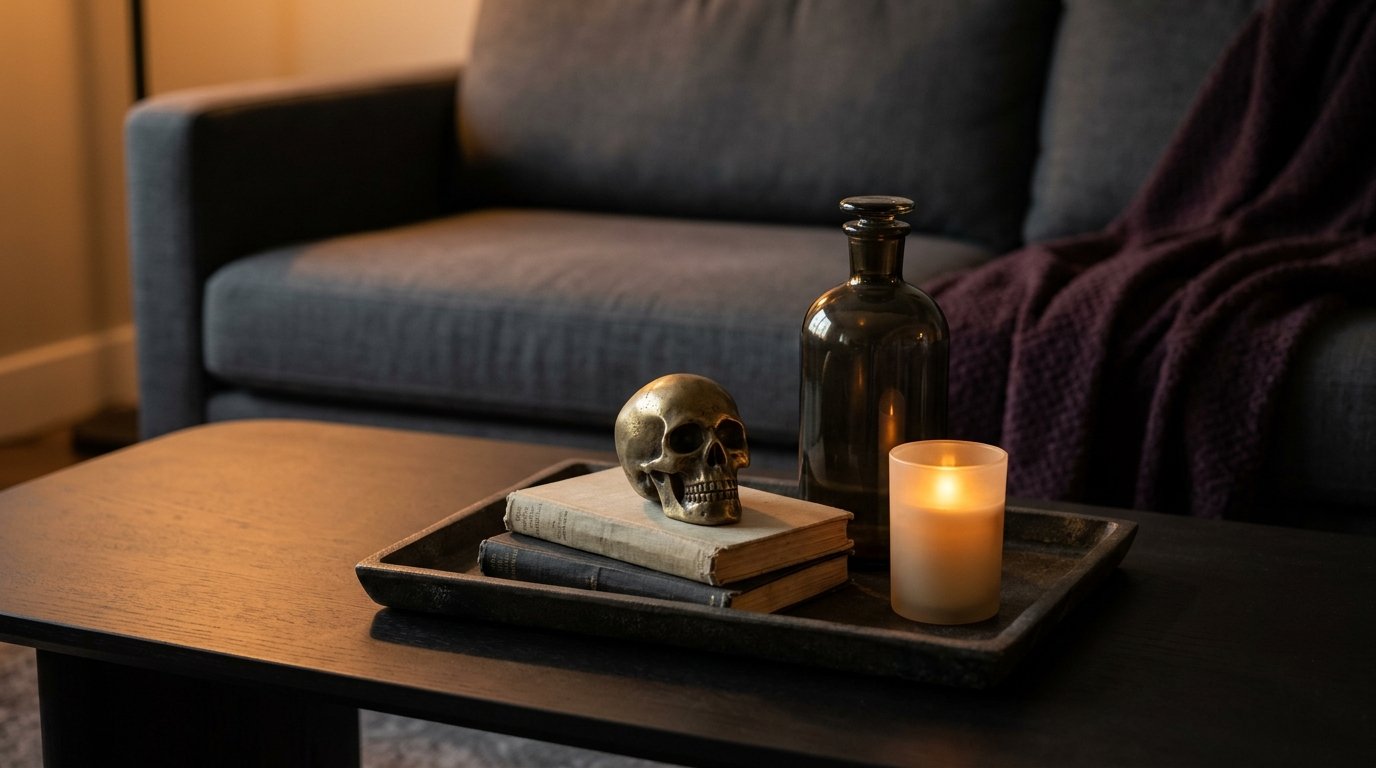
- Five layers: light, textile, object, scent, sound, in that order.
- Swap, do not add: every surface ends with the same object count it started with.
- Five focal spots, assigned to the guest’s route through the evening.
- Warm light at 2200 to 2700K, flameless flicker, one supervised exception at most.
- Teardown is 20 minutes, because the night was built on a fall base.
FAQs
What is at home Halloween decor?
Decorating the inside of your home for Halloween, built here as a night in: five layers (light, textile, object, scent, sound) across five focal spots, run on an evening timeline for the people inside.
How do you decorate your home for Halloween without clutter?
Swap, do not add. Every surface keeps the object count it started with: three things leave the mantel, three Halloween pieces take their place. Clutter is accumulation, and the swap rule bans it.
What are the five layers of at home Halloween decor?
Light, textile, object, scent and sound, in that order. Light changes the room most, textiles set the palette, objects fill five focal spots, and scent and sound finish the atmosphere.
Why does light matter more than decorations at home?
Because light decides how every object reads. Perfection Cleaner’s guide states it directly: amber light does more than any decoration you can buy, and it is also the cheapest layer to change.
What bulb temperature makes a home feel haunted?
Warm white, roughly 2200 to 2700 kelvin, in lamps. Both fetched guides in this research use that range for the amber swap. Cool white above it reads like a shop display.
What does swap, do not add mean in Halloween decorating?
Replace existing accessories with Halloween versions instead of piling new ones on top: pillow covers for pillow covers, candles for candles, stems for stems. The Sunflowers and Stories guide builds its whole indoor system on it.
What are the five focal spots in a home for Halloween?
The entryway, the mantel or main shelf, the coffee table, the dining table, and one bedroom or bath. Leave every other surface alone; the restraint is what makes the five read.
How do you plan a Halloween night in at home?
Set the five layers in the afternoon, then run the evening timeline: arrival with the entry glow and simmer pot, dinner with scent down and tapers leading, movie with lights down, and timers for the late phase.
How do you decorate for a Halloween movie night?
Quiet screen wall, low glow at the sides of the console, dark textiles in use, and the ambient sound layer under the film. The movie does the scary; the room does the frame.
How do you decorate around a TV for Halloween?
Keep the screen wall itself plain, place flameless clusters at the ends of the console where they cannot reflect in the glass, and put silhouettes and garlands on the side walls instead.
What should the entryway look like for guests arriving at night?
One strong moment and one glow: a tall jug of black branches, a pumpkin stack, a bat garland on the mirror, a flameless light at tray height, and the floor and key tray still working.
How do you set a dining table for a Halloween dinner at home?
A low centerpiece under about 12 inches, tapers at two or three heights, and about 10 inches clear at each place setting. Cheesecloth runner, flameless tapers, one themed detail per plate.
What scent works for a Halloween night in?
One family only: a simmer pot of water, orange peel, cinnamon, cloves and vanilla for the sweet spiced lane, or a woodsy profile for the elegant lane. Never two families competing.
Should you use scented candles at a Halloween dinner?
Keep strong scent away from the plates. Simmer in the kitchen or entry during arrival, then turn it down when food lands; fragrance over a meal fights the food.
Does sound count as Halloween decor?
Yes, it is the fifth layer. Out Interiors’ indoor guide includes sound for immersion, and a night in has a soundtrack whether it is planned or not. Plan it.
How loud should Halloween ambience sound be?
Under conversation level at all times. Wind, distant bells or a fire crackle loop in the living room, near silence at dinner, and nothing with jump scares around kids or guests.
How do you decorate a living room for Halloween and keep it livable?
Style from the seats outward: mantel formula above, pillow cover swaps, a coffee table tray vignette, and throws people may actually use. If a piece cannot survive a three hour movie, it does not belong.
How do you make Halloween decor look elegant, not cheesy?
Tight palette, natural materials over plastic, suggestion over literal. One sculptural skull beats a dozen novelties, and matte finishes read as sculpture where glossy reads as toy.
What palette works best for grown up Halloween at home?
Black and cream with one warm accent, rust, burnt orange or deep plum, per the Sunflowers guide. It ties rooms together and converts back to fall without a fight.
How do you decorate a coffee table for Halloween?
A tray, then odd numbers and varied heights: vintage looking books, an apothecary bottle, a candle, one intriguing object. Shop your own shelves first; restyled pieces you own cost nothing.
How do you decorate a mantel for a night in?
Pumpkins in odd numbers and three heights, tall tapers in brass holders, one tall element such as dried branches, and space left at the ends. Grouped, never lined up.
What is a Halloween reading nook and how do you build one?
A corner chair with a dark throw, a side table with a candle and a basket of real spooky books, and one warm focused lamp. Guests pick the books up, so the nook entertains by itself.
How do you decorate a bathroom for Halloween guests?
One surprise: a black hand towel, a dark amber soap bottle, and one small vintage print or a single taper on the counter. Guests spend a minute there alone, which is why one detail lands.
How do you decorate kids bedrooms for Halloween without scaring them?
The fun not frightening calibration: friendly ghosts, their own paper crafts, a warm string of lights, and color over gore. Cute lives in kids spaces; gothic stays in adult zones.
How do you decorate a kitchen for Halloween without blocking cooking?
Small and off the working counters: a bowl of small pumpkins on the island, a printed dish towel, the scent jar by the window, and real pumpkins kept away from the stove’s heat.
How do you decorate a small apartment for a Halloween night in?
Shrink the spots, not the system: entry moment, one living surface, the table, all vertical or textile based, and pieces that store flat when October ends.
How do renters decorate at home for Halloween without damage?
Removable decals and putty, over-door hooks, inside-glass silhouettes, and swaps that need no fixing at all. Test removable vinyl on delicate paint first, per the living room guide’s caution.
What Halloween decor should you buy once and reuse?
The kit: amber or smart bulbs, flameless candles of one brand, pillow covers, neutral pumpkins, one good garland, one hero object. Paper and cloth consumables are the only yearly repurchase.
How do you turn fall decor into Halloween decor at home?
Add black and one or two unmistakably Halloween pieces per spot: black candles, black ribbon, crows, bats. The fall base of pumpkins, branches and warm textiles does the rest.
How do you take Halloween decor down and keep the fall look?
Remove only what says Halloween outright: black pumpkins, bats, black tapers, spooky prints. The switch takes about 20 minutes, and cream and rust pumpkins, throws and warm bulbs stay.
Are flameless candles better than real candles at home?
For decor, yes: the NFPA recommends battery operated candles or glow sticks in Halloween decorations. Group flameless in threes and fives, one brand, and use timers in enclosed spots like a firebox.
When can real candles be used at home on Halloween?
At a supervised dining table at most, in stable holders, away from costumes, curtains and anything combustible, per CPSC guidance. On a cheesecloth runner, the answer is flameless, full stop.
How do you keep Halloween decor safe with toddlers at home?
Small pieces out of reach, nothing dangling at grab height, flameless everywhere, and scary content kept out of their rooms entirely. Their spaces run the cute calibration.
How do you keep Halloween decor safe with pets at home?
Chocolate and candy decor out of reach, stretch webbing away from pet height, dangling pieces anchored against cats, and simmer pot ingredients kept on the supervised stove.
How much does an at home Halloween night cost to decorate?
Mostly swaps, not purchases: bulbs, covers and consumables carry the spend, and the kit pieces are bought once for years of nights. A household starting from a fall base can run the night on a small, single shopping trip.
Can you decorate at home for Halloween with things you already own?
Largely, yes. The object layer is built on restyling: books restacked, bottles relabeled, branches painted, jars filled. The fetched guides both treat shopping your own home as step one.
What is the cheapest high impact at home Halloween change?
The bulbs. Swapping the main lamps to warm amber changes every room the light touches, for the price of a few bulbs, before a single decoration is bought.
How long does it take to set up a Halloween night in?
An afternoon: the swaps and spots take one to two hours once the kit exists, the table an hour before dinner, and the timeline runs itself after that.
What is the lights down moment in a Halloween night in?
The deliberate minute where overheads go off and the amber lamps and flameless layers take the room, with everyone in it. It is the night’s signature, and it costs nothing.
How do you fix a home that looks like a Halloween store aisle?
Run the disciplines in order: cut back to five focal spots, swap until surface counts match September, enforce one palette, and fix the light. The aisle look is a quantity problem, not a taste problem.
How do you store at home Halloween decor by zone?
One labeled section per focal spot, fragile pieces wrapped in the cheesecloth or tissue they displayed with, and a photograph of each spot taken before teardown as next year’s instruction.
Can at home Halloween decor stay up all October?
Yes, and it should: the night in is the peak of a season-long setup built on swaps and a fall base. The same five spots serve a quiet Tuesday and the big night without rebuilding.
Conclusion
At home Halloween decor stops being a shopping problem once the audience is clear: the home is the venue, and the guests are already inside it.
Build the five layers in order, light first and sound last, swap instead of adding, and let the evening timeline do the hosting. Start today with the bulbs and the entry spot, and the rest of the night assembles itself around them.