
A halloween decor sale is not really a sale event. It is a calendar, and the shoppers who win it are the ones who read the calendar instead of chasing percentages.
Prices for the same skeleton follow a fixed annual rhythm. Full price while the sets go up, patience through September, the first cracks in late October, then the cliff on November 1.
Every percentage also carries a warning label most pages omit. No retailer publishes an official clearance schedule, so every figure here is a reported strand with a store, a place, and a date attached.
The Sale Is a Calendar, Not a Page
Deal pages rot because they are lists of prices. Prices expire in days; the calendar underneath them repeats every year, which is why the calendar is the content.
The rhythm exists for a simple retail reason. Seasonal stock has a hard deadline: after October 31 it competes for shelf space with Christmas, and every day it sits, it costs more than it earns.
That pressure is your discount. The store is not rewarding you; it is paying to empty the aisle, and the payment deepens on a schedule set by logistics, not by generosity.
Reading the schedule beats hunting coupons. There is no code that turns a 29.98 dollar skeleton into a 7.98 dollar one; there is only a date on which the store does it for you.
Every Percentage Here Carries a Store, a Place, and a Date
Percentages without provenance are how this topic lies to people. A bare “up to 90 percent off” tells you nothing about which store, which week, or whose observation stands behind it.
The method on this page is borrowed from the two most honest sources in the search results, and it is worth naming. One flags its conflicts in a column; the other dates every price it prints.
Follow that discipline with the PriceBugAlerts after Halloween clearance guide, which labels every row reported and names its sources per store. Its candor about disagreement is the standard this page adopts.
Expect the same treatment throughout. Where trackers disagree, both figures appear with their labels, because a conflict you can see is worth more than a merged number nobody observed.
Phase One and Two: Full Price and the Patience Month
The season opens quietly. Deal tracking reports that Target puts full Halloween sets out in late August, and Home Depot has most stores decorated by early September.
Everything is full price, and that is fine. Phase one is for measuring, photographing, and choosing, not buying; the piece you fall for in September is the piece you hunt in November.
September adds almost nothing except early online events. Amazon’s fall event usually lands in early October per the deal guides, a window to treat as likely rather than fixed.
The discipline of phase two is a watch list. Write down the exact pieces, their full prices, and their stores. Clearance rewards shoppers who arrive knowing precisely what they are looking for.
Start from the system those pieces will join: our halloween home decor guide shows how the indoor rooms organize by zones and palettes, so a clearance haul lands in a plan instead of a pile.
Phase Three: Late October, the First Cracks
About two weeks out, the first markdowns appear where stock is heaviest. Inflatables and pneumatic props historically move first, with one major chain reported cutting them toward 50 percent in that window.
Home Depot reportedly starts online clearance near half price three or four days before Halloween, while stores hold longer. Target’s week-of markdowns reportedly begin nearer 30 percent.
Phase three is the selection play. If a specific animatronic is the whole point of your season, a verified 50 percent with the item in hand beats a hypothetical 75 percent over an empty shelf.
Buy phase three when the piece is this year’s display. The calendar’s later phases serve next year’s display, which is a different purchase with different rules.
Phase Four: November 1, the Cliff
Halloween ends on a Saturday in 2026, and the cliff arrives the next morning. On November 1 the same merchandise becomes the store’s problem, and first step markdowns cluster around 50 percent across most chains.
Spirit Halloween compresses the whole cliff into two days. Its stores ran 50 percent off the entire store on November 1 and closed for the season on November 2, per the dated tracker reporting.
Then the steps deepen through the first half of November, unevenly, store by store. Reported cadences step from 50 toward 70 and beyond, with the deepest claims attached to the thinnest stock.
The cliff has a tail. Spirit’s online clearance continued after the stores closed, reported up to 50 percent on select items with free standard shipping over a threshold, which is where late shoppers should look.
For the yard pieces that are the cliff’s best value per dollar, our outdoor halloween decor guide covers the outdoor system those skeletons, tombstones, and lights will join next season.
The Cadence by Store, as Reported Strands
Read the table as strands, not promises. Each row names what trackers and shoppers reported for 2026 or the pattern year behind it, and the conflicts stay visible on purpose.
|
Store |
Reported Pattern |
Label |
|---|---|---|
|
Target |
50 percent Nov 1, steps claimed to 70, then 90 |
Step chart claims; online snapshot conflicts (below) |
|
Walmart |
50 percent Nov 1, 75 around Nov 3 to 4 |
Tracker reported; 90 timing disputed |
|
Lowe’s |
75 percent in the first week |
Dated snapshot verified Nov 9, 2026 |
|
Home Depot |
Up to 75 percent in stores first week |
Dated snapshot Nov 1; 90 tier disputed |
|
Spirit Halloween |
50 percent entire store Nov 1, closed Nov 2 |
Tracker reported; online tail up to 50 |
|
Michaels, Hobby Lobby |
50 to 70 percent opening steps |
Coupon community reported |
|
Grocery and drug chains |
30 to 70 percent, candy shallower |
Coupon community reported |
Two rows deserve their warnings in words, not footnotes. Target’s 90 percent step is claimed by social step charts for around November 5 to 7, yet the dated online snapshot a few days later showed far shallower discounts, covered next.
Home Depot’s supposed 90 percent tier is disputed outright by one tracker, which reports no such tier recorded for Halloween. Print the claim and the dispute together, or print neither.
The Dated Snapshot: What November 2026 Actually Looked Like
Snapshots are the antidote to step charts: the Haunted Attraction Network clearance tracker read retailer sites on named dates and printed what it found, store set stated, which lets a reader weigh the evidence properly.
At Lowe’s, the tracker found 75 percent off with 73 Halloween clearance items listed on November 9, down from 101 on November 3. One example: a two foot lighted Disney skeleton blow mold at 14.99 dollars, down from 59.98.
At Home Depot, clearance at one California store ran 72 to 75 percent off on November 1, with the five foot pose and stay skeleton at 7.98 dollars from 29.98.
At Target, the same tracker found online clearance at only 15 to 40 percent off on November 9, dramatically shallower than the step charts claimed for that week.
At one home goods chain, the Halloween page listed no products at all by November 3, while the menu still advertised 50 percent off Halloween. Signage outlives stock; the shelf is the only honest advertisement.
Selection Decay, Counted in Items
The Lowe’s counts are the most useful numbers in this whole topic. 101 items on November 3 became 73 by November 9, a fall of more than a quarter in six days, at the season’s deepest discount.
That is the trade in arithmetic. Every step down in price is paid for in choice, and the payment accelerates exactly when the percentages look most exciting.
Animatronics pay first. Coupon trackers warn they sell out quickly even at the opening steps, because haunters and resellers hunt the same short list of big pieces.
Treat selection as a currency. A shopper who waits for 90 percent is spending choice to buy depth, and should do it only for pieces they are happy to miss entirely.
Waiting Is a Trade, Not a Strategy
The best value day is a judgment, and one deal guide makes it explicitly: the Coco N Deals best time to buy guide places the sweet spot around November 3 to 5, when most chains step from 50 toward 70 while selection is still reasonable.
Its calendar is honest about its own basis: the figures come from what major retailers did the previous year, tracked across chains, and nothing is guaranteed to repeat.
Adopt the shape, hold the numbers loosely. Your store’s cadence will rhyme with the strand without matching it, because local stock decides local steps more than any national pattern.
The practical rule: buy at the step where the piece in front of you is worth its price today, not at the step a chart promises for a shelf that may be bare.
Final Sale: The Rules That Change Your Behavior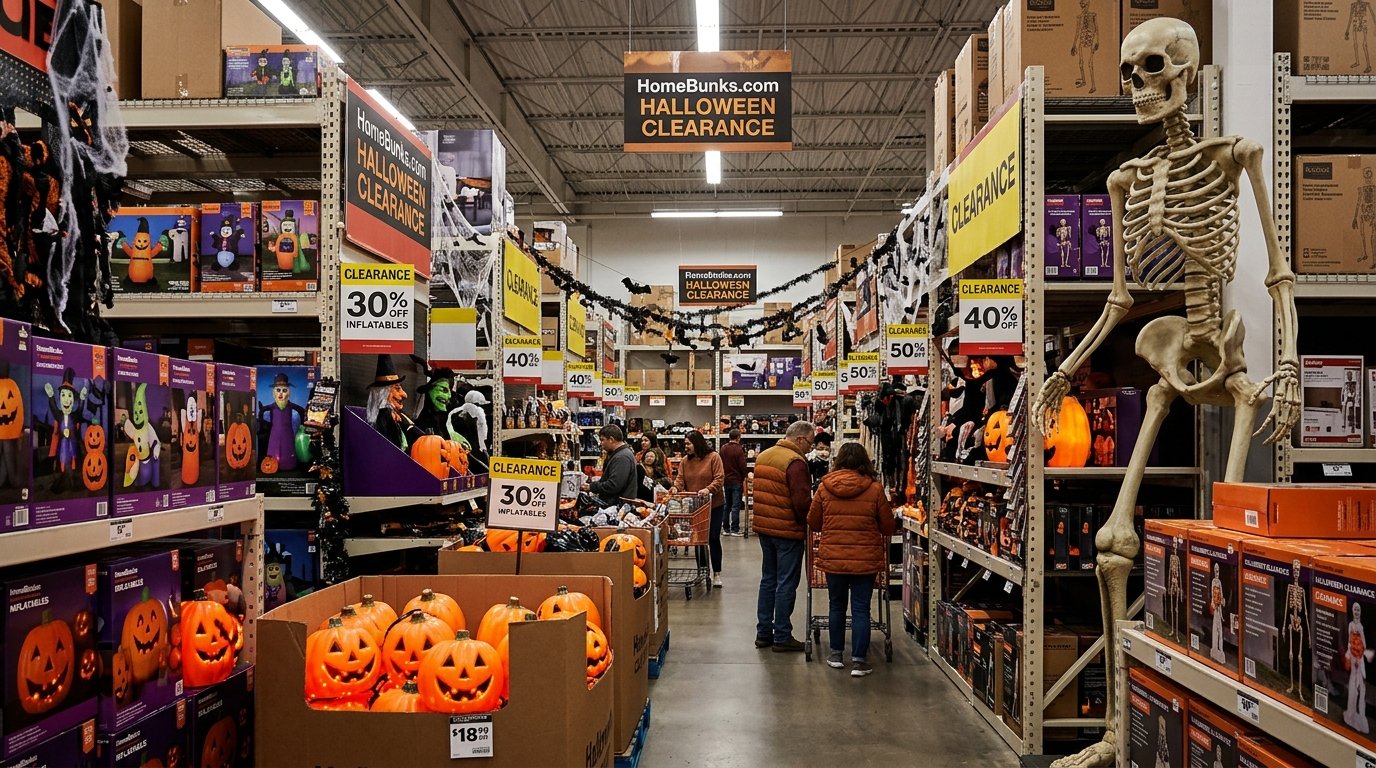
Clearance has fine print, and Spirit’s is the clearest in the topic. Its return policy states that after October 22, 2026, all sales become final, so clearance purchases cannot be returned or exchanged.
Final sale converts inspection from a chore into part of the price. A discounted animatronic you cannot return is worth exactly what a working one is worth, and zero if it is not.
Other chains keep ordinary return windows, which quietly makes their shallower discounts worth more than they look. Price comparisons that ignore return terms are comparing different products.
Read the policy before the haul, not after. The tracker quoted Spirit’s terms in its clearance coverage, which is the level of attention this topic’s fine print deserves.
Test Before You Store, the Same Week Rule
The protocol is short enough to memorize. Unbox and run everything within days of buying it, while the failure is fresh, the receipt is findable, and any non-final-sale return window is still open.
Run animatronics through full cycles, not a five second demo. Motors fail at minute ten, sensors fail in low light, and both failures hide from a quick power check.
Inflatables get the same treatment: inflate fully, check seams and fans, then dry them completely before boxing. A damp inflatable stored in November is a mildewed one discovered next October.
Only then does the haul become inventory. The piece that passes its test is next year’s decor; the piece that fails is this week’s errand, which is a far cheaper discovery.
Buy for Next Year: What Stores Well
A year in storage is a material test, and decor types pass it unevenly. The ranking below is the buying filter for the cliff: spend deepest where storage is safest.
|
Decor Type |
Storage Verdict |
Care Before Boxing |
|---|---|---|
|
Blow molds |
Excellent, the collector’s choice |
Wipe clean, store upright |
|
Skeletons and hard props |
Excellent |
Keep original boxes where possible |
|
Textiles, wreaths, garlands |
Very good |
Wash or dust, flat or hung storage |
|
Ceramics and resin |
Good with padding |
Wrap individually, no stacking weight |
|
LED lights and projectors |
Good |
Remove batteries, coil loosely |
|
Inflatables |
Fair |
Inflate, dry fully, fold loosely |
|
Animatronics |
Fair to risky |
Full cycle test, original box, climate care |
|
Foam tombstones |
Fair |
Flat storage, nothing heavy on top |
Textile heavy styles are clearance gold for exactly this reason: our cute halloween decor guide builds whole rooms from soft textures and faces that fold, hang, and wash without drama.
Door pieces split by material, and our halloween door decor guide shows which wreaths and mats shrug off a year in a tote and which arrive pre-aged in the wrong way.
The Storage Math Nobody Prints
The discount is not the whole saving, because storage is a second purchase. Totes, shelving, and the square footage itself all charge rent against that 75 percent.
Run the honest version of the math. A 30 dollar skeleton at 7.98 saves 22 dollars; a pair of storage totes at 12 dollars each spends the saving before the lid closes.
The fixes are cheap and boring: original boxes beat totes for animatronics and skeletons, labels by zone (porch, yard, indoor) speed next October, and batteries come out of everything, always.
Porch pieces earn their storage fastest, since they are bought once and displayed daily for a month: our halloween porch decor guide plans the porch as zones, which makes a clearance list write itself.
Price Endings and Other Shelf Literacy
Small signals help on the shelf. Deal guides note that prices ending in .97 or .98 flag clearance stock at several chains, a quick way to spot marked down pieces mixed into full price shelves.
Store sections matter too. Lowe’s keeps clearance in a named section, the Back Aisle, whose online count is the decay tracker quoted earlier; knowing where your chain hides clearance is half the hunt.
Candy runs on a shallower track than decor at the same store. A 50 percent decor sign beside 30 percent candy is normal, and conflating the two inflates expectations for both.
When the sign and the shelf disagree, believe the shelf and the register. At Home’s empty page behind a live 50 percent menu banner is the season’s cleanest lesson in that rule.
The First Haunt Kit, Bought on Clearance
A first yard or apartment haunt assembles beautifully from the cliff, because the starter kit is all storage friendly pieces. One skeleton, one light string or projector, two tombstones, a wreath, and textiles cover door, yard, and room.
Buy the kit in one November pass at the value window, test it the same week, and store it labeled. Next October opens with a complete display that cost less than one full price animatronic.
Table pieces belong in the kit deliberately: runners, napkins, and ceramic pumpkins are the cheapest per use items in the entire sale, and our halloween table decor guide shows the tablescapes they build when October returns.
Scale by one category per season afterward. A yard that grows a section each November compounds like savings, without a single full price October.
When You Missed the Cliff
Missing the first steps is not missing the sale. The online tail runs for weeks after stores close or empty, shallower but wider, and Spirit’s post closing clearance is the model.
Second chances live in resale and thrift channels through winter, as other households shed the storage math they failed in November. Their regret is priced kindly.
What not to do is panic buy full price in December for next year. The calendar guarantees another cliff; patience is the entire strategy this topic teaches.
Note the near me lesson from the cluster: stock beats distance, and a dated snapshot from one store set never describes your store. Check your own shelf before driving across town.
Plan the season from our HomeBunks home page, where the whole Halloween cluster is gathered in one place.
The 2027 Cycle: Dates to Hold
Halloween 2027 falls on Sunday, October 31, 2027, and the calendar restarts on the same rhythm. Sets in late August, patience in September, cracks in mid October, cliff on Monday, November 1, 2027.
One date from this year deserves a permanent note: Party City’s standalone stores are gone, their Halloween products sold inside Staples, so route that errand accordingly next season.
Spirit’s footprint also shifts yearly, with a subset of locations reopening as a Christmas concept. The store map you memorized in 2026 will be partly wrong by next August; recheck it then.
Mark the value window now: the days around November 3 to 5, 2027 are where this year’s strand points, subject to the same local variation as every figure here.
Reading a Snapshot Like a Tracker
You can audit any deal claim in minutes once you know what a tracker records. A real observation carries five fields: the store, the store set or city, the channel, the date read, and the exact item with both prices.
Claims missing fields are not lies; they are weather reports without a location. The step charts fail this test on channel alone, blending in store steps with online screenshots until neither can be checked.
Run the same audit on your own store before a trip. Check the chain’s clearance section online for your store set, note the count, and compare it against the last dated figure you saw.
When the online count for your set is falling fast, go today or let it go. The decay curve from the Lowe’s strand, a quarter of stock in six days, is the normal shape of the cliff’s second week.
Photograph shelf tags when you shop. A dated photo of your store’s actual step is worth more for next year’s planning than any national guide, including this one.
The October Decision: Buying for This Year’s Display
Everything so far serves next year’s display, but some purchases cannot wait: the party is this month, the yard is bare, and the piece matters now. October buying has its own rules.
First, prefer chains whose return windows cover Halloween when you buy late. A piece bought at 30 percent off in the final week with returns intact can beat a final sale piece at 50.
Second, watch the online starts. Home Depot’s reported pattern of online clearance opening days before the holiday is the selection safe way to buy this year’s centerpiece at a real discount.
Third, keep every receipt through November 1. Some retailers adjust prices within a window when an item steps down days after purchase; policies vary, but the receipt is the only ticket to ask.
The mistake is mixing the two budgets. This year’s display is bought for use, next year’s kit for value, and judging either by the other’s rules produces regret in both directions.
Condition and Completeness: What the Percentage Hides
Deep steps attract imperfect stock: floor models, open boxes, returns with missing stakes, and animatronics whose sensors were demoed to death by October’s shoppers. The percentage never mentions any of this.
Inspect before the register. For boxed pieces, check the parts list against the box contents where the store allows it, and treat a resealed box as a question, not a bargain.
Floor models carry a hidden discount logic: they have already survived weeks of demos, which proves the motor and ruins it a little, in proportions nobody can measure. Price them as risky, however clean they look.
Missing accessories are negotiable in a way missing electronics are not. A skeleton short two stakes is a haggling opportunity; an animatronic short its adapter is a paperweight at any percentage.
This is where final sale bites hardest. The same imperfection is a shrug at a chain with returns and a total loss at a final sale register, which is why the rules section sits before this one.
The Pro End of the Cliff: Haunters and Resellers
The deepest steps draw professionals, and knowing their habits explains the shelf. Haunted attraction operators restock in November because their buying season is the off season, and animatronics at 75 percent are inventory, not indulgence.
Resellers hunt the same big pieces for the opposite reason: scarcity next October. A stored animatronic bought at the cliff can list the following September when retail stock is full price and thin.
Both groups share one discipline the casual shopper can steal: they buy categories, not items. A haunter needs fog, light, and figures every year, so any working unit in the category serves.
They also share the testing rule, hardened by experience. Professionals power everything before it enters storage, because a warehouse of untested clearance is a warehouse of next October’s surprises.
Expect their pressure on the first weekend. If your list overlaps the pro list, big electronics and licensed pieces, your value window opens earlier than the guide strand suggests.
The Cliff Weekend: A Practical Itinerary
November 1, morning: work your list in priority order, big pieces first, at the store whose dated strand ran deepest. Spirit’s entire store day belongs to this morning, before its doors close for the season.
November 1, afternoon: the second chain on your route, then home to test everything while the day’s receipts are still on the counter. Testing is part of the shopping day, not a later chore.
The value window days: return for the stepped prices on textiles, tableware, and the pieces you were happy to miss. Whatever survived the weekend at 70 percent is the true bargain tier.
The following weekend: one last pass for the tail, online and in store, then the storage ritual closes the season. Photograph your labeled totes; next October will thank this November for the map.
Frequently Asked Questions
1. When do Halloween decorations go on sale?
Decorations go on sale in phases.
Full sets arrive late August at full price, the first markdowns crack open about two weeks before Halloween, and the deep sale starts November 1, the morning after, at most major chains.
2. When does Halloween clearance start?
Clearance starts November 1 at most chains, the Sunday after Halloween 2026.
First steps cluster near 50 percent, then deepen through the first half of November, unevenly, store by store and shelf by shelf.
3. Is there an official Halloween clearance schedule?
No.
No retailer publishes an official clearance schedule, which is why every figure in this guide is a reported strand with a store, a place, and a date attached instead of a promise.
4. What is the best day to buy Halloween decorations on clearance?
Around November 3 to 5, by one deal guide’s strand: most chains step from 50 toward 70 percent there, while selection is still reasonable.
Treat it as a judgment built on prior year tracking, not a guarantee.
5. How much do Halloween decorations get marked down?
Deeper in steps.
Reported cadences run from 50 percent on November 1 toward 70 and 75 percent in the first week, with 90 percent claimed by some step charts and disputed or unconfirmed at several chains.
6. Does Target really do 90 percent off Halloween clearance?
Unconfirmed, and this guide prints the conflict.
Social step charts claim 90 percent around November 5 to 7, yet a dated online snapshot on November 9 showed Target clearance at only 15 to 40 percent.
7. Why do sources disagree about Halloween clearance percentages?
Because there is no official schedule to quote.
Trackers observe different stores, cities, and channels on different days, then report honestly different numbers, which is why strands carry labels instead of being merged.
8. When does Spirit Halloween have its clearance sale?
In two compressed steps.
Its stores ran 50 percent off everything on November 1, 2026, then closed for the season on November 2, with online clearance continuing afterward at up to 50 percent on select items.
9. Can I still buy Spirit Halloween clearance after the stores close?
Yes, online.
Spirit’s end of season online clearance continued after the stores closed, reported up to 50 percent on select items with free standard shipping over a threshold, while stock lasts.
10. Can you return Halloween clearance items?
At Spirit, effectively no: its policy made all sales final after October 22, 2026, so clearance purchases cannot be returned.
Other chains keep ordinary return windows, which quietly adds value to their shallower discounts.
11. What does final sale mean at Spirit Halloween?
It means the purchase is the end of the transaction: no returns, no exchanges, whatever the item does at home.
Final sale converts testing the same week from a chore into part of the bargain.
12. Is Lowe’s or Home Depot better for Halloween clearance?
Both reached roughly 75 percent in dated snapshots, Lowe’s counted online in one store set and Home Depot read in store.
Lowe’s published item counts let you watch selection decay; Home Depot’s deepest tier claims are disputed.
13. Why is online Halloween clearance shallower than in store?
Because stores clear shelves physically while online warehouses clear them patiently.
Target’s online figure of 15 to 40 percent on November 9 sat far below its claimed in store steps in the same week.
14. What Halloween decorations are worth buying on clearance?
Buy what stores well: blow molds, skeletons and hard props, textiles, wreaths, and ceramics with padding.
These survive a year in a box and anchor next season’s display at a quarter of the price.
15. What should I not buy on Halloween clearance?
Skip untested electronics you cannot return, mystery or damaged boxes, and anything you have no storage for.
A 75 percent saving on a broken animatronic is a 100 percent loss with extra steps.
16. How do I store clearance animatronics for a year?
In original boxes where possible, batteries removed, in a dry and temperate space.
Run each one through full cycles before boxing, and keep the receipt and model details with the unit for next year.
17. Should I test clearance animatronics before storing them?
Yes, within days of buying, while returns are still possible where they exist.
Run full cycles, not five second demos: motors and sensors fail at minute ten, in low light, exactly where quick checks never look.
18. Do Halloween inflatables store well?
Fairly, with one ritual: inflate fully, check seams and the fan, then dry completely before folding loosely.
A damp inflatable boxed in November is a mildewed discovery waiting for next October.
19. How much storage space does clearance decor need?
Less than feared if original boxes are kept and totes are labeled by zone: porch, yard, indoor.
One skeleton, lights, tombstones, and textiles, a full starter kit, fit in two large totes.
20. Are price endings like .97 and .98 really clearance flags?
At several chains, yes, per deal guide reporting: prices ending in .97 or .98 flag clearance stock.
Use it as a shelf spotting aid mixed among full price items, not as a universal rule.
21. Is candy discounted the same as decor?
No.
Candy runs a shallower track at the same store: 50 percent decor beside 30 percent candy was a reported opening pattern, and candy steps top out lower than decor at most chains.
22. When do Halloween decorations first come out in stores?
Early.
Target’s full sets reportedly appear in late August and Home Depot has most stores decorated by early September, at full price, which makes those months for measuring and watch lists, not buying.
23. Should I buy Halloween decor before Halloween or after?
Both, for different pieces.
Buy before at a verified 50 percent when a specific piece is this year’s display; buy after for next year’s kit, where selection risk costs you nothing you needed.
24. What is selection decay in clearance terms?
It is the measured shrinkage of choice as discounts deepen.
Lowe’s clearance count fell from 101 items on November 3 to 73 on November 9, 2026, more than a quarter gone in six days.
25. How fast does Halloween clearance sell out?
Fast at the top of the list.
Big animatronics sell out within the opening steps per coupon trackers, because haunters and resellers hunt the same pieces, while textiles and tableware linger into the tail.
26. What if I missed the November 1 clearance?
Work the online tail, resale listings, and thrift shelves through winter, when other households shed their storage mistakes.
Then hold for the next cycle; the calendar guarantees another cliff next November.
27. Does Amazon run Halloween decor sales?
Yes, around its fall event in early October per deal guide reporting, a window treated as likely rather than fixed.
Depths are shallower than the November cliff; it serves this year’s display, not next year’s kit.
28. What is the Back Aisle at Lowe’s?
It is Lowe’s named clearance section, online and in store, where the Halloween stock concentrates as it steps down.
Its item count is exactly what trackers watched fall from 101 to 73 in November 2026.
29. Can I use coupons on Halloween clearance?
Sometimes, where the retailer’s policy allows clearance and promotions to combine, but many final sale and clearance terms exclude stacking.
Read the specific store’s terms; never build the plan assuming a coupon lands.
30. Do Halloween clearance prices vary by store location?
Yes, genuinely.
Strands are observations from named store sets on named dates; your store’s stock decides its own steps.
That is why the standing rule is to check your shelf and register before driving anywhere.
31. Is it worth buying Halloween decor a year ahead?
For pieces that store well and suit a display you will actually build, yes.
The math works when storage is cheap and testing happens immediately; it fails when totes and space cost more than the saving.
32. What is the average spend on Halloween decorations?
Per the NRF’s 2026 consumer figures carried in the cluster research, decorations spending totaled about 4.3 billion dollars, with an average decor spend near 54.95 dollars per celebrating household, a dated strand like every figure here.
33. How should I clean and prep decor before storing it?
Wipe hard pieces, wash textiles, dry inflatables completely after a full inflation test, and dust wreaths before hanging storage.
Clean decor stores without smells, stains setting, or mildew, and unpacks ready next October.
34. Should batteries come out of clearance props before storage?
Yes, always.
Batteries left in props and light strings corrode over a year and can kill the electronics they powered.
Removing them is the cheapest insurance in the entire storage protocol.
35. What stores well better, blow molds or inflatables?
Blow molds, clearly.
They wipe clean, stack or stand upright, and shrug off a year in a box, which is why collectors hunt them first.
Inflatables store smaller but demand the drying ritual to survive.
36. When does the next Halloween sales cycle start?
In August 2027, on the same rhythm: sets out late August, patience through September, first cracks mid October, and the cliff on Monday, November 1, 2027, the morning after Halloween.
37. What day is Halloween 2027?
Sunday, October 31, 2027.
Mark the expected value window too: the days around November 3 to 5, 2027, where this year’s strand points, subject to the same local variation as every figure in this guide.
38. Does Party City still have Halloween clearance?
No, not as standalone stores: they have closed, and the brand’s Halloween products are sold inside Staples.
Route that errand to Staples, and expect a different, smaller clearance pattern there.
39. How do I know a clearance percentage is real?
Check its provenance: a real figure carries a store, a place, a date, and a channel.
A bare percentage with none of those is marketing weather, pleasant to read and useless to plan by.
40. What is the value day idea in clearance shopping?
It is the point where the falling price and the falling selection cross for the pieces you want: deep enough to matter, early enough that the shelf still holds your list.
One guide strands it at November 3 to 5.
41. Can I resell Halloween clearance decor?
Some do, through marketplaces and local listings, and the margins live in big pieces bought at the deepest steps.
Storage, testing, and a year of patience are the real costs; price them before calling it profit.
42. Where does this guide get its percentages?
From the sources named throughout: dated clearance trackers, a conflict flagging deal guide, coupon community reporting, and retailer policy text for the rules.
Every figure keeps its label so you can weigh it yourself.
Conclusion
Halloween decor sale rewards the reader who shops the calendar instead of the sign. Learn the four phases, expect full price in September and the cliff on November 1, and treat every percentage as a dated strand that your own shelf must confirm.
Make the trade consciously: earlier steps buy selection, later steps buy depth, and the value window sits where the two curves cross for the pieces you actually want. Respect the fine print, test everything the week you buy it, and store only what stores well.
Build the first kit this November, label it by zone, and let one category grow each season after. By Halloween 2027 your display will look expensive for the best reason: almost none of it was bought in October.
Start with the cluster hub on our HomeBunks home page and plan the rooms this haul will haunt.