
Minimalist bedroom ideas work best when editing comes before buying, because a new bed or lamp cannot fix a room full of unused furniture and open clutter. A calm room starts with fewer, better pieces that serve daily life well.
Minimalist bedroom ideas also fail when minimalism is mistaken for emptiness. An empty room with a mattress, white walls, and no texture feels unfinished, while a restrained room with warm wood, soft bedding, and clear surfaces feels intentional and welcoming.
Minimalist bedroom ideas succeed when every visible object earns its place through use, comfort, or meaning. A room built on that test stays easier to clean, easier to use, and easier to keep calm over time.
What Minimalism Really Means
Less, but better
Minimalism means fewer pieces chosen well, not the fewest pieces possible. A bed, a nightstand, a wardrobe, and a lamp can be enough, provided each piece fits the room and supports daily routines.
Less, but better also means quality over quantity in visible places. A well-made bed frame, a comfortable mattress, and soft bedding matter more than many small decorations that compete for attention.
Less, but better does not mean removing useful furniture. A dresser that holds clothes, a bench that holds luggage, and a desk that supports work all earn their place, even in a restrained room.
Intentional objects, not empty walls
Intentional objects are chosen for a clear reason, such as use, comfort, memory, or beauty that lasts. An object that is kept only because it was on sale, or because a corner looked empty, usually becomes clutter.
Intentional objects also need a home. A vase, a book, and a lamp each need a surface, a shelf, or a drawer, so the room can return to calm after daily use.
Intentional objects do not need to be expensive. A handmade bowl, a framed photograph, and a well-worn book can feel more personal than a set of matching decorations bought in one trip.
Visual silence and visual weight
Visual silence means the eye can rest on clear surfaces, plain walls, and open floor. Visual silence does not mean a room with nothing to look at; it means a room without competing focal points.
Visual weight describes how heavy an object looks. Dark, bulky, tall, and highly patterned pieces carry more visual weight than light, low, slim, and plain pieces in the same room.
Visual weight should concentrate in one place, usually the bed. A heavy bed with light nightstands, light walls, and a light rug feels balanced, while heavy furniture on every wall feels crowded.
Minimalist Versus Nearby Styles
Minimalist versus Scandinavian
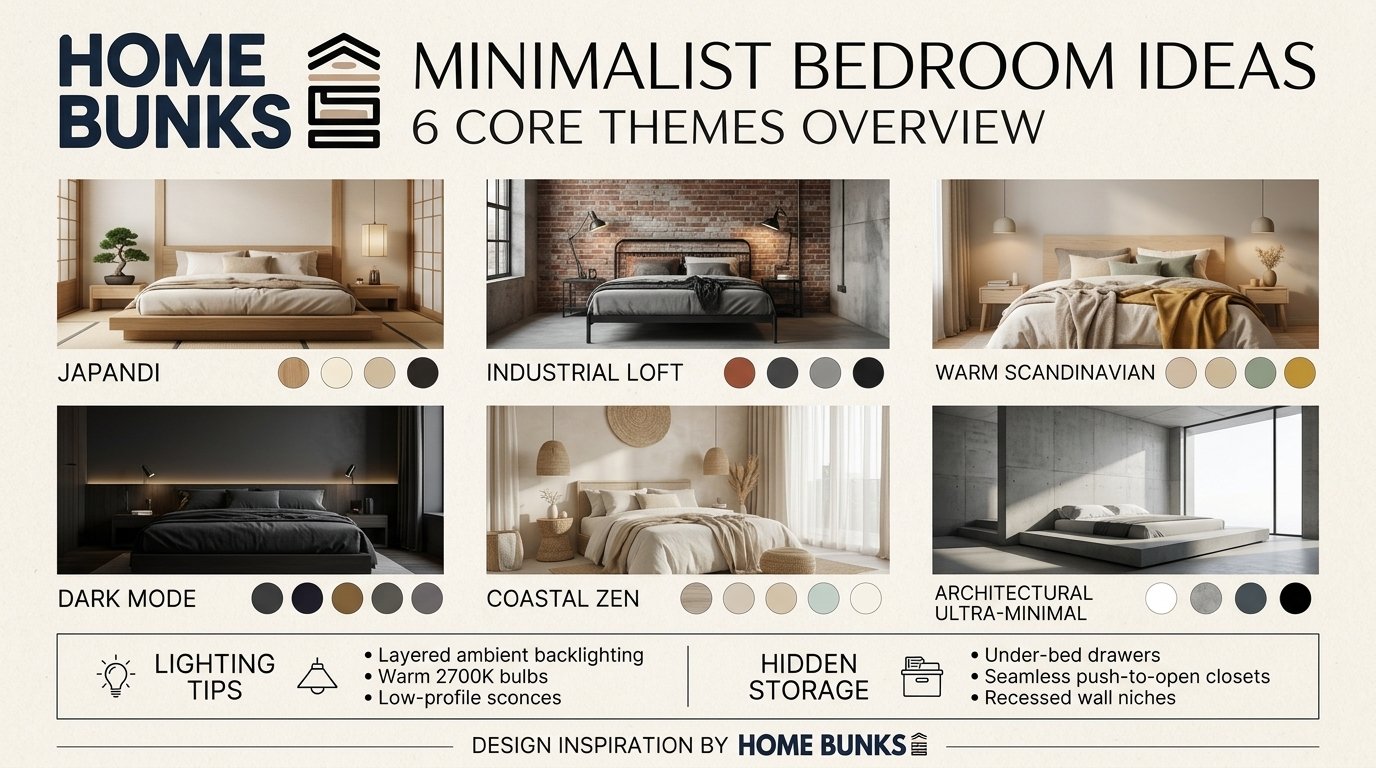
Scandinavian bedrooms share simplicity and light wood, but they add cozy textiles, candles, and soft layers more freely. Scandinavian rooms often feel brighter, softer, and more decorated than strict minimalist rooms.
Minimalist bedrooms keep decoration tighter, with fewer textiles on display and fewer small objects on surfaces. Scandinavian bedrooms keep warmth through many soft layers, while minimalist bedrooms keep warmth through fewer, better textures.
A reader who wants cozy layers and visible comfort may prefer Scandinavian style. A reader who wants visual silence and very clear surfaces may prefer minimalist style, with Scandinavian warmth added only through bedding and rugs.
Minimalist versus Japandi
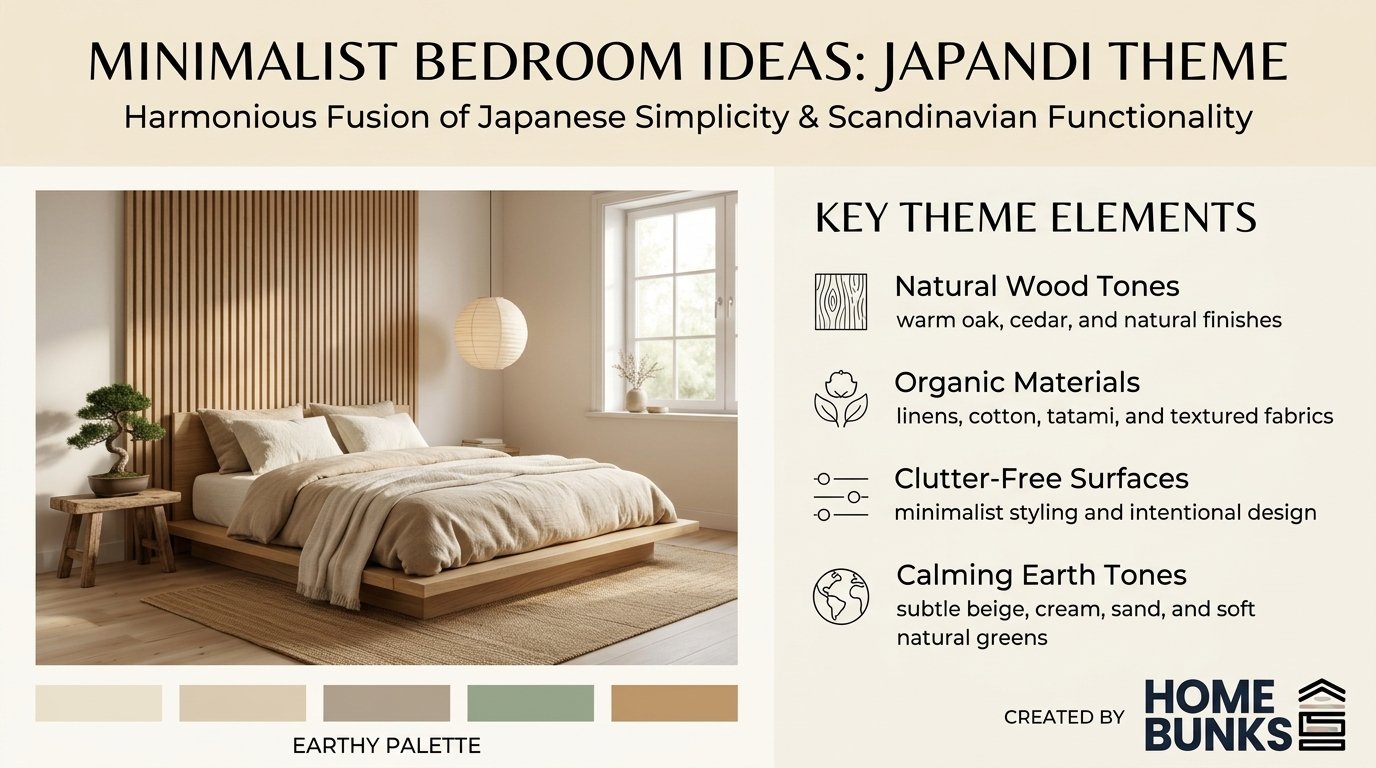
Japandi blends Japanese restraint with Scandinavian warmth, using low furniture, darker woods, and crafted imperfection. Japandi rooms feel grounded, earthy, and handmade, with visible wood grain and ceramic texture.
Minimalist rooms can use any wood tone and any clean material, provided the room stays restrained. Japandi rooms specifically favour low profiles, warm earth tones, and objects that show the mark of making.
A reader who loves handmade ceramics, low beds, and dark wood accents may prefer Japandi. A reader who wants a clean, modern room without a specific cultural blend may prefer plain minimalism.
Minimalist versus wabi-sabi and mid-century modern
Wabi-sabi centres imperfection, age, and natural wear as beauty itself. Wabi-sabi rooms use raw, weathered, and irregular materials, while minimalist rooms usually use clean, smooth, and controlled materials.
Mid-century modern uses tapered legs, graphic shapes, bold lamps, and retro colours such as mustard and teal. Mid-century rooms feel lively and retro, while minimalist rooms feel quiet and restrained.
Minimalism can borrow from both styles, but borrowing too much changes the room. A wabi-sabi bowl or a mid-century lamp can work as a single focal point, provided the rest of the room stays restrained.
| Style | Palette | Furniture height | Decor count | Mood |
|---|---|---|---|---|
| Minimalist | White, grey, warm neutrals | Low to standard | Very few, intentional | Clean, quiet |
| Scandinavian | Bright white, pale grey, pastels | Standard, light | Some, cozy textiles | Bright, cozy |
| Japandi | Warm white, clay, charcoal | Low to medium | Few, handmade | Grounded, calm |
| Wabi-sabi | Earth, clay, ochre, stone | Low, rustic | Very few, aged | Raw, earthy |
| Mid-century modern | Wood, mustard, teal, orange | Standard, tapered legs | Statement pieces | Lively, retro |
| Boho | Cream, sand, terracotta, sage | Mixed, layered | Many, collected | Layered, warm |
Start With an Edit, Not a Purchase
Declutter by zone
Decluttering by zone prevents overwhelm, because one zone at a time is easier than a whole room at once. Start with the closet, then the dresser, then nightstands, then under-bed space, then the desk, then decor.
Each zone needs four decisions: keep, donate, store elsewhere, or relocate within the room. A fifth pile for trash or recycling keeps broken, stained, and unsafe items out of donation boxes.
Zone work should end with a clear surface and a labelled home for kept items. A zone that is emptied but not organised will refill within a week, because kept items have nowhere to go.
Closet edit
A closet edit starts by removing everything, then returning only clothes that fit, suit current life, and are worn regularly. Seasonal clothes, formal clothes, and spare bedding belong in labelled storage, not in prime closet space.
Slim hangers increase rod capacity and create a uniform look, while drawer dividers separate socks, underwear, and accessories. A closet that looks uniform feels calmer, even when it holds the same number of items.
A closet edit also needs a capsule rule for the future. A capsule wardrobe limits daily clothes to a smaller, coordinated set, which reduces morning decisions and keeps the closet from refilling quickly.
Dresser and nightstand edit
A dresser edit removes surface clutter first, then drawer clutter second. A dresser top should hold at most one lamp, one meaningful object, and one small tray, while drawers should hold grouped items with dividers.
A nightstand edit follows a simple rule: lamp, book, charger, and one personal object. A nightstand that holds medicines, cables, books, glasses, and random objects becomes a clutter magnet, even in a minimalist room.
A nightstand with a drawer hides charging cables, medicines, and small essentials better than an open shelf. A floating nightstand also frees floor space and makes cleaning easier in a small room.
Under-bed and desk edit
Under-bed space suits flat storage bins for seasonal clothes, spare bedding, and luggage, provided bins have lids and slide easily. Under-bed space should never become a hidden dump for items that should be donated or stored elsewhere.
A desk edit keeps only daily work tools on the surface: laptop, lamp, notebook, and pen. Papers, cables, and reference books belong in a drawer, a shelf, or a closed box, not scattered across the desk.
A desk that doubles as a nightstand or dressing table needs a clear boundary. A small tray, a drawer divider, or a set work hour can keep work items from spreading into sleep space.
The Minimalist Palette Rule
One base, one grounding tone, one accent
A minimalist palette works with one base neutral, one grounding tone, and one accent used in only two places. A base of warm white, cream, or soft grey gives a calm background for the whole room.
A grounding tone of light oak, mid wood, warm brown, or soft black gives weight and contrast. A grounding tone should appear in the bed frame, wardrobe, or rug, not in every piece of furniture at once.
An accent of sage, dusty blue, clay, or muted olive should appear in only two places, such as bedding and artwork, or a throw and a plant pot. An accent scattered everywhere becomes a new colour theme, not a restrained accent.
Warm white versus cool white
Warm white has yellow, beige, or pink undertones and feels softer under warm bulbs. Cool white has blue or grey undertones and can feel clean in daylight but clinical under artificial light at night.
Warm white suits most bedrooms because it pairs well with wood, linen, and wool. Cool white suits very bright rooms with strong daylight and pale wood, but it needs warm light and texture to avoid a sterile feeling.
Paint samples should be tested on two walls, with bedding and flooring nearby, under both daylight and bedside lamps. A paint colour that looks perfect in a shop can look grey, yellow, or blue in a real bedroom.
Texture over paint name
Texture matters more than a specific paint name, because linen, wood, wool, and matte surfaces create depth without colour or pattern. A room with one paint colour but three textures feels richer than a room with three paint colours and no texture.
Texture should vary by touch and light: smooth bedding, rough wood grain, soft wool, and matte walls each reflect light differently. That variation prevents a neutral room from looking flat or unfinished.
Texture should stay restrained in count. Three main textures, repeated consistently, create calm, while six textures competing for attention create visual noise, even in a neutral palette.
Furniture That Earns Its Place
Bed first
The bed is the largest visual object in a bedroom, so bed choice decides the whole room. A low-profile platform bed with clean lines suits most minimalist rooms, because it lowers visual weight and leaves wall space visible.
A storage bed suits small rooms where a separate dresser cannot fit, because drawers or a lift-up base hide seasonal clothes and spare bedding. A storage bed needs side clearance for drawers, or a lift-up mechanism for beds near a wall.
A bulky headboard, a tall canopy, and a heavy frame can overwhelm a small minimalist room. A simple headboard, a wall panel, or no headboard with a strong wall colour can anchor the bed without visual bulk.
Nightstand, dresser, and wardrobe
A nightstand should fit the bed height and hold only nightly essentials. A nightstand that is too tall, too wide, or too deep blocks bed access and creates a crowded corner, especially in a small room.
A dresser should match the room size and storage need, not a matching set ideal. A slim dresser with deep drawers suits many rooms better than a wide dresser with shallow drawers that cannot hold folded clothes.
A wardrobe with closed doors suits minimalism better than open shelving for daily clothes. Closed doors hide colour, pattern, and clutter, while open shelves display every item and require constant tidying to look calm.
Bench, chair, and desk
A bench at the foot of the bed can serve as storage, seating, and luggage space in one piece. A bench with internal storage suits guest rooms and small primary rooms, provided it does not block bed access.
A chair in a bedroom should have a clear purpose: reading, dressing, or work. A chair that holds discarded clothes becomes a clutter pile, not seating, and should be replaced with a hook, a tray, or a laundry basket.
A desk in a bedroom should be compact, wall-mounted, or foldable where space is tight. A desk that doubles as a nightstand or dressing table can work, provided work items have a drawer or tray for the night.
| Furniture | Minimalist choice | Avoid |
|---|---|---|
| Bed | Low platform or storage bed | Bulky canopy or tall frame |
| Nightstand | Slim, drawer, bed height | Wide, open, cluttered |
| Dresser | Slim, deep drawers | Wide, shallow, matching set |
| Wardrobe | Closed doors, slim profile | Open shelves for daily clothes |
| Bench | Storage bench, clear access | Bench that blocks bed |
Storage That Hides Clutter
Closed storage first
Closed storage should come before open storage in a minimalist bedroom, because closed doors, drawers, and bins hide daily clutter without effort. Open storage suits only a few beautiful, intentional objects.
Closed storage includes wardrobes, dressers, drawer beds, ottomans, and lidded bins. Each closed unit should have a label or a clear category, so items return to the same place after use.
Closed storage can still fail when it becomes overstuffed. A wardrobe that cannot close, a drawer that cannot slide, and a bin that cannot lid all signal that an edit, not more storage, is needed.
Open storage last
Open storage suits books, one plant, and one meaningful object, not daily clothes, cables, and toiletries. A floating shelf with three books and a plant looks intentional, while a floating shelf with twenty small items looks cluttered.
Open storage should be limited to one or two shelves in a minimalist room, with empty space around each object. Empty space around an object makes that object look chosen, while crowded shelves make every object look stored.
Open storage near the bed should stay minimal, because bedside shelves are seen last at night and first in the morning. A bedside shelf with a book and a lamp feels calm, while a bedside shelf with chargers, medicines, and papers feels busy.
Under-bed, wardrobe, and vertical storage
Under-bed storage suits seasonal clothes, spare bedding, and luggage in flat, lidded bins. Bins should slide easily, stack neatly, and label clearly, so seasonal rotation does not become a search.
Wardrobe storage suits daily clothes, shoes, and accessories with hanging space, drawer space, and shelf space in balance. A wardrobe with only hanging space wastes shelf space, while a wardrobe with only shelves wastes hanging space.
Vertical storage suits tall wardrobes, wall hooks, and one tall shelf unit, provided tall pieces do not block light or door swing. Vertical storage frees floor space, but tall open shelving can reintroduce visual clutter if filled carelessly.
Texture, Warmth, and Light
Texture trio
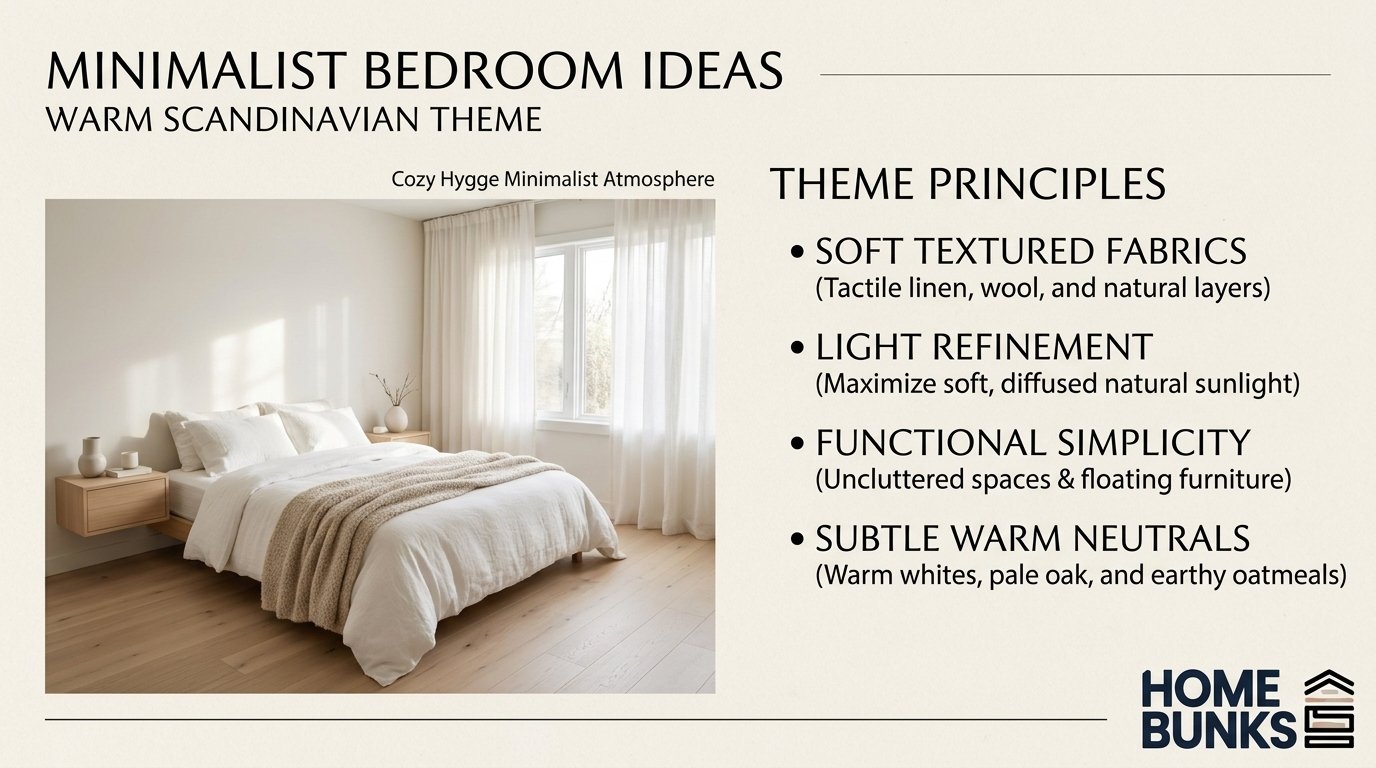
A texture trio of linen or cotton, wood, and wool gives a minimalist room warmth without decoration. Linen bedding adds soft wrinkles and breathability, wood adds grain and warmth, and wool adds softness underfoot.
Texture trio should repeat in different places: linen on the bed, wood on the bed frame and nightstand, wool on the rug and throw. Repetition creates cohesion, while random textures create visual noise.
Texture trio should stay in the same palette family. Warm linen, warm wood, and warm wool feel cohesive, while cool linen, dark wood, and bright wool can clash even in a neutral room.
Warm lighting layers
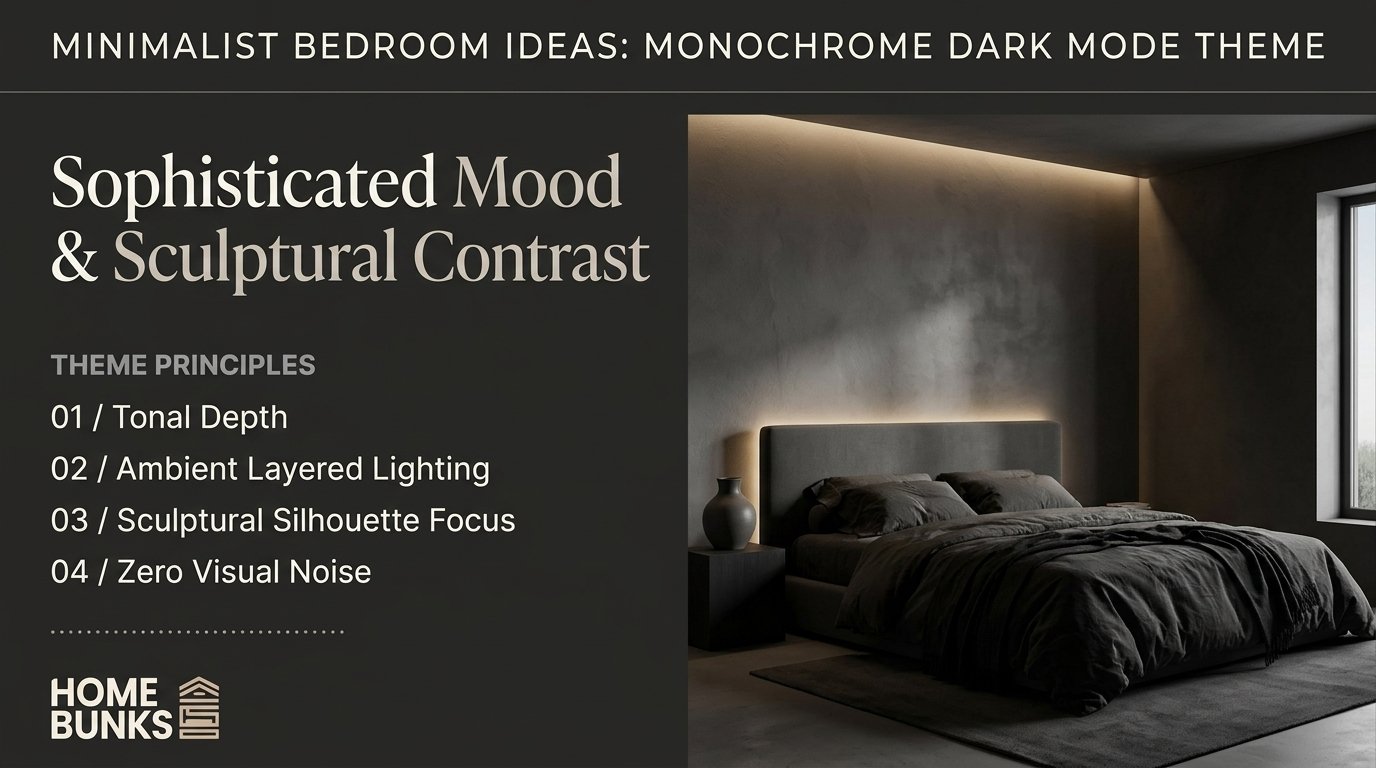
Warm lighting uses ambient, task, and accent layers together, rather than one harsh ceiling light alone. Ambient light gives general brightness, task light supports reading, and accent light highlights a wall or artwork.
Warm bulbs in the 2700K to 3000K range suit most bedrooms, because they feel soft and relaxing in the evening. Cooler bulbs can feel bright and clinical at night, even when they look clean during the day.
Lighting layers should use dimmers where possible, because a room that is bright for cleaning and soft for sleep needs flexible light. A single bright ceiling light cannot serve both purposes well.
Cove, sconce, and lamp choices
Cove lighting, hidden behind a headboard or ceiling edge, creates a soft glow without visible fixtures. Cove light suits minimalist rooms because it adds atmosphere without adding objects to walls or ceilings.
Wall sconces free bedside table space and direct light for reading, provided they sit at a comfortable height for the actual sleeper. Swing-arm sconces allow light to move toward a book and away afterward.
Table lamps suit rooms where hardwiring is not possible, especially rentals. A simple lamp with a warm bulb and a plain shade adds warmth without pattern, colour, or visual bulk.
Rug, Artwork, and Plant Rules
Rug size rule
A rug should extend at least 18 inches past each side of the bed, so feet land on soft texture in the morning. A rug that sits only under the bed, with no visible border, looks like an afterthought.
A rug for a queen bed often needs an 8 by 10 foot size in a spacious room, while a smaller room may suit runners on each side instead. Runners give warmth without overwhelming a narrow room or blocking door swing.
A rug should stay low pile and neutral in a minimalist room, with a subtle pattern at most. A busy rug pattern competes with bedding, artwork, and wood grain, and can make a small room feel smaller.
Artwork size rule
One large artwork suits minimalism better than a gallery wall of many small frames, because one focal point gives the eye a place to rest. A gallery wall can work in a large room, but it usually adds visual noise in a small minimalist room.
Artwork width guidance from competitor design pages suggests about 60 to 75 percent of bed width for a piece above the bed. That size anchors the bed without overwhelming the wall or competing with the headboard.
Artwork should be hung at eye level from a standing position, with the centre near the middle of the visible wall space above the bed. Artwork hung too high looks disconnected, while artwork hung too low crowds the headboard.
One large plant rule
One large plant suits minimalism better than many small pots, because one sculptural plant becomes a focal point while many small pots become clutter. A large plant in a simple pot grounds a corner and adds life without filling surfaces.
Plant height guidance from competitor pages suggests about 35 to 59 inches for an empty corner plant, converted from metric guidance to US inches. That height fills a corner without blocking light or door swing.
Plant choice should match light, water, and pet safety for the actual home. A plant that needs bright light will fail in a dark bedroom, while a plant that is unsafe for pets should not sit where pets can reach it.
Layouts by Room Size and Use
Small bedroom layout
A small minimalist bedroom should start with the bed against the longest clear wall, with clearance on the daily use side and wardrobe access on the other side. A bed placed first prevents furniture from dictating the layout.
Small room clearance guidance from competitor pages suggests about 18 to 24 inches beside the bed, converted from metric guidance to US inches. That clearance allows sitting, dressing, and making the bed without squeezing past furniture.
Small rooms benefit from wall sconces instead of table lamps, floating nightstands instead of wide tables, and a wardrobe instead of a dresser plus a closet. Each swap frees floor space without removing function.
Narrow bedroom layout
A narrow bedroom should avoid lining every piece of furniture along both walls, which creates a corridor feeling. A bed at one end, a wardrobe at the other end, and a clear walkway down the middle feels calmer.
A narrow room benefits from a large rug that defines the sleeping zone, a mirror that reflects light, and a single focal wall behind the bed. A narrow room with too many focal walls feels divided and busy.
A narrow room should use shallow wardrobes, slim nightstands, and wall hooks instead of deep dressers. Shallow storage keeps walkways clear, while deep storage blocks movement in a narrow space.
Primary bedroom layout
A primary minimalist bedroom needs daily closet space, dressing space, and a reading or seating zone if space allows. A primary room is not a guest room with a larger bed; it is a daily living space.
Primary layout should keep the bed centred on the main wall, with matching or coordinated nightstands, a wardrobe on one side, and a dresser or bench on the other side. Symmetry helps a primary room feel calm, even with different furniture pieces.
Primary layout should also include a laundry path: a basket, a hamper, or a laundry bag that does not sit on a chair. A primary room without a laundry home will accumulate clothes on chairs and benches within days.
| Layout | Bed position | Storage priority |
|---|---|---|
| Small | Longest clear wall | Wardrobe and under bed |
| Narrow | One end, headboard wall | Shallow wardrobe, wall hooks |
| Primary | Centred main wall | Large wardrobe and dresser |
| Guest | Clear wall, luggage space | Wardrobe and bench |
| Teen | Clear wall, desk zone | Desk, wardrobe, under bed |
| Rental | Longest clear wall, no drill | Leaning mirror, plug-in lights |
Styles Within Minimalism
Warm minimalism
Warm minimalism uses cream, oatmeal, latte, light oak, and soft wool to create a soft, enveloping room. Warm minimalism suits readers who want calm without coldness, and who prefer rounded edges and layered texture.
Warm minimalism keeps decoration low, but texture high. A wool throw, a linen duvet, a wood frame, and a soft rug give warmth through touch, not through objects or patterns.
Warm minimalism should avoid cool grey walls, chrome finishes, and bright white bedding together, because that combination can feel clinical. Warm wood and warm bulbs correct coolness without adding clutter.
Modern minimalism
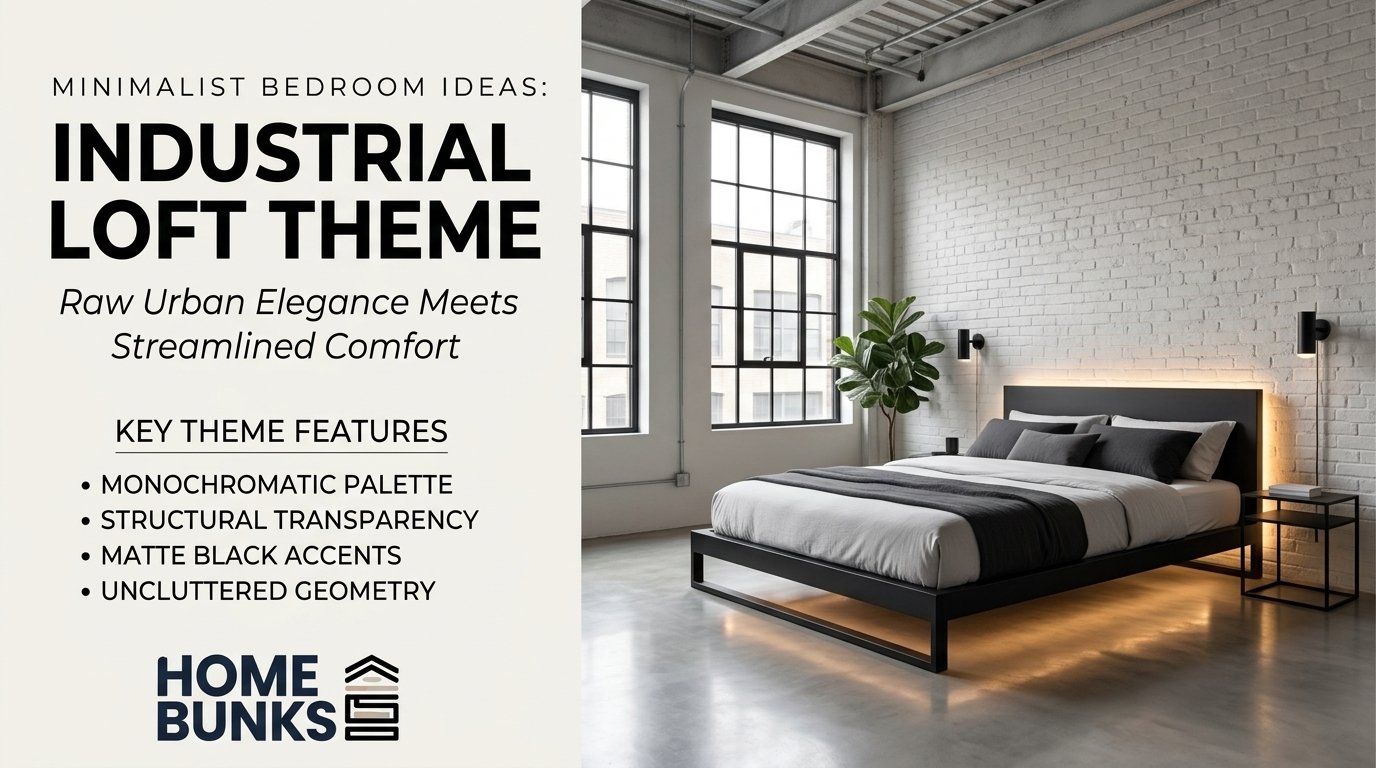
Modern minimalism uses clean lines, matte black or brushed brass accents, and geometric shapes to create a sleek, contemporary room. Modern minimalism suits readers who want a polished, hotel-like bedroom with minimal pattern.
Modern minimalism keeps furniture low and slim, with handleless wardrobes, floating nightstands, and simple lamps. Modern minimalism avoids ornate headboards, carved wood, and busy patterns that break clean lines.
Modern minimalism should still include texture, because sleek surfaces alone can feel hard. A wool rug, a linen throw, and a wood accent soften modern lines without breaking the style.
Organic modern minimalism
Organic modern minimalism blends minimalist forms with natural textures, soft curves, and muted palettes. Organic modern rooms use cane, rattan, jute, stone, and ceramic to feel natural without feeling rustic or boho.
Organic modern minimalism suits readers who want nature indoors without many plants or patterns. A cane headboard, a stone tray, a ceramic lamp, and a jute rug give nature through materials, not through decoration.
Organic modern minimalism should avoid too many natural materials at once. Cane, rattan, jute, stone, and wood together can feel busy, while two or three natural materials repeated consistently feel calm.
Japanese-inspired minimalism
Japanese-inspired minimalism uses low furniture, natural wood, paper light, and intentional negative space to create a grounded, serene room. Japanese-inspired rooms favour low platform beds, simple bedding, and one sculptural object.
Japanese-inspired minimalism should not be reduced to a mattress on the floor. Proportion, material quality, and a clear focal point matter more than floor height alone, and a low bed still needs a frame, bedding, and storage.
Japanese-inspired minimalism suits readers who want stillness and craft. A handmade ceramic vase, a low wood bench, and a paper lantern can carry the style, provided the rest of the room stays restrained.
Budget and Renter Systems
Zero-cost declutter and rearrange
A zero-cost minimalist refresh starts with removing, relocating, and rearranging what already exists. Remove unused furniture, relocate items to their proper rooms, and rearrange the bed, wardrobe, and nightstands for better movement.
Zero-cost work also includes cleaning surfaces, washing bedding, and opening curtains for daylight. A clean, rearranged room with existing furniture often feels more minimalist than a room with new furniture but old clutter.
Zero-cost work should end with a donation box, a storage box, and a trash bag by the door. A declutter session without an exit plan leaves bags in the room and recreates clutter in a new form.
Low-cost refresh
A low-cost refresh focuses on one or two high-impact changes: neutral bedding, a warm lamp, a correctly sized rug, a mirror, or one large artwork. Those five items change how a room feels without replacing all furniture.
Low-cost refresh should start with bedding, because the bed dominates the room visually. Neutral linen or cotton bedding in one palette family can calm a room faster than new wall colour or new furniture.
Low-cost refresh should avoid buying many small decorations. A small rug, a small lamp, a small plant, and small artwork together cost more than one good rug or one good lamp, and they add visual noise instead of calm.
Renter-safe changes
Renter-safe changes avoid drilling, painting, and permanent fixtures where leases require it. Removable wallpaper, leaning mirrors, plug-in sconces, and adhesive hooks give style without landlord conflict.
Renter-safe storage uses freestanding wardrobes, storage benches, and under-bed bins instead of built-in closets. Freestanding storage moves with the renter and does not require wall changes.
Renter-safe lighting uses table lamps, floor lamps, and plug-in sconces instead of hardwired fixtures. Plug-in sconces with cord covers give bedside light without electrical work, provided cords do not run under rugs or across walkways.
| Scope | Main actions | What to verify |
|---|---|---|
| Zero cost | Declutter, rearrange, clean | Donation exit plan |
| Low cost | Bedding, lamp, rug, mirror, art | Size and palette fit |
| Mid cost | Bed, wardrobe, dresser swap | Measurements and delivery |
| Full room | Furniture, storage, lighting system | Budget scope, not a single price |
| Rental | Removable, plug-in, freestanding | Lease rules before drilling |
Keep It Minimal: Routines That Work
Daily reset
A daily reset takes five minutes and protects minimalism from daily life. Make the bed, clear nightstands, return clothes to closet or laundry, and coil chargers before leaving the room.
A daily reset also reveals problems early. A nightstand that keeps refilling, a chair that keeps holding clothes, and a drawer that keeps sticking all point to a storage or habit issue worth fixing.
A daily reset should be tied to an existing habit, such as morning dressing or evening wind-down. A reset tied to no habit will be forgotten, while a reset tied to a routine becomes automatic.
Weekly surface check
A weekly surface check clears dresser tops, nightstands, shelves, and desks of items that migrated during the week. A weekly check takes less time than a monthly deep declutter, because clutter has less time to accumulate.
A weekly check should include a one-in, one-out review for new items. A new book, garment, or decoration should replace an old one, or find a labelled home, rather than joining a surface pile.
A weekly check should also include laundry, bedding, and plant care in one pass. A room with clean bedding, watered plants, and clear surfaces feels minimalist, even when furniture stays the same.
Seasonal rotation
Seasonal rotation moves off-season clothes, bedding, and decor into labelled under-bed or wardrobe storage, while current-season items move into prime closet space. Seasonal rotation prevents closets from holding two seasons at once.
Seasonal rotation should happen at a fixed time, such as the start of spring and autumn, rather than whenever clutter becomes unbearable. A fixed rotation keeps the room calm across the year, not just after a crisis declutter.
Seasonal rotation should include a donate box for items not worn in the past year. A seasonal box that only moves items from closet to under-bed storage, without an exit, becomes hidden clutter rather than a solution.
Common Mistakes and Fixes
Mistake: making the room too empty
Making a room too empty removes useful furniture, comfort, and personality in the name of minimalism. A room without a nightstand, a lamp, a rug, or a place for clothes feels unfinished, not calm.
The fix keeps useful furniture and adds texture, warmth, and one personal object. A bedside lamp, a soft rug, a wood frame, and a framed photograph give comfort without clutter.
A room that feels empty usually lacks texture, not objects. Adding linen, wool, and wood often fixes emptiness better than adding decorations, because texture adds warmth without visual noise.
Mistake: buying minimalist decor
Buying minimalist decor can recreate clutter in a new, matching form, because many small minimalist objects together still fill surfaces. A set of matching vases, trays, and sculptures can look as busy as mismatched decor.
The fix applies the same test to minimalist decor as to any object: use, comfort, or lasting meaning. A minimalist object that serves no purpose and carries no meaning should not enter a minimalist room.
A minimalist room should grow slowly, one intentional object at a time, rather than in one shopping trip. Slow growth allows each object to prove its place before the next object arrives.
Mistake: ignoring storage
Ignoring storage guarantees that a minimalist room will look messy within days, because clothes, chargers, and daily items have nowhere to go. A room without storage forces clutter onto surfaces, chairs, and floors.
The fix plans storage before decor: wardrobe, dresser, under-bed bins, and drawer dividers first, then artwork and plants last. Storage planned after decor usually ends up as an extra bin in a corner.
Storage should be measured for the actual items it must hold. A wardrobe that cannot hold hanging clothes, a drawer that cannot hold folded clothes, and a bin that cannot hold bedding all fail, even when they look minimalist.
Mistake: choosing style over comfort
Choosing style over comfort sacrifices mattress quality, lighting, and storage for appearance, and a bedroom that looks calm but sleeps poorly will not stay minimalist for long. Comfort is a function, not a decoration.
The fix prioritises mattress, pillow, lighting, and storage before artwork, colour, and furniture style. A comfortable bed with simple bedding beats a stylish bed with uncomfortable bedding every night.
Style over comfort also appears in tiny nightstands, hard chairs, and dim lamps that look good in photos but fail in daily use. A minimalist room should be tested by living in it, not only by photographing it.
| Mistake | Symptom | Fix |
|---|---|---|
| Too empty | No lamp, rug, or personal object | Add texture, warmth, one object |
| Buying decor | Matching clutter on surfaces | Use, comfort, or meaning test |
| Ignoring storage | Clothes on chairs and floors | Storage before decor |
| Style over comfort | Poor mattress, dim light | Comfort and storage first |
Safety, Pets, Kids, and Cleaning
Furniture anchoring and kid safety
Tall wardrobes, dressers, and shelves should be anchored to walls where manufacturer guidance requires it, especially in homes with children. A minimalist room with tall, unanchored furniture is not safe, even when it looks tidy.
Kid rooms need rounded edges, stable furniture, and clear floor space for play and movement. A minimalist kid room should keep toys in closed bins, books in a low shelf, and a clear path to the door.
Kid rooms also need a bed size and height that suit the child, not an adult minimalist ideal. A low platform bed suits many children, provided bedding, guardrails where needed, and floor clearance are considered.
Pet-safe plants and materials
Pet-safe plant choice matters in a minimalist bedroom, because a single large plant sits where pets can reach it. Plant toxicity varies by species, so a plant should be checked against a reliable pet safety source before purchase.
Pet materials should handle fur, scratches, and cleaning. Washable bedding, low-pile rugs, and wipeable surfaces suit pet homes better than delicate linen, high-pile wool, and light suede that show wear quickly.
Pet beds, bowls, and toys need a home that does not break minimalism. A basket by the bed, a mat under a bowl, and a toy bin in a wardrobe keep pet items contained without hiding them in another room.
Cleaning a minimalist room
Cleaning a minimalist room is easier because clear surfaces and closed storage reduce dusting and moving objects. A weekly dust of surfaces, a vacuum of rugs, and a wash of bedding cover most needs.
Cleaning should include under-bed bins, wardrobe interiors, and drawer dividers, because hidden storage can accumulate dust and forgotten items. A minimalist room with dirty hidden storage is not truly clean, even when surfaces look tidy.
Cleaning products should suit materials: wood, linen, wool, and ceramic each need different care. A product that works on wood may damage linen, and a product that works on ceramic may damage wool, so labels matter.
FAQs
What is a minimalist bedroom?
A minimalist bedroom uses fewer, carefully selected pieces of furniture and decor, with clean surfaces, calming colours, comfortable textures, and practical organisation. The goal is not an empty room, but a room where every visible piece serves use, comfort, or lasting meaning.
How do I start a minimalist bedroom?
Start by decluttering one zone at a time, beginning with the closet, then the dresser, nightstands, under-bed space, desk, and decor. Remove, donate, store, or relocate items, then organise kept items into labelled homes before buying anything new.
How do I make a minimalist bedroom cozy?
Cozy minimalism comes from texture, warmth, and light, not from more objects. Layer linen or cotton bedding, add a wool rug, use warm wood, and choose warm bulbs in the 2700K to 3000K range, with one personal object for warmth.
How do I make a minimalist bedroom feel warm, not sterile?
Warmth comes from warm white walls, warm wood tones, wool and linen textures, warm lighting, and a soft rug. Avoid the combination of cool white walls, chrome finishes, bright white bedding, and a single harsh ceiling light, which can feel clinical.
What colours work best for a minimalist bedroom?
Warm white, cream, beige, taupe, soft grey, muted green, and warm brown work well as a base, with one accent used in only two places. Select one primary neutral tone and pair it with one grounding tone and one soft accent for balance.
Can a minimalist bedroom have colour?
Yes, minimalism is about restraint, not colour removal. One soft colour, such as sage, dusty blue, or clay, used in two places, such as bedding and artwork, adds personality without breaking the calm palette.
How many decorative items should a minimalist bedroom have?
There is no universal number, but a useful test is one focal point plus one personal object, with clear surfaces elsewhere. A room with one large artwork, one plant, and one meaningful object usually feels intentional, while many small items feel cluttered.
What furniture does a minimalist bedroom need?
A minimalist bedroom needs a bed, a nightstand, storage for clothes, and lighting, plus a dresser, wardrobe, or bench only where daily life requires it. Every large piece should fit the room, support a routine, and leave clear walkways.
How do I make a small bedroom minimalist?
Start by removing furniture rarely used, then use closed storage, floating nightstands, wall sconces, and a correctly sized rug. Keep surfaces mostly clear, choose multifunctional pieces, and limit the palette to one base neutral plus one accent.
How do I make a minimalist bedroom in a rental?
Use removable wallpaper, leaning mirrors, plug-in sconces, adhesive hooks, and freestanding wardrobes instead of drilling or painting. Check lease rules before any wall change, and keep cords out of walkways and from under rugs.
How do I make a minimalist bedroom on a budget?
Start with zero-cost decluttering and rearranging, then invest in one or two high-impact changes, such as neutral bedding, a warm lamp, a rug, or a mirror. Avoid buying many small decorations, which cost more together and add visual noise.
What is the difference between minimalist and Scandinavian bedrooms?
Scandinavian bedrooms add cozy textiles, candles, and soft layers more freely, with bright light wood and a brighter palette. Minimalist bedrooms keep decoration tighter, with fewer textiles on display and fewer small objects on surfaces.
What is the difference between minimalist and Japandi bedrooms?
Japandi blends Japanese restraint with Scandinavian warmth, using low furniture, darker woods, and crafted imperfection. Minimalism alone centres fewer, better, functional pieces and visual silence, without requiring low furniture or a specific cultural blend.
What is warm minimalism?
Warm minimalism uses cream, oatmeal, latte, light oak, and soft wool to create a soft, enveloping room that feels calm without feeling cold. Warm minimalism keeps decoration low but texture high, with rounded edges and layered softness.
Platform bed or storage bed: which is better for minimalism?
A platform bed suits rooms with enough wardrobe or dresser storage, because it lowers visual weight and leaves wall space visible. A storage bed suits small rooms where a separate dresser cannot fit, provided drawer clearance or lift-up access works in the actual room.
How big should a minimalist bedroom rug be?
A rug should extend at least 18 inches past each side of the bed, so feet land on soft texture in the morning. A spacious queen room often suits an 8 by 10 foot rug, while a narrow room may suit runners on each side instead.
How big should minimalist bedroom wall art be?
One large artwork above the bed, about 60 to 75 percent of bed width according to competitor design guidance, anchors the bed without overwhelming the wall. Artwork hung at eye level, centred over the bed, looks intentional rather than crowded.
What colour temperature is best for a minimalist bedroom?
Warm bulbs in the 2700K to 3000K range suit most bedrooms, especially for bedside and evening light. Test bulbs in the actual room with actual bedding and wall colour, because the same bulb can look warm, yellow, or dim in different rooms.
How do I keep a minimalist bedroom clean?
Keep a daily five-minute reset, a weekly surface check, and a seasonal rotation for off-season clothes and bedding. A one-in, one-out rule for new items prevents surfaces from refilling after a declutter session.
How do I organise a minimalist bedroom closet?
Remove everything, return only clothes that fit and suit current life, use slim hangers and drawer dividers, and store seasonal items in labelled bins. A capsule wardrobe for daily clothes reduces morning decisions and keeps the closet from refilling quickly.
Can a minimalist bedroom work for couples?
Yes, when each person has storage, bedside space, and a personal object, even in a restrained room. Shared wardrobes need divided sections, and bedside lighting should work independently, so one person can read while the other rests.
Can a minimalist bedroom work for kids?
Yes, with rounded edges, anchored tall furniture, closed toy bins, a low bookshelf, and a clear floor path. A minimalist kid room should keep toys in bins, books in one low shelf, and a bed size and height suited to the child.
How do I make a minimalist guest bedroom?
A guest room needs a comfortable bed, luggage space, charging, a water glass, and a clear bathroom path, plus a wardrobe or bench for clothes. A storage bench, a luggage rack, and a bedside lamp give guest comfort without filling the room.
What plants work in a minimalist bedroom?
One large, sculptural plant in a simple pot suits minimalism better than many small pots, provided light, water, and pet safety match the actual home. Check plant toxicity against a reliable pet safety source before placing a plant where pets can reach it.
What are the biggest minimalist bedroom mistakes?
The biggest mistakes are making the room too empty, buying minimalist decor that becomes clutter, ignoring storage, and choosing style over comfort. Each mistake has a simple fix: texture and warmth, a use test, storage before decor, and comfort before style.
Conclusion
Minimalist bedroom ideas succeed when editing, storage, palette, texture, and light work as one system, not as separate purchases. A bed that fits, closed storage that hides daily life, one base neutral with one accent, a texture trio, and warm layered light create a room that feels calm without feeling empty.
Minimalist bedroom ideas also reward patience. Declutter one zone, organise kept items into labelled homes, test paint and bulbs in the actual room, and add one intentional object at a time. That slow, measured approach prevents a room that looks minimalist in a photograph but feels uncomfortable, cluttered, or cold in daily life.
Start with the closet zone today, then choose one high-impact refresh, such as neutral bedding, a warm lamp, or a correctly sized rug, before buying more furniture. A minimalist bedroom built on that sequence will stay easier to clean, easier to use, and easier to keep calm, long after the first declutter session ends.