
Flowers that start with W are surprisingly diverse. This letter covers climbing vines like Wisteria, aquatic plants like Water Lily, and delicate wildflowers like Windflower. Whether you’re planning a garden, writing a school project, or simply curious about botanical names, this guide has you covered.
This article lists 55 flowers starting with W, organized by color, season, habitat, and garden use. Each entry includes practical details you can actually use, not just a name and nothing else.
By the end, you’ll know which W flowers suit your climate, which ones are toxic to pets, and which rare varieties are worth hunting down for collectors.
Quick Answer: What Are Flowers That Start With W?
Flowers that start with W include well known garden favorites and lesser known wild species. The most recognized are Wisteria, Water Lily, Wallflower, Windflower, and Weigela.
These blooms span multiple plant families, growth habits, and climates. Some are woody vines, some are aquatic perennials, and others are short lived annuals.
- Wisteria: A woody, fragrant flowering vine
- Water Lily: An aquatic perennial with floating blooms
- Wallflower: A cottage garden perennial known for its scent
- Windflower: A woodland perennial in the Anemone family
- Weigela: A flowering shrub popular in temperate gardens
Flower Names Starting With W: At A Glance
Here is a fast reference table before the full list below.
| Category | Example Flowers |
| Most Popular | Wisteria, Water Lily, Wallflower |
| Common Garden Types | Weigela, Windflower, Wax Flower |
| Rare or Unusual | Wandflower, Watsonia, Winter Aconite |
| Wildflowers | Wild Bergamot, Wild Columbine, Wild Indigo |
| Aquatic | Water Hyacinth, Water Poppy, Water Iris |
| Shade Loving | Wood Anemone, Wood Sorrel, Woodruff |
Complete List Of 55 Flowers Starting With Letter W
Below is the full alphabetical reference list. Each flower is followed by its plant family for quick identification.
- Wisteria (Fabaceae)
- Water Lily (Nymphaeaceae)
- Windflower (Ranunculaceae)
- Wax Flower (Myrtaceae)
- Wallflower (Brassicaceae)
- Winter Jasmine (Oleaceae)
- Wood Anemone (Ranunculaceae)
- Woodbine (Caprifoliaceae)
- Wandflower (Iridaceae)
- Watsonia (Iridaceae)
- Weigela (Caprifoliaceae)
- Winged Everlasting (Asteraceae)
- Winter Aconite (Ranunculaceae)
- Wild Rose (Rosaceae)
- Wild Bergamot (Lamiaceae)
- Wild Ginger (Aristolochiaceae)
- Wild Sweet William (Polemoniaceae)
- Wild Indigo (Fabaceae)
- Wild Sunflower (Asteraceae)
- Wild Columbine (Ranunculaceae)
- Wishbone Flower (Linderniaceae)
- Wood Sorrel (Oxalidaceae)
- Wood Lily (Liliaceae)
- Water Hyacinth (Pontederiaceae)
- Water Poppy (Alismataceae)
- Water Iris (Iridaceae)
- Water Forget-me-not (Boraginaceae)
- Whorled Milkweed (Apocynaceae)
- White Campion (Caryophyllaceae)
- White Clover (Fabaceae)
- Winter Heath (Ericaceae)
- Winterberry (Aquifoliaceae)
- Wild Carrot (Apiaceae)
- Wild Petunia (Acanthaceae)
- Wax Begonia (Begoniaceae)
- Wax Plant (Apocynaceae)
- Widow’s Tears (Commelinaceae)
- Wild Geranium (Geraniaceae)
- Wild Hyacinth (Asparagaceae)
- Wild Lupine (Fabaceae)
- Wild Mustard (Brassicaceae)
- Wild Pansy (Violaceae)
- Wild Strawberry (Rosaceae)
- Wild Thyme (Lamiaceae)
- Wild Violet (Violaceae)
- Wolfsbane (Ranunculaceae)
- Wood Betony (Orobanchaceae)
- Woodruff (Rubiaceae)
- Woolflower (Amaranthaceae)
- Wandering Jew (Commelinaceae)
- Wart Cress (Brassicaceae)
- Water Lettuce Flower (Araceae)
- Winter Cherry (Solanaceae)
- Windmill Flower (Passifloraceae)
- Wine Cup (Malvaceae)
Popular Flower Names Starting With W
Some W flowers appear in gardens worldwide because they are reliable, attractive, and easy to source. These are the top picks most gardeners recognize first.
- Wisteria: Long, drooping clusters of purple or white flowers on a fast growing vine
- Water Lily: Floating pads with star shaped blooms in ponds and water gardens
- Wallflower: Compact clusters of orange, yellow, or maroon flowers with a spicy scent
- Weigela: Trumpet shaped pink or red flowers on arching shrub branches
- Windflower: Simple, daisy like blooms that sway easily in breezes
These five flowers work well for beginners because they tolerate a range of soil types and need minimal specialized care.
Common Flowers That Start With W
Common W flowers are ones you’re likely to spot in neighborhood gardens, parks, or roadside plantings. They are widely available at nurseries.
| Flower | Bloom Color | Growth Type |
| Wax Begonia | Pink, red, white | Annual bedding plant |
| Wild Rose | Pink | Shrub |
| Winter Jasmine | Yellow | Vine or shrub |
| Wishbone Flower | Purple, blue | Annual |
| White Clover | White | Groundcover |
These flowers are common because they propagate easily, tolerate average garden soil, and are sold at most garden centers.
Rare Flowers That Start With W
Rare W flowers are harder to find commercially and often appeal to collectors or native plant enthusiasts.
- Watsonia: A South African bulb with tall spikes of tubular flowers, uncommon outside specialty nurseries
- Wandflower: Delicate, bell shaped blooms on wiry stems, rarely stocked in standard garden centers
- Winter Aconite: One of the earliest bloomers, often overlooked because it flowers before most gardeners start shopping
- Wood Lily: A native North American lily facing habitat pressure in parts of its range
- Wine Cup: A low growing mallow with cup shaped magenta flowers, popular with prairie garden specialists
Seek these out through native plant societies or specialty seed exchanges rather than big box stores.
Types Of Flowers That Start With W
W flowers fall into several structural types based on how they grow and bloom.
- Vines: Wisteria, Woodbine, Wax Plant
- Bulbs and corms: Watsonia, Winter Aconite, Wild Hyacinth
- Shrubs: Weigela, Winterberry, Winter Heath
- Herbaceous perennials: Windflower, Wild Bergamot, Wild Columbine
- Annuals: Wishbone Flower, Wax Begonia
- Aquatic plants: Water Lily, Water Hyacinth, Water Poppy
Knowing the type helps you decide where a flower fits in your yard, whether that’s a trellis, a pond edge, or a flower bed.
Plants Vs Flowers That Start With W
Not every W named plant is grown primarily for its flowers. Some are grown for foliage, fruit, or fragrance, with blooms as a secondary feature.
| Grown Mainly For Flowers | Grown Mainly For Foliage or Fruit |
| Wisteria | Wandering Jew |
| Weigela | Wax Plant (also grown for waxy leaves) |
| Windflower | Wild Ginger (grown for groundcover foliage) |
| Wallflower | Winterberry (grown for red winter berries) |
This distinction matters when planning a garden bed, since foliage plants often need different light and spacing than true flowering specimens.
Perennials That Start With W
Perennial W flowers return year after year, making them a long term investment for garden beds.
- Windflower
- Wild Columbine
- Wild Bergamot
- Wild Indigo
- Winter Heath
- Wood Sorrel
- Wine Cup
Most of these perennials establish within two to three growing seasons and require dividing every three to four years to stay healthy.
Annual Flowers That Start With W
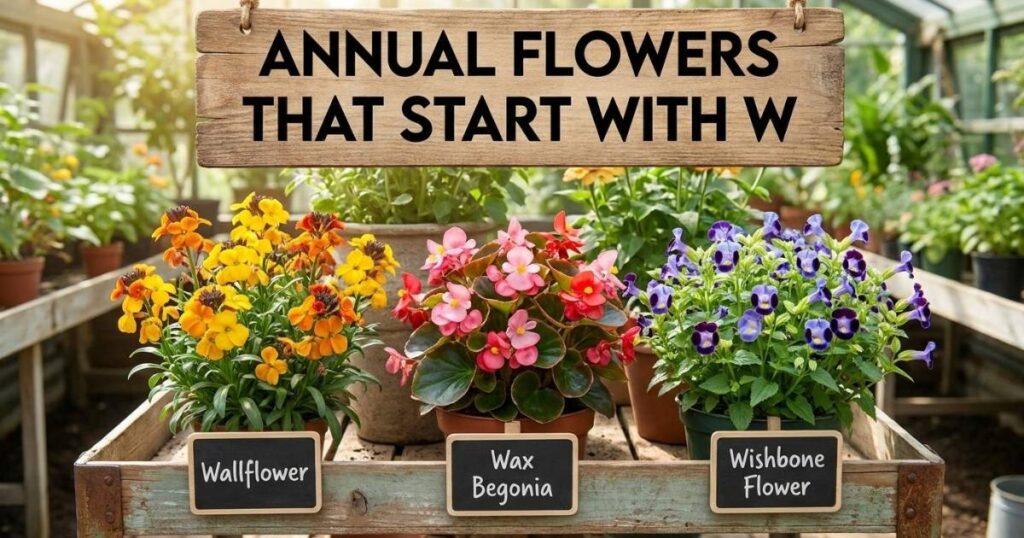
Annual W flowers complete their life cycle in a single season and need replanting each year.
- Wishbone Flower
- Wax Begonia
- Wild Mustard
- Wart Cress
Annuals are useful for filling gaps in a garden bed or adding quick color while perennials establish.
Purple Flowers That Start With W
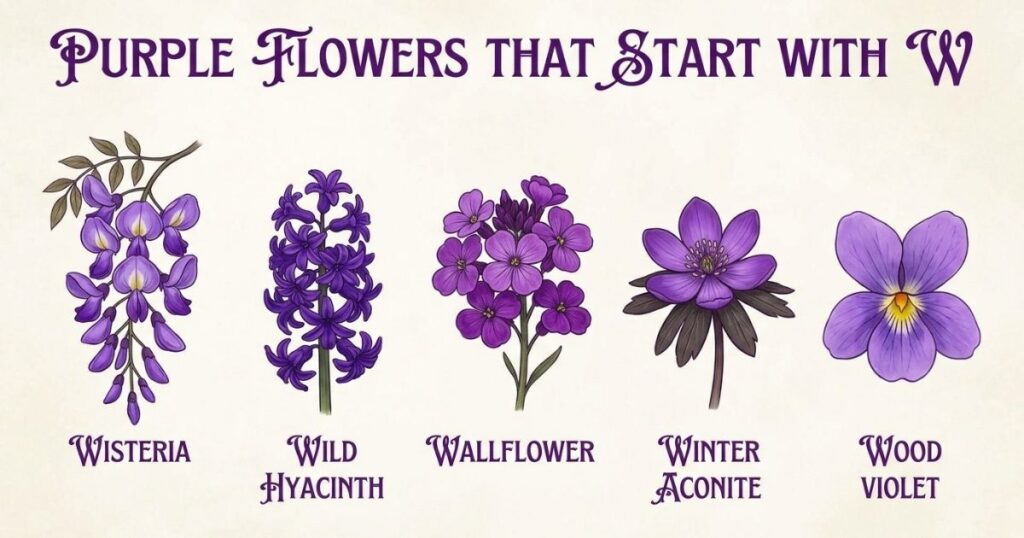
Purple is one of the most common colors among W named flowers. Here are the top purple bloomers.
- Wisteria: Cascading purple clusters, the most iconic purple W flower
- Wishbone Flower: Small purple and yellow throated blooms
- Wild Lupine: Tall purple spikes common in prairie restorations
- Wine Cup: Deep magenta purple cups
- Wild Petunia: Soft lavender purple trumpets
Purple W flowers pair well with yellow or white companions for contrast in mixed borders.
Wildflowers That Begin With The Letter W
Wildflowers are species that grow naturally without cultivation, often supporting local pollinators.
- Wild Bergamot: Attracts bees and hummingbirds with shaggy pink or lavender blooms
- Wild Columbine: Nodding red and yellow flowers favored by hummingbirds
- Wild Indigo: Deep blue pea like flowers on sturdy native shrubs
- Wild Carrot: Also called Queen Anne’s Lace, with flat white flower clusters
- Wild Sunflower: Bright yellow blooms common along roadsides and meadows
Planting native W wildflowers supports local ecosystems better than non-native ornamentals since they co-evolved with regional pollinators.
Aquatic And Wetland Flowers That Begin With The W
Aquatic W flowers grow in or near water and need consistently moist or submerged roots.
| Flower | Water Depth Needed | Bloom Color |
| Water Lily | 6 to 24 inches | White, pink, yellow |
| Water Hyacinth | Floating, no rooting needed | Lavender |
| Water Poppy | 2 to 6 inches | Yellow |
| Water Iris | Boggy or shallow water | Yellow, blue |
| Water Forget-me-not | Wet soil or shallow water | Blue |
These plants are ideal for pond edges, water gardens, and rain gardens where soil stays saturated.
Woodland And Shade Friendly W Flowers
Shade tolerant W flowers thrive under tree canopies where sunlight is limited.
- Wood Anemone
- Wood Sorrel
- Wood Lily
- Woodruff
- Wild Ginger
These species typically bloom in early spring before deciduous trees fully leaf out, taking advantage of brief periods of higher light.
Shrubs, Vines, And Structural Bloomers
Structural W flowers add height, framework, and long term architecture to a garden.
- Wisteria: Needs a strong trellis or arbor due to its heavy woody growth
- Weigela: Forms a rounded shrub, useful as a flowering hedge
- Woodbine: A climbing honeysuckle relative that covers fences quickly
- Winterberry: A deciduous holly shrub valued for winter berry display
- Wax Plant: A twining houseplant vine with waxy, star shaped flowers
These plants require more planning than annuals since they occupy permanent space and often need pruning maintenance.
Best W Flowers By Color
| Color | Flowers |
| White | Water Lily, White Campion, White Clover, Woodruff |
| Yellow | Winter Jasmine, Wild Sunflower, Water Poppy, Winter Aconite |
| Purple | Wisteria, Wine Cup, Wild Lupine, Wishbone Flower |
| Pink | Weigela, Wax Begonia, Wild Rose |
| Red | Wild Columbine, Winterberry |
| Blue | Water Forget-me-not, Wild Indigo, Water Iris |
Color grouping helps when designing coordinated flower beds or matching a specific garden theme.
Best W Flowers By Bloom Season
| Season | Flowers |
| Early Spring | Winter Aconite, Wood Anemone, Winter Jasmine |
| Late Spring | Wisteria, Wild Columbine, Weigela |
| Summer | Wild Bergamot, Wishbone Flower, Water Lily |
| Fall | Winterberry (fruit display), Wild Sunflower |
| Winter | Winter Heath, Winter Cherry |
Choosing flowers across different bloom seasons keeps a garden visually interesting throughout the year instead of peaking all at once.
Best Picks For Different Garden Uses
- Pollinator gardens: Wild Bergamot, Wild Indigo, Wild Columbine
- Ground cover: Wild Violet, Wood Sorrel, White Clover
- Vertical structures and trellises: Wisteria, Woodbine, Wax Plant
- Container gardening: Wishbone Flower, Wax Begonia
- Water features: Water Lily, Water Poppy, Water Iris
- Cut flower arrangements: Wallflower, Weigela, Wild Rose
Matching flower type to garden purpose prevents wasted effort on plants unsuited to a specific space or climate.
Quick Comparison
| Flower | Type | Sun Needs | Water Needs | Difficulty |
| Wisteria | Vine | Full sun | Moderate | Moderate |
| Water Lily | Aquatic perennial | Full sun | Standing water | Easy |
| Wallflower | Perennial | Full sun | Low | Easy |
| Weigela | Shrub | Full sun to part shade | Moderate | Easy |
| Windflower | Perennial | Part shade | Moderate | Easy |
| Wild Indigo | Perennial | Full sun | Low | Easy |
| Wax Plant | Vine, houseplant | Bright indirect light | Low | Moderate |
This table gives a snapshot for gardeners comparing several W flowers before choosing what to plant.
Visual Identification Tips
Identifying W flowers correctly comes down to checking a few key features before relying on name alone.
- Petal count and shape: Anemones (Windflower) have simple, open petals, while Wisteria has pea shaped clusters
- Leaf structure: Wood Sorrel has clover like leaves that fold at night, a clear identifying trait
- Growth habit: Vines climb and twine, shrubs hold a fixed woody shape, aquatics float or root in water
- Scent: Wallflower and Winter Jasmine both have a distinct sweet fragrance useful for confirming identification
- Bloom timing: Early spring flowers like Winter Aconite rule out summer blooming look-alikes
When in doubt, cross check a plant’s leaf shape and growth habit together, since flower color alone can be misleading across similar species.
FAQ’s
What is the most popular flower that starts with W?
Wisteria is the most widely recognized W flower, known for its cascading purple blooms and climbing vine growth.
Are there any purple flowers that start with W?
Yes, Wisteria, Wine Cup, Wild Lupine, and Wishbone Flower are all common purple W flowers.
What W flowers grow well in shade?
Wood Anemone, Wood Sorrel, and Wild Ginger all thrive in shaded, woodland style garden conditions.
Which W flowers are good for ponds?
Water Lily, Water Poppy, and Water Iris are the top choices for pond edges and water gardens.
Is Wisteria toxic to pets?
Yes, all parts of Wisteria are toxic to pets and humans if ingested, so caution is needed around children and animals.
What is a rare W flower for collectors?
Watsonia and Wandflower are considered rare, since they are not commonly stocked at standard garden centers.
Do any W flowers attract pollinators?
Wild Bergamot, Wild Indigo, and Wild Columbine are excellent pollinator plants that attract bees, butterflies, and hummingbirds.
Conclusion
Flowers that start with W range from classic garden staples like Wisteria and Water Lily to rare finds like Watsonia and Wandflower. This list of 55 blooms covers every major category, including color, season, habitat, and garden use.
Use the tables and quick reference sections above to match flowers to your specific garden conditions, whether that’s a shaded woodland corner, a sunny pollinator bed, or a backyard pond. With this guide, choosing the right W flower for your space should be straightforward.