
Halloween mantel decor is the styling of one surface, the fireplace mantel shelf and the wall above it, and it rewards a system over a shopping list every single time.
The fireplace is already the room’s focal point, so the mantel carries more visual weight per inch than any other surface. One composed scene there lifts the whole room with it.
Whole house planning sits with the halloween house decor hub, and room by room scenes sit with the halloween indoor decor room guide. This page owns one layer: the mantel as a composed scene, in depth.
The Short Answer: One Surface, Four Decisions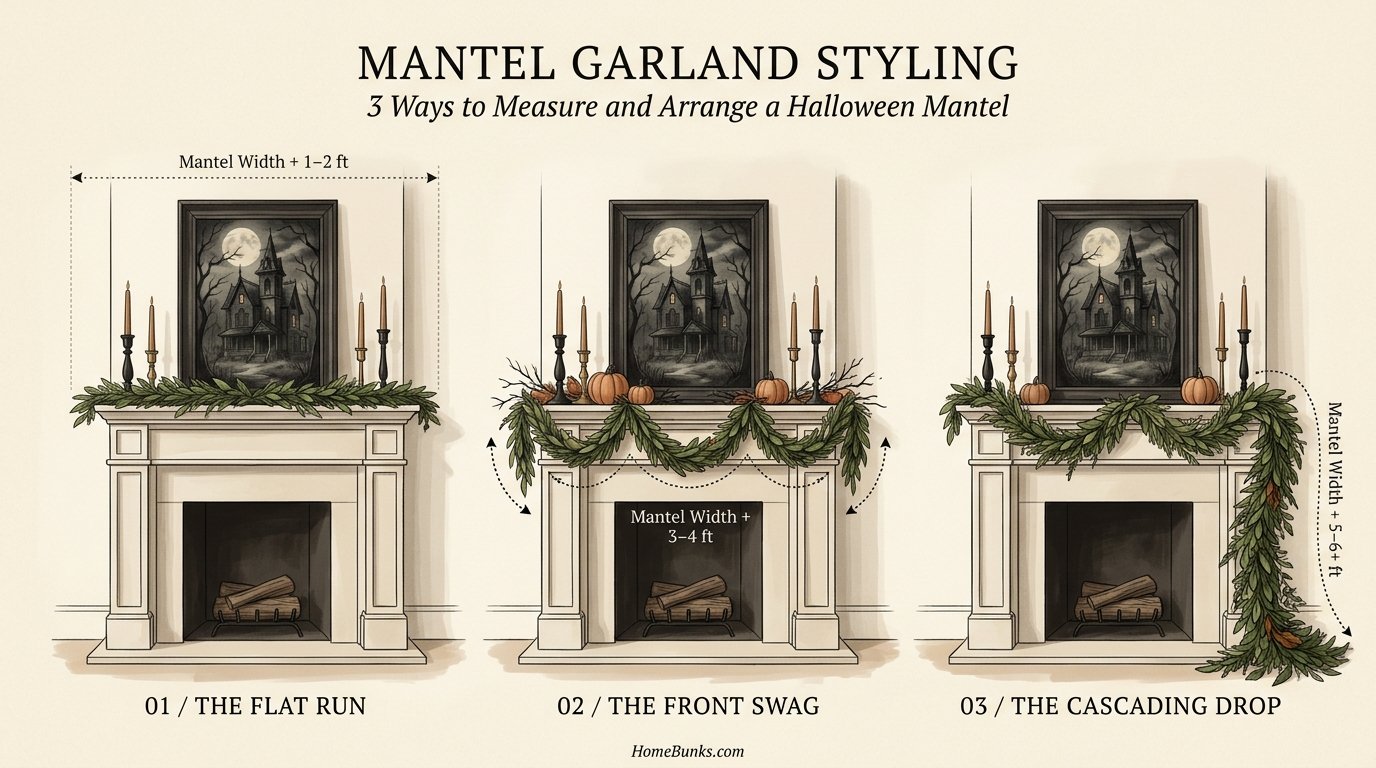
A finished mantel scene rests on four decisions made in order: the anchor piece, the garland architecture, the height system and the light layer. Everything after that is variation.
Get the order right and the scene builds itself: the garland lays the base line, the anchor gives the eye a home, heights step down around it, and flameless light finishes the glow.
- Anchor first. One large piece sets the scene’s center and its scale.
- Garland second. The base line runs under and around the anchor.
- Heights third. Verticals and groups step down in thirds.
- Light last. Flameless candles sit inside the finished scene.
The Composition System
The Anchor Piece and Focal Hierarchy
The anchor piece is the largest object in the scene: a mirror, framed art, a mantel clock or one statement piece. It fixes the center, the height ceiling and the style lane.
Lean the anchor against the chimney breast rather than hanging it, wherever the shelf allows. A leaned piece sits lower, overlaps the garland line and reads layered instead of lined up.
Everything else obeys the focal hierarchy: tall verticals support the anchor, mid height groups fill beside it, and low fillers run along the shelf front. No piece should rival the anchor’s size.
The mantel’s partner surface, the dining table, runs the same hierarchy wide and low, as the halloween table decor guide builds it. Here the hierarchy stands vertical, because the wall above does half the work.
Garland Architecture: Swag Depth, Drape Ratios and Layering Order
Garland is the base line of the scene, laid before any object goes up. Fluff it on the floor first, shaped into its swags, so it is not fighting its packaging bends on the shelf.
Anchor the garland at three points minimum, both ends and the center, with mantel clips, hooks under the front lip or plain weight. Tuck the ends behind the anchor piece and heavy candlesticks.
Three formulas cover every look. A flat run takes the mantel’s own length, a swagged front takes 1.5 to 2 times the length, and a floor cascade takes the width plus twice the mantel height.
One secondary strand suggests adding only 30 percent for a gentle drape. It prints here as a strand, because the 1.5 to 2 times rule is what produces a swag the eye can actually read.
Swag depth follows span: a dip of roughly one quarter to one third of the span between ties. A 36 inch span reads well with an 8 to 12 inch dip; shallower looks like a mistake.
|
Mantel width |
Flat run |
Swagged front (1.5 to 2x) |
Cascade (width + 2x height) |
|---|---|---|---|
|
48 in (4 ft) |
4 ft |
6 to 8 ft |
13 ft |
|
60 in (5 ft) |
5 ft |
7.5 to 10 ft |
14 ft |
|
72 in (6 ft) |
6 ft |
9 to 12 ft |
15 ft |
How the garland fastens, strips, hooks and putty with their ratings, is surface method, covered by the indoor halloween decor by surface guide. This page assumes the fastening and teaches the architecture it serves.
Height and Symmetry: Matched Pairs, the Rule of Thirds and Stepping Down
Divide the shelf into three zones. The tallest vertical stands in one outer third, the anchor’s center holds the middle third, and a low, wide group fills the remaining third.
Step heights down by 2 to 3 inches at a time between neighbors. The tallest piece sits at about two thirds the height of the mirror or art behind it; taller competes, shorter disappears.
Books are the risers of the system: a stack of two or three lifts a small piece into its third without a single purchase. Vintage spines in the lane’s palette do double duty as decor.
|
System |
Structure |
Reads as |
Suits best |
|---|---|---|---|
|
Symmetry |
Matched pairs flanking a center anchor |
Formal, elegant, calm |
Centered mirror or clock, elegant lane |
|
Asymmetry |
One tall cluster, cascade to one side, low weight opposite |
Modern, relaxed, dynamic |
TV above mantel, corner fireplace |
Both systems work; they fail differently. The real error is mixing the two halfway, which reads as unfinished rather than either one. Choose a system before the first piece goes up.
Light Last: Flameless Inside the Scene
Light is placed last and inside the scene: flameless tapers in the candlesticks, a lantern at one end, the garland’s own pre lit strand if it has one. Layered heights make the glow read as depth.
Inside a styled scene, flameless is the default, not the compromise. Garland, webbing and dried pieces sit within inches of the candlesticks, and the 12 inch flame clearance below leaves real candles almost no legal room.
Homes with cats run the same scene with mantel height discipline: the repeated cat motif in the black cat halloween decor guide works on the shelf, with putty under light pieces a paw can test and nothing dangling low.
The Working Fireplace Split
One question splits every mantel rule in two: will this fireplace be lit while the decor is up? The two answers carry different rule sets, and most decorating advice fails by never asking it.
Working Fireplace: The Clearance Envelope and the First Fire Check
On a working fireplace, the mantel is a code assembly before it is a shelf. The clearance envelope comes from IRC R1001.11 and NFPA 211, and seasonal decor inherits every inch of it.
|
Clearance rule |
The envelope |
|---|---|
|
Combustible material beside or around the opening |
None within 6 inches, any direction |
|
Combustible projection inside 12 inches of the opening |
At most 1/8 inch of projection per inch of distance |
|
Mantel parts projecting more than 1 1/2 inches |
At least 12 inches above the top of the opening |
A garland swag that dips into the envelope is a code problem, not a styling choice. Fabric, webbing and dried botanicals stay out of the heat plume above the firebox entirely.
Candle spacing follows the NFPA halloween safety guidance: at least 12 inches between a real flame and anything that can burn, which is why this system runs flameless inside the scene.
The wider record is whole home, and it is labeled that way here: the Illinois State Fire Marshal halloween safety page, carrying NFPA figures, records an annual average of 835 home structure fires begun with decorations in 2020 to 2024.
About 47 percent of those fires involved a heat source too close, and about one third were started by candles. No mantel specific fire figure exists in the sources checked, and none is invented on this page.
Before the first fire of the season, run the check: swags lifted clear of the envelope, fabric off the surround, real candles off the shelf, damper open and drawing. Decorating season and inspection season are the same season.
The National Fire Protection Association recommends an annual chimney inspection under NFPA 211. Book it for the same weeks the mantel goes up, and the flue question is answered before the first match.
Non-Working Fireplace: The Firebox as a Second Scene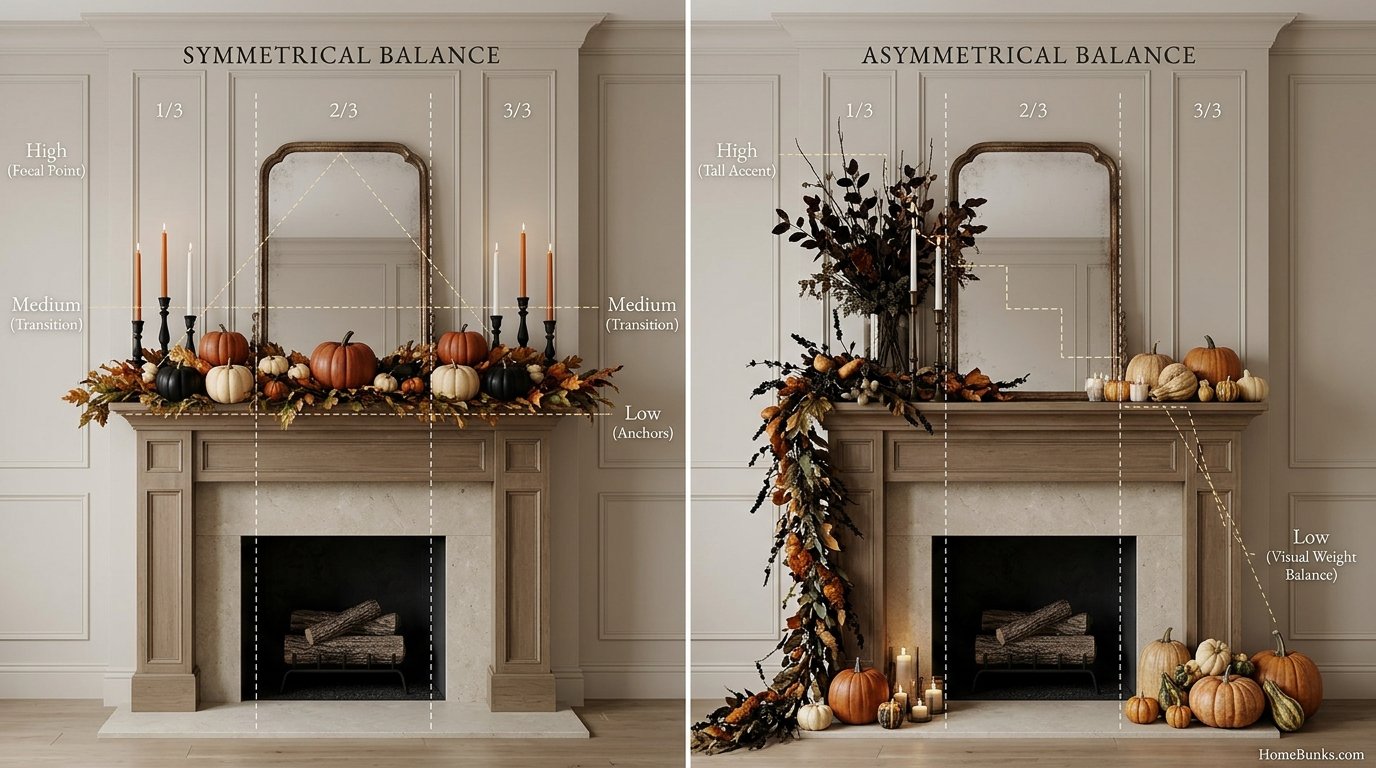
A fireplace that stays cold all season drops most of the envelope rules, and the firebox itself becomes a second scene: pumpkins spilling out, a flameless candle cluster, stacked spell books.
Two conditions hold. The fireplace must be genuinely out of use, damper closed, with everyone in the household aware it is decorated, and the fill comes out before the first real fire, without exception.
The surround is freer too: garland can drape lower, fabric can sit closer, and the hearth carries the heavy pieces. It is the one fireplace state where the scene becomes pure composition.
The TV Above the Mantel
The Heat Test and the Gap
A TV above the mantel makes the screen the anchor, and it adds a heat problem no other anchor has. TV mounting guidance, printed here as guidance strands and never as code, sets the working numbers.
The gap strand runs about 7 to 10 inches between the mantel top and the screen’s bottom edge in most guidance, with some fireplace manufacturers asking 12 inches. Heat sets the floor; comfort sets the ceiling.
A deep mantel is the best heat protection the setup can have: a shelf projecting 7 to 8 inches or more deflects the rising heat column forward, away from the wall and the screen’s lower edge.
Most makers rate their sets for ambient temperatures up to about 100 to 104 degrees Fahrenheit. The practical test: tape a thermometer where the screen center will sit, run the fireplace for two to three hours, and read it.
|
Reading at screen height |
Verdict |
|---|---|
|
Under 90 F |
Comfortable; mount and decorate |
|
90 to 100 F |
Borderline; deepen the mantel or widen the gap |
|
Over 100 F |
Do not mount there until the heat path changes |
Comfort pulls the other way: seated eye level sits at 42 to 48 inches, while a standard mantel already stands at 54 to 60 inches. A tilting or pull down mount is the standard fix when the two conflict.
Composing Around a Screen
With a screen as anchor, the scene goes low, wide and quiet: garland swags stay below the screen’s bottom edge, tall end pieces stop short of the corners, and decor light becomes accent only.
The screen should never be wider than the mantel below it. The styling rule is a shelf at least as wide as the TV, ideally 10 to 20 percent wider, so the end verticals keep their room.
Asymmetry suits the TV mantel best: one tall cluster, a cascade falling to one side, low weight on the other. It keeps the sightline to the screen clean from every seat in the room.
No Fireplace? Mantel Substitutes That Run the Same System
Homes without a fireplace are not excluded from the mantel scene. They need a substitute with the same proportions: a horizontal surface near mantel height, with wall space above it for the anchor.
|
Substitute |
Proportion rule |
Watch out for |
|---|---|---|
|
Floating shelf |
About 54 inches high, anchor hung on the wall above |
Fixings’ load rating; keep the scene light |
|
Console table |
Standard table height, anchor on the wall |
Walkway clearance around the scene |
|
Piano top |
Existing height, low and wide scene |
Nothing that can spill or vibrate loose |
|
Faux mantel surround |
Furniture piece with full mantel proportions |
Stability; secure it if children climb |
Run the identical composition on the substitute: garland base, anchor above, thirds for height, light last. The scene reads as a mantel because the proportions and layers match, not because there is a firebox.
The floating shelf is the one substitute where the anchor hangs on the wall, never leaned on the shelf. Paper, foam, flameless candles and small ceramics keep the load inside the fixings’ rating.
Five Style Lanes on One Composition
A style lane changes the pieces, never the method. Pick the lane before shopping; the anchor, garland, thirds and light order stay identical underneath all five lanes.
|
Lane |
Anchor |
Garland and pieces |
Palette |
|---|---|---|---|
|
Spooky |
Haunted portrait |
Webbing, bats, skeletons, jack o lanterns |
Orange and black |
|
Elegant |
Leaning mirror |
Plain garland, taper candles, white pumpkins |
Black, cream, one metallic |
|
Gothic |
Candelabra or dark art |
Dark florals, potion bottles, ravens |
Black, plum, deep red |
|
Farmhouse |
Wood framed sign or clock |
Natural garland, harvest pumpkins, burlap banner |
Wood, cream, harvest orange |
|
Kid friendly |
Friendly ghost art |
Felt garland, soft pumpkins, no gore |
Bright orange, white, purple |
Elegant is the restraint lane: symmetry, two colors plus one metallic, and negative space doing visible work. Gothic keeps the same order and swaps in dark florals, portraits and candelabra.
Kid friendly changes the risk profile, not the composition: flameless only, nothing glass at the shelf edge, no small detachable pieces at reach height, and tall pieces weighted or puttied against a tug.
The farmhouse lane crosses over longest: its pumpkins, wood and textiles are already autumn pieces, so the Thanksgiving transition below costs this lane the least of the five.
Buying for the Mantel: Dated Budget Strands
Mantel spending prints as dated strands, never an average, because the sources price different baskets. One designer step guide prices a single styled look at $25 to $45 of materials, US, checked in November 2026.
A garland planning table carried in a Christmas mantel guide puts garland alone at $25 to $90 by length, and a thrift first budget tier runs $20 to $40. Each strand prices its own basket; none becomes a mantel average here.
The wider season, from the National Retail Federation halloween hub: its 2026 survey press release records 78 percent of celebrators buying decorations and $4.3 billion spent on decorations within $13.5 billion total, surveyed September 1 to 9, 2026.
One sourcing reality shapes the basket: some big craft retailers stock no halloween aisle at all, as the hobby lobby halloween decor guide documents. Mantel pieces come from seasonal, craft and thrift sources mixed, not one aisle.
Pack Away: The Mantel Box
The mantel stores as one labeled box, packed in takedown order, so next year’s scene rebuilds in the order it came down. Photograph the finished scene before takedown; the photo set is the rebuild plan.
|
Piece |
Storage form |
Rule |
|---|---|---|
|
Garland |
Wound on a flat labeled card |
Label with mantel width and swag style |
|
Flameless candles |
Upright in a divided box |
Batteries out before storage |
|
Anchor art or mirror |
Wrapped, stored padded |
Never stored under weight |
|
Small pieces |
Grouped by layer in the mantel box |
Clusters stay together |
Batteries come out of every flameless candle before storage. Stored batteries leak and corrode contacts over a year, the most common reason last year’s set fails its first test. Note each piece’s battery size on the label.
The November 1 routine closes the season: labeled halloween pieces come off, crossover pieces stay (plain pumpkins, warm lights, autumn textiles), one harvest note goes on, and the same composition carries the shelf to Thanksgiving.
FAQs
What is halloween mantel decor?
It is the seasonal styling of one surface, the fireplace mantel shelf and the wall above it, treated as a composed scene rather than a line of objects. A finished scene has an anchor piece, a garland architecture, a height system and a light layer, on the room’s existing focal point.
What goes on a halloween mantel, in what order?
Build in layering order: garland first as the base line, then the anchor piece (mirror, art, clock or statement object), then tall verticals at the ends, then grouped mid height pieces, then low fillers, and light last. Reversing that order is why most mantels end as a flat line of unrelated objects.
How much garland do I need for my mantel?
Match the formula to the look. A flat run takes the mantel’s own length. A swagged front takes 1.5 to 2 times the length, so a 6 foot mantel needs 9 to 12 feet. A floor cascade takes the width plus twice the mantel height. One strand suggests adding only 30 percent; it prints as a strand, because the 1.5 to 2 times rule makes a visible swag.
How deep should a garland swag dip?
A working rule is a dip of roughly one quarter to one third of the span between anchor points: a 36 inch span reads well with an 8 to 12 inch dip. Shallower than that looks like a mistake rather than a swag; deeper pulls the garland ends off the shelf and drags the eye line down to the firebox.
How do I keep a garland from sliding off the mantel?
Anchor at three points minimum: both ends and the center. Use mantel clips, removable hooks under the front lip, or weight, tucking the ends behind the anchor piece and heavy candlesticks. Fluff and shape the garland on the floor first, in the swag shape you want, so it is not fighting its packaging bends once it is up.
Should a halloween mantel be symmetrical or asymmetrical?
Both systems work; they fail differently. Symmetry (matched pairs flanking a center anchor) reads formal and elegant and suits a centered mirror or clock. Asymmetry (one tall cluster, a garland cascading to one side, low weight opposite) reads modern and suits a TV above the mantel or a corner fireplace. Mixing the two halfway reads as unfinished.
What is the rule of thirds on a mantel?
Divide the shelf into three zones. Place the tallest vertical in one outer third, the anchor’s visual center in the middle third, and a low, wide group in the remaining third, then step heights down between them. It is the shelf version of the photographic rule, and it stops the common failure of every piece standing at the same height in a row.
How tall should the tallest piece on a mantel be?
A useful guide from mantel styling practice: the tallest object sits at about two thirds the height of the mirror or art behind it, and the remaining pieces step down by 2 to 3 inches at a time. Pieces that reach or pass the top of the art compete with it; pieces under a third of its height disappear against it.
Can I decorate a mantel above a working fireplace?
Yes, with the working fireplace rule set: nothing combustible inside the code clearance envelope around the firebox opening, no fabric or dried botanicals hanging into the heat plume, flameless candles wherever decor sits close, and the flue and damper checked before the first fire. A non-working fireplace drops most of these rules, which is why the two cases are treated separately.
How much clearance does a mantel need from the firebox opening?
The code envelope, from IRC R1001.11 and NFPA 211: no combustible material within 6 inches of the fireplace opening in any direction; combustible material within 12 inches may project no more than 1/8 inch for each inch of distance; and any part projecting more than 1 1/2 inches must sit at least 12 inches above the top of the opening. A garland swag that dips into the envelope is a code problem, not a styling choice.
How far should candles be from garland and other decor?
At least 12 inches between a real flame and anything that can burn; that is the spacing NFPA gives for candles generally. On a mantel, where garland, webbing and dried botanicals sit within inches of candlesticks, the practical answer is flameless candles inside the scene and real candles, if used at all, standing alone with the full 12 inches clear on every side.
Is there a fire statistic for mantel decorations specifically?
No. No mantel specific or indoor only decoration fire figure exists in the NFPA or CPSC sources checked, and any page quoting one should be distrusted. The published window is whole home: an annual average of 835 home structure fires began with decorations in 2020 to 2024, about 47 percent involving a heat source too close and about one third started by candles. A separate 2019 to 2023 window averages 832; the two print unmerged.
Can I fill a non-working firebox with pumpkins and candles?
Yes; it is one of the strongest non-working fireplace moves, and decorating magazines show pumpkins spilling from the firebox. Two conditions: the fireplace must be genuinely out of use for the season, damper closed, with everyone in the household aware it is decorated, and the candles inside must be flameless. Never light a fire in a decorated firebox, and remove the fill before the first real fire.
What changes when I light the first fire under a decorated mantel?
Run the first fire check: garland swags lifted out of the clearance envelope, fabric and dried pieces off the surround, real candles removed from the shelf entirely, the flue open and drawing, and nothing hanging below the shelf front into rising heat. Decor that was safe on a cold fireplace is not automatically safe over a lit one.
Can I put a TV above a halloween mantel?
Yes, and it changes the composition: the screen becomes the anchor, so the mantel scene must be low, wide and quiet in the screen’s sightline. Keep garland swags below the screen’s bottom edge, avoid tall pieces at the ends that crowd the corners, and treat decor lighting as accent only, because the screen is the room’s light source when it is on.
How high above the mantel should a TV be?
Heat sets the floor: a minimum of about 7 to 10 inches between the top of the mantel and the bottom of the TV in most mounting guidance, with some fireplace manufacturers asking 12 inches. Comfort sets the ceiling: seated eye level is roughly 42 to 48 inches, and a standard mantel already sits at 54 to 60 inches. A tilting or pull down mount is the standard fix when the two numbers conflict.
How hot is too hot for a TV above a fireplace?
Most TV makers rate their sets for ambient temperatures up to about 100 to 104 degrees Fahrenheit. The practical test: tape a thermometer where the screen center will sit, run the fireplace for two to three hours, and read it. Under 90 is comfortable, 90 to 100 is borderline and calls for a deeper mantel or a bigger gap, and over 100 means do not mount there until the heat path changes.
Does mantel depth protect a TV from heat?
Yes. A mantel shelf projecting 7 to 8 inches or more deflects the rising heat column forward and away from the wall, which is why a deep mantel is the single best heat protection a TV above a fireplace can have. A shallow shelf, or no shelf, lets heat run straight up the wall face to the screen’s lower edge.
How wide should a TV be relative to the mantel?
The screen should never be wider than the mantel below it; the styling rule is a mantel at least as wide as the TV and ideally 10 to 20 percent wider. A screen that overhangs the shelf looks unstable and crowds out the end verticals the composition needs.
I have no fireplace. How do I get a mantel look?
Use a mantel substitute with the same proportions: a floating shelf at mantel height (about 54 inches), a console table against a wall, a piano top, or a faux mantel surround built or bought as furniture. Run the identical composition system on it: garland base, anchor above, thirds for height, light last. The scene reads as a mantel because the proportions and layers match, not because there is a firebox.
How much weight can a floating shelf hold as a faux mantel?
Only what its fixings are rated for; check the shelf manufacturer’s rating and the wall anchors, and keep the scene light: paper, foam, flameless candles and small ceramics. A floating shelf is the one mantel substitute where the anchor piece should be hung on the wall, not leaned on the shelf.
What are the main halloween mantel style lanes?
Five lanes run on the same composition system: spooky (skeletons, webs, jack o lanterns), elegant (black, cream and one metallic, restraint and symmetry), gothic (dark florals, candelabra, portraits), farmhouse (natural pumpkins, wood, burlap, harvest crossover) and kid friendly (friendly ghosts, felt, no gore, nothing at toddler reach that tips). Pick the lane before shopping; the layers do not change, only the pieces do.
How do I make a halloween mantel kid friendly?
Keep the composition, change the risk profile: flameless candles only, no small detachable pieces at reach height, nothing glass on the shelf edge, friendly ghosts and felt garlands instead of gore, and every tall piece puttied or weighted so a tug does not bring it down. The scene still reads as designed, because the layers and heights stay.
How much does a halloween mantel cost to style?
There is no honest single figure; sources quote strands, and this page keeps them separate. One designer guide prices a single styled look at $25 to $45 of materials. A garland planning table puts garland alone at $25 to $90 depending on length. A thrift first mantel can land at $20 to $40, while a buy it all new mantel with a pre lit garland runs well past $100. All strands are US, dated November 2026, and never merged into an average.
What is the cheapest way to style a halloween mantel?
Shop your home first: books as risers, jars as apothecary pieces, a mirror or frame you already own as the anchor. Then thrifted candlesticks painted matte black, dollar store pumpkins and a paper bat garland cut from cardstock. The budget lanes across the research agree on this order: anchor free, light cheap, one bought garland.
When should halloween mantel decor go up and come down?
For the 2027 cycle, Halloween falls on Sunday, October 31, 2027. Most households style the mantel in late September or the first October weekend and run it to November 1, when the swap layer comes off and the crossover pieces (plain pumpkins, warm lights, autumn textiles) carry the same shelf to Thanksgiving.
How do I transition a halloween mantel to Thanksgiving?
Remove only the labeled halloween layer: bats, ghosts, webs, potion labels and anything with a halloween word on it. The base that stays is the garland if it is autumnal rather than spooky, the pumpkins if unthemed, the candlesticks and the anchor. Add one harvest note, wheat, dried leaves or a gratitude sign, and the same composition carries the shelf for three more weeks.
How do I store mantel garland so it survives to next year?
Wind each garland around a flat card or reel, ends tied, labeled with the mantel width and the swag style it was cut for. Never stuff a garland loose into a bin; wired garland kinks permanently and faux foliage crushes flat. Store the mantel’s pieces as one labeled box, anchor art wrapped, candles with batteries removed, so next year’s scene rebuilds in the order it came down.
Should batteries come out of flameless candles before storage?
Yes. Stored batteries leak and corrode contacts over a year, which is the most common reason last year’s flameless candles fail their first test. Note each piece’s battery size on the storage label and keep a fresh pack with the box.
How do I stop real pumpkins rotting on the mantel?
Heat is the accelerant: a mantel over a working fireplace is the warmest shelf in the room, and real pumpkins soften there days faster than on a cool hearth. Use real pumpkins low on the hearth instead and faux or ceramic on the shelf, or accept a mid October replacement as part of the plan. Check the underside weekly; the first soft spot is the removal signal.
Can I use dried flowers and pampas grass on a mantel?
Yes on a non-working fireplace, with handling care; with real distance on a working one. NFPA names dried flowers, cornstalks and crepe paper as materials that catch fire easily and must stay away from open flames and heat sources like light bulbs and heaters. On a working fireplace mantel, dried botanicals belong at the far ends of the shelf, never beside candles and never in the swag that dips toward the firebox.
What is a mantel scarf?
A mantel scarf is a decorative fabric runner made for the shelf, often with a hanging fringe or embroidered edge that drops over the front. It is a legacy product term that still drives searches; in a halloween scene it works as the base layer under the garland, adding color and protecting the shelf finish, provided it hangs nowhere near the firebox opening on a working fireplace.
What is the difference between mantel and mantle?
Mantel is the shelf and surround around a fireplace; mantle is a cloak, or the layer of the earth. The decor keyword is spelled both ways across the web, and several ranking pages use mantle in their titles, but mantel is the correct term for the fireplace structure, and it is the spelling this page uses.
Why does my halloween mantel look flat?
Almost always one of three causes: every piece stands at the same height, the garland runs in a tight straight line with no swag, or there is no anchor, so the eye has nowhere to land. Fix in that order: create three height levels using books or boxes as risers, re drape the garland with slack, and lean one large piece at the center or in one third.
Why does my halloween mantel look cluttered?
Too many pieces at the same visual weight, with no negative space. Remove a third of the pieces, group what remains in odd numbered clusters with gaps between them, and limit the palette to two or three colors. The strongest pages in the research agree on this point: restraint is what separates a styled mantel from a shelf of decorations.
How many pieces should a halloween mantel have?
There is no fixed count, but a working structure is one anchor, two tall verticals, two to three mid height groups, one low filler line (the garland counts) and light. On a standard 60 inch mantel that usually lands between nine and fifteen pieces including candle multiples. If you cannot name each piece’s layer, there are too many.
Can I hang a wreath above the mantel instead of art?
Yes; a wreath is an anchor variant. Center it on the chimney breast, keep its diameter to roughly half to two thirds of the mantel width, and let the shelf scene stay low so the two do not compete. On a working fireplace, hang it from the wall, never from a hook that places it inside the heat plume, and keep fabric wreaths out of the clearance envelope.
How do I decorate a very narrow mantel?
Depth under 8 inches changes the rules: no leaning anchors (they tip), candlesticks with weighted bases only, the garland run along the front face on clips rather than lying on the shelf, and flat pieces (banners, paper fans, silhouettes) doing the work that objects cannot. Height comes from the wall above, not from stacking on the shelf.
How do I decorate a corner or double sided fireplace mantel?
A corner fireplace takes an asymmetrical composition by default, because the sightline is diagonal; put the tall third on the side the room enters from. A double sided fireplace needs two low scenes back to back with no piece tall enough to read wrongly from the other room, and garland anchored so neither side’s swag hangs into the other’s view line.
Are real candles ever acceptable on a halloween mantel?
Only under the full rule set: 12 inches clear of anything combustible on every side, a stable non combustible holder, never left unattended, and never on a mantel where garland, webbing or dried pieces share the shelf within that radius, which in practice excludes most styled scenes. That is why this page defaults to flameless inside the scene and treats real flame as a standalone hearth choice, not a mantel one.
How do I photograph my mantel for next year?
Take one straight on shot at seated eye height, one from each room entry, and one close shot of each end, all before takedown. Store the photos with the storage box label. The set is your rebuild plan, your shopping list (what failed, what faded) and your proof of what the scene contained if anything is damaged in storage.
What should I check on the fireplace itself before decorating season?
Four things: the damper opens and closes, the flue is clear (a chimney sweep inspection is the NFPA 211 annual recommendation), the hearth and firebox are cleaned of last season’s ash, and the mantel’s own clearance to the opening still meets the code envelope if the surround has been altered. Decorating season and inspection season are the same season; do them together.
Conclusion
Halloween mantel decor is one surface treated properly: an anchor, a garland with its math done, heights stepped in thirds, light placed last, and the fireplace’s own rules respected before any of it.
Start with the surface you actually have, working fireplace, cold firebox, TV above or no fireplace at all, and run the same four decisions. The cluster at HomeBunks carries the scene onward, into the halloween kitchen decor zones and the rest of the house.
When you are ready to build your scene, begin with the anchor and one garland measured honestly, photograph the result, and let next October start from a plan instead of a blank shelf.