
Olive green kitchen ideas fail in one predictable way: a photograph promises earthy warmth, and the finished room delivers mud. The color did not change; the light, the partners, and the depth were never checked against each other.
Olive is the warm green, the yellow leaning branch of the family, and every decision it asks for runs on temperature. Depth comes from a ladder of real numbers, dose comes from your room’s light budget, and pairings are a warmth system, not a mood board.
The Home Bunks library already hosts our sage green kitchen ideas, and the two pages are partners by design. Sage cools a kitchen down; olive warms it up. This page teaches the warm side whole: ladder, doses, pairings, protocol, and the diagnosis when it goes wrong.
Olive Is the Warm Green: The Undertone Fork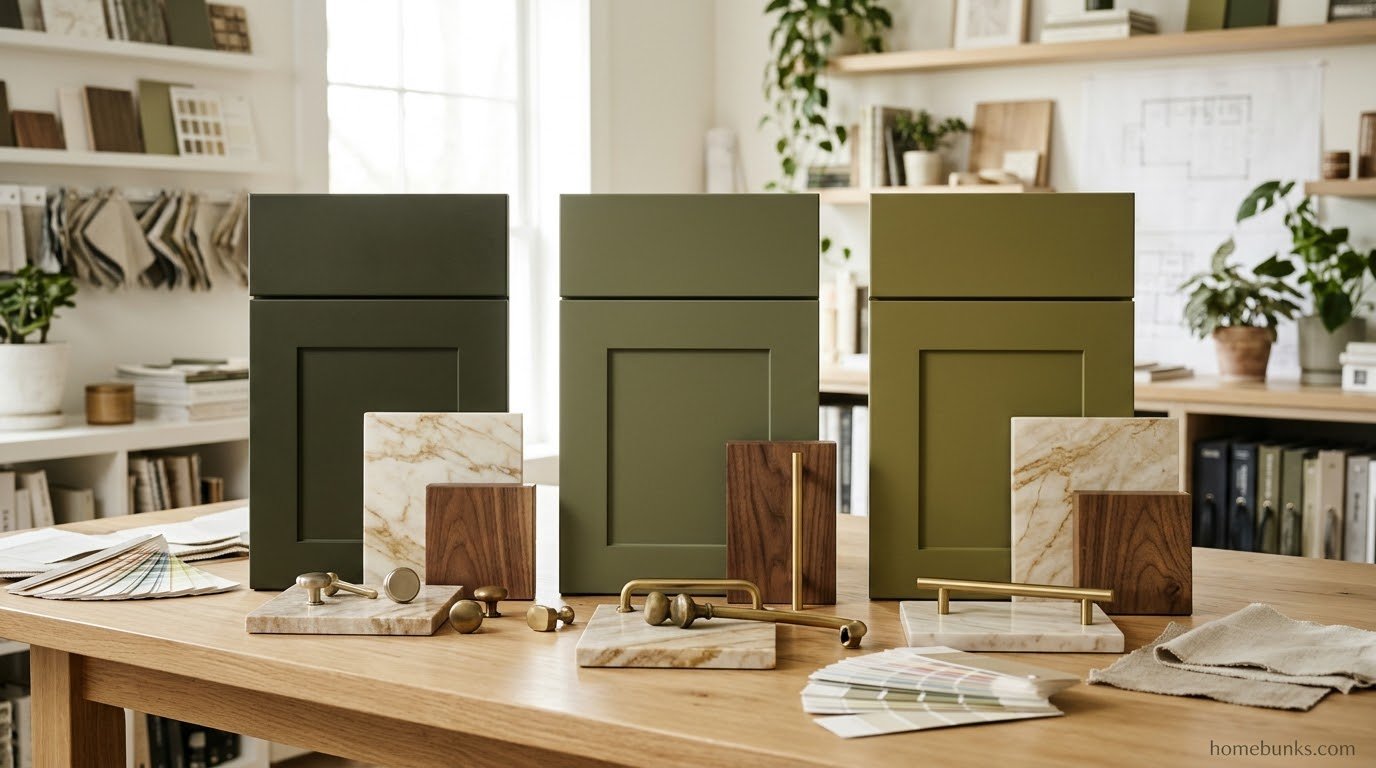
Green paint splits into temperature families. Sage is green pulled toward gray and blue until it reads silvery and calm; olive is green pulled toward yellow and brown until it reads earthy and warm; forest is green deepened and cooled until it reads formal.
The fork decides more than the shade. Sage tolerates cool whites, nickel, and gray stone; olive curdles beside them and glows beside brass, walnut, and cream. Readers who choose the wrong family spend the next year fighting their own kitchen’s temperature.
Our sage green bathroom ideas show the cool family’s discipline in a smaller room, while the emerald green bathroom ideas demonstrate how a saturated green behaves when it goes jewel instead of earth. Olive sits between them in depth and apart from both in temperature.
Olive vs Sage vs Forest, Settled Once
|
Family |
Undertone |
Benchmark Depth |
Natural Partners |
Failure Mode |
|---|---|---|---|---|
|
Olive |
Yellow, brown |
LRV 6 to 21 on cabinets |
Brass, walnut, cream, warm marble |
Turns muddy in dim or cool company |
|
Sage |
Gray, blue |
LRV 30 to 49 typical |
Warm white, oak, black accents |
Turns bland or cold in warm rooms |
|
Forest |
Blue, deep |
LRV 12 to 16 |
Marble, brass, formality |
Turns blackish in low light |
Pick the family by the room you have: its light, its woods, its metals. The shade inside the family is the easy second decision, and the ladder below makes it a short one.
The Olive Ladder: Depth by LRV
LRV, light reflectance value, is the percentage of light a color returns to the room. Olive’s cabinet range is dark by green standards, which is precisely why the number, not the name, should drive the choice.
The ladder below is built from published color data, compiled in Sarah Karon’s olive green paint color roundup, whose olive roundup remains the only numbers first resource in this field. Verify hero rungs on the brands’ own pages at purchase; the bands are what endure.
|
Rung |
Paint |
Published LRV |
Character and Best Use |
|---|---|---|---|
|
Deep anchor |
Sherwin Williams Ripe Olive 6209 |
6 |
Very dark, slightly bluer than most olives; bright rooms and two tone lowers |
|
Deep warm |
Sherwin Williams Palm Leaf |
10 |
Yellow brown warmth; statement runs with serious light support |
|
Boundary |
Sherwin Williams Pewter Green 6208 |
12 |
Gray boundary rung; where olive hands over to sage |
|
Mid deep |
Benjamin Moore Shady Lane |
18 |
Workable depth for average light, full runs with pale partners |
|
Mid yellow |
Sherwin Williams Olive Grove 7734 |
20 |
The strongest yellow lean; full warmth kitchens |
|
Mid default |
Benjamin Moore Tate Olive HC-112 |
21 |
The balanced default for full runs in real light |
|
Reported 2027 |
Benjamin Moore Webster Green HC-130 |
20.2 |
Deep classic green energy at olive’s depth band |
Two footnotes protect the ladder’s honesty. Farrow and Ball’s Treron and Bancha belong to this family and appear across the galleries, but the brand publishes no LRVs, so they are named here without numbers.
Sherwin Williams’ reported 2027 color, Celery 6421 at about LRV 71, marks the pale edge where olive thins into something else.
The Dose Ladder: How Much Olive Your Light Can Afford
Shade is the second decision; dose is the first. Park City Kings Crown’s olive green kitchen guide built its guide on one observation: olive absorbs light instead of reflecting it, so a full run either grounds a kitchen or swallows it, and natural light decides which.
Price each dose in light before you price it in paint:
- Full run, all cabinets. The deep rungs (LRV 6 to 12) need a bright room, pale counters and backsplash, and layered lighting. Mid rungs (18 to 21) forgive average light. This is the commitment dose.
- Two tone, olive lowers and cream uppers. Olive’s safest full presence: the color grounds the floor line while the uppers keep ceiling height and bounce. A documented scheme runs Rosemary lowers under Alabaster uppers; any ladder rung works below a warm white.
- Island only. The personality dose: full character, perimeter untouched, cheapest repaint, easiest reversal. Brass pendants and wood stools repeat its warmth across the room.
- Olive walls, pale cabinets. The rental friendly inversion: walls repaint in a day, and deep olive behind open shelves and brass rails is a documented rustic gallery look.
- Objects and textiles. Linens, ceramics, a painted hutch or pantry door, stools, and living herbs. The zero commitment rung, and the right first step for the undecided.
The 60 30 10 proportion from the research audits any dose: about 60 percent neutral, 30 percent olive, 10 percent brass. When a scheme feels wrong, one share is off, and it is usually the neutral share that got squeezed.
The Warm Pairing System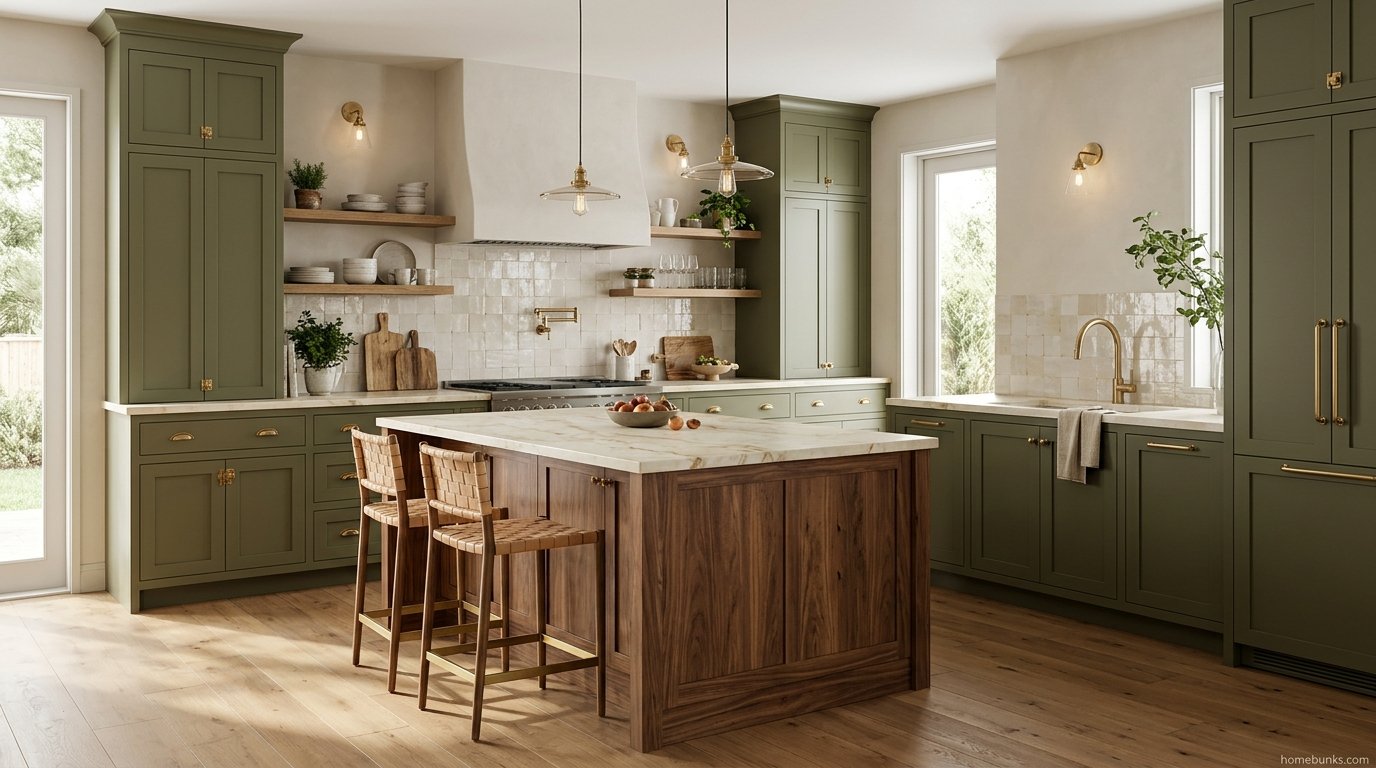
Olive’s partners are chosen by temperature, and the system has five stations. Counters: warm marble and marble look quartz first (their veining carries cream and gold), walnut or oak wood counters second, cool gray stone only with warm mediation and a slab test.
Backsplash: warm white subway or ceramic as the default light return, handmade look zellige for texture, marble carried up for luxury. Hardware: brass and brushed gold as the default warmth, matte black as the modern register, chrome and nickel as the documented clash.
Woods: walnut and white oak lead; the honey oak question is genuinely split in the research, one guide warning of mud, practice pairing them widely, so the sample test decides.
Walls: warm whites and creams, with the white and beige living room ideas showing how that palette behaves at room scale before you commit the kitchen to it.
The Three Debates, Printed Honestly
Reference guides for this color disagree in print, and a trustworthy page says so. Bright white counters: banned as jarring by one researched guide, recommended as crisp contrast by two others. The truth is slab dependent: warm whites harmonize, blue whites fight.
Stainless appliances: condemned as warmth killers by several guides, present in most real olive kitchens. The mediation is repetition: brass, wood, and warm light around the steel make it read as equipment, not as a temperature argument.
Honey oak floors: one warning, much practice. Yellow floors plus a yellow green can overload the room’s warm channel; walnut’s brown or white oak’s neutrality is the safer engineering, and the sample board is the judge when the floor already exists.
Style Recipes
Mediterranean olive. A mid or deep rung on shaker or slab fronts, handmade look tile, stone or wood counters, open shelves with ceramics and herbs. Olive is native here; let texture do the decorating.
English country olive. Deep rungs, brass everywhere, marble counters, an apron front sink, and painted cabinet interiors in the same olive for the furniture finish one researched guide delights in.
Modern farmhouse olive. Two tone by default: olive lowers, cream uppers, wood island or shelves, black accents in the faucet and lighting. Compare its bones with our navy blue kitchen ideas, which run the same two tone discipline in the cool direction.
Contemporary matte olive. Slab fronts in a mid rung, matte finish, black hardware system, pale quartz, concealed everything. The register where olive reads as architecture rather than nostalgia.
The open plan olive kitchen adds one zoning rule to every recipe above: in a joined kitchen and living space, the olive field ends where the living area begins, and the two zones shake hands through repeated warmth rather than repeated color.
The same walnut, brass finish, and cream family carry the system across the boundary while the green itself stays in its room, which keeps the open plan calm and lets each zone keep its own light logic.
Three Rooms, Read Closely
The bright south facing kitchen earns the ladder’s deep end.
A full run of Ripe Olive in satin, warm marble counters, brass hardware, and a cream ceiling: the light budget covers LRV 6 with change, and the room reads as the galleries promise, grounded and rich at noon and by lamplight.
The small north facing galley cannot afford that photograph and should not attempt it.
Its working version: Tate Olive lowers only, cream uppers replaced by oak open shelves, a warm white backsplash washed by under cabinet strips at 3000K, and brass repeated at the faucet, the rails, and the stool frames.
Same family, same warmth, a third of the light debt.
The rental with good cabinets takes the inverse dose: mid olive walls behind white cabinets, olive linens and ceramics on the counters, a painted hutch as the one furniture commitment. The landlord keeps the cabinets; the tenant keeps the color, and the deposit survives the experiment.
Lighting: The Third Ingredient
Olive kitchens are lit, not just painted, because a color that absorbs light must be given light deliberately. The layered scheme the research repeats has three heights, and each does a different job for the color.
Pendants over the island put warm pools on the room’s center and give brass its moment. Under cabinet strips wash the backsplash and the counter run, the exact zone a deep cabinet front would otherwise shadow into darkness.
Ambient ceiling light sets the room’s base level, and its temperature is the system’s constitution: around 3000K keeps the green warm, while 5000K daylight bulbs push olive toward gray and quietly undo the undertone decision.
Dimmers earn their cost here, because olive at dinner light and olive at noon are two colors, and both should be good.
The Repaint Protocol
Most olive kitchens are repaints, so the protocol is the product. 1. Remove doors, drawers, and hardware; label everything. 2. Degrease until a white cloth stays white; kitchen film defeats more paint than bad paint does.
3. Sand to dull, wipe, and apply a bonding primer made for slick surfaces. 4. Two coats of cabinet grade enamel (the classes trade guides name: Benjamin Moore Command or Advance, Sherwin Williams Emerald Urethane Trim Enamel), sprayed or fine rolled.
5. Choose sheen by depth: satin as the default, a step up at the deep rungs to return light. 6. Respect the cure: roughly 7 to 10 days of gentle use before the finish takes real work, per trade guidance.
When Olive Goes Wrong: Mud and Gray, Diagnosed
Mud is the famous failure, and it has three causes in order of likelihood: light too dim or too cool for the depth chosen; a cool partner nearby isolating the yellow; or a shade browner than the room around it.
Fix in that order and most mud is curable without repainting.
Gray is mud’s quieter sibling: at low saturation the eye surrenders the green, north light accelerates the surrender, and deep olives are near neutrals by design.
Warm bulbs, warm metals, and wood in the sightline are the treatment; a rung up the ladder is the cure when the room cannot supply warmth.
One styling layer pays for itself in both diagnoses: living green.
Herbs on the sill, an olive toned ceramic, a plant on the open shelf: real leaves beside the paint keep the eye calibrated to green, so the cabinets read as the deepest note of a living family.
It is the cheapest color correction in this guide, and the only one that improves monthly.
The Sample Set: Three Boards Before Any Paint
Do not sample the whole ladder; sample its decision points. Buy three small cans: one deep rung (Ripe Olive), one mid default (Tate Olive), and one yellow lean (Olive Grove). Together they bracket every outcome the full ladder can produce in your room.
Paint each on a large board, at least the size of a cabinet door, in the finish you intend to use, because sheen changes depth. Label the backs; unlabeled green boards are a household argument waiting for a quieter moment.
Live with the boards for two full days: against the cabinets at breakfast light, beside the counter slab at noon, under the evening bulbs at cooking time.
The board that survives all three readings without turning muddy or gray is your color; the other two have done their job by failing informatively.
Then run the partner test: lean the winning board against the floor, the counter, the hardware finish, and the wall color in one sightline. Olive is a system color; the board that wins alone but argues with the floor has not won.
Keep the two losing boards. They are next season’s evidence for the bathroom, the pantry, or the hutch, and they record exactly how your home’s light treats this family, which is knowledge no paint deck can sell you.
Serious color households accumulate these boards the way cooks accumulate knives: slowly, and then for everything.
Common Mistakes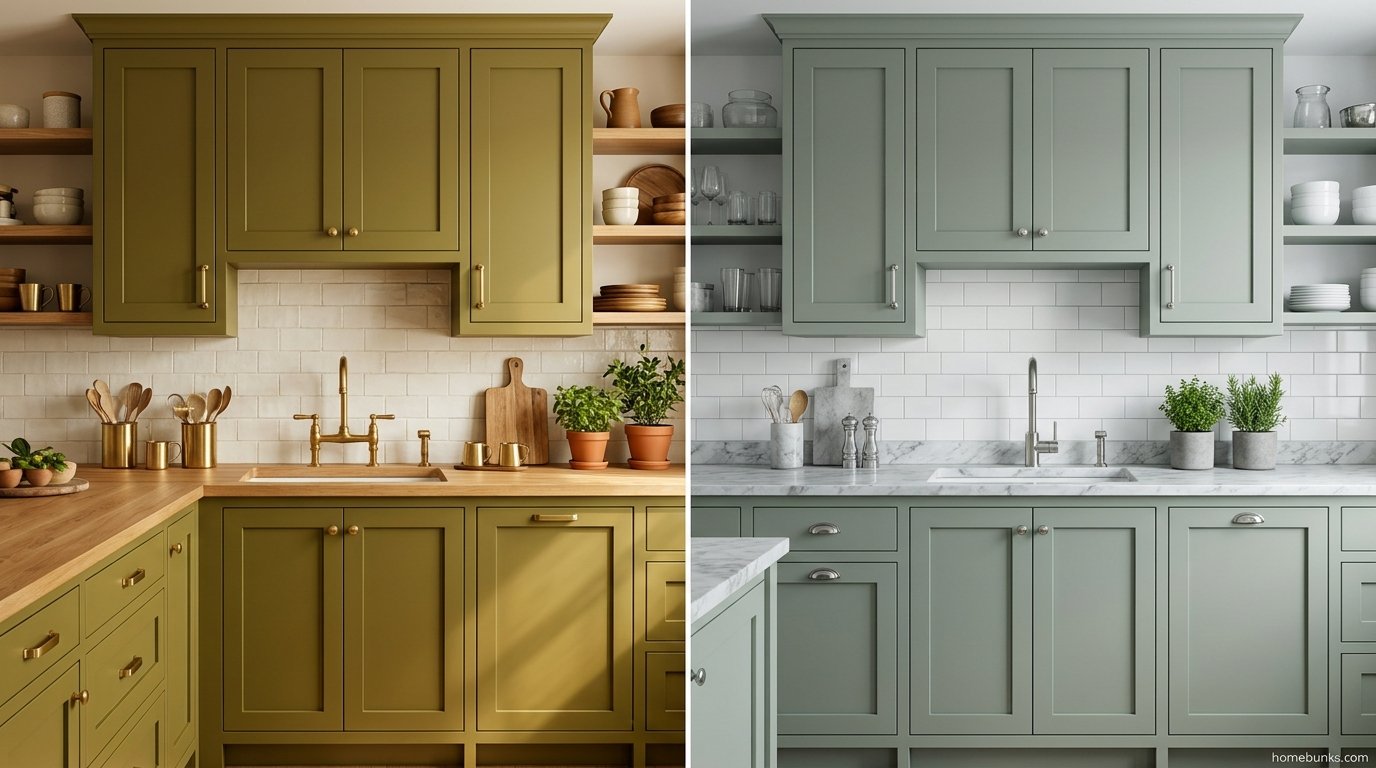
- Choosing from the chip. Olive shifts more between lights than most greens; the board in your room at three dayparts is the minimum evidence.
- Full deep run in a dim room. LRV 6 is a bright room color; the dose ladder exists to prevent exactly this photograph.
- Cool partners by default. Chrome handles, a gray counter, and a blue white wall will dismantle the color one reasonable choice at a time.
- Wall paint on cabinets. The enamel class and bonding primer are not upsells; they are the difference between a finish and a film.
- Ignoring the ceiling. The ceiling is part of the light budget; a cool white overhead taxes every surface below it.
- Borrowing sage’s partners. Nickel and gray whites serve the cool family; olive’s system is brass, walnut, and cream, and mixing the systems muddles both.
Frequently Asked Questions
What is olive green in a kitchen?
Olive is the warm, yellow leaning branch of the green family: green pulled toward brown and gold until it reads earthy rather than fresh.
In kitchens it lives mostly on cabinets, from deep olives at LRV 6 through mid olives around LRV 18 to 21, with warmth as its defining trait and mud as its defining risk.
What colors go with olive green cabinets?
Warm partners: cream and warm white on walls and uppers, brass and gold metals, marble or warm quartz counters, and mid tone woods like walnut and white oak.
The near universal warning runs against cool partners: chrome, brushed nickel, cool gray counters, and stark blue whites, which fight olive’s yellow undertone and make it read muddy or dated.
What is the best olive green paint color for kitchen cabinets?
By use case, not by crown. Ripe Olive SW 6209 (LRV 6) is the deep anchor for bright rooms; Tate Olive HC-112 (LRV 21) is the mid olive for average light and full runs.
Olive Grove SW 7734 (LRV 20) leans hardest yellow for full warmth. Sample all three in your own light; the ladder, not the name, decides.
Is olive green a good color for a kitchen?
Yes, with a light condition. Olive is warm, food friendly, forgiving of daily mess at mid and deep values, and unusually compatible with the woods and warm metals kitchens already contain.
Its condition is light: the deep olives reflect only 6 to 14 percent of it, so dim rooms need the dose ladder instead of a full deep run.
Will olive green cabinets make my kitchen look dark?
They can, and the arithmetic is public: the classic cabinet olives sit at LRV 6 to 21, so a full run in a low light room reads dark and can turn muddy.
The mitigations are structural: lighter uppers or open shelving, pale counters and backsplash returning light, 3000K layered lighting, and the dose decided before the shade.
What is the difference between olive green and sage green?
Undertone. Sage is green cooled and grayed, blue and gray leaning, and it tolerates cooler whites and nickel.
Olive is green warmed and browned, yellow leaning, and it loves brass, walnut, and cream. Choosing between them chooses the room’s whole temperature system, not just a shade; the fork section above settles it in full.
What wall color goes with olive green cabinets?
Warm whites and creams dominate: Farrow and Ball String Number 8 is named in the research as a warm cream white paired with olive cabinets, and Alabaster SW 7008 anchors a documented two tone scheme.
Avoid stark blue whites and cool grays on large wall areas; they isolate olive’s yellow and make both colors look off.
What backsplash works with olive green cabinets?
Warm white subway or ceramic tile is the consensus default: it returns light and stays neutral between olive and counters.
Zellige style handmade look tile adds texture in Mediterranean and rustic schemes, and marble carried up from the counter is the luxe version. Dark backsplashes are the recurring warning; they remove the light relief a deep olive needs.
What countertop goes with olive green cabinets?
Warm marble and marble look quartz lead, because their cream and gold veining rhymes with olive’s warmth; wood counters in walnut or oak follow for rustic registers.
Cool gray quartz is the debated zone: one researched guide bans cool counters outright, others allow them with warm metals mediating. Test the actual slab against the actual sample.
Brass or black hardware on olive cabinets?
Both work, at different temperatures. Brass and brushed gold amplify olive’s warmth into the luxe register and are the research consensus default.
Matte black modernizes and sharpens, especially with a black faucet as a system. Chrome and brushed nickel are the finishes guides consistently warn against, because their coolness fights the undertone.
Can olive green work in a small kitchen?
Yes, at the right dose and depth: olive lowers with cream uppers or open shelves, an olive island in a pale kitchen, or mid olives around LRV 20 instead of the deep band.
Small kitchens fail with full deep runs at LRV 6 to 12 and succeed when every light returning surface, counters, backsplash, ceiling, stays pale and warm.
What flooring goes with olive green cabinets?
Mid tone warm woods, white oak, natural oak, walnut tones, are the consensus floor, continuing the warmth system.
Honey oak is the contested case: one researched guide warns its yellow turns muddy against olive, while the two share a warm base in many real kitchens. Hold the actual floor sample against the actual paint sample, in your light, before deciding.
Are olive green cabinets trendy or timeless?
Olive’s defense is ancestry: an earth pigment color with centuries of European use, in shades that stay low in saturation and high in earth.
The trend risk concentrates in high saturation yellow greens. Staying power evidence: both brands’ reported 2027 Colors of the Year are greens, Benjamin Moore’s Webster Green and Sherwin Williams’ Celery, keeping the family current at both ends.
How do I paint my cabinets olive green?
Follow the cabinet protocol, not the wall protocol: remove doors and hardware, degrease, sand, and apply a bonding primer, then two coats of cabinet grade enamel.
Trade guides name Benjamin Moore Command or Advance class products and Sherwin Williams Emerald Urethane Trim Enamel. Allow roughly 7 to 10 days of gentle use while the finish cures; wall paint on cabinets is the classic failure.
What finish or sheen is best for olive cabinets?
Satin is the working default: enough sheen to clean and to keep a deep olive luminous, without gloss’s glare and flaw exposure.
Matte is the contemporary look on slab fronts but shows handling on a rich color; semi gloss is the traditional, scrubbable choice. At LRV 6 to 12, a step up in sheen also returns visible light.
How much does it cost to paint kitchen cabinets olive?
No verified dataset specific to this color exists, and this guide prints none. The structure: DIY is materials plus tools across several days of labor.
Professional cabinet painting is priced per door and drawer front in most markets and typically lands in the low thousands for an average kitchen, per general trade reporting. The protocol is the price, not the color.
What is Ripe Olive by Sherwin Williams?
SW 6209, the deep anchor of the olive ladder at LRV 6 per published color data: a very dark, rich green, slightly bluer and less yellow than the other olives in the researched ladder.
One kitchen guide calls it the safest deep olive for a full run because it reads nearly neutral once brass and wood settle around it. At LRV 6 it is a bright room or two tone color, full stop.
What is Tate Olive by Benjamin Moore?
HC-112, the mid olive benchmark at LRV 21 per published color data, from Benjamin Moore’s Historical Collection.
Designers cite it among the top cabinet contenders because it keeps olive’s warmth while reflecting enough light for real kitchens, pairing predictably with marble, brass, and warm woods. It is the ladder’s default when light is average and the dose is a full run.
What is the lightest olive I can use on cabinets?
True olives thin out as they lighten: past the low 20s LRV the color slides toward sage or celery.
Sherwin Williams’ reported 2027 color, Celery SW 6421 at about LRV 71, is olive’s pale cousin rather than olive itself. For a light warm green kitchen, keep olive for the island or lowers and let a pale sage carry the field.
What colors should I avoid with olive green?
The consensus avoid list: chrome and cool nickel metals, cool gray counters and walls, stark blue white paint, and competing deep jewel tones in large doses.
One pairing splits the research and is printed as split: bright white countertops, banned by one guide as jarring, used as crisp contrast by others. Resolve it with actual materials in actual light, slab against sample.
Does olive green go with stainless steel appliances?
This is the loudest debate in the research. Several guides warn that cool stainless kills olive’s warm feel and advise black or panel ready appliances instead.
Practice is softer: most real olive kitchens contain stainless ranges, mediated by warmth everywhere else. Panel ready is the luxe answer, black the sharp answer, and stainless the common answer that works in a warm system.
What is a two tone olive kitchen?
Olive below, light above: olive base cabinets ground the room at the floor line while cream or warm white uppers, or open wood shelving, keep the ceiling height and bounce light.
A documented scheme pairs Rosemary SW 6187 lowers with Alabaster SW 7008 uppers. Two tone is olive’s safest full commitment in average light, and its most classic configuration.
Can I use olive green only on the island?
Yes, and it is the recommended first dose: the island takes the color’s full personality while the perimeter stays pale and light safe.
An olive island wants warm repetition, brass pendants above it and wood stools at it, plus a bridging counter from the warm marble family. Island only is also the cheapest repaint and the easiest reversal in the system.
What style kitchens suit olive green?
Mediterranean and rustic kitchens treat olive as native; English country and traditional kitchens take the deep olives with brass and marble.
Modern kitchens take matte slab fronts in mid olive with black accents; farmhouse takes it two tone with apron sinks and wood. The style that works hardest is cool Scandinavian, whose gray whites fight the undertone.
How do I test olive paint before committing?
Large format, in place, over time: paint generous boards, or the inside of a cabinet door, and read them morning, noon, and under evening lighting, because olive shifts more between lights than most greens.
A chip is a rumor; a board in your light is evidence. The research’s painter version of the rule: sample generously on every wall before committing.
Why does my olive green look muddy?
Three usual causes: the light is too dim or too cool for the color’s depth; a cool partner nearby, gray counter, nickel hardware, blue white wall, is isolating the yellow until it reads dirty.
Or the shade itself leans browner than the room around it. Fix in that order: light, partners, then shade.
Why does my olive paint look gray?
Because at low saturation and low light the eye reads olive’s green away: deep olives are near neutrals by design, and one guide praises Ripe Olive for reading nearly neutral.
North light and gray days accelerate it. Warm bulbs around 3000K, warm metals, and wood in the sightline pull the green back; otherwise step up to a clearer mid olive.
What ceiling color works with olive cabinets?
The warm white family used on the walls, carried up: the ceiling is part of the light returning system a deep olive depends on.
Bright blue whites overhead cool the whole room and show up in the cabinets’ appearance. In two tone kitchens the ceiling matches the uppers, which is what preserves the perceived height the scheme exists for.
What window treatments suit an olive kitchen?
Warm naturals: linen shades in cream or oatmeal, woven wood blinds repeating the wood layer, or nothing where privacy allows, because olive kitchens run on light budgets and curtains spend light.
Avoid cool gray fabrics for the same undertone reason as cool paint. A warm botanical print is olive’s oldest textile partner if the room wants pattern.
Can olive green work in a north facing kitchen?
Carefully, and usually at reduced dose: north light is cool and weak, olive’s two enemies.
The workable versions are mid olives near LRV 20 as lowers or island, warm whites on every other surface, layered 3000K lighting doing real work, and brass everywhere it can repeat.
A full deep run in a dim north room is the combination this guide exists to prevent.
What about olive green kitchen walls instead of cabinets?
The inverse dose: white or wood cabinets against olive walls, suiting kitchens whose cabinets are worth keeping, because walls repaint in a day.
Mid olives read best on walls. Deep olive on walls plus dark cabinets anywhere is the cave; open shelves and brass rails against deep olive is the documented gallery version from the rustic schemes.
How do I add olive green without painting cabinets?
The ladder’s lower rungs: olive linen runners and towels, ceramics and glass in olive tones, a painted pantry door or hutch, and stools in olive leather or fabric.
Plants count too; their greens flatter olive’s family. The first paint rung is a painted island or a single run of lowers; the full run is the last decision, not the first.
What grout color with a warm white backsplash and olive cabinets?
Warm gray or greige grout keeps the tile field soft against olive; bright white grout sharpens into a cooler contrast, and dark grout turns the backsplash graphic and modern.
Grout is a temperature dial disguised as a detail: match it to the warm system unless the design intends the black accent register.
Do olive cabinets show dirt and fingerprints?
Mid and deep olives are among the most forgiving cabinet colors for everyday marks: depth and low saturation hide the splash zone’s evidence better than white or pale sage.
Matte finishes show handling oils more than satin, which is part of why satin is the default. Pulls rather than touch latches keep any color’s fronts cleaner.
What sink and faucet finishes suit olive cabinets?
Brass and gold faucets extend the warm metal system; matte black faucets are the modern accent the research layers against brass hardware intentionally.
Stainless reads as appliance, not accent. Sinks: white fireclay for farmhouse and country, stainless undermount for invisible, or black composite for the black accent register.
How do I style shelves in an olive kitchen?
Warm materials against the green: wood boards and bowls, cream ceramics, brass rails and brackets, glass jars with warm contents, and living green from herbs.
Open shelves in oak or walnut are the research’s repeated device for loosening a full olive run: they break the painted field with exactly the wood warmth olive wants.
Is olive green good for resale?
Color is a resale dial, not a verdict: mid olives in good light read as considered and current, while deep olives in dark rooms photograph heavy.
The resale safe plays are the reversible ones: island only, lowers only, and walls. A full deep run is a keep it and love it decision; price it as such.
What is the 60 30 10 rule in an olive kitchen?
A proportion guide from the research: roughly 60 percent neutral (walls, floors, ceilings), 30 percent olive (the cabinetry), and 10 percent accent metal (brass).
Its real value is diagnostic: when an olive kitchen feels wrong, one share is usually off, most often the neutral share squeezed by too much cabinet field or too dark a floor.
What lighting temperature suits olive cabinets?
Warm, around 3000K, layered: pendants over the island, under cabinet strips washing the backsplash, and ambient ceiling light, so no hour leaves the color unsupported.
Cool daylight bulbs around 5000K push olive toward gray green and undo the undertone you bought. The under cabinet wash keeps the counter run from receding into shadow, because olive absorbs.
Can I mix olive cabinets with wood cabinets?
Yes, the mixed material kitchen is a documented configuration: olive painted runs with a natural wood island, or olive lowers with wood uppers and shelving.
Match the wood’s undertone temperature to the warm system, walnut and white oak are the safe species, and let one material lead; the 60 30 10 logic applies to materials as well as colors.
What is the difference between olive and forest green in a kitchen?
Depth and temperature together: forest green is deeper and cooler, its benchmarks at LRV 12 to 16 with blue in the base, reading formal and shadowy.
Olive is warmer and usually mid depth, earthy and food friendly. In dim light forest goes blackish and olive goes muddy, which is why their failure modes, and their rooms, differ.
Are there olive toned cabinet brands if I do not want to paint?
Factory finished olive and green cabinetry exists across the semi custom market each season, and green has held a place in manufacturers’ color programs through the current trend cycle.
Shades rotate with model years, so verify the current program with the manufacturer or dealer. A factory finish also answers durability differently: baked finishes are typically harder than site applied enamel.
Conclusion
Olive green kitchen ideas succeed when the room’s warmth is treated as a system: the family chosen by undertone, the depth chosen from the ladder by your light, the dose priced before the shade, and every partner, brass, walnut, cream, warm stone, running the same temperature.
Sample generously, in your own light, at the depth your windows can afford. Do that, and an olive green kitchen delivers what its photographs promise: the warmest green a kitchen can wear, grounded, food friendly, and built to outlast the trend cycle that recommended it.
Start with three boards, one deep, one mid, one yellow, and let your own kitchen’s light make the final call. The color will repay the patience every single day it spends on your cabinets, at breakfast, at noon, and under the warm bulbs at dinner.