
Farmhouse bathroom ideas succeed in 2026 when they are edited, not themed. The bones of the style, real wood, warm whites, simple tile, and black metal, are exactly what designers still want.
The themed layer is what is fading: word signs, distressed everything, and shiplap on every surface. Sorting one from the other is the whole skill, and it starts with the trend data.
The pages collected by HomeBunks treat style as a system, and this one follows that approach. Every element below comes with a dosage rule, so the room stays farmhouse without turning into a set.
The 2026 Verdict: What the Trend Data Says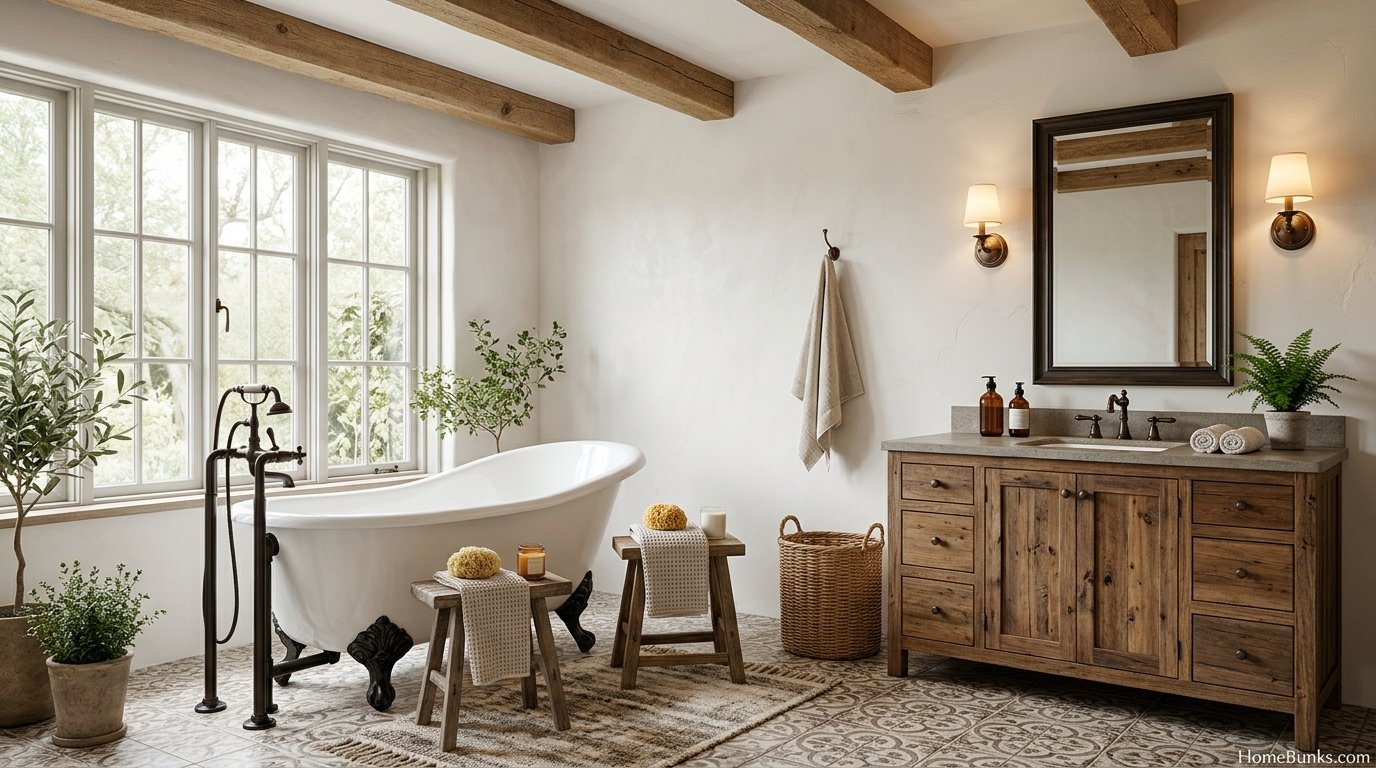
The National Kitchen and Bath Association publishes the industry’s most cited design survey each year. Its 2026 bath trends findings, as reported in coverage of the NKBA 2026 Bath Trends Report, draw a clear line through this style.
Natural style leads designer expectations at about 65 percent. Transitional follows at about 63 percent, and modern minimalist at about 60 percent.
Farmhouse sits at about 14 percent. Designers expect the themed version to keep fading, and the survey’s style rankings say so plainly.
Two honesty notes belong with those figures. They are designer expectations, not measured homeowner behavior, and secondary coverage reports the survey’s respondent count inconsistently, so no exact count is printed here.
The useful reading is not that farmhouse is dead. It is that farmhouse’s materials won while its decorations lost, because natural and transitional rooms are built from wood, warm white, and simple tile too.
|
Style direction, NKBA 2026 coverage |
Designer expectation |
|---|---|
|
Natural |
About 65 percent |
|
Transitional |
About 63 percent |
|
Modern and minimalist |
About 60 percent |
|
Farmhouse |
About 14 percent |
White also remains the top bathroom color at about 76 percent, with green near 71 and blue near 51. Farmhouse palettes borrow that shift in the palette section below.
Timeless Versus Dated: The Sorting Table
Every farmhouse decision sorts into one of two columns. Keep the left column at full strength and let the right column go without regret.
|
Timeless farmhouse |
Dated farmhouse |
|---|---|
|
Real wood vanity, natural finish |
Distressed finish on every surface |
|
Warm white walls |
Gray washed everything |
|
Beadboard or shiplap, one placement |
Shiplap on every wall and ceiling |
|
Apron or trough sink |
Mason jars as the whole storage system |
|
Black or bronze metal, used as outline |
Word signs and themed quotes |
|
Historic tile formats: subway, penny, hex |
Faux barn door where privacy matters |
|
One or two genuine antiques |
A full set of themed accessories |
|
Vintage rug, bathroom rated |
Chippy paint as a universal finish |
The table explains the style’s split reputation. Rooms built from the left column read warm and settled, while rooms built from the right column read as a 2016 time capsule.
Notice that nothing in the left column is a decoration. Materials age slowly; slogans and distressing were always fashion, and fashion is what the trend data retires.
The Element System
Farmhouse is five elements in balance: walls, vanity, tile, metal, and textiles. Strength in two or three elements carries the style; maximum strength in all five is how rooms tip into theme.
Walls: Shiplap, Beadboard, and Restraint
Shiplap and beadboard supply the style’s signature texture. The dosage rule is one wall treatment per room: a vanity wall, wainscot height around the room, or the ceiling.
Wainscot height beadboard suits small rooms best, protecting walls at splash height while keeping the upper wall calm. Full height shiplap suits one wall in a larger room, behind the vanity or the tub.
Board and batten is the third option, reading slightly more tailored. It pairs well with painted vanities and gives modern farmhouse rooms structure without roughness.
The Vanity: Wood First
Coverage of the NKBA 2026 survey reports wood faced vanities ahead of painted ones among designers, about 62 percent to 53 percent. The market agrees with the instinct: wood is the farmhouse material that matters most.
White oak, walnut, and reclaimed wood lead the natural options. Shaker fronts keep a traditional profile, while slab fronts push the same wood toward modern farmhouse.
Painted vanities remain the color route, in white, sage, or dusty blue. An antique dresser or buffet conversion is the character option, with the plumbing and sealing caveats covered in the FAQs.
Tile and Floors: Historic Formats
Subway tile is the wall default because actual farmhouses used it. Penny rounds and small hex tiles are the period correct floors, and their small scale also grips well under wet feet.
Wood look porcelain plank solves the room’s hardest conflict. It delivers the farmhouse floor signal with none of real wood’s moisture risk, and it suits radiant heat.
Pattern enters through layout, not prints. A herringbone or windowpane arrangement in plain tile gives the room its one graphic moment, the way designer galleries use it in kids baths.
Metal and Fixtures: The Outline
Matte black is the modern outline: faucets, mirror frames, lighting, and pulls drawing a clean line against white and wood. Oil rubbed bronze is the traditional equivalent, warmer and more historical.
Brushed brass is the update color, used as the single supporting metal. Two metals per room is the working limit; three turns the outline into noise.
Hard water changes the plan, not the palette. Keep black at low splash points in hard water homes and let brushed finishes take the shower, where spots show first.
Textiles and Decor: The Soft Layer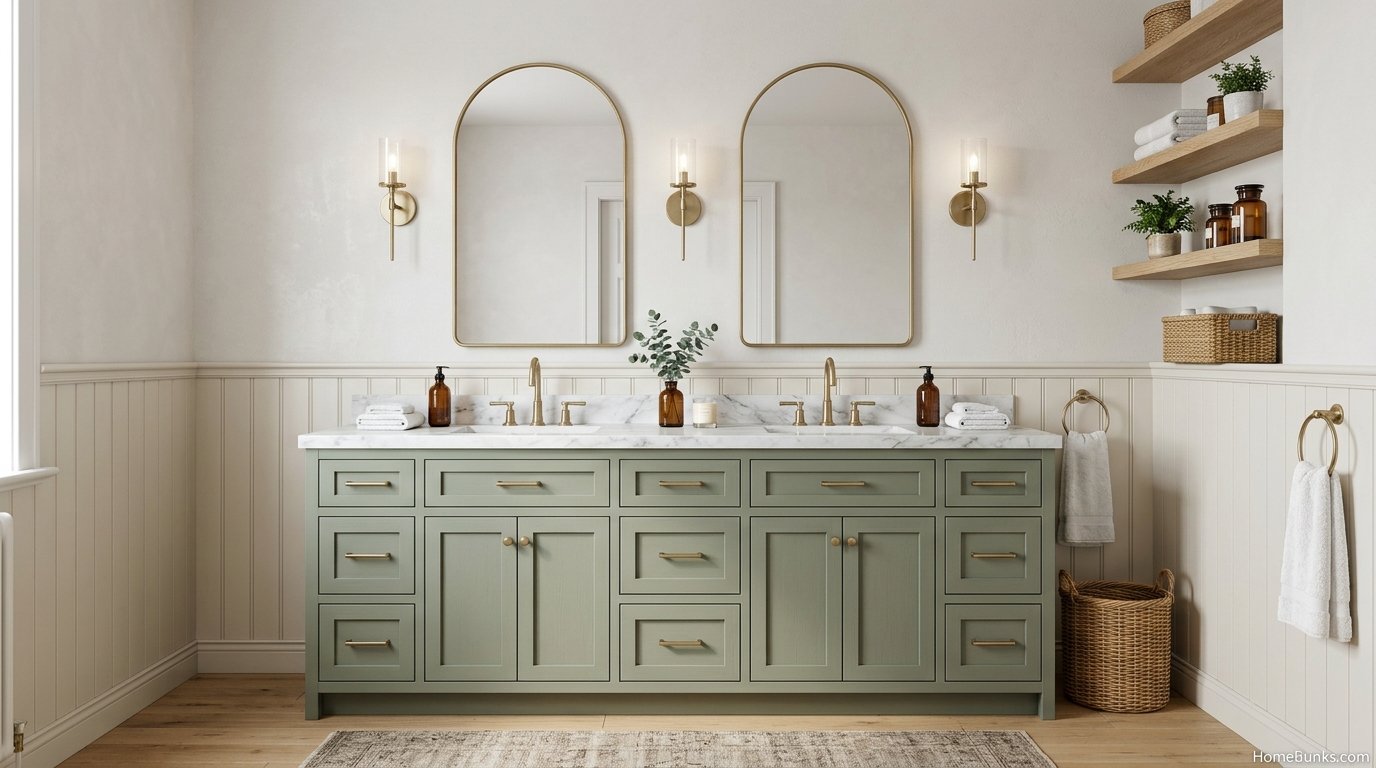
Textiles carry the style’s comfort: white towels, linen tones, ticking stripes, and a vintage style rug rated for bathroom use. This layer is also where color and pattern visit without committing the room.
Decor stops at utility. Woven baskets, a wood stool, a plant, and one genuine antique complete the list, and anything beyond it needs to earn its place by being used daily.
Open shelving belongs to this layer’s discipline. It reads as farmhouse shorthand and works only with a strict kit: folded towels, baskets, and greenery, with clutter stored behind doors.
Wood in a Wet Room: The Moisture Rulebook
Wood is this style’s soul and its biggest technical risk. Bathrooms cycle humidity daily, and the rulebook below keeps wood beautiful instead of swollen, moldy, or peeling.
1. Keep real wood out of the shower. No finish makes pine shiplap a shower material. Tile owns the wettest zone in every durable farmhouse bathroom.
2. Seal every wood surface, including edges and backs. Moisture enters through unsealed ends first. A vanity top, shelf, or shiplap run sealed on all sides outlasts a prettier piece sealed only where visible.
3. Choose moisture rated or PVC beadboard at splash height. Around tubs and in kids baths, synthetic beadboard delivers the exact profile with none of the swelling, and painted it is indistinguishable at arm’s length.
4. Ventilate like it matters, because it does. A working exhaust fan run during and after showers protects every wood element in the room. Wood farmhouse bathrooms fail from trapped steam more often than from splashes.
5. Seal reclaimed wood and respect its history. Reclaimed pieces need thorough sealing and, in older painted stock, a lead paint check before sanding or cutting. Character is worth keeping; hazards are not.
6. Let ceilings carry real wood. Ceilings get the style’s texture with the least splash exposure, which is why beadboard and tongue and groove ceilings age better than the same materials at tub height.
The Barn Door Question, Answered Honestly
No element signals farmhouse faster than a sliding barn door, and no element deserves a clearer warning. The door is beautiful, space saving, and genuinely flawed for bathroom duty.
A barn door hangs on a rail with gaps at every edge. It seals poorly, locks weakly, and passes sound and light, which are exactly the properties a bathroom door exists to block.
The verdict splits by room. On a primary suite entry with an inner door, or between a bedroom and a dressing area, the trade can be worth it.
On a family’s only bathroom or a guest bath off a hall, choose a real door and take the farmhouse signal elsewhere. Privacy is a function, and functions outrank signals every time.
Palettes: Farmhouse Colors That Work
The farmhouse palette is a warm base with one color decision. The cluster pages on this site map each option in depth, and each behaves differently against wood and black metal.
Warm Whites, Cream, and Beige
cream bathroom ideas show the style’s home base: soft whites that keep wood golden instead of orange. beige bathroom ideas and warm beige bathroom ideas deepen that base toward greige and taupe, the direction current designer rooms favor.
Warmth is the whole game in this family. A blue white makes oak look brassy and the room feel cold, undoing the comfort the style promises.
Black and White, and Black and Beige
black and white bathroom ideas deliver the graphic version: white tile, black outline, wood warmth in the middle. It is the most photographed farmhouse palette and the easiest to keep timeless.
black and beige bathroom ideas soften the same structure. Beige replaces stark white, black stays as outline, and the room reads calmer and warmer at a small cost in contrast.
Sage, Blue, Emerald, and the Cottage Colors
Sage green bathroom ideas bring the color NKBA’s survey says is rising. Sage on a vanity or lower wall is the single most current farmhouse color move, pairing naturally with oak and black.
blue and white bathroom ideas cover the dusty blue branch, historically grounded and calm. emerald green bathroom ideas suit the bolder farmhouse room, best held to a vanity or one wall so wood and white can balance them.
Lavender bathroom ideas belong to the soft cottage edge of the style, pale and floral friendly. pink and green bathroom ideas complete that cottage crossover, where farmhouse bones meet softer color.
Signature Fixtures: Apron Sinks, Clawfoot Tubs, Cross Handles
Three fixtures carry the style’s history more than any others. Each earns its place by working well, which is why they outlast the decorative layer around them.
Apron Front and Trough Sinks
The apron front sink is deep, easy to clean, and period correct for farmhouses. Wall mounted versions free floor space in small rooms, while trough sinks serve double vanities with one sculptural piece.
Splash management is the only caveat, mainly with children. A slightly deeper faucet reach and a tall backsplash solve most of it, and the fixture’s signal is strong enough that one per room suffices.
Clawfoot and Freestanding Tubs
A clawfoot tub is the room’s sculpture and soaker in one. Cast iron originals hold heat beautifully and weigh enough to demand a floor structure check, especially in older houses and upper floors.
Acrylic versions cut the weight dramatically and keep the silhouette. Pair any clawfoot with a separate shower where daily life allows, because curtain ring showers are a compromise everyone tolerates and nobody loves.
Cross Handles and Gooseneck Faucets
Cross handles and gooseneck spouts are the jewelry of the system: small, touched daily, and instantly period. They cost little more than generic modern faucets and carry the era at the exact points hands and eyes meet.
Keep their finish inside the room’s two metal limit. A bronze cross handle set against black lighting is the classic farmhouse pairing, warm at the touch points and graphic at the outline.
Pattern and Layout Playbook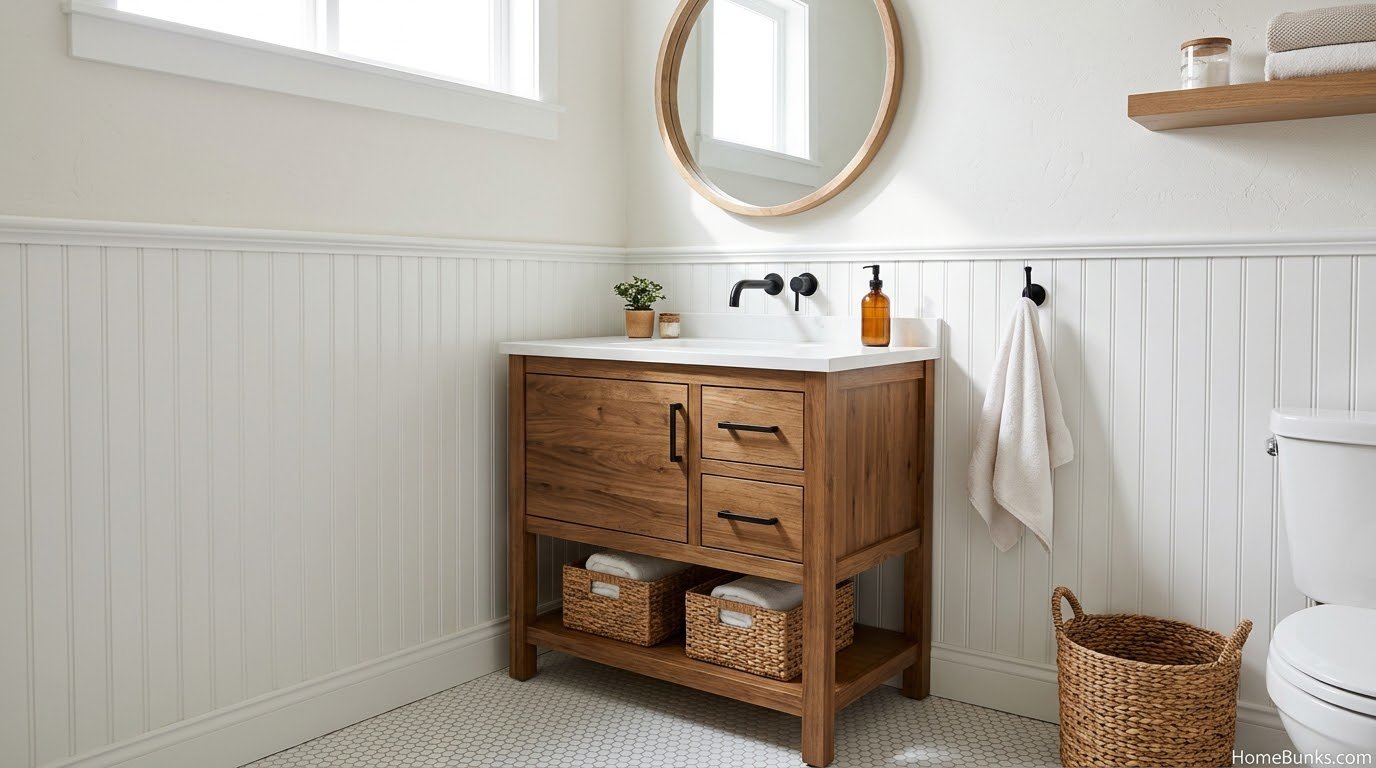
Farmhouse pattern is quiet and structural. The room’s one graphic moment usually comes from tile layout: herringbone, windowpane, or a bordered penny floor in two tones.
Textiles hold the second pattern slot, and only one of them. A ticking stripe towel set or a striped shower curtain is enough; adding gingham and floral on top turns quiet into busy.
Wallpaper belongs to the powder room, where steam is low and guests linger. Small florals and woodland prints over beadboard wainscot are the proven pairing, pattern above and texture below taking turns.
Scale discipline keeps patterns calm. Small rooms take small patterns, and large patterns need the wall area of a primary bath to breathe without overwhelming the fixtures.
Room Plays
The Powder Room
The powder room is farmhouse’s best stage: small, dry, and guest facing. Beadboard wainscot, a small wood vanity or pedestal with a farmhouse mirror, and one pattern, wallpaper or a tiled floor, complete it.
Because the room stays dry, it can carry the real materials other rooms cannot: a genuine antique mirror, an unsealed look wood stool, and wallpaper without steam anxiety.
Small Bathrooms
Small rooms need the dosage rules most. One wall treatment, one wood tone, and penny or hex floors for grip and period character keep the style legible at small scale.
Storage decides whether the room works daily. The layouts in double vanity ideas for small bathrooms show how even compact rooms fit real storage, and a furniture style vanity with drawers beats open shelving where space is tight.
Guest Bathrooms
Guests read a bathroom in seconds, and farmhouse’s hospitality signals are warm ones: folded white towels, a wood tray, a plant, and clear surfaces. Keep the themed layer at zero and the welcome reads genuine.
Durability still leads the spec. Guests will not manage delicate finishes carefully, so the guest bath gets the synthetic beadboard and sealed wood, not the antiques.
Kids Bathrooms
Kids baths take the wipeable version: beadboard or tile wainscot, black hooks instead of towel bars, wood toned step stools, and patterned tile carrying the fun. Antiques and fragile accessories skip this room entirely.
Primary Bathrooms
Primary baths fail at farmhouse when powder room tricks are enlarged. Scale up materials instead: a long wood vanity, stone look floors, a soaking tub, and beadboard or plain warm walls.
The rustic extreme of the family shows the boundary clearly. small cabin bathroom ideas sit at the lodge end, while a primary farmhouse bath stays domestic and calm, with luxury coming from material quality rather than rustic objects.
Mirrors, Lighting, and Floors: The Supporting Details
Mirrors are the cheapest strong signal after textiles. Round or arched frames in black or wood, and two individual mirrors over a double vanity, read farmhouse where one wide mirror reads modern.
The pedestal sink version of the same decision is mapped in mirror over pedestal sink ideas. A wood framed or pivoting vintage style mirror over a pedestal gives a small farmhouse room its focal point.
Lighting runs warm, 2700K to 3000K, in barn style sconces, lanterns, or schoolhouse glass. Mirror height light at the face matters more than any fixture’s style, so sconces flank the mirror before a statement pendant is considered.
Floors close the system. Beyond penny and hex, the grounded options in bathrooms with dark floors show how deep toned floors anchor pale farmhouse rooms, trading a little light for a lot of warmth and hide the dirt practicality.
A Farmhouse Refresh Without Remodeling
Most of the look is a layer, not a build. This sequence takes a plain bathroom to edited farmhouse in a weekend, in the order that makes each step visible.
1. Warm the base. Paint walls a warm white and swap bulbs to 2700K. Most cold bathrooms are a temperature problem, and this step fixes the base every later item sits on.
2. Add wood at two points. A wood stool, tray, or shelf plus one wood toned organizer. Two points minimum turns wood from an accident into the room’s material story.
3. Swap the outline. Black towel hooks, pulls, and a mirror frame where budget allows. Hardware changes the room’s outline faster than any fixture swap at this budget.
4. Dress the soft layer. White towels with one ticking stripe set, a woven basket, and a bathroom rated vintage style rug. Textiles do the farmhouse talking at this tier.
5. Edit, then stop. Remove anything themed that arrived by accident over the years. The refresh ends with subtraction, because edited is the style’s whole 2026 position.
Renters follow the same five steps with reversible swaps only. Nothing on this list needs a drill into tile, and the deposit survives intact.
Mistakes and Fixes
Mistake: shiplap everywhere, including the shower. The fix is the rulebook above: tile in the wet zone, shiplap as one statement, and synthetic profiles at splash height.
Mistake: the barn door on the only bathroom. Privacy fails daily and resentment builds. Move the door to a suite entry or replace it, and let hardware and wood carry the signal instead.
Mistake: distressing and word signs as the style. These are the retiring layer. Replace them with one real antique and plain textiles, and the room moves a decade forward in an afternoon.
Mistake: cold white and gray overload. The room feels like a clinic with rustic props. Warm the paint, warm the bulbs, and add wood before adding anything else.
Mistake: black fixtures spotted and peeling. Hard water plus abrasion strips cheap black finishes. Keep black at low splash points, choose quality finishes at wet points, and wipe spots weekly.
Mistake: antiques that cannot get wet. Unsealed vintage pieces beside tubs swell and stain. Give antiques the dry zones and powder rooms, and let sealed or synthetic pieces take the splash zones.
Frequently Asked Questions
What is a farmhouse bathroom?
A bathroom built on rural utility and warm materials: wood vanities, apron front or trough sinks, shiplap or beadboard walls, simple tile such as subway, penny, or hex, black or bronze metal, and a warm white and wood palette.
Modern farmhouse keeps those bones with cleaner lines and fewer themed decorations.
Is farmhouse style outdated in 2026?
The themed version is fading; the material version is not.
In coverage of the NKBA 2026 Bath Trends Report, only about 14 percent of designers expected farmhouse to stay popular, while natural, transitional, and modern styles led. Wood, warm whites, and simple tile remain central to those leading styles, so edited farmhouse survives inside them.
What is the difference between farmhouse and modern farmhouse?
Farmhouse leans historical: distressed finishes, antiques, chippy paint, and visible age.
Modern farmhouse keeps the materials, wood, white, black metal, simple tile, but cleans the lines and removes themed decor such as word signs. The Spruce’s ranking guide frames its whole list as modern farmhouse for this reason.
What colors are used in a farmhouse bathroom?
Warm whites lead, with wood tones as the second color and black as the outline.
NKBA 2026 coverage puts white still first among bathroom colors at about 76 percent of designers, with green and blue rising. Farmhouse accents borrow from that shift: sage, dusty blue, and greige or taupe walls all appear in current ranking galleries.
Does shiplap belong in a bathroom?
Yes, with moisture discipline. Real wood shiplap needs sealing, ventilation, and distance from direct spray, and suits walls and ceilings outside the shower.
In wet zones, PVC or moisture rated beadboard delivers the same profile without swelling and mold risk. Ranking galleries show shiplap as wainscot or a single wall, not a full wet room wrap.
Are barn doors good for bathrooms?
Visually yes, functionally mixed.
Sliding doors save swing space and carry the style, but they seal poorly, lock weakly, and pass sound and light at the edges. Use one on a primary suite entry where a second door exists, or accept the trade knowingly in a low privacy powder room.
What tile is used in farmhouse bathrooms?
Simple historic formats: subway tile on walls, penny rounds and small hex on floors, and wood look porcelain where real wood cannot go.
The formats are period correct for actual farmhouses, which is why they read authentic. Pattern enters through layout, herringbone or windowpane, rather than through busy printed designs, as the HGTV gallery’s windowpane floor shows.
What is the best vanity for a farmhouse bathroom?
A wood vanity leads: shaker or slab front in white oak, walnut, or reclaimed wood, or a painted shaker in white, sage, or dusty blue.
Coverage of the NKBA 2026 survey reports wood faced vanities ahead of painted ones, about 62 percent to 53 percent among designers. Antique conversions are the character option, with plumbing and sealing caveats.
Can a small bathroom be farmhouse style?
Yes, and small rooms carry the style well because its elements are compact: beadboard wainscot, a small wood vanity, penny or hex floors, and black accents for outline.
The editing rules matter more at small scale: one wood tone, one wall treatment, and no themed decor competing for the little visual space available.
How do I make my bathroom farmhouse without remodeling?
Work the reversible layer: a wood toned stool or organizer, black hardware swaps, white and linen textiles, woven baskets, a bathroom rated vintage style rug, styled open shelving, and greenery.
Skip permanent themed items. This is also the renter route, and it captures most of the look.
What metal finishes suit farmhouse bathrooms?
Matte black is the modern outline, oil rubbed bronze the traditional one, and brushed brass or gold the warm update.
Ranking galleries mix metals increasingly, one dominant with one supporting. Hard water argues against matte black at the shower, where spots show; use black at mirrors, lights, and pulls there instead.
Is a clawfoot tub practical?
A clawfoot tub is a soaker, not a daily shower solution, unless fitted with a riser and curtain ring, as one HGTV example shows.
Cast iron versions are extremely heavy and need floor structure checks; acrylic lookalikes cut weight sharply. Choose one for a primary bath with a separate shower.
What flooring works in a farmhouse bathroom?
Historic formats in modern materials: penny and hex porcelain, wood look porcelain plank, and honed stone look tile.
Real wood appears in ranking photos but carries moisture risk at tubs and toilets. Slip resistance matters more than pattern in wet rooms, especially for kids and older users.
How much shiplap is too much?
When it covers every wall and the ceiling in a small wet room, the texture flattens into theme and moisture exposure multiplies.
The durable pattern is one statement: a vanity wall, wainscot height, or a ceiling. Designer galleries vary shiplap placement room by room rather than wrapping every surface.
What lighting suits a farmhouse bathroom?
Warm light at 2700K to 3000K, in black, bronze, or brass fixtures with simple silhouettes: barn style sconces, lantern pendants, and schoolhouse glass.
Layer mirror light at face height; a single rustic ceiling fixture photographs well and performs badly. Clear glass shades keep light output honest in small rooms.
Can farmhouse work in a new build house?
Yes, if the materials are real and the theme stays home. New builds fail when every item is distressed, themed, and bought as a set.
They succeed with genuine wood, simple tile, warm whites, and one or two vintage pieces for age. Authenticity is a material property, not a purchase list.
What should I avoid in a farmhouse bathroom?
Word signs, mason jars as the entire storage system, distressing on every surface, faux barn doors on private rooms, gray toned everything, and shiplap inside the shower.
Each marks the themed version the trend data is abandoning. The fix is better materials and fewer signals, never more farmhouse.
Does farmhouse style hurt resale?
Heavily themed rooms narrow the buyer pool; material led rooms do not. The NKBA direction points buyers toward natural and transitional rooms, which edited farmhouse resembles. Keep permanent surfaces neutral and quality, let farmhouse live in replaceable items, and resale risk stays low.
What is the farmhouse bathroom color palette for walls?
Warm whites first, then greige, taupe, and soft gray blues or sage as color options.
The Spruce list includes taupe shiplap walls and gray blue upper walls over white wainscot. Stark blue white is the palette error: it makes wood look orange and the room feel cold.
Can I mix farmhouse with modern elements?
That mixture is the definition of modern farmhouse and the current mainstream.
Pair the wood vanity and beadboard with a frameless mirror, simple faucets, and large format floor tile. Keep one era dominant per surface so the room reads edited rather than undecided, and let black metal be the bridge finish both eras share.
What window treatments suit farmhouse bathrooms?
Simple and washable: linen look cafe curtains, woven shades, or frosted glass with no curtain at all.
Heavy drapes and themed valances fight the style’s utility roots and suffer in humidity. Privacy film on the lower sash is the modern farmhouse answer in many ranking photos, keeping light while solving the neighbor problem.
How do I add farmhouse style to a kids bathroom?
Use the durable version: beadboard or tile wainscot that wipes clean, a wood look vanity, black hooks instead of a towel bar, and wood toned step stools.
Skip antiques and delicate accessories. Patterned tile can carry the personality, as in the HGTV gallery’s kids bath, while the bones stay practical.
What storage works in farmhouse bathrooms?
Open shelves with discipline, woven baskets, ladder shelves, and furniture style vanities with real drawers. Open shelving fails daily without a strict kit: towels, baskets, and one plant, nothing else. Closed storage carries the visual clutter so the open layer can stay styled.
Are apron front sinks practical in bathrooms?
Yes. Apron front and trough sinks are deep, easy to clean, and period correct.
They need compatible vanities or wall mounts and slightly more splash management with children. Their farmhouse signal is strong, so one apron sink usually suffices; doubling every fixture’s theme is how rooms tip into costume.
What mirrors suit farmhouse style?
Round or arched mirrors in black or wood frames, pivoting vintage style mirrors, and simple wood framed rectangles.
The mirror is the cheapest farmhouse signal after textiles, and it doubles light. Oversized single mirrors over double vanities read modern; two individual mirrors read farmhouse and function better for two users.
How do I warm up a white farmhouse bathroom?
Add wood at two points minimum, warm the bulbs to 2700K, choose a warm white over a blue white, and layer textiles in natural fibers.
Cold white farmhouse rooms are almost always a temperature problem, in paint undertone or bulb Kelvin, not a decor shortage. More accessories on a cold base only clutter it.
What patterns work in farmhouse bathrooms?
Quiet ones: ticking stripes, small gingham at textile scale, subtle florals in wallpaper for powder rooms, and geometric layouts in tile.
One pattern per room is the working rule, with the floor layout allowed as the second if it is monochrome. The HGTV powder room example pairs woodland wallpaper with plain shiplap, pattern and texture taking turns.
Can farmhouse style work with a walk in shower?
Yes. Frame the shower as the modern element: stone look tile or subway with dark grout, black framed glass, and a wood bench. Keep farmhouse signals at the vanity and walls, and the shower reads as a clean modern core.
What is beadboard and is it better than shiplap for bathrooms?
Beadboard is narrow grooved paneling, historically used as wainscot in farmhouses and cottages. In bathrooms it has a practical edge: PVC and moisture rated versions are common, it protects walls at splash height, and its scale suits small rooms.
Shiplap’s wider profile suits walls and ceilings. Many durable farmhouse baths use beadboard low and paint or tile above.
How do I convert an antique dresser into a vanity?
Choose a solid wood piece at counter height, cut for plumbing, seal every surface or add a stone top, and reinforce for the sink’s weight.
Budget for the plumbing adaptation, which is the real cost. Keep the piece as the room’s single character item, the proportion designer galleries use.
What towels and textiles fit farmhouse style?
White and natural linen tones lead, with ticking stripe or grain sack style stripes as the accent pattern.
Waffle and Turkish cotton read utilitarian and photograph honestly. Textiles are the fastest farmhouse layer to change seasonally, and the layer where a small amount of pattern or color, a vintage rug, a striped towel, does the most work per dollar.
Does farmhouse work in a rental bathroom?
At the textile and accessory layer, completely: a ticking stripe or linen look shower curtain, wood toned accessories, baskets, a stool, removable black hooks, and plants.
Do not install shiplap or barn doors in a rental. Photograph the original room and keep every change reversible.
What is the cheapest farmhouse bathroom update?
Paint and textiles: warm white walls, a painted vanity, white towels, and one wood accessory usually land as the under a weekend, low budget transformation.
Prices vary by market and are not printed here. The ordering principle is permanent neutral first, farmhouse signals second, so the spend survives style shifts.
Can farmhouse and cottage styles mix?
Freely; they are close relatives. Cottage adds softer color, florals, and more pattern; farmhouse adds utility, wood, and black metal.
A farmhouse bath with a floral curtain and a sage vanity is already the mix. Keep the utility bones farmhouse and let cottage live in the soft layer, and the room stays coherent.
What grout color works with farmhouse subway tile?
Dark gray grout is the farmhouse signature with white subway: it traces the brick pattern, hides wear, and gives the graphic outline black fixtures echo. Light grout reads cleaner and more modern.
In showers, mid gray balances staining and style. Match the grout decision to the era you chose: dark for historic, light for modern farmhouse.
How do I keep black fixtures looking good?
Wipe water spots weekly and avoid abrasive cleaners that strip the finish.
In hard water areas, use black at low splash points, mirrors, lighting, and pulls, and keep chrome or brushed finishes at the shower and faucets. This division is driven by maintenance reality, not style compromise.
What plants suit farmhouse bathrooms?
Humidity tolerant and low fuss: pothos, ferns in bright rooms, and eucalyptus stems in the shower for the photographable classic.
Plants supply the living green that NKBA’s natural style direction centers. One plant well kept beats three struggling ones, and dried stems are the honest low light alternative.
Should the toilet and tub match the farmhouse theme?
Fixtures stay simple and white; the theme lives around them.
Period style toilets and clawfoot tubs are the enthusiast options, but a standard white suite with farmhouse walls, vanity, and metal reads fully farmhouse at a fraction of the cost. Spend theme money on surfaces touched daily, not on themed plumbing sculptures.
What ceiling treatments work in farmhouse bathrooms?
Beadboard, tongue and groove, shiplap, and beams where structure allows, painted warm white or left as sealed wood.
Ceilings carry farmhouse texture without splash exposure, the safest place for real wood. Faux beams crowd low ceilings and usually date the room, so treat them as a judgment call.
How do I do farmhouse in a primary bathroom without it feeling themed?
Scale up the materials and scale down the signals: a long wood vanity, stone look floors, beadboard or limewash style walls, black and brass metal, and no themed decor at all.
Primary baths fail at farmhouse when powder room tricks are enlarged. Luxury in this style is material quality and calm, not more rustic objects.
Is shiplap expensive to install?
Material costs are modest for pine and MDF versions and higher for moisture rated and PVC products; labor depends on room size and cuts.
Exact US figures vary by market and are not printed here. The budget trap is the prep: sealing, ventilation upgrades, and trim finishing around fixtures.
What is the difference between farmhouse and rustic style?
Rustic is rawer and heavier: logs, stone, rough beams, lodge and cabin associations. Farmhouse is domestic and lighter: painted wood, white, domestic textiles, and farm utility.
They overlap in wood and age, but a farmhouse bathroom should still feel like a house, not a hunting lodge. The small cabin cluster on decor sites shows the rustic end of the spectrum. —
Conclusion
Farmhouse bathroom ideas endure when the style is treated as a material palette with rules, not a theme to apply. Real wood, warm whites, historic tile, and honest metal outlast every trend cycle the surveys record.
Choose one wall treatment, let a wood vanity lead, keep black as the outline, and hold themed decor at zero. Rooms built that way sit comfortably inside the natural and transitional direction designers are moving toward.
Start with the refresh sequence if the budget is small, or with the moisture rulebook if you are building. Either way, the edited farmhouse bathroom you finish will still look right when the next trend report lands.