
Flowers that start with U are some of the most overlooked in the plant world. Most gardeners can name a dozen flowers starting with A or R, but U often draws a blank.
This guide fixes that. Below you will find 55 flowers and plants beginning with U, covering garden favorites, rare wildflowers, houseplants, and carnivorous species.
Each entry includes the scientific name, native range, bloom season, and quick care notes. Use this list for garden planning, school projects, word games, or simple curiosity.
Quick Answer: What Are Flowers That Start With U?
Flowers that start with U include Urn Plant, Uvularia, Ulex, Utricularia, Umbrella Magnolia, and Unicorn Plant, among others.
They span several plant families, from bromeliads and legumes to carnivorous bladderworts and flowering trees.
Most U flowers fall into three groups:
- Woodland perennials such as Uvularia and Upland Ironweed
- Desert and dryland natives such as Utah Agave and Uinta Basin Hookless Cactus
- Ornamental and container plants such as Urn Plant and Uncarina
Flowers That Begin With The Letter U At A Glance
This table gives a fast snapshot of some of the best known U flowers before the full list.
| Common Name | Scientific Name | Flower Color | Plant Type |
| Urn Plant | Aechmea fasciata | Pink and blue | Bromeliad |
| Uvularia | Uvularia spp. | Yellow | Woodland perennial |
| Ulex | Ulex europaeus | Yellow | Shrub |
| Uva Ursi | Arctostaphylos uva-ursi | Pink and white | Groundcover |
| Umbrella Magnolia | Magnolia tripetala | White | Flowering tree |
| Unicorn Plant | Proboscidea louisianica | Pink and purple | Annual |
| Utricularia | Utricularia spp. | Yellow and purple | Carnivorous aquatic |
| Utah Agave | Agave utahensis | Yellow | Succulent |
| Uraria Crinita | Uraria crinita | Purple | Perennial shrub |
| Unwin’s Mix Godetia | Clarkia amoena | Mixed pastel shades | Annual |
Bloom Season And Native Range Summary
Bloom time and origin help you decide which U flowers suit your climate. Here is a quick reference table.
| Flower | Bloom Season | Native Range |
| Uvularia Grandiflora | Spring | Eastern North America |
| Ulex Europaeus | Late winter to spring | Western Europe |
| Uva Ursi | Spring | Northern Hemisphere, circumboreal |
| Urn Plant | Summer | Brazil |
| Utah Penstemon | Late spring | Southwestern United States |
| Utricularia Vulgaris | Summer | Europe, Asia, North America |
| Uraria Crinita | Summer to fall | Tropical Asia |
| Uruguayan Pampas Grass | Late summer to fall | South America |
| Unwin’s Mix Godetia | Summer | Western North America |
| Uvaria Grandiflora | Spring to summer | Southeast Asia |
Native range matters because it tells you the growing conditions a plant is adapted to. A flower native to Utah desert basins will need very different care than one native to Brazilian rainforests.
Complete List Of 50 Flowers That Begin With The Letter U
Below is the full list. Each entry includes a short description and quick facts for easy reference.
1. Urn Plant
Urn Plant, or Aechmea fasciata, is a bromeliad grown for its silvery green banded leaves and bright pink urn shaped bract. Small blue flowers emerge briefly from the bract before fading.
It is a popular houseplant because it tolerates low light and irregular watering.
Native range: Brazil. Bloom season: Summer. Color: Pink and blue.
2. Ursinia
Ursinia is a genus of daisy-like flowers in the Asteraceae family. The blooms are usually bright yellow or orange with dark centers, similar to a small sunflower.
Ursinia thrives in sunny, dry conditions and is often used in rock gardens.
Native range: South Africa. Bloom season: Spring to summer. Color: Yellow and orange.
3. Uvularia
Uvularia, commonly called bellwort, is a genus of woodland perennials with drooping, bell shaped yellow flowers. The twisted petals give the plant a slightly shy, nodding appearance.
It spreads slowly by rhizomes and prefers shaded, moist soil.
Native range: North America. Bloom season: Spring. Color: Pale yellow.
4. Uvularia Grandiflora
Uvularia grandiflora, or large-flowered bellwort, is the showiest species in the genus. Its twisted, lemon yellow petals hang below arching stems in early spring.
This species naturalizes well in shady woodland gardens and pairs nicely with ferns.
Native range: Eastern North America. Bloom season: Early spring. Color: Yellow.
5. Uvularia Perfoliata
Uvularia perfoliata gets its name from leaves that appear pierced by the stem, a trait called perfoliate. The flowers are smaller and paler than Uvularia grandiflora.
It grows in rich, moist woodland soil and spreads gradually into small colonies.
Native range: Eastern United States. Bloom season: Spring. Color: Pale yellow.
6. Uvularia Sessilifolia
Also called wild oats, Uvularia sessilifolia has leaves that sit directly on the stem without wrapping around it, unlike its perfoliate cousin. Flowers are small and creamy yellow.
It tolerates drier soil better than other Uvularia species.
Native range: North America. Bloom season: Spring. Color: Cream yellow.
7. Ulex
Ulex, commonly known as gorse, is a genus of spiny evergreen shrubs covered in bright yellow, pea-shaped flowers. The blooms have a coconut like fragrance.
Gorse is tough and drought tolerant but can become weedy if left unmanaged.
Native range: Europe and North Africa. Bloom season: Late winter to spring. Color: Yellow.
8. Ulex Europaeus
Ulex europaeus, or common gorse, is the most widespread gorse species. It forms dense, thorny thickets covered in golden yellow flowers that can bloom nearly year round in mild climates.
It is listed as invasive in parts of North America and Oceania.
Native range: Western Europe. Bloom season: Year round in mild areas. Color: Bright yellow.
9. Ulex Gallii
Ulex gallii, or western gorse, is smaller and more compact than common gorse. It blooms later in the season, usually from late summer into autumn, filling coastal heathlands with color.
It prefers acidic, well drained soil.
Native range: Western Europe. Bloom season: Late summer to autumn. Color: Yellow.
10. Uva Ursi
Uva ursi, scientifically Arctostaphylos uva-ursi and commonly called bearberry, is a low growing evergreen groundcover. Its small pink and white urn shaped flowers appear in spring, followed by red berries.
It is widely used in erosion control and traditional herbal remedies.
Native range: Northern Hemisphere. Bloom season: Spring. Color: Pink and white.
11. Umbrella Magnolia
Umbrella Magnolia, or Magnolia tripetala, is a small deciduous tree named for the umbrella-like whorl of large leaves at its branch tips. Creamy white flowers with an unpleasant scent bloom in late spring.
It grows best in moist, shaded forest understories.
Native range: Southeastern United States. Bloom season: Late spring. Color: White.
12. Umbrella Plant
Umbrella Plant, often Cyperus alternifolius, is grown primarily for its whorled, umbrella shaped foliage rather than showy flowers. Tiny greenish brown flower clusters appear at the top of the foliage rays.
It thrives in wet soil or shallow standing water.
Native range: Madagascar. Bloom season: Summer. Color: Greenish brown.
13. Umbrella Sedge
Umbrella Sedge refers to related Cyperus species grown for their grasslike, radiating foliage. Flowers are small and inconspicuous, clustered at the tips of the umbrella-like bracts.
It is a common pond edge and bog garden plant.
Native range: Tropical regions worldwide. Bloom season: Summer. Color: Brownish green.
14. Upright Prairie Coneflower
Upright Prairie Coneflower, or Ratibida columnifera, has drooping yellow petals surrounding a tall, cylindrical brown cone. It is a hardy, drought tolerant native prairie flower.
Pollinators, especially bees, are strongly attracted to this species.
Native range: North American prairies. Bloom season: Summer. Color: Yellow with brown cone.
15. Upright Clematis
Upright Clematis, or Clematis integrifolia, is a non-vining clematis that grows as an upright perennial rather than a climber. It produces nodding, bell shaped blue-purple flowers.
It works well in mixed borders where a climbing structure is not available.
Native range: Europe and Asia. Bloom season: Early to midsummer. Color: Blue-purple.
16. Upright Yellow Flax
Upright Yellow Flax, or Linum rigidum, is a slender annual wildflower with cheerful yellow, five-petaled blooms. It grows in dry, open prairie habitat.
The flowers open in the morning and often close by afternoon.
Native range: Central United States. Bloom season: Summer. Color: Yellow.
17. Unicorn Plant
Unicorn Plant, or Proboscidea louisianica, is an annual known for its trumpet shaped pink and purple flowers and long, curved seed pods. The pods inspired both its common name and the nickname devil’s claw.
It self seeds readily in warm climates.
Native range: Southwestern United States. Bloom season: Summer. Color: Pink and purple.
18. Utah Agave
Utah Agave, or Agave utahensis, is a small, spiny succulent that sends up a tall flower stalk covered in yellow blooms once in its lifetime. It grows slowly over many years before blooming.
It is well adapted to rocky desert slopes.
Native range: Southwestern United States. Bloom season: Summer. Color: Yellow.
19. Utah Penstemon
Utah Penstemon, or Penstemon utahensis, produces tubular, reddish pink flowers on upright spikes. It is a favorite of hummingbirds in its native desert range.
This penstemon needs sharp drainage and full sun to thrive.
Native range: Utah and surrounding states. Bloom season: Late spring. Color: Red-pink.
20. Utah Serviceberry
Utah Serviceberry, or Amelanchier utahensis, is a shrub covered in clusters of small white five-petaled flowers in spring, followed by edible purple berries. It is an important food source for wildlife.
It tolerates poor, rocky soil with ease.
Native range: Western United States. Bloom season: Spring. Color: White.
21. Utah Sweetvetch
Utah Sweetvetch, or Hedysarum boreale, is a perennial legume with clusters of pink-purple pea-shaped flowers. It fixes nitrogen in the soil, improving conditions for nearby plants.
It is often used in rangeland restoration projects.
Native range: Western North America. Bloom season: Late spring to summer. Color: Pink-purple.
22. Uinta Basin Hookless Cactus
Uinta Basin Hookless Cactus, or Sclerocactus wetlandicus, is a small barrel cactus with pale pink flowers. It is federally listed as threatened due to habitat loss from energy development.
It grows only in a narrow region of northeastern Utah.
Native range: Uinta Basin, Utah. Bloom season: Spring. Color: Pink.
23. Uinta Cactus
Uinta Cactus refers to small globular cactus species native to the Uinta Basin region, producing magenta or pink flowers close to the plant body. These cacti are adapted to arid, mineral rich soils.
Several related species in this region are considered rare or protected.
Native range: Uinta Basin, Utah. Bloom season: Spring. Color: Magenta.
24. Utricularia
Utricularia, or bladderwort, is a genus of carnivorous plants that trap tiny aquatic organisms in bladder-like structures on their roots. Flowers rise above the water on thin stalks and resemble small snapdragons.
Species range from yellow to deep purple in color.
Native range: Worldwide, mostly wetlands. Bloom season: Summer. Color: Yellow or purple.
25. Utricularia Vulgaris
Utricularia vulgaris, common bladderwort, is a free floating aquatic carnivorous plant with bright yellow flowers that rise above the water surface. Underwater bladders trap small insects and larvae.
It is often found in ponds, ditches, and slow moving water.
Native range: Europe, Asia, North America. Bloom season: Summer. Color: Yellow.
26. Utricularia Sandersonii
Nicknamed bunny bladderwort, Utricularia sandersonii produces tiny purple and white flowers shaped remarkably like rabbit faces. It is a popular choice for terrariums and paludariums.
It grows in consistently moist, humid conditions.
Native range: South Africa. Bloom season: Nearly year round indoors. Color: Purple and white.
27. Utricularia Graminifolia
Utricularia graminifolia has thin, grass-like leaves and small purple flowers. It is widely used as a carpeting foreground plant in aquascaped aquariums.
It needs high light and CO2 supplementation to form a dense carpet.
Native range: Southeast Asia. Bloom season: Variable, often suppressed underwater. Color: Purple.
28. Utricularia Dichotoma
Known as fairy aprons, Utricularia dichotoma produces delicate purple flowers with a distinctive lower lip. It grows in damp soil rather than fully submerged water.
It is popular among carnivorous plant collectors for its ease of care.
Native range: Australia. Bloom season: Spring to summer. Color: Purple.
29. Urceolina
Urceolina is a small genus of bulbous plants related to Amaryllidaceae, producing drooping, urn shaped orange or yellow flowers. The blooms hang in small clusters atop leafless stalks.
It is grown as a specialty bulb by collectors.
Native range: Andean South America. Bloom season: Summer. Color: Orange and yellow.
30. Urceolina Amazonica
Urceolina amazonica produces clusters of bright orange, tubular flowers that hang gracefully from a tall stem. It resembles a smaller relative of the Amazon lily.
It grows from a bulb and prefers bright, indirect light.
Native range: Amazon basin. Bloom season: Summer. Color: Orange.
31. Urginea Maritima
Urginea maritima, also called sea squill, sends up a tall spike covered in small white star shaped flowers in late summer, before the leaves appear. The bulb is toxic if ingested.
It has a long history of use in traditional medicine, handled with caution.
Native range: Mediterranean region. Bloom season: Late summer to autumn. Color: White.
32. Urginea Indica
Urginea indica, the Indian squill, is closely related to sea squill and produces similar white flower spikes. Its bulb has been used in traditional Ayurvedic preparations.
Like its Mediterranean relative, the bulb is toxic in raw form.
Native range: India. Bloom season: Monsoon season. Color: White.
33. Urena Lobata
Urena lobata, sometimes called Caesarweed, produces small pink, hibiscus-like flowers. It is a fast growing shrub used traditionally for fiber and folk medicine.
It spreads easily and is considered weedy in some tropical regions.
Native range: Pantropical. Bloom season: Summer to fall. Color: Pink.
34. Urena
Urena is the broader genus that includes Urena lobata and related species, all members of the mallow family. Flowers are typically small, pink, and five-petaled.
Most species tolerate poor soil and disturbed ground.
Native range: Tropical Africa and Asia. Bloom season: Summer to fall. Color: Pink.
35. Uraria
Uraria is a genus of legumes with small pea-shaped flowers arranged on dense, upright spikes. Several species are used in traditional herbal medicine across Asia.
Most Uraria species prefer warm, humid growing conditions.
Native range: Tropical Asia. Bloom season: Summer to fall. Color: Purple.
36. Uraria Crinita
Uraria crinita, known as cat’s tail or prince’s plume, produces fuzzy purple flower spikes that closely resemble a cat’s tail. It is a striking ornamental shrub for warm climate gardens.
The dense flower spikes attract butterflies and bees.
Native range: Tropical Asia. Bloom season: Summer to fall. Color: Purple.
37. Upland White Aster
Upland White Aster, or Oligoneuron album, produces clusters of small white daisy-like flowers on upright stems. It grows in dry prairie and upland habitats.
It is an important late season nectar source for pollinators.
Native range: North American prairies. Bloom season: Late summer to fall. Color: White.
38. Upland Ironweed
Upland Ironweed, or Vernonia glauca, produces fluffy purple flower clusters atop tall, sturdy stems. It grows in dry woodland edges and open fields.
Butterflies, especially monarchs, are frequently seen on its blooms.
Native range: Eastern United States. Bloom season: Late summer. Color: Purple.
39. Upland Larkspur
Upland Larkspur, or Delphinium nuttallianum, produces spurred, blue-purple flowers on short upright stems. It blooms early in spring, often before many other wildflowers emerge.
All parts of the plant are toxic to livestock if consumed in quantity.
Native range: Western North America. Bloom season: Early spring. Color: Blue-purple.
40. Upland Cotton
Upland Cotton, or Gossypium hirsutum, produces creamy yellow flowers that turn pink before fading and forming cotton bolls. It is the most widely cultivated cotton species in the world.
Commercial cotton production relies almost entirely on this species.
Native range: Central America and Mexico. Bloom season: Summer. Color: Cream to pink.
41. Ulmus
Ulmus, the elm genus, produces small, inconspicuous reddish green flowers that appear on bare branches before the leaves emerge in spring. The flowers are wind pollinated.
Elms are valued mainly for shade rather than floral display.
Native range: Northern Hemisphere. Bloom season: Early spring. Color: Reddish green.
42. Ulmus Americana
Ulmus americana, the American elm, produces small clustered flowers in very early spring, followed by flat, winged seeds. Many mature trees were lost to Dutch elm disease in the twentieth century.
Disease resistant cultivars are now more commonly planted.
Native range: Eastern North America. Bloom season: Early spring. Color: Reddish green.
43. Uvaria
Uvaria is a genus of tropical climbing shrubs with star shaped, maroon or dark red flowers. It belongs to the custard apple family and often produces edible fruit.
Most species need warm, humid, frost free conditions.
Native range: Tropical Asia and Africa. Bloom season: Spring to summer. Color: Maroon.
44. Uvaria Grandiflora
Uvaria grandiflora is a vigorous climbing shrub with large, deep maroon, star shaped flowers. It is grown ornamentally in tropical gardens for its unusual bloom shape.
The flowers have a faint fruity fragrance.
Native range: Southeast Asia. Bloom season: Spring to summer. Color: Maroon.
45. Uvaria Rufa
Uvaria rufa is a smaller flowering vine with reddish brown blooms, followed by clusters of edible fruit. It is used in some traditional medicine practices.
It grows well along fences and trellises in warm climates.
Native range: Southeast Asia. Bloom season: Spring to summer. Color: Reddish brown.
46. Uncarina
Uncarina is a genus of caudex forming succulents from Madagascar, producing bright yellow, trumpet shaped flowers with a dark maroon throat. The plants store water in a swollen woody base.
They are popular among succulent and caudex plant collectors.
Native range: Madagascar. Bloom season: Spring to summer. Color: Yellow with maroon center.
47. Uncarina Roeosiiana
Uncarina roeosiiana is one of the most commonly cultivated Uncarina species, prized for its cheerful yellow flowers and thick, sculptural caudex. It drops its leaves during dry dormancy periods.
It requires excellent drainage and minimal winter watering.
Native range: Madagascar. Bloom season: Spring to summer. Color: Yellow.
48. Uruguayan Firecracker Plant
Uruguayan Firecracker Plant, or Manettia luteorubra, is a twining vine with narrow, tubular flowers that are bright red at the base and yellow at the tip. The color combination resembles a small firecracker.
It climbs readily on trellises and fences in warm climates.
Native range: South America. Bloom season: Summer to fall. Color: Red and yellow.
49. Uruguayan Pampas Grass
Uruguayan Pampas Grass, or Cortaderia selloana, is an ornamental grass known for its tall, feathery white to pink plumes. It is widely used in landscaping for texture and movement.
It is classified as invasive in several regions, including parts of the United States.
Native range: South America. Bloom season: Late summer to fall. Color: White to pink.
50. Unwin’s Mix Godetia
Unwin’s Mix Godetia, a cultivar of Clarkia amoena, produces satiny, cup shaped flowers in shades of pink, red, salmon, and white on a single plant. It is a popular cut flower and bedding annual.
It grows quickly from seed and blooms within weeks.
Native range: Western North America. Bloom season: Summer. Color: Mixed pastel shades.
Types Of Flowers That Start With U
U flowers fall into several distinct categories based on growth habit and use.
- Woodland perennials: Uvularia species, Upland Ironweed
- Desert and dryland natives: Utah Agave, Uinta Basin Hookless Cactus
- Carnivorous aquatic plants: Utricularia species
- Flowering trees and shrubs: Umbrella Magnolia, Ulmus
- Tropical vines and climbers: Uvaria, Uruguayan Firecracker Plant
- Ornamental grasses: Uruguayan Pampas Grass
- Container and houseplants: Urn Plant, Uncarina
Each category has different light, water, and soil needs, so identifying the type first makes care much easier.
Indoor And Container Flowers With U
Several U flowers adapt well to pots and indoor conditions.
- Urn Plant grows well in bright, indirect light with minimal soil watering
- Utricularia sandersonii thrives in terrariums with constant moisture
- Uncarina roeosiiana suits sunny windowsills and needs a dry winter rest
- Umbrella Plant does well in containers kept consistently damp
These species are forgiving for beginners and rarely need repotting more than once every year or two.
Best Flowers With U For Garden Use
For outdoor beds and borders, these U flowers perform reliably.
- Uvularia Grandiflora for shaded woodland gardens
- Upright Prairie Coneflower for sunny, drought tolerant beds
- Utah Serviceberry as a flowering, wildlife friendly shrub
- Unwin’s Mix Godetia for fast, colorful annual borders
- Uruguayan Pampas Grass as a dramatic landscape accent
Matching each plant to its preferred sun and soil conditions is the single biggest factor in garden success.
Common Flowers That Start With U
Some U flowers are widely available at nurseries and easy to find.
| Flower | Where Commonly Found |
| Ulex Europaeus | Coastal and hedgerow landscaping |
| Uva Ursi | Groundcover in rock gardens |
| Ulmus Americana | Street and park trees |
| Unwin’s Mix Godetia | Seed packets, cut flower gardens |
| Upland Cotton | Agricultural fields |
These species are well documented, easy to source, and generally low maintenance once established.
Rare Flowers That Start With U
A few U flowers are genuinely hard to find, either because of limited range or conservation status.
- Uinta Basin Hookless Cactus, federally protected and restricted to a small region
- Uraria Crinita, uncommon outside specialty tropical nurseries
- Urceolina Amazonica, rarely stocked outside bulb collector circles
- Uncarina Roeosiiana, found mainly through succulent specialty sellers
If you want to grow any of these, expect to search specialty growers rather than big box garden centers.
Purple Flowers That Start With U
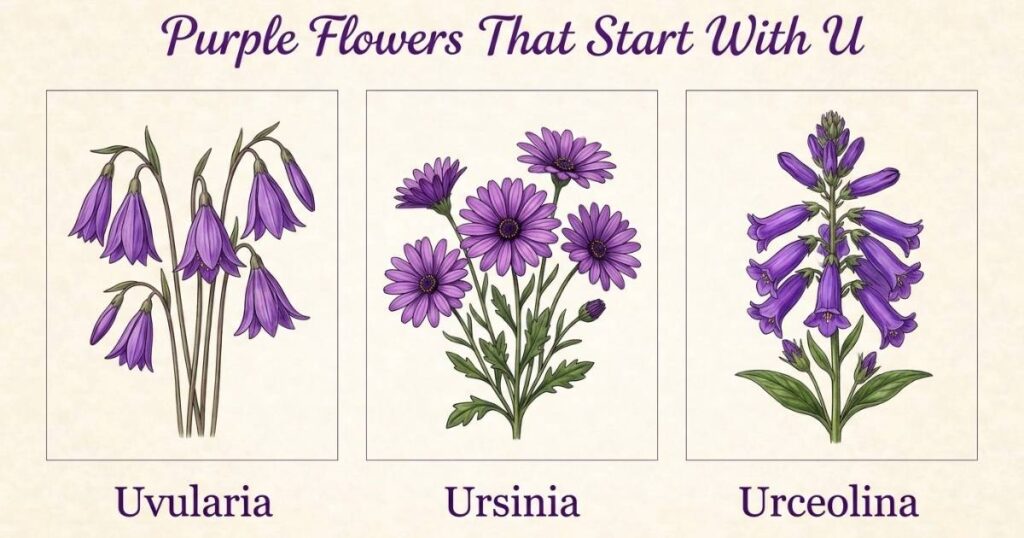
Purple is one of the most common colors among U flowers.
- Uraria Crinita
- Upland Ironweed
- Upland Larkspur
- Utricularia Sandersonii
- Utricularia Dichotoma
- Upright Clematis
Purple U flowers tend to attract pollinators like bees and butterflies more strongly than pale colored blooms.
Yellow Flowers With U
Yellow is another dominant color in this list.
- Ursinia
- Uvularia Grandiflora
- Ulex Europaeus
- Utricularia Vulgaris
- Uncarina Roeosiiana
- Upright Yellow Flax
Yellow flowering U species often bloom earliest in the growing season, making them useful for early pollinator support.
Perennial Flowers That Start With U
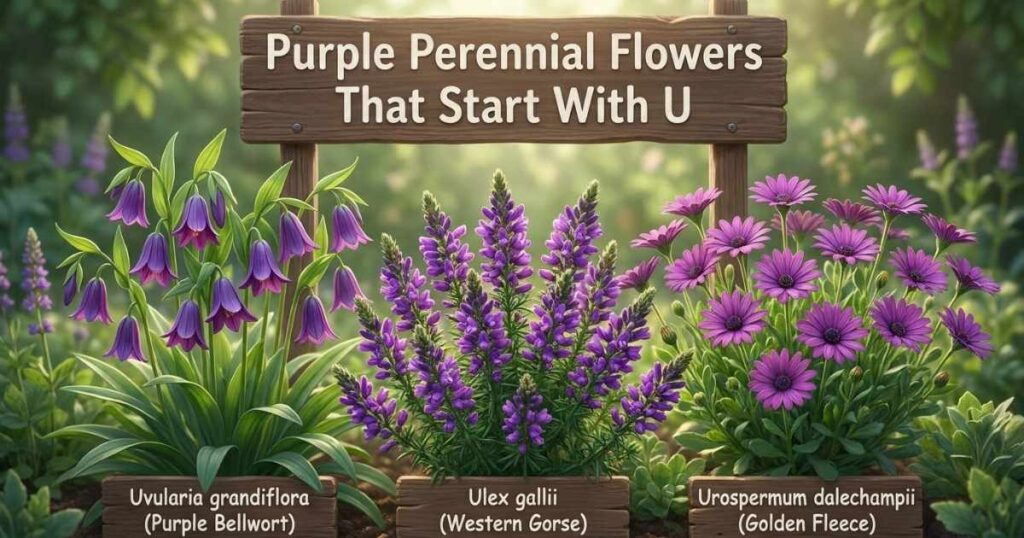
These U flowers return year after year without replanting.
- Uvularia species
- Uva Ursi
- Utah Penstemon
- Upright Clematis
- Ulex
Perennial U flowers are a good investment for gardeners who want long term color with less yearly maintenance.
Annual Flowers That Start With U
These U flowers complete their life cycle in a single season and are typically replanted yearly.
- Unwin’s Mix Godetia
- Unicorn Plant
- Upright Yellow Flax
Annuals are ideal for gardeners who want to experiment with color combinations each year.
Beginner Friendly U Flowers
New gardeners should start with forgiving, low maintenance species.
- Urn Plant, tolerant of irregular watering
- Unwin’s Mix Godetia, fast and easy from seed
- Uva Ursi, spreads on its own once established
- Utricularia Sandersonii, thrives with minimal intervention in a terrarium
Starting with these species builds confidence before moving on to more demanding plants like Uncarina or rare cacti.
Plants Vs Flowers That Start With U
Not every U plant on this list is grown primarily for its blooms. Some are valued mainly for foliage, form, or fruit.
| Grown Mainly For Flowers | Grown Mainly For Foliage Or Form |
| Uvularia, Unwin’s Mix Godetia | Umbrella Plant, Umbrella Sedge |
| Uraria Crinita, Uraria | Ulmus, Ulmus Americana |
| Utricularia species | Uncarina (caudex form) |
Knowing which category a plant falls into helps set realistic expectations. A tree like Ulmus americana will never rival a Godetia for floral display, but it offers shade and structure instead.
Care Tips For Flowers That Begin With The Letter U
Care needs vary widely across this list, but a few general rules apply.
- Bulb and rhizome types like Uvularia and Urceolina prefer rich, well drained soil and partial shade
- Carnivorous types like Utricularia need consistently moist to wet conditions and no fertilizer
- Succulent and caudex types like Uncarina and Utah Agave need sharp drainage and minimal winter water
- Shrub types like Ulex and Uraria Crinita tolerate poor soil but need full sun
- Annuals like Unwin’s Mix Godetia need regular watering during active growth but little else
Checking a plant’s native habitat before planting is the fastest way to avoid common care mistakes.
Safety, Invasive, And Conservation Notes
A few U flowers require extra caution.
- Ulex Europaeus is classified as invasive in parts of North America, New Zealand, and Australia
- Uruguayan Pampas Grass is invasive in several US states and parts of Europe
- Urginea Maritima and Urginea Indica bulbs are toxic if ingested and should be kept away from children and pets
- Upland Larkspur is toxic to grazing livestock in large quantities
- Uinta Basin Hookless Cactus is federally protected and should never be collected from the wild
Always check local invasive species lists before planting Ulex or Cortaderia species, since regulations vary by region.
Best U Flower Names For Learning Lists
These names work especially well for vocabulary lists, spelling exercises, or plant identification games because they are short and easy to remember.
- Urn Plant
- Ulex
- Uva Ursi
- Unicorn Plant
- Uvularia
- Ursinia
- Ulmus
They also make a useful starting point for classroom projects on the alphabet and botany.
FAQ’s
What flower starts with the letter U?
Uvularia and Urn Plant are two of the most well known flowers that start with U. Both are widely grown and easy to recognize.
Is there a flower called Umbrella?
Yes, Umbrella Plant and Umbrella Sedge are both real plants, though they are grown mainly for their foliage rather than showy flowers.
Are any U flowers poisonous?
Yes, Urginea maritima, Urginea indica, and Upland Larkspur contain toxic compounds and should be handled with care around children and pets.
What is the rarest U flower?
Uinta Basin Hookless Cactus is among the rarest, since it is federally protected and grows only in a small region of Utah.
Can Utricularia grow indoors?
Yes, several Utricularia species like Utricularia sandersonii grow well indoors in terrariums with high humidity and constant moisture.
Is Ulex invasive?
Yes, Ulex europaeus is considered invasive in parts of North America, New Zealand, and Australia due to its rapid spread.
What color are most U flowers?
Yellow and purple are the two most common colors among flowers that start with U, based on this list of 55 species.
Conclusion
Flowers that start with U prove there is more variety hiding in the alphabet than most people expect. From the carnivorous Utricularia to the towering Umbrella Magnolia, this letter covers an unusually wide range of plant families.
Whether you are planning a garden, building a vocabulary list, or simply curious, this list gives you a solid, accurate starting point. Pick one or two species that match your climate and growing space, and start there.