
Flowers that start with A cover an unusually wide range of the plant kingdom, from towering acacia trees to tiny alpine asters.
If you are naming a garden bed, picking a bouquet, or just curious about botany, this list gives you accurate, easy-to-use information on 65 flowers, organized by common name, botanical name, color, and use case.
Every entry below is checked against standard horticultural naming conventions so you get facts you can actually rely on, not guesswork.
This guide is built for three types of readers: gardeners choosing what to plant, florists or gift buyers picking blooms with the right meaning, and curious readers who simply want to know which flowers share the letter A. Each section below is organized so you can jump straight to the part that matters to you, whether that is color, care level, or symbolism.
Quick Answer: What Are Flowers That Start With A?
Flowers that start with A are blooms whose common or botanical name begins with the letter A, such as Aster, Azalea, Anemone, Amaryllis, and Allium.
This group includes garden perennials, annual bedding plants, flowering shrubs, houseplants, and a few rare wildflowers.
Some entries share only their first letter and nothing else. For example, an Anthurium (a tropical houseplant) and an Alyssum (a low-growing ground cover) belong to completely different plant families despite both starting with A.
The letter A also covers an unusually broad climate range. Acacia trees thrive in dry, arid regions of Africa and Australia, while Astilbe prefers cool, shaded, and consistently moist soil in temperate zones. This means the “A flower” category is not a single style or growing condition, but a mixed group that spans deserts, woodlands, ponds, and windowsills.
For quick reference, here is what most A flowers have in common and where they differ:
- Most are grown either as ornamental garden plants or as cut flowers for bouquets.
- A smaller subset, including Amaranth and Artichoke, doubles as a food or dye source.
- Bloom colors across the group span nearly the full spectrum, though purple, white, and red are the most frequent.
- Care difficulty ranges from very easy (Alyssum, Aster) to moderately demanding (African Violet, Anthurium).
Quick List of A Flowers
Below are two versions of the same list. One is sorted by the common name people usually search for, and the other leads with the scientific name for readers who need it for research or labeling.
Common-Name Entries
- Aster
- Azalea
- Anemone
- Amaryllis
- African Daisy
- Alstroemeria
- Allium
- Anthurium
- Angelonia
- Ageratum
- Columbine (Aquilegia)
- Arum Lily
- Astilbe
- Aubrieta
- Auricula
- Acacia
- Yarrow (Achillea)
- Adonis Flower
- African Violet
- Agapanthus
- Alyssum
- Amaranth
- Angel’s Trumpet
- Apple Blossom
- Aralia
- Rock Cress (Arabis)
- Sea Thrift (Armeria)
- Artemisia
- Milkweed (Asclepias)
- Asiatic Lily
- Astrantia
- Avens (Geum)
- Flowering Maple (Abutilon)
- Acanthus
- Achimenes
- Winter Aconite
- Desert Rose (Adenium)
- African Marigold
- Hollyhock (Alcea)
- Allamanda
- Alpine Aster
- Amsonia
- Scarlet Pimpernel (Anagallis)
- Pearly Everlasting (Anaphalis)
- Andromeda
- Rue Anemone
- Angelica
- Kangaroo Paw (Anigozanthos)
- Snapdragon (Antirrhinum)
- Zebra Plant (Aphelandra)
- Water Hawthorn (Aponogeton)
- African Daisy (Arctotis)
- Prickly Poppy (Argemone)
- Dutchman’s Pipe (Aristolochia)
- Wild Ginger (Asarum)
- Aeonium
- Alkanet
- Alocasia
- Alumroot (Heuchera)
- Anise Hyssop (Agastache)
- Aptenia
- Arisaema
- Artichoke Flower
- Autumn Crocus (Colchicum)
Botanical-Name-First Entries
- Aster spp.
- Rhododendron (Azalea group)
- Anemone coronaria
- Hippeastrum (Amaryllis)
- Osteospermum (African Daisy)
- Alstroemeria spp.
- Allium giganteum
- Anthurium andraeanum
- Angelonia angustifolia
- Ageratum houstonianum
- Aquilegia vulgaris
- Zantedeschia aethiopica (Arum Lily)
- Astilbe japonica
- Aubrieta deltoidea
- Primula auricula
- Acacia dealbata
- Achillea millefolium
- Adonis vernalis
- Saintpaulia ionantha
- Agapanthus africanus
- Lobularia maritima (Alyssum)
- Amaranthus caudatus
- Brugmansia spp. (Angel’s Trumpet)
This dual list matters because plant labels at nurseries often use the botanical name, while search engines and casual buyers use the common one.
A Named Flowers: Comparison
The table below compares ten popular A flowers on the traits most people search for before buying or planting.
| Flower | Type | Bloom Season | Sun Needs | Fragrance | Difficulty |
| Aster | Perennial | Late summer to fall | Full sun | Mild | Easy |
| Azalea | Shrub | Spring | Partial shade | Light | Moderate |
| Anemone | Perennial | Spring or fall | Full to partial sun | None | Easy |
| Amaryllis | Bulb | Winter (indoor) | Bright indirect light | None | Easy |
| Allium | Bulb | Late spring | Full sun | Mild oniony scent | Easy |
| Anthurium | Houseplant | Year-round | Bright indirect light | None | Moderate |
| Alstroemeria | Perennial | Summer | Full to partial sun | None | Moderate |
| Ageratum | Annual | Summer to fall | Full sun | Mild | Easy |
| African Violet | Houseplant | Year-round | Bright indirect light | None | Moderate |
| Agapanthus | Perennial | Summer | Full sun | None | Easy |
Use this table as a fast reference before deciding what to plant or buy, since bloom time and sun needs are the two factors that cause the most beginner mistakes.
A few patterns stand out when you compare these ten flowers side by side. Bulb-based flowers like Amaryllis and Allium tend to be the easiest to grow because the bulb already stores the energy needed for a strong bloom. Shrubs like Azalea take longer to establish but reward patience with dense, long-lasting spring color.
If fragrance matters to your selection, note that most A flowers in this table are scent-free, which makes Azalea and Aster better paired with a fragrant companion plant if you want a full sensory garden bed.
Plants vs Flowers That Start With A
Not every plant that starts with A produces a showy flower, and not every A flower comes from a plant grown mainly for its bloom.
A plant is the whole organism, including its leaves, stem, and roots, while a flower is just the reproductive structure it produces.
- Aloe is a plant grown mostly for its leaves, though it does produce a tall flower spike.
- Asparagus is a vegetable plant that also produces small, often overlooked flowers.
- Anthurium is grown specifically for its flower, which is actually a modified leaf called a spathe.
- Acacia trees are grown for shade and wood, yet their fluffy yellow flower clusters are a bonus feature.
Knowing this distinction helps when searching for A plants versus A flowers, since the two searches return very different results.
This matters practically when shopping online or at a nursery. A search for “Aloe plant” will return foliage-focused listings, while “Aloe flower” narrows results to the rare spike bloom, which only appears on mature plants under the right conditions.
Here is a simple way to tell the two apart before you buy:
- If a listing emphasizes leaf shape, size, or color, it is being marketed as a plant.
- If a listing emphasizes petal color, bloom size, or vase life, it is being marketed as a flower.
- Some A names, like Anthurium and Amaryllis, are marketed almost entirely as flowers because their bloom is the main selling point.
- Others, like Acacia and Aralia, are marketed mainly as plants, with their flowers treated as a secondary feature.
Common Flowers That Start With A
This section groups the most searched A flowers by where people actually encounter them: gardens, homes, florists, and flower beds.
Most Recognized In Gardens
Aster, Allium, and Agapanthus dominate outdoor garden searches because they are hardy, low maintenance, and bloom reliably year after year.
- Aster produces daisy-like blooms in purple, pink, or white during late summer, filling the gap after most perennials fade.
- Allium sends up round, spiky flower balls on tall stems and is a favorite for adding height to a border.
- Agapanthus produces blue or white globe-shaped flower clusters and tolerates drought once established.
Beyond these three, gardeners also frequently plant Astilbe for shaded areas where fewer flowers thrive, since it tolerates low light better than most bloomers. Armeria, or sea thrift, is another garden staple in coastal regions thanks to its tolerance for salty air and sandy soil.
Most Recognized Indoors
Amaryllis, African Violet, and Anthurium are the three A flowers most commonly grown as houseplants.
- Amaryllis bulbs are popular winter gifts because they bloom indoors within six to eight weeks of planting.
- African Violets flower nearly continuously indoors under bright, indirect light and are a classic windowsill plant.
- Anthurium’s glossy red or pink spathe can last for weeks, making it a long-lasting indoor color source.
A common mistake with indoor A flowers is overwatering. All three of these plants prefer their soil to dry out slightly between waterings, and root rot is the leading cause of indoor plant failure across this group.
Florist And Bouquet Favorites
Alstroemeria, Amaranth, and Anemone appear regularly in professional floral arrangements because of their vase life and visual texture.
- Alstroemeria, also called the Peruvian lily, can last two to three weeks in a vase, longer than most cut flowers.
- Amaranth’s trailing, tassel-like blooms add drama and movement to bouquets and dried arrangements.
- Anemone offers a bold, dark center that photographs well, which is why it appears so often in wedding florals.
Florists also value these three A flowers because they pair easily with other letters in mixed arrangements. Alstroemeria in particular is often used as a filler flower since its multiple blooms per stem stretch a bouquet’s visual volume without raising costs significantly.
Garden Favorites For Beds And Borders
Alyssum, Ageratum, and Angelonia are common choices for filling garden beds and borders with steady color.
- Alyssum forms a low, dense carpet of tiny white or purple flowers and works well as an edging plant.
- Ageratum’s fuzzy blue or purple flower clusters bloom from summer through the first frost.
- Angelonia, sometimes called summer snapdragon, tolerates heat and humidity better than true snapdragons.
These three are frequently planted together in layered borders, with Alyssum in front as an edge, Ageratum in the middle for mid-height color, and Angelonia at the back for vertical structure.
Botanical Flower Names That Start With A
Botanical names are useful when buying seeds, searching scientific databases, or confirming a plant’s identity across languages, since common names can vary by region.
Most botanical names that start with A follow standard Latin naming, where the first part identifies the genus and the second part identifies the species.
This naming system exists because common names change by region and language, while botanical names stay consistent worldwide. A gardener in Texas and a gardener in Germany might both grow Aster novi-belgii without ever agreeing on a shared common name for it.
Botanical Name Crosswalk
| Common Name | Botanical Name | Plant Family |
| Aster | Aster spp. | Asteraceae |
| Azalea | Rhododendron spp. | Ericaceae |
| Anemone | Anemone coronaria | Ranunculaceae |
| Amaryllis | Hippeastrum spp. | Amaryllidaceae |
| Allium | Allium giganteum | Amaryllidaceae |
| Anthurium | Anthurium andraeanum | Araceae |
| Columbine | Aquilegia vulgaris | Ranunculaceae |
| Arum Lily | Zantedeschia aethiopica | Araceae |
| Yarrow | Achillea millefolium | Asteraceae |
| African Violet | Saintpaulia ionantha | Gesneriaceae |
Notice that Azalea’s botanical name is actually Rhododendron, since Azalea is a common grouping name used for certain species within that genus.
Similarly, Amaryllis is a case where the common name and botanical name have partly split apart. The true botanical genus Amaryllis refers to a South African bulb, while most plants sold as “Amaryllis” in stores are actually Hippeastrum, a related but distinct genus. Knowing this can help you search for accurate growing information rather than mixed results.
More Flower Names Worth Knowing
A few A flowers do not fit neatly into the common categories above but still deserve attention for their unique traits.
- Astrantia, also called masterwort, has star-shaped bracts surrounding a pincushion center and is prized in cottage gardens.
- Avens, or Geum, produces small cup-shaped flowers in red, orange, or yellow and blooms early in the season.
- Aponogeton, known as water hawthorn, is an aquatic flower that grows in ponds and releases a vanilla-like scent at dusk.
- Arisaema, the Jack-in-the-pulpit family, produces an unusual hooded flower structure rather than typical petals.
These lesser-known names are worth learning if you want variety beyond the usual garden center selection.
A few more names round out the full picture of the letter A in the flower world:
- Achimenes, sometimes called the hot water plant, produces trumpet-shaped blooms in vivid pink, purple, and blue and is often grown in hanging baskets.
- Anagallis, the scarlet pimpernel, is a small wildflower whose petals close in response to falling air pressure, historically earning it the nickname “poor man’s weather glass.”
- Anigozanthos, or kangaroo paw, produces a fuzzy, tubular flower native to Australia and is prized in modern floral design for its unusual texture.
- Arctotis, another plant called African Daisy, differs from Osteospermum in leaf shape and is more tolerant of poor, sandy soil.
Learning these extended names is especially useful for crossword puzzles, trivia, and plant identification apps, where common names alone are often not specific enough to confirm a match.
Types of Flowers That Start With A
A flowers can be sorted by meaning, color, life cycle, growing location, and function, which helps narrow down the right choice for a specific goal.
Flower Meanings And Significance
Flower meanings come from long-standing cultural and Victorian-era traditions, and several A flowers carry well-documented symbolism.
- Aster symbolizes patience and daintiness, and was historically associated with love and wisdom in Greek legend.
- Amaryllis represents pride and determination, often linked to its dramatic, upright bloom.
- Anemone signifies anticipation but has also historically been tied to forsaken love in some European traditions.
- Acacia is associated with friendship, purity, and in some cultures, immortality.
- Allium symbolizes unity and patience, partly due to its perfectly round, cluster-like bloom shape.
- Angelonia is linked to strength and resilience, largely because of its ability to bloom through heat that wilts other flowers.
These meanings are useful when choosing a flower for a gift, sympathy arrangement, or wedding theme, since color and species both carry different emotional weight depending on the occasion.
Purple Flowers That Start With A

Purple is one of the most common colors in the A flower group, appearing in both wild and cultivated varieties.
- Aster produces classic purple, daisy-shaped petals in the fall garden.
- Aubrieta forms a low mat of small purple flowers, often used to cascade over rock walls.
- Agapanthus offers a striking blue-purple, globe-shaped bloom on tall, upright stems.
- Allium’s globe-shaped flower heads also come in a rich purple shade and add architectural height to a purple-themed bed.
Purple A flowers pair especially well with silver-leafed companion plants like Artemisia, which was itself named on this list, creating a cohesive color palette without needing additional species.
Red Flowers With A
Red A flowers tend to stand out as focal points and are popular for both gardens and indoor arrangements.
- Amaryllis is best known for its large, trumpet-shaped red blooms sold widely during the winter holidays.
- Anthurium’s glossy red spathe makes it one of the longest-lasting red houseplant flowers available.
- Adonis vernalis, despite usually being yellow, has red-flowered relatives used in ornamental borders.
- African Daisy varieties also come in deep red and orange-red tones, offering a warmer alternative to the true red of Amaryllis.
Red A flowers work well as focal points in a garden because the eye is naturally drawn to warm tones first, so even a single Amaryllis bulb can anchor an entire bed.
White Flowers With A
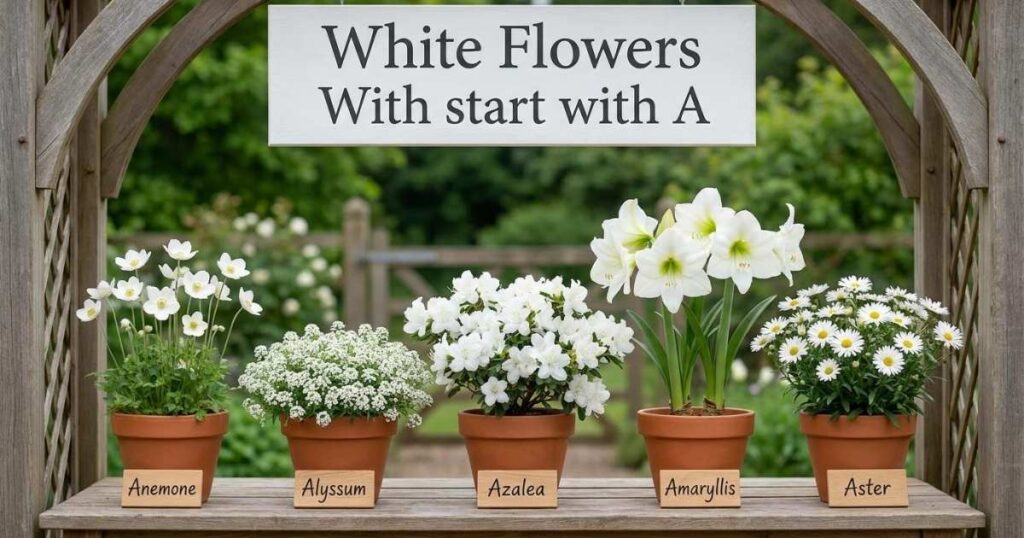
White A flowers are frequently chosen for weddings, moon gardens, and minimalist landscaping.
- Arum Lily produces an elegant, funnel-shaped white bloom often used in formal bouquets.
- Alyssum’s tiny white flowers create a soft, snow-like ground cover.
- Anemone’s white varieties, often with dark centers, are a florist staple for their contrast.
- Astilbe also produces feathery white plume-shaped blooms that soften the look of shaded garden beds.
White A flowers are especially useful in evening gardens, since pale petals reflect available light and remain visible well after sunset compared to darker-colored blooms.
Perennial Flowers That Start With A
Perennials return year after year, making them a cost-effective choice for long-term garden planning.
- Aster, Agapanthus, and Astilbe are three reliable perennials that establish well in most temperate climates.
- Perennial A flowers generally need dividing every three to four years to stay healthy and avoid overcrowding.
Dividing perennials also gives you free plants for other parts of the garden, since a healthy Aster or Agapanthus clump can typically be split into two or three new plantings without harming the parent.
Annual Flowers That Start With A

Annuals complete their life cycle in a single season, which means they need replanting but often bloom longer and more intensely.
- Ageratum, Alyssum, and Angelonia are dependable annuals that bloom from late spring until the first frost.
- Annual A flowers are a good option for gardeners who want to change color schemes every year.
Because annuals put all their energy into blooming rather than surviving winter, they typically flower more heavily than perennials planted in the same bed, which makes them a good choice for high-impact seasonal displays.
Indoor Flowers That Start With A
Several A flowers thrive specifically as houseplants due to their tolerance for indoor light levels and humidity.
- African Violet, Amaryllis, and Anthurium are the top three indoor A flowers based on popularity and ease of care.
- Most indoor A flowers prefer bright, indirect light rather than direct sun through a window, which can scorch their leaves.
A north or east-facing window is usually the safest placement for these three, since it provides consistent brightness without the intense afternoon heat of a south or west-facing window.
Fragrant Flowers That Start With A
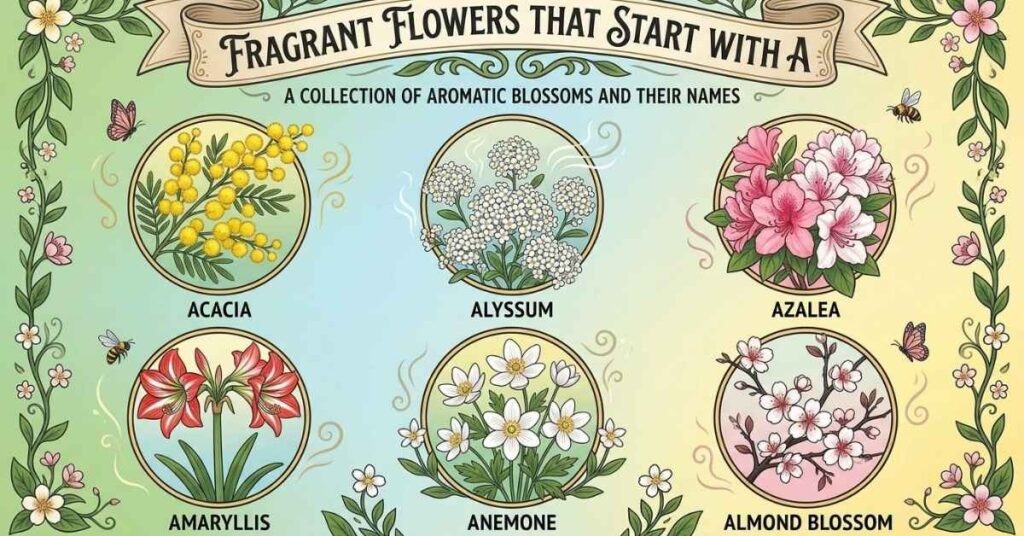
Fragrance adds another layer of value beyond visual appeal, and a handful of A flowers are grown specifically for their scent.
- Acacia produces a sweet, honey-like fragrance from its fluffy yellow flower clusters.
- Alyssum has a light, honey-scented bloom despite its small size.
- Angel’s Trumpet releases a strong, sweet fragrance most noticeably in the evening.
Evening fragrance in flowers like Angel’s Trumpet exists to attract night-flying moths, which pollinate the plant while most daytime pollinators are inactive.
Good A Flowers For Beginners
Beginner gardeners should prioritize flowers that tolerate mistakes in watering, soil, and sun exposure.
- Alyssum, Aster, and Ageratum are forgiving choices that recover quickly from underwatering or poor soil.
- These three also germinate easily from seed, which builds confidence for first-time growers.
Beginners should also know that overwatering, not underwatering, causes the most failures with these flowers. Letting the soil dry slightly between waterings mimics their natural growing conditions better than keeping soil constantly damp.
A Flowers That Attract Pollinators
Pollinator-friendly A flowers support bees, butterflies, and hummingbirds, which benefits the wider garden ecosystem.
- Aster and Achillea (Yarrow) are especially attractive to bees and butterflies during late summer.
- Agastache, or anise hyssop, draws hummingbirds due to its tubular flower shape and nectar output.
- Asclepias, known as milkweed, is the required host plant for monarch butterfly caterpillars.
Planting a mix of these pollinator-friendly A flowers extends nectar availability across spring, summer, and fall, since each species blooms at a slightly different time of year.
Rare Flowers That Start With A
Some A flowers are rarely sold commercially, either due to specific growing requirements or limited geographic range.
- Aristolochia, or Dutchman’s Pipe, produces an unusual pipe-shaped flower and is mostly grown by specialist collectors.
- Adonis vernalis is now considered vulnerable in parts of its native European range due to habitat loss.
- Aponogeton, the water hawthorn, is uncommon outside of pond and aquatic gardening circles.
- Arisaema species vary widely by region, and several are considered rare outside their native woodland habitats.
If you come across one of these in a nursery, it is worth noting that their care requirements often differ significantly from common garden varieties.
Rare A flowers are also more likely to be sourced from specialty growers rather than big-box garden centers, so expect higher prices and longer shipping times if you want to add one to your collection. Many rare species also have narrower hardiness zones, meaning a flower that grows easily in one region may fail entirely in another, even a few hundred miles away.
How To Choose The Right Flower With A
Choosing the right A flower depends on where it will grow, how much maintenance you want to commit to, and what purpose it serves.
Start by matching the flower type to your growing conditions rather than picking based on appearance alone, since a beautiful flower that cannot survive your climate will not last.
Consider these three questions before choosing any A flower:
- How much sunlight does the planting location actually receive, measured in hours, not general impressions.
- Is the flower going indoors, in a garden bed, or in a container, since each setting has different watering needs.
- Do you want a one-time seasonal display or a plant that returns year after year with minimal replanting effort.
Answering these honestly narrows the list from 65 options down to a handful that will realistically thrive in your specific space.
A Few Flowers With A: Need Extra Caution
A small number of A flowers require extra care due to toxicity or specific handling needs.
- Angel’s Trumpet (Brugmansia) is toxic if ingested and should be kept away from pets and small children.
- Autumn Crocus (Colchicum) is highly toxic and easily confused with edible crocus varieties, so it should never be planted near food gardens.
- Aconite, particularly Winter Aconite’s relatives in the wider Aconitum genus, contains toxic compounds and should be handled with gloves.
If you have young children or pets that spend time in the garden, it is worth checking any A flower against a trusted toxicity database before planting, since symptoms of ingestion can range from mild stomach upset to more serious reactions depending on the species and amount consumed.
Decision Flow
Use this simple flow to narrow down your choice:
- If you want low maintenance and long-term value, choose a perennial like Aster or Agapanthus.
- If you want quick, season-long color, choose an annual like Alyssum or Ageratum.
- If you are growing indoors, choose African Violet, Amaryllis, or Anthurium.
- If you want fragrance, choose Acacia or Angel’s Trumpet, keeping toxicity in mind.
- If you want to support pollinators, choose Aster, Achillea, or Asclepias.
This decision flow is designed to be used repeatedly, since most gardens end up combining flowers from more than one category. A well-planned bed might include a perennial anchor like Aster, an annual filler like Alyssum, and a pollinator draw like Achillea, all working together across a single season.
Before finalizing your choice, it also helps to review the general care pattern shared across most A flowers:
- Water deeply but infrequently rather than giving small amounts daily, which encourages stronger root growth.
- Amend heavy clay soil with compost, since most A flowers prefer well-draining conditions.
- Deadhead spent blooms on repeat-flowering types like Ageratum and Angelonia to encourage continuous flowering through the season.
- Watch for common pests like aphids, which are frequently drawn to soft-stemmed A flowers such as Aster and Anemone.
Conclusion
Flowers that start with A range from easy, beginner-friendly perennials like Aster to dramatic indoor blooms like Amaryllis and Anthurium.
Whether you are planting a border, decorating a windowsill, or building a bouquet, this list gives you enough variety and accurate detail to choose confidently.
Start with one or two flowers from the beginner-friendly section, then expand into fragrant or pollinator-friendly varieties as your garden grows.
Keep this guide handy as a reference the next time you are shopping for seeds, bulbs, or cut flowers. With 65 options covering nearly every color, care level, and use case, there is very likely an A flower that fits exactly what you are looking for, whether that is a low-maintenance perennial, a fragrant evening bloom, or a long-lasting centerpiece for your next bouquet.
These answers are written to be quick and direct, so you can find what you need without scrolling through unrelated detail.
FAQ’s
What is the most popular flower that starts with A?
Aster is generally the most searched and most commonly planted A flower worldwide. It is valued for its long bloom time and easy care.
Is Azalea the same as Rhododendron?
Azalea is a common name for certain species within the Rhododendron genus. All azaleas are rhododendrons, but not all rhododendrons are azaleas.
Which A flowers are toxic to pets?
Angel’s Trumpet, Autumn Crocus, and Amaryllis bulbs are all toxic to cats and dogs if ingested. Keep them out of reach of pets.
What A flower is best for beginners?
Alyssum, Aster, and Ageratum are the easiest A flowers for beginners due to their tolerance for mistakes. All three grow well from seed.
Which A flowers bloom indoors?
Amaryllis, African Violet, and Anthurium are the top choices for indoor blooming. They require bright, indirect light rather than direct sun.
Are there any rare flowers that start with A?
Yes, Aristolochia, Adonis vernalis, and Aponogeton are considered rare or specialist flowers. They are less common in standard garden centers.
What does the Amaryllis flower symbolize?
Amaryllis symbolizes pride, determination, and radiant beauty. It is a popular winter gift plant due to its bold, upright bloom.