
Two sinks in a small bathroom sounds like wishful thinking. But with the right layout, the right vanity depth, and a few clever tricks, it is completely doable. Whether you are sharing a bathroom with a partner, a roommate, or a sibling, a double vanity changes your morning routine entirely.
This guide covers nine practical, design-smart approaches that actually work in tight spaces. Each idea is rooted in real bathroom constraints, not just pretty inspiration photos.
Make It Work Under a Slanted Ceiling
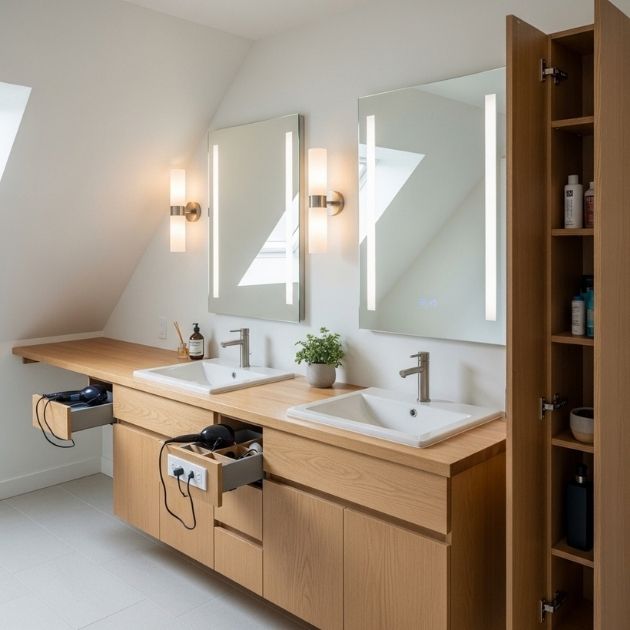
Attic bathrooms and upper-floor en suites often come with sloped ceilings that seem to rule out a double vanity before you even start. They do not. The key is placement and proportion.
Position your vanity so the taller side aligns with the highest point of the ceiling. Use that taller section for your mirrors and any wall-mounted storage. The lower side can hold toiletries, a lower shelf, or a vessel sink that adds height without needing overhead clearance.
A curved or arched mirror works especially well here because it softens the awkward angle of the slope. Avoid tall, rectangular cabinet towers on the low end since they will feel cramped and eat into usable space quickly.
Some handy options:
- Oval or round vessel sinks that add height without needing tall cabinetry
- Arch-frame wall mirrors to soften slanted angles and reflect more light
- Slim vertical open shelves positioned on the tallest wall section for toiletry access
Go Wall-to-Wall With a Slim Double Vanity
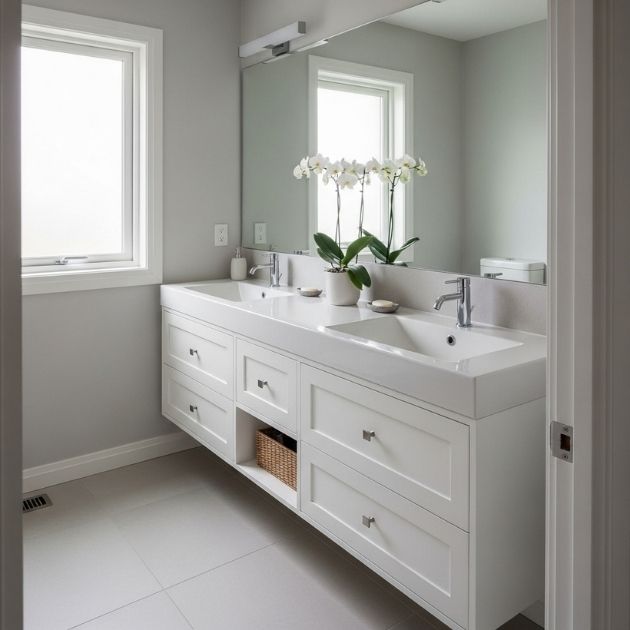
One of the cleanest looks in a small bathroom is a vanity that stretches from wall to wall. No awkward gaps, no side space wasted on nothing. It reads as built-in and custom even when it is not.
The trick is choosing a shallow-depth unit. Standard vanities run 21 inches deep. In a small bathroom, going with a 15 to 18-inch depth keeps the walkway clear while still giving you two sinks and counter space. Pair it with under-cabinet lighting to lift the floating effect and make the floor feel more open.
This approach works especially well in narrow, rectangular bathrooms where a full-width vanity anchors the room without dominating it.
Items that may come in handy:
- Slim-depth double sink vanity (15 to 18 inches) with a wall-to-wall span
- Modern square vessel sinks that sit above the counter and add visual height
- Matte black single-handle faucets that take up minimal counter footprint
Choose Two Sinks on One Shared Plumbing Wall
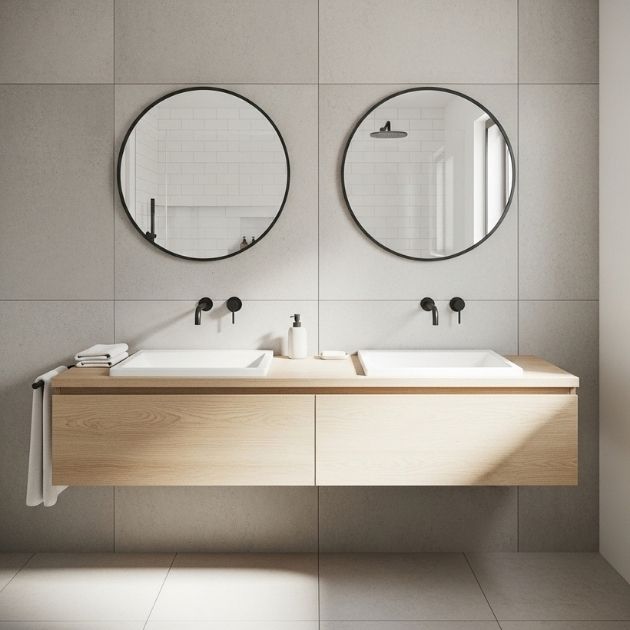
In a small bathroom, plumbing placement drives cost more than almost anything else. When you keep both sinks on the same wall as your existing supply and drain lines, you avoid the expense of rerouting pipes and dramatically simplify the installation.
A floating double vanity on a single plumbing wall also keeps the opposite wall completely free for a tall linen cabinet, a wall-mounted mirror with hidden storage behind it, or simply breathing room. This matters more than most people expect. Keeping one wall uninterrupted makes a compact bathroom feel noticeably larger.
These products might be useful:
- Wall-mounted floating vanity with integrated plumbing cutouts
- Undermount double basin sink for a cleaner counter surface that is easy to wipe down
- Recessed medicine cabinets on the opposite wall to add hidden storage without bulk
Keep the Palette Light and Low-Contrast
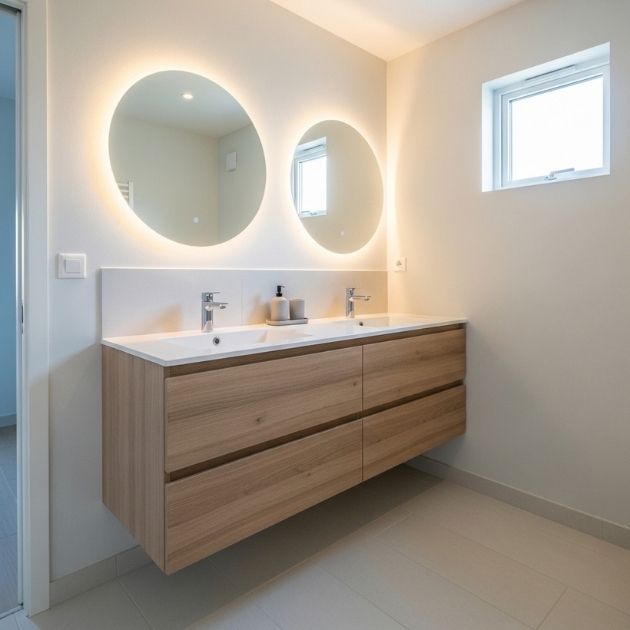
Color is doing more work in your small bathroom than you probably realize. A double vanity automatically adds visual weight to a room. When you match the vanity finish closely to the wall color and floor tile, that weight disappears.
Soft whites, warm creams, pale greiges, and light natural wood tones are all strong choices. The goal is a low-contrast palette where surfaces blend rather than compete. Large-format tiles with minimal grout lines reinforce this. So does a continuous countertop material that runs edge to edge without interruption.
Avoid dark lower cabinets paired with bright white walls in a tight space. The contrast draws attention to where the ceiling meets the wall and makes the room feel smaller.
A few suggestions:
- Quartz countertop in soft white or warm ivory that blends with the vanity finish
- Large-format porcelain floor tile with tight joints to reduce visual noise
- Light oak or natural wood vanity fronts for warmth without contrast overload
Use Drawers Over Doors for Better Function
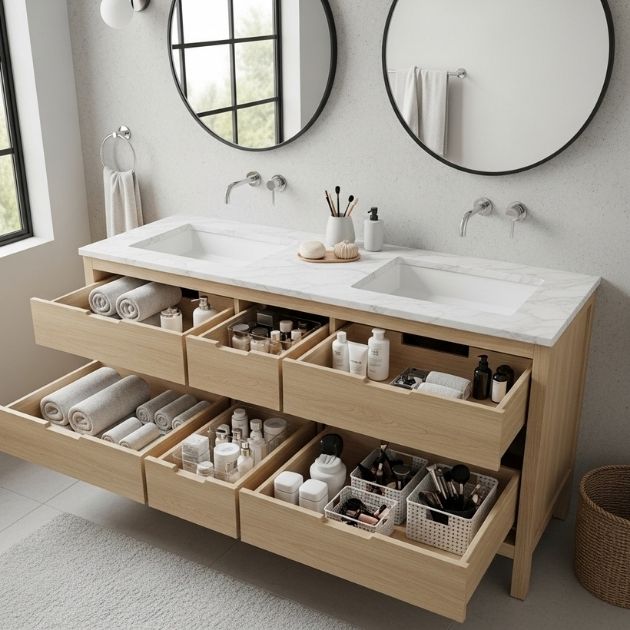
Cabinet doors on a small bathroom vanity are a daily inconvenience. They swing out, block the walkway, and require you to crouch down to see what is inside. Deep drawers solve all of this.
Full-extension soft-close drawers let you pull everything out to eye level. You can see what you have, grab it quickly, and close it with a nudge. In a shared bathroom, drawers also make it easier to divide storage between two people without things getting mixed up.
For double vanities in tight spaces, a configuration with two large lower drawers and one shallower upper drawer per side is extremely practical. It holds more than it looks like it should.
You might give these a try:
- Soft-close full-extension drawer inserts for organizing hairdryers, brushes, and products
- Drawer dividers and organizers to separate two people’s items cleanly
- Tilt-out trays at the front panel for storing small items like cotton rounds or floss
Use a Galley Layout With the Vanity Opposite the Shower
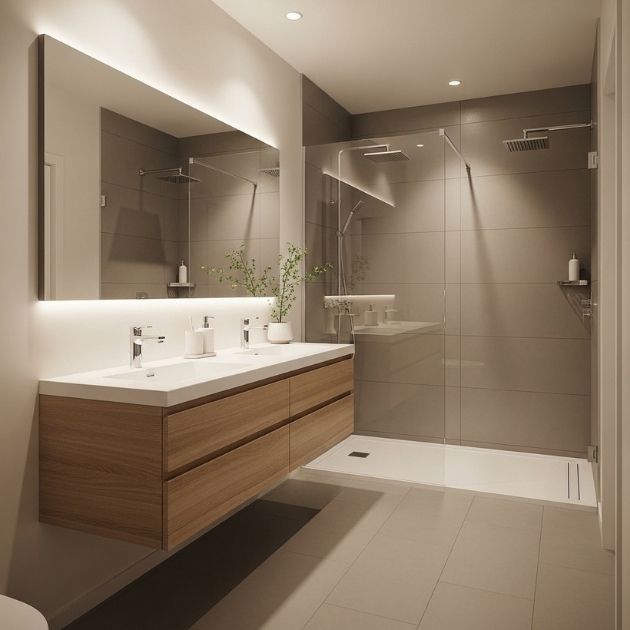
A galley bathroom runs long and narrow, usually between four and six feet wide. This layout is often dismissed as limiting, but it is actually ideal for fitting in a double vanity without crowding.
Place the double vanity along one wall and the shower or tub along the opposite wall. Keep at least 30 inches of clear floor space between them. A frameless glass shower enclosure keeps the sight line open so the space does not feel pinched from either side.
Wall-mounted faucets and a wall-hung vanity both help here. They push the eye upward and remove the visual clutter at floor level that makes narrow rooms feel like hallways.
You might like:
- Frameless glass shower door to maintain an open sight line across the galley
- Wall-mounted faucets to free up counter space and reduce visual clutter
- Pocket or barn-style bathroom door to eliminate swing clearance conflicts
Fit the Double Vanity Into an Alcove Niche
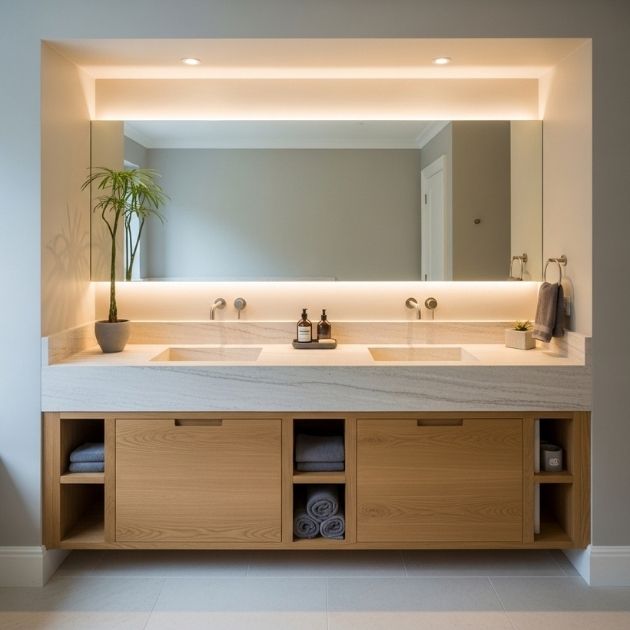
If your bathroom has a bump-out, a recessed wall section, or an alcove left over from old plumbing or structural framing, that space is essentially free real estate for a double vanity.
A vanity built into an alcove looks completely custom because the surrounding walls define the footprint. It does not look dropped in. It looks designed. The walls on either side can hold recessed shelving, towel hooks, or sconce lighting without taking up any additional floor area.
Measure the alcove width carefully. Many of these spaces land between 48 and 60 inches, which is the ideal range for a compact double vanity.
Maybe worth checking out:
- Gold or brushed brass arched wall mirrors to reflect light and fill the niche elegantly
- White ceramic vessel sinks with a clean, spa-like feel for alcove installations
- Recessed wall niches on the side walls for soap, skincare, and toiletry storage
Add an Open Shelf Under the Vanity for Baskets
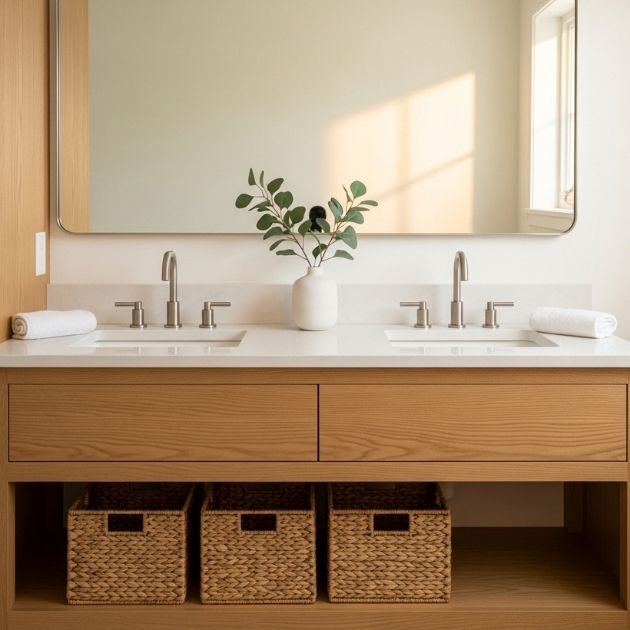
Not every inch of vanity space needs to be behind a door. A section of open shelving under the counter, sized for woven or wire baskets, adds storage without any of the visual weight of solid cabinet fronts.
This works especially well on a floating vanity where the legs or frame are already exposed. Slide in two or three baskets and you have instant, accessible storage for extra towels, hair tools, or cleaning supplies. It breaks up the monotony of cabinet doors and adds a bit of texture to the design.
Keep the baskets consistent in style and color so the open shelf reads as intentional rather than messy.
Consider these options:
- Seagrass or rattan storage baskets sized to fit under the vanity opening
- Wire pull-out organizers that slide in and out easily without lifting
- Labeled canvas bins for separating two people’s personal care items neatly
Create a Split-Level Counter for a Built-In “Getting Ready” Spot
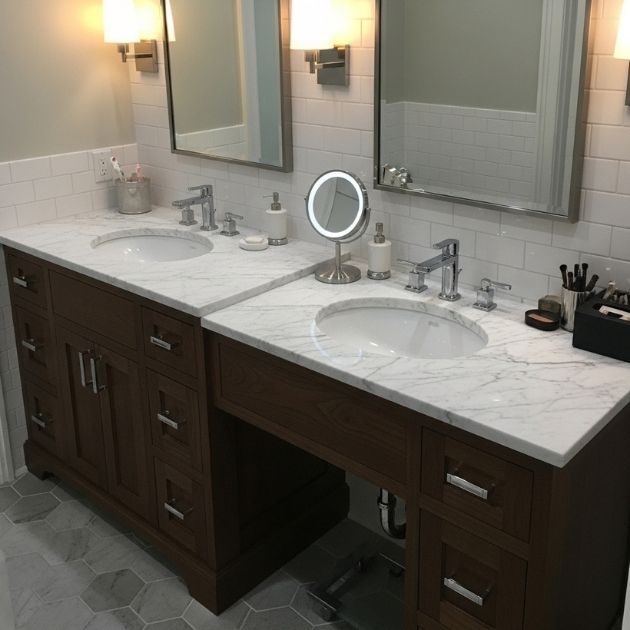
This idea is underused and genuinely smart. Instead of one flat countertop across both sinks, lower one section of the counter by four to six inches. That lower section becomes a dedicated makeup or grooming spot with a stool or small bench pulled up to it.
It works because the lowered counter gives you a comfortable seated height, which most standard vanity counters do not offer. One person can stand at their sink while the other sits to apply makeup or style hair. No more negotiating mirror time or leaning awkwardly over the counter.
The height difference also breaks up the horizontal line of the vanity, making it look more custom and less like an off-the-shelf unit.
Check if these fit your needs:
- Compact vanity stool or bench that tucks under the lower counter section when not in use
- Lighted vanity mirror mounted at seated-eye height for the grooming zone
- In-drawer electrical outlets to keep cords off the counter and appliances charged
Final Thoughts
A double vanity in a small bathroom is not about forcing a large fixture into a tight room. It is about choosing the right configuration, keeping the depth sensible, working with your plumbing wall, and letting the rest of the room breathe.
Start with your layout. Then choose a vanity depth that keeps your walkway clear. Use drawers over doors. Keep the palette light. And if your bathroom has any architectural quirk like a sloped ceiling, an alcove, or a galley shape, lean into it rather than fighting it. Those quirks are often where the best ideas live.
With the right approach, a shared bathroom with two sinks can feel just as open, and far more functional, than a single-sink version ever did.